INTRODUCTION
The perennial legume alfalfa (Medicago sativa L.) is one of the most important forage species because of its high nutritive value. In ruminant feeding it is mostly used as hay, silage or haylage, but the nutritive value of these feeds depends greatly on the quality of the plant material from which they are produced. Therefore, determination of the right moment for cutting is of utmost importance in obtaining alfalfa forage with high nutritive value as well as meeting yield requirements. The prediction of chemical composition and nutritive value in alfalfa based on the morphological stage of development is the oldest and most applicable method for determining the right moment for cutting.
Kalu & Fick (Reference Kalu and Fick1981) developed the first equations to predict chemical composition and nutritive value of alfalfa based on the average development stage, and defined the classification system for alfalfa shoots in ten morphological stages as well as two methods to quantitatively express average stages, mean stage by count (MSC) and mean stage by weight (MSW). The morphological stages were ranked from 0 to 9, where shoots with stems shorter than 150 mm were classed as stage 0, and shoots with ripe seeds were stage 9. The mean stage is calculated from an assessment of all morphological stages within a cut sample. The MSC value is simply calculated as the average morphological stage of all shoots within a sample, such that
 $${\rm MSC} = \left( {S_{\rm 1} {\rm} + {\rm} S_{\rm 2} {\rm} + {\rm} S_{\rm 3} + {\ldots} + S_{\rm c}} \right)/C$$
where S 1=morphological stage of shoot 1, etc. and C=total number of shoots in the sample.
The MSW value is a weighted average such that
 $${\rm MSW} = \left( {0 \times D_0 + {\rm 1} \hskip-1pt \times \hskip-1pt D_{\rm 1} + {\rm 2} \times D_{\rm 2} + {\cdots} + {\rm 9} \times D_{\rm 9}} \right)/W$$
where D 0 is the dry weight of stage 0, etc., and W is the total dry weight of the sample.
According to Fick & Mueller (Reference Fick and Mueller1989), MSW was considered a more accurate measure for morphological stage evaluation than MSC. Consequently, most of the later researchers used MSW to evaluate the nutritive value of alfalfa.
Kalu & Fick (Reference Kalu and Fick1983) published equations for predicting the most important nutritive characteristics of alfalfa based on the MSW value. Subsequently a number of authors investigated MSW further for predicting chemical composition and nutritive value of alfalfa (Fick & Onstad Reference Fick and Onstad1988; Hintz & Albrecht Reference Hintz and Albrecht1991; Sanderson Reference Sanderson1992; Griffin et al. Reference Griffin, Cassida, Hesterman and Rust1994).
The procedure for determining MSW is more complex than that for MSC, since it requires oven drying of separated herbage subsamples (Mueller & Fick Reference Mueller and Fick1989), which limits its use as a commercial decision support tool (Fick et al. Reference Fick, Wilkens, Cherney, Fahey, Collins, Mertens and Moser1994). Therefore, Mueller & Fick (Reference Mueller and Fick1989) suggested converting MSC values to MSW via regression models to exploit the rapidity of the MSC method. Alternatively, some authors investigated MSC as a direct prediction parameter (Allen & Fick Reference Allen and Fick1990), or introduced simpler prediction methods not based on the average morphological stage (Hintz & Albrecht Reference Hintz and Albrecht1991; Parsons et al. Reference Parsons, Cherney and Peterson2009; Hakl et al. Reference Hakl, Šantrůček, Fuksa and Krajíc2010). Allen & Fick (Reference Allen and Fick1990) tested the slightly simpler MSC procedure as an estimator of alfalfa quality; however, they found that estimates of neutral detergent fibre (NDF) and acid detergent fibre (ADF) were biased and prediction errors exceeded 40 g/kg of plant dry matter (DM) for samples collected from commercial fields. According to Fick et al. (Reference Fick, Wilkens, Cherney, Fahey, Collins, Mertens and Moser1994) predictions with MSC were found to be biased, requiring recalibration for each harvest.
The aim of the current investigation was to develop and test a simplified method of determining MSW based on fresh weight rather than dry weight of stages, and to establish the regression equations, based on this value, for some characteristics of chemical composition and nutritive value of alfalfa. The modified MSW, designated as mean stage by fresh weight (MSFW), was compared with the MSW value obtained in the standard procedure using stage dry weights. The work published by Kalu & Fick (Reference Kalu and Fick1983) was used as the basis for this investigation, and because of that the same values of chemical composition and nutritive value were chosen to compare the two methods for mean stage determination.
MATERIALS AND METHODS
Sample collecting
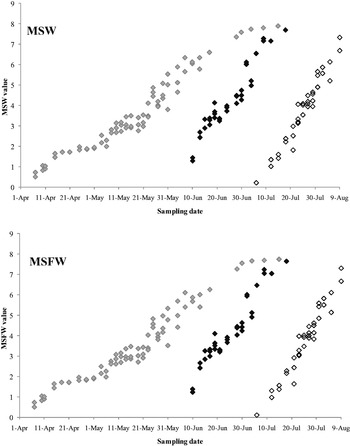
Alfalfa samples were collected from a field near Belgrade, Serbia (44°59′N, 20°25′E, 67 m a.s.l.) during the growing season of 2010. The trial was confined to a single cultivar, Banat, which was sown in the spring of 2008. The crop was grown using standard agronomic practices without irrigation. Sampling was carried out during three growth cycles: spring growth, first regrowth and second regrowth. Within each growth cycle, sampling was done during the whole growing period, commencing when plant height was below 150 mm and continuing until plants were bearing ripe seeds. Spring growth started on 21 March when the first green shoots were observed. The first regrowth cycle commenced on 24 May and the second regrowth cycle commenced on 1 July. Sampling of spring growth extended from 7 April to 15 July (33 sampling days and a total of 72 samples), that of the first regrowth from 10 June to 18 July (15 sampling days and 35 samples), and that of the second regrowth from 6 July to 9 August (13 sampling days and 34 samples) (Fig. 1). The highest number of samples was collected during spring growth because, according to its yield, this is the most important growth cycle in a temperate climate without irrigation. The number of samples collected on a sampling day and the intervals between sampling days were variable. During the stages which are most important for alfalfa exploitation (flower bud development and flowering) the sampling was done every day and up to four samples were collected each day.
MSW and MSFW values for all collected samples at all sampling dates in 2010. Symbols are samples from spring growth ( ), first regrowth (◆) and second regrowth (◊).

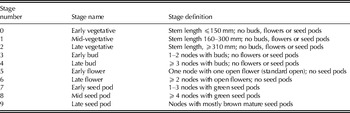
The samples were obtained by hand clipping a randomly selected area of 0·12 m2. Clipping was done at a height of 35 mm, and all shoots with stems above clipping height were collected. After clipping, the samples were placed in plastic bags, stored in a portable refrigerator, and transported to the laboratory for processing. The portable refrigerator was cooled by frozen containers. On the same day all shoots within each sample were classified into development stages according to Kalu & Fick (Reference Kalu and Fick1981) as described in Table 1. After stages were separated, the fresh weight of each stage was recorded using a laboratory scale with 0·01 g accuracy. All shoots from the same stage were coarsely chopped into separate bags, immediately frozen to –18 °C, and stored at this temperature for at least 3 days before further processing. After that they were dried in a forced air oven (60 °C) to a constant weight and dry weight was recorded. Average drying time to constant weight was 36 h.
Definition of morphological stages of development for individual alfalfa stems (Kalu & Fick Reference Kalu and Fick1983)

Laboratory analysis
After drying separate stages of each sample, they were bulked, ground to pass through a 1 mm sieve, and stored in plastic bags at 4 °C until chemical analysis. The following analyses were conducted: crude protein (CP), NDF, ADF, acid detergent lignin (ADL), crude ash (CA) and in vitro organic matter digestibility (IVOMD). All analytical results were expressed on a DM basis, obtained by drying at 103 °C until constant weight was achieved (4±0·1 h as defined by ISO 6496 (1999)).
Crude protein was analysed according to Kjeldahl (ISO 5983-2, 2005), using the Tecator Kjeltec Auto Analyzer 1030 (Kjeltec, Tecator AB, Höganäs, Sweden). The Gerhardt FibreBag (C. Gerhardt GmbH & Co., Königswinter, Germany) apparatus was used to analyse NDF, ADF and ADL. Neutral detergent fibre was analysed with the use of 50 μl amylase (Sigma A 3306, Sigma-Aldrich, St. Louis, MO, USA) without sodium sulphite according to Van Soest et al. (Reference Van Soest, Robertson and Lewis1991). Acid detergent fibre and ADL were analysed according to ISO 13 906 (2008). The NDF and ADF analyses were not done sequentially and were expressed inclusive of residual ash. Crude ash analysis was done according to AOAC (2000), and data were used only to calculate IVOMD.
The IVOMD was determined by the means of a gas production technique (Menke et al. Reference Menke, Raab, Salewski, Steingass, Fritz and Schneider1979) in graduated 100 ml glass syringes (Model Fortuna, Häberle Labortechnik, Lonsee-Ettlenschieβ, Germany) according to the modified method of Blümmel & Ørskov (Reference Blümmel and Ørskov1993). The rumen fluid was collected from two cannulated wethers, fed ad libitum with meadow hay and 200 g of concentrate daily (132 g maize, 56 g soybean meal and 12 g premix). Measurements were done in triplicate: c. 170 mg sample of DM was weighed into each syringe and incubated with 30 ml of rumen fluid plus buffer for 24 h (Menke & Steingass Reference Menke and Steingass1988). The total gas production was corrected by subtracting the volume of gas which was produced in blanks without samples. Gas production was also corrected for variability in rumen fluid activity. The adjustment was done on the basis of standard hay sample (Menke & Steingass Reference Menke and Steingass1988), which was kindly provided by The Institute of Animal Nutrition, University of Hohenheim, Germany. Equation (43c) from Menke & Steingass (Reference Menke and Steingass1988) was used for the calculation of IVOMD.
Method of MSFW calculation
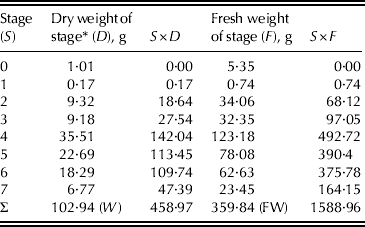
The modification of the MSW method that was investigated was based on determining the mean stage value using the fresh weight rather than the dry weight of alfalfa. Kalu & Fick (Reference Kalu and Fick1981, Reference Kalu and Fick1983) determined MSW values by drying individual development stages at 65 °C until constant weight was achieved. In the current investigation, drying temperature was set at 60 °C, so that the analysis of NDF, ADF and IVOMD would not be compromised. The comparative calculations of MSW and MSFW for a representative sample are given in Table 2.
An example of MSW and MSFW calculation on data from present study
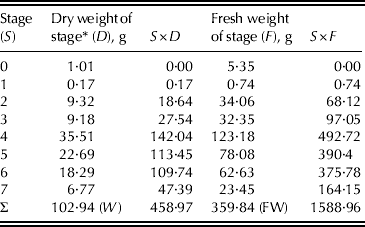
* Determined by drying at 60 °C to constant weight.
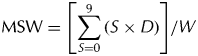
The equation for calculating MSW according to Kalu & Fick (Reference Kalu and Fick1981) is shown in Eqn (1) below, while the equation for calculating MSFW is shown in Eqn (2). The examples of MSW and MSFW calculation with the results from Table 2 are shown in Eqns (3) and (4).
 $${\rm MSW} = \left[ {\sum\limits_{S = 0}^9 {(S \times D)}} \right]/W$$
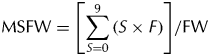 $${\rm MSFW} = \left[ {\sum\limits_{S = 0}^9 {(S \times F)}} \right]/{\rm FW}$$
 $${\rm MSW} = 458\! \cdot\! 97/102\! \cdot\! 94 = 4\! \cdot\! 46$$
 $${\rm MSFW} = 1588 \! \cdot\! 96/359 \! \cdot\! 84 = 4\! \cdot\! 42$$
where S is the morphological stage; D is the dry weight of stage; W is the total dry weight of sample; F is the fresh weight of stage; and FW is the total fresh weight of sample.
Statistical analysis
Significance of differences between MSW and MSFW, calculated for each individual sample, were tested using one way analysis of variance (ANOVA). For all investigated parameters a comparison of possibilities for predicting nutritive value with MSW and MSFW was done using regression analysis. Coefficient of determination (R 2) and root-mean-square error (RMSE) were used to compare regressions. All statistical analyses were performed using the software package Statistica 6 (Statsoft, Inc. 2003). Statistical analysis included all samples.
RESULTS
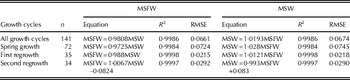
The ANOVA showed no statistically significant differences between MSW and MSFW values. The correlation (r) between MSW and MSFW was 0·999. The regression equations to convert MSW into MSFW (and vice versa) for each growth cycle separately and for the three growth cycles combined are shown in Table 3.
Equations for conversion between MSW and MSFW

MSFW: mean stage by fresh weight; MSW: mean stage by weight; n: number of samples; R 2: coefficient of determination; RMSE: root mean square error.
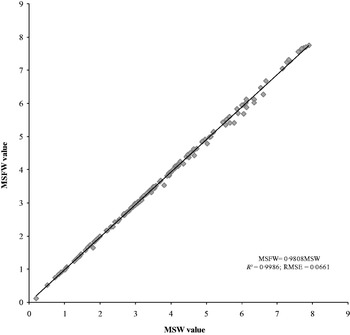
There were minimal differences observed in R 2 of the regressions, for the growth cycles combined and for each individual cycle. The values of MSW and MSFW depending on sampling date are presented in Fig. 1, whereas Fig. 2 shows the relationship between MSW and MSFW. The difference between the two methods for determining the mean stage of development was negligible as indicated by the very high correlation coefficient, a regression slope of nearly 1 with intercept 0 and an average absolute difference between paired MSW and MSFW values of only 0·073. A somewhat higher deviation between MSW and MSFW values was observed in seven samples taken near the end of the spring growth cycle. Absolute differences in these samples varied from 0·23 to 0·38.
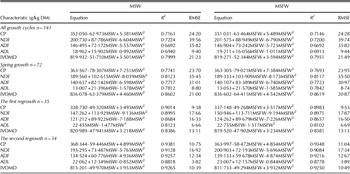
The equations for predicting the nutritional parameters are shown in Table 4. The regression coefficients were all statistically significant (P<0·01). Within the same growth cycle there were minimal differences in R 2 and RMSE between regressions calculated for MSW and MSFW for all characteristics. The difference in R 2 was maximally 0·0049, while for RMSE it was 0·42. In all characteristics (CP, NDF, ADF, ADL and IVOMD) differences between growth cycles were observed in R 2 and RMSE. A trend for R 2 to increase and RMSE to decrease was observed from the spring growth to the second regrowth in all chemical characteristics. This trend, however, was not observed in IVOMD, where R 2 was lower for the first regrowth cycle than for the spring cycle.
Prediction equations for evaluation of chemical composition and nutritive value of alfalfa herbage on the basis of MSW and MSFW

MSW: mean stage by weight; MSFW: mean stage by fresh weight; n: number of samples; R 2: coefficient of determination; RMSE: root mean square error; CP: crude protein; NDF: neutral detergent fibre; ADF: acid detergent fibre; ADL: acid detergent lignin; IVOMD: in vitro organic matter digestibility.
DISCUSSION
Several authors considered MSW the best method for determining the mean development stage of alfalfa (Kalu & Fick Reference Kalu and Fick1981; Sulc et al. Reference Sulc, Albrecht, Cherney, Hall, Mueller and Orloff1997). Kalu & Fick (Reference Kalu and Fick1981) expressed the view that, without simplification, MSW and MSC procedures would remain specialized research techniques which are too complicated to be used in commercial fields. Notwithstanding, Fick & Mueller (Reference Fick and Mueller1989) believed that the system could be improved. They recommended that improvements should be based on the advancement of the MSC method since this method is much simpler to perform in practical conditions compared with the MSW method. However, further investigations showed that equations based on MSC had higher absolute error (Allen & Fick Reference Allen and Fick1990). Additionally, Fick et al. (Reference Fick, Wilkens, Cherney, Fahey, Collins, Mertens and Moser1994) and Sulc et al. (Reference Sulc, Albrecht, Cherney, Hall, Mueller and Orloff1997) concluded that MSC is not suitable for nutritive value estimation since predictions were found to be biased and therefore required recalibration for each harvest separately. This raised doubts concerning the use of that method for practical work. However, some authors (Berg Reference Berg2000; Hall et al. Reference Hall, Smiles and Dickerson2000) used MSC for the evaluation of mean development stage of alfalfa. According to Berg (Reference Berg2000), the MSW was considered in their investigation but rejected because the required drying period (48 h) was too long. The long drying period was also considered the main constraint to adoption of the MSW system by some other authors (Fick et al. Reference Fick, Wilkens, Cherney, Fahey, Collins, Mertens and Moser1994; Sulc et al. Reference Sulc, Albrecht, Cherney, Hall, Mueller and Orloff1997). The modified system of MSW determination (MSFW) described in the current paper is as rapid as the MSC system but with the accuracy of the original MSW.
In the current investigation, the time required to determine the MSFW value was c. 45 min for the most complex samples. The rounding of sample stage weights from two decimal places to one did not result in statistically significant changes in calculated MSFW. This implies that using a balance with an accuracy of 0·1 g would probably not increase the error in predicting the various nutritional parameters. This opens up the opportunity of using MSFW under field conditions with the aim of predicting the optimal moment for alfalfa cutting to obtain maximal yield together with high nutritive value.
The results of the current investigation indicated that differences between MSW and MSFW with respect to determining the mean development stage were minimal. Moreover, the growth cycle had no influence on differences between the two methods. For that reason, the suggested equation for all growth cycles could be used for conversion of MSFW into MSW and vice versa, since the equation based on all cycles was developed on a larger data set. The similarity between MSW and MSFW was also confirmed by the predictions of chemical composition and nutritive value. Regardless of the method (MSW or MSFW) used for development of predictive equations, the R 2 and RMSE for the same characteristic of nutritive value within the same growth cycle were very similar.
High congruence between MSW and MSFW values was necessarily the result of the similarity in the distribution of weight between the different stages within the same sample, irrespective of whether the distribution was based on dry weight or fresh weight. The calculated coefficients of variation were very similar for dried and fresh stage weight within each sample.
The aim of the current work was to investigate a modified method for assessment of morphological stage of development and to compare it to the original method. The work included only one alfalfa cultivar and locality in order to eliminate the potential influence of these factors on the comparison. The R 2 and RMSE values for the regressions developed in the current investigation are not comparable to most of the results reported by other authors who have developed equations for predicting the nutritive value based on MSW. Kalu & Fick (Reference Kalu and Fick1981, Reference Kalu and Fick1983), Sanderson & Wedin (Reference Sanderson and Wedin1988), Hintz & Albrecht (Reference Hintz and Albrecht1991) and Griffin et al. (Reference Griffin, Cassida, Hesterman and Rust1994) reported regressions based on data collected during several years of investigation, and most of them also used several cultivars and locations. However, in the present investigation, R 2 values for regression equations calculated for all growth cycles together were either below (Kalu & Fick Reference Kalu and Fick1981, Reference Kalu and Fick1983; Griffin et al. Reference Griffin, Cassida, Hesterman and Rust1994) or in accordance with those from the literature (Sanderson & Wedin Reference Sanderson and Wedin1988; Hintz & Albrecht Reference Hintz and Albrecht1991).
The R 2 of predictive equations increased with consecutive growth cycles (from spring growth to the second regrowth) while the RMSE decreased. That trend probably reflected the influence of weather conditions on alfalfa plants. During spring growth, alfalfa was subjected to longer intervals of colder weather, with 6–15 °C lower daily temperatures compared with annual averages for the season, and with frequent storms. Such weather conditions continued until the middle of the first regrowth. Thereafter the daily temperatures were stable and within the annual average for the season. The equations derived for all growth cycles together were characterized by lower R 2 and higher RMSE than equations for individual growth cycles. Differences between R 2 and RMSE values in different growth cycles lead to the conclusion that to decrease error in the prediction of alfalfa nutritive value the equations should be derived for individual growth cycles. A similar conclusion was also suggested by Griffin et al. (Reference Griffin, Cassida, Hesterman and Rust1994), but this should be the subject of further investigations.
It can be concluded from the results of the present investigation that there is great similarity between the original MSW and modified MSFW values. Coefficients of determination and errors (RMSE) of the derived equations for predicting the relevant nutritional parameters of alfalfa were almost identical for both methods of mean stage determination. It seems that the MSW method could be replaced by the MSFW method without affecting the accuracy of predictive equations. Using the MSFW method the mean stage of development is obtained with the same speed as for determining MSC but with all advantages of the MSW system. This provides the scope for wider use of the MSFW method both in scientific research and for practical field use: it can be used to establish the precise moment for cutting alfalfa to obtain the best yield consistent with high nutritive value.
The relationship between MSW and MSFW for all growth cycles (141 samples).

This investigation was financed by the Grant III 46012 of Integral and Interdisciplinary Research by The Ministry of Education and Science of the Republic of Serbia, and also by Programme Sustainable Agriculture (P4-0133) financed by The Slovenian Ministry of Higher Education, Science and Technology.