Introduction
In most insects, the chemosensory system plays an extremely important role in detecting food sources, mating, and searching for suitable oviposition sites (Hansson and Stensmyr, Reference Hansson and Stensmyr2011; Lassance and Löfstedt, Reference Lassance and Löfstedt2013; Renou and Anton, Reference Renou and Anton2020). The main function of odorant-binding proteins (OBPs) located in the lymphatic fluid of the chemosensory organs is to detect, discriminate and transport the odor molecules from the environment to the dendritic membrane of the olfactory receptor neurons (ORNs), where the odor molecules interact with odorant receptors (ORs) (Pelosi et al., Reference Pelosi, Iovinella, Zhu, Wang and Dani2018), which could affect the behavior of insects concurrently.
OBPs are presented in high concentrations in the lymphatic fluid of the main olfactory organ (antennae). They are small water-soluble proteins characterized by six highly conserved cysteine residues and six α- helices that appear to provide a pocket for binding hydrophobic ligands (Song et al., Reference Song, Sun and Du2018). A large number of different OBP subtypes were found to be highly expressed in insects and vary greatly between species using distinct functions. Pheromone-binding proteins (PBPs) are the common and special proteins among those classic proteins. It has long been thought that PBP, as the name implies, was a kind of protein to specifically bind sex pheromones secreted by female glands in corresponding insect populations (Li et al., Reference Li, Ma, Yin, Cai, Luo, Bian, Xin, He and Chen2018b). PBPs expression have mostly been identified in male antennae; however, lower levels of expression have been found in female antennae and mainly divided into three types in most moths, namely PBP1, PBP2 and PBP3, such as Antheraea polyphemus (Maida et al., Reference Maida, Krieger, Gebauer, Lange and Ziegelberger2000), Plutella xyllotella (Sun et al., Reference Sun, Liu and Wang2013), Helicoverpa armigera (Zhang et al., Reference Zhang, Mei, Feng, Berg, Zhang and Guo2012), Tryporyza intacta (Fang et al., Reference Fang, Hu, Mao, Bi, Zheng, Guan, Wang, Li, Mao and Ai2018), Spodoptera litura (Liu et al., Reference Liu, Liu and Dong2013), A. ipsilon (Gu et al., Reference Gu, Zhou, Wang, Zhang and Guo2013), M. brassicae (Maïbèche-Coisné et al., Reference Maïbèche-Coisné, Jacquin-Joly, François and Meillour1998), Heliothis virescens (Campanacci et al., Reference Campanacci, Krieger, Bette, Sturgis, Lartigue, Cambillau, Breer and Tegoni2001; Abraham et al., Reference Abraham, Löfstedt and Picimbon2005), Chilo suppressalis (Chang et al., Reference Chang, Liu, Yang, Pelosi, Dong and Wang2015; Dong et al., Reference Dong, Liao, Zhu, Khuhro, Ye, Yan and Dong2019).
Several types of research have shown that host plant volatiles, produced by both anabolic and catabolic processes, played an important role in the cooperative evolution of plants and insects and had an important influence on insect behavior (Harrewijn et al., Reference Harrewijn, Minks and Mollema1994). Generally, many insect species used a chemosensory system to detect and discriminate the chemicals released by host plants, such as allyl isothiocyanate, dipropyl thiosulfinate, and other plant-specific odor components (Lecomte et al., Reference Lecomte, Pierre, Pouzat and Thibout1998). Different types of insect behaviors e.g. finding the suitable host plants through volatiles and oviposition sites using plant secondary metabolites have been previously studied in many species (Dicke et al., Reference Dicke, Sabelis, Takabayashi, Bruin and Posthumus1990; Binder et al., Reference Binder, Robbins and Wilson1995; Lucas-Barbosa et al., Reference Lucas-Barbosa, Sun, Hakman, van Beek, van Loon and Dicke2015), which revealed that host plant volatiles extremely affected insect behavior. Additionally, many plant species can emit volatile organic compounds (VOCs), such as terpenoids, nitrogen and sulfur compounds, upon insect pests attack to reduce damage caused and/or induced resistance in plants against them (Maffei, Reference Maffei2010). It was found that some allelochemicals released by plants, mainly secondary metabolites, participate in the defense mechanisms of plants against herbivore attack which in turn affect the reproductive activities of insects (Harrewijn et al., Reference Harrewijn, Minks and Mollema1994). This study indicated that plant volatiles are particularly abundant and play an important role in mediating the interaction between insects and their host plants. Therefore, in-depth studies investigating the mechanisms involved in insect chemoreception systems will help to decode this sophisticated communication language to make better decisions about pest control and crop protection.
It has been found that organisms maintain inter-group or intra-group communication through corresponding ways of information transmission, to coordinate biological behaviors. Sex pheromones, a kind of tiny special chemical substance, were secreted in vitro by the homogenous sex individual to induce courtship and mating behavior. In insects, many volatiles sex pheromones have been detected or identified, such as cis-8-dodecenyl acetate of Grapholita molesta (Roelofs et al., Reference Roelofs, Comeau and Selle1969), (Z, Z)-11,13-Hexadecadienal of Amyelois transitella (Liu et al., Reference Liu, Vidal, Syed, Ishida and Leal2010), Z-11-hexadecenyl acetate of M. brassicae (Veire and Dirinck, Reference Veire and Dirinck1986), (Z,E)-9,12-tetradecadien-l-ol acetate and (Z)-9-tetradecen-l-ol of Spodoptera exigua (Tumlinson et al., Reference Tumlinson, Mitchell and Sonnet1981), (Z)-11-hexadecenal, (Z)-11-hexadecenyl acetate and (Z)-11-hexadecenyl alcohol of P. xylostella (Chisholm et al., Reference Chisholm, Underhill and Steck1979; Lee et al., Reference Lee, Lee and Boo2005), and Bombykol and Bombykal of B. mori (Odinokov et al., Reference Odinokov, Ishmuratov, Ladenkova, Sokol'skaya, Muslukhov, Akhmetova and Tolstikov1993). Related behavioral experiments have shown that sex pheromones were usually released at certain times during the life cycles of insects that influence their activities of mating recognition and altering predator-prey interactions (Mondor et al., Reference Mondor, Tremblay, Awmack and Lindroth2004; Curkovic and Ferrera, Reference Curkovic and Ferrera2012; Lo Pinto et al., Reference Lo Pinto, Cangelosi and Colazza2013), revealing that the effects of sex pheromones on insect behaviors were very complex which need further investigation.
Athetis lepigone Möschler (Lepidoptera, Noctuidae) is one of the most important polyphagous destructive insect pests of economic crops worldwide (Jiang et al., Reference Jiang, Luo, Jiang, Zhang, Zhang and Wang2011) It caused a great loss to the production of summer maize after the first report in China in 2011 (Fu et al., Reference Fu, Liu, Li, Ali and Wu2014). Synthetic insecticides are now the primary agents for their control, but the excessive use of insecticides may lead to the damage of ecosystems and increase the resistance levels of the target pest. Therefore, it is necessary to strengthen dynamic monitoring, timely make pest predictions to reduce the damage or develop novel green pest control strategies in modern pest management (Sarfraz et al., Reference Sarfraz, Evenden, Keddie and Dosdall2005; Choo et al., Reference Choo, Xu, Hwang, Zeng, Tan, Bhagavathy, Chauhan and Leal2018; Hackett and Bonsall, Reference Hackett and Bonsall2019). The development of novel green behavioral inhibitors based on olfactory genes has become a hot spot research field for pest control (Pelosi et al., Reference Pelosi, Iovinella, Zhu, Wang and Dani2018; Caballero-Vidal et al., Reference Caballero-Vidal, Bouysset, Gevar, Mbouzid, Nara, Delaroche, Golebiowski, Montagne, Fiorucci and Jacquin-Joly2021). In order to fully understand the concept of insect chemical communication, we have recently identified two female sex pheromone of A. lepigone as (Z)-7-dodecenyl acetate (Z7-12:Ac) and (Z)-9-tetradecenyl acetate (Z9-14:Ac) with a ratio of 1:5 by analyzing the extracts of the female sex pheromone gland (Yan et al., Reference Yan, Zheng, Xu, Ma, Chen, Dong, Liu, Dong and Zhang2018), and obtained three antennae-enriched PBP genes (AlepPBP1-3) in A. lepigone by antennal transcriptome analysis (Zhang et al., Reference Zhang, Zhu, Ma, Dong, Xu, Kang and Zhang2017). Afterward, we expressed and purified the recombinant AlepPBP1 protein in a prokaryotic expression system. Moreover, the ligand-binding assay showed that AlepPBP1 had a higher binding affinity to two sex pheromones of A. lepigone (Zhang et al., Reference Zhang, Yan, Li, Xu, Mang, Wang, Hoh, Ye, Ju, Ma, Liang, Zhang, Zhu, Zhang, Dong, Zhang and Zhang2020a, Reference Zhang, Xu, Zhang, Zhang, Li, Yuan, Mang, Zhu, Zhang, Dewer, Xu and Wu2020b, Reference Zhang, Zhang, Zhang, Xu, Li, Zhu, Wang, Wei, Mang, Zhang, Yuan and Wu2020c). In this study, we further analyzed and explored the potential functions of the other two AlepPBP candidates (AlepPBP2 and AlepPBP3) according to their different binding affinities to sex pheromones and host plant volatiles. Furthermore, some key amino acid residues involved in the process of AlepPBP2 recognition and their binding properties to different ligands were identified based on their molecular docking approach.
Materials and methods
Total RNA extraction, cDNA synthesis
The total RNAs were extracted from 100 adult male antennae using Trizol reagent (Invitrogen, Carlsbad, CA, USA) following the manufacturer's instructions. After checking the RNA quality, the first cDNA strand was synthesized using a PrimeScript™ RT reagent kit (TaKaRa, Dalian, China).
Molecular cloning and preparation of expression vectors
We amplified the full-length open reading frame (ORFs) of AlepPBP2 and AlepPBP3 using the PCR approach and following the protocol recently described in Zhang et al. (Reference Zhang, Zhu, Ma, Dong, Xu, Kang and Zhang2017). Then, the amplified products were directly cloned into the expression vector pET-30a(+) (Novagen, Darmstadt, Germany) for expression of recombinant proteins, following the manufacturer's instructions. The details of the cloning and construction of the expression vectors are displayed in the supplementary information.
Expression and purification of the recombinant AlepPBPs
Plasmids were transformed into E. coli BL21 (DE3) to express these proteins according to the method recently described by us and other researchers (Damberger et al., Reference Damberger, Michel, Ishida, Leal and Wuthrich2013; Katti et al., Reference Katti, Lokhande, Gonzalez, Cassill and Renthal2013; Zhu et al., Reference Zhu, Ban, Song, Liu, Pelosi and Wang2016; Wang et al., Reference Wang, Ma, Wang, Chen, Dewer, He, Zhang, Yang, Liu and He2020; Zhang et al., Reference Zhang, Xu, Zhang, Zhang, Li, Yuan, Mang, Zhu, Zhang, Dewer, Xu and Wu2020b, Reference Zhang, Xu, Zhang, Zhang, Li, Yuan, Mang, Zhu, Zhang, Dewer, Xu and Wu2020b). After the E. coli cells were crushed by ultrasound, the recombinant AlepPBP2 and AlepPBP3 were detected to be insoluble inclusion body by SDS-PAGE analysis. Similar to the previous experiments, the recombinant AlepPBPs were dialyzed and purified followed our previous studies methods (Zhang et al., Reference Zhang, Yan, Li, Xu, Mang, Wang, Hoh, Ye, Ju, Ma, Liang, Zhang, Zhu, Zhang, Dong, Zhang and Zhang2020a, Reference Zhang, Xu, Zhang, Zhang, Li, Yuan, Mang, Zhu, Zhang, Dewer, Xu and Wu2020b). After removing His-tag, further purification and dialysis were needed. The active AlepPBPs without His-tag were used for in vitro binding assays.
Molecular docking
Amyelois transitella (Walker) (Lepidoptera: Pyralidae) AtraPBP1 (PDB ID: 4INW) was employed as an appropriate template. The homology proteins modeling and molecular docking were performed by using MODELER version 9.19 (http://salilab.org/modeller/), Autodock Vina version 1.1.2 (Trott and Olson, Reference Trott and Olson2009), AutoDock Tools version 1.5.6 (Morris et al., Reference Morris, Huey, Lindstrom, Sanner, Belew, Goodsell and Olson2009), and PyMOL version 1.9.0 (http://www.pymol.org/), according to our recent studies (Zhang et al., Reference Zhang, Xu, Zhang, Zhang, Li, Yuan, Mang, Zhu, Zhang, Dewer, Xu and Wu2020b).
In vitro binding assays of AlepPBPs and data analysis
Different binding affinities of 1 mM N-phenyl-1-naphthylamine (1-NPN) as the fluorescent reporter to AlepPBP2 and AlepPBP3 were measured by a fluorescent competitive combination experiment. Then, sex pheromones or host plant volatiles were used to titrate the AlepPBPs, according to our described methods (Zhang et al., Reference Zhang, Ye, Yang and Dong2014; Zhang et al., Reference Zhang, Yan, Li, Xu, Mang, Wang, Hoh, Ye, Ju, Ma, Liang, Zhang, Zhu, Zhang, Dong, Zhang and Zhang2020a, Reference Zhang, Xu, Zhang, Zhang, Li, Yuan, Mang, Zhu, Zhang, Dewer, Xu and Wu2020b). The details of binding assays are displayed in the supplementary data.
Results
Cloning, expression and purification of AlepPBP2 and AlepPBP3
In an initial step, the genes encoding AlepPBP2 and AlepPBP3 were amplified from cDNA using the primers containing restriction sites. After agarose gel electrophoresis of PCR products and recycle, these genes were cloned into cloning vector pEASY-T3 or expression vectors pET-30a( + ). The recombinant AlepPBPs expressed existed in the E. coli as insoluble inclusion bodies, and the proteins were purified using affinity chromatography and 6 × His-tags were removed using enterokinase (fig. 1). According to previous experiments, the proteins denatured in urea and reconstituted in a series of dialysis (Liu et al., Reference Liu, Yang, Yang, He, Niu, Xu, Anderson and Dong2015). The SDS-PAGE results indicated that the molecular mass of AlepPBP2 and AlepPBP3 was approximately 16.6 KDa and 16.37 KDa, respectively. These results are consistent with our recent findings (Zhang et al., Reference Zhang, Xu, Zhang, Zhang, Li, Yuan, Mang, Zhu, Zhang, Dewer, Xu and Wu2020b).
Expression and purification of AlepPBP2 (A) and AlepPBP3 (B) by SDS-PAGE analysis. The purified fractions (lane 1) of recombinant proteins pET/AlepPBPs with His-tag. Re-purification of AlepPBPs after His-tag removal by recombinant enterokinase (lane 2). M: Protein molecular mass marker of 70.0, 33.0, 25.0, 17.0 and 10.0 KDa.

Ligand-binding assay of two AlepPBPs
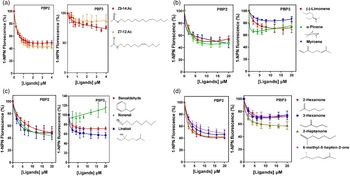
Generally speaking, ligand-binding assay is the most reliable analytical method for screening which ligand can bind to PBP, which has been confirmed by in vivo experiments in different insects (Dong et al., Reference Dong, Sun, Liu, Gu, Zhou, Yang, Dhiloo, Gao, Guo and Zhang2017a; Zhu et al., Reference Zhu, Zheng, Yan, Sun, Khuhro, Huang, Syed and Dong2019). First, the binding affinities of 1-NPN to AlepPBP2 and AlepPBP3 were measured, with the Kd = 5.47 ± 0.34 μM and Kd = 13.76 ± 0.75 μM, respectively, and the saturation and linear Scatchard plots were observed (fig. S1). The results showed that the two AlepPBPs had activity and there is a single binding site between AlepPBPs and 1-NPN, which are similar to our recent research findings (Zhang et al., Reference Zhang, Xu, Zhang, Zhang, Li, Yuan, Mang, Zhu, Zhang, Dewer, Xu and Wu2020b). We detected the binding affinities of two AlepPBPs to two sex pheromone components (Z7-12: Ac and Z9-14: Ac), using fluorescence competitive binding assays with 1-NPN as a fluorescent probe. By comparison, it was found that the binding affinities of AlepPBP2 to both sex pheromones (Z7-12: Ac and Z9-14: Ac) were much high (Z7–12:Ac, Ki = 1.11 ± 0.1 μM; Z9–14:Ac, Ki = 1.32 ± 0.15 μM] (table 1 and fig. 2a). However, AlepPBP3 gave the exact opposite trend. In addition, the binding affinities of AlepPBPs to ten different host plant volatiles were also examined. Among the different alkenes (limonene, α-pinene and myrcene), the binding affinities to AlepPBP2 were observed similarly (fig. 2b). Several ketones have been found to exhibit a strong affinity for AlepPBP2 (Ki < 9 μM), such as 2-hexanone, 3-hexanone, 2-heptanone, and 6-methyl-5-hepten-2-one (fig. 2d). Furthermore, aldehydes (nonanal and benzaldehyde) and alcohol (linalool) have also been found to bind AlepPBP2 (fig. 2c). However, we observed that all of the above volatile ligands of maize displayed no binding affinities to AlepPBP3 (fig. 3).
Ligand-binding assay for AlepPBPs. Binding curves of selected ligands to two AlepPBPs, including A. lepigone sex pheromones (a), Alkenes (b), Aldehydes and Alcohol (c), and Ketones (d). The ligand names are shown on the right of the curves.

Comparison of the binding affinities (indicated by 1/Ki) for AleppBP2 to different components. Between different compounds were analyzed with one-way analysis of variance (ANOVA) at a significance level of p < 0.05 and significant differences are marked with different letters: a, b for AlepPBP2.

Binding data of different ligands to AlepPBP2 and AlepPBP3.

a The ligands were identified as sex pheromones or host plant volatiles according to literatures; Mixtures of protein and 1-NPN, both at the concentration of 2 μM, were titrated with 0.1 mM solutions of sex pheromone to final concentrations of 0.2–4 μM and were titrated with 1 mM solutions of each ligand (non sex pheromone) to final concentrations of 1–20 μM. ‘>20’ means that IC50 could not be calculated directly with the tested ligand concentrations, and subsequently the Ki of the ligand is designated as ‘–’.
Protein modeling, molecular docking of ligands and AlepPBP2
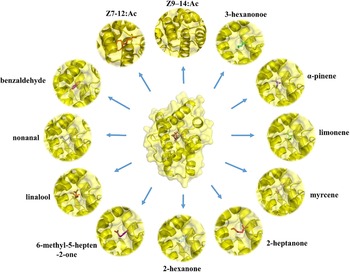
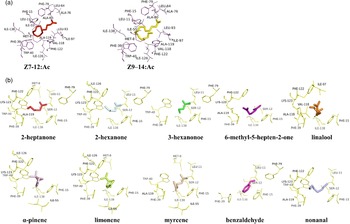
According to homology protein modeling and conformation of small molecules, the protein structure of AlepPBP2 was obtained (Zhang et al., Reference Zhang, Xu, Zhang, Zhang, Li, Yuan, Mang, Zhu, Zhang, Dewer, Xu and Wu2020b) and used to identify the key amino acid residues that strongly interact with the ligands by molecular docking. Previous studies reported that the hydrophobic cavity of PBPs was detected which bind a broad array of hydrophobic ligands (Gong et al., Reference Gong, Tang, Bohne and Plettner2010). We also found in the present study that the same amino acid residues were involved in the binding of AlepPBP2 to both sex pheromone components by analyzing the binding models (fig. 4). There were two hydrophobic residues (Phe-15 and Phe-39 underlined by the solid line) in AlepPBP2 that bind to all examined ligands (including sex pheromones) (fig. 5), suggesting that these residues may play important roles in the interaction between AlepPBPs and ligands. Additionally, some other residues have been found to play key roles in binding to plant volatiles (fig. 5) and were listed in table 2. Moreover, there was a significant difference in the number of key amino acid residues (6–11), among which the residues (polar Ser-12 and Lys-123, and Trp-40, Phe-122, and Ile-138) played major roles in most of the host plant volatiles (more than 70%). Interestingly, only Val residue (Val-118) is presumed to play a special role in the interaction with linalool.
Binding modes of AlepPBP2 to different ligands. Two sex pheromones (Z7-12:Ac and Z9-14:Ac), (-)-limonene, α-pinene, myrcene, linalool, benzaldehyde, nonanal, 2-hexanone, 3-hexanone, 2-heptanone, and 6-methyl-5-hepten-2-one, in the putative binding pocket of AlepPBP2.

The key residues of the different ligands. Two sex pheromones (Z7-12:Ac and Z9-14:Ac), (-)-limonene, α-pinene, myrcene, linalool, benzaldehyde, nonanal, 2-hexanone, 3-hexanone, 2-heptanone, and 6-methyl-5-hepten-2-one, that interact with AlepPBP2. The residues of the ligands are highlighted in light purple or yellow.

Prediction of key amino acid residues during the docking of AlepPBP2 to different ligands.

Note: Key amino acid residues common to all ligands are underlined by the solid line.
Discussion
Many studies have found that PBPs not only have a high binding affinity with sex pheromones, but also can bind several host plant volatiles (Robertson et al., Reference Robertson, Martos, Sears, Todres, Walden and Nardi1999; Picimbon and Gadenne, Reference Picimbon and Gadenne2002). Although, sex pheromones and host plant volatiles were abundant in the surrounding environment (Linn et al., Reference Linn, Campbell and Roelofs1987; Kehat and Dunkelblum, Reference Kehat and Dunkelblum1990). Since the first identification of sex pheromones in insects (Karlson and Butenandt, Reference Karlson and Butenandt1959), the importance of insect sex pheromones involved in insect life activities has been demonstrated in a growing body of literature. This indicated that insect sex pheromones participate in the regulation of various behavioral responses of insects, for instance, insect population assembly (Soroka et al., Reference Soroka, Bartelt, Zilkowski and Cosse2005), the release of warning and defensive signals (Purnamadjaja and Russell, Reference Purnamadjaja and Russell2005), and attraction of male insects to mate which affects female laying-eggs (Lo Pinto et al., Reference Lo Pinto, Cangelosi and Colazza2013). Correspondingly, plant volatiles have been found to influence the life activities of insects with varying degrees of success (Sweeney et al., Reference Sweeney, De Groot, MacDonald, Smith, Cocquempot, Kenis and Gutowski2004; Xu and Turlings, Reference Xu and Turlings2018). For example, (1) (Z)-3-hexenol and (E)-β-farnesene could influence the flight time and host plant acceptance of Episyrphus balteatus (Verheggen et al., Reference Verheggen, Arnaud, Bartram, Gohy and Haubruge2008), (2) the mixtures of (E)-2-hexenyl acetate and the sex pheromone of Holotrichia parallela resulted in significantly higher male catches than the sex pheromone alone (Ju et al., Reference Ju, Guo, Li, Jiang, Jiang, Ni and Qu2017), (3) host plant volatiles could help egg parasitoids distinguish host habitats with parasitized hosts from those without (Li et al., Reference Li, Sun, Gao, Bian, Noman, Xiao, Zhou and Lou2020). PBPs usually played crucial roles in the process of sexual communication of moths. Some studies found that PBPs are involved in the recognition of several key ligands, such as sex pheromones and host plant volatiles (Picimbon et al., Reference Picimbon, Gadenne, Bécard, Clément and Sreng1997; Grater et al., Reference Grater, Xu, Leal and Grubmuller2006; Guo et al., Reference Guo, Huang, Pelosi and Wang2012; Yang et al., Reference Yang, Su, Yang, Yang, Chen, Lu, Liu and Tao2017; Fu et al., Reference Fu, Zhang, Qiu, Song, Wu, Feng, Zhang and Li2018). Additionally, it was worth noting that insect PBPs were generally divided into three sub-groups in the phylogenetic tree (Picimbon and Gadenne, Reference Picimbon and Gadenne2002), indicating that they may diverge in the direction of evolution. Therefore, in order to better explain the evolution mechanism of PBPs functional differentiation, we need to carry out this research using different insect models.
In this study, we found that AlepPBP2 exhibited higher binding affinities for both sex pheromone components (Z7-12:Ac and Z9-14:Ac), reflecting the vital function of AlepPBP2 in sexual communication in accordance with the result of previous tissue expression analysis (Zhang et al., Reference Zhang, Zhu, Ma, Dong, Xu, Kang and Zhang2017). However, the AlepPBP3 highly expressed in both male and female antennae (Zhang et al., Reference Zhang, Zhu, Ma, Dong, Xu, Kang and Zhang2017), had almost no binding affinity to sex pheromones, suggesting that AlepPBP3 had produced functional differentiation in evolution and portended that it may have other unknown functions (Xiu et al., Reference Xiu, Zhou and Dong2008; Liu et al., Reference Liu, Liu and Dong2013). Moreover, these results bore strong resemblances to those of the noctuid moth, S. litura (Liu et al., Reference Liu, Liu and Dong2013). Other studies have found that all identified PBPs of C. suppressalis (Dong et al., Reference Dong, Liao, Zhu, Khuhro, Ye, Yan and Dong2019), A. polyphemus and Antheraea pernyi (Maida et al., Reference Maida, Ziegelberger and Kaissling2003), had the ability to bind to their sex pheromones. However, AlepPBP3 had not binding affinities to test ligands, which is similar to SinfPBP3 of Sesamia inferens (Noctuidae) (Jin et al., Reference Jin, Li, Zhang, Liu and Dong2014), indicating that AlepPBP3 and SinfPBP3 may play the least role (if any). In addition, proteins expressed by olfactory related genes of insects have been proved to bind to insect sex pheromones, such as GOBP2 (Ziegelberger, Reference Ziegelberger1995; Zhou et al., Reference Zhou, Robertson, He, Dufour, Hooper, Pickett and Field2009; Zhang et al., Reference Zhang, Yan, Li, Xu, Mang, Wang, Hoh, Ye, Ju, Ma, Liang, Zhang, Zhu, Zhang, Dong, Zhang and Zhang2020a), OBP-LUSH (Laughlin et al., Reference Laughlin, Ha, Jones and Smith2008), and SinfCSP19 (Zhang et al., Reference Zhang, Ye, Yang and Dong2014). It was also observed in other studies that PBPs enhanced the sensitivity of olfactory receptors to sex pheromones (Syed et al., Reference Syed, Ishida, Taylor, Kimbrell and Leal2006; Chang et al., Reference Chang, Liu, Yang, Pelosi, Dong and Wang2015). All these findings indicated that sex pheromones are essential for insect life activities and complete their vital roles in a variety of ways. It also pointed out to us that the roles of sex pheromones in male recognition and sexual behavior in female are also very complex.
From previous experiments (Chang et al., Reference Chang, Liu, Yang, Pelosi, Dong and Wang2015; Khuhro et al., Reference Khuhro, Liao, Dong, Yu, Yan and Dong2017; Pelosi et al., Reference Pelosi, Iovinella, Zhu, Wang and Dani2018), we found that the relationship between the olfactory proteins and host plant volatiles is not one to one, and this may present a considerable challenge in further studying the functions of certain proteins. Therefore, the binding affinity between the host plants volatiles and the PBPs in the olfactory system of insects can be also lucubrated. In this study, we found that AlepPBP2 had high binding affinities to certain alkenes and ketones released by the host plant-maize, suggesting that AlepPBP2 also had the partial function of OBPs, like locating the host and food sources (Matsuo et al., Reference Matsuo, Sugaya, Yasukawa, Aigaki and Fuyama2007). Furthermore, we also found that there was a lower binding affinity of AlepGOBPs to the examined plant volatiles than sex pheromones used in our recent study (Zhang et al., Reference Zhang, Yan, Li, Xu, Mang, Wang, Hoh, Ye, Ju, Ma, Liang, Zhang, Zhu, Zhang, Dong, Zhang and Zhang2020a). This information indicated that there might be compensation and interactions between PBPs/GOBPs and OBPs in the insect olfactory system (Xu et al., Reference Xu, Atkinson, Jones and Smith2005), and also showed that AlepPBP2 mainly functions by binding to sex pheromones, while the reorganization of host plant volatiles was a secondary function. Other experiments have also proved that the recognition of plant volatiles might modulate the sensitivity of insects to sex pheromones. For example, linalool and phenylacetaldehyde enhanced the sensitivity of H. armigera and S. litura to sex pheromones, respectively, while high concentration reduced the sensitivity (Ochieng et al., Reference Ochieng, Park and Baker2002; Kaissling, Reference Kaissling2013), and α-pinene, as an attractant and synergistic agent, had been found to play a role in the insect-host relationship (Sweeney et al., Reference Sweeney, De Groot, MacDonald, Smith, Cocquempot, Kenis and Gutowski2004). In addition, in the study of the interaction between insect sex pheromones and plant volatiles, it was easy to observe that the combination greatly improved the attraction to insects (Varela et al., Reference Varela, Avilla, Anton and Gemeno2011), and the plant volatiles were used to compete with sex pheromones to inhibit neuronal excitation and could be as synergistic agents to increase the control effect of pests (Hanks et al., Reference Hanks, Millar, Mongold-Diers, Wong, Meier, Reagel and Mitchell2012). These data suggested that there is a possible synergy between sex pheromones and host plant volatiles (Harrewijn et al., Reference Harrewijn, Minks and Mollema1994; Yang et al., Reference Yang, Bengtsson and Witzgall2004; Varela et al., Reference Varela, Avilla, Anton and Gemeno2011; Hanks et al., Reference Hanks, Millar, Mongold-Diers, Wong, Meier, Reagel and Mitchell2012; Collignon et al., Reference Collignon, Swift, Zou, McElfresh, Hanks and Millar2016), and showed that the binding of AlepPBP2 to maize volatiles in A. lepigone serves as a secondary auxiliary function to regulate insect life activities. Our findings will lay the foundation for revealing the mutual recognition mechanisms between proteins and ligands.
Furthermore, we also revealed the key amino acid residues involved in the recognition process through molecular docking of AlepPBP2 and different ligands. We found that residues (Phe-15 and Phe-39) involved in all ligand binding which might play important roles in binding to ligands, and similar results were found in other studies (Dong et al., Reference Dong, Duan, Liu, Sun, Gu, Yang, Dhiloo, Gao, Zhang and Guo2017b). In addition, all residues predicted were found to be consistent in the binding to both sex pheromones, indicating that these residues may be involved in the specific recognition of sex pheromones. It has been found that some residues may affect the structure of proteins (Dong et al., Reference Dong, Duan, Liu, Sun, Gu, Yang, Dhiloo, Gao, Zhang and Guo2017b; Mazumder et al., Reference Mazumder, Dahal, Chaudhary and Mohanty2018). Therefore, X-ray diffraction of protein–ligand complexes (Mazumder et al., Reference Mazumder, Dahal, Chaudhary and Mohanty2018) and the mutant binding assay (Laughlin et al., Reference Laughlin, Ha, Jones and Smith2008; Zhang et al., Reference Zhang, Xu, Zhang, Zhang, Li, Yuan, Mang, Zhu, Zhang, Dewer, Xu and Wu2020b) could be used to further analyze the molecular mechanisms of the interaction between insect PBPs and ligands.
Reverse chemical ecology has emerged as a method of screening for behaviorally active odorants (such as attractants and repellents) based on their molecular interactions with olfactory proteins (OBPs or ORs) (Leal et al., Reference Leal, Barbosa, Xu, Ishida, Syed, Latte, Chen, Morgan, Cornel and Furtado2008; Zhu et al., Reference Zhu, Arena, Spinelli, Liu, Zhang, Wei, Cambillau, Scaloni, Wang and Pelosi2017; Venthur and Zhou, Reference Venthur and Zhou2018). Usually, the interaction between olfactory proteins and different odorants are studied in vitro to screen out the odorants that can highly bind to olfactory proteins, and then conduct behavioral experiments to further determine which highly bound odorants have behavioral attraction or repellent activity. This has been successfully applied in different insects, such as Culex quinquefasciatus (Choo et al., Reference Choo, Xu, Hwang, Zeng, Tan, Bhagavathy, Chauhan and Leal2018), Rhodnius prolixus (Franco et al., Reference Franco, Xu, Brito, Oliveira, Wen, Moreira, Unelius, Leal and Melo2018), Aenasius bambawalei (Li et al., Reference Li, Yi, Li, Nie, Li, Wang and Zhou2018a), and Spodoptera littoralis (Caballero-Vidal et al., Reference Caballero-Vidal, Bouysset, Gevar, Mbouzid, Nara, Delaroche, Golebiowski, Montagne, Fiorucci and Jacquin-Joly2021). Therefore, the assays on the binding affinity of AlepPBPs and volatiles in our study belongs to a part of reverse chemical ecology, the results will provide important help for us to develop attractants or repellents in the future.
It could be concluded that AlepPBP2 displayed a higher binding affinity with both sex pheromone components and some host plant volatiles than AlepPBP3. This suggests that AlepPBPs might produce differences in evolution and have different roles in the recognition process of distinct ligands. Some key residues involved in the ligand-binding of AlepPBP2 were revealed by the molecular docking and we found the hydrophobic residues (Phe-15 and Phe-39) in AlepPBP2 bind to all ligands, which could achieve the target for further study of ligand-binding mechanism. These findings will not only lay a foundation to understand the molecular mechanisms by which PBP bind to ligands, but also help to use sex pheromones and host plant volatiles for target insect pest control.
Supplementary material
The supplementary material for this article can be found at https://doi.org/10.1017/S0007485321001127.
Acknowledgements
We would like to thank Prof. Shuang-Lin Dong (Nanjing Agricultural University, China) for kindly assistance in performing the fluorescence competitive binding assay.
Financial support
This work was supported by the National Natural Science Foundation of China (31970456), Anhui Provincial Natural Science Foundation (2008085MC63), Natural Science Fund of Education Department of Anhui Province, China (KJ2021B10, KJ2019B09 and KJ2019A0586), National College Students' Innovation and Entrepreneurship Training Program (202110373017 and 202113620004), Anhui College Students' Innovation and Entrepreneurship Training Program (202010373096 and S202013620012).
Conflict of interest
The authors declare that they have no conflict of interest.
Ethical standards
This article does not include any study on human participants or animals performed by any of the authors.