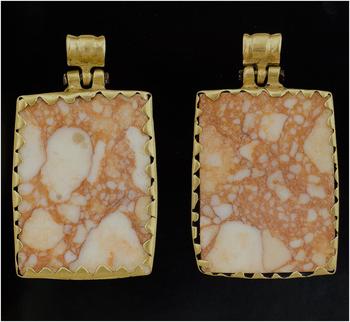
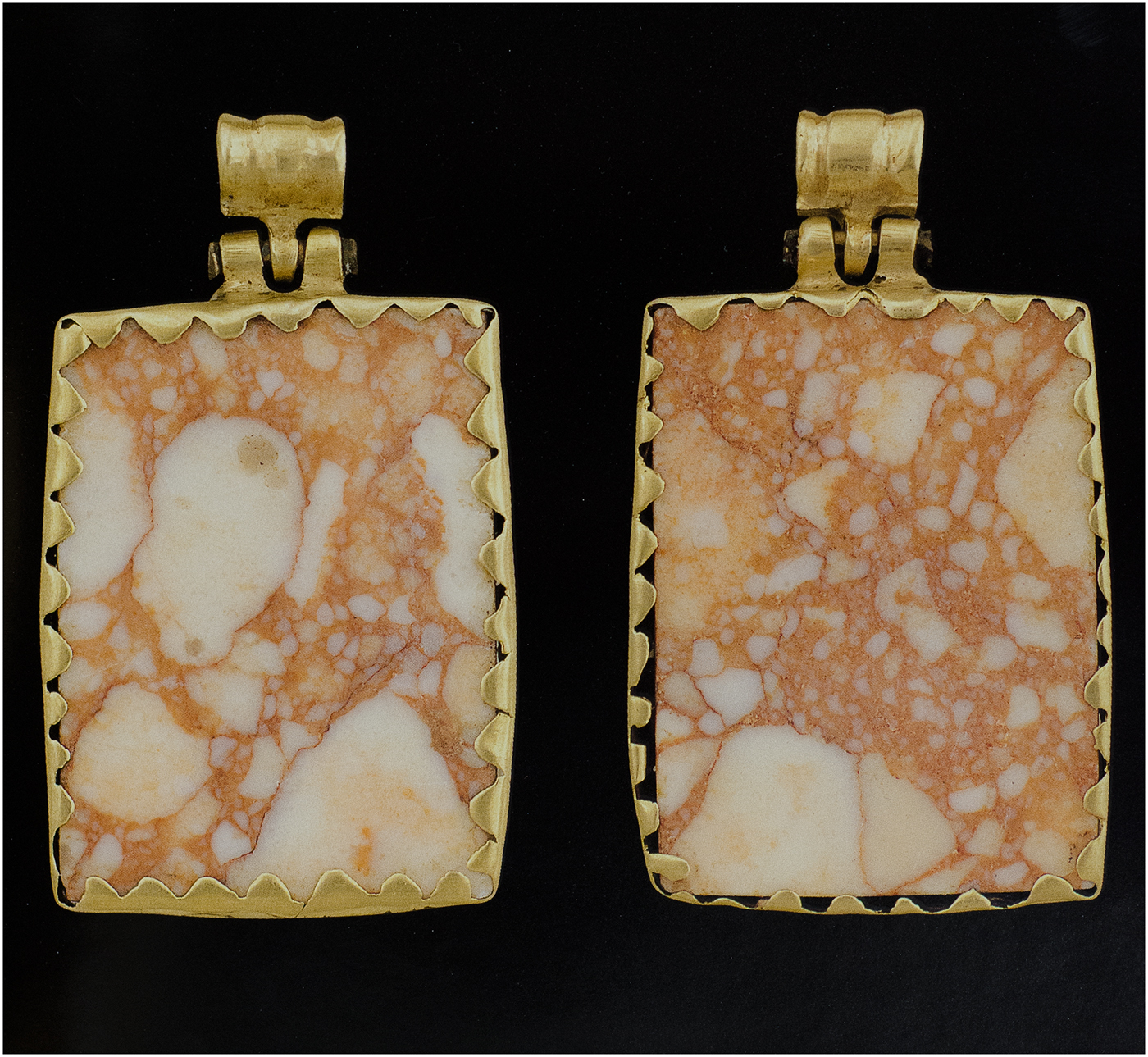
The treasury of the Vatopedi monastery on Mount Athos houses a rather peculiar enkolpion (fig. 1). Possibly dating from the Late Byzantine era, this miniature pectoral pendant, a mere 3.6 cm in height, consists of a rectangular plaque of reddish marble with white spots set in a serrated silver-gilt mount supplied with a suspension loop.Footnote 1 The stone plaque seems to be a piece of breccia corallina, a type of marble quarried in Bithynia and other parts of Asia Minor in antiquity.Footnote 2 At first blush, the simplicity of the pendant's design, which fully exposes the surface of the stone, with its constellation of irregular milky blotches and specks, might strike us as a medieval example of a pervasive and seemingly universal fascination with stones, if not as a piece of abstract art avant la lettre. Yet, within the context of a monastic treasury, the significance of the stone plaque lies not so much in its visual and tactile appeal—its ‘intrinsic, infallible, immediate beauty, unanswerable to no one’, to borrow a phrase from Roger CailloisFootnote 3—but rather in its purported provenance. An inscription, which runs along the narrow side of the precious-metal mount, identifies the framed piece of marble as a relic. It reads: Ἐκ τοῦ ἁγίου λίθου ἐν ᾧ ἐτέθη τὸ κυριακὸν ἅγιον σῶμα (‘From the holy stone upon which the holy body of the Lord was laid’). Mentioned neither in the Gospels, nor in the apocrypha, the stone slab upon which the dead body of Christ was placed after the descent from the cross and prepared for burial was one of the relics of Christ's Passion, highly venerated in the Middle Ages and beyond. In this article I wish to offer some thoughts on the fate of the Stone of Unction, as the relic came to be known in English, in twelfth-century Byzantium, and in particular to elucidate its association with the emperor Manuel I Komnenos. While this relic has been a subject of scholarly inquiry, the available textual and visual evidence merits reconsideration.Footnote 4
Enkolpion with a fragment of the Stone of Unction, late Byzantine period (?), Vatopedi monastery, Mount Athos (photo: after G. Oikonomake-Papadopoulou, B. Pitarakis, and K. Loverdou-Tsigarida, Ἱερά Μεγίστη Μονή Βατοπαιδίου: Ἐγκόλπια [Mount Athos 2000] 167).
The Stone of Unction was the last major Passion relic to reach Constantinople. In 1169, this intriguing remnant of Christ's earthly existence was solemnly transported to the imperial capital from the city of Ephesos, where it seems to have been kept in the church of Saint John the Evangelist. The contemporary historians John Kinnamos and Niketas Choniates report that, once the sacred lithos reached the Boukoleon harbour, the emperor Manuel I hoisted it on his back and in a remarkable display of piety carried it to the church of the Pharos in the Great Palace.Footnote 5 The lithos was reddish in colour and, as we shall see, apparently mottled — just like the fragment from the Vatopedi monastery. As for its size, Choniates states that the slab measured the length of a man (ἀνδρομήκης),Footnote 6 while a later source, the Spanish traveller Ruy Gonzáles de Clavijo who visited Constantinople in 1403, specifies that it was nine palms long.Footnote 7
The early history of the Stone of Unction is shrouded in obscurity. Kinnamos relates the tradition that Mary Magdalene was responsible for transporting this stone slab to Ephesos. As he writes,
Mary Magdalene, they say, took the stone and set sail straight for Rome so that, coming in the presence of the caesar Tiberius, she might accuse Pilate and the Jews as Jesus’ unjust murderers. When by some chance she put into the harbor of Ephesos, she left it there, but she departed and went to Rome.Footnote 8
If the Stone of Unction was, indeed, a large slab of breccia corallina, one is tempted to speculate whether its provenance may have been more proximate than the tradition associating the relic with Mary Magdalene would have us believe. Asia Minor, as already noted, was the principal source of breccia corallina in antiquity. As a matter of fact, several ancient quarries of this stone have been identified on the Karaburum peninsula, not far from Ephesos.Footnote 9 Did the sacred lithos originate at one of these sites? This is certainly a possibility. One should also bear in mind that breccia corallina was fairly popular in the Roman world, with its uses ranging from revetment panels and column shafts to basins and other decorative furnishings. It is quite conceivable that the Ephesian stone relic was a locally obtained piece of ancient marble that at some point, for reasons that we can only surmise, came to be recognized as a material trace of Christ's sacrificial death on the Cross.
By the time the Stone of Unction was deposited in the church of the Pharos, this palatine chapel had already been home to the majority of the relics of Christ's Passion, in addition to a host of other inestimable treasures.Footnote 10 The formation of this impressive assembly, unique in the Christian world, was tied to imperial piety and initiative. During the tenth and early eleventh centuries, a series of successful military campaigns in the East facilitated the procurement of numerous sacred objects from Christian shrines and communities formerly under Muslim rule. Their translation to the capital gave tangible expression to the programme of imperial renewal and helped articulate the idea of Constantinople as the New Jerusalem.Footnote 11 Between 1032, the year when the emperor Roman III Argyros acquired the Letter of Christ to King Abgar, and 1169 there were no major additions to the collection of relics in the Pharos church. The late arrival of the Stone of Unction thus may appear somewhat strange, especially since this relic had been kept in a celebrated shrine within the territory of the empire, not in a distant locale threatened by the ‘infidel’. Paul Magdalino has argued that the translation of the lithos may have been a politically opportune act; not only did it proclaim continuity with the glorious epoch of relics-collecting under the Macedonians, but it also signalled a desire on the part of Manuel I to assert his supremacy over the Latin potentates who, at that time, controlled the Holy Land.Footnote 12 In the era of the Crusades, the church of the Pharos with its panoply of the Passion relics became increasingly important as a symbolically charged place, a locus where the Komnenian empire could claim its right to the land where the Son of God had assumed flesh, died, and was resurrected.Footnote 13 Recently, Theodora Antonopoulou has proposed that the translation of the lithos should be related to the contemporary theological controversy surrounding the interpretation of Christ's words, ‘The Father is greater than I’ (John 14:28), in which Manuel took an active part. In her view, the relic's advent to the capital was a compelling public statement signalling the emperor's orthodoxy and his spiritual and physical proximity to the divine.Footnote 14 Be that as it may, one should recall that Manuel appropriated sacred objects from the provinces on more than one occasion. In 1149, he acquired the prokalymma from the tomb of Saint Demetrios in Thessalonike and, perhaps following the Norman sack of Corinth in 1147, had an icon of Saint Theodore Teron venerated in that city transferred to the palace. The emperor seems to have been eager to associate himself with select proskynemata from beyond Constantinople.Footnote 15
The Stone of Unction did not stay in the Pharos church for long. Shortly after Manuel's death in September of 1180, the relic was transferred yet again to the Pantokrator monastery and placed near the emperor's tomb.Footnote 16 In the wake of the Fourth Crusade, the lithos did not share the fate of the majority of other Passion relics, which ended up in the West, but remained at the Pantokrator. It is repeatedly mentioned as the most precious possession of the monastery until the fall of Constantinople to the Ottomans in 1453, when, as so many other treasures, the relic disappears from the scene.Footnote 17
The second translation of the lithos only eleven years after its deposition in the palace and its insertion into the context of the imperial burial ground is arguably a rather unexpected gesture. The church of the Pharos certainly lost nothing of its prestige in the last decades of the twelfth century, continuing to receive praise as the New Ark of the Covenant and the Second Holy Land.Footnote 18 What is more, the Akolouthia, or Liturgical Office, composed by George Skylitzes on the occasion of the first translation of the relic from Ephesos to Constantinople unambiguously portrayed the Stone of Unction as a common good. The emperor presented it to the Christian populace at large. The stone slab, in Skylitzes' words, was given to the imperial city as an ‘exceedingly precious ornament’ (κόσμος ὑπέρτιμος) and ‘foundation’ (θέμεθλον).Footnote 19 Then why was the lithos separated from the other relics of Christ and transferred to the Pantokrator? How are we to account for this jarring expropriation? In what follows, I wish to propose that in late-twelfth-century Constantinople the Stone of Unction was perceived and treated not simply as yet another sacred treasure of the highest order, but also as a semi-private relic of sorts, a personal devotional object directly and intimately associated with Manuel I. Strange as it may appear, the Vatopedi enkolpion, with which I began, is an excellent object to think with when it comes to interpreting the peregrinations and handling of the Stone of Unction in the hands of the Komnenoi. But first we must turn to the Pantokrator.
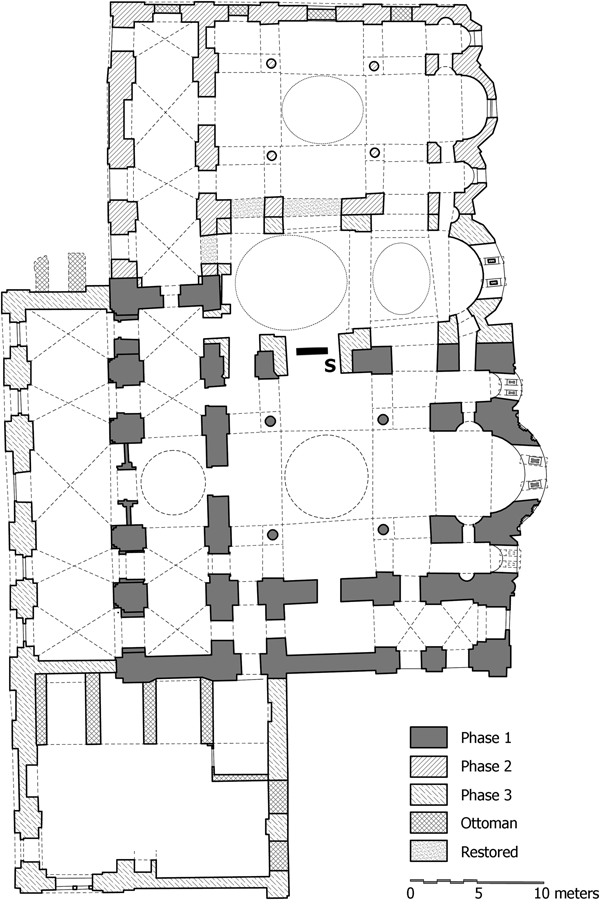
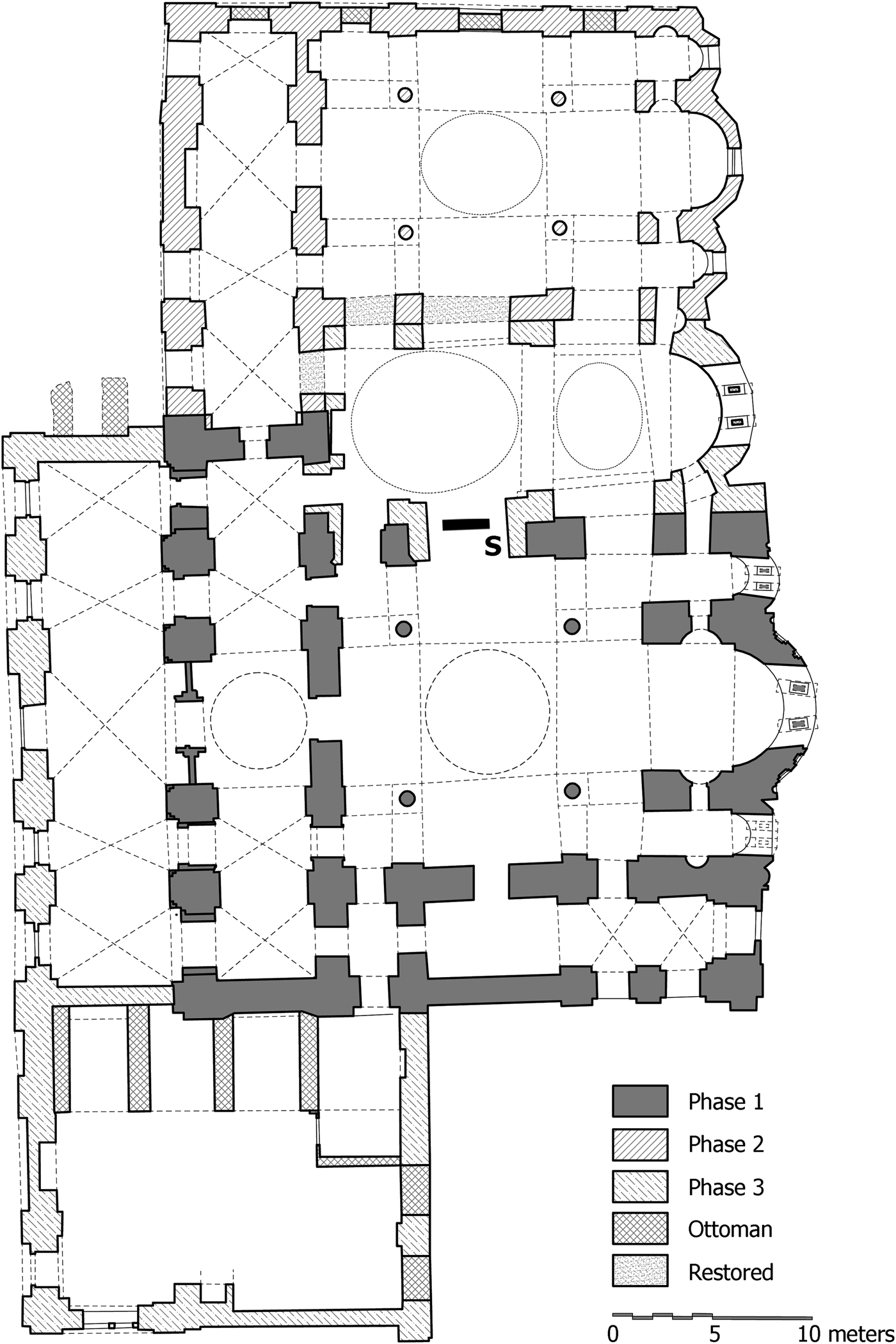
Founded by the emperor John II Komnenos and his wife Irene, Manuel's parents, the monastery of Christ Pantokrator was the most important religious foundation in twelfth-century Constantinople.Footnote 20 The monastery's liturgical centre was a complex of three domed churches: the katholikon, or main church, dedicated to Christ Pantokrator to the south; the church of the Virgin Eleousa serving a lay congregation to the north; and sandwiched between them, the oratory of the archangel Michael (fig. 2). The latter, referred to as heroon in the sources, served as a mausoleum for the imperial family. Its western part accommodated the tombs of the founders, John II and Irene, their sons Alexios and Andronikos, and Manuel's first wife, Bertha of Sulzbach. These tombs were in the form of sarcophagi, either free-standing or attached to the walls and set underneath monumental arcosolia. Their original arrangement is not certain. The last of the imperial tombs to be installed was that of Manuel I. It was a large freestanding sarcophagus located most likely towards the centre or in the southern part of the oratory.Footnote 21 The Stone of Unction, as we learn from Choniates, was placed on a pedestal (κρηπίς) to the side of the emperor's tomb.Footnote 22 In all likelihood, the relic was displayed underneath the vaulted passageway that connected the katholikon with the imperial mausoleum. The restoration work conducted by Arthur H. S. Megaw in the early 1960s revealed an elongated cavity measuring 2.45 × 0.64 m in this location. The cavity, as Megaw has suggested, probably served as a setting for the relic's pedestal.Footnote 23 The area around the cavity was evidently important since the magnificent opus sectile paving of the katholikon was extended to encompass it.
Plan of the churches of the former monastery of Christ Pantokrator (Zeyrek Camii), Istanbul, with the location of the Stone of Unction (S) (drawing: Ljubinko Ranković, after R. Ousterhout, ‘The Pantokrator monastery and architectural interchanges in the thirteenth century’, in G. Ortalli, G. Ravegnani, and P. Schreiner [eds.], Quarta crociata: Venezia – Bisanzio – Impero Latino, 2 vols. [Venice 2006] II, fig. 3).
In its new setting, the Stone of Unction was accompanied by a lengthy epigram in dodecasyllable, which, fortunately, has come down to us. Originally probably inscribed on the relic's pedestal, the epigram is recorded in a much later yet reliable source, the Geography written by Meletios, bishop of Athens, and published in Venice in 1728.Footnote 24 This remarkable poem, about which I shall have more to say shortly, indicates that the lithos was transferred to the Pantokrator and placed near Manuel's tomb at the order of his widow, the empress Maria of Antioch. It is possible that the removal was decreed by the emperor himself and that Maria simply fulfilled his wish. The second translation of the relic may have been an act of considerable political significance for the empress.Footnote 25 Following Manuel's death, Maria was tonsured under the name of Xene. The empress-turned-nun continued to wield power as a regent to her underage son Alexios II. The status of her regency, however, was extremely unstable. As a foreigner, a Latin from the crusader state of Antioch, Maria was rather isolated, without a kinship network to support her regime. Besides, she met with a strong opposition headed by the princess Maria, Manuel's first-born daughter, and she also had to contend with the growing anti-Latin sentiments in the capital. The regency eventually collapsed when Manuel's cousin, the notorious Andronikos Komnenos, seized power in the spring of 1182. Soon afterward, Andronikos had first the empress and then her son strangled. In such precarious political circumstances, the transfer of the Stone of Unction to the Pantokrator and its placement next to Manuel's tomb may have been perceived as a symbolic gesture affirming Maria's faithfulness to the memory of her deceased husband and thus bolstering the legitimacy of her government. While this political reading of the relic's second translation is certainly plausible, even probable, I wish to shift the focus elsewhere and look at the lithos through the lens of personal piety. To understand the fate of this relic in late-twelfth-century Constantinople, we need to place it against the background of the devotional culture of the contemporary Byzantine aristocracy.
To begin with, the interest of Manuel I in the Stone of Unction should not be seen in isolation, but rather as part and parcel of what amounts to a veritable vogue for stone relics in Komnenian Byzantium.Footnote 26 This phenomenon is partly explained by the changes in the political map of the Eastern Mediterranean brought about by the Crusades. Ever since the transformation of Palestine into the Christian Holy Land in the fourth century, stones from places and structures associated with the individuals and events described in the Scriptures had been much prized sacred commodities.Footnote 27 Naturally, such rocky fragments of the loca sancta became more readily available in the aftermath of the crusader capture of Jerusalem in 1099 and the reopening of pilgrimage routes to the Holy Land.
Epigrammatic poetry is a good witness to the increasing interest in stone relics among members of the Byzantine élite. The celebrated anthology of epigrammatic verse preserved in the manuscript Marcianus Graecus 524 contains six epigrams on reliquaries with sacred stones, at least five of which were in the form of enkolpia. The earliest among these is a mid-eleventh-century epigram on an enkolpion of the emperor Constantine IX Monomachos, which contained fragments of the Stone of Unction and the sword of Saint George.Footnote 28 Built around a pun on the emperor's family name—Monomachos literally means ‘the one who fights alone’—the poem presents the following appeal to Christ:
Fight along with him, O Christ, who carries on his chest a piece of the stone, upon which your dead body was wrapped in a linen cloth with myrrh, and <a piece> of the sword of your martyr George, with him, your Constantine Monomachos.
The other epigrams from the group date from the twelfth century. One was written on an enkolpion in the possession of the megas domestikos John Komnenos Batatzes, a nephew of Manuel I.Footnote 29 This pectoral pendant enshrined another piece of the Stone of Unction, a further indication that fragments of the great stone relic were in circulation.Footnote 30
You who live as God, yet die according to the law of the flesh, who were laid upon a stone in a royal fashion, like a lion, and wrapped in a linen cloth scented with frankincense and myrrh, may you, O Saviour, protect me who carry a holy piece of this stone, John Komnenos, along with my wife Maria, an offshoot of the Doukai.
Two epigrams from the Anthologia Marciana accompanied enkolpia with pieces of stone from the Holy Sepulchre. One of these enkolpia belonged to John IX Merkouropoulos, titular patriarch of Jerusalem residing in Constantinople.Footnote 31 The verses on the patriarch's pectoral reliquary evoke the vision of the stone cut from a mountain without hands in Daniel 2:34–35, a common prefiguration of Christ's virginal birth.
Τhis is a piece of your rock-hewn tomb, O Saviour, you who are a stone unhewn from the mountain of the Virgin. Be a support, a bond joining those who have been separated,Footnote 32 for the patriarch of Zion [i.e., Jerusalem] John.
The second enkolpion with a stone fragment from the Holy Sepulchre recorded in the Anthologia Marciana belonged to a Russian prince by the name of Theodore.Footnote 33 The verses on this pectoral reliquary, too, playfully allude to the scriptural imagery of stone.
This piece of stone is from the tomb that covered the corner stone [i.e., Christ; cf. Ephesians 2:20], which Theodore the Russian of royal stock carries as his foundation.
The enkolpion of one Michael Alousianos, sometimes identified with Michael Hagiotheodorites, a high official at the court of Manuel I, represented nothing less than a personal, portable replica of the Holy Land.Footnote 34 The enkolpion contained, in addition to pieces of the True Cross and the wood from the Garden of Gethsemane, stone fragments from the Holy Sepulchre, the tomb of the Virgin, Mount of Olives, Golgotha, and Mount Sinai. The epigram on this precious objects inventories its contents as follows:
I carry the wood <from the tree> that grew at the place of prayer [i.e., Garden of Gethsemane] and <the wood> of the Cross of Christ, and stones from the tomb of the Mother of the Logos, Mount of Olives, Golgotha, and Sinai.
The final epigram from our group was dedicated to a piece of stone coming from the tomb of the Virgin.Footnote 35 Intriguingly, this piece featured a carved image of Mary. The poem opens by highlighting the theme of the Incarnation through reference to Daniel 2:34–35 and then proceeds to juxtapose the sculpted fragment with the whole to which it once belonged.
This piece of stone is from the tomb that covered the spiritual mountain [i.e., the Virgin], from which a stone had been cut, <namely> Christ who bound together the <old> law with a new grace. The Maiden, whom the entire tomb was unable to hold, is contained in this <piece of stone> by the carver's hand.
In contrast to the tomb itself, which failed to retain the Virgin's body—according to tradition, the Mother of God was bodily taken up into heaven after her death—the fragment of the tomb now contains her by means of the carved image. The title attached to the poem in the manuscript gives no information on the setting of the image-bearing stone relic, but in view of the poem's brevity, it is possible that the relic was enshrined in an enkolpion.
None of the objects recorded in the epigrams from the Anthologia Marciana has come down to us, but we do have contemporaneous Byzantine reliquaries designed to house sacred rocks. Perhaps the best known example is the reliquary that contained a large piece of stone from the Holy Sepulchre, formerly in the treasury of the Sainte-Chapelle in Paris and now in the Louvre.Footnote 36 Two plaques sheathed in gilded silver and adorned with repoussé reliefs of the Women at the Sepulchre and a crux gemmata, respectively, are the only remains of this object. The stylistic and paleographic features of the plaques indicate that the reliquary was made or refurbished in the twelfth century. Before its transfer to France in the aftermath of the Fourth Crusade it was most likely kept in the Pharos church of the Great Palace.
The treasury of the Protaton on Mount Athos preserves another example, a precious-metal container with a collection of relics in its interior, including stones from the Holy Sepulchre, Golgotha, Bethlehem, and Gethsemane, each supplied with an identifying label on a sheet of silver.Footnote 37 The reliquary was thoroughly refashioned in the eighteenth century, but its sacred contents as well as its cover with a scene of the Crucifixion are medieval, likely datable to the early twelfth century. The verse inscription framing the Crucifixion commemorates two individuals:
Zosimas is rich in the life-giving stones from the venerable places with ardent faith, and Nicholas adorns their container with desire.
Zosimas, who evidently acquired the sacred stones, perhaps while on pilgrimage to the Holy Land, is portrayed on the cover, kneeling at Mary's feet and addressing his prayer, inscribed above him, to Christ: Κύριε βοήθει घωσιμᾷ μοναχῷ (‘Lord, help the monk Zosimas’). Zosimas' relationship with Nicholas, the second person mentioned in the verse inscription, is not clear, but the latter appears to have been a man of means, since he provided for the precious-metal adornment of the box.
A further example that may be added to this brief survey is the staurotheke from the Benedictine abbey of Mont-Saint-Quentin north of Péronne in Picardy, destroyed during the French Revolution but known through drawings and descriptions.Footnote 38 This elaborate reliquary, which can be dated to the eleventh or twelfth century, housed, apart from five pieces of the True Cross, several other relics associated with the Nativity and Passion of Christ. These included fragments of the swaddling clothes, the crib, the nails, and the crown of thorns, remains of Christ's blood, as well as stones from Golgotha and the Holy Sepulchre. Finally, it is worth mentioning that the inventory of the Xylourgou monastery on Mount Athos, drawn up in 1142, records an enkolpion with relics of the True Cross and an unspecified ‘venerable stone’ (λίθος τίμιος), presumably a piece of rock from the Holy Land.Footnote 39
Manuel I's involvement with the Stone of Unction should be seen as the ultimate example of the fascination with stone relics in eleventh- and twelfth-century Byzantium. Befitting his status and power, the emperor could afford to obtain not a small fragment, like the one mounted in the Vatopedi enkolpion, but the entire massive slab of marble upon which the body of the Lord had been laid. But the affinity between what may be termed the lithic piety of the Byzantines and the emperor's appropriation and handling of the Stone of Unction, I believe, runs deeper. As we have seen, the epigrammatic evidence indicates that, in the context of personal devotion, pieces of sacred stones were typically enshrined in pectoral reliquary pendants, some of which may have resembled the specimen in the Vatopedi monastery.Footnote 40 This kind of treatment was not fortuitous. Normally worn underneath the garments, close to the body, enkolpia were arguably the most personal and intimate of all devotional objects in Byzantium.Footnote 41 Protecting the wearer and providing a constant focus to his or her prayers, these small pendants were embraced, clasped in the hand, caressed, kissed, and intensely scrutinized. In the case of enkolpia with sacred stones, such haptic, even visceral engagement was uniquely appropriate, as stone relics operated primarily through touch. Sanctified by means of direct, physical contact with the bodies of Christ, the Virgin, and other holy figures, they asked to be touched to release their sacred energy. Besides, because they were worn suspended around the neck, enkolpia could evoke, despite their small size, the notions of burden and weight. Stones—by nature heavy, hard, and solid—would make such association all the more apparent. Bits and fragments of rocks from the loca sancta carried on the chest may not have been literally heavy, but they would highlight the spiritual weight and metaphorical gravity of the suspended enkolpion with particular force.Footnote 42 Manuel's striking decision to carry the Stone of Unction on his own shoulders from the Boukoleon harbour to the church of the Pharos brings to the fore the same concerns with touch and weight. The emperor's physical proximity to the relic was compellingly dramatized in this spectacle of devotion and humility, as was the heavy burden of the sacred, which, in the case of the massive stone slab from Ephesos, was both literal and metaphorical.
Yet the drama of imperial piety that accompanied the first translation of the relic was envisioned primarily as a reenactment of Christ's burial. Indeed, Niketas Choniates explicitly states that Manuel carried the Stone of Unction ὡς ὁμόθεον σῶμα, ‘as though it were the actual body of God’.Footnote 43 To be sure, the lithos was a ‘secondary’ relic, an object sanctified through contact with Christ's flesh and blood, but it could also function as an ersatz body, standing in for the now absent body of the Lord. The intimate link between this body and the stone slab was also emphasized in the liturgical office composed by George Skylitzes, where the Divine Logos is said to have been σύσσωμος, that is, ‘in bodily contact’ or, better put, ‘bodily united’ with the lithos.Footnote 44 This kind of union, if not conflation, was in part predicated upon the common notion of stone as a figure of Christ. Based upon the Scriptures—for instance, the well-known references to Christ as the cornerstone—this notion was a topos in Byzantine religious discourse.Footnote 45 But the visual appearance of the relic itself encouraged, too, its association with the body. The reddish colour of the lithos could readily bring to mind the sight of human flesh or the redness of blood, as though the stone slab had absorbed the blood of the Lord spilt upon it. As a matter of fact, Skylitzes in his Akolouthia states as much. He declares that the lithos was ‘dyed by the stream of blood flowing from God’ (ῥοῇ δὲ βαφεὶς τοῦ θεορρύτου αἵματος).Footnote 46
At this juncture we should recall that the Middle Ages, like the ancient world, perceived stones rather differently from us. We tend to see rocks and mineral formations as inert, unmoving, and intractable—the quintessential lifeless matter. By contrast, in the medieval understanding of the natural world, the boundaries between the animate and the inanimate, between minerals, plants, and humans were surprisingly porous. In accordance with this understanding, stones—the precious varieties in particular—were perceived as quasi-organic entities, active, transformative things often endowed with distinct powers and agency. From the geological and mineralogical writings of Aristotle and Theophrastos to Michael Psellos' treatise On the Properties of Stones, from ekphraseis of marble-clad church interiors to epigrams on engraved gems, a range of texts bear witness to the currency of such views in Byzantium.Footnote 47 Far from being unyielding and intractable, the Stone of Unction was highly receptive, capable of transforming itself, in this instance, under the impact of bodily fluids. The blood of Christ coloured the stone, transforming it into a holy substance.
The susceptibility of the sacred lithos to transform, however, had another critical dimension. In his account of the relic, John Kinnamos relates that, upon Christ's death on the Cross, his mother ‘laid him prone, as was customary, on this stone; falling down, she lamented deeply, as was reasonable, and the tears from her weeping reached the stone and still remain there, unexpunged (μυρομένης δὲ τὰ δάκρυα τῷ λίθῳ πελάζοντα ἔτι καὶ νῦν ἀναπόνιπτα μένουσι), something rather miraculous’.Footnote 48 Like the Vatopedi fragment, the lithos was evidently mottled, featuring white blotches and spots, which the Byzantines identified as Mary's miraculously preserved tears. Pilgrims' accounts repeatedly mention these white marks.Footnote 49 The Russian pilgrim Anthony of Novgorod, who saw the relic in 1200, likens them to drops of wax,Footnote 50 while according to Clavijo, they appear as though they had been frozen.Footnote 51 Perhaps the most interesting is the statement of Rabban Sauma, a Nestorian monk from China who visited Constantinople in 1287. As he reports, ‘Mary wept on that stone, and the place whereupon her tears fell is wet even at the present time; and however often this moisture is wiped away the place becometh wet again’.Footnote 52 Miraculously preserving the Virgin's tears, petrified yet liquid at the same time, the Stone of Unction was not only a Passion relic, but a Marian relic as well.
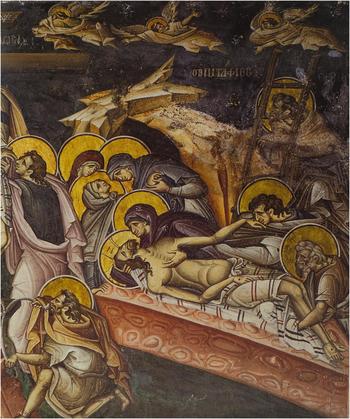
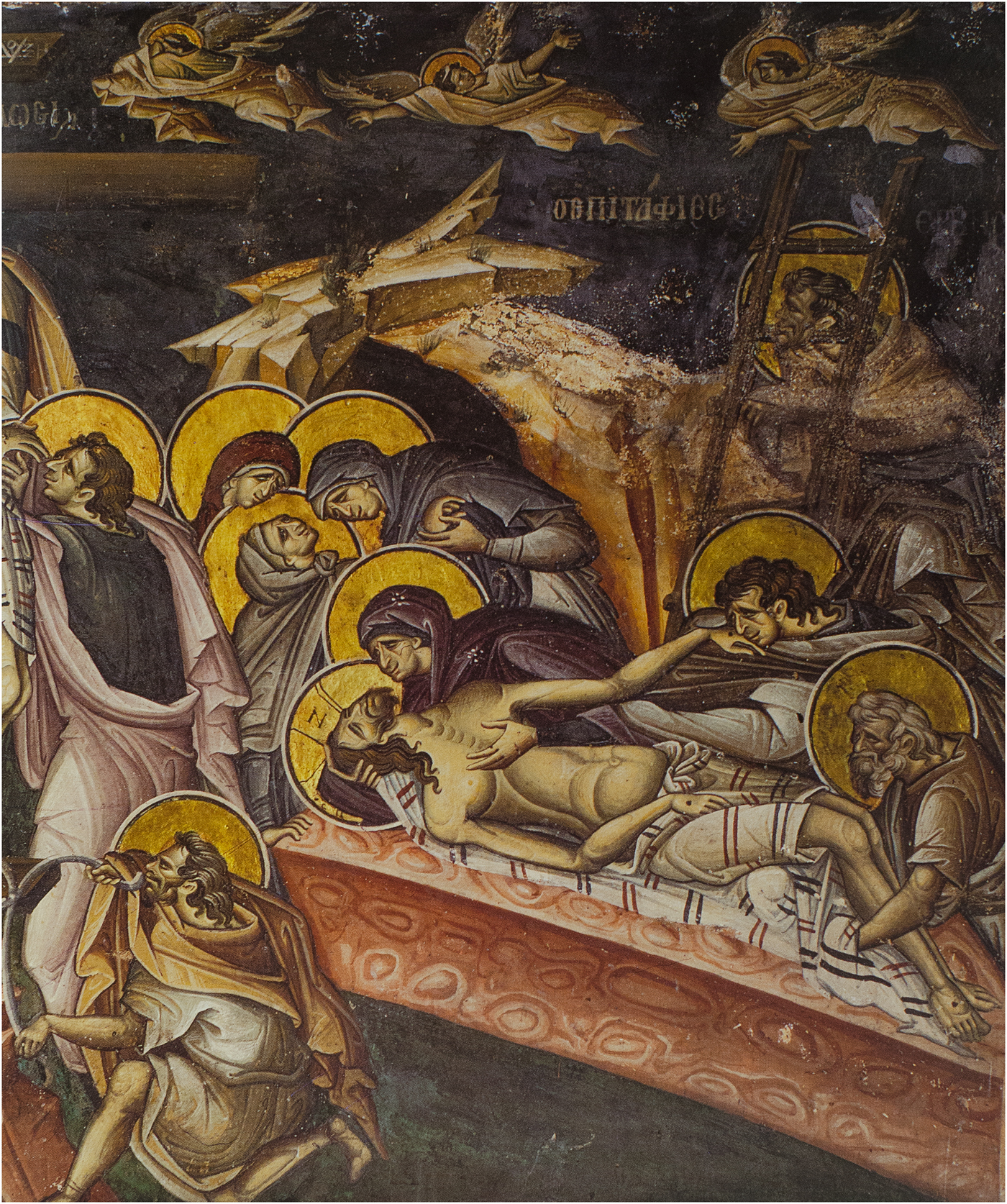
Depictions of the Lamentation best encapsulate the intimate link that the Byzantines established between the lithos, Christ, and Mary. As Ioannis Spatharakis has pointed out, following the transfer of the relic from Ephesos to Constantinople, the motif of the stone slab was gradually introduced into pictorial representations of the Epitaphios Threnos, or Burial Lament.Footnote 53 In an early-fourteenth-century fresco in the katholikon of the Vatopedi monastery, this new iconography finds a strikingly dramatic formulation (fig. 3).Footnote 54 Surrounded by a group of agitated mourners, the dead body of Christ is shown stretched half-naked on a large block of reddish stone with a pattern of curiously biomorphic and seemingly three-dimensional shapes highlighted in white. The compositional and emotional focus of the scene is the passionate embrace of the grief-stricken Mother of God, her face almost turned into a caricature, and her dead Son. The prominence accorded to the Stone of Unction in the Vatopedi fresco underscores the importance of this relic as a witness of and participant in the events of Christ's Passion. The variegated surface of the depicted stone block may not exactly resemble the fragment of the relic preserved in the same monastery, but its white streaks and highlights were undoubtedly meant to evoke traces left by Mary's tears. Quite remarkably, the odd organic forms of these markings also echo the muscles and sinews of Christ's recumbent body, thus allowing for a visual assimilation of the lithos into flesh.
Lamentation, 1311/2, katholikon of the Vatopedi monastery, Mount Athos (photo: after E. N. Tsigaridas, ‘The mosaics and the Byzantine wall-paintings', in The Holy and Great Monastery of Vatopaidi: Tradition, History, Art, 2 vols. [Mount Athos 1998] I, fig. 224).
The mutability and multivalence of the Stone of Unction rendered this relic not only a powerful carrier of presence and memory that afforded the worshipper a direct, physical contact with the protagonists of the sacred history, but also a potent site of mimetic identification. The relic accommodated and even called for an active, bodily reenactment of the drama of the Passion. Manuel's hoisting of the stone slab on his back, though by all means exceptional, exemplified this kind of self-dramatizing engagement.
Mimetic identification is a leitmotif in the epigram once likely inscribed on the pedestal of the lithos at the Pantokrator monastery.Footnote 55 The poem, which in the transcription published in the Geography by Meletios of Athens runs to forty-four lines, but was originally longer, presents a generic mixture; best described as an epitaph, it also features elements of a dedicatory epigram. The highly personal outlook of the verses, enhanced by their emotional tenor, firmly anchored the stone relic within the private salvation program of the imperial burial ground and tied it directly to Manuel's tomb. The poem opens with an address to the reader:
Admire these novel things as you see them, O stranger; our master, the emperor Manuel, reenacts the resolve of the Disciple [i.e., Joseph of Arimathea] as he bears on his shoulders the stone upon which the Lord's body was laid and prepared for burial in a winding sheet. He even lifts it up announcing in advance his own burial, that in death he may be buried together with the Crucified One and may arise together with our buried Lord.Footnote 56
Commemorating Manuel's carrying of the relic to the church of the Pharos, the verses draw a parallel between the emperor and Joseph of Arimathea, the disciple who removed the dead body of Christ from the Cross. Manuel's feat is here explicitly presented as an act of deliberate identification with Joseph. The reference to the emperor's wish to be ‘buried together with the Crucified One’ suggests that the emperor himself may have arranged for the Stone of Unction to be removed from the palace and transferred to the Pantokrator.
The themes of identification and reenactment are further developed in the lines that introduce Manuel's widow, Maria of Antioch:
The empress Maria, his wife, who, deprived of her resplendent master, is again our holy augousta and empress, <renamed> Xene, together with her son, the ruler Alexios, like that other Maria who secretly brought unguents, once again mixes unguents with her tears, not in seeking him who will roll the stone away from the door of the life-bringing tomb, but that she may roll that life-giving stone to the tomb wherein is buried the body of the Lord's anointed, the emperor Manuel, later <renamed> Matthew.Footnote 57
Almost as a continuation of Manuel's imitation of Joseph of Arimathea, the bereft widow here appears in the guise of Mary Magdalene. Her rolling of the ‘life-giving stone’ to the tomb of her deceased husband is clearly an allusion to the transfer of the lithos to the Pantokrator.
The remainder of the poem praises Manuel's monastic vocation — shortly before his death, the emperor embraced the monk's habit under the name of Matthew — and elaborates at some length on Maria's heart-rending grief employing, quite appropriately, a rich imagery of stone. The epigram ends with an impassioned lament spoken in the voice of the widow.
Break, my heart; receive my master within my much-sighing bosom—him whom you held very dear, whom you loved indeed. Since now he has died and has been hidden in stone, I too have turned into stone with sorrow and I am also dying because of <the sight of> the tomb and the stone, for my soul is broken and my breath has flown away.Footnote 58
The mimetic identification on the part of the imperial couple is not limited, however, to the figures of Joseph of Arimathea and Mary Magdalene. More significant, if less explicit, is the parallelism that the verses draw between Manuel and Maria, on the one hand, and Christ and the Virgin, on the other. As Nancy Ševčenko has pointed out, the language of Maria's lament shows affinities with the verbal articulation of Mary's grief at the death of her Son, found in liturgical and homiletic texts.Footnote 59 Inscribed next to the lithos, Maria's mournful words would have inevitably prompted the viewer to associate the empress with the Mother of God lamenting over the corpse of Christ laid upon this very stone. Similarly, the placement of the lithos in close proximity to the emperor's sarcophagus—a juxtaposition to which, as we have seen, the verses allude—made palpable the parallelism between Manuel and Christ. United in death and burial, the emperor and his Lord were also associated through the theme of anointment, aptly introduced in reference to the nature of the relic. As the χριστὸς Κυρίου, ‘the Lord's anointed one’, Manuel was laid next to the slab whereupon the body of Χριστός, Christ, had been anointed for burial.
The emperor's imitation of Christ was an important aspect of political ideology and imperial propaganda in Byzantium. In the public image that Manuel's encomiasts sought to project, the theme of Christomimesis received an unprecedentedly rich and daring elaboration.Footnote 60 Perhaps the most striking example is provided by an oration composed by Gregory Antiochos several months after Manuel's death, in which the emperor's toils and struggles against his many enemies are directly aligned with the Passion of Christ.Footnote 61 In the case of our epigram, however, Christomimesis was not so much a matter of ideology and propaganda as it was a function of the double status of the lithos in its new setting at the Pantokrator. In this context, the Stone of Unction figured as a substitute for the tomb of Christ, thus transforming the imperial mausoleum into a replica of the Holy Sepulchre in Jerusalem, a proposition already explored by Robert Ousterhout.Footnote 62 But the relic also functioned as a kind of extension of Manuel's tomb. It is indicative that the inscribed verses place the grieving widow next to the Stone of Unction and not, as one would expect, at the side of the emperor's sarcophagus: ‘the empress sheds tears like unguents and wears herself out before the stone’ (ἡ γοῦν βασιλὶς δάκρυσιν ὥσπερ μύροις / ὅλην ἑαυτὴν ἐκκενοῖ πρὸς τὸν λίθον) (25–26). Cast in the image of the Mother of God, Maria is portrayed weeping and mourning the loss of her husband at the side of the stone relic.
This notion that the lithos and the emperor's tomb were not simply juxtaposed, but constituted a unified whole, brings me to my final point. I would argue that the status of the stone relic in its new setting at the Pantokrator monastery was to a certain extent comparable to that of a personal devotional object displayed at the burial place of its former owner. Tombs featuring religious items associated with the deceased seem to have been common in the Komnenian era, at least in the context of élite aristocratic burials. The tomb that Manuel's uncle, the sebastokrator Isaac Komnenos, planned to have installed at his foundation, the monastery of the Virgin Kosmosoteira near Bera in Thrace, provides the best documented example. Isaac's Typikon for the monastery, dated to 1152, gives detailed instructions concerning the decorative apparatus of this monument, which was to be set up in the narthex of the monastery church.Footnote 63 Aside from the portraits of his imperial parents, Alexios I Komnenos and Irene Doukaina, two icons were to be displayed at Isaac's tomb, one of the Virgin Kosmosoteira and the other of Christ. The former icon was apparently an object to which the sebastokrator was particularly attached, for, as he states in the Typikon, this icon had been sent down to him from God (θεόθεν), and subsequently he had embellished it with a precious-metal revetment. In addition, rather than having his personal enkolpion buried together with him, as was the norm, Isaac arranged for it to be placed on the lid of his sarcophagus in a specially prepared silver setting. The devotional objects listed by the sebastokrator are, of course, vastly different from the Stone of Unction, but the association of this relic with Manuel's tomb followed the same logic. The display of the relic in conjunction with the emperor's final resting place was a function of its privatization. This is not to say that, once it was transferred to the Pantokrator, the stone slab lost its ‘public’ identity as a major Passion relic, brought to the imperial capital for the spiritual benefit of its populace. The placement of the relic at the Pantokrator is telling in this regard. As indicated above, the lithos was most likely installed under the vaulted passageway connecting the south, main church of the monastery and the oratory of the archangel Michael. This strategic location would have ensured that the relic was directly accessible from the katholikon and thus available for veneration by the monks and visitors alike, while at the same time remaining part of the more restricted space of the imperial mausoleum. Nonetheless, the very decision to expropriate the Stone of Unction from the collection of the Passion relics in the church of the Pharos and move it to the Pantokrator was justified by the notion that the stone slab, in a sense, belonged to the deceased emperor.
Studies of the imperial uses of relics have typically focused on political and ideological aspects of their cult — the role of relics as palladia of the Empire, symbols of power, guarantors of military victory, diplomatic gifts, or sureties for the repayment of loans.Footnote 64 The story of the Stone of Unction prompts us to reconsider the imperial uses of relics from the point of view of personal piety.Footnote 65 What this article has attempted to highlight is the degree to which the manipulation of the ‘God-receiving’ stone slab under the late Komnenoi was informed by broader trends in the devotional culture of the twelfth-century aristocratic élite. Ultimately, the intimate association of the lithos with Manuel I should be seen as a particularly compelling manifestation of a larger phenomenon, much in evidence during the Komnenian era, namely, the increasing personalization and even privatization of the sacred. An intensely felt desire to pull the sacred into the personal sphere colours Komnenian piety. Its materializations are diverse and include such developments as the rise of privately orchestrated icon cults in aristocratic households, the popularity of dedicatory epigrams in the form of a personal prayer, or the proliferation of portraits of lesser mortals in the vicinity of holy figures. In twelfth-century Byzantium, across a variety of artistic genres and religious contexts, élite displays of devotion reflect a previously unparalleled urge to foreground and assert one's self.Footnote 66
To state that Manuel's handling of the Stone of Unction simply reflected the dominant devotional style, however, would not be entirely accurate. Under the Komnenian emperors, the relationship between imperial and aristocratic expressions of piety was fundamentally a two-way relationship. For as much as Manuel's intimate rapport with the sacred lithos amounted to a self-conscious privatization of the venerable imperial tradition of relic veneration, it also elevated aristocratic practice to the imperial level. The same kind of mutual imbrication between the two domains informed the conception of the Pantokrator monastery as a dynastic monument. The religious house established by Manuel's parents, John II and Irene, was unmistakably aristocratic in character insofar as it was focused on the founders' family and conceived as a place of burial and commemoration. Yet, as Paul Magdalino has pointed out, the Pantokrator was also given an emphatically imperial dimension. In its sheer size and wealth, the multiplicity of functions it accommodated, and even its architecture, the Pantokrator echoed such quintessentially imperial monuments as the complexes of the Holy Apostles and Saint George of the Mangana, or the churches of the Great Palace.Footnote 67 Both the monastery and the stone relic it housed served to recast imperial piety in an aristocratic mold. They were mobilized to assert imperial power in terms that would have resonated particularly strongly among the uppermost echelon of Komnenian society, sending a clear message of the emperor's unique, superior status within this group.