Prenatal testing, which is widely accepted for the detection of chromosomal abnormalities and a wide range of monogenic disorders, is necessary to enable women and their partners make informed choices, terminate the pregnancy or not. Parents are strongly advised to collect as much information as possible relevant to their decisions. For the parents to make the best decisions, healthcare professionals should “ascertain whether they possess all the relevant information, and to impart upon that information if that was unknown to them” (Reference Zhang, Ng, Wang, Zhai and Lie1). It comprises two procedures: prenatal screening and prenatal diagnosis. For several years, prenatal screening methods have been a combination of measurement of maternal serum markers and more recently with ultrasound, to measure fetal nuchal translucency to assess the risk of chromosomal abnormalities (Reference Malone, Canick and Ball2). These methods are then followed by the prenatal diagnosis; amniocentesis (around 14 wks of gestation) or chorionic villus sampling (9.5–12.5 wks of gestation) (Reference Swanson, Sehnert and Bhatt3) for detecting trisomy 21 (Down syndrome), 18, or 13. Both strategies provide a high detection rate of 90 percent (Reference Nicolaides4;Reference Leung, Chan, Law, Sahota, Fung and Leung5); yet, they carry a significantly high risk of total pregnancy loss and spontaneous miscarriage of the fetus (Reference Alfirevic, Sundberg and Brigham6). The major limitation of these tests is the false-positive rate of about 5 percent (Reference Lau, Chan, Lo, Chan, Chan and Koo7), which causes not only significant maternal anxiety (Reference Susanne, Sissel, Ulla, Charlotta and Sonja8), but also “unnecessary” fetal losses due to subsequent invasive diagnostic procedures. Until a few years ago, the invasive prenatal diagnosis has been the standard of measure of the fetal aneuploidies test (Reference Zhai, Cai, Li, Chen, Huang and Zhong9).
The non-invasive prenatal testing (NIPT) is a breakthrough molecular approach for assessing fetal aneuploidy using cell-free fetal deoxyribonucleic acid from the plasma of pregnant women (Reference Yagel10), which has been shown to be effective at detecting trisomy 21 (Down syndrome), 18, and 13. For Down syndrome, it has >99 percent sensitivity and a false-positive rate of <.1 percent (Reference Allyse, Minear, Berson, Sridhar, Rote and Hung11), and it can also be used as early as 10 weeks of gestation without the risk of miscarriage. However, despite its safety and early screening for assessing fetal aneuploidy, the entire genome testing also presents more serious ethical concerns (Reference Yagel10), and thus has a higher level of requirement for informed consent and genetic counseling (Reference Benn, Borell, Chiu, Cuckle, Dugoff and Faas12–Reference Deans, Hill, Chitty and Lewis14).
NIPT was first released in Hong Kong in 2011 (Reference Lau, Chan, Lo, Chan, Chan and Koo7), and has subsequently been offered in over 60 counties worldwide (Reference Allyse, Minear, Berson, Sridhar, Rote and Hung11;Reference Kellogg, Slattery, Hudgins and Ormond15). Most international guideline recommendations and common practices for NIPT are prenatal testing strategies for select and high risk pregnant women to detect trisomy 21, 18, or 13, and the combination of NIPT with other diagnostic strategies for the detection of chromosomal abnormalities (16–20).
In China on 14 February 2014, the China Food and Drug Administration (CFDA) and National Health and Family Planning Commission (NHFPC) jointly issued a document to put a moratorium on NIPT, based on the ethical concerns and, human genetic resources protection, biosafety and regulation of technology application, pricing, and quality supervision. After the moratorium, the National Health and Family Planning Commission initiated a pilot project (15 January 2015) in 108 institutions, including hospitals and for-profit genetic testing companies, approved for a certificate to practice NIPT during this pilot project. One year after the pilot project began it was stopped (27 October 2016), and a certificate program of NIPT was launched. Since then, China has been experiencing a rapid adoption and implementation of NIPT for prenatal testing.
For NIPT, the obstetricians' and gynecologists' enthusiasm combined with for-profit genetic testing company's promotion effort may change the perceived value of NIPT and disregard ethical concerns. Understanding the attitudes and adoption behavior of a wider range of health professionals toward the delivery of prenatal tests is important because those attitudes and adoption may affect their professional practice (Reference Levy21). Although in most cases, physician recommendations usually guide patient adoption of new medical technologies. Obstetricians and gynecologists were recommended to communicate with their patients to assist in decision making on NIPT use (Reference Anderson22). However, their opinions, the adoption behaviors of providers toward NIPT, and the reasons why individual physicians adopt or recommend NIPT are poorly understood. This study aimed to describe the status of NIPT adoption, to examine factors impacting on obstetricians' and gynecologists' adoption of NIPT, and to provide policy suggestions for regulation of appropriate implementation of NIPT.
Methods
Design and Sampling
A multi-step study sampling method was used. First, because China's thirty-one provinces are classified into three levels according to their GDP per capita, one province from each level was selected, including Shanghai in the high-economy level, Fujian Province in the middle-economy level, and Sichuan Province in the low-economy level. Second, in each of the selected provinces, the capital city and one city with a medium population size and medium economic development level were selected. Third, in each of the selected cities, we selected two secondary and two tertiary hospitals. A total of thirteen hospitals, which responded (response rate: 13/20, 65.0 percent) to our research and completed the hospital survey, included 100 percent (8/8) hospitals in Fujian Province, 50 percent (2/4) hospitals in Shanghai, and 37.5 percent(3/8) hospitals in Sichuan Province. A hospital survey was also conducted to collect hospital characteristics. All of the physicians working on prenatal screening in gynecology and obstetrics in these hospitals completed self-administered physician questionnaires, from July 2016 to October 2016. All research participants completed written informed consent. The study protocol and questionnaires were approved by the Fudan University School of Public Health Institutional Review Board (IRB # 2015-12-0577).
Empirical Model
Rogers' innovation diffusion theory is one of the most popular theories for studying adoption of innovations and understanding how innovations spread within and between communities and individuals. Data analysis for this study was conducted using the Rogers' innovation diffusion model. The Rogers' innovation diffusion model recognized: physicians' perceived attributes of innovations, communication channels, nature of the social system, and extent of change agent's promotion efforts can determine the adoption of innovations and actually are key elements of the theory itself (Reference O'Sullivan23). These elements of the theory were used to explore the adoption of NIPT in China. Based on a previous study, the key predictors of physician-perceived benefits were also included.
Measures
Adoption of Non-Invasive Prenatal Testing
In this study, the physicians prescribed NIPT to pregnant women when judged appropriate. The test could take place either inside or outside the hospitals.
Physician Perceptions
Physician-perceived attributes of NIPT, including effectiveness, cost-effectiveness, ethical concerns, compatibility, and HTA evidence were collected. Adoption by other physicians before his/her own adoption, communication with peer colleagues, and the number of hospital physicians were recognized as communication channel variables in this study, and were collected as well. Physician perception of certificates of the prenatal testing industry and medical association promotion effects were also collected as change agents' promotion efforts. Most importantly, perceived clinical practice skill improvement, training frequency, perceived receiving financial returns within the adoption of NIPT were collected as perceived benefits.
Hospital Predictors
Predictors of hospital competition (e.g., number of the same level hospitals in the local city), physician competition (e.g., number of hospital physicians), and hospitals characteristics including hospital level (secondary or tertiary) and teaching hospital status were collected.
Statistical Analysis
Statistical analysis included descriptive analysis and multivariable logistic regressions that were conducted separately on each of five sets of factors: physicians' perceived attributes of innovations, communication channels, nature of the social system, the extent of change agents' promotion efforts and physician's perceived benefits. Data were analyzed using STATA version 12.0. The level of significance was defined at p < .05, and a borderline significance was defined as .05 ≤ p < .1.
Results
Physician's Characteristics
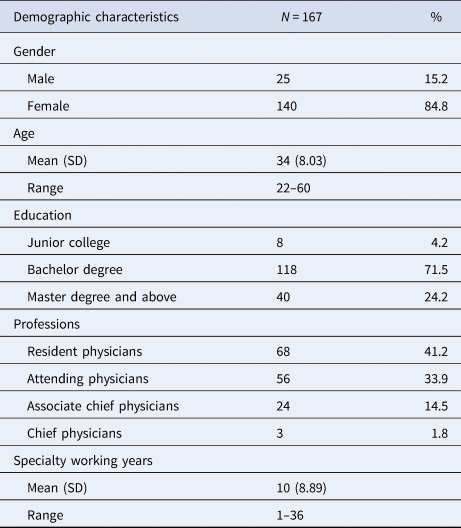
A total of 167 physicians working on prenatal screening in obstetrics and gynecology completed the questionnaire. The demographic characteristics of 167 physicians are described in Table 1. They were 34 years old on average (ranging from 22 to 60 yr), had 10 years working experience in the specialty (ranging from 1 to 36 yr), and 95.8 percent had a Bachelor or above education. The majority of physicians were female (84.8 percent) and the top two professional titles of the physicians were resident physicians (41.2 percent) and attending physicians (33.9 percent).
Demographic characteristics of surveyed physicians

SD, standard deviation.
Physician Attitude, Willingness, and Adoption Behavior
Of 167 physicians, over half of them (53.2 percent) has a positive attitude toward NIPT technology in their clinical practice from their own perspectives. Regarding the adoption behavior of NIPT, ninety-three physicians (58.9 percent) had already adopted NIPT, whereas sixty-five physicians (41.1 percent) had not yet ordered this new prenatal screening technology.
Perceived Attributes of NIPT and the Adoption of NIPT
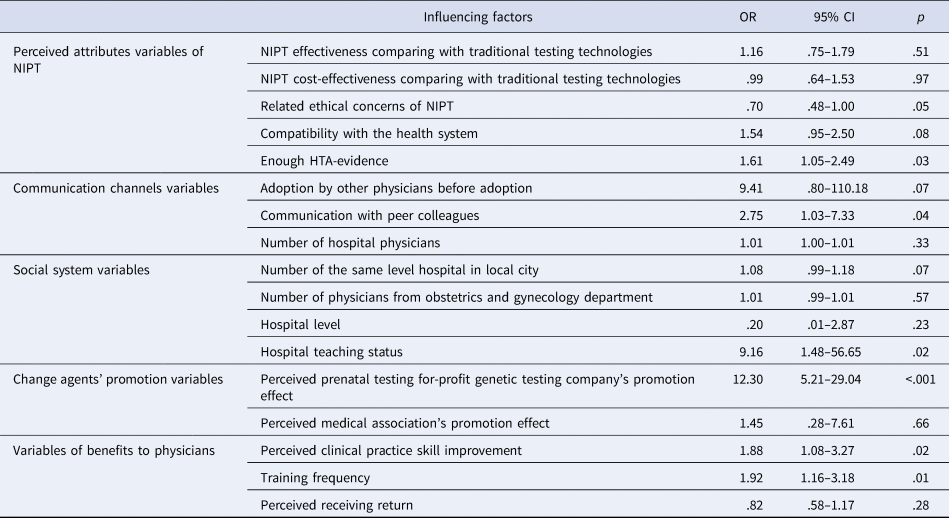
In the multivariable logistic regression of perceived attributes of NIPT (Table 2), physician-perceived ethical concerns of NIPT were negatively correlated with physician adoption behaviors of NIPT, whereas HTA-evidence strength was positively associated with physician adoption behaviors. NIPT's compatibility with the hospital system had a borderline significant trend (p = .08) on the provider's adoption behavior of NIPT. However, compared with traditional prenatal testing technologies, physician-perceived effectiveness and cost-effectiveness were not significantly correlated with the adoption of NIPT.
Multivariable logistic regression of the factors associated with the adoption of NIPT
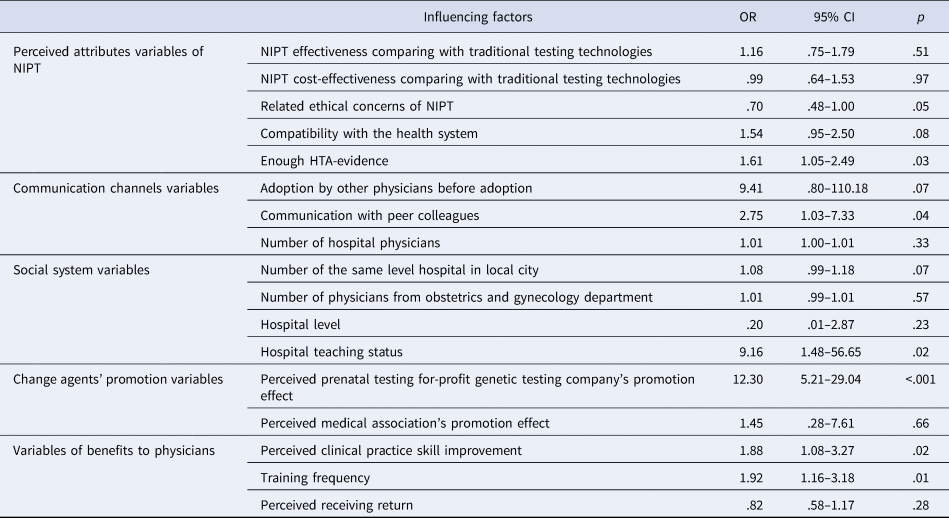
OR, odds ratio; CI, confidence interval.
Communication Channels and the Adoption of NIPT
Perceived communication frequency with peer colleagues was significantly associated with physician adoption behavior, suggesting their better communication with colleagues meant that they were more likely to adopt NIPT. Adoption by other physicians might have a positive effect (p = .07); however, the number of hospital physicians was not significantly associated with adoption behavior of NIPT.
Nature of the Social System and the Adoption of NIPT
Predictors of hospital competition, that is, the number of same level hospitals in a local city, had a positive borderline significant trend (p = .07) on the adoption of NIPT. Although the predictor of physician competition, that is, number of physicians from obstetrics and gynecology department, was not associated with the adoption behavior of NIPT. Regarding hospital characteristics, physicians of teaching hospitals were 9.16 times more likely to adopt NIPT than those of non-teaching hospitals.
Change Agents' Promotion Effort and the Adoption of NIPT
Agents or stakeholders in this study were referred to as the prenatal testing institutions, hospital leaders, physician opinion leaders, medical insurance departments, food and drug administration departments, health administration departments, medical associations, and patients. Qualitative interview of physicians indicated that for-profit genetic testing company and medical association were the most powerful promotion efforts in the adoption of NIPT. For-profit genetic testing company's promotion effort was positively associated with the adoption of NIPT, whereas the medical associations’ promotion effect was not as strongly associated with adoption of NIPT.
Physician perception on for-profit genetic testing company's promotion effort is shown in Table 3. Determining whether hospitals and for-profit genetic testing company cooperate to conduct NIPT technology, the majority (51.7 percent) of the physicians neither disagreed nor agreed. However, under the circumstance that the for-profit genetic testing company directly conducts prenatal testing to pregnant woman, there was a large group (33.1 percent) of physicians who disagreed on this direct-to-clients model in the adoption of NIPT technology.
Physician perception on the prenatal testing model of NIPT

Benefits to Physicians and the Adoption of NIPT
Table 2 presents the multivariable logistic regression of physicians' benefits on the adoption of NIPT. Physician-perceived improvement in clinical practice skill was positively associated with the adoption of NIPT. The training frequency was also positively associated with physician adoption behavior, whereas physician perception on receiving financial return was not related to the adoption of NIPT technology.
Discussion
This study applies Roger's diffusion of innovation theory to the adoption of NIPT by obstetricians and gynecologists in China.
The main finding of this study was that the obstetricians and gynecologists in general had a positive attitude (53.2 percent), whereas the majority (59.8 percent) had already ordered NIPT for prenatal screening. However, in previous studies assessing the attitudes of respondents to prenatal testing strategies, only 15.0 percent of participants reported having a “high level of knowledge” about NIPT (Reference Sayres, Allyse, Norton and Cho24) and 55–65 percent of respondents were positive about traditional prenatal testing (Reference Bryant, Hewi and Green25). The initial introduction of new innovations in the clinical setting might often cause significant confusion, due to unexpected problems and resulting in a lower early adoption rate. It is likely that physicians who use NIPT have a strong desire to avoid invasive tests in high risk pregnant women (Reference Lau, Chan, Lo, Chan, Chan and Koo7); however, physician views on its use in this high risk group may have been influenced by the promise of NIPT, due to its high sensitivity and specificity. However, these patients must be fully informed so that they understand the limitations of the NIPT test (Reference Lau, Chan, Lo, Chan, Chan and Koo7). The most significant limitation is that, before this test is widely adopted, both the clinicians and pregnant women should be fully aware that a positive test result cannot be considered diagnostic and must be confirmed by karyotyping. There are also concerns that increased implementation of NIPT could lead to its routine use (Reference de Jong, Dondorp, de Die-Smulders, Frints and de Wert13), making it difficult for pregnant women to reject this test (Reference Williams and Farsides26).
Many factors influence the acceptance and implementation of new clinical testing and diagnostic technologies by physicians (Reference Gelijns and Dawkins27). Peer colleague communication has a significant effect on the adoption of NIPT in our study. This result is consistent with previous studies (Reference Escarce28;Reference O'Sullivan29) that showed having a colleague who has adopted an innovation lessens the perceived risk for other physicians and speeds adoption in a new surgical technology and drug-eluting stent diffusion. The positive association with the hospital competition found in the current study is consistent with previous studies, which showed that increased competition among hospitals leads to more rapid and greater adoption of new technologies (Reference Mansfield30–Reference Castle32). This result may be due to the fact that hospitals are more likely to cooperate with other institutions to conduct NIPT under a higher competitive environment. Another possible explanation of this phenomenon is that the centrality of these hospitals is relatively high, and according to the theory of social network, the higher concentration of hospitals leads to higher willingness for them to accept new technology. However, there was no significant association between physician competition and the adoption of NIPT, which is not consistent with a previous study (Reference O'Sullivan29). In the previous study, “number of cardiologists at hospital” was included as physician competition variable in the drug-eluting stents diffusion analysis. The difference between “number of physicians at the department” and “number of physicians at the hospital” may be one of the reasons for explaining the different results, but further research is needed for verification.
Another interesting finding was that physician adoption of NIPT was influenced by their perceived adequacy of NIPT-related HTA-evidence. The ethical concerns were negatively associated with physician adoption behavior, which indicates that as ethical problems increase, physicians were less likely to adopt NIPT. What's more, as previous studies have suggested, some of the current-informed counseling processes for communicating NIPT ethical problems may be formalistic (Reference van Schendel, Kater-Kuipers, van Vliet-Lachotzki, Dondorp, Cornel and Henneman33–Reference Chitayat, Langlois and Wilson36), which prevent the appropriate adoption of NIPT. The perceived effectiveness, and cost of NIPT were not associated with the adoption behavior, which is similar to the results of a study (Reference Lewis, Hill, Skirton and Chitty37) conducted interviews with pregnant women. In that study, the majority rated safety as the most important and only a small number of participants felt the accuracy of the test is the most important in NIPT testing. This result may be due to the fact that NIPT demonstrated high specificity (>99 percent) and sensitivity (>99 percent), which lead to minimal impact. Also physicians were more concerned about the factors and attributes that benefit them as well as safety of technologies, compared to the cost of NIPT.
A significant finding of this study was that the for-profit genetic companies promotion effort was positively associated with the adoption of NIPT, which was consistent with previous studies (Reference Rogers38;Reference Greenhalgh, Robert, Bate, MacFarlane and Kyriakidou39) showing that change agents promotion effort provides much of the physician's early knowledge and information about the innovation. Following the for-profit genetic company's promotion, approximately 60 percent of the physicians have subsequently, within 1 year of the implementation of the pilot project, adopted NIPT. A previous study suggested that NIPT had come into practice too rapidly due to multiple companies competing for marketplace shares (Reference Hahn, Hösli and Lapaire40). With regard to different models of NIPT implementation in China, most of the physicians agreed or strongly agreed with the cooperation of hospitals and third parties to conduct NIPT. Most of the physicians disagreed or strongly disagreed with for-profit genetic testing companies direct-to-client service model due to ethical concerns, privacy-protection and quality ramifications, which was consistent with the recommendation of a previous study that NIPT should be offered by and through qualified clinicians and never directly to consumers (Reference Allyse, Sayres and Havard35). It may due to the fact that direct-to-consumer genetic testing continues in a largely unsupervised fashion (Reference Sayres, Allyse, Norton and Cho24).
With respect to the benefit to physicians in the implementation of NIPT, training frequency has shown positive signs on the adoption of NIPT, suggesting that the more training physicians got, the more likely they were to adopt NIPT in prenatal screening. The importance of support resources for NIPT has also been recognized. For example, to maintain high standards of care, the American Congress of Obstetricians and Gynecologists indicates that effective professional educational and training programs and practice guidelines are needed (Reference Silcock, Liao, Hill and Chitty41). It may be necessary to offer all providers comprehensive information about this technology and address the concerns of the population before the technology is further developed and routinely introduced (Reference Sayres, Allyse, Norton and Cho24).
Compared with previous studies, the current study was conducted from the perspective of physicians, who are also the key stakeholders in the decision making of screening choice. Previous studies were mainly conducted from the patient's perspective, and only a few of them were focused on physician attitude and adoption. In the current study some statistically significant associations have been found between certain predictors and the adoption of NIPT, whereas others were not statistically significant. Roger's diffusion model was improved by adding predictors of benefits to physicians, as numerous studies had demonstrated the significance of perceived benefits to physicians in the adoption of new innovations (Reference Escarce28;Reference Dirksen, Ament and Go42).
Although a number of interesting findings were evident in this study, there were also a number of limitations. First, the generalizability of the results is limited, because three NIPT pilot hospitals were included in this study, whereas ten hospitals were not pilot hospitals. The difference between pilot hospitals and non-pilot hospitals is that the pilot hospitals conduct NIPT testing themselves, rather than sending blood samples to other institutions for NIPT testing, and there is no obvious selection bias in the technical awareness and adoption behavior between pilot hospitals and non-pilot hospitals. Second, the response rates were far from 100 percent, and it varied much in high, middle, and low economy development regions. Thus, whether these results are generalizable to all obstetricians and gynecologists in China need further study. Third, this study is mainly focusing on the adoption of NIPT from a health provider's perspective. However, pregnant women and their partners are also playing an important role in the adoption of NIPT. Thus, much more effort is needed to develop a body of knowledge on physicians and pregnant women perceptions in the future. A more informed choice would enhance their experience for physicians and pregnant women. Fourth, as previous study recommended, although NIPT appears very promising as a screening test for Down syndrome, studies in average-risk pregnancies and a significant reduction in the cost of technology are needed before this can replace the current maternal screening approach. Thus, cost-effectiveness studies of NIPT compared to other traditional screening strategies are also needed before this new approach can replace current the screening options (Reference Douglas Wilson, Langlois and Brock19).
Conclusions
The findings of this study make significant contribution to the practice of physicians' adoption of NIPT. The results from multi-regression analysis revealed that perceived ethical concerns of NIPT, HTA-evidence, hospital characteristics, and training frequency for NIPT are the main determinants in leading physicians' attitude toward NIPT adoption. Much research also remains to be done on improving the proposed model and identifying other factors. Combined with cost-effectiveness analysis of prenatal screening methods, health policy making can promote the adoption of appropriate, cost-effective prenatal screening in pregnant women.
Acknowledgements
We sincerely acknowledge the National Natural Science Foundation of China for supporting the program of physician–patient shared decision-making in China (Grant no. 71573044). We would like to thank all the patients and physicians who participated in the study. We acknowledge the cooperation of all the hospitals in this study, which provided great convenience to our survey. Many thanks to professor Wendy Babidge for her kindly help to review and edit the manuscript, and also thanks to the research assistants Luyang He, Yan Xu, Gongru Wang, Xiaoxiao Qin, Da Li, Yijie Li, and Junqiu Li, for their great contributions on data collection and data entry.
Conflict of Interest
The author(s) declared no potential conflicts of interest with respect to the research, authorship, and/or publication of this article.
Ethical Standards
This study protocol and questionnaires were approved by the Fudan University School of Public Health Institutional Review Board (IRB # 2015-12-0577).