INTRODUCTION
Epistemic modals express our beliefs about states of the worlds that we assume to be possibly or necessarily true on the basis of the evidence we have (Palmer, Reference Palmer1986; Portner, Reference Portner2009). In many circumstances, their use expresses the speaker's commitment towards the outcome of a reasoning process, and it also informs the hearer about the various alternatives that have, or have not, been excluded. This is the reason why the emergence of the linguistic category of epistemic modality can reveal much about the development of reasoning abilities in young children. At least since Piaget and Inhelder (Reference Piaget and Inhelder1975), many efforts have been made to capture its development, but to date several important issues still remain unsolved. One of them is the puzzling fact that by the age of five children are already sensitive to the degree of commitment expressed by different modal expressions, yet they fail to evaluate statements that contain these modal expressions in a simple reasoning scenario.
Several production studies revealed that modals begin to appear in children's speech at age two, and that by the age of three children already use them epistemically (Kuczaj & Maratsos, Reference Kuczaj and Maratsos1975; Wells, Reference Wells and Lee1979; Shepherd, Reference Shepherd and Ahlquist1982; Perkins, Reference Perkins1983; Bliss, Reference Bliss1988; Stromswold, Reference Stromswold1990). Despite this early production, it is still unclear when children converge on the adult semantics. In their seminal work, Hirst and Weil (Reference Hirst and Weil1982) investigated children's sensitivity to modals of different force by asking them to identify the location of a hidden object solely on the basis of the verbal indications of two characters (e.g. the peanut must be under the cup vs. the peanut may be under the box). When asked to look for the hidden object, five-year-olds consistently went for the location associated with the stronger modal. This result, later replicated in Byrnes and Duff (Reference Byrnes and Duff1989) and in Bascelli and Barbieri (Reference Bascelli and Barbieri2002), indicates that children are sensitive to scalar terms of the sort must > may, where the term on the left entails the one on its right (Horn, Reference Horn1989). This, however, does not imply that children have already mastered modal semantics. To be considered fully competent, children not only need to be sensitive to the modal force, but also to assign the appropriate modal base to the modal expressions (e.g. epistemic, deontic, …) and to evaluate the sentence against the appropriate set of alternatives. The problem in the aforementioned studies was that in absence of an adequate background, it was hard to assess what the alternatives taken into consideration were and to control for the modal base children assigned to the modal. In the original Hirst and Weil task, in fact, modal sentences were to be evaluated in the absence of any premise. Thus children had no ground to judge if, for example, the proposition in the must sentences was a logical necessity (i.e. a state of the world that necessary follows from certain premises) or if it was just a statement about the puppet's own belief about the likelihood of a certain event. Therefore, the same results could have been obtained even if, for example, children had incorrectly assumed that must and may express a degree of confidence of the sort expressed by psych verbs like know and believe, which are also scalar terms. Having pointed out this other possibility of interpreting the data from previous research, we are not claiming that children confuse psych verbs with modals. We simply wish to note that the type of forced-choice tasks used in previous studies does not provide sufficient conditions for testing children's competence with modal semantics.
To overcome this problem, later studies used an explicit reasoning scenario. Noveck, Ho, and Sera (Reference Noveck, Ho and Sera1996) and Noveck (Reference Noveck2001) tested children's understanding of different types of modal sentences. For example, they looked at simple declaratives similar to the sentences in (1) and (2).
-
(1) a bear has to be in the closed box
-
(2) a bear might be in the closed box
Children were asked to evaluate sentences like (1) and (2) against a small set of alternatives, the ones that were made salient by a simple reasoning task. In the experimental set-up, children saw a set of three boxes: two open (A and B) and one closed (?), as in Figure 1. Children were then told that the content of the closed box was the same as the content of one of the two open boxes, A or B. In this scenario, sentence (1) was false whereas (2) was true. In contrast with previous findings, the five-year-olds in the study by Noveck and colleagues were answering at chance in most of the conditions.
Visual display of the scenario used in Noveck (Reference Noveck2001).

Ozturk and Papafragou (Reference Ozturk and Papafragou2015) used a slightly different version of this box-task to investigate whether children's poor truth-value judgments were sensitive to the type of reasoning scenario. They used determined scenarios in which only a single outcome was allowed (scenarios with one box only), and undetermined scenarios where multiple possibilities had to be considered simultaneously (scenarios with two boxes). In their Experiment 1, Ozturk and Papafragou used two types of procedures to assess children's comprehension of modal statements. In the first, children had to accept (or reject) a declarative sentence (e.g. the X has to be in the yellow box), while in the second they had to answer to a yes/no question (e.g. Does the X have to be in the yellow box?). The yes/no answers revealed the sharpest difference between determined and undetermined scenarios: in the determined scenarios, children's performance was similar to the adult one, whereas their proportion of correct yes/no answers dropped to the chance level in the undetermined scenarios, regardless of the force of the modal. Although the performance improved with acceptance judgments, the same asymmetry between determined and undetermined scenarios remained, with children being less accurate in the undetermined scenarios than in the determined ones.
Taken together, previous research indicates that although children are sensitive to the relative force of modal expressions, as shown in the seminal work by Hirst and Weil (Reference Hirst and Weil1982), they have difficulties in associating modal sentences with the right truth-conditions. Noveck (Reference Noveck2001) and Ozturk and Papafragou (Reference Ozturk and Papafragou2015) have shown that, at around age five, children still fail to consistently accept true sentences and reject false ones. A possible explanation, already voiced in Noveck (Reference Noveck2001) and Ozturk and Papafragou (Reference Ozturk and Papafragou2015), is that children's poor performance is not due to their poor knowledge of modal semantics, but rather to a strategy that allows children to reduce the uncertainty by eliminating some of the alternatives. This tendency, dubbed premature closure in Acredolo and Horobin (Reference Acredolo and Horobin1987), is defined as children's propensity to offer only a single solution to any problem that, because of insufficient or ambiguous information, logically permits more than one result. This interpretation of children's behaviour is consistent with many other studies showing that children tend to make single interpretations based on insufficient information (Somerville, Hadkinson & Greenberg, Reference Somerville, Hadkinson and Greenberg1979; Robinson & Whittaker, Reference Robinson and Whittaker1986; Sophian & Somerville, Reference Sophian and Somerville1988; Taylor, Reference Taylor1988; Beck & Robinson, Reference Beck and Robinson2001). Thus, according to the premature closure hypothesis, children's poor performance in truth-value decision tasks might not be due to their incomplete knowledge of the modal's semantics, but to their general tendency to make arbitrary choices under uncertainty.
In this paper we tested some empirical predictions that follow from this hypothesis. The first is that children should be advantaged in reasoning scenarios that only allow a single outcome (determined scenarios) as compared to reasoning scenarios that allow more than one (undetermined scenarios), a prediction that has already found support in previous literature. The second prediction is that, if children are already aware of the semantic import of modal expressions, they will process modals in the same way as adults do, at least up to the point where they discard alternatives. This prediction has not been tested, since to date no study has investigated children's real-time processing of sentences containing modal expressions. In order to address this point, we designed a new experiment with eye-tracking to determine if eye-movements can reveal the use of different verification strategies in children and adults and, eventually, at what point the two patterns of fixation start to diverge.
METHOD
In order to look at real-time processing of epistemic modals, we monitored eye-movements in a reasoning task that is similar to the one described in Noveck (Reference Noveck2001), but in which we also manipulated the type of scenario. As in Noveck, we presented children with a version of the hidden-object task in which they had to infer the content of a closed box. Also, the reasoning rule was the same and participants were told that the closed (orange) box had the same content as one of the two open (green) boxes. However, we asked participants to apply this rule to two different types of scenarios: undetermined and determined. In both scenarios we had the same set of boxes, but in the determined scenarios the content of the two open boxes was the same. The consequence of this was that, in the determined scenarios, the content of the closed box was clear, with no room for indeterminacy. To illustrate, consider the set-up for determined scenarios in Figure 2. Here the two open boxes had a monkey each, so that the closed box could also contain nothing other than a monkey. Figure 3 illustrates a typical undetermined scenario, in which the two open boxes had a different content. In this case, a monkey and a pig. By applying the same reasoning rule, now the content of the closed box was compatible with two different possibilities and it was impossible to say which one of the two animals was inside the closed box. Given that the available information is not enough to decide between the two different alternatives (monkey or pig), this scenario represented a typical undetermined problem.
Determined Scenario. The closed orange box contains a monkey.

Undetermined Scenario. The closed orange box contains a monkey or a pig.

Let us now look more closely at the undetermined scenario in Figure 3, in which a variation in the modal's force leads to two different truth-values. Consider the minimal pair below:
-
(3) a monkey might be in the orange box
-
(4) a monkey must be in the orange box
By looking at Figure 3, it is easy to check that sentence (3) is true while (4) is false, since there could also be a pig in the closed box. Adults are then expected to consistently accept (3) and reject (4). What about children? Let's consider what would happen if a premature closure occurs before children's judgments. At first, if children correctly understand the reasoning rule, they would build a set of possible outcomes, namely a situation in which a pig is in the box and an alternative situation in which a monkey is in the box. Then, before judging the sentence, they would discard one of the two alternatives. Assuming that the two alternatives are equally salient, we may expect that half of the children will decide that a pig is in the box and the other half will decide that a monkey is in the box. Therefore, the problem now becomes fully deterministic: children have arbitrarily reduced an indeterminate problem to a determined one. Adopting this strategy, those children who have chosen the monkey would judge (4) to be true, whereas those who have chosen the pig would instead judge it to be false. However, it is important to stress the fact that even if a random pattern of responses would be observed, we cannot exclude the possibility that children are aware of the different semantics of the modal expressions. If this is the case, we would then expect to detect children's sensitivity to modal expressions before the moment when premature closure occurs.
For this reason, we monitored eye-movements in order to observe how the different verification strategies associated with different modals unfolded in real time. In the case of expressions like “might p” as in (3), the hearer needs to check if the proposition p is among the array of allowed outcomes. So in sentences like “a monkey might be in the box”, one needs to check if the monkey (the mentioned object) is among the possible outcomes. We then expect that might sentences trigger a higher proportion of fixations on the mentioned object. This would happen in a relatively narrow time-window: after the modal has been heard and before that premature closure occurs. By contrast, an opposite pattern is expected in the case of expressions like “must p”. Sentences with modals expressing necessity will be verified by looking at potential counter-examples. Thus in sentences like (4) “a monkey must be in the box” a higher proportion of fixations on the unmentioned object is expected. In sum, if sensitive to the meanings of might and must, children are expected to look more at the pig – the unmentioned object – in sentence (4) than in sentence (3), in the same way as adults would do. It would only be at a later stage, after that premature closure occurs, that the adult and the child eye-movement patterns will eventually diverge.
In the determined scenario, on the contrary, premature closure doesn't apply and adult-like responses are expected. In this second scenario, if children are asked to judge a sentence like “a monkey must be in the orange box”, they are expected to show an adult-like pattern of responses. Notice that while sentence (4) is false in the undetermined scenario, now this sentence becomes true in the determined scenario. For this reason, in order to control for a positive bias, in the determined scenario we also presented false sentences involving a fruit on a plate (e.g. a pear might be in the orange box).
We decided to limit the experiment to only four conditions, trying to replicate only the set of previous results (Noveck, Reference Noveck2001; Ozturk & Papafragou, Reference Ozturk and Papafragou2015) that offer more direct support for the premature closure hypothesis. This was necessary in order to keep the experiment's duration to a minimum, considering the additional time required for the eye-tracking set-up. The four types of sentences are summarized in Table 1.
Experimental conditions

Participants
Child participants were recruited through a dedicated website (www.ccd.edu.au/services/neuronauts) at Macquarie University. All of them had normal vision and no reported history of speech, hearing, or language disorders. A total of twenty-three children took part in the study. Due to technical calibration problems, four children couldn't participate in the test session. Another five children decided to interrupt the task before the test session concluded. In total, we report data from fourteen children between ages 4;6 and 5;6 (M = 5;0, SD = 0;5). A group of sixteen adults also took part in the study. All of them were students at Macquarie University.
Procedure and materials
Participants were invited to play a game about a ‘mystery box’ and introduced to the rules of the game. The experimental procedure consisted of three parts. The first was a short naming task in which participants had to name the animal inside a single open box. This first part familiarized children with the experimental set-up and served to make sure that all children knew the names of the objects visualized in the pictures. In the second part, the reasoning scenario was introduced, and participants saw a set of three boxes and a plate. They were told that the content in the closed orange box was the same as one of the two open green boxes, and also that what was on the plate could not be in the orange box. The only difference between this phase and the following one was that children were allowed to see the content of the orange box before judging the truth-value of a sentence containing no modal term (e.g. there is a monkey in the box). The purpose of this second stage was to show children that the orange box could contain only one object, so as to exclude the possibility that it could contain both the objects in the green boxes. We also included an object on a plate – an item that clearly cannot occur in the orange box – in order to create false might sentences of the kind “a pear might be in the orange box”. This allowed us to counterbalance the overall number of true and false sentences. Finally, in the third phase, participants heard thirty-two target sentences and this time they were not allowed to peep inside the orange box. Trials were evenly split between determined and undetermined scenarios, and participants heard eight sentences in each condition, for a total of thirty-two trials presented in random order. Both children and adults were tested using a visual world paradigm (Tanenhaus, Spivey-Knowlton, Eberhard & Sedivy, Reference Tanenhaus, Spivey-Knowlton, Eberhard and Sedivy1995; see also Trueswell, Sekerina, Hill & Logrip, Reference Trueswell, Sekerina, Hill and Logrip1999; Snedeker & Trueswell, Reference Snedeker and Trueswell2004; Snedeker & Yuan, Reference Snedeker and Yuan2008; Choi & Trueswell, Reference Choi and Trueswell2010; Zhou, Crain & Zhan, Reference Zhou, Crain and Zhan2012, Reference Zhou, Crain and Zhan2014; Zhan, Crain & Zhou, Reference Zhan, Crain and Zhou2015). The visual display was divided into four interest areas (IAs), one for each corner of the screen. A cluster of objects occupied the centre of each IA, as in Figures 2 and 3. For each trial, all visual stimuli were presented in the same sequence: first, the full set of boxes and the plate appeared on the screen, with the two green boxes initially closed. Then, the two green boxes opened, revealing their content. At this point, the target sentence uttered by a female voice was presented via two external speakers. Participants’ eye-movements were recorded from the onset of the target sentence with a sampling rate of 500 Hz and were classified according to the IA. Participants sat at about 60 cm from the monitor and their eye-movements were recorded using an EyeLink 1000 without head support.
RESULTS
We report results of the behavioural responses first. As Figure 4 shows, adults were at ceiling in almost all the experimental conditions, regardless of the type of scenario. Children's proportion of correct answers instead strongly differed between determined and undetermined scenarios. While their performance was nearly adult-like in the determined condition (i.e. 86·9% with might and 97·6% with must), it dramatically dropped in the undetermined condition. In fact, the overall proportion of adult-like answers in the undetermined condition was much lower, i.e. 57·1% with might and 40·4% with must. Notice that, while in the undetermined condition accuracy was slightly higher for might, in the determined condition accuracy was instead higher for must. This could be due to a mild positive bias, since in each scenario the sentences associated with the highest accuracy were the ones in which the correct answer was the ‘true’ one.
Proportion of correct responses in the Determined and Undetermined condition.

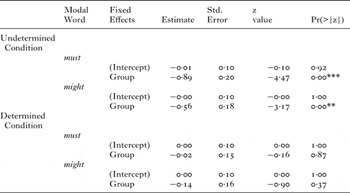
We fit participants’ responses for each modal expression into generalized linear mixed models computed in R (v.3.0.0; R Development Core Team, 2010), and a comparison of deviance of chi-square tests between different models suggested that the best-fitting ones were those in which Group was included as a predictor. For the determined condition, the model revealed no significant Group difference in the probability of correct answers, regardless of the modal expression. By contrast, the probability of correct responses differed in the undetermined condition for the two groups. These results, summarized in Table 2, show that children's probability of giving the correct responses was lower with respect to the adults’ one, but only in the undetermined condition.
Main effects of Group for Condition and Type of Modal

notes: Formula in R: Response~1 + Group + (1| Subject) + (1 + Group | Item). Reference level for Group = Child. **p < ·01, ***p < ·001.
We also explored individual data in the undetermined condition, looking for a possible bimodal distribution of children's behavioural responses. We report individual data in the scatterplot in Figure 5. As the figure shows, children's answers were normally distributed, and no child was above 80% of adult-like answers.
Proportion of correct responses in the Undetermined Condition for each participant.

These results replicated previous findings in the literature and confirmed children's poor performance in decision tasks under indeterminacy. We now turn to the eye-movement data, looking at the pattern observed in the undetermined condition.
In preparing the eye-movement data, we pooled any fixations shorter than 80 ms with their preceding or following ones if they were within 0·5° of visual angle, otherwise we deleted them. This is because short fixations are a result of false saccade planning rather than meaningful information processing (Rayner & Pollatsek, Reference Rayner and Pollatsek1989). We then equally divided the test scene into four interest areas: the closed box, the open box with the mentioned animal, the open box with the unmentioned animal, and the plate. We then partitioned the test audio of the length 5100 ms into 17 temporal bins, each 300 ms long, and we grouped them into three main interest periods (IP). The first (period I) started at the beginning of the audio signal and ended before the onset of the modal. The second (period II) spanned the whole verbal cluster, and it included the modal and the copular verb. The last one (period III) began at the onset of the prepositional phrase and lasted until the end of the sentence. The dependent variable of this experiment is the proportion of fixations in a particular area in a specific temporal bin. Figure 6 illustrates participants’ fixations on the unmentioned character as the test audios unfold.
Participants’ proportion of fixations on the unmentioned character.

Figure 6 shows that the fixation pattern in the undetermined scenario is roughly the same until the presentation of the modal (periods I and II). At the beginning of the third interval, that coincides with the onset of the prepositional phrase (period III), two different fixation patterns emerged both in adult and children: the unmentioned animals were more fixated when the modal word was must than when it was might. This indicates that the modal term played a role in directing the eye-gaze toward the unmentioned object, as a result of the adoption of a different verification strategy for each modal expression. Figure 6 also shows that, towards the end of the sentence, the difference between must and might disappeared in children, while it persisted in adults.
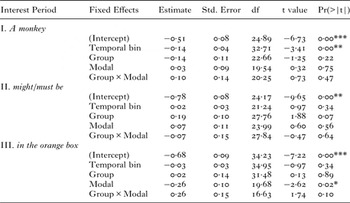
We analyzed the data by fitting them into linear mixed models, again using the R software package. Since we were interested in determining the variations of the proportion of fixations on the unmentioned object triggered by the type of modal, we treated Group, Modal, and Temporal Bin as fixed effects. For the purpose of the analysis, we again used the same division into three interest periods coinciding with the onset of the sentence (period I), the onset of the modal (period II), and the final prepositional phrase (period III). Because proportions of fixations were used as the dependent variable, the data were first transformed using an empirical logit function (Barr, Reference Barr2008). A comparison of deviance of chi-square tests revealed that the best-fitting model was the one in which Group, Modal, and Temporal Bin were included as predictors. A power analysis (powerSim function in R) revealed that our model had a 96·6% probability of detecting a main effect of Modal and a 45·2% probability of detecting a significant interaction between Modal and Group. Results are summarized in Table 3.
Logistic regression model results of the eye-movement data (empirical logit transformed)

notes: Fixations were transformed using the following empirical logit formula (Barr, Reference Barr2008): proportion = ln((y + 0·5)/(n−y + 0·5)); where y is the number of fixations in the interested areas during a particular temporal bin and n is the total number of fixations in that temporal bin.
Formula used in R: response~1 + Temporal bin + Group × Modal + (1 + Modal + Temporal bin | Subject) + (1 + Group + Temporal bin | Item). Reference level for Group = Child; Modal = Might. *p < ·05 **p < ·01, ***p < ·001.
In the first two interest periods, the models revealed no main effects of Modal or Group, although there was a main effect of the Temporal Bin in Period I. More interesting is the final period, the one following the presentation of the modal (period III). In period III, the model revealed a main effect of Modal, indicating that the probability of fixating on the unmentioned object was significantly higher when the modal word was must than when it was might. No interactions were observed between Group and Modal. The results indicate that both children's and adults’ fixations on the unmentioned object increased when presented with the must sentences. This is shown in Figure 6, most clearly in the Temporal Bins between 3·6 and 4·2, where adults and children exhibited very similar patterns of fixations.
DISCUSSION
Children's low proportion of correct truth-value judgments replicated previous findings, confirming that children's difficulties with modals are largely found in contexts of indeterminacy. In these contexts, however, we also found that children explored the visual scenario in two different ways, depending on the type of modal they heard: they looked more at the unmentioned object when they heard sentences with must and less when they heard sentences with might. This pattern was the same for adults and children in the time-window immediately following the verb cluster modal + be. This finding excludes the possibility that children simply treat the two modals alike, and it reveals their sensitivity to modal semantics. Our results also revealed that an important difference in the pattern of fixations emerged between the two groups towards the end of the sentence. In the last portion of Period III, adults but not children continued to look more at the unmentioned object. This result could be explained by assuming that the point at which the two patterns diverge coincides with the point of premature closure. Overall, our behavioural and eye-tracking results are consistent with the idea that five-year-olds are sensitive to the semantics of different modal expressions, but that their truth-value judgments are influenced by their tendency to make arbitrary choices that obliterates their early knowledge of modal semantics.
CONCLUSION
Epistemic modality is a complex category that has been often investigated by looking at children's behaviour in tasks where they need to represent and store in mind situations that might not be real. This kind of task arguably requires non-trivial cognitive abilities and it is thus important to be aware of the demands associated with the experimental procedure. In this study we explored the idea that children's alleged difficulties with modal semantics were in fact not due to their poor comprehension of modal terms, but instead to the high demands introduced by the hidden-object paradigm. Our results added new evidence in favour of the view that five-year-olds already have an advanced linguistic competence for the semantics of epistemic modals, despite their poor accuracy in judgment tasks. On the one hand, we replicated previous findings showing that young children struggle in judging the truth-value of modal statements in the same way as adults. On the other, we provided new data (eye-movements) in support of the idea that children at this stage are already sensitive to the semantic differences between possibility and necessity. A comparison of the eye fixation patterns between children and adults has revealed that the two groups rely on the same reasoning strategies, at least in the time-window that immediately follows the offset of the modal. On the basis of these findings, we propose that the reason for children's lower performance in truth-value judgments resides not in an incomplete semantic competence, but rather in their tendency to reduce uncertainty, at least in the type of reasoning tasks that have traditionally been used.
The factors underlying this tendency to premature closure remains to be investigated, and its precise characterization is beyond the goals of the present paper. However, we wish to conclude by speculating on what could be the sources of children's premature closures. One possibility is that children's non-adult responses are vitiated by the pragmatics of the task. It is conceivable that children could mistakenly interpret the task as a sort of guessing game in which they find it more appropriate to endorse a specific outcome instead of providing a fully informed judgment on the basis of the premises they have. A second possibility is that the source of children's non-adult judgments reflects a deeper strategy to minimize the cognitive load associated with indeterminacy. More specifically, children could use premature closures to reduce the cognitive demands of situations in which different outcomes have to be considered and stored in mind. Discriminating between these two alternatives is not trivial, but it seems to us to be empirically feasible. For example, if task-related pragmatic factors play a role in determining children's high proportion of non-adult judgments, we would expect that this proportion should decrease if extra training is provided. In contrast, if premature closures are determined by the effort of keeping the alternatives in mind, we should be able to increase (or decrease) the judgment's accuracy by experimentally manipulating the number and the complexity of the alternatives. Once we have understood what are the factors behind premature closure, we might expect that this tendency could be reduced, if not removed, to observe children's knowledge of modal semantics also in their behavioural responses based on truth-value judgments.