Introduction
Youth and young adult suicide has appeared increasingly on international vital statistics as a rising trend of concern in the past 50 years (Blum, Reference Blum2009; Patton et al. Reference Patton, Coffey, Sawyer, Viner, Haller, Bose, Vos, Ferguson and Mathers2009). The reporting of suicide deaths in five year age bands, which has been the international convention to date, though statistically convenient (World Health Organization, 2012) may be limiting our knowledge, and may mask a greater understanding of year-on-year factors that may accelerate or ameliorate the emergence of suicidal thoughts, acts and fatal consequences.
Clinical limitations of 5-year age bands for reporting of suicide mortality
The clinical, psychological and psychosocial factors relevant to the suicide death of a 15-year old are at variance with those associated with the suicide death of a 19-year old (Malone & Yap, Reference Malone, Yap, Wasserman and Wasserman2009). Yet, worldwide, suicide deaths are aggregated collectively for ‘15–19 year olds’ – data which are then supplied by countries to the WHO, and which are drawn upon for international comparisons, informing national suicide prevention strategies in most countries (Gould et al. Reference Gould, Wallenstein, Kleinman, O'Carroll and Mercy1990; Department of Health, 2002; Scottish Government, 2002; Department of Health & Children, 2005; Wasserman et al. Reference Wasserman, Cheng and Jiang2005; Department of Health, Social Services and Safety, 2006; Welsh Assembly Government, 2008; Commonwealth of Australia, 2009). Similarly, the deaths of young adults aged 20–24 are also grouped together, which precludes for instance an examination of age-specific stresses which may contribute to peak suicide rates seen in the 19–24-year-old age bands in many countries (Mann et al. Reference Mann, Apter, Bertolote, Beautrais, Currier, Haas, Hegerl, Lonnqvist, Malone, Marusic, Mehlum, Patton, Phillips, Rutz, Rihmer, Schmidtke, Shaffer, Silverman, Takahashi, Varnik, Wasserman, Yip and Hendin2005). To our knowledge, no studies to date have gone beyond the 5-year age band national statistics across countries in relation to suicide to examine age, year on year as a risk factor in youth and young adult suicide.
Methods
Overview
To examine whether there may be age-related periods of risk for suicide, we obtained (i) Central Statistics Office (CSO – Ireland, 2010) data for the distribution of age of suicide deaths and open verdicts (in years) nationally in Ireland from 2000 to 2006 (most recent complete dataset); (ii) Eurostat data (Eurostat, 2012) for age-specific Ireland population data to calculate suicide rates year on year; (iii) similar age-related suicide deaths mortality data (in years) in the UK (England and Wales (Office for National Statistics, 2012), Scotland (General Register Office for Scotland, 2012) and Northern Ireland (Northern Ireland Statistics and Research Agency, 2012) from 2000 to 2006.
Statistical Analysis
A combination of survival analysis and general linear modelling are the primary methods of analysis. Actuarial survival tables identify the annual rates of events across the various populations of the study. General linear modelling compares the rate of increase of events before age 21 as compared with after age 21. While age is the covariate identified as being correlated with a number of events, it is strictly establishing the existence of a relationship and is not intended as a causal relationship. It is believed to capture not only the physical ageing process but also confound variables associated with maturing from adolescence into adulthood. The purpose of the model is to demonstrate that pooling data into age ranges to protect anonymity conceals meaningful patterns in the data. Further adjustment, while important in establishing the specific relationships, is not relevant here as controlling measures are generally not recorded to protect anonymity and the specific contributions of confounding variables are not central to the work.
Results
UK and Ireland epidemiological analyses of suicide mortality (2000–2006)
Quantitative statistical analysis of year-on-year age of all suicide deaths in the UK and Ireland UK, 2000–2006
Suicide data from national vital statistics was collected by age group and gender separately for England, Wales, Scotland, Northern Ireland and the Republic of Ireland for 2000–2006, as outlined above. Suicide research practice in many countries combines suicide deaths with ‘undetermined’ deaths as the most representative approximation of suicide deaths, although it may modestly overestimate the count. In keeping with this practice and to maintain consistency across countries, suicide deaths were combined with undetermined deaths to accumulate definite and probable suicide counts (N = 11,964).
Of note, in the dataset provided to us for Wales (n = 610) ages 15–17 were combined and were entered at the median age of 16. In the Northern Ireland dataset (n = 467), there were no 15 year olds or 24 year olds in 2002, no 15 or 17 year olds in 2003, and no 26 or 29 year olds in 2004. England and Scotland datasets recorded 7,803 and 1,539 deaths, respectively, and Ireland recorded 1,545 such deaths.
Quantitative exploration of distribution of age and suicide mortality in merged international datasets (England, Wales, Scotland, Ireland and Northern Ireland)
We used survival analysis to investigate whether the rates at which suicide deaths occurring as a function of age were substantially different for each region. Life-tables report the proportion of the subjects that survived to 20 years of age and to 21 years of age in each country. These results are provided in Table 1.
Proportions of subjects surviving to 20 years of age and 21 years of age in the UK and Ireland 2000–2006 (Combined Suicide and Open Verdict) (N = 11 964)

These data indicate strong similarity across countries and show that Ireland is no different to the other countries in relation to young suicide deaths. Given this, it is reasonable to combine the other countries in the UK (England, Wales, Scotland and Northern Ireland) and Ireland as a reference group for suicide and open verdict deaths in ages 15–35.
Regression analysis for suicide by age for UK and Ireland 2000–2006
As the relative patterns across countries are similar, the data across countries were combined and a single linear regression model was generated, which predicts the number of events as a function of age for the ranges of up to and including 20 year olds and for those over 21.
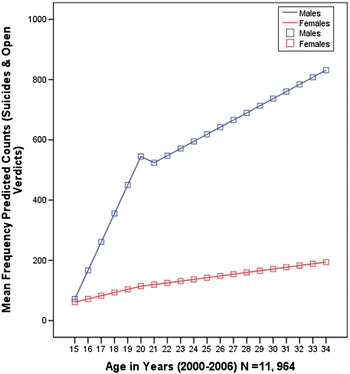
With suicide and undetermined deaths combined (Fig. 1, N = 11,964), males have a significantly different rate of increase after age 20, (t (16) = 15.4, p < 0.001), with a rate of increase of 94.6 cases per year before 20 and compared with 23.7 cases per year after age 20. The difference for females is in the same direction, but is not statistically significant (t (16) = 1.3, p = 0.205), with a rate of increase of 10.6 cases per year before age 20 and 5.7 cases per year after age 20.
Frequency of suicide and open verdicts in the UK and Ireland by age (in years) UK and Ireland, 2000–2006.

Discussion
The observed epidemiological phenomenon reported in this paper has not been presented in the scientific literature before. Statistical analyses of International mortality databases from five countries (UK and Ireland) in relation to the 11, 964 – suicide and undetermined deaths aged 15–35 between 2000 and 2006 showed an accelerated pattern up to the age of 20 from a low base rate, with a less inclined upward slope from age 21 towards age 35. The fact that this finding is observed in five jurisdictions supports the validity of the observation. In epidemiological terms, this observed trend resembles other examples of a so-called epidemiological transition, such as for instance National per capita income and life expectancy, where changes in underlying risk factor distributions alter the pattern of the slope of association (Wilkinson, Reference Wilkinson1994). Usually, this is associated with changes in the macrosocial economic environment influencing a health-related indicator, and this has been proposed previously in relation to between-country variations in suicide rates (Moniruzzaman and Anderson, Reference Moniruzzaman and Andersson2004) and for trends in elderly suicides (Shah, Reference Shah2011). In this instance, we believe that the alterations in patterns of association relate to changing influences on personal development. Interpreting our findings at face value in the first instance led us to adopt the phrase used by the playright John B Keane from his 1961 play ‘Many young men of twenty said goodbye’ (Keane, Reference Keane1961), except in the case of our study, we are referring to the lives of young men lost to suicide, whereas Keane was referring to the lives of men lost to war.
Our finding may be interpreted as identifying age 16–20 as being a particularly critical period for increased rate of suicide for young men. Alternatively, the national datasets from the UK and Ireland suggest that actually surviving to age 21 might be interpreted as a partially protective factor in relation to young adult suicide risk. As such, this may serve as a useful factor to include in future models to advance our knowledge of suicide risk. The stress-diathesis model (Mann et al. Reference Mann, Waternaux, Haas and Malone1999) identifies the interaction between stress and other trait-like factors. Our finding suggests that ‘stress’ may be further analysed to include age-dependent as well as age-independent stress risks.
Our finding challenges current International practice in which suicide mortality is reported in 5-year age bands, in that such reporting may eclipse age-related risk factors for suicide such as that we have identified. While Gould et al explored ‘age-specific’ factors relating to suicide in young people, this analysis was hindered by the data being in 5-year age bands (Gould et al. Reference Gould, Wallenstein, Kleinman, O'Carroll and Mercy1990). Similarly, Kessler et al. examined the epidemiology of age of onset for psychiatric illness, but again, the data were analysed in age bands (Kessler et al. Reference Kessler, Berglund, Demler, Jin and Walters2005).
Our finding needs to be examined in other international datasets, or from within the same countries we studied but at different time periods to 2000–2006. Alternative factors associated with moving through early adulthood other than approaching aged 21 may exist in different time periods in the UK and Ireland, or in different countries and cultures, that may confer a heretofore unidentified age-related increased (or decreased) risk of suicide. For the period studied (2000–2006), the combined 60 million or so population of Ireland and the four nations of the UK are modern, broadly secular, multi-cultural societies with much cultural diversity, situated within the European Union. As such, these nations are considered ‘international’ in the broad sense, sharing cultural and economic parallels with many if not most modern western societies.
Perhaps ageing in years towards 21 simply coincides with the peak age of onset for major psychiatric disorders such as depression or psychosis in males. We were unable to explore this possibility, due to the aggregation of data across age ranges of possible confounds such as mental illness and alcohol use in the existing international datasets. Clearly, ageing from 18 to 24 is a high-risk age period for overt manifestation of psychiatric pathology of sufficient severity to warrant in-patient care (Kessler et al. Reference Kessler, Berglund, Demler, Jin and Walters2005).
The peak age of psychosis also tends to be reported in 5-year age bands in epidemiological studies. It has been reported as peaking for males in the 20–24 year age group, but not by peak age in years (Kirkbride et al. Reference Kirkbride, Fearon, Morgan, Dazzan, Morgan, Tarrant, Lloyd, Holloway, Hutchinson, Leff, Mallett, Harrison, Murray and Jones2006). Other international studies have identified the highest rates of first onset of depression (1.4–9.1% of the population) occur among young adults (aged 12–24), and lower rates (1.3–1.8%) occur among people 65 years of age or more (Patten, Reference Patten2000). Of note, data from these studies in relation to the epidemiology of depression are also typically presented in age bands (e.g. ages 18–29) (Hasin et al. Reference Hasin, Goodwin, Stinson and Grant2005), which again, blurs the analysis of relative contribution of depression year on year to our understanding of its contribution to the emergence of suicidal acts including suicide through adolescence and early adulthood.
We were unable to assess the impact of alcohol by age, as all the available data were again archived in 5-year age bands. Exploration of ageing towards 21 as a risk factor, and subsequent differential year-on-year age-specific alcohol consumption is essential, but is hindered until such data are available in a disaggregated form.
The study has strengths and limitations. The strengths include: (i) inclusion of disaggregated 7 years of suicide mortality datasets from the UK and Ireland; (ii) an analysis of almost 12,000 suicide deaths between ages 15 and 35; (iii) incorporating a period of study where there was relative macro-economic stability – i.e. pre-economic recession.
Limitations include: (i) the inability to conduct a more detailed analysis on possible confounding factors such as alcohol use and psychiatric illness as well as other possible confounding factors; (ii) there are limitations in studying suicide ‘counts’ as opposed to suicide rates. However, because of differing suicide rates between jurisdictions (Pearl et al. Reference Pearl, Navneet, Kirsten, Alastair, Louis, Stephen and Roger2012), the method of using counts actually un-earthed the age-related factor we identified. Moreover, this type of analysis suits jurisdictions where suicide rates vary across age bands, as the age distribution across ages is of greater importance for our study than the actual rates per 100 000 for any given region; (iii) a longer period of observation would have provided more validity to our finding, and perhaps more insight into the age of risk periods for young adult female suicide. Our data identified a doubling of suicide rates in females under 21 compared with over 21 for the period studied, but the finding was not significant, probably due to mathematically low numbers.
In conclusion, we suggest that future reporting of national suicide rates in years, as opposed to 5-year age bands, will facilitate more in-depth research and understanding of possible age-related periods of increased suicide risk in young adults, where an epidemiological transition is apparent for young men before versus after age 21.
Acknowledgments
We wish to acknowledge Sandra Tobin for assistance with data from the Irish Central Statistics Office; Antoinette Daly, The Irish Health Research Board; David Hosey for assistance with database design, and comments on the manuscript; Lucy Madigan and Suzanne O'Connor for assistance with database management
Declaration of interest
The funders of the study are Registered Charities and include: Turn The Tide of Suicide, The National Lottery, The National Office for Suicide Prevention, ESB Electric Aid, Be Not Afraid, Padraig Harrington Foundation, The Ireland Funds of Monaco. The authors declare no conflict of interest.