Trust has increasingly come to be recognized as a critical element of both democracy and markets. The willingness to trust strangers promotes civic engagement and community building, and helps overcome the dilemmas of collective action (Fukuyama 1995; Putnam 1993; Uslaner, 2002). It also plays a central role in economic life, fostering cooperation and thus facilitating impersonal exchange. The results can be dramatic: higher trust has been associated with greater citizen involvement in politics, lower corruption, more effective public services, higher economic growth, and other benefits (see, e.g., Knack and Keefer 1997; LaPorta et al. 1997; Zak and Knack 2001).
But such generalized faith in others seems to be far greater in ethnically homogeneous than in more diverse societies. Cross-national surveys demonstrate that trust is lower in heterogeneous countries (Knack and Keefer 1997). Research in the United States points to less generalized faith in others when local communities are diverse (Alesina and La Ferarra 2002). Studies of other elements of social capital come to a similar conclusion (Alesina and La Ferarra 2000; Costa and Kahn 2003).
The dominant explanation is that ethnic difference breeds more particularized, rather than generalized, trust. To use Fukuyama's (1999) phrase, the radius of particularized trust is short. People extend their confidence to a narrow set of ingroups—to family, friends, and others like themselves, but seldom beyond. Ethnic difference is thus assumed to generate a high level of ingroup trust, but little or no confidence in others. Some research suggests that the relationship is actually zero-sum: the higher the trust in one's own group, the lower the faith in people outside it.
This image of exclusionary ethnic trust is problematic, however. Because most people are assumed to have faith in members of their own ethnic group, cross-ethnic confidence must be low by definition. If such trust does arise, the assumption is that faith in the ingroup cannot be high. The possibility of what might be called “inclusionary” trust—in both one's own and in other groups—is omitted. So, too, is the possibility of atomization, or distrust of in- and outgroups alike. Also missing is the very real possibility that cross-ethnic trust might be selective; some outgroups may be viewed more favorably than others.
Thus, a fuller model is essential if we are to explain when and where cross-ethnic confidence does arise. We think the first step is to reevaluate the connections among ethnicity and generalized versus particularized trust. We then offer a model to identify the microfoundations of confidence across ethnic lines. We draw on new survey data from two multiethnic republics of Russia, to determine what factors lead culturally and racially diverse groups to trust others. Given the spread of ethnic assertiveness in the USSR and its successor states over the past two decades, this should provide a particularly stringent test of our model.
The analysis can also offer some purchase on how diversity affects social and economic outcomes more broadly. Research on cross-national variation in social and economic performance has tied ethnic difference to lower rates of economic growth, lower provision of public goods, higher corruption, and other economic problems (see, e.g., Alesina, Baqir, and Easterly 1999; Easterly and Levine 1997; Zak and Knack 2001). The logic in most of the literature is similar to that for trust: ethnic difference is seen as impeding cooperation. In Paul Collier's (2001, 130) words, “The underlying propositions are that ethnic divisions make cooperation more difficult and victimization more likely.” The results might be interpreted as a brief for separation.
But as with interethnic trust, the literature is less clear on when and where ethnic groups do cooperate. Thus, identifying the factors that promote or impede cross-ethnic confidence can also help us understand other aspects of cooperation across ethnic lines.
GENERALIZED VERSUS PARTICULARIZED TRUST
A growing body of research on trust emphasizes the distinction between generalized versus particularized confidence in others—part of what Putnam (2000) labels “bridging” versus “bonding” social capital. Generalized trust helps promote the norms of reciprocity and cooperation that underpin civil society (Putnam). It appears to reflect an individual's belief that most others share the same fundamental values, and belong to the same “moral community” (Fukuyama 1995; Uslaner 2002).
Particularized trust entails deeper ties to a closer circle such as family members, friends, and others with similar backgrounds. Particularized trusters, as Uslaner (2002) argues, tend to be suspicious of people they don't know; and feel they have little control over what happens. They are also more withdrawn from society at large (Uslaner; Uslaner and Conley 2003).
The difference is considered to be crucial for community building and public decision making. Generalized trusters appear to engage more readily in the community and in collective action, and cooperate more easily with people from different backgrounds. Generalized faith in others also seems to have a far more positive impact on the spread of information and innovation. The broader an individual's connections, the more access to new ideas (Granovetter 1973).
But a number of authors have argued that generalized trust is diminished in ethnically diverse societies.1
There is debate, however, over which ethnic “structures” (numbers and size distribution of ethnic groups) are most problematic. See, for example, the discussion in Collier (2001); Fearon (2003); and Garcia-Montalvo and Reynal-Querol (2002).
The assumption, as Alesina and La Ferarra (
2002, 207) note, is that “most individuals are less inclined to trust those who are different from themselves.” Ethnic difference is described as breeding ingroup rather than outgroup confidence, due either to groups' different worldviews or preferences; greater ability to coordinate within groups rather than across them; or simply aversion toward outgroup members (see, e.g., Easterly and Levine
1997; Knack and Keefer
1997; Landa
1995).
2 For an overview, see Bowles and Gintis (2004)
The implication, then, is that people who “bond” are less likely to “bridge.” Intraethnic trust is assumed to be the inverse of confidence in others at large and confidence in outgroups.
We think the image of a tradeoff is persuasive but incomplete. Ingroup trust need not be an impediment to confidence in outgroups or in others generally (cf. Herring, Jankowski, and Brown, 1999). Some people may trust only their own and distrust outsiders, but others may well trust both. In fact, those with generalized faith in others should be disposed to such inclusionary trust.3
Uslaner (2002), for example, finds a small but positive correlation between generalized and particularized trust. See his discussion in chapter 2, particularly pp. 32–33.
The tradeoff thesis poses several other problems as well. One is the assumption of ingroup homogeneity: groups are in conflict because they have cohesive and opposing preferences. But cohesion clearly varies. In fact, as Hardin (1995) observes, ingroup norms—the informal rules that reinforce a sense of distinctiveness—arise as a way of reducing differences in degrees of commitment within the group.
The idea of a tradeoff in trust also implies that ingroup attachment breeds a similar reaction to all outgroups. In part, it does: what Hardin labèls “norms of exclusion” would shape a person's trust toward outgroups in general. But we also know that attitudes have a selective element as well. People may respond to various groups differently—depending in part on images of the other group (Fiske 2000, 2002) and on everyday contact (see Gibson 2004; Oliver and Wong 2003; Welch et al. 2001, for examples).
Disentangling these issues has been difficult, however, because individual-level data on cross-ethnic trust are rare.4
Several studies have assessed confidence across racial/ethnic lines using experiments developed in economics; but the results are mixed. Eckel and Wilson (2004) report pronounced racial differences in trust in the United States, whereas Glaeser et al. (2000) find little difference in trust, but a large gap in trustworthiness (i.e., the willingness to reciprocate). Research conducted in Israel finds that male European- and Eastern-Israelis both distrust Easterners; but women show no particular bias (Fershtman and Gneezy 2001).
Research linking ethnic difference to confidence in others focuses primarily on generalized trust (see, e.g., Alesina and La Ferrara
2002; Knack and Keefer
1997). Most such studies find low generalized trust and conclude from it that confidence across ethnic lines must be low as well. But this can be misleading, because people may display more trust in an outgroup than in “other people” as a whole.
Thus, explaining cross-ethnic trust requires that we measure it directly, rather than infer it from questions about generalized faith in others. That would allow us to determine whether and how the two forms of confidence are in fact related. We would also need a model to help distinguish between the disposition to trust outgroups as a whole versus the disposition to trust a specific outgroup.
We think that such a model should include three components. The first would be the disposition to broad-gauged trust, without reference to ethnicity. The second would be the disposition to trust other ethnic groups, based on one's own ethnic attachment. And the third would be the disposition to trust a particular outgroup. Each of these, in turn, includes several elements.
Broad-gauged trust would include generalized faith in others, conceived here as a core value that persists over time; localized or “intermediate trust,” focused in the community at large; and confidence in government. All of these may be related empirically, but they are conceptually distinct, and we expect them to have independent effects on cross-ethnic confidence.
Generalized trust, as Uslaner (2002) argues, is the willingness to consider strangers as part of one's moral community; to assume that they share fundamental values at some level. It appears to reflect a person's basic optimism about life and the ability to influence it; satisfaction with life; and sense of equality (cf. Smith 1997; Uslaner 2002). It varies with changes in a person's life circumstances or with broader changes in society. But studies of generational differences also show that new cohorts begin their adult life with very different levels of faith in others, and that the differences persist over time (Putnam 2000; Robinson and Jackson 2001; Uslaner 2002). Trust thus seems to have a stable component from adolescence through the life cycle.
Broad-gauged trust should also include confidence developed in more concrete contexts, in everyday transactions such as those with neighbors and coworkers. Thus, people with low levels of generalized trust might still develop faith in others within a relatively familiar environment. We label this as “intermediate” trust, to distinguish it from faith in closer contacts such as family and friends, on the one hand, and generalized faith in people on the other.5
This overlaps in part with what Uslaner (2002) labels “strategic” trust, based on transactions with specific individuals. But we want to emphasize that the experience can be generalized beyond specific individuals within the local community, and thus be cumulative.
Broad-gauged trust should include confidence in government as well. Political institutions can reduce the risk of opportunism in transactions across ethnic lines, and help to reduce the uncertainty that can arise in dealing with perceived outsiders (Levi 1996; Posen 1993; Weingast 1998). People who see government as providing stable rules of the game should be more willing to trust outside their own ethnic group.
The second component of our model is the disposition to trust other ethnic groups, given one's own ethnic attachment. This would include adherence to what Hardin (1995) labels norms of exclusion, the informal rules that help to define who is “one of us” and who is an outsider. Values that reinforce one's sense of difference should diminish the willingness to trust outgroups. Having a sense of ethnically based bias should also influence cross-ethnic confidence. People who believe they have experienced discrimination, or who see their group as systematically disadvantaged, should display less confidence in other ethnic groups.
The third component in our model is outgroup specific. The willingness to trust a given outgroup should depend on a person's stereotypes about and contact with that group. Stereotypes of warmth or likability and competence appear to be especially relevant. As Fiske (2000, 2002) suggests, these perceived traits help to define who may be a friend and who is a rival.
Contact with outgroup members in everyday settings should also be a key element underlying cross-ethnic trust Day-to-day contact can help to provide information about the outgroup, especially information to individualize its members. As Pettigrew (1998) notes, it can also simply habituate people to being in a mixed environment and thus reduce anxiety about being face to face with a stranger. Of course, one might also argue that contact can breed competition and hostility; but mounting empirical evidence suggests that in nonconflict settings, the effect is generally positive rather than negative (see, e.g., Oliver and Wong 2003; Pettigrew and Tropp 2000; Welch et al. 2001).6
Two other questions also arise in evaluating the contact hypothesis: self-selection and context. Where these effects have been addressed explicitly, the evidence suggests that contact can have a positive effect even controlling for self-selection (Oliver and Wong 2003; Powers and Ellison 1995); and that it can do so in a variety of different contexts (Pettigrew 1998; Pettigrew and Tropp, 2000). However, more favorable contexts (e.g., where groups are relatively equal) heighten the effect (Pettigrew and Tropp).
We are skeptical, then, of the idea that ingroup trust necessarily comes at the expense of faith in other ethnic groups or in others generally. And we are skeptical of the idea that low generalized trust automatically implies a lack of confidence among ethnic groups. We assess these issues first with evidence on different types of trust, then evaluate how well our model helps to explain cross-ethnic confidence. We also examine how ingroup trust and outgroup trust are connected.
If assumptions about exclusionary trust are valid, we should find a negative correlation between ingroup and generalized confidence in others; and a negative correlation between ingroup trust and outgroup trust. We should also find little to no difference in an individual's confidence toward different outgroups. If our argument is correct, generalized trust should be positively correlated with faith in one's own and in outgroups. And an individual's confidence in another group should depend on the outgroup in question.
TRUST AND ETHNICITY IN RUSSIA
The Russian Federation offers a good context for evaluating our argument, with a low reported level of generalized faith in others, and widespread particularized trust. Surveys fielded during the 1990s reported that 25% to 30% of the population displayed generalized trust (Dowley and Silver 2002; Gibson 2001; Rose 1995). But the surveys revealed far higher faith in acquaintances, and even more trust in friends and family (Gibson 2001; Rose 1995).
The combination of low generalized and high particularized confidence in others implies fertile ground for exclusionary ethnic trust—especially where ethnic differences have been so highly politicized. The surge of ethnic assertiveness in the late 1980s through the end of the 1990s opened up extended public debate about the role and rights of ethnic minorities. And Russia's ethnic republics set out to promote ethnic revival for their titular nationalities, with expanded use of titular languages, renewed interest in groups' history and culture, and in some cases renewal of traditional religions as well.
We focus here on two republics, Tatarstan and Sakha-Yakutia, that experienced substantial ethnonational mobilization in the late 1980s and 1990s (Balzer and Vinokurova, 1996; Gorenburg 2003). These two were among the leaders in asserting their rights, and devoted considerable resources to reviving the titular languages and cultures.
Both regions are also ethnically diverse. Tatars make up around half of the population in Tatarstan; and Yakuts, roughly 40% in Sakha. Russians in both cases make up another 40% to 45%. The two major groups in each republic are large enough to come into regular contact and also into potential competition and conflict.7
But cross-ethnic contact is more common in Tatarstan, with its more compact territory, larger cities, and more urbanized population. In Sakha, most Yakuts live in villages, whereas the vast majority of Russians live in the cities. Sakha also has fewer and smaller cities, and more limited infrastructure linking them to villages.
The two regions also offer some important cultural and socioeconomic contrasts that may affect cross-ethnic trust. The titular languages and Russian belong to different language families (Tatar and Yakut are both Turkic).8
And the titular nationalities generally speak both, whereas very few Russians know the titular language. Among Russians in Tatarstan, 2% say they can speak Tatar freely or well, and around 14% say they can speak it poorly. The corresponding figures for Russians in Sakha are 2% and 7%, respectively.
With respect to religion, most Russians identify themselves as Orthodox, and most Tatars identify themselves as Muslims. Fewer Yakuts identify with a religion, and of those who do, most identify with either Orthodoxy or shamanism. A third distinction involves race—Yakuts are Asian, whereas Tatars and Russians are Caucasian. A final distinction lies in the relative socioeconomic status of the two dominant ethnic groups in each republic. Although Tatars and Russians are more or less equal in the distribution of occupations and incomes, there is a larger gap between the predominantly rural Yakuts and the predominantly urban Russians in Sakha-Yakutia (Bahry
2002).
Given these conditions, we should find high trust in ingroups and little to none in outgroups. Evidence of trust in both should thus be all the more compelling.
DATA AND ANALYSIS
We concentrate here on the level of interethnic trust between the titular nationality and the Russians in each republic. Our data come from a survey conducted in Tatarstan and Sakha-Yakutia in spring–summer 2002, with republic-wide probability samples. Questionnaires were developed in Russian and translated into Tatar and Yakut. The Tatar and Yakut versions were then blind-backtranslated to ensure linguistic equivalence. Interviews with members of the titular nationality and with Russians in almost all cases were conducted by same-nationality interviewers. Titular-nationality respondents had the option of using either the titular language or the Russian language in the interview.
All told, 2,572 respondents were interviewed. Response rates were 81% in Tatarstan and 72% in Sakha. Ten percent of the interviews were verified ex-post by independent staffers (except in very small villages). Additional details on the survey design and sample are provided in Appendix 1. Details on the variables used in the analysis are found in Appendix 2.
Our primary dependent variable is the level of interethnic or Outgroup trust. For the two titular groups, Tatars and Yakuts, this variable comes from a question about the level of trust in Russians. For Russians, the question is about the level of trust in the titular group in each republic. We think that cross-ethnic confidence should be a function of:
Generalized trust, based on the standard question of whether most people can be trusted, or “you can't be too careful” [“you always need to be careful”] in dealing with other people (cf. Alesina and La Ferrara 2002; Gibson 2001; Knack and Keefer 1997; Uslaner 2002);
Political trust,an average score from three questions on the level of confidence in federal, republic and local governments;9
Initially, we ran our analysis with trust in the federal, republic, and local governments separately, because it seemed likely that people in sovereignty-minded regions might have divergent views of the federal versus republic and local governments. But the results showed that trust in all three levels was highly correlated, with an interitem alpha of .79, so we combined them. We also tried using measures for trust in leaders (Putin and republic Presidents Shaimiev and Shtyrov) rather than institutions. The results were very similar to those reported here.
Intermediate trust, from two items about the level of confidence in one's neighbors and coworkers;
Outgroup stereotypes, a mean score for four word-pair items rating the titular group and Russians;
Intergroup contact, from two questions about the ethnic mix among an individual's neighbors and coworkers;
Ingroup norms, an average of three questions asking how important it is for a “true” member of one's ingroup to follow certain behaviors—sending children to one's native-language school; marrying within the group; and speaking only the group's native language.
Individual discrimination, based on a question about an individual's personal experience with discrimination due to nationality; and
Collective discrimination, based on a question about the importance of nationality in access to good jobs in the republic. (We include these separately because they may operate in somewhat different ways.)
We also include several control variables. Residence in a village might diminish confidence across group boundaries, in part because villages tend to be more homogeneous and more insulated from the larger society. Residence in the largest cities might have the opposite effect. Age cohort might exert an impact, because younger people especially have been the focal point of republic government efforts to reinvigorate the titular language and culture. And education might prove significant as well, by increasing tolerance and thus trust.
Given the different histories and different statuses of the titular groups and Russians in each republic, we think it is important to conduct the analysis separately for each of them. To determine group membership, we rely on an open-ended question about a person's subjective ethnic identity.10
And most respondents named a single nationality. The survey also asked if people identified with any other nationality as well; but relatively few people did so. Among people who identified themselves primarily as Tatars, only 3.2% also identified as Russians. Among primary Russian identifiers in Tatarstan, only 1.4% also identified as Tatars. Among Yakuts and Russians in Sakha, the corresponding percentages are 3.2% 4.0%, respectively. (A small percentage in each case also identified with other groups—for example, Russians with Ukrainians, or Tatars with Chuvash or Bashkirs.) Nor were there very many respondents from titular Russian families of origin: fewer than 10% of Tatars, Yakuts or Russians were children of such families.
THE DIMENSIONS OF INTERETHNIC TRUST
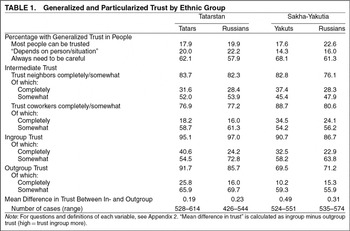
As in earlier research on Russia, we find that most people are cautious about others. A little more than 60%, on average, say that you “always need to be careful” in dealing with others (see Table 1). Around 20% say that most people can be trusted, and a roughly similar proportion responds that “it depends.” Generalized trust, then, is low.
Also as in earlier research, we find higher levels of particularized trust. Between 86% and 97% of respondents trust their ingroup to some degree.11
We combine the responses of “trust completely” and “trust somewhat” in order to allow comparisons with earlier research (cf. Gibson, 2001). We have also found from other questionnaire items that some respondents (often the older and less educated) favor more categorical answers in general, whereas others favor less categorical ones. However, our multivariate analysis below (Table 3) treats “trust completely” and “trust somewhat” as separate categories.
Intermediate trust is high as well. Over three fourths of our sample trust their neighbors; and a similarly high percentage trust their coworkers.
If we stopped here, we would have told the usual story of zero-sum trust: there is little generalized faith in others, and instead people turn inward to trust their ethnic group. What is striking, however, is that people display considerable confidence in the outgroup. Thus, over 90% of Tatars trust Russians; and local Russians express almost the same high level of faith in Tatars. Mutual confidence is somewhat lower among Yakuts and Russians, but still registers at around 70% in each case (see Table 1).
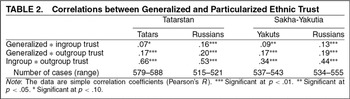
What is also striking is that the correlations among generalized, in- and outgroup trust are all positive (Table 2). Thus, faith in one's own and faith in the major outgroup are not mutually exclusive, but complementary.
It could be, of course, that the relatively high level of mutual confidence simply reflects social desirability (cf. Javeline 1999). People may be unwilling to express negative sentiments about an outgroup, especially when face-to-face with an interviewer of another nationality. But virtually all titular and Russian respondents were interviewed by same-nationality interviewers. And other evidence in the survey shows that people did not simply give “rote” positive responses about interethnic relations. One indication is that responses on outgroup trust vary substantially across different outgroups. People answered more readily when asked about the major, visible outgroup (titular or Russian) than when asked about less visible or more distant groups. The “don't know's” for questions about trust in titular groups and in Russians ranged from 1% to 7%. Questions about trust in other, less visible or proximate groups (Chechens, Chinese, Jews, and Americans) elicited “don't know's” from up to 50% of respondents. And among people who did give a substantive answer on these latter groups, levels of trust varied much more.12
Of the people who gave a substantive answer about trust in less visible/proximate groups, 27% to 49% expressed trust in Jews; 16% to 34% in Chinese; 20% to 38% in Americans; and 11% to 24% in Chechens. Factor analysis of all six ethnic trust questions yields two factors—one for trust in the titular nationality and Russians and a second factor for trust in these latter nationalities. We think this reflects a difference between proximate and more distant groups.
(Given the high rates of item nonresponse, we evaluate trust in the less visible/proximate groups separately, later.)
13 Unless otherwise noted, we exclude “don't know” responses from the analysis.
People also varied in their responses when asked to rate the major outgroup (titular or Russian) on several stereotypical traits. Although most people held relatively neutral or positive images of the other group, their images varied depending on the trait in question. Few people simply gave rote responses.
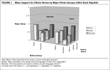
In addition, respondents seemed little inclined to endorse exclusionary ingroup norms just to please interviewers. Figure 1 plots the mean level of importance that people attached to three different norms: marrying within one's own group, speaking only the ingroup language, and having one's child educated in that tongue. Most people in each of our four groups saw these behaviors as less than essential to be a “true” member of their group.14
One reason might be that ethnicity is simply not very salient to individuals. But other items suggest that it is salient, especially for titular groups. On questions tapping the importance of various sources of group identification, nationality ranked second only to family, and higher than eight other sources of affiliation (generation; standard of living; resident of the republic; of Russia; or of the locality, religion, place of origin, and occupation), for titular groups and Russians alike. When asked if they seldom thought about their nationality or always thought about it, over 60% of Tatars and over 75% of Yakuts said “always,” whereas 30% to 40% of Russians said the same.
Mean Support for Ethnic Norms by Major Ethnic Groups within Each Republic
IDENTIFYING THE ROOTS OF INTERETHNIC TRUST
Our model holds that outgroup trust should depend on orientations at three levels. One is broad-gauged trust, which would dispose people to trust others regardless of their group affiliation. The components of broad-gauged trust include generalized faith in others; intermediate trust (in neighbors and coworkers), and confidence in government. The second level would dispose people to trust other ethnic groups on the whole. In this case, trust would depend on attachment to norms of ethnic exclusion and on an individual's sense of being the victim of ethnic discrimination. The third level would dispose people to trust in specific outgroups, based on stereotypes of the outgroup and on contact with its members.
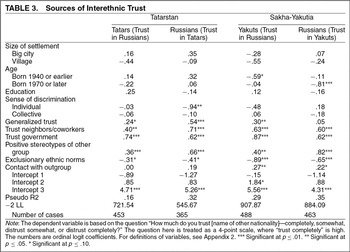
We evaluate these arguments here with an ordered logit (Table 3). The results bear out much of our argument.15
The control variables—urban/rural residence, age and education, generally have little impact. When these variables alone are used to predict levels of interethnic trust, the pseudo-R2's are .01, .02, .03, and .05, for Tatars and Russians in Tatarstan, Yakuts, and Russians in Sakha, respectively.
All three components of what we have termed broad-gauged trust prove significant, almost across the board. Intermediate trust—in neighbors and coworkers—leads to higher faith across ethnic lines. So, too, does confidence in government. The more positive the view of the authorities, the more trust in the major outgroup. And generalized faith in people increases cross-ethnic trust for three of our four groups.
Also as we would predict, support for exclusionary ethnic norms lowers confidence across ethnic lines. People who endorse endogamy, exclusive use of their own language, and exclusive own-language education for their children have less faith in the outgroup.
Attitudes toward the particular outgroup also prove significant. The more the outgroup is viewed as likable and competent, the greater the confidence across group boundaries. Contact, however, appears to play a more limited role. It proves significant in one republic (Sakha) but not in the other, and moreso for the titular group than for Russians. We would need a more detailed study to determine why these results differ; but one possible explanation is that interethnic contact is less common in Sakha than in Tatarstan, and the effect may thus be heightened.
Perceptions of discrimination have even less impact, proving significant only for one of the four groups, and then only for individual-level perceptions of bias (among Russians in Tatarstan). One reason might be the inclusion of two potentially related measures of discrimination in the same model. But including each one in the model separately yields the same results as those listed in Table 3.16
Because other independent variables are also related, we ran a variety of tests to determine how the correlations might influence our conclusions about the factors shaping outgroup trust. We partialled the impact of generalized trust out of our measures of confidence in government and intermediate trust; but the signs and levels of significance of the latter two variables remained the same as those in Table 3. We also partialled outgroup stereotypes out of our measure of ingroup norms, and the results remained the same. Finally, we estimated a two-stage least-squares model to check our assumptions about the impact of generalized trust in Table 3. (It could be argued that outgroup trust shapes generalized faith in others, rather than the reverse.) But the results confirmed the analysis in Table 3.
All told, then, the results generally support our model of cross-ethnic trust. They show, moreover, that there are some strong similarities in the roots of trust across the four groups in our study, despite their religious, linguistic, and socioeconomic differences.17
We also ran the analysis in Table 3 with additional variables to tap commitment to a group's traditional religion and use of the group's language, but neither proved to be significant.
But the results are not identical, as our findings on contact and perceived discrimination attest.
Gauging Inclusionary versus Exclusionary Trust
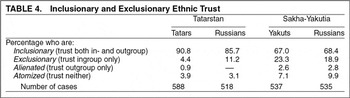
Our analysis thus far also raises some doubts about the prevalence of exclusionary ethnic trust. High levels of intra- and interethnic confidence suggest that relatively few people are “zero-sum” trusters. We can determine their numbers more directly, however, by combining questions on in- and outgroup trust. These yield a fourfold typology:
- “inclusionary” (people who express confidence in both the in- and outgroup);
- “exclusionary” (people who trust their own, but distrust the other group);
- “alienated” (people who trust the other group but distrust their own); and
- “atomized” trust (people who distrust both the in- and the outgroup).
The frequencies are presented in Table 4. Exclusionary trusters constitute a minority in each case, from 4% among Tatars to 23% among Yakuts. Inclusionary trust is more common. Two thirds of respondents in Sakha and four fifths of respondents in Tatarstan express some confidence in both their own and the other group.18
We also calculated a differential trust score, by subtracting outgroup from ingroup trust. Seventy percent of respondents received a score of zero—that is, they expressed the same degree of trust in their own and in the outgroup. Roughly 26% expressed more trust in their own group, and another 3% expressed less. An Ordinary Least Squares regression analysis with the same independent variables as those in Table 3 shows that exclusionary ingroup norms and stereotypes of the outgroup are the most significant factors predicting differential trust.
Another small minority (from 3% to 10%) are atomized, trusting neither group. And only a handful are alienated.
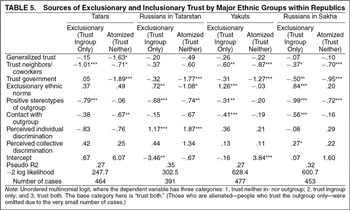
We explore what differentiates people in each category with an unordered logit (Table 5).19
Because of the small numbers in some categories, and because most of the background variables in the analysis have relatively little effect compared to the subjective ones, we dropped age, place of residence, and education from this part of the analysis.
Inclusionary trust—in both one's own group and in the major outgroup—is the omitted category. (The “alienated” were dropped from the analysis because there were too few cases.) For each ethnic group, the data in column 1 help identify the factors that that lead to more exclusionary (rather than inclusionary) trust; and in column 2, the factors that lead to atomization (rather than inclusion).
With respect to exclusionary trust, one factor stands out as significant across all four groups: stereotypes. The more negative the perception of outgroup members, the more the zero-sum trust. Ingroup norms have a slightly less consistent impact, as does intermediate faith in others. And as in our earlier analysis (Table 3), contact proves significant for the two major groups in Sakha. Perceived discrimination also has a selective effect for Russians in each region.
Atomization—distrust of both in- and outgroup— appears to be associated chiefly with distrust of government. Intermediate trust also plays a role, though the impact is less uniform. Otherwise, the roots of atomization vary more. But given the small number of cases in this category, we would not want to read too much into these differences.
Thus, we do find some evidence of exclusionary ethnic trust, and it is connected both to ingroup bias and to negative views of the outgroup. What is most striking, though, is that it is far from the modal category. More people are inclusionary.
CROSS-ETHNIC CONFIDENCE IN MORE DISTANT GROUPS
To this point, we have examined the roots of cross-ethnic trust between relatively large and visible groups, who are most likely to be in contact on a daily basis. How would our model fare when the question turns to trust in other, less proximate or visible groups? As we noted earlier, both salience and trust decline with social and physical distance. Questions about trust in Jews, Chinese, Americans, and Chechens evoke many more “don't know” responses than do questions about titular groups and Russians. And when people do give a substantive reply, they express lower levels of confidence in less proximate groups.
But the underlying roots of cross-ethnic confidence in less proximate groups appear to be very similar to those identified in Table 3. We cannot replicate the analysis in Table 3 in its entirety, because our data do not include outgroup-specific questions on stereotypes of, or contact with, each of the less proximate groups. We can, however, estimate the effects of broad-gauged trust, exclusionary ethnic norms, and perceived discrimination. We thus ran an ordered logit similar to that in Table 3 to estimate how much titular groups and Russians in each republic trust each of the less proximate groups.20
We also did an analysis of the “don't know” responses for questions about trust in each of the four less proximate groups. “Don't knows” were more prevalent among older, less educated, and rural respondents. They were not very closely related to our other measures of trust, to ingroup norms, or to a sense of ethnic discrimination.
Because this produced 16 equations—four analyses for each titular group and for Russians in each republic—we summarize the results here.
Three factors turn out to be significant almost across the board (in 12 or more of the 16 equations). People who have higher confidence in government, more generalized faith in people, and less attachment to ingroup norms express more trust in less proximate outgroups. Intermediate trust, on the other hand, seems to have much less impact here than it does for trust between titular groups and Russians. Trust in neighbors and coworkers thus appears to be capturing the effect of living in what is mostly a biethnic context.
CONCLUSIONS
The value of interpersonal trust is now a central element in theories of democracy and markets. But the benefits seem to stop where ethnic attachments begin. A growing literature thus characterizes ethnic capital as the inverse of more general social capital, and of outgroup trust.
Our analysis suggests that this image may be too limited. High ingroup trust is no barrier to faith in others. In fact, we found most people to be inclusionary—displaying confidence both in their own and in the major outgroup. We are not suggesting that the same proportions would hold elsewhere. In fact, our argument is that we should not prejudge the proportions, because they will depend on levels of what we have termed broad-gauged trust, attachment to one's ingroup, and stereotypes of, and contact with, the particular outgroup.
We find strong support for this model of the roots of cross-ethnic trust. Broad-gauged trust leads to greater confidence across ethnic lines. In contrast, strong attachment to ingroup norms and negative stereotypes of the outgroup lower cross-ethnic confidence. These findings are similar, moreover, among ethnic groups—Tatars, Yakuts, Russians—with marked differences in language, religion, and culture. Everyday contact appears to have a more selective effect, stronger where contact itself is more limited.
Many of the sources of interethnic trust also appear to be similar when people are asked about their level of trust in other, less proximate groups as well. Generalized faith in others figures almost across the board, as do confidence in government and attachment to ingroup norms. Our analysis shows, however, that people display more trust in, and are more likely to give an opinion about, groups they see on a day-to-day basis.
Thus, trust varies across different outgroups, depending at least in part on contact and familiarity. But our data suggest an important distinction between lack of contact/familiarity (and high rates of “don't know” responses) versus distrust. They also suggest the possibility that the effect of contact on individuals' willingness to trust outgroups may be u-shaped: limited both where transactions across ethnic lines are very common and where they are very scarce.
Our results also hold several other implications for the study of trust. One is about the distinction between generalized and particularized confidence in others. As in other studies of Russia, our analysis finds low generalized and high particularized confidence in others. But we also find intermediate forms of trust that do not fit neatly into either category. Relatively high levels of confidence in neighbors and coworkers, and in major outgroups, suggest that faith in others is somewhat broader than many images of the particularized variant alone would suggest. These forms of trust seem to depend in part on familiarity; but they extend to whole groups and not just to the individuals people see face-to-face.
A second implication relates to the role of confidence in government. We find, as several other authors do, that faith in political institutions bolsters cross-ethnic trust. But the Russian government has been rated as increasingly undemocratic since the late 1990s. This all implies that the key feature connecting confidence in government to cross-ethnic trust need not be the degree of democracy or transparency, as some authors suggest. It may simply be the provision of stable rules of the game (cf. Barber 1983; Posen, 1993; Sztompka, 1999).
Finally, our results should make us skeptical of generalized faith in others as an indicator of confidence across ethnic lines. As we have demonstrated, it does contribute to cross-ethnic trust. But the two are clearly not interchangeable. Only one fifth of our sample displays generalized faith in others; but roughly four fifths trust the major outgroup in their republic. Trust is also higher for some less proximate ethnic groups than it is for “people” in general. If so, then arguments about the connection between ethnicity and trust need to be refined.
APPENDIX 1: DESCRIPTION OF THE SURVEY
Our data come from a survey conducted in Tatarstan and Sakha in the summer and fall of 2002. The 2-hour, face-to-face survey covered a number of issues ranging from work to social relations and ethnic identification to trust. The questionnaire was developed in English and Russian with collaborators from Demoscope in Moscow, and then translated into Tatar and Yakut. The Tatar and Yakut versions were subsequently blind-backtranslated to ensure linguistic equivalence. In almost all cases, titular and Russian respondents were interviewed by same-nationality interviewers. Titular-nationality respondents were interviewed by bilingual interviewers and could opt to give the interview either the titular language or Russian. The eligible population included non-institutionalized permanent residents 18 years of age and older.
The stratified, random sample was designed to achieve two goals—to allow comparisons between the titular nationality and Russians in each republic and to allow inferences about the populations of each republic as a whole. However, comparisons across ethnic groups could be complicated by the fact that the two groups were unevenly distributed, with Tatars and Russians making up around 48% and 43% of Tatarstan's population, respectively, and with Yakuts and Russians accounting for approximately 40% and 45% in Sakha. The survey thus included an oversample of the underrepresented nationality in each case.
The sample design began with two strata: urban and rural, using data from the most recent census updates. Urban areas were then further stratified by size and drawn randomly with probability proportional to size. Each urban area in the sample was then partitioned into districts, and districts were randomly selected for inclusion in the sample. Within each sample district, a list of all dwellings was constructed by visual inspection and consultation with authorities. In the case of dormitories and communal apartments, each room or space housing a separate household was treated as a dwelling unit, not the entire building. Then, a number of dwelling units were selected systematically starting with a random number. An individual from each drawn household was then selected using the Kish (1965) procedure.
Sampling in rural areas presented more problems. Cost considerations and lack of detailed data made it impossible to build a sample from the ground up based on all rural settlements, or to conduct only a few interviews apiece in widely dispersed settlements. As an alternative, villages were drawn from the raions (regions) included in the urban stratum. However, many villages in the two republics are ethnically homogeneous, and because only a few villages could be selected from most raions, we wanted to avoid the problem of disproportionate representation of one or the other major ethnic group. As a result, within each selected raion, villages were stratified by ethnic composition—predominantly (90% or more) titular, predominantly (90% or more) Russian, and mixed. Within each of these strata, villages with at least 100 residents were ordered by size and selected by probability proportional to size. Within each village, households were selected systematically starting from a random number and drawn from the official residence registration book (pokhoziaistvennaia kniga). The Kish procedure was employed to select an individual respondent from each drawn household. As in urban areas, at no point did interviewers exercise discretion in the selection of households or respondents.
Geography and budgetary considerations imposed some limitations on the sample design. Remote areas of Sakha were eliminated because many points were sparsely settled, and not regularly accessible by scheduled transportation. Such exclusions are common in national surveys employing face-to-face interviews; certain territories are eliminated in advance due to practical considerations such as very low population density, low accessibility, or political unrest. (Thus, in the United States, Alaska and Hawaii are typically excluded from national samples.)
A total of 2,572 people were interviewed: 1,266 in Tatarstan and 1,306 in Sakha. Response rates were 81% and 72%, respectively. Ten percent of completed questionnaires were chosen for inspection of interviewers' work by independent evaluators from Moscow, although these inspections were not typically conducted in very small villages. Here, we exclude 59 respondents who were participants in another part of the study and who did not fall into our original sample.
APPENDIX 2: VARIABLES USED IN THE ANALYSIS
Respondent nationality: “What is your nationality?” [responses were open-ended].
Generalized trust: “Do you think that most people can be trusted, or that you always need to be careful in dealing with others?” [1 = always need to be careful; 2 = “depends” (volunteered response); 3 = most people can be trusted.]
Ingroup trust: “How much do you trust [Tatars/Yakuts/Russians]—completely, somewhat, distrust somewhat, or distrust completely?” [1 = distrust completely; 2 = distrust somewhat; 3 = trust somewhat; 4 = trust completely]. For Tatars, this question refers to Tatars; for Yakuts to Yakuts, and for Russians, it refers to Russians.
Outgroup trust: “How much do you trust [Tatars/Yakuts/Russians]—completely, somewhat, distrust somewhat, or distrust completely?” [1 = distrust completely; 2 = distrust somewhat; 3 = trust somewhat; 4 = trust completely]. For Tatars and Yakuts, this question refers to trust in Russians; for Russians, it refers to trust in either Tatars or Yakuts.
Outgroup stereotypes: An average score of four questions about stereotypes of Tatars (asked only in Tatarstan), Yakuts (asked only in Sakha), and Russians (asked in both regions). For each group, the questions were of the following form:
“Let's talk about character traits that are typical of people of different nationalities. Here is a scale where one means that (Tatars/Yakuts/Russians) are mostly characterized by slyness, and seven means that they are mostly characterized by simplicity. Where would you place (Tatars/Yakuts/Russians) on this scale?” [1 = slyness; 7 = simplicity].
The other three scales were [1 = hardworking; 7 = lazy]; [1 = sharp-witted; 7 = slow-witted]; and [1 = respectful of other nationalities; 7 = disrespectful of other nationalities].
These items were rescaled from −3 to +3, with the negative trait at −3 and the positive trait at +3; and averaged together. (Respondents were included if they answered on at least three of the four items.)
Trust government: a composite of three questions—“How much do you trust the federal government?” “The government of the republic?” “The administration of this city/village?” [1 = distrust completely; 2 = distrust somewhat; 3 = trust somewhat; 4 = trust completely]. These three were averaged together to give an index of trust in government. (Respondents were included if they answered at least two of the three items.)
Trust neighbors/coworkers: an index of two items—“How much do you trust your neighbors?” “Your coworkers?” [1 = distrust completely; 2 = distrust somewhat; 3 = trust somewhat; 4 = trust completely]. These two were averaged together to give an index of trust in neighbors/coworkers. (People were scored on this index if they answered at least one of the two questions.)
Exclusionary ethnic norms: Derived from questions asked about Tatars (in Tatarstan only), Yakuts (in Sakha only), and Russians (in both regions). The questions were: “What, in your opinion, is obligatory, what is desirable, and what is not important in order to consider someone a true (Tatar/Yakut/Russian)?
- (a) Marry a (Tatar/Yakut/Russian) [1 = not important; 2 = desirable; 3 = obligatory]
- (b) Speak only (Tatar/Yakut/Russian) [1 = not important; 2 = desirable; 3 = obligatory]
- (c) Send children to (Tatar/Yakut/Russian)—language school [1 = not important; 2 = desirable; 3 = obligatory]
Size of settlement:
Big city = 1 if city is greater than 100,000 residents; 0 otherwise.
Village = 1 if population of 3,000 or fewer people; 0 otherwise.
Education: 1 = completed less than secondary; 2 = completed secondary; 3 = completed higher.
Sense of individual discrimination: “Have you personally had to experience a violation of your rights or opportunities due to your nationality?” 1 = no; 2 = yes.
Sense of collective discrimination: “Do you think that a person's nationality in this republic affects his chances to get the best jobs?” 1 = not; 2 = “it depends” (volunteered); 3 = yes. Contact with outgroup: Derived from two questions:
“What is the national composition of the collective where you work?” [1 = only Tatar/Yakut; 2 = mostly Tatar/Yakut; 3 = about half Tatar/Yakut; 4 = mostly non-Tatar/Yakut; 5 = no Tatars/Yakuts].
“What is the nationality of your neighbors?” [1 = only Tatar/Yakut; 2 = mostly Tatar/Yakut; 3 = about half Tatar/Yakut; 4 = mostly non-(Tatar/Yakut); 5, no Tatars/Yakuts].
These were rescaled for Tatars, Yakuts, and Russians so that a high value indicates that most or all neighbors or coworkers are of the other nationality. We then averaged the two to obtain a measure of contact with the outgroup. (People were scored on this index if they answered at least one of the questions.)
Data for this paper were collected with the support of the National Science Foundation (OPP0082715) and the National Council for Eurasian and East European Research. We would also like to thank the Rockefeller Foundation's Bellagio Center and the Russell Sage Foundation for their support of the analysis, and Jim Gibson and three anonymous reviewers for comments on an earlier draft.






Comments
No Comments have been published for this article.