Women are underrepresented in elected office, holding 20% of the seats in Congress and about a quarter of the seats in state legislatures. Women are also underrepresented in civic life. Compared to men, women are less likely to express interest in politics; they reveal lower levels of political knowledge; and they are less likely to participate in campaigns (Bennett and Bennett Reference Bennett and Bennett1989; Burns, Schlozman, and Verba Reference Burns, Schlozman and Verba2001; Delli Carpini and Keeter Reference Delli Carpini and Keeter1996; Jerit and Barabas Reference Jerit and Barabas2017; Rosenstone and Hansen Reference Rosenstone and Hansen1993). Scholars have argued that these patterns are related, where the underrepresentation of women in government deters other women from engaging in politics.
According to theories of political empowerment, women's presence in politics is thought to encourage other women to engage in political life. If women look at their representatives in politics and see only men, they might feel that government is not open to their concerns or that their interests will not be represented (Carroll Reference Carroll1994; Mansbridge Reference Mansbridge1999; Phillips Reference Phillips1995; Sapiro Reference Sapiro1981). As women run for political office or serve in government, it signals to other women that they can be heard in politics. Prior studies have found that when women live in places with more women seeking office, they are more likely to engage in political discussion, express interest and efficacy in politics, and try to persuade others how to vote than women living in places without women candidates (Atkeson Reference Atkeson2003; Atkeson and Carillo Reference Atkeson and Carrillo2007; Burns, Schlozman, and Verba Reference Burns, Schlozman and Verba2001; Hansen Reference Hansen1997; Koch Reference Koch1997; Reingold and Harrell Reference Reingold and Harrell2010). Women's representation in politics has also been argued to be associated with higher levels of political knowledge (Fridkin and Kenney Reference Fridkin and Kenney2014; Jones Reference Jones2014; Koch Reference Koch1997). Although some doubts have been raised about the extent to which women candidates promote political engagement among other women (Dolan Reference Dolan2006; Lawless Reference Lawless2004; Wolak Reference Wolak2015), the weight of existing evidence generally supports theories of empowerment.
However, most of the research on gender and political empowerment relies on survey data from the 1980s and 1990s, a time when women made up a significantly smaller share of Congress. As women's political representation has increased, do women officeholders continue to mobilize other women to greater political involvement? Women's presence in elected office may have only heightened in importance as a symbolic cue to other women. Alternately, the empowering effects of descriptive representation may no longer emerge as women's presence in politics has become more familiar. Based on recent studies, the gender of politicians may no longer be as important to women's political engagement as it once was. Gender may not be that important to how Americans think about politicians running for office. Although people hold stereotypes about women who run for office, they are not necessarily related to how ballots are cast or to women's success at the ballot box (Brooks Reference Brooks2013; Dolan Reference Dolan2014; Fox Reference Fox, Tolleson-Rinehart and Josephson2000; Huddy and Capelos Reference Huddy, Capelos and Ottati2002). Media coverage of women candidates now looks quite similar to how men are portrayed in congressional campaigns (Hayes and Lawless Reference Hayes and Lawless2016). Furthermore, gender may not be that important for how voters see and experience congressional campaigns.
Thus, it is important to reconsider the evidence for theories of empowerment and descriptive representation. To analyze the empowering effects of women politicians in recent years, I have taken advantage of a rich data source in the Cooperative Congressional Election Study (CCES). Most prior studies rely on the American National Election Studies (ANES), which include respondents from only a portion of all districts represented by women. Although the 2008 ANES includes respondents from 106 congressional districts, the 2008 CCES sample includes respondents from 434 congressional districts. The CCES is useful because it includes respondents from all or nearly all of the districts represented by female representatives. Samples in the ANES generally include respondents from only a subset of all districts with female candidates or officeholders, which may or may not be fully representative of the overall population of female politicians at the time of the survey. Moreover, the large samples available from the CCES offer enough statistical power to detect the effects of descriptive representation even if they are quite small in magnitude.
Using the CCES from election years between 2006 and 2014, I consider the effects of women officeholders and candidates for office on levels of political knowledge, interest in politics, voter turnout, and political participation of men and women. Even though others have argued that the political representation of women is associated with greater knowledge among other women (e.g., Dolan Reference Dolan2011; Fridkin and Kenney Reference Fridkin and Kenney2014; Jones Reference Jones2014), my analysis shows that both men and women tend to report higher levels of knowledge when represented by women. In the case of political engagement, I find little evidence that women are any more likely to engage in politics when they live in districts represented by female elected officials or reside in places where women are seeking state and national office.
Consistent with recent work on the limited salience of gender in congressional races, my analysis confirms that the presence of women candidates and officeholders appears to have little effect on the political interest or participation of the women living in those districts. Although past studies have demonstrated that women's representation in politics could inspire the political engagement of women in the electorate, these patterns do not emerge within contemporary surveys. Increases in women's representation in politics will likely influence how women's voices are heard in policy making, but it will not likely alter how other women engage in political life.
POLITICAL ENGAGEMENT AMONG WOMEN
Across many dimensions, women are less engaged in politics than men are. Women express less interest in politics than men do (Bennett and Bennett Reference Bennett and Bennett1989; Verba, Burns, and Schlozman Reference Verba, Burns and Schlozman1997). Women are less likely to participate in political discussion than men, and they are less likely to try to influence the votes of others (Rosenstone and Hansen Reference Rosenstone and Hansen1993; Verba, Schlozman, and Brady 1997). Men score better than women on tests of general political knowledge (Delli Carpini and Keeter Reference Delli Carpini and Keeter1996; Dolan Reference Dolan2011). Although women turn out to vote at rates similar to or greater than men, for most other forms of political participation, women are less politically engaged. Women are less likely to contact an elected official, less likely to donate money to a campaign, and less likely to participate in political organizations (Conway Reference Conway and Whitaker2008; Rosenstone and Hansen Reference Rosenstone and Hansen1993; Verba, Schlozman, and Brady 1997).
Women's lower levels of political engagement have been attributed in part to resource differences, given that women are less likely to hold resources like income and education that promote political engagement (Verba, Schlozman, and Brady 1997; Welch Reference Welch1977). Also, the routes to political engagement are different for women than for men (Burns, Schlozman, and Verba Reference Burns, Schlozman and Verba2001; Sapiro and Conover Reference Sapiro and Conover1997). Through their experiences in childhood and adolescence, women are less likely to see themselves in political roles (Fox and Lawless Reference Fox and Lawless2014; Jennings Reference Jennings1983). As a result of this socialization, women seem less interested in political pursuits. If socialization leads women to think of politics as a domain for men more so than for women, then such perceptions are challenged when women are increasingly represented in politics. Descriptive representation has been argued to be uniquely important for promoting women's engagement in politics. If women look at their representatives in politics and see only men, they might feel that government is not open to their concerns or that their interests will not be represented (Carroll Reference Carroll1994; Mansbridge Reference Mansbridge1999; Sapiro Reference Sapiro1981). As women run for political office or serve in government, it signals to women that they can be heard in politics.
Increasing women's representation in politics has been argued to be an important factor in closing the gender gap in political engagement. When women live in places with more women seeking office, they are more likely to engage in political discussion, express more interest in politics, and are more likely to try to persuade others how to vote (Atkeson Reference Atkeson2003; Burns, Schlozman, and Verba Reference Burns, Schlozman and Verba2001; Hansen Reference Hansen1997; Koch Reference Koch1997; Reingold and Harrell Reference Reingold and Harrell2010). When women are represented by women in the Senate, they are more knowledgeable about their senators’ issue positions (Fridkin and Kenny Reference Fridkin and Kenney2014; Jones Reference Jones2014). Even so, other studies have failed to provide strong evidence that the presence of women candidates and officeholders promotes women's engagement in political life. When women are personally represented by women in Congress, they are no more likely to feel like they have political influence (Atkeson and Carrillo Reference Atkeson and Carrillo2007; Lawless Reference Lawless2004). Others have found little evidence that the presence of women politicians promote political interest or participation among other women (Broockman Reference Broockman2014; Dolan Reference Dolan2006; Lawless Reference Lawless2004; Wolak Reference Wolak2015).
CONSEQUENCES OF DESCRIPTIVE REPRESENTATION FOR WOMEN'S ENGAGEMENT
Why would the presence of women politicians inspire other women to engage in political life? Scholars have proposed that women's presence in politics is of symbolic importance, communicating to other women that their concerns and perspectives will be heard in politics (Mansbridge Reference Mansbridge1999; Phillips Reference Phillips1995). Yet when we look to how citizens appraise candidates for office, gender seems not to be particularly salient to campaigns and elections. Women candidates make similar choices to men in how they shape their campaign platforms (Dolan Reference Dolan2014; Hayes and Lawless 2015). Although women candidates have received different amounts and kinds of press coverage in the past (Kahn Reference Kahn1994), men and women now receive similar kinds of treatment in the news (Hayes and Lawless Reference Hayes and Lawless2016).
Just as gender often does not seem particularly salient to how congressional candidates present themselves to voters, it does not seem to be particularly important to how voters evaluate politicians. In recent years, scholars have noted the limits to gendered thinking in the course of campaigns. Women candidates appear to face limited explicit bias from voters at the polls (Dolan and Lynch Reference Dolan and Lynch2015; Kinder and Dale-Riddle Reference Kinder and Allison2012). When tallying up the votes on Election Day, women who run for Congress are not disadvantaged relative men when it comes to securing electoral victory (Burrell Reference Burrell1994; Fox Reference Fox, Tolleson-Rinehart and Josephson2000). Even though people apply different stereotypes to male candidates than they do female candidates, these inferences no longer appear strongly related to vote choice (Brooks Reference Brooks2013; Dolan Reference Dolan2014). In congressional races, people report few differences in their assessments of the competence, empathy, and trustworthiness of female candidates compared to male candidates (Hayes and Lawless Reference Hayes and Lawless2016). Rather than making their voting decisions based on candidate gender, factors like incumbency, partisanship, and ideological congruence seem more important to vote choice (Dolan Reference Dolan2014; Hayes Reference Hayes2011; Huddy and Capelos Reference Huddy, Capelos and Ottati2002).
If people are not actively using gender to inform their candidate evaluations and vote choice, then we should question whether the mere presence of women candidates will empower other women to greater interest and engagement in politics. For descriptive representation to inspire interest and engagement with voters, candidate gender needs to be of strong importance to women in the electorate. But relative to the importance of race in politics, gender divides tend to be much less pronounced (Burns and Kinder Reference Burns, Kinder and Berinsky2012). Although blacks and whites diverge in partisanship and issue preferences, men and women are more likely to hold similar political beliefs on average. Although minority voters often strongly identify in terms of their race and use their identity to inform choices, women are much less likely to use their gender identity in the same way. Evidence is mixed regarding whether women even prioritize or strongly value descriptive representation in politics (Dolan and Lynch Reference Dolan and Lynch2015; Dolan and Sanbonmatsu Reference Dolan and Sanbonmatsu2009; Harden Reference Harden2016). If women do not think about politics in strongly gendered terms, then it seems unlikely that the presence of female politicians should change one's predispositions to participate in politics or express interest in current events.
Moreover, the origins of political engagement are often deeply rooted. Political interest tends to be a pretty stable individual trait, one that does not change much over time (Prior Reference Prior2010). Likewise, the reasons why people turn out to vote tend to reflect standing resources or deep-rooted dispositions like civic duty, such that scholars have often struggled to confirm that even things like campaign spending and candidate advertising promote knowledge, political interest, and participation (i.e., Coleman and Manna Reference Coleman and Manna2000; Franz et al. Reference Franz, Freedman, Goldstein and Ridout2008; Gimpel, Kaufmann, and Pearson-Merkowitz Reference Gimpel, Kaufmann and Pearson-Merkowitz2007; Wolak Reference Wolak2006). Even if women's presence in politics is of symbolic importance to other women, it may not be of sufficient magnitude or importance to produce significant shifts in women's engagement and participation.
WOMEN'S REPRESENTATION AND LEVELS OF POLITICAL KNOWLEDGE
Using survey responses from the CCES from election years between 2006 and 2014, I first considered whether women were more politically knowledgeable when represented by women in politics. Political knowledge is in many ways at the heart of representation. Citizens’ political knowledge helps them express their desires to politicians and articulate their interests. Political knowledge helps citizens select candidates that align with their interests and hold incumbent politicians accountable for their choices. Yet despite the normative value of knowledge, it is a resource that is not evenly held across men and women (Delli Carpini and Keeter Reference Delli Carpini and Keeter1996).
Gender gaps emerge among respondents in the CCES as well. In the CCES, respondents are given a list of names of elected officials and asked to identify the party allegiance of each politician on the list.Footnote 1 Respondents are asked to identify the partisanship of their representative, their senators, and their governor as well as name the party that controls each chamber of the state legislature. As shown in Figure 1, significant gender differences emerge with all of these measures of knowledge. Although 70% of men correctly identify the partisanship of their representative, the same is true for only 59% of women. In addition, 67% of men correctly named the partisanship of both of their senators, compared to only 52% of women in the sample. Women were also significantly less likely than men to know the party leanings of the governor and the state legislature.Footnote 2
Gender differences in knowledge and engagement.

Do these knowledge gaps diminish when women are represented by women in office? Descriptive representation has been thought to cultivate greater political knowledge among other women (Atkeson Reference Atkeson2003; Fridkin and Kenney Reference Fridkin and Kenney2014; Jones Reference Jones2014; Koch Reference Koch1997). To consider whether women are more politically knowledgeable when represented by women in office, I use a multilevel modeling approach. This was an important improvement on prior studies of the empowering effects of women's representation. When considering the effects of contextual factors, we need to be concerned about the clustering of survey responses within geographic units. If not properly accounted for, we overestimate the amount of unique variance among respondents and underestimate the standard errors associated with our estimates, particularly those associated with contextual explanations. Failing to correct for clustering biases the results toward finding false positives and the possibility of exaggerating the importance of descriptive representation for women's empowerment. Although some prior studies have used clustered standard errors to address this issue, these may not have fully addressed problems of clustering (Huang Reference Huang2016; Steenbergen and Jones Reference Steenbergen and Jones2002). Here, I rely on a random coefficient specification to better account for how the relationship between respondent gender and political engagement varies across districts as a function of the presence of women's representation. In this model, I include random effects associated with both the intercept and the coefficient on respondent gender, as well as an estimate of the covariance between these terms.Footnote 3
To test whether female respondents have greater partisan knowledge of their elected officials when represented by a woman, I interact respondent gender and the gender of the representative. In the state legislative knowledge model, I interact respondent gender with the percentage of women in the state legislature.Footnote 4 At the individual level, I control for education and household income, given the importance of resources and socioeconomic status to political knowledge levels.Footnote 5 I expect that strong partisans will be better informed about the party leanings of politicians than independents, measured with a folded version of the seven-point partisanship scale. I also control for age and race, given that political knowledge has been shown to be lower among nonwhites and young people (Delli Carpini and Keeter Reference Delli Carpini and Keeter1996).
At the district level, I control for the number of years that the elected official had been in office, given that longer-serving politicians are more likely to be known to constituents. I also control for the competitiveness of the election that year, given that campaign efforts should promote greater knowledge.Footnote 6 I also include a control for the “women friendliness” of the district, using an indicator of districts where women are more likely to emerge as successful candidates (Palmer and Simon Reference Palmer and Simon2006).Footnote 7 Women politicians tend to be more likely to emerge from districts with diverse, educated, and high-income constituents. Because women's representation in office may coincide with electorates prone to greater knowledge and participation, this control helps limit the possibility of finding a spurious relationship.
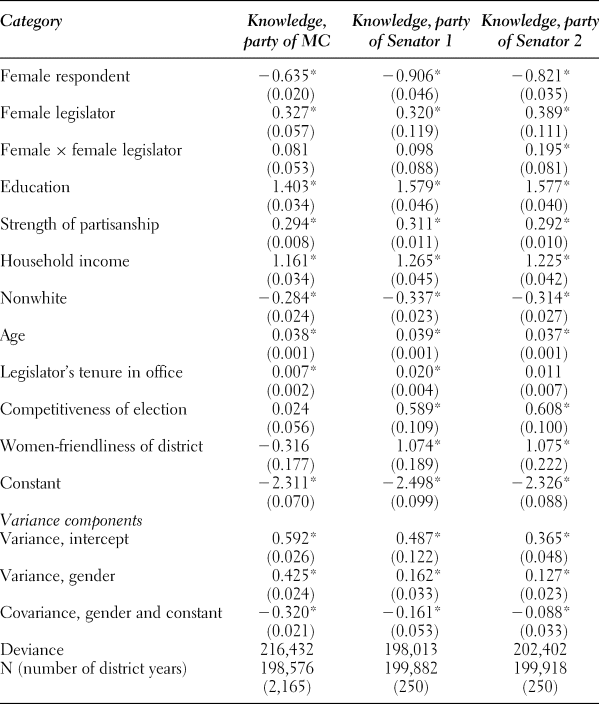
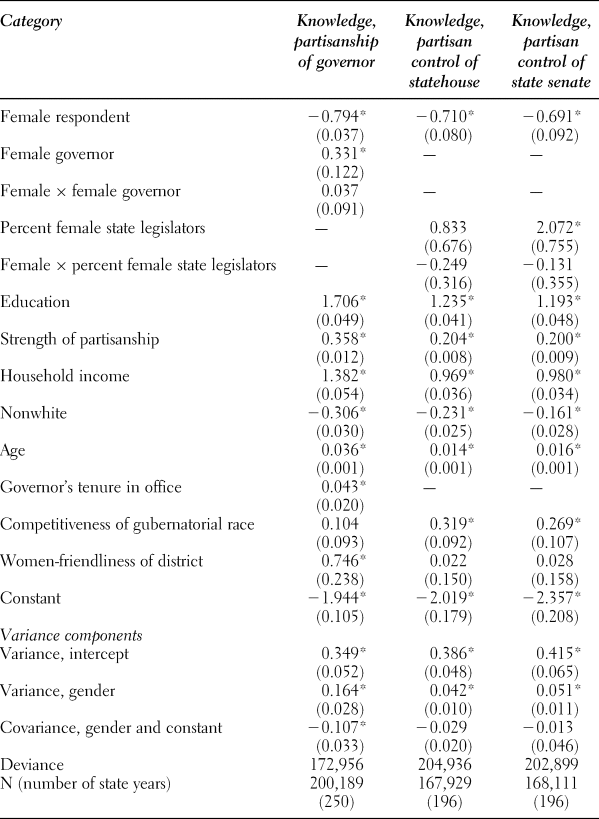
Here, I report the effects of officeholder gender for knowledge of one's representatives in Congress in Table 1 and knowledge of party control of the state legislature and governor's office in Table 2.Footnote 8 Both men and women reveal higher levels of partisan political knowledge when represented by women compared to men. However, the results provide only limited support for the idea that women are uniquely responsive to the effects of candidate gender. Women's knowledge gains under female representation are significantly greater than those of male respondents only in one of the two senatorial knowledge models.
Correct identification of partisanship of representatives in Congress

Multilevel logit estimates. Standard errors in parentheses. * p < 0.05.
Descriptive representation and state partisan knowledge

Multilevel logit estimates. Standard errors in parentheses. * p < 0.05.
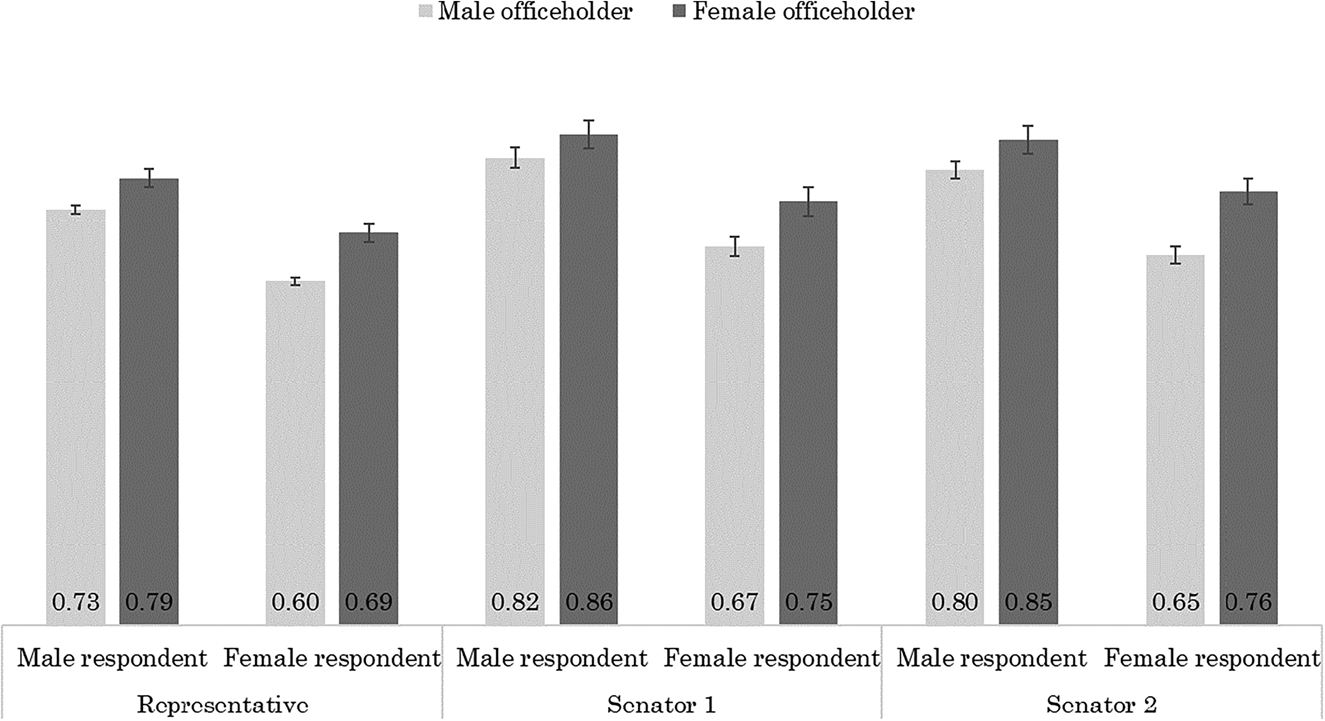
In the case of one's representative, both men and women reveal higher knowledge when represented by women in Congress, as shown in Figure 2. Holding other variables at their means, a woman represented by a man in Congress has a 60% likelihood of naming the correct partisanship of her representative, whereas a woman represented by female legislator has a 69% likelihood of correctly naming the representative's partisanship.Footnote 9 Among men, 73% correctly identify the partisanship of their representative when he is male, whereas 79% name the partisanship of the representative when she is female. Although knowledge gains were slightly greater among women than men, the difference was not statistically significant, as indicated by the insignificant interaction term. Men and women are both more likely to correctly identify the partisanship of their representative when she is female than when he is male.
Gender and knowledge of representative's partisanship.

In the case of the Senate, both men and women hold greater partisan knowledge when they are represented by women in the Senate. As shown in Figure 2, men have an 82% likelihood of correctly identifying the first senator's party when he is male and an 86% likelihood of correctly naming the party of the senator when she is female. Among women, 67% correctly name the party of the first senator when he is male, whereas 75% correctly name the senator's party when she is female. Even though the knowledge gains associated with female representation are somewhat greater among women, the marginal effect of senator gender is not significantly different for men and women in the sample. In the case of the second senator, a similar pattern emerges, with significant knowledge gains for both men and women represented by a woman in the Senate. However, in this case, a significant interaction effect indicates that the effects of female representation are significantly greater for women's knowledge gains than for men's.
These results provide partial support for theories of women's empowerment, where women seem at least somewhat distinct from men in how they respond to the effects of being represented by a woman. Although both men and women are more knowledgeable about their senator when she is female, the magnitude of the knowledge difference was somewhat greater among women than men. Even so, gender gaps in political knowledge persist even in the case of a female senator, where women are still less likely to know the party of their senator than men. Thus, the election of women to the Senate is likely to promote knowledge for women, but it may not close the persistent gender gaps that exist in political knowledge.
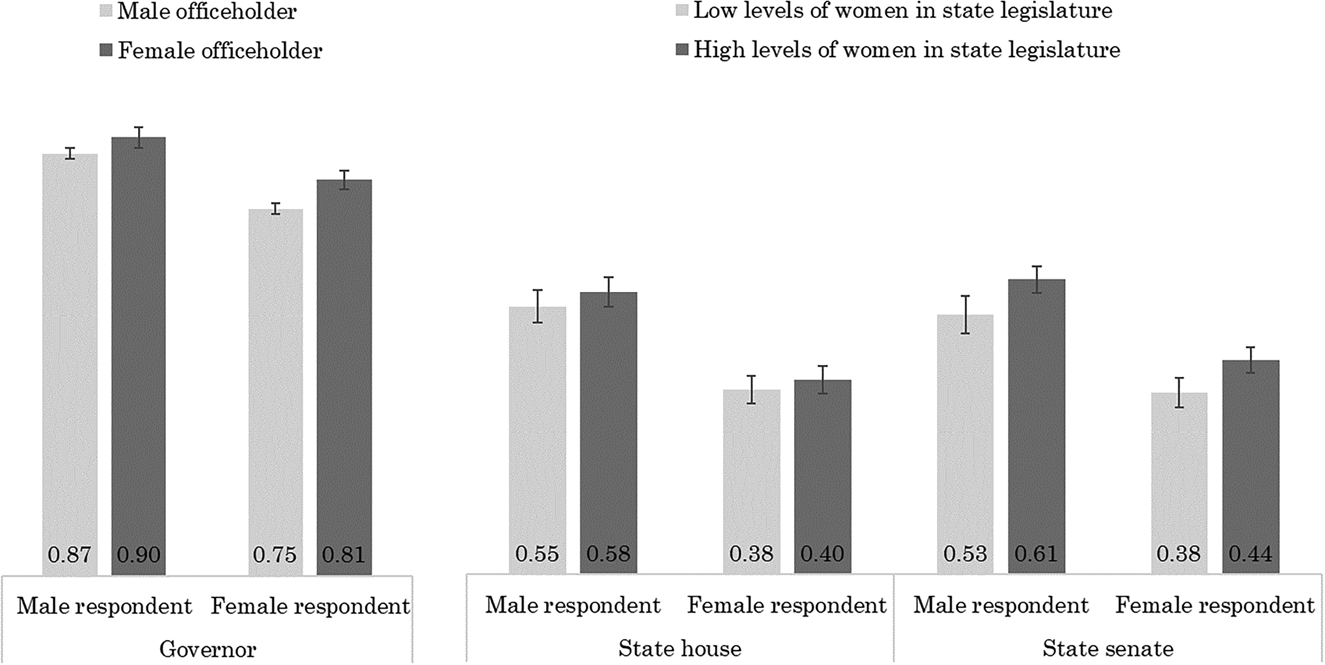
In the case of state political knowledge, both men and women are slightly more likely to know the partisanship of the governor when she is female. As the plot of predicted knowledge in Figure 3 shows, the magnitude of the effect of the governor's gender is small and statistically significant, but it was not significantly different for men than for women. In the case of people's knowledge of the partisan composition of the state legislature, the share of women in the state legislature is unrelated to knowledge of party control of the state house.Footnote 10 In the case of the state senate, both men and women have a greater likelihood of knowing the partisan control of the state senate when women are more highly represented, but the magnitude of this increase is statistically indistinguishable for men and women in the sample.
Gender and state political knowledge.

Citizens are more likely to hold partisan knowledge when represented by women, which suggests that increasing women's representation is important for the knowledge and civic competence of the electorate. However, in contrast to predictions from theories of women's empowerment, these knowledge gains do not appear unique to women in the sample. Both men and women reveal greater political knowledge when represented by women. Only in the case of the Senate was there any evidence that women's knowledge gains under female representation were significantly greater compared to men's. In the other cases, knowledge gains for men and women were of similar magnitude.
Why do men and women tend to reveal similar knowledge gains when represented by women in office? Perhaps a novelty effect is at play in which women lawmakers remain more attention-grabbing or noteworthy compared to men. Or perhaps this finding provides evidence of heuristic use in which both men and women are better at guessing the partisanship of female politicians, given that women in Congress are more likely to be Democrats than Republicans. To consider the second possibility, I explored whether these effects depend on the party of the legislator. Using three-way interactions of respondent gender, the gender of the politician, and the partisanship of the elected official, I found little evidence to suggest that respondents were more likely to know the party of their female representative when she was a Democrat than when she was Republican.Footnote 11 Instead, women politicians were more salient or more memorable to both men and women in the sample, independent of their party.
To consider the ramifications of this political knowledge, I also conducted several robustness checks. I explored whether the effects of descriptive representation were specific to those cases in which women were represented by female politicians who shared the same partisanship. Others have argued that the importance of descriptive representation to women's political engagement is conditioned on whether the partisanship of the politician is congruent with that of the respondent (Lawless Reference Lawless2004; Reingold and Harrell Reference Reingold and Harrell2010). In the supplemental appendix, robustness checks offer little evidence that the effects of politician gender on women's political knowledge is any greater given shared partisanship.Footnote 12
I also explored whether the effects of women's representation vary across the years of the samples, to determine whether the effects of politician gender were more pronounced in some years than in others as a function of variations in the salience of gender to national news coverage of the election (Hansen Reference Hansen1997; Koch Reference Koch1997). I considered the effects across five different elections, including three midterms and two presidential elections. However, it was difficult to determine which elections really met this criterion. In 2008, there was a strong female contender for the presidency. In 2010, the campaign rhetoric around the “War on Women” had particular play in news coverage. In 2012, women had historic gains in the Senate. The 2014 election resulted in a record-breaking number of women serving in Congress. In the supplemental appendix, I report the models disaggregated by election year.Footnote 13 However, in no particular years was the presence of women officeholders distinctively important for women's political knowledge or engagement.Footnote 14
WOMEN'S REPRESENTATION AND LEVELS OF POLITICAL ENGAGEMENT
Next, I explore whether the presence of women politicians affects the ways that other women interact with politics. Even if women's representation in politics did not seem strongly associated with knowledge gains among women, descriptive representation may alter women's behavior, inspiring greater interest in political pursuits. As shown in Figure 1, women are less likely than men to say that they follow politics and are less likely to participate in campaigns. If this was due to women's underrepresentation in politics, then we might expect to see greater interest and engagement in places where women are better represented on the ballot. In prior studies, women's representation in politics has been thought to help close gender gaps in political interest and engagement (e.g., Burns, Schlozman, and Verba Reference Burns, Schlozman and Verba2001; Dolan Reference Dolan2006; Fridkin and Kenney Reference Fridkin and Kenney2014; High-Pippert and Comer Reference High-Pippert and Comer1998; Lawless Reference Lawless2004).
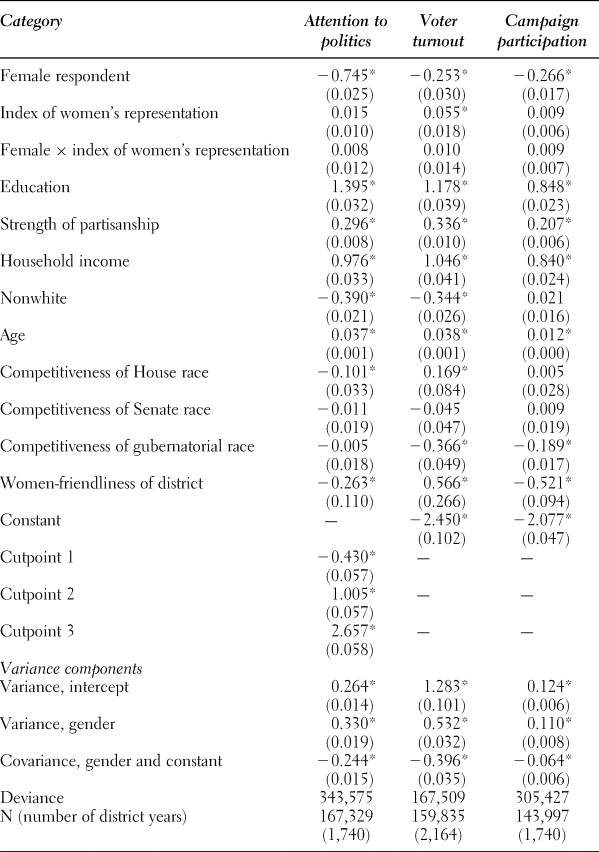
I explored this hypothesis using three measures of political engagement that have been regularly included in the CCES surveys: (1) expressed interest in following politics, (2) (validated) voter turnout, and (3) campaign participation. Although the last analyses focused on specific knowledge of one's representative, here I expand my focus to consider the potential empowering effects associated with both women candidates and women officeholders. In prior studies, some have focused on the empowering effects of being represented by women in office (e.g., Fridkin and Kenney Reference Fridkin and Kenney2014; Lawless Reference Lawless2004), whereas others have considered the empowering effects of women candidates (e.g., Atkeson Reference Atkeson2003; Dolan Reference Dolan2006; Hansen Reference Hansen1997; Koch Reference Koch1997; Wolak Reference Wolak2015). Both have the potential to encourage women's engagement. In the case of elected officials, women's orientations to politics may change most when they are personally represented by other women in politics. In the case of women candidates, the presence of women on the ballot may alter how women choose to interact with the campaign before them. Following Reingold and Harrell (Reference Reingold and Harrell2010), I created an index that summed the number of women running for governor in the state, the number of women running to represent the respondent in Congress, and the indicators of being represented by a woman in the House, in the Senate, and in the governor's office. I use the same individual level controls as in the knowledge models. At the state and district level, I include controls for the competitiveness of congressional and gubernatorial races as well as the women-friendliness of the district.
I first consider the relationship between women's presence in politics and the political interest expressed by survey respondents, using an item about how much people followed government and current events.Footnote 15 Because responses were recorded on a four-point scale, I use multilevel ordered logit with random effects associated with congressional district years. These results are shown in Table 3. The interaction between women's representation and the gender of the respondent is not statistically significant. Although women are significantly less interested in politics than men, levels of political interest appear unrelated to being represented by women in politics.
Descriptive representation and campaign engagement

First column, multilevel ordered logit, second column, multilevel logit, third column, multilevel negative binomial estimates. Standard errors in parentheses. * p < 0.05.
I also consider the effects of female representation and female candidates on levels of political participation. I first examine voter turnout using the validated voter turnout measure in the CCES. Second, I consider campaign participation beyond the voting act. I summed the answers to four items about people's political participation in the last year: (1) whether the respondent attended local political meetings, (2) whether the respondent put up a political sign or bumper sticker, (3) whether the respondent worked for a candidate or a campaign, and (4) whether the respondent donated money to a campaign, candidate, or political organization.Footnote 16 For the voter turnout models, I rely on multilevel logit; for the political participation models, I use multilevel negative binomial regression.
As shown in Table 3, I find little evidence in support of the argument that women candidates and officeholders uniquely inspired political engagement among women in their districts.Footnote 17 The interaction effect between the gender of the respondent and women's political representation is insignificant in both the voter-turnout model and the campaign participation model. When women live in places where they are represented by women or saw more women running for office, they are no more likely to turn out to vote than if they are represented by men. As women's political representation increases, other women in the electorate are no more likely to participate in campaign activities like donating money or volunteering for a campaign. As reported in the online appendix, these findings are robust to alternative specification of women's political representation.Footnote 18 Although women's representation in politics has been associated with levels of political knowledge, this representation appears unrelated to women's decisions to participate in politics.
DISCUSSION
These results suggest that descriptive representation plays, at most, a modest role in inspiring political knowledge and engagement among other women. Both men and women generally showed greater political knowledge when represented by women, but for the most part, women have little unique benefit in political knowledge from descriptive representation. The results offer little evidence that the politician and candidate gender matters for outcomes other than political knowledge. Descriptive representation appears to have little effect on women's interest or engagement in politics.
Past studies have predominantly found support for the thesis that women's representation in politics is important for the political engagement of other women. Why was there no evidence of this in this study? In many ways, the CCES are very well suited to detecting the effects of women's presence in politics. The large sample size of the surveys provides good statistical power to detect even small effect sizes. In contrast to the ANES, which covers only some portion of districts represented by women, the CCES includes respondents from the population of all states and districts represented by women in office. The coverage of nearly all national races and major state races with women candidates across multiple election years in both presidential and midterm contests means that these results are not a function any unique attributes of the campaigns that overlap with the districts included in the survey sample. I cast a relatively wide net by considering the potential empowering effects of both women candidates and women officeholders across both state races and national contests, and I found little evidence that women's presence alone altered how other women uniquely engaged in politics. Although I cannot be certain, the lack of much evidence in support for theories of women's empowerment may be a function of the changing trends in how people viewed gender in campaigns. Just as gender seems to not be particularly salient to how candidates present themselves or how voters evaluate the candidates, women's representation in politics may also not be very important to how women approach campaigns.
In this study, my focus was on the global effects of women's representation in office and on the ballot for how other women engage in politics. I focused on these direct effects as a way to investigate whether women as a group were different in how they interacted with campaigns in the face of descriptive representation. I found little evidence that this was the case. However, women's political representation may matter for outcomes other than those considered here. Some have explored whether descriptive representation can encourage feelings of efficacy (Atkeson Reference Atkeson2003; Atkeson and Carrillo Reference Atkeson and Carrillo2007; Dolan Reference Dolan2006; Lawless Reference Lawless2004), but I was unable to test this because the CCES does not include measures of efficacy. Likewise, both men and women reported higher partisan political knowledge when represented by women in office. However, greater empowerment effects might emerge when other kinds of political information are considered (Fridkin and Kenney Reference Fridkin and Kenney2014; Jones Reference Jones2014).
Women's representation may be consequential for some subsets of women in the electorate, even if it is not important globally important to women as a group. For women with high gender consciousness, descriptive representation might hold greater mobilizing potential. Also, women's representation in politics may matter for political socialization of young women (Campbell and Wolbrecht Reference Campbell and Wolbrecht2006; Wolak and McDevitt Reference Wolak and McDevitt2011; Wolbrecht and Campbell Reference Wolbrecht and Campbell2017). Likewise, some women officeholders may do more to encourage women's political engagement than others due to the issues they are engaged in or the policy positions they lobby for. Prominent women lawmakers who pursue policies important to women as a group might be more likely to affect how other women engage with politics, even if few empowerment effects emerge for women officeholders overall. Even if this is the case, women as a group are not distinctively responding to descriptive representation, which is consequential for the normative value placed on women's incorporation into politics. If women's representation in politics increases, some women might be encouraged to engage more in politics, but this will likely not be not a sufficient intervention to close those gender gaps that exist in women's knowledge of and participation in politics.
CONCLUSION
Prior studies have highlighted how women's representation in elected office could pay dividends for civic engagement, encouraging women to engage in politics, and helping close some of the gender gaps that exist in political knowledge and participation. However, in considering patterns of women's political engagement across congressional districts and states and over several elections, these results offer little evidence that the presence of women candidates or women officeholders uniquely inspires the interest or political participation of other women. Even though normative theorists may value the goal of descriptive representation in principle, it is less clear that descriptive representation alters citizen behavior in practice. To the extent to which descriptive representation alters how women think about politics, its effects do not appear to be tied to specific dyadic representation by other women in office. I found little evidence that women are more likely to express interest in politics, engage in campaign participation, or turn out to vote when women are represented in office or on the ballot.
Rather than being uniquely important to women, I find that women's presence in politics is noteworthy to both men and women. When represented by women in the House or in the governor's office, both men and women were more likely to correctly identify her partisanship than when represented by men in those roles. In the case of the Senate, both men and women were significantly more knowledgeable when represented by women, but the gains made by women were at least sometimes significantly greater than those seen among men. Because both men and women tended to be knowledgeable when represented by women in office, increasing women's representation in politics will not likely close existing gender gaps in political knowledge. Women politicians are better known to their constituents, but women report lower levels of political knowledge than men, even when represented by women in office.
SUPPLEMENTARY MATERIAL
To view supplementary material for this article, please visit https://doi.org/10.1017/S1743923X18000910.