


Introduction
Somatic symptoms (SSs) represent a host of physical complaints, such as headaches or chest pain that often necessitate clinical attention from pediatricians, school nurses, or other health care providers. Somatic symptoms can cause significant interference with daily functioning, including sleep problems, school absences, and disruptions in social activities (Roth-Isigkeit, Thyen, Stoven, Schwarzenberger and Schmucker, Reference Roth-Isigkeit, Thyen, Stoven, Schwarzenberger and Schmucker2005). Although SSs are common among children and adolescents in general (Garber, Walker and Zeman, Reference Garber, Walker and Zeman1991), studies have indicated a higher prevalence of SSs among youth with psychiatric conditions (Egger, Angold and Costello, Reference Egger, Angold and Costello1998; Garber et al., Reference Garber, Walker and Zeman1991; Livingston, Taylor and Crawford, Reference Livingston, Taylor and Crawford1988). Furthermore, in both clinical and community-based studies, research has revealed a specific association between anxiety disorder diagnoses and rates of SSs, such that, compared with non-anxious children, children with anxiety disorder diagnoses have more SSs (Beidel, Christ and Long, Reference Beidel, Christ and Long1991; Egger, Costello, Erkanli and Angold, Reference Egger, Costello, Erkanli and Angold1999; Jolly et al., Reference Jolly, Wherry, Wiesner, Reed, Rule and Jolly1994; Masi, Favilla, Millepiedi and Mucci, Reference Masi, Favilla, Millepiedi and Mucci2000).
Despite being a core characteristic of anxiety disorders, research on SSs in pediatric anxiety disorders is limited due to several methodological inadequacies, including differences in the types of SSs investigated across studies and lack of a consensus regarding a standardized measure for evaluating SSs. Furthermore, the majority of research has focused exclusively on investigating the frequency of SSs, with little attention paid to examining the impact of SSs on symptom severity, impairment, and treatment response. There are mixed findings regarding age and gender differences in the frequency and type of somatic symptoms among pediatric patients, with some studies reporting age differences (Ginsburg, Riddle and Davies, Reference Barbosa, Tannock and Manassis2006; Last, Reference Last1991; Masi et al., Reference Masi, Favilla, Millepiedi and Mucci2000) and gender differences (Egger et al., Reference Egger, Costello, Erkanli and Angold1999; Livingston et al., Reference Livingston, Taylor and Crawford1988), and other studies finding no age (Egger et al., Reference Egger, Costello, Erkanli and Angold1999; Livingston et al., Reference Livingston, Taylor and Crawford1988) or gender differences (Ginsburg et al., Reference Ginsburg, Riddle and Davies2006; Last, Reference Last1991; Masi et al., Reference Masi, Favilla, Millepiedi and Mucci2000).
The most rigorous study of SSs among children with anxiety disorders examined 128 children diagnosed with social phobia (SOP), separation anxiety disorder (SAD), and/or generalized anxiety disorder (GAD) (Ginsburg et al., Reference Ginsburg, Riddle and Davies2006). Results indicated that the overwhelming majority (96%) of the sample reported at least one somatic symptom, and the mean number of somatic symptoms reported per child was six (Ginsburg et al., Reference Ginsburg, Riddle and Davies2006). The most common SSs in this sample were restlessness (74%), stomachaches (70%), blushing (50%), palpitations (48%), muscle tension (45%), sweating (45%), and trembling/shaking (43%). Findings from this study revealed that specific SSs were associated with certain anxiety disorders, and that older children reported more somatic symptoms than younger children. Results also indicated that SSs were significantly and positively related to anxiety symptom severity, impairment, and global functioning (Ginsburg et al., Reference Ginsburg, Riddle and Davies2006). Furthermore, results indicated that treatment with the selective serotonin reuptake inhibitor [SSRI] fluvoxamine had a superior effect on reducing SSs in this sample when compared to placebo. In another clinical sample of anxiety-disordered youths, 60% of the subjects reported experiencing at least one clinically significant SS (Last, Reference Last1991). As in the Ginsburg et al. (Reference Ginsburg, Riddle and Davies2006) study, findings revealed that the rate of SSs differed by type of anxiety disorder, suggesting the need to evaluate SSs within specific anxiety disorder diagnoses.
Although SSs have been studied in some anxiety disorders (i.e. GAD, SAD, SOP), limited data exist regarding the frequency and impact of SSs in youth with obsessive-compulsive disorder (OCD) despite the fact that SSs are a cardinal feature of anxiety disorders. To date, only one study of pediatric SSs has included youth with OCD (n = 9) in its sample, and findings suggested that these youth experienced higher rates of SSs (44%) compared to non-clinical youth (Last, Reference Last1991). Intuitively, youth with OCD may be more likely than healthy peers to experience SSs for several reasons, including heightened levels of OCD-related as well as generalized anxiety. Additionally, given that a primary symptom pattern in pediatric OCD pertains to somatic concerns (Ivarsson and Valderhaug, Reference Ivarsson and Valderhaug2006), it is likely that youth with such obsessions may selectively and maladaptively attend to and consequently exacerbate normal physiological sensations, leading to the development of SSs. For example, a child with fears of getting cancer may misinterpret a mild upset stomach as indicative of an early warning sign for the disease, and may consequently obsess about the stomachache, causing additional, anxiety-induced stomach pains. Within this instance as well as others, parents may accommodate symptoms by participating in rituals (e.g. checking somatic complaints), allowing the child to avoid situations that provoke somatic symptoms, escape from undesirable tasks (e.g. school) or gain access to preferred items. Finally, given elevated levels of mental health concerns in the parents of youth with OCD (Calvo, Lazaro, Castro, Morer and Toro, Reference Calvo, Lazaro, Castro, Morer and Toro2007; Derisley, Libby, Clark and Reynolds, Reference Derisley, Libby, Clark and Reynolds2005), it is possible that parents may model maladaptive ways of coping with somatic symptoms such as making catastrophic interpretations or performing ritualistic checking.
Although it seems clear that many youth with OCD may experience obsessions related to somatic concerns, we have limited data pertaining to the frequency of SSs among youth with OCD and whether these SSs relate to the clinical presentation of the disorder and the response to cognitive-behavioral treatment (CBT). Examining these relations has important implications for the assessment and treatment of youth with OCD. Significant relations may suggest the need to include an evaluation of SSs as part of routine OCD assessment. Additionally, the degree to which SSs are related to CBT response may establish the need to include additional interventions targeting these symptoms and their impact on treatment outcome. Finally, in revising the DSM-IV-TR (American Psychiatric Association, 2000), some have suggested moving OCD out of the anxiety disorders cluster into a separate Obsessive-Compulsive Spectrum Disorders classification (Bartz and Hollander, Reference Bartz and Hollander2006; Hollander and Zohar, Reference Hollander and Zohar2004). The presence of rates of SSs consistent with other pediatric anxiety disorders, however, would provide further phenomenological evidence for conceptualizing OCD as an anxiety disorder as many have suggested (Abramowitz and Deacon, Reference Abramowitz, Deacon, Abramowitz and Houts2005; Storch, Abramowitz and Goodman, in press). Thus, the present study contributes to the literature by examining the presence of SSs in a pediatric OCD sample. The present study has three primary aims: (1) to examine the frequency of SSs in youth with OCD and whether the frequency varies by age and/or gender; (2) to examine the associations between SSs, OCD symptom severity, general anxiety symptoms, depressive symptoms, and OCD-related impairment; and (3) to examine whether SSs are reduced following participation in CBT. We hypothesize that somatic symptoms would be common in pediatric OCD patients, correlate with symptom severity, anxiety, and depressive symptoms, and impairment, and would be significantly reduced following CBT.
Method
Participants
Participants were 85 children and adolescents between the ages of 7 to 17 years (M = 12.85 ± 3.02) who were seeking treatment for their OCD. Participants included 45 males and 40 females, and were primarily Caucasian (92.9%), followed by Hispanic (2.4%), Asian (2.4%), and Other (2.4%). Household income ranged from $25,000 to $190,000 annually (M = $85,088.61 ± $30,064.12). All participants had a principal diagnosis of OCD that was made by the first or second author following an unstructured clinical interview. Diagnoses were verified through administration of the Anxiety Disorder Interview Schedule for DSM-IV-Child Interview Schedule – Parent version (ADIS-IV-P; Silverman and Albano, Reference Silverman and Albano1996) and Children's Yale-Brown Obsessive Compulsive Scale (CY-BOCS; Scahill et al., Reference Scahill, Riddle, McSwiggin-Hardin, Sharon, King, Goodman, Cicchetti and Leckman1997) by a trained rater. Baseline assessments were conducted immediately before treatment commenced. Youth were stable on their medications for at least 8 weeks prior to beginning CBT. Of the sample, 56 were taking serotonergic medication for their OCD, 28 were not taking medication, and data about medication status were not available for 1 child. Comorbid diagnoses, when present, included the following: Attention Deficit/Hyperactivity Disorder (n = 22), Generalized Anxiety Disorder (n = 22), Major Depressive Disorder (n = 15), Social Phobia (n = 13), Oppositional Defiant Disorder (n = 10), Tourette's Disorder (n = 3), Panic Disorder (n = 3), Asperger's Syndrome (n = 2), Enuresis (n = 1), Separation Anxiety Disorder (n = 1), and Trichotillomania (n = 1).
Measures
Children's Yale-Brown Obsessive Compulsive Scale
Considered the gold standard for pediatric OCD symptom presence and severity, the CY-BOCS (Scahill et al., Reference Scahill, Riddle, McSwiggin-Hardin, Sharon, King, Goodman, Cicchetti and Leckman1997) consists of two primary parts: Symptom Checklist and Severity Scale. The Symptom Checklist provides information about the presence or absence of 54 common symptoms. The 10-item Symptom Severity Scale assesses the frequency, interference, distress resistance, and degree of control over both obsessions and compulsions. Separate scores for Obsession (5 items) and Compulsion Severity (5 items) are derived. These scores are summed to generate a Total Score (range 0–40), with higher scores indicating greater symptom severity. A number of studies have demonstrated that the CY-BOCS has excellent reliability (i.e. inter-rater reliability, internal consistency, 6-week test-retest stability) and construct validity (i.e. strong correlations with other measures of OCD symptoms, weaker correlations with divergent measures, treatment sensitivity; Scahill et al., Reference Scahill, Riddle, McSwiggin-Hardin, Sharon, King, Goodman, Cicchetti and Leckman1997; Storch et al., Reference Storch, Murphy, Geffken, Soto, Sajid, Allen, Roberti, Killiany and Goodman2004, Reference Storch, Abramowitz and Goodman2007; Yucelen, Rodopman-Arman, Topcuoglu, Yazgan and Fisek, Reference Yucelen, Rodopman-Arman, Topcuoglu, Yazgan and Fisek2006).
Child Behavior Checklist
The Child Behavior Checklist (CBCL; Achenbach, Reference Achenbach1991) is a 118-item parent report of their child's behavior. The CBCL consists of eight subscales measuring somatic complaints, social problems, anxiety/depression, withdrawn behaviors, attention problems, thought problems, delinquent behaviors, and aggressive behaviors. The CBCL also yields scores for Internalizing Problems, Externalizing Problems, and Total Problems. For purposes of this study, somatic complaints were not included in the Internalizing Problems subscale. Parents respond by rating the degree to which each behavior is representative of their child (0 = not true, 1 = somewhat or sometimes true, 2 = very true or often true). Widely used, the CBCL is psychometrically sound (Achenbach, Reference Achenbach1991; Aschenbrand, Angelosante and Kendall, Reference Aschenbrand, Angelosante and Kendall2005; Heubeck, Reference Heubeck2000).
Multidimensional Anxiety Scale for Children
The Multidimensional Anxiety Scale for Children (MASC; March, Parker, Sullivan, Stallings and Conners, Reference March, Parker, Sullivan, Stallings and Conner1997) is a 39-item self-report measure of anxiety symptoms. A Total Score is generated from the sum of all items; four subscale scores measuring physical symptoms, social anxiety, harm avoidance, and separation anxiety can also be derived. For purposes of this study, physical symptoms were not included in the Total Score. The MASC has demonstrated strong psychometric properties (Baldwin and Dadds, Reference Baldwin and Dadds2007; Rynn et al., Reference Rynn, Barber, Khalid-Khan, Siqueland, Dembiski, McCarthy and Gallop2006; March et al., Reference March, Parker, Sullivan, Stallings and Conner1997; March, Sullivan and Parker, Reference March, Sullivan and Parker1999).
Children's Depression Inventory
The Children's Depression Inventory (CDI; Kovacs, Reference Kovacs1992) is a self-report measure of the presence and severity of cognitive, affective, or behavioral symptoms of depression during the previous 2 weeks. The CDI consists of 27 items that ask the child to select one of three statements that best expresses how they have been feeling over the past 2 weeks, with individual item scores ranging from 0 to 2, and an overall score ranging from 0 to 54. The CDI is widely used and has demonstrated good internal consistency, test-retest reliability, and construct validity (Kovacs, Reference Kovacs1992; Timbremont, Braet and Dreessen, Reference Timbremont, Braet and Dreessen2004).
Child Obsessive Compulsive Impact Scale-Parent Version
The Child Obsessive Compulsive Impact Scale – Parent Version (COIS-P; Piacentini and Jaffer, Reference Piacentini and Jaffer1999) is a 58-item, parent-report measure that assesses the extent to which pediatric OCD causes impairment to the child. Items assess impairment in several domains of functioning including school activities (16 items), social activities (19 items), home/family activities (17 items), and 4 global impairment items related to school, social activities, going places, and home/family activities. Respondents rate OCD impairment for each area of functioning over the previous month using a 4-point scale ranging from “not at all” to “very much”. The COIS-P has demonstrated adequate psychometric properties (Piacentini, Bergman, Keller and McCracken, Reference Piacentini, Bergman, Keller and McCracken2003; Valderhaug and Ivarsson, Reference Valderhaug and Ivarsson2005) and treatment sensitivity (Storch et al., Reference Storch, Geffken, Merlo, Mann, Duke, Munson, Adkins, Grabill, Murphy and Goodman2007).
Somatic Symptoms Measure
Similar to Ginsburg et al. (Reference Ginsburg, Riddle and Davies2006), we formed two composite measures of SSs, one child-report and one parent-report. The parent-report somatic symptom index was created by combining nine items assessing somatic complaints from the CBCL. The child-report somatic symptom index was created by summing the 12 items assessing somatic symptoms on the MASC. Although Ginsburg et al. (Reference Ginsburg, Riddle and Davies2006) used a single measure of SSs based on clinician ratings, we believed that creating separate child and parent composite scores would provide meaningful information about how children and parents view their symptoms, as well as the possibility of differential relations with dependent variables. Cronbach's alpha for parent and child-rated SSs were .67 and .87.
Procedures
Prior to study onset, appropriate human subjects ethical approval was obtained from the University of Florida institutional review board. After a screening interview with the patient and his/her parent(s), participants were scheduled for an initial assessment prior to beginning CBT. At this assessment, the first or second author obtained written parental consent and child assent. Thereafter, a trained research assistant (RA) administered the ADIS-IV-P to confirm diagnostic impressions. Following this, the same RA administered the CY-BOCS to the parent(s) and child jointly. Relevant parent and child-rated indices were then completed.
Clinician raters were trained by the first author and had considerable prior experience working with pediatric OCD patients. Training consisted of an instructional meeting about the instrument content and structure, at least four mock practice interviews, and four interviews observed by the first or second author. The CY-BOCS was re-administered to 20 participants to examine inter-rater reliability; kappa was high for the total score (kappa = .96).
For the subset of youth receiving treatment (n = 62), CBT consisted of 14 90-minute sessions delivered in a weekly or intensive format that was based on the POTS (2004) protocol.Footnote 1 This empirically-supported treatment manual includes psychoeducation, cognitive training, and exposure with response prevention, and was adapted by the first author to be family oriented (i.e. include parents in sessions, considerable attention to family dynamics and reduction of family accommodation). Further information about the treatment provided can be found in Storch et al. (Reference Storch, Geffken, Merlo, Mann, Duke, Munson, Adkins, Grabill, Murphy and Goodman2007).Footnote 2
Data analysis
Only data from the baseline assessment were used to examine cross-sectional associations among study variables, while data from the baseline and post-treatment assessments for a subgroup of youth were used to examine the impact of CBT on SSs. Composite scores of somatic symptoms were calculated as means to account for differing numbers of items on parent and child scales. Independent sample t-tests were used to examine possible differences in parent- and child-rated individual SSs based on age (ages 6–11 vs. 12–17 years) and gender. Age groups were split in this manner to be consistent with Ginsburg et al. (Reference Ginsburg, Riddle and Davies2006). Pearson's correlations were used to examine the relationships among parent- and child-rated somatic symptom indices and study variables (e.g. CY-BOCS, CBCL scores, COIS-P, MASC, CDI). Given that the SS indices were derived from the MASC and CBCL, the overlapping items were removed in subsequent analyses (e.g. the MASC total score equaled the MASC minus any SS items that were embedded within this measure). Given the preliminary nature of this study, no statistical correction was used to minimize the chance of obscuring potentially important relationships.
In order to facilitate comparison of parent and child rated symptoms, items on the parent- and child-rated somatic symptoms indices were re-scaled for the following analyses only. These measures were chosen as part of a larger study, and therefore it was not possible to examine parent and child scores on the same measure. Parent responses were re-scaled as follows: 0 = 0, 1 = 3, and 2 = 6. Child responses were re-scaled as follows: 0 = 0, 1 = 2, 2 = 4, and 3 = 6. Both parent- and child-rated indices were then averaged across the number of questions in each scale. A 2 × 2 within-subjects analysis of variance (ANOVA) was used to test for significant differences based on reporter (parent or child) and treatment time-point (pre- and post-treatment). Paired-samples t-tests were used to examine individual SSs for change from pre- to post-treatment. Multiple regression was used to determine whether SSs predicted treatment outcome (measured by the CY-BOCS), with parent and child-rated symptoms entered in one block.
Results
Age and gender effects
No age differences were found on parent- and child-rated SS Total Scores. The child-rated SS Total Score revealed a gender difference such that females (M = 11.95 ± 5.99) endorsed more symptoms than males (M = 7.70 ± 6.17), t(77) = −3.09, p < .05.
Child responses
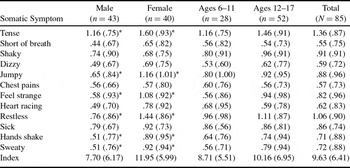
Table 1 presents child-rated means for individual items by age and gender. Girls endorsed the following symptoms more often than boys: tension, feeling jumpy, feeling strange, restlessness, shaking hands, and getting sweaty. There were no age differences on individual items. Overall, the most commonly reported symptoms were tension (85.0%) and feeling restless (69.1%). Only 3.5% of the children did not report any SSs, whereas 67.1% of the sample reported five or more SSs.
Child-rated means (standard deviations) for individual items by age and gender

Note: Child reported items are from the MASC (response scale = 0, 1, 2, or 3). Differences based on gender and age were tested with independent samples t-tests.
*p < .05, **p < .001
Parent responses
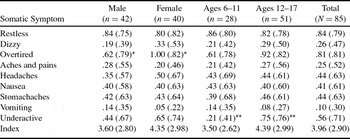
Table 2 presents parent-rated means for individual items as a function of child age and gender. Parents were more likely to endorse symptoms of tiredness for girls than for boys. Older children were more likely to be rated as underactive than younger children. The most commonly-reported symptoms included restlessness (59.0%) and being overtired (54.9%). Only 11.8% of the parents did not report any SSs in their children, whereas 28.1% of the sample reported five or more SSs.
Parent-rated means (standard deviations) for individual items by child age and gender

Note: Parent reported items are from the CBCL (response scale = 0, 1, or 2). Differences based on gender and age were tested with independent samples t-tests.
*p < .05, **p < .001
Associations among study variables
Child responses
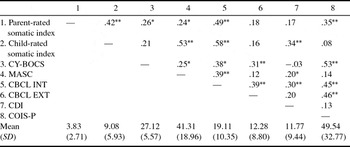
Child-rated SSs were significantly and positively related to parent-rated SSs, CBCL Internalizing score, and CDI score (see Table 3). They were also significantly related to the MASC total score (with overlapping somatic symptom items removed).
Correlations for somatic symptoms, psychological functioning, and impairment

Note: Parent-rated somatic index = somatic items from the Child Behavior Checklist; Child-rated somatic index = somatic items from the Multidimensional Anxiety Scale for Children; CY-BOCS = Children's Yale-Brown Obsessive Compulsive Scale; MASC = Multidimensional Anxiety Scale for Children without somatic items; CBCL INT = Child Behavior Checklist Internalizing without somatic items; CBCL EXT = Child Behavior Checklist Externalizing; CDI = Children's Depression Inventory; COIS-P = Child Obsessive Compulsive Impact Scale-Parent Version.
* p < .05, ** p < .01
Parent responses
Parent-ratings of their children's SSs were significantly and positively related to child-rated SSs, CY-BOCS total score, MASC total score, and COIS-P score (see Table 3). They were also significantly related to the CBCL Internalizing scale (with overlapping somatic symptom items removed).
Impact of responder and cognitive-behavioral treatment
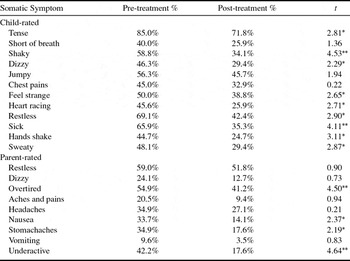
A total of 62 of the 85 children in the sample received a full course of family-based CBT. For this analysis, both parent- and child-rated SS scores are interpreted on a scale from 0 (no symptoms) to 6 (all symptoms). These children displayed a statistically significant reduction in total number of SSs across both reporters from pre- (M = 1.36 ± .10) to post-treatment (M = .95, ± = .09), F (1, 61) = 30.51, η2 = .333, p < .001. Examination of individual symptoms indicated that percentage of all child-rated symptoms decreased after treatment, and all parent-rated symptoms were decreased after treatment, with the exception of vomiting (see Table 4).
Percentages of somatic symptom endorsement before and after cognitive-behavioral therapy

Note: Child-rated symptoms reflect the percentage of children who gave a 1, 2, or 3 on somatic items from the MASC. Parent-rated symptoms reflect the percentage of parents who gave a 1 or 2 on somatic items from the CBCL. Differences between pre- and post-treatment scores were tested with paired-samples t-tests.
*p < .01, **p < .001
Many clinical trials use a threshold of 35% reduction in given symptoms to be considered clinically significant, and thus we employ that standard. Average percent reduction for individual symptoms (parent and child-rated) ranged from 7.06% to 23.33%. The average reduction in child-rated symptoms was 16.65% (SD = 21.00) and in parent-rated symptoms was 13.14% (SD = 18.68). However, given the large standard deviations of symptom change, improvement varied widely among participants. On parent-rated symptoms, 17.8% of children demonstrated at least a 35% reduction in overall symptoms. Parent-rated symptoms that were least likely to change included “Dizzy” (9.4% demonstrated at least a 35% reduction in symptoms), “Headaches” (7.7%), and “Vomiting” (8.2%), while those most likely to change included “Overtired” (18.2%) and “Underactive” (18.8%). On child-rated symptoms, 18.8% of children demonstrated at least a 35% reduction of overall symptoms. Child-rated symptoms that were least likely to change included “Chest pain” (7.1% demonstrated at least a 35% reduction in symptoms), while those most likely to change included “Shaky” (22.4%), “Restless” (20.0%), and “Sick” (23.3%). It is likely that symptoms demonstrating low percentage of change reflect items that were infrequently endorsed at pre-treatment, leaving little room for clinical improvement (see Table 4). Additionally, low percentages on parent-rated symptoms may reflect symptoms that are not easily observable (e.g. “Dizzy” and “Headaches”).
Presence of parent- and child-rated somatic symptoms at pre-treatment were not related to CY-BOCS scores at post-treatment (F = 1.06, p > .05, R2 = .032), indicating that somatic symptoms do not predict treatment response. However, change in somatic symptoms from pre- to post-treatment predicted 35.3% of the variance in the post-treatment CY-BOCS total score (F = 4.19, p < .05, R2 = .353), indicating that change in somatic symptoms is likely a marker for improvement in treatment.
Discussion
Despite data that indicate that SSs are highly prevalent among children with psychiatric conditions (e.g. Beidel et al., Reference Beidel, Christ and Long1991; Egger et al., Reference Egger, Costello, Erkanli and Angold1999; Ginsburg et al., Reference Ginsburg, Riddle and Davies2006), few studies have examined SSs in youth with OCD and their relationship to symptom severity. Thus, the aims of the current study were threefold: (1) to examine the frequency of SSs in youth with OCD and whether the frequency varies by age and/or gender; (2) to examine the associations between SSs, OCD symptom severity, general anxiety symptoms, depressive symptoms, and OCD related impairment; and (3) to examine the impact of CBT on SSs.
Somatic symptoms were common in this pediatric OCD sample, with 96.5% of children in the sample reporting at least one SS, and 67.1% reporting five or more symptoms. These prevalence rates are similar to those observed in children with anxiety disorders other than OCD (Ginsburg et al., Reference Ginsburg, Riddle and Davies2006; Masi et al., Reference Masi, Favilla, Millepiedi and Mucci2000), and suggest that appraisal of SSs should be incorporated into the routine assessment of pediatric OCD. Tension and feeling restless, both hallmarks of other anxiety disorders, were the most commonly-endorsed symptoms, highlighting the need for the assessment of comorbid anxiety disorders among youth with OCD as additionally suggested by the DSM-IV-TR (American Psychiatric Association, 2000). Although few age effects were observed, there were significant gender differences, with females endorsing six specific symptoms more often than males, including tension, feeling jumpy, feeling strange, restlessness, shaking hands, and getting sweaty. There are multiple potential interpretations of this finding. It could signify a gender difference in anxiety presentation, with males and females exhibiting unique patterns of symptoms. Alternatively, it may suggest that anxiety symptoms present differently in males than females (e.g. fewer SS in males), and point to a need for more comprehensive assessment techniques tailored to measure the unique clinical presentation exhibited by children of various genders and ages. This could also suggest that girls are more “in tune” with their somatic/visceral sensations, and may be more likely than boys to notice and report such symptoms. This gender disparity has important implications for clinicians, who may need to modify their assessment techniques in order to effectively evaluate SSs in both boys and girls. For example, OCD assessment protocols could be tailored to include specific items related to somatic complaints, while recognizing that certain SSs (e.g. tension, feeling jumpy, feeling strange, restlessness, shaking hands, and getting sweaty) are more likely to be reported by girls as opposed to boys.
Our findings indicate that parents generally reported fewer SSs than their child. It is difficult to ascertain whether this discrepancy between parent and child-report reflects an overestimation of SSs by children, an underestimation of SSs by parents, or both. On the one hand, these findings could suggest that parents may have difficulty recognizing SSs in children with OCD, a trend that is widely reported in the literature (e.g. Barbosa, Tannock and Manassis, Reference Barbosa, Tannock and Manassis2002; Engel, Rodrigue and Geffken, Reference Engel, Rodrigue and Geffken1994). On the other hand, clinical wisdom dictates that parents of children with OCD are frequently anxious; thus, this could reflect child over-reporting of symptoms that results, in part, from parental hypervigilance (e.g. parents' heightened awareness of any complaint, physical or emotional, in themselves or their children with OCD), parental modeling (e.g. children attending to somatic complaints on the part of their parent(s)) and reinforcement of symptoms (e.g. parents attend to the child when s/he reports somatic complaints). Parents may also inadvertently provide their children with further reinforcement via secondary gain, in the form of avoidance of school or other undesirable activities. Given the often secretive nature of certain obsessive-compulsive symptoms, another possibility is that children are not reporting SSs to their parents, thereby making it difficult for them to assess these largely internal symptoms.
The second study aim was to examine the associations between SSs, OCD symptom severity, general anxiety symptoms, depressive symptoms, and OCD related impairment. Findings revealed that child-rated SSs were significantly and positively related to parent-ratings of the children's SSs and internalizing symptoms, and child-rated depressive symptoms and anxiety symptoms, while parent-reports of the children's SSs were significantly and positively related to child-rated SSs and anxiety symptoms, clinician-rated OCD symptoms, and parent-rated OCD related impairment. The finding that parent-rated SSs but not child-rated SSs were significantly associated with OCD severity is somewhat surprising. This may reflect differences in the appraisal of SSs; for example, while parents may view SSs as related to their child's OCD symptoms or as part of their overall clinical presentation, children may view SSs as distinctly different from their OCD-related cognitions and behaviors. These results also suggest that perhaps, as noted above, parents are less proficient than children at assessing internalizing symptoms, including symptoms of anxiety and depression. This relationship between SSs and OCD severity is likely to result in increased impairment; indeed, our findings illustrated that increased SSs were associated with higher functional impairment as measured by the COIS-P. This impairment may manifest itself in various ways; for example, children with SSs may avoid participating in sports or activities or evade taking their medication due to their somatic complaints.
The final aim of the study was to examine the impact of participation in CBT on children's SSs. A statistically significant reduction in total number of SSs from pre- to post-treatment was observed, per both child and parent report. Additionally, modest reductions in the percentage of those reporting individual symptoms were observed, with the exception of parent-rated vomiting. This finding contributes to a growing body of research that suggests that CBT successfully addresses both the maladaptive cognitions and resulting overt behaviors that serve to maintain OCD symptoms. Further, it is likely that the cognitive and behavioral skills developed during treatment may generalize to improve other anxiety and mood symptoms in additional to alleviating OCD-related features. Children who participate in CBT for OCD are taught to challenge their initial appraisals of their cognitions and physiological symptoms. Thus, this generalization of treatment effects is likely to lessen SSs as well as OCD-related symptoms. Thus, it may be reasonable to expect SSs to decrease following CBT without additional adjunctive intervention (e.g. pharmacological). Indeed, our findings suggest that a change in somatic symptoms may be useful, in part, as a marker for treatment response.
Of note, although a significant reduction in total number of SSs from pre- to post-treatment was observed in the current study, this reduction was modest and our results demonstrate that some clinically significant somatic symptoms remain post-treatment. The presence of these residual symptoms suggests that CBT's effectiveness in addressing SSs may be enhanced through the inclusion of specifically tailored treatment techniques such as relaxation training and diaphragmatic breathing. Targeting SSs more directly (i.e. as separate from OCD symptoms) may yield even greater reductions in SS severity.
These findings also add to the considerable evidence suggesting that OCD warrants housing among the anxiety disorders in the forthcoming DSM-V (Marks, Reference Marks1987; Bolton, Reference Bolton, Hersen and Bellack1998; Mancini, Van Ameringen and Farvolden, Reference Mancini, Van Ameringen and Farvolden2002) rather than in a separate Obsessive-Compulsive Spectrum Disorders classification as some have suggested (Bartz and Hollander, Reference Bartz and Hollander2006; Hollander and Zohar, Reference Hollander and Zohar2004). Our findings indicate that anxiety-related SSs are highly prevalent among a pediatric sample with OCD in a manner similar to that of other pediatric anxiety disorders (e.g. Ginsburg et al., Reference Ginsburg, Riddle and Davies2006). Somatic symptoms are a hallmark of pediatric anxiety disorders and provide further phenomenological evidence for conceptualizing OCD as an anxiety disorder (Abramowtiz and Deacon, Reference Abramowitz, Deacon, Abramowitz and Houts2005); thus the present data support the theory of an anxiety-related somatic dimension to OCD as suggested by Lochner and Stein (Reference Lochenr and Stein2006), as opposed to a theory of multiple Obsessive-Compulsive Spectrum Disorders in which the overarching commonality among disorders is repetitive behavior (e.g. OCD, Body Dysmorphic Disorder, Pathological Gambling, Autism, etc; Bartz and Hollander, Reference Bartz and Hollander2006).
The present study has several important limitations. First, our measure of SSs was not standardized and represented items drawn from child- and parent-report measures. Second, although our assessment of SSs was fairly comprehensive, there are SSs that were not assessed by both parent and child (i.e. stomachaches). Third, a significant number of children in the study were on stable doses of medication for their OCD. Side effects of seretonergic medications may include several somatic-type symptoms; thus, it is difficult to tease out which SSs are related to medication use. Finally, our sample may have limited generalizability given that the majority of families who present at our OCD specialty clinic are Caucasian and of high SES.
Overall, these findings suggest that SSs are highly prevalent among youth with OCD and significantly impact the clinical presentation of the disorder, although CBT may also help to alleviate these symptoms. These results are congruent with findings from other studies that suggest that SSs are positively correlated with anxiety symptoms (Ginsburg et al., Reference Ginsburg, Riddle and Davies2006), and highlight the need for more comprehensive assessment of pediatric OCD and related comorbidities, including SSs. The development of future assessment techniques designed to capture the prevalence of specific SSs would likely guide clinical treatment decision-making. For example, the development of a standardized measure of SSs validated among children with anxiety disorders would facilitate the assessment and treatment of SSs among the pediatric OCD population. In addition to assessing for baseline levels of SSs, this would be helpful to monitor side effects commonly associated with serotonergic medications. From a CBT standpoint, recognizing the presence of SSs would allow clinicians the opportunity to problem-solve with parents about the origin of SSs and identify parent and child behaviors that may be inadvertently reinforcing them. For example, clinicians may be able to address reinforcing behaviors by the parents (e.g. attention) that serve to maintain somatic complaints.
Acknowledgements
The contributions of Marni Jacob, B.A. are gratefully acknowledged. Portions of this paper were supported by grants from the National Institutes of Health to TKM (NIMH K23 MH01739) and TKM and WKG (NIMH R01 MH063914).



Comments
No Comments have been published for this article.