1. Introduction
An extensive body of literature on the repression–dissent nexus examines how political repression shapes protest behavior. That is, researchers have generally employed protest activity as their unit of analysis in quantifying the effects of repression. Yet, research remains inconclusive because repression is found to produce every possible effect on dissenting behavior (Davenport and Inman, Reference Davenport and Inman2012). Rational choice theorists assert that repression deters collective action because it imposes participation costs and impedes future mobilization (Tilly, Reference Tilly1978). Others, however, draw on empirical evidence that repression often backfires owing to the perceived illegitimacy of the repressive act, individual proximity to the repressive episode, and prior integration into protest networks (White, Reference White1989; Opp and Roehl, Reference Opp and Roehl1990). Protest movements may also survive repression by sustaining key abeyance structures (Taylor, Reference Taylor1989). More scholars have come to recognize that the relationship between repression and dissenting behavior is conditioned by an array of factors, such as types and targets of repression (Lichbach, Reference Lichbach1987; Moore, Reference Moore1998; Earl, Reference Earl2011b; De Jaegher and Hoyer, Reference De Jaegher and Hoyer2019), time frame (Rasler, Reference Rasler1996), temporal sequence (Brockett, Reference Brockett1993; Sullivan et al., Reference Sullivan, Loyle and Davenport2012), and emotions (Klandermans et al., Reference Klandermans, van der Toorn and van Stekelenburg2008).
Although previous studies have greatly advanced our understanding of the dynamics between repression and protest behavior, challenges arise as researchers seek to identify the effects of repression at the level of individual preferences. As repression intensifies, the wider population could be inaccessible to surveys, or may falsify their preferences. Even studies emphasizing the role of emotions and grievances in response to repression often seem to infer mechanisms ex post from process-tracing protest behavior in abeyance or decline, or by interviewing and surveying informants retrospectively.
As much of the scholarship focuses on the most direct and observable changes in protest activity, we systematically overlook how repression interacts with the causal constituents of collective action, such as grievances, efficacy, and claim making (Klandermans and van Stekelenburg, Reference Klandermans, van Stekelenburg, Huddy, Sears and Levy2013). In particular, we know little about how repression affects underlying support for opposition demands. If repression reconfigures earlier causal links to protests, subsequent choices of political behavior may well fundamentally change. Repression can alter public perceptions and preferences, resulting in a variety of potential outcomes, such as disengagement, movement continuity or abeyance, or paradigm shifts in protest demands, goals, and tactics. Hence, to provide a more nuanced understanding of the consequences of repression, it is necessary to measure support for protesters' demands before and after the repressive event, regardless of whether people still turn out to protests.
The case of Hong Kong protests provides a unique opportunity to capture the effects of repression on political preferences. In the context of the massive anti-government protests that erupted in Hong Kong since June 2019, this study examines the changes (or lack thereof) in aggregate policy preferences regarding the ‘five demands’ before and after the enactment of the Hong Kong National Security Law (hereafter, the NSL), widely regarded as a major episode of institutional repression amid the yearlong protests. We revisit the theoretical linkages between grievances, opposition demands, and protest behavior, and posit that one possible reification of the repression effects is to distinguish whether the public is apathetic about or persists with opposition demands.
It is indeed challenging to estimate how the NSL has altered the utility of each protest demand, as the five demands call for comprehensive measures (i.e., bill retraction, police accountability for misconduct, amnesty for arrestees, and electoral reform) that entail political changes across varying time horizons. For this reason, we employ repeated conjoint experiments that estimate public support for policy proposals encompassing government responses to protest demands. By requiring participants to repeatedly select from attributes and levels, conjoint experiments are a robust and reliable tool that simultaneously estimates multidimensional preferences for these attributes and levels and their impacts on respondent choices, which overcomes the limitation of survey experiments that can only include few treatments (Bansak et al., Reference Bansak, Hainmueller, Hopkins, Yamamoto, Druckman and Green2020). In this regard, conjoint experiments can reveal the relative importance of each of the five demands, comparing them with other government policies, such as fiscal appeasement. Another significant advantage over conventional survey studies is that this method does not ask respondents to self-report political preferences, which mitigates social desirability bias (Horiuchi et al., Reference Horiuchi, Markovich and Yamamoto2020).
The first conjoint experiment was conducted from April to May 2020, before the NSL was first unveiled to the public, providing the baseline estimates before the draconian repression. The results first show that financial appeasement had little effect on respondents' preferences compared with responses to protest demands, regardless of their political positions. Second, we observe homogeneity across the two pro-democracy factions (i.e., pan-democrats and localists) in preferences concerning the five demands. The primary demands of the pro-democracy camp were the establishment of an independent commission of inquiry (COI) into alleged police brutality and dual universal suffrage. Third, the preferences of the pro-establishment camp differed from those of the pro-democracy camp; however, importantly, the pro-establishment camp did not significantly reject many of the concessions, even with the establishment of a COI and dual universal suffrage. In other words, pro-establishment supporters were neutral about, or indifferent to, a COI or dual universal suffrage. However, the pro-establishment camp most strongly objected to amnesty for all arrested protesters and retraction of the classification of protesters as ‘rioters.’
Following the completion of the first conjoint experiment, the plan to pass the NSL was first revealed publicly by pro-Beijing media in an exclusive report from a source on 21st May and later became effective on 30th June. The NSL was a political shock that prompted an immediate backlash. Thousands of protestors defied the social gathering ban and took to the streets on 24th and 27th May to protest against both the NSL and the National Anthem Law, and on 4th June to participate in the banned annual candlelight vigil. One of the last large-scale street protests in the city was on 1st July, when crowds again swelled in opposition to the NSL on the first day of its enactment. Ten arrests were made on the scene under national security offences. A handful of small ‘Sing with You’ protests in shopping malls followed until 610,000 eligible voters peacefully turned out to the opposition-led pro-democracy primaries, later to be outlawed under the NSL, between 11th and 12th July.
This series of dramatic shifts in Hong Kong's political landscape demonstrated that the sweeping powers outlined by the NSL had great potential to change Hong Kong citizens' preferences for the five demands; therefore, the second conjoint experiment was implemented between 3rd and 24th August 2020 and the post-repression preferences were compared with those before the legislation. Note that the repeated conjoint experiments cannot isolate changes of preferences at the individual level because each participant responds to different selection tasks in the first and second experiments. Thus, the changes between the first and second experiments can only be captured at the aggregate level. In addition, as the comparison between the first and second conjoint experiments lacks a control group (i.e., all participants are ‘treated’ by the NSL), we cannot isolate the causal impact of the NSL on policy preferences. Thus, this study only reveals temporal changes in aggregate policy preferences caused by any number of factors, including the enactment of NSL, which was enacted between the first and second conjoint experiments.Footnote 1
The primary finding was that the preferences estimated in the first conjoint experiment were mostly stable despite the repression, although some notable moderation in the demands from the pro-democracy camp was observed. That is, the pattern of aggregate public preferences regarding the five demands did not change significantly after the enactment of the NSL, regardless of participants' political positions. This suggests that preferences concerning the five demands have been entrenched among Hong Kong citizens by the political unrest that began in June 2019.
Overall, this study shows that institutional repression, in this case the enactment of the NSL, was not effective in altering public support for protest demands, even though it may have visibly reduced the prevalence of street protests in Hong Kong. This suggests avenues for future research to confirm the mechanisms involved and examine the subsequent changes in protest behavior that each mechanism produces.
2. Rethinking collective action and the expression of demands
How does protest, as a form of contentious collective action, emerge? Klein and Regan (Reference Klein and Regan2018: 488) explain the formation of protest by stating ‘Grievances generate demands that citizens can express in the form of protests.’ This essentially identifies several causal processes that produce collective action. Members of society must perceive and develop shared grievances over a discrepancy between the status quo and their political preferences. Those who are inclined to change the status quo reveal their preferences by articulating opposition demands to the government, which the latter may or may not accommodate. In this bargaining process, citizens participate in activities in an attempt to influence political decisions, including but not limited to voting in elections, making donations, joining campaigns, and – of interest in this study – protests.
The current state of literature on the repression–dissent nexus probes into the causal effects of repression on protest behavior. Davenport (Reference Davenport2007: 2) defines state repression as:
The actual or threatened use of physical sanctions against an individual or organization, within the territorial jurisdiction of the state, to impose a cost on the target as well as deter specific activities and/or beliefs perceived to be challenging to government personnel, practices or institutions.
With repression as a cost-imposing strategy, rational choice models commonly predict that it dampens and quells protests. Targeting both the dissidents and bystanders who may potentially join and sustain the opposition, repression aims to diminish the capacity and will of individuals to engage in collective action. Participation in collective action is expensive because repression makes clear the severity and certainty of punishment (Ross and Lafree, Reference Ross, Lafree, Smelser and Gerstein1986), especially when arrests are anticipated (Earl, Reference Earl and Sarat2011a). Moreover, the opposition faces difficulties in mobilizing resources such as recruits and funds, owing to the perceived efficacy in reducing willingness to participate and its subsequent waning (Klandermans, Reference Klandermans1984; Rasler, Reference Rasler1996). In addition, dispiriting emotions, such as fear and avoidance, foster risk aversion and prioritization of security, leading individuals to resign rather than resist (Goodwin and Pfaff, Reference Goodwin, Pfaff, Goodwin, Jasper and Polletta2001; Klandermans, Reference Klandermans2003, Reference Klandermans, Snow, Soule and Kriesi2004; Klandermans et al., Reference Klandermans, van der Toorn and van Stekelenburg2008; Pearlman, Reference Pearlman2013).
Central to our understanding of the effectiveness of repression is its ability to alter the cost structures of participation in collective action. This explains why collective action emerges even in highly repressive environments. Drawing on the 1989 Eastern European revolutions, Kuran (Reference Kuran1989, Reference Kuran1991) conceptualizes the ‘revolutionary threshold’ and argues that individuals voice their dissent publicly once the internal costs of preference falsification outweigh the external costs of joining the opposition, given that their private preferences remain constant. In the context of civil wars, Kalyvas and Kocher (Reference Kalyvas and Kocher2007) contend that the opposition can overcome collective action and coordination problems when the risks of nonparticipation or free riding exceed those of collective action. Similarly, Maher (Reference Maher2010) concludes that overt collective action took place when the repressive threat was collectively perceived as fatal and immediate. Pearlman (Reference Pearlman2013) highlights that even when repression occurs as a presumably less lethal form of protest policing, outrage about excessive police violence and illegitimate state repression have a powerful role in fueling a public backlash to overcome fear, promoting acceptance of risk, and prioritizing dignity over security.
Following this line of thought, scholars have further distinguished between situational and institutional repression to investigate their effects on mobilization. ‘Situational repression’ typically refers to protest policing, which is by nature reactive to mobilization events, whereas ‘institutional repression’ encompasses a variety of indirect, preemptive measures, such as bans on organizations and demonstrations, or trials and court rulings against activists (Koopmans, Reference Koopmans1997). One escalatory mechanism is moral outrage and indignation at situational repressive events (Brockett, Reference Brockett1993; Costalli and Ruggeri, Reference Costalli and Ruggeri2015) as state coercion elicits a sense of injustice among activists and bystanders (Della Porta, Reference Della Porta2013; Aytaç et al., Reference Aytaç, Schiumerini and Stokes2018). Observational and survey experimental evidence also found the same backfiring effect of police repression in China and Uganda (O'Brien and Deng, Reference O'Brien and Deng2015; Curtice and Behlendorf, Reference Curtice and Behlendorf2021). In both cases, perceived police brutality has reduced government legitimacy and general support for the security apparatus, provoked public sympathy for protesters, and raised willingness to dissent openly despite heightened repression. Moreover, subsequent mobilization becomes more likely if the repressive episode is effectively communicated to the public (Hess and Martin, Reference Hess and Martin2006). In contrast, institutional repression has received less theoretical attention, but is, in fact, more consistent and legitimate because it is oriented toward preventing mobilizing structures from taking shape (Koopmans, Reference Koopmans1997).
Given all those variations of behavioral outcomes in the aftermath of repression, the repression–protest nexus is anything but a simple two-step process, and it requires closer attention to other mechanisms in the process. For example, the preservation of abeyance structures, such as activist networks, repertoires of goals and tactics, and construction of a collective identity, facilitates the reemergence of social movements despite prolonged repression (Taylor, Reference Taylor1989; Taylor and Crossley, Reference Taylor, Crossley, Snow, Della Porta, Klandermans and McAdam2013). In this regard, key pathways leading to collective action, for instance protest goals expressed as demands, can remain intact after the repressive event. Therefore, the effects of repression should be evaluated not only in terms of protest activity, but also its potential to alter public perceptions and preferences by spurring collective action and affecting subsequent political behavior.
From this perspective, a variety of potential outcomes can be observed, such as disengagement, radicalization, or a paradigm shift in protest goals, demands, and tactics, which makes it difficult to predict the occurrence or recurrence of protest under repression. Chenoweth and Ulfelder (Reference Chenoweth and Ulfelder2017) show that protesters use a creative combination of methods to overcome challenges; therefore, structural factors cannot reliably predict protest dynamics. A simulation of protest diffusion through social networks by Steinert-Threlkeld and Steinert-Threlkeld (Reference Steinert-Threlkeld and Steinert-Threlkeld2021) also shows that the intensity of repression can increase, decrease, or have no effect on the size of the protest. Moreover, the inconsistency was most significant when the repression rate is close to what is observed in reality. Despite scholarly attempts to solve the longstanding repression–dissent puzzle, there is still no all-encompassing theory that accounts for the diversity in protest characteristics, especially because protest groups and state leaders have the agency to adapt themselves constantly to adverse conditions and create paradigm shifts in protest behavior. It is thus necessary to examine each individual case in detail.
Consider the case of the Hong Kong protests, where both opposition demands and tactics drastically changed with shifts in protesters' perceptions and preferences within the first few months. For example, the earlier version of the five demands included the resignation of Chief Executive (CE) Carrie Lam and principal officials, but was later replaced by a broader demand for dual universal suffrage, because protesters soon readjusted their preferences to seek a lasting representative political system over a quick political solution (Lee et al., Reference Lee, Yuen, Tang and Cheng2019). Following a series of incidents of alleged police brutality and collusion with the triads during the Yuen Long incident on 21st July 2019, protesters also began to tolerate and justify radicalization as ‘necessary self-defense’ because they registered a salient deterioration in the status quo, stating that ‘but up to that day [July 21st] I feel that all these means [i.e., traditional forms of protest or seeking to use mainstream politics] have come to an end and they no longer achieve anything’ (Stott et al., Reference Stott, Ho, Radburn, Chan, Kyprianides and Morales2020: 15).
Thus, our study focuses on the specific interaction between repression and public support for opposition demands. By measuring the relative importance of protest demands in determining individuals' policy preferences, we can distinguish whether the public is genuinely indifferent to the demands. If the institutional repression is effective, the demands should no longer affect policy preferences. Admittedly, this study does not seek to test explanatory mechanisms for the observed effects, nor does it intend to predict future protest dynamics. Rather, it provides a preliminary understanding of the effects of repression on opposition demands and calls for further investigation into these meaningful questions.
3. ‘Five demands’ of the Hong Kong protests
This study examines the anti-government protests in Hong Kong that erupted in June 2019 and the resulting government repression. The anti-government protests, which started as opposition to a proposed bill to allow the extradition of fugitives to mainland China, became protracted with multiple large-scale rallies against the police and government. On 1st July 2019, protestors formally articulated their so-called ‘five demands,’ that is, full withdrawal of the extradition bill, establishment of an independent COI into alleged police brutality,Footnote 2 retraction of the classification of protesters as ‘rioters,’ amnesty for arrested protesters, and dual universal suffrage in electing the Legislative Council and the CE.Footnote 3 The demands were supported not only by the protesters, but also by broader audiences. In a poll conducted in October 2019, support for the establishment of a COI and for dual universal suffrage reached 87.6 and 81.3%, respectively (Centre for Communication and Public Opinion Survey, 2019).
These demands were packaged as ‘five demands, not one less’ in a popular protest slogan. Although the slogan was titled ‘not one less,’ many dissidents did not believe that all five of the major appeals would be granted at once. However, they considered some partial concessions by the government to be feasible. In fact, the extradition bill was withdrawn, fulfilling one key demand. In addition, CE Carrie Lam mentioned an independent review committee with members appointed by the SAR government and certain measures to ensure that some underage arrestees would neither be prosecuted nor have a criminal record, suggesting some room for compromise. These suggestions led some of the pro-democracy people to expect that partial concessions or compromises by the government were possible. However, no meaningful progress has been made to date.
What is theoretically unique and important about the five demands is that they were raised to strengthen solidarity within the pro-democracy movement. Hong Kong's democratization and the backlash against it have been a common thread in Hong Kong politics since 1997. Large-scale demonstrations have become more frequent since the early 2000s, but on the contrary, cracks within the pro-democracy camp had become increasingly apparent. In particular, the rift had grown between the traditional pan-democrats, who were more willing to engage with Beijing, and the emerging localists with a more radical and exclusionary stance toward the mainlanders, which became a major factor in the failure of the 2014 Umbrella Movement. One of the aims of the five demands was to learn from the lessons of the Umbrella Movement and to strengthen solidarity by bridging these rifts within the pro-democracy camp (Lee, Reference Lee2020). In this sense, the five demands were not only an expression of grievances and political preferences, but also one of the mechanisms to consolidate the diverse pro-democracy groups.
After a year of mass protests, the Chinese central government announced the enactment of the Hong Kong NSL in May 2020, which came into effect on 30th June 2020. The NSL criminalizes any act of secession, subversion, terrorism, and collusion with foreign or external forces. Although the law's terms and operations remain largely arbitrary, the promotion of Hong Kong independence and the use of major protest slogans are now considered outlawed. On 6th January 2021, mass arrests of 53 opposition figures were conducted for suspected subversion in organizing or running in the pro-democracy primaries in July 2020, involving some 1,000 local national security officers. Because of the possibility that national security agents from the mainland were involved in the investigation, the chilling effect has suppressed dissent on the streets and in social media. The NSL is qualitatively different from the previous local repression enforced by police in that it clarifies the central government's involvement in protest repression and institutionalizes harsh repression. Because the NSL casts doubt on the maintenance of ‘One Country, Two Systems,’ 10 countries have expressed their concerns and suspended their extradition treaties with Hong Kong. The USA also unprecedentedly imposed targeted sanctions against senior Hong Kong and Chinese officials.
In fact, since the NSL came into effect, the visible expression of the five demands has been greatly reduced, in part because of the continued COVID-19-related ban on public assembly. The reduction of visible protest activity, in turn, raises the threshold for participation in protests. More specifically, repression raises costs of protesting through harsher punishments and alters the social environment defined by the number of visible protesters, enhancing the hurdle of collective action for less radical participants (Granovetter, Reference Granovetter1978). When people commonly expect the demise of protests, political apathy would prevail among protesters and those who support them (al-Anani, Reference al-Anani2019), weakening support for the demands even at a preference level that is not visible. It may be more rational for an individual to live a depoliticized private life rather than to keep protesting with demands that are unlikely to be met. It is also important to note that the overall level of protest was already declining because of the pandemic. Because harsh repression in the descending phase of a protest cycle can bring the protests to an abrupt end (Tarrow, Reference Tarrow1989), the NSL could have had the effect of terminating the protest. This study focuses on this situation and examines whether the institutional repression undermines public support for the demands that consolidated the movement.
Examining whether and how the preferences for the five demands changed before and after the implementation of the NSL is of primary significance in demonstrating the effectiveness of institutional repression. As mentioned above, there was an expectation that some demands might be accepted by the government. Because the NSL was intended to undermine expectations and instill political apathy among the pro-democracy camp (Wong, Kellogg, and Lai, Reference Wong, Kellogg and Lai2021), an important empirical issue is to determine the extent to which the institutional repression was effective, at least in the short-term, in changing preferences concerning the demands.
The response to this empirical issue also has important theoretical implications for the possibility of rekindling protests in the future. On the one hand, if support for demands had weakened at the preferential level, this not only adds new insights into a literature that has focused primarily on changes at the behavioral level, but also brings the implication that institutional repression reduces the likelihood of protests rekindling in the future. On the other hand, if protests at the behavioral level disappear, but support at the preference level is preserved, the implication is that protests may be in abeyance under institutional repression and may resurge in other forms in the future (Almeida, Reference Almeida2003; Tang and Yuen, Reference Tang and Yuen2020). In addition, these implications are relevant to the broader issue of authoritarianization outside of Hong Kong. The finding that preference-level support for demands was maintained despite the harsh repression of the NSL implies that rapid authoritarianization through repression is not easy.
It is essential to note the difference between general attitudes and preferences about demands. Changes in general attitudes, such as increased support for an authoritarian regime, occur over an extended period and rely more on continuous state indoctrination than repression. In contrast, this study is concerned with more specific, demand-related preferences that are potentially subject to government compromise. Because the NSL is designed to make it harder for the opposition to be heard, even if it does not change underlying pro-democracy attitudes, it may well reduce the perceived feasibility of specific demands, resulting in preferential changes.
4. Research design
The present study employs conjoint experiments to probe the changes in aggregate preferences regarding the demands before and after repression. As noted above, because the protest demands are bundled together, it is difficult to observe a preference for each demand directly. Conjoint experiments, in which many experimental factors can be manipulated simultaneously, are better suited than factorial experiments to quantifying changes in aggregate preferences regarding individual demands rather than changes in support for the five major demands overall.
We also manipulate potential fiscal policies as attributes of conjoint experiments. The inclusion of fiscal policies is for two purposes. First, quantifying preferences about demands to make them comparable to the government's potential fiscal policies allows for a more intuitive understanding of the intensity of demands. Second, there has been a pro-government narrative that the hidden but more fundamental cause of the protests is economic frustration toward housing issues and influx of mainland immigrants (e.g., Shao, Reference Shao2019). If this was the case, Hong Kong citizens may react more strongly to fiscal appeasement, such as cash handouts and housing support policies, than to government acceptance or denial of demands. In the second conjoint experiment after the repression, we additionally manipulate the main controversies surrounding the NSL. All the attributes and their levels used in the experiments are shown in Table 1.

4.1 The first conjoint experiment
We conducted an online conjoint experiment using quota sampling in April and May 2020 to gather 1,522 responses from Hong Kong citizens aged 18–69. The sample was collected from the online panel of Dynata (formerly Survey Sampling International).
Because it is crucial in conjoint experiments that participants pay careful attention to the two policy proposals on each page, so-called ‘satisficers’ who minimize their effort by not paying due attention to the materials must be excluded. Thus, we asked each participant's location at the beginning of the survey; those who selected ‘Commuting or taking public transportation’ were screened out because those who are moving tend to pay less attention to survey materials. We also included an Instructional Manipulation Check (IMC) (Oppenheimer et al., Reference Oppenheimer, Meyvis and Davidenko2009; Miura and Kobayashi, Reference Miura and Kobayashi2016) to identify less-attentive participants. Those who failed the IMC twice in a row were automatically excluded from further participation. An additional attention check was included in the Likert scale items, just before the conjoint experiment items, to improve identification of low-attention participants: an item stating ‘Please select “Strongly Disagree” for this question’ was embedded in the measurement of items that were not related to this study. Those who failed to select ‘Strongly Disagree’ as instructed were automatically screened out. Through these three screening processes, potential satisficers were effectively removed.
Among those who provided valid responses, 52.76% were women, and the mean age was 40.08 years (S.D. = 12.29). As for the educational level, 42.77% had community college degrees or less, 44.61% had university degrees, and 12.62% had postgraduate degrees. In terms of partisanship, 35.15% identified with the pro-establishment camp, 34.89% identified with the pan-democrat camp, and 29.96% identified with localists.
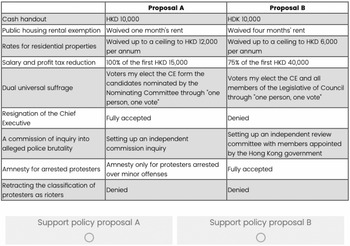
After responding to the pretreatment covariates, participants responded to the five conjoint experiment questions by selecting the policy profile they supported. An example of a conjoint question is shown in Figure 1 (the Chinese version was used in the experiment). Attributes are broadly categorized into two blocks: policies related to the five demands, and government fiscal policies. The order of blocks was randomized for each respondent and held constant across the five selection tasks. The order of attributes within each block, and the level for each attribute were completely randomized for each selection task. After completing the five selection tasks, the participants were fully debriefed and thanked.
Example of the first conjoint experiment.

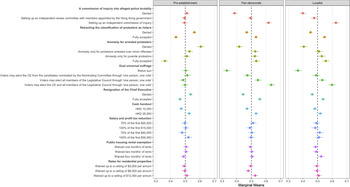
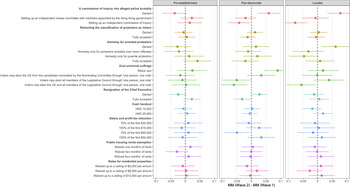
We use marginal means to display the conjoint analysis results in this study. Marginal means indicate the probability of one policy package being preferred over another when a certain level of an attribute is present. Thus, if it does not affect choice, then the level is in the middle 50% position. When a given level of an attribute is preferred, it is shown further to the right on the scale. Conversely, when the level of an attribute repels the participant, it appears further to the left. Hong Kong's current political positions can be broadly divided into three categories: pro-establishment, pan-democrat, and localist. Marginal means are presented for each (see Figure 2).
Marginal means for the first conjoint experiment.

First, financial policies had little effect on participants compared with the five demands, regardless of their political positions. We found only a slight preference for HKD 25,000 over HKD 10,000 in cash handouts (the latter is equivalent to the coronavirus relief received by Hong Kong citizens, setting a precedent beyond any other cash programs).
Next, the results for the pan-democrats and localists are remarkably similar, insofar as there were no between-group differences in preferences for the five demands. The similarity in preferences between the pan-democrats and localists is revealing, given the conflict between the two after the 2014 Umbrella Movement and their solidarity in the 2019 anti-government protests. In the 2019 protests, the two groups did not emphasize solidarity as a mere discursive practice, but there was a strong consensus at the preference level for individual demands. Put differently, the five demands were not just an expression of grievances but also a manifestation of integration at the level of the personal preferences of the pan-democrats and localists. For these two groups, responses to the demands for the establishment of a COI into alleged police brutality and dual universal suffrage (i.e., electing both the CE and legislature via a one-person-one-vote system) have the greatest impact on their policy support. In addition, although less influential than a COI or universal suffrage, a policy package is less likely to be accepted by the pro-democracy camp when amnesty for arrested protesters, retracting the classification of protesters as ‘rioters,’ and the resignation of the CE are rejected. These results indicate that the five demands are not equally important to the pro-democracy camp. Their primary demands are the establishment of a COI and dual universal suffrage.
In contrast, the pro-establishment camp reacted very differently. First, the most important finding was that the pro-establishment camp showed no significant rejection of government acceptance of a COI and dual universal suffrage. Nor did the pro-establishment camp strongly prefer rejection of a COI or dual universal suffrage. In other words, pro-establishment supporters were neutral about, or indifferent to, a COI or dual universal suffrage. However, the pro-establishment camp most strongly disliked amnesty for all arrested protesters and retraction of the classification of protesters as ‘rioters.’ As shown in Figure 2, the preferences of the pro-democracy and pro-establishment camps contrast with these two demands. These results suggest that the pro-establishment camp does not necessarily support the authoritarian turn of the regime. What those in this camp strongly oppose is the radical actions of the protesters that threaten the stability of their daily lives and businesses, but they are not sharply opposed to the pro-democracy camp on political institutions and alleged police brutality. In fact, there remains room for compromise between the pro-democracy and pro-establishment camps. A closer look at the results shows that even the pro-establishment camp was not opposed to amnesty for juvenile protesters or protesters who commit minor offenses but rather preferred these options. The pro-democracy and pro-establishment camps shared a preference for these two levels (i.e., arrested juvenile protesters or those who have committed minor offenses).
4.2 The second conjoint experiment
To examine the potential changes in aggregate preferences before and after the significant institutional repression measure, the NSL, we conducted the second online conjoint experiment in August 2020, gathering 1,540 responses from Hong Kong citizens aged 18–69. The sample was collected from the online panel of Dynata. Note that the second conjoint experiment targeted the participants in the first conjoint experiment. That is, it employed the panel design. However, not all participants took part in both conjoint experiments. Among the 1,540 responses in the second experiment, 797 had not participated in the first conjoint experiment. The procedures to screen out potential satisficers were identical to those in the first conjoint experiment.
Among the valid responses, 52.40% were from women. The mean age of respondents was 39.38 years (S.D. = 12.44). As for the educational level, 42.73% had some college degrees or less, 43.05% had university degrees, and 14.22% had postgraduate degrees. In terms of partisanship, 33.64% identified with the pro-establishment camp, 33.31% identified with the pan-democrat camp, and 33.05% identified with localists.Footnote 4
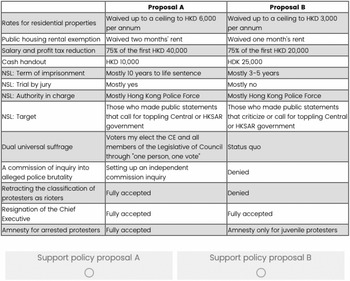
The participants answered the five conjoint experiment questions by selecting the policy profile they supported. An example of a conjoint question is shown in Figure 3 (the Chinese version was used in the experiment). Attributes are broadly categorized into three blocks: policies related to the five demands, fiscal policies, and the Hong Kong NSL (see Table 1 for details). The order of blocks was randomized for each respondent and held constant across the five selection tasks. The order of attributes within each block and the level of each attribute were completely randomized for each selection task. After completing the five selection tasks, the participants were fully debriefed and thanked.
Example of the second conjoint experiment.

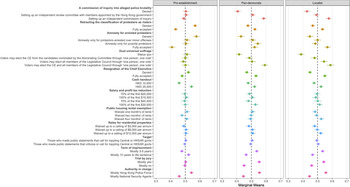
As in the first conjoint analysis, the marginal means were presented by breaking the sample into three partisan groups: pro-establishment, pan-democrat, and localist camps (Figure 4).
Marginal means for the second conjoint experiment.

The overall pattern of the aggregate preferences regarding the five demands and fiscal policies was consistent with that of the first conjoint experiment. Both pro-democracy and pro-establishment camps were insensitive to fiscal policies, except for the cash handout. Regarding the preference for a cash handout, the pro-establishment camp had a stronger preference for the HKD 25,000 payment than the pro-democracy camp. The finding that the COI and dual universal suffrage demands were most decisive also did not change from the first experiment. On the contrary, the pro-establishment camp consistently opposed the retraction of protesters' classification as rioters and amnesty for all arrested protesters. Their insensitivity to the COI and dual universal suffrage remained intact. Although weaker than the opposition to the retraction of classification as rioters and amnesty for arrestees, the pro-establishment camp continued to oppose the CE's resignation.
With regard to the additional NSL-related attributes in the second experiment, Figure 4 shows that preferences regarding the NSL do not entirely show a contrast between the pro-establishment and pro-democracy camps. The only attribute on which preferences contrasted between the camps was the term of imprisonment. Expectedly, the pro-establishment camp preferred a longer term of imprisonment (i.e., 10 years to a life sentence), whereas the pan-democratic and localist camps preferred a shorter term (i.e., 3 to 5 years). In contrast, both camps agreed upon a preference regarding who should execute the law (i.e., the Hong Kong Police Force or the National Security Agency). The pro-democracy camp preferred trial by jury, but the pro-establishment camp did not show a clear preference. As for the target of the NSL, neither camps showed a clear preference between ‘those who made public statements that call for toppling the central or Hong Kong government’ and ‘those who made public statements that criticize or call for toppling the central or Hong Kong government.’
Although the aggregate pattern of preferences regarding the demands and fiscal policies did not significantly change between the first and second experiments, the strength of preferences may have changed. Therefore, we examined the change at each level of attributes more formally using the subsample that participated in both experiments (n = 743). In this way, although the within-participant changes cannot be quantified because they responded to different questions, at the very least we were able to eliminate the possibility that the differences between the two experiments were due to differences in participants. The change was calculated as the difference of marginal means (i.e., marginal means of the second experiment minus that of the first experiment) and plotted in Figure 5.Footnote 5 As the point estimates were the change from the first to the second experiment, a positive difference indicates that an originally positive preference for a level had strengthened or an originally negative preference had weakened. Note that the changes in Figure 5 do not isolate the causal impacts of the NSL. As mentioned above, the repeated conjoint experiments cannot isolate the effects of the NSL because the design lacks a control group. The changes shown in Figure 5 represent the sum of the responses to the various events that occurred between the first and second experiments, including the NSL.
Changes of marginal means between the two conjoint experiments.

Figure 5 indicates moderation in the pro-democracy camp's preferences concerning some demands. First, the preference for a COI weakened among the pan-democrats. In contrast, the dislike for the status quo and the compromise (i.e., setting up an independent review committee with members appointed by the Hong Kong government) was mitigated, although these changes were not statistically significant. Moreover, the preferences for dual universal suffrage weakened, while the rejection of the status quo was moderated. The preference for the resignation of the CE also weakened. Like the pan-democrats, localists showed weakened support for a COI. Opposition to the denial of amnesty for arrestees weakened, and preference for amnesty for juvenile arrestees also weakened. There was no significant change in localists' preference for dual universal suffrage.
The preferences of the pro-establishment camp concerning the demand for a COI and dual universal suffrage did not show a statistically significant change. Nevertheless, it is noteworthy that their dislike for amnesty for all arrested protesters had alleviated. Although it is difficult to infer from this result alone, the pro-establishment camp may have come to expect that pardoned arrestees would no longer disrupt their daily lives because the violent protests had disappeared.
In general, there was no significant change in the pattern of aggregate preferences between the first and second experiments. This finding suggests that even when the repression deters visible protests at the street level, it does not necessarily change preferences regarding the protest. As the previous studies on the effects of repression indicate, the effects are complex, and the deterrence of protests based on the rational choice model does not always occur beyond visible protests. Continued support for the demands of the pro-democracy camp indicates a potential for rekindled protests. However, it is noteworthy that the strength of some preferences has shifted from the first experiment. Support for the primary demands such as a COI and dual universal suffrage moderated in the pro-democracy camp, whereas the distaste of those in that camp for the government's denial of demands had weakened.Footnote 6 Although those in the pro-establishment camp did not show remarkable changes in preferences, their attitudes regarding amnesty of the arrestees had moderated slightly.
5. Discussion
With a vast body of scholarly output on the repression–dissent nexus, this study analyzed whether aggregate public preferences concerning protest demands change after harsh institutional repression by examining the massive anti-government protests in Hong Kong that broke out in 2019. This departed from the dominant approach, which centers on the interplay of situational police repression and protest activity. As indicated by the previous studies, repression primarily aims to transform the cost structures of participating in collective action. Given that collective action is the outcome of an interactive process between grievances, perceived efficacy, and demands, it is necessary to examine carefully not only the visible changes in protest activity, but also whether aggregate preferences regarding protest demands have changed, which could potentially motivate alternative forms of political participation.
This study provided several implications through conducting two conjoint experiments before and after the repression. First, in contrast to the sharp decline in street protests following the enactment of NSL, the pattern of preferences for demands was remarkably stable. NSL has clearly increased the cost of participation and dissuaded people from participating in the visible protests. However, the fact that pattern of preferences regarding demands was preserved suggests that challengers may have responded to repression through tactical and strategic adaptation. For example, it is argued that challengers respond to repression by, for example, shifting between violent and nonviolent approaches or from open dissent to private mobilization and coordination (Lichbach, Reference Lichbach1987; Zwerman et al., Reference Zwerman, Steinhoff and Porta2000; Davenport and Inman, Reference Davenport and Inman2012). That is, when repression decreases a single type of challenging behavior, it could ignite another type of behavior that is less likely to be the target of repression. As in the context of Hong Kong, because street protests died out after the implementation of the NSL, protesters have upheld the brinksmanship-style laam caau strategy, or mutual destruction, expressed by the popular slogan ‘if we burn, you burn with us.’ Protesters have solicited external support and informational campaigns to call for international sanctions against Hong Kong and Beijing officials. This signifies a paradigm shift as protesters deliberately elevate the domestic pro-democracy movement as the epicenter of international containment of the rise of China to offset the overwhelming power asymmetry. The preservation of demands could retain resources crucial to a resurgence of collective action. For example, if the pandemic ends and legal demonstrations are permitted, such preserved preferences may reignite the protests.Footnote 7 Panel survey evidence gathered between April and October 2020 shows that a majority of protestors still indicated willingness to ‘participate in large-scale demonstrations to press for the movement demands after the pandemic (4.15 out of 5 points)’ (Tang and Yuen, Reference Tang and Yuen2020).
It is noteworthy that although there was no significant change in the aggregate of pattern preferences, there was some moderation in the intensity of preferences among those in the pro-democracy camp. Preferences among pan-democrats and localists concerning key demands such as a COI and dual universal suffrage have moderated, and dislike of the government's rejection of these demands has eased. Although attributing this moderation to the NSL alone is impossible with the current research design, this moderation may arise from the perceived difficulty of having their demands met. For example, although opposition members continued to oppose the status quo strongly in their call for dual universal suffrage in the second wave (Figure 4), this negative preference for the status quo weakened significantly from the first experiment in the panel sample (Figure 5). If they felt that the NSL had made it unlikely that these demands would be granted, they might see the status quo better off than deterioration. In examining the long-term effects of repression, it will be essential to see how such moderation in the intensity of preferences will affect the cohesion of the pro-democracy camp in the future.
The implications of analyzing the pro-establishment camp also provided insights. Hong Kong studies, especially on protests, primarily focus on the attitudes and behavior of the pro-democracy camp, so less attention has been paid to the pro-establishment camp. However, in analyzing the repression–dissent nexus, it is imperative to elucidate the loyalists' preferences because the potential for compromise between the two opposing camps can only be identified when the preferences of both sides are clear. In this regard, a stable pattern of aggregate preferences was found not only in support for the protests, but also in the pro-establishment camp's support for the government. The pro-establishment camp generally supports the uncompromising stance of the Hong Kong government but not its continued refusal to permit dual universal suffrage or to establish a COI. They are specifically opposed to radical protest activities that disrupt their daily lives, which leads them to support the government. Therefore, it might not be an authoritarian ideology that defines the pro-establishment camp, but a kind of privatism that emphasizes stability and predictability of everyday life. In other words, the conflict between the pro-democracy and pro-establishment camps over the protests lacks ideological symmetry. Democrats are clearly oriented toward liberal democracy, whereas loyalists lack any firm political ideology. The lack of a clear ideology in the pro-establishment camp led to the finding that its opposition to the demands did not strengthen after the enactment of the NSL, although this could have arisen from a desire to achieve successful deterrence and the demise of protests. Rather, the negative preference for amnesty for all arrestees had significantly weakened among loyalists (Figure 5). This moderation on the side of the pro-establishment camp arguably reflects their sense of relief that the repression had successfully suppressed violent street protests, which were perceived as a grave threat to the stability of their everyday lives and businesses.
This study shows that the pattern of preferences regarding protest demands before and after the institutional repression of the NSL has not changed significantly among citizens across parties, but the long-term effects of repression remain unknown. If visible protests are stifled in the long term, a sense of political powerlessness among protesters and their supporters may spread, leading to a retreat to private life. It is plausible that the second conjoint experiment in this study, conducted immediately after repression, does not capture the long-term effects. In the case of Hong Kong, the perception of the status quo could have shifted drastically, potentially weakening support for the demands as the sweeping effects of the NSL began to unfold after the second conjoint study. Most opposition figures have faced crackdowns under the NSL, being arrested, put on trial, jailed, or even went into exile. We have also witnessed exiting trends among ordinary dissidents, either through emigration or asylum-seeking, and passivity among those who remain in Hong Kong as they retreat into their private lives. Therefore, longitudinal data collection is essential to track how preferences concerning the five demands, which at one time had the effect of uniting protesters, change over time.
Several limitations remain to be addressed. First and foremost, this study could not isolate the causal impact of NSL on Hong Kong citizens' preferences for the five demands, owing to the lack of a control group. Because all citizens were ‘treated’ with the NSL, any changes or the lack thereof could be attributed to events other than the NSL that occurred between the two experiments. Although the NSL was by far the most salient act of repression during the period, its effects on preferences need to be estimated in future studies using some form of statistical causal inference. In addition, this study revealed a pattern of aggregate public preferences regarding the five demands by repeating conjoint experiments, but at the cost of being unable to capture the preferential changes at the individual level. This is because the participants did not engage in precisely the same selection tasks in the first and second experiments as the profiles of options were randomly generated. The findings of this study should be corroborated using measures of within-individual changes, such as panel surveys.
Second, although the protest and government responses are essentially bidirectional, this study has only been able to examine the path from government response to the protest. Prior research has shown that it is easier to extract concessions from the government when protesters' demands are minimalist in nature (Rothman and Olson, Reference Rothman and Olson2001; Abrahms, Reference Abrahms2006, Reference Abrahms2012; Lorentzen, Reference Lorentzen2013), but repression is more likely when the demands are maximalist in nature, such as those targeting the core of the regime and seeking to alter the loci of authority (Leonardi et al., Reference Leonardi, Nanetti and Putnam1981; Klein and Regan, Reference Klein and Regan2018). It is evident that the call for dual universal suffrage in the five demands was seen by the government as a grave threat because a free election weakens Beijing's control of Hong Kong. Therefore, the maximalist nature of the five demands might be responsible for such harsh institutional repression.Footnote 8 However, these paths from demands to repression are not clear in this study.
Third, the insignificant change in preferences for the demands before and after the enactment of the NSL may be because there was already much repression in the lead up to the NSL. Excessive crowd control by the police has drawn much criticism. Given that the alleged police brutality had been salient enough to be included as one central demand, it could be said that those who supported the protest had already been subjectively repressed when the NSL was enacted. That is, at least the pro-democracy camp was ‘pretreated,’ which might explain the absence of drastic changes before and after the NSL. The best point in time to measure the effects of repression is one of the issues for future research. However, if the pro-democracy camp were pretreated, the lack of change in aggregate preference patterns between the first and second experiments would be even more important. It would not only imply situational repression to such an extent that even the harsh institutional repression of the NSL did not change them, but also that support for the five demands was maintained regardless.
Finally, it is unknown how generalizable our findings in Hong Kong are. This study does not aim to propose a broad theory but rather to contribute to the literature a case study on the relationship between repression and protest; it will be necessary to seek generalization from a more comparative perspective in future studies.
Supplementary material
The supplementary material for this article can be found at https://dataverse.harvard.edu/dataset.xhtml?persistentId=doi%3A10.7910%2FDVN%2FKJBRQG&version=DRAFT.
Acknowledgement
This study was supported by the Public Policy Research (PPR) Funding Scheme (Special Round) of the Government of the Hong Kong Special Administrative Region of the People's Republic of China (Project No. SR2020.A1.004).
Conflict of interest
We have no conflicts of interest to declare.
Tetsuro Kobayashi is an associate professor at the Department of Media and Communication, City University of Hong Kong. His research focuses on political communication and psychology in East Asian countries.
Jaehyun Song is an associate professor of Faculty of Informatics, Kansai University. His research interest is political behavior and political methodology.
Polly Chan is a graduate student of International Relations in the Department of Politics and International Relations at the University of Oxford.