Introduction
In the post-Second World War period, there has been a widespread process of decentralization in Europe (Marks et al., Reference Marks, Hooghe and Schakel2008: 177–178). This has often entailed the creation of regional levels of government to which policy responsibilities previously exercised by central governments have been devolved. In some states – Belgium, Italy, Spain, and the United Kingdom – the process has gone as far as profound constitutional transformations from unitary structures to federal or quasi-federal ones. This contrasts the long process of centralization of power and nationalization of politics that characterized the European states in the 19th century and the first half of the 20th century (Sharpe, Reference Sharpe1979; Caramani, Reference Caramani2004). Over the same period, the process of integration led to a significant transfer of power upwards to what is now the European Union.Footnote 1 A key question in this context is whether there is a causal connection between inter-state integration and intra-state restructuring and, if so, the nature of such a connection. In other words, are processes of state restructuring fuelled or facilitated by the development of the European Union? The question was first raised in the mid-1970s and has since been present directly and indirectly in the literature but has not so far been systematically investigated.
This article seeks to make a two-fold contribution towards answering this question. At the theoretical and methodological level, first, it identifies party competition as the crucial mechanism through which European integration can potentially influence state restructuring and ‘rhetorical strategies’ as the key tool utilized in such competition. Party competition can be conceptualized as the intervening variable connecting the European dimension as a causal variable to domestic restructuring as the outcome variable. This occurs through the adoption of a rhetorical strategy linking references to ‘Europe’ to policy positions on domestic state restructuring, with the objective of maximizing the electoral attractiveness of such positions. Analysing parties’ strategic use of ‘Europe’ in relation to state reform can thus shed valuable light on the causal connections between the two phenomena. At the empirical level, it performs a cross-sectional and cross-temporal investigation of the degree to which parties have exploited the European dimension in their rhetorical strategies on state restructuring, and what factors have been necessary and/or sufficient causes of the patterns observed. The article shows that European integration can indeed exercise causal influence upon state restructuring via party strategies, but that this is highly contingent on the complex interaction of several factors. The article thus both confirms and challenges previous results and sheds new light on the evolution of state structures in the context of European integration.
The remainder of the article proceeds as follows. The second section presents the research questions, reviews the existing literature, and outlines the theoretical framework. It makes the case for focussing on party strategies as the main causal mechanism linking European integration and state restructuring, and identifies the key conditions likely to shape parties’ decisions to ‘play the European card’. The third section describes the research design and the methods employed, outlining the advantages of a Qualitative Comparative Analysis (QCA) approach. The fourth section presents the results of the analysis, divided into the descriptive results and the analysis of necessity and sufficiency. Lastly, the two concluding sections discuss the interpretation of the results and their significance for our understanding of the influence of ‘Europe’ on state restructuring.
Theoretical framework
The article seeks to answer the following questions:
-
Q1: To what extent have political parties exploited the European dimension in their rhetorical strategies over state restructuring?
-
Q2: Have parties exploited the European dimension to support or to oppose state restructuring?
-
Q3: Which conditions have been necessary and/or sufficient for parties to adopt such a strategy?
For the purposes of this article, European integration is defined as the process of development of what is now the European Union through transfers of power from the member states. State restructuring is defined as the process of devolution of power that has resulted in a transition from unitary to federal or quasi-federal structures in several EU member states. In quantitative terms, this refers to regions scoring higher than 10 on the self-rule component of the RAI index developed by Hooghe et al. (Reference Hooghe, Schakel and Marks2008). Strategic use of ‘Europe’ in relation to state restructuring takes place when the idea of European integration and/or aspects of the EU system are rhetorically linked to devolution of power to regional governments in order to advocate or to oppose it.
European integration and state restructuring: state of the art
The broad question of the impact of integration on the politics of state structures started to be addressed in the 1970s (Feld, Reference Feld1975; Wolfe, Reference Wolfe1976; Rudolph, Reference Rudolph1977; Scheinman, Reference Scheinman1977; Birch, Reference Birch1978; Sharpe, Reference Sharpe1979) and has since attracted a considerable degree of interest. A number of authors have addressed the link between integration and state restructuring and generally postulated a positive connection between the two.
Four main channels through which European integration has a causal impact on state restructuring have been identified. First, integration has been seen as fuelling regions’ general demands for self-government because it undermines states’ sovereignty and their policy-making role. Such demands put pressure on state actors to devolve power to the regions through constitutional reforms (e.g. Rudolph, Reference Rudolph1977: esp. 544; Kellas, Reference Kellas1991: 226–231; Keating, Reference Keating2001: 9–10).
Other authors emphasize that the EU's endorsement of the idea of a ‘Europe of the Regions’ and of the principle of subsidiarity – both of earlier origin but adopted in the EU's official discourse of the late 1980s–early 1990s – has lent a powerful external legitimation to regional autonomy by making it appear a natural complement of the process of integration. It has also been seen as strengthening the case for regions to acquire – or to increase – governmental powers in order to be able to access EU decision making (e.g. Anderson, Reference Anderson1991: 420; Ladrech, Reference Ladrech1994: 82; Anderson and Goodman, Reference Anderson and Goodman1995: 617; Jones, Reference Jones1995: 294–295; Loughlin, Reference Loughlin1996; Börzel, Reference Börzel2002: 585–586).
A third major factor discussed in the literature is the effect of cohesion policy (e.g. Marks, Reference Marks1993; Keating, Reference Keating1995; Hooghe, Reference Hooghe1996; Hix and Goetz, Reference Hix and Goetz2000: 11, Hooghe and Marks, Reference Hooghe and Marks2001: 81–118; Bartolini, Reference Bartolini2005: 260–264). The reform of the structural funds in 1988 opened a channel for regional governments to be involved directly in EU policy-making often by-passing the state level. This is seen as having triggered a multi-faceted ‘mobilization and empowerment of subnational governments’ (Marks, Reference Marks1993: 407) and putting pressure on state governments to devolve power to the regions. According to Bartolini (Reference Bartolini2005: 261): ‘The EU policies have fostered the decentralization trend in most EU countries … the EU has played an institution-building role for subnational regional strengthening’. Hix and Goetz (Reference Hix and Goetz2000: 11) outline the core mechanism as such: ‘EU regional policy encourages member states to establish planning authorities at the regional level, which in turn produce demands for a democratization of these structures, and hence the creation of elected regional assemblies and governments’ and where these bodies already exist it reinforces the demands ‘for further delegation of policy competences away from central government’.
Last, but perhaps most prominently, European integration has been theorized as leading to state restructuring through economic integration. By guaranteeing free trade and regulatory uniformity across its member states, the EU makes smaller states economically viable and thus encourages secessionism in those with a high territorial heterogeneity of preferences over public policy (Birch, Reference Birch1978: 336; Meadwell and Martin, Reference Meadwell and Martin1996; Alesina and Spolaore, Reference Alesina and Spolaore1997; Bolton and Roland, Reference Bolton and Roland1997: 1066; Alesina et al., Reference Alesina, Spolaore and Wacziarg2000; Alesina and Spolaore, Reference Alesina and Spolaore2003: 213–214). As Alesina et al. (Reference Alesina, Spolaore and Wacziarg2000: 1277) put it: ‘trade openness and political separatism go hand in hand: economic integration leads to political “disintegration”’. The same authors, however, acknowledge (2000: 1285) that secessions remain costly and difficult processes and hence are only likely to take place in the presence of major changes in the ‘underlying parameters’. As a result, granting regional autonomy via state restructuring, rather than secession, is a more likely outcome, on the grounds that ‘an answer to the trade-off between economies of scale and heterogeneity can be found in a decentralized structure of government’ (Alesina and Spolaore, Reference Alesina and Spolaore1997: 1046).
European integration has thus been theorized as having a causal influence on state restructuring in multiple ways. The existing systematic empirical studies of this connection, however, have focussed almost exclusively on the effects of economic integration and have reached contrasting conclusions. Using demands for regional autonomy and electoral support for secessionist parties, respectively, as the dependent variable, Van Houten (Reference Van Houten2003) and Sorens (Reference Sorens2004) find no general evidence of a direct effect of globalization and European integration but indications that more complex, indirect effects are possible. Using fiscal decentralization as the dependent variable, Garrett and Rodden (Reference Garrett and Rodden2003) find a negative correlation with trade integration, whereas Stegarescu (Reference Stegarescu2004) and Baskaran (Reference Baskaran2010) both conclude that European integration has led to greater fiscal decentralization. These contrasting results can at least partly be imputed to the limitations of correlation analysis – on which they are based – which confines itself to testing for co-variation between variables and which makes it difficult to isolate the impact of the EU from that of many other variables. In order to deepen our understanding of how European integration influences state restructuring, it is thus necessary to move beyond correlation and focus on the causal mechanisms through which the connection is meant to operate. This calls for a focus on the role played by political parties, which are, as argued in the following section, key actors of state restructuring in contemporary Europe.
Party strategies as key causal mechanism
The theoretical literature on ethnic politics and demands for regional self-government places great emphasis on the crucial role played by political parties. Newman (Reference Newman1996: 3) argues that ‘in most democracies the dominant form of ethnoregional conflict occurs among political parties’; Lecours (Reference Lecours2000) conceptualizes elite agency such as party strategies as the decisive mechanism through which ethnic identities are politicized and mobilized around demands for regional autonomy; in a similar vein, Van Houten (Reference Van Houten2003: 132) argues: ‘the most important conclusion … is that any possible influence of globalization on autonomy demands is mediated by political factors’ and (2003: 133) ‘globalization creates pressures and incentives for political actors to change governance structures but electoral and party competition are important intervening factors’, while Sorens (Reference Sorens2009) and Alonso (Reference Alonso2012) squarely explain state restructuring as a product of ‘partisan logic’. Likewise, empirical accounts of the main processes of state restructuring also stress the central role played by political parties (e.g. Bogdanor, Reference Bogdanor1999; Cotta and Verzichelli, Reference Cotta and Verzichelli2007: 171–201; Deschouwer, Reference Deschouwer2009: 42–54; Gunther and Montero, Reference Gunther and Montero2009: 71–96).
There is thus strong theoretical and empirical support for conceptualizing party competition as the key causal mechanism through which the European dimension can potentially impact the politics of state reform. If European integration provides incentives and opportunities for state restructuring, as the theoretical literature claims, we should expect parties pursuing restructuring as a policy objective to exploit the European dimension in their strategies. By analysing the degree to which parties do so, it is thus possible to perform a more fine-grained testing of the postulate than those offered by correlation analysis. Yet the role of political parties is left implicit in the theories of connections between European integration and state restructuring. Likewise, the literature on minority nationalist parties attitudes to European integration (Lynch, Reference Lynch1996; De Winter and Gomez-Reino, Reference De Winter and Gomez-Reino Cachafeiro2002; Jolly, Reference Jolly2007; Laible, Reference Laible2008; Elias, Reference Elias2009; Hepburn, Reference Hepburn2010) shows how such parties often see ‘Europe’ as an ally but does not specifically focus on parties’ exploitation of the European dimension for state restructuring.
In order to derive testable implications, it is necessary to identify the principal means through which parties compete. These are their ‘rhetorical strategies’ (Breuning and Ishiyama, Reference Breuning and Ishiyama1998; Alonso, Reference Alonso2012: 35–39). Through their choice of discourse and campaigning arguments, parties try to attract support for themselves and their core policies. If such strategies resonate with voters and bring electoral rewards to a party, the latter would be in a stronger bargaining position vis-à-vis its competitors and therefore more likely to achieve its policy objectives. By investigating whether parties have exploited the European dimension in their rhetorical strategies, we can thus shed light on a crucial mechanism through which integration can influence state restructuring and ascertain which factors are best able to account for the patterns observed.
Conditions for parties’ strategic use of ‘Europe’
What conditions may determine parties’ propensity to engage in the strategic use of the European dimension as defined above? While the decision to ‘play the European card’ may often be shaped by contingent agency factors – such as the preferences of individual party leaders’ – that are beyond the scope of this article, the literature suggests eight main structural conditions that are likely to affect a party's propensity to exploit the European dimension in its strategy over state restructuring.
The first condition is whether a party can be categorized as a state-wide or as a regional party. The literature on party competition over state restructuring (Meguid, Reference Meguid2008; Dardanelli, Reference Dardanelli2009; Sorens, Reference Sorens2009; Alonso, Reference Alonso2012) shows that such competition is usually initiated by a challenge brought about by a regional party – typically a regional–nationalist one – vis-à-vis one or more state-wide parties. Regional parties are unlikely ever to be in a position to implement state restructuring directly, and rely on their electoral threat to state-wide parties to push the latter towards adopting devolution policies. The literature on regional–nationalist parties’ attitudes to European integration referred to above shows that they often see ‘Europe’ as an ally. There are thus reasons to expect regional parties to be more inclined than state-wide ones to exploit the European dimension to strengthen their competitive challenge vis-à-vis the latter.
The second condition concerns a party's status within the party system. In a similar way to the competition within regional and state-wide parties, we can hypothesize that the likelihood to obtain office at either the state or the regional level may affect a party's propensity to make strategic use of ‘Europe’. There is some evidence (Sorens, Reference Sorens2009: 257; Alonso, Reference Alonso2012: 56) that state-wide parties are more likely to support devolution when they are less likely to gain office. In such circumstances, they may also look at exploiting the European dimension to bolster the attractiveness of their policy and of themselves. It seems plausible to expect that outsider regional parties might behave likewise vis-à-vis dominant regional parties, who may be able to reap the rewards of office at the regional level. A party that occupies an outsider position within the party system – at either state or regional level – could thus be expected to be more likely to exploit the European dimension as a key strategic device to strengthen its competitive position.
The third condition is a party's position on the classic left–right spectrum. There is evidence that attitudes towards state restructuring as well as towards the EU are not independent of left–right positioning. Alonso (Reference Alonso2012: 90) shows that left parties are more likely to display what she calls ‘pro-periphery’ positions, while Massetti (Reference Massetti2009: 518, 522) finds that regionalist parties’ positioning on the left–right spectrum seems to affect both their positioning on ‘the centre-periphery’ dimension and their attitudes towards the EU. Although there is no univocal hypothesis emerging from the literature, there are thus reasons to test whether parties’ propensity to exploit the European dimension is affected by their left–right position.
The fourth condition relates to a party's position on the question of state restructuring. As seen above, the theoretical literature identifies several ways in which European integration offers incentives and opportunities to regions to seek autonomy or even independence. The latter, in particular, has been seen to be facilitated on the grounds that economic integration lowers the costs of independence. On that basis, ‘Europe’ can be thought of being particularly attractive as a competitive weapon to parties demanding greater devolution compared with those with a more moderate position or outright opposition to devolution. It is thus likely that the propensity to exploit the European dimension be linked to the ‘radicalism’ of the autonomy demanded.
Fifth, the economic status of the region in which a party operates can be an important condition. The claim that economic integration leads to political disintegration rests on the assumption that regions seeking autonomy or independence expect to derive economic benefits from it. This is more likely in regions that are relatively wealthier than the rest of the state and are thus net contributors to state finances. Previous empirical studies have also found that relative wealth is associated with higher ‘assertiveness’ in autonomy demands (Van Houten, Reference Van Houten2003: 127). We should thus expect parties operating in relatively richer regions to be more likely to exploit the European dimension in their strategies.
The sixth condition relates to the temporal dimension of the connection between European integration and state restructuring. The literature on the domestic impact of European integration, or Europeanization (e.g. Cowles et al., Reference Cowles, Caporaso and Risse2001; Featherstone and Radaelli, Reference Featherstone and Radaelli2003; Ladrech, Reference Ladrech2010), theorizes such impact as a function of the deepening of integration whereby past a certain ‘threshold’ the latter increasingly comes to shape political outcomes at the state level. From such a perspective, Europeanization is essentially a post-Single European Act (SEA) phenomenon, as before then the EU system had little capacity to influence domestic politics. This is especially relevant for this article, as the completion of the single market and the achievement of monetary union have magnified the incentives economic integration gives for political disintegration compared to the pre-SEA period. Parties’ propensity to use ‘Europe’ strategically in competition over state restructuring could thus be expected to increase over time as integration deepens.
Finally, parties’ decisions to exploit the European dimension in their strategies are likely to be shaped by their attitudes towards ‘Europe’. There is considerable evidence that perceptions of whether European integration facilitates or constrains state restructuring is to a significant extent a function of a party's general attitude to integration (e.g. Dardanelli, Reference Dardanelli2009). An important point raised in the literature, however, is that there is a distinction between attitudes to integration as an idea, on the one hand, and to the actual EU, on the other hand (e.g. Elias, Reference Elias2009). The two sometimes diverge sharply, specifically in the form of positive attitudes to the idea of integration co-existing with negative attitudes to the actual EU system, particularly so in the early phase of integration when a ‘gap’ between ideals and reality was more likely to be perceived. Although we should generally expect both positive types of attitudes to be more likely to lead to strategic use of ‘Europe’ than negative ones, the connection is probably stronger in the case of attitudes to the EU system.
These conditions can be expected to interact with each other in complex ways. A key objective of the fuzzy-set QCA (fsQCA) reported below is thus to identify which conditions, or configurations of conditions, are necessary and/or sufficient for a party to engage in strategic use of ‘Europe’ in relation to state restructuring.Footnote 2
Design and methods
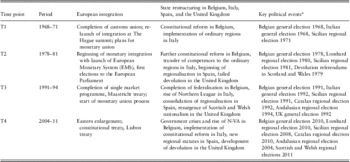
The research has been designed as a cross-sectional and cross-temporal investigation. On the cross-section axis, the analysis focusses on the countries that have undergone state restructuring, defined as a decentralization process resulting in at least one regional government scoring above 10 on the Regional Authority Index devised by Hooghe et al. (Reference Hooghe, Schakel and Marks2008).Footnote 3 In other words, these are the countries where the process of decentralization through empowerment of regional governments has gone furthest. Four EU states meet this criterion: Belgium, Italy, Spain, and the United Kingdom. Within each of these ‘macro cases’, the analysis focusses on the main parties operating in two regions that have played an important role in the process of state restructuring but that differ in terms of other conditions such as geographical location, economic development, and ethno-linguistic character. The selected regions are Flanders and Wallonia (Belgium), Lombardy and Sicily (Italy), Catalonia and Andalusia (Spain), and Scotland and Wales (UK) and the number of parties analysed is 33 (Table A1 in the online appendix). On the cross-temporal axis, the focus is on four time points: the late 1960s (T1), the late 1970s (T2), the 1990s (T3), and the 2000s (T4).Footnote 4 As summarized in Table 1, these time points have been selected because they are characterized by critical junctures in both integration and the process of state restructuring in the four countries. They are thus intended to maximize the chances of observing a European influence on the latter operating through the strategies of political parties. The combined axes of comparison yield a total of 80 units of observation.
Time points

Note: See Dinan (Reference Dinan2010: Chs 1–6) for a concise outline of European integration and Deschouwer (Reference Deschouwer2009: 42–54), Cotta and Verzichelli (Reference Cotta and Verzichelli2007: 171–201), Gunther and Montero (Reference Gunther and Montero2009: 71–96), and Mitchell (Reference Mitchell2009) for overviews of state restructuring in Belgium, Italy, Spain, and the United Kingdom, respectively, as well as recent editions of the European Journal of Political Research's Political Data Yearbook for the latest developments.
*As T4 spans a longer period than the other time points, several elections could be seen as ‘key political events’. For the sake of tractability only one has been included for each case, selected on the grounds of its significance for the respective trajectory of state restructuring.
The degree to which parties exploited the European dimension in their rhetorical strategies at each point in time has been estimated through qualitative content analysis of campaign documentsFootnote 5 relating to the key elections or referendums of each period, detailed in Table 1. Sentences linking the European dimension to state restructuring are the basic unit of measurement for the outcome. The quantity of such sentences and the nature of the link established have been manually coded to estimate the ‘intensity’ – how strongly the link between ‘Europe’ and state restructuring was made – and the ‘direction’ – whether it was used in favour of or against state reform – of linking. ‘Intensity of exploitation’ (O1, europ-i) and ‘direction of exploitation’ (O2, europ-d) are thus the two ‘outcomes’ – in QCA terminology, the equivalent of dependent variables – under examination. The estimates for these outcomes have been coded in six-value fuzzy-set scores ranging from 0 to 1 (Ragin, Reference Ragin2008: 30-3). Tables A2 and A3 in the online appendix detail the codes adopted and the sources that have informed the coding decisions. Qualitative manual coding was chosen over existing data sets such as that generated by the Comparative Manifesto Project (CMP; Budge et al., Reference Budge, Klingemann, Volkens, Bara and Tanenbaum2001) for several reasons. First, CMP data only refer to general elections, thus excluding referendums and regional elections. Second, the CMP's ‘decentralization’ variable (per301) does not adequately capture the phenomenon of interest.Footnote 6 Third, manual coding allows for a more fine grained and ‘sensitive’ estimation compared with computerized methods based on key words’ frequencies and the valence theory. This is in line with Budge's (Reference Budge2001: 90) acknowledgment that coding based on valence theory is not always the best method and that ‘specialized investigations may well need their own specializing codings’. To assess longitudinal trends, indices have been calculated for each outcome at each time point and their values compared over time. As the number of parties analysed differs between T1, T2, and T3-T4, three different trend lines have been estimated.
Q3 is addressed through an fsQCA analysis of necessary and sufficient conditions. QCA seeks to combine the strengths of both qualitative and quantitative approaches by using deep, case-focused knowledge to analyse complex causation and reach parsimonious modest generalizations (Ragin, Reference Ragin2008). The fuzzy-set variant of QCA employed here, is centred on the notion of ‘degrees of membership’ in categories – ‘sets’ – and allows for a more fine-grained measurement of conditions and outcomes. The causal connections between conditions and outcomes are conceptualized in terms of ‘set relations’, whereby degrees of membership in the set of cases displaying the outcome is analysed in relation to degrees of membership in the set of cases sharing the condition/s. This is done in particular by identifying which conditions or ‘configurations’ of conditions are necessary and/or sufficient to produce the outcome under investigation (Ragin, Reference Ragin2008). It is thus a particularly useful approach in small-N research with qualitative data such as the project presented here.
Eight conditions,Footnote 7 as discussed in the previous section, have been identified as likely to lead to a party's strategic use of ‘Europe’ in connection with state restructuring: party type (C1, partyp); party system status (C2, syssta); left–right position (C3, leri); constitutional position (C4, cospos); regional economic status (C5, regest); depth of integration (C6, integ); attitudes to integration (C7, attint); attitudes to the EU (C8, atteu). The eight conditions have been estimated from a wide range of primary and secondary sources and, like the two outcomes, have been coded in six-value fuzzy-set scores. Tables A2 and A3 in the online appendix detail the codes chosen and the sources on which the coding decisions were based. The analysis for necessity and sufficiency was carried out with fsQCA2.5, a recently developed software specifically designed to perform QCA analysis (Ragin et al., Reference Ragin, Drass and Davey2006). The necessity analysis is performed in a single step. The sufficiency analysis proceeds in two steps. fsQCA2.5 first organizes conditions and outcome into a fuzzy-set ‘truth table’ matching each configuration of conditions to the outcome. It then performs a so-called ‘minimization’ operation to produce complex, parsimonious, and intermediate ‘solutions’. Such solutions are configurations of conditions which, through their consistent association with the outcome, can be seen as being sufficient to produce the latter (Ragin, Reference Ragin2008: 124–144). Intermediate solutions ‘strike a balance between parsimony and complexity, based on the substantive and theoretical knowledge of the investigator’ (Ragin, Reference Ragin2008: 175) and are thus the most informative.Footnote 8 The sufficiency analysis has been performed on the cases displaying ‘positive’ use (i.e. O2 = 1). Following Marx and Dusa's (Reference Marx and Dusa2011) recommendations, concerning the ratio between number of conditions and number of cases, the former has been adjusted by reducing it to seven for the purpose of the sufficiency analysis.
Results
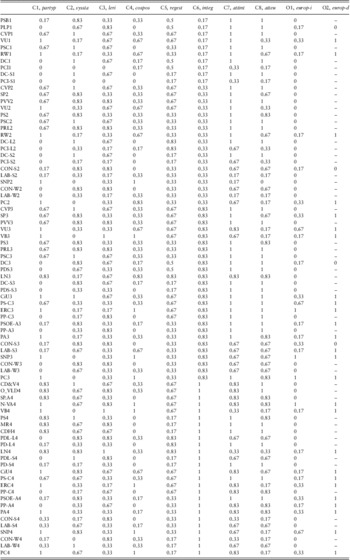
Table 2 summarizes the descriptive results.
Descriptive results as fuzzy-set scores

Note: C1, partyp = party type; C2, syssta = party system status; C3, leri = left-right position; C4, cospos = constitutional position; C5, regest = regional economic status; C6, integ = depth of integration; C7, attint = attitudes to integration; C8, atteu = attitudes to the EU; O1, europ-i = intensity of ‘use of Europe’; O2, europ-d = direction of ‘use of Europe’.
Table A1 in the online appendix for party codes.
Frequency, intensity, and direction
Overall parties have only infrequently linked ‘Europe’ and state restructuring in their strategies. Only in 30 out of 80 cases (38%) can some use of the European dimension to strengthen the case for or against state restructuring be observed. A number of parties have never made such a link. Moreover, in only seven cases (9%) can the intensity of use be scored above 0.5 and in only four cases (5%) did it reach the maximum score of 1. If frequency and intensity have been rather low overall, direction has been very clear. ‘Europe’ has been used overwhelmingly in a ‘positive’ direction: in 26 of the 30 cases (87%) displaying strategic ‘use of Europe’, such use has been to support state restructuring.
Intensity and direction over time
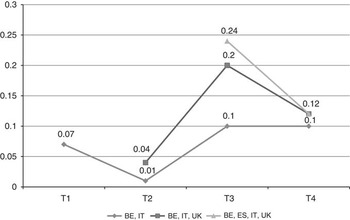
The trends over time for intensity of use (O1, europ-i) paint a rather complex picture. As shown in Figure 1, the longest-term trend (including Belgium and Italy) presents only a small increase between T1 and T4 and fluctuation between T2 and T3. The mid-term trend (Belgium, Italy, and the United Kingdom) displays an even more dramatic increase between T2 and T3 but also a rather steep decline between T3 and T4. A broadly similar decline between the latter two time points is also displayed by the shortest, but most inclusive (Belgium, Italy, Spain, and the United Kingdom), trend. To the extent that an overall trend can be detected, this seems to be one of sharp short-term fluctuations overshadowing a rather modest long-term increase.
Index trend for O1 (europ-i). Note that the figures are the sum of each party score divided by the number of parties.

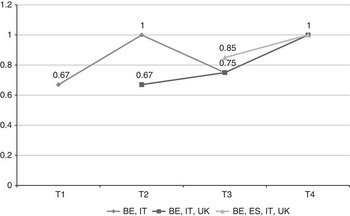
The trend for direction of use (O2, europ-d), in contrast, has been much more univocal, as shown in Figure 2. Instances of ‘negative’ use of ‘Europe’, that is, to oppose state restructuring, have progressively decreased and no such instances can be observed at T4.
Index trend for O2 (europ-d). Note that the figures are the sum of each party score divided by the number of parties. Between T3 and T4, the first and the second line follow the same path.

Necessary and sufficient conditionsFootnote 9
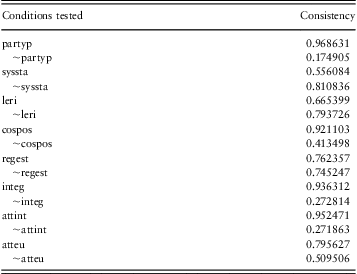
The necessity analysis reported in Table 3 indicates that four conditions are ‘almost always necessary’ – as pointed out by consistency scores above 0.9 – for a party to engage in strategic use of ‘Europe’ to support state restructuring: (a) being a regional party (C1, partyp), (b) having a radical constitutional position (C4, cospos), (c) being active at a time of high level of integration (C6, integ), and (d) displaying positive attitudes to integration (C7, attint).
Necessary conditions for O2 = 1

None of these conditionsFootnote 10 is individually sufficient to produce the outcome but their combined effect, together with other conditions, almost always is. On the basis of a frequency threshold of 1 and a consistency threshold of 0.88,Footnote 11 fsQCA2.5 produces the following intermediate solutionFootnote 12 (Tables A4, A5, A6 and Graph A1 in the online appendix):
 $$ \matrix{ party{{p} \ast } \!\sim \!sysst{{a} \ast } \!\sim \!ler{{i} \ast } cos po{{s} \ast } \:{int}e{{g} \ast } \:att{int}{}\: \rightarrow \:europ {\hbox -} i{} \cr {\rm{(coverage:}} \ {\rm{0}}{\rm{.605513;}} \ {\rm{consistency:}} \ {\rm{0}}{\rm{.885953)}} \hfill$$
The solution shows that a configuration of the following conditions – being a regional party (C1, partyp), outsider status (C2, ∼syssta), a left of centre position (C3, ∼leri), a radical constitutional position (C4, cospos), high level of integration (C6, integ), and positive attitudes to integration (C7, attint) – is sufficient to produce ‘positive’ strategic use of ‘Europe’ 88% of the time and that such configuration covers 60% of the cases. The necessary conditions identified above are all included in the solution, which underlines the central role they play. This is an example of causal factors being individually (almost always) necessary and collectively (almost always) – together with other ancillary factors – sufficient for a given outcome (Goertz, Reference Goertz2003: 70).
In the truth table on which this solution is based, there are four cases of ‘contradictory configurations’, that is, of configurations associated to cases with both high and low ‘membership’ in the outcome (Table A4 in the online appendix). The cases associated with the contradictory configurations do not seem to share a condition that is missing from the analysis, and therefore the existence of such configurations is best interpreted as a sign of the causal complexity determining parties’ strategic decisions that would require in-depth study of each individual case to be further explored.
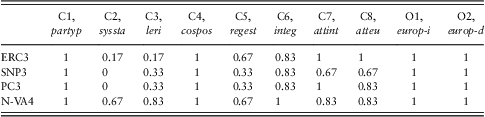
If we focus on the four crucial cases displaying the most intense use of ‘Europe’, that is, O1 = 1, the conditions of being a regional party (partyp) and having a radical constitutional position (cospos) emerge again as crucial factors, but what stands out is the particularly important conjunctural role of C8 (atteu). While C8 is not necessary on its own to produce strategic exploitation of the European dimension in general, it becomes such in association with a high level of C4 (cospos) in those cases. As shown in Table 4, all are regional parties (C1 = 1) with a radical constitutional position (C4 = 1) and positive attitudes to the EU (C8>0.67).Footnote 13 All the other cases scoring 1 on C4 but low intensity of use of ‘Europe’ score less than 0.5 on C8 (Table 2). In other words, a secessionist position and positive attitudes to the EU are together both necessary and sufficient for maximum exploitation of the European dimension.
Descriptive results for O1 = 1

Note: This table is an excerpt from Table 2.
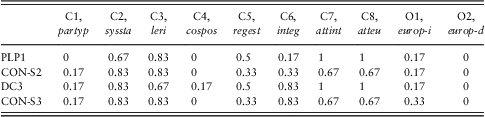
The ‘profile’ of the parties that display ‘negative’ use of ‘Europe’, in contrast, is very different. A simple inspection of Table 5 shows that these are state-wide parties with a dominant status within the party system, a right of centre position, hostility to state restructuring, and positive attitudes to integration and to the EU.
Descriptive results for O2 = 0

Note: This table is an excerpt from Table 2.
Discussion
These findings suggest five main points. First and foremost, the frequency and intensity of strategic exploitation of the European dimension in relation to state restructuring has been overall limited, as only in a few cases have parties ‘played the European card’ to a significant extent. This suggests that, in contrast to the claims put forward by a substantial body of literature, the external dimension of inter-state integration has only had a ‘punctuated’ influence on the politics of intra-state restructuring. Confidence in this claim is buttressed by the fact that the research design, as explained above, intended to maximize the chances of observing strategic use being deployed.
Second, the European dimension has overwhelmingly been exploited in a ‘positive’ direction, that is, to boost support for state restructuring. While the existence of a few cases of ‘negative’ use indicates that, in principle, appeals to ‘Europe’ could have supported both sides of the political debate on state restructuring, the imbalance between the two ‘directions’ of use clearly shows that most actors have indeed seen integration as a facilitator of domestic reform, as widely theorized in the literature. The fact that the two forms of strategic use of ‘Europe’ have consistently been employed by parties with a very different profile seems to underscore the systematic, as opposed to casual, nature of these strategic choices.
Third, the most intense strategic exploitation of the European dimension in connection to state restructuring has been made by regional–nationalist parties committed to independence for their region – conceived as a stateless nation – as the ultimate goal. Indeed, in three out of four cases (ERC3, PC3, and N-VA4), the adoption of a strategic focus on ‘Europe’ coincided with a shift from an autonomist to a secessionist position. The punctuated influence of ‘Europe’ on state restructuring via party strategies thus seems to manifest itself primarily in an indirect manner – by raising the credibility of secessionist policies – rather than directly affecting parties’ positions on devolution of powers within existing state boundaries. While this provides empirical support to the ‘economic integration-political disintegration’ thesis, the latter does need to be qualified. Not all secessionist parties have exploited the European dimension, and their attitudes to the EU are a critical accompanying condition. Moreover, the economic status of the region in which the party operates does not seem to have a clear influence, either for the whole set of cases or for the four displaying maximum intensity of exploitation. This suggests that even among secessionist parties, perceptions of the European context and the decision to strategically exploit it are determined by more than a mere calculus of the economic costs and benefits of independence.
Fourth, parties’ decisions to ‘play the European card’ are determined in complex ways, primarily by the interaction among several conditions rather than the net effect of any one of them. This is particularly true of the role of attitudes to integration and to the EU. While by themselves they do not determine strategic use of ‘Europe’, in interaction with other conditions they are decisive, but in different ways. On the one hand, positive attitudes to integration rather than to the EU as such, is a necessary condition determining parties’ strategic use of the European dimension. On the other hand, full exploitation – corresponding to an intensity score of 1 – is dependent on positive attitudes to the EU, not just to the idea of integration. This seems to suggest that negative attitudes to the EU are compatible with some use of the European dimension but prevent an intense strategic exploitation of it. It is thus important to distinguish between the two sets of attitudes, in line with the findings of previous research.
Lastly, the trends over time indicate that the influence of ‘Europe’ on state restructuring is not a ‘linear’ product of integration, one that can be expected to increase in line with the latter's deepening. While the ‘direction’ of exploitation has become clearly more univocal over time, both frequency and intensity display sharp fluctuations. On the one hand, the fact that significant exploitation of the European dimension has only taken place at T3 and T4 – that is, at times of advanced integration – suggests that a high level of integration is necessary for parties to link the latter to domestic restructuring. On the other hand, the drop between the two most recent time points clearly shows that the effect of integration is mediated by other powerful conditions, notably attitudes to the EU. Between T3 and T4, attitudes to the EU have become more negative, especially so among some of the regional–nationalist parties that had previously exploited ‘Europe’ to the full. This would explain why several such parties have maintained their radical constitutional policies but have made much less use of the European dimension to bolster them. The less sharp drop in frequency compared with intensity between T3 and T4 – 11 cases against 13 but 0.12 vs. 0.24 average intensity (Table 2 and Graph 1) – seems also to indicate that the former is more closely associated with the level of integration, while the latter is more volatile and dependent on party-specific circumstances. Hence, as integration progressed further, parties’ propensity to use the European dimension remained comparatively high but the intensity of their use was weaker and more ‘formulaic’. In other words, a greater proportion of parties ‘paid lip service’ to the European dimension but did not seriously exploit it.
Conclusions
European integration and state restructuring are among the most important processes that have shaped the evolution of politics in Europe since the Second World War. The questions of whether there is a causal connection between them and what form this might take have attracted scholarly attention since the 1970s. While the theoretical literature suggests a positive link between them, previous empirical studies have reached contrasting conclusions. This article offers an alternative testing of the proposition, centred on the role of party strategies as key causal mechanisms, analysed across states, regions, and over time. The findings indicate that parties have generally made limited strategic use of ‘Europe’ in relation to state restructuring but also that in a few cases such use has been intense and associated with crucial turning points in party strategy. These cases are all of regional–nationalist parties with a secessionist agenda and positive attitudes to the EU, who have argued that integration provides political and economic incentives and opportunities to acquire independent statehood. While further research is needed to firmly establish the extent to which this intense strategic use of ‘Europe’ has had a significant impact on the politics of state restructuring, the existing literature already provides evidence that, in the case of Scotland at least, this was indeed the case (Dardanelli, Reference Dardanelli2009). It thus seems plausible to infer from the findings presented here that integration can have a ‘positive’ causal influence upon state restructuring via party competition, but that this is highly contingent on the complex interaction of multiple conditions. Chief among them, parties’ attitudes to both the idea of integration and the existing EU can be decisive. Only when these are positive can strategic use be observed, hence the causal mechanism is activated. The fact that attitudes have become less positive in the most recent period and that strategic use has consequently declined, points to the fact that the influence of the European dimension is not a linear product of the deepening of integration. These findings confirm some of the theorizations and empirical findings of previous research but challenge others. Perhaps most significantly, they lend empirical support to the core insight of the ‘economic integration-political disintegration’ thesis, but also suggest that its wider claims need to be qualified. They thus shed further light on the long-standing but still not fully answered question of the causal connection between European integration and state restructuring and suggest two main avenues for further research. At the empirical level, in-depth case studies of the degree to which parties’ strategic use of ‘Europe’ have impacted on state restructuring. At the theoretical level, an effort to develop and refine the framework through which the connection between integration and state restructuring is theorized, with the aim of better capturing its complex operation. This would further deepen our understanding of an important aspect of contemporary politics in Europe.
Acknowledgements
The author thanks the James Madison Trust for generously funding this research project. Previous versions of this article were presented at the 107th APSA Annual Meeting, at the 23rd IPSA World Congress, at the University of Oslo's Political Science Research Seminar, and at the University of Kent's Comparative Politics Work in Progress Seminar. The author is grateful to Øivind Bratberg, César Colino, Paul Delforge, Kris Deschouwer, Lieven de Winter, Antoni Estupiñá, Paz Fernandez, Arianna Gerardi, Salvatore Glorioso, Fátima Gomez, Mireia Graus, Angustias Hombrado, Bruno Hopp, Alexander Libman, Matthew Loveless, Gloria Martinou, Hugh Miall, Hélène Michel, José Ramón Montero, Edward Morgan-Jones, Fabiola Mota, Klaus-Jürgen Nagel, Wendy Olsen, Jane O'Mahony, Ferran Requejo, Caroline Sägesser, Filippo Salvia, Ignacio Sánchez-Cuenca, Ben Seyd, Marloes van Hooijdonk, Tom Vandenkendelaere, Giuseppe Verde, Carles Viver, Andrea Volkens, George Woodcock, Andy Wroe, and the journal referees for their help and advice.