INTRODUCTION
The zooplankton community is composed of a blend of shallow and deep water species which may change according to local trades and seasons (Rawlinson et al., Reference Rawlinson, Davenport and Barnes2004). Decapod larvae of benthic and pelagic species are very common and eventually dominants in the marine plankton, especially in neritic waters (e.g. Boltovskoy, Reference Boltovskoy1981; Lindley, Reference Lindley1986; Schwamborn, Reference Schwamborn1997; Paranaguá et al., Reference Paranaguá, Nascimento-Vieira, Gusmão, Neumann-Leitão, Schwamborn, Eskinazi-Leça, Neumann-Leitão and Costa2004). In several areas those larvae constitute a link among pelagic primary producers and the higher trophic levels, serving as food for planktivorous fish and larger invertebrates (Drake & Arias, Reference Drake, Arias, Walter and Fyhn1993; Schwamborn et al., Reference Schwamborn, Neumann-Leitão, Silva, Silva, Ekau and Saint-Paul2001).
Knowledge of temporal and spatial variability of biological communities is a first step toward understanding their dynamics. Since planktonic larvae are, in general, exposed to quite different selective forces than their parents, they show their own evolutionary adaptations, principally in locomotion and feeding. Their special behaviour traits ensure either the retention in the parental habitat or, in other species, the transport between ontogenetically changing environments and, eventually, the return, settlement, and recruitment to the adult populations (Anger, Reference Anger2001).
The main feature of St Paul's Rocks is the high isolation degree of marine benthic species, which are separated by more than 500 km from the nearest coastal habitat. The maintenance of benthic species that preserved a pelagic phase in their life cycles depends ultimately on the return of these organisms to the parental domain. In remote environments, these populations persist by: (1) increasing the retention of local larvae nearshore (Roughan et al., Reference Roughan, Mace, Largier, Morgan, Fisher and Carter2005); (2) entraining remotely spawned larvae (Gaylord & Gaines, Reference Gaylord and Gaines2000); and (3) accelerating larval development through elevated concentrations of food and warm water, thereby reducing the pelagic larval duration and exposure to predation (Pechenik, Reference Pechenik, Giese and Pearse1987; Forward et al., Reference Forward, Tankersley and Rittschof2001).
Larval behaviour and local hydrography plays an important role in keeping larvae near parental habitats during the post-embryonic development or by returning larvae to suitable settlement sites late in development (Morgan, Reference Morgan and McEdward1995; Shanks, Reference Shanks1995; Kingsford et al., Reference Kingsford, Leis, Shanks, Lindeman, Morgan and Pineda2002). The magnitude of horizontal transport, for instance, can be regulated by larval depth preferences coupled with vertical migrations between opposing stratified currents (Sastry, Reference Sastry, Vernberg and Vernberg1983; Gibson, Reference Gibson2003). Onshore transport of late-stage larvae may occur by winds, internal waves, and other physical mechanisms coupled with an ontogenetic shift in depth preference (Shanks, Reference Shanks1995; Mace & Morgan, Reference Mace and Morgan2006). Hence, biological–physical interactions may influence distribution patterns and population maintenance, and could result in different assemblages in discrete regions and time scales.
Previous information concerning the St Paul's Rocks marine fauna reveals the occurrence of 19 adult decapod species (16 benthic and 3 pelagic) (Holthuis et al., Reference Holthuis, Edwards and Lubbock1980; Sankarankutty et al., Reference Sankarankutty, Oliveira and Ferreira2001; Viana et al., Reference Viana, Ramos-Porto and Torres2004). The archipelago is known to be an important area for pelagic fish (Lessa et al., Reference Lessa, Mafalda, Advíncula, Lucchesi, Bezerra, Vaske and Hellebrandt1999), supporting also a variety of reef fish (Feitoza et al., Reference Feitoza, Rocha, Luiz-Júnior, Floeter and Gasparini2003) and high zooplanktonic density (Macedo-Soares et al., Reference Macedo-Soares, Brandão, Koettker, Menezes, Stumpf, Freire, Mohr, Castro, Costa and Válka2009). The present study is the first specific research on decapod larvae in this most remote oceanic area of the Brazilian territory. Our goal was to provide a better knowledge of decapod local fauna and to understand relevant aspects of their larval phase in ecological terms such as temporal, spatial and diel variation, as well as its diversity and species assemblages.
Study area
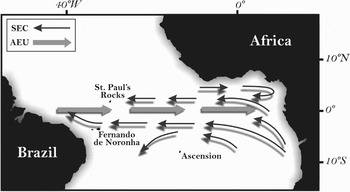
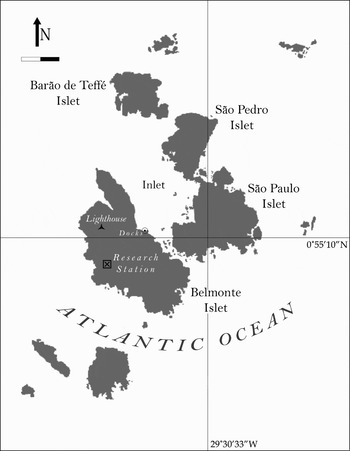
The St Paul's Rocks are an isolated group of ten islets and several rock points destitute of any sort of terrestrial vegetation. It is located in the vicinities of the Mid-Atlantic Ridge, just north of the equator (00°55′N–029°20′W) around 1000 km from the north-east coast of Brazil and 1800 km from the African coast (Figure 1). The archipelago constitutes an emergence of the sub-oceanic mantle, which elevates from abyssal depths of approximately 4000 m. At sea level the St Paul's Rocks are barely 400 m across in their greatest length and reach a maximum height of just 18 m above sea level. Narrow channels separate the four main islets (Figure 2) forming a 100 by 50 m horseshoe shape inlet with an average depth of 6 m.
Location of St Paul's Rocks and the major shallow currents in the area (modified from Edwards & Lubbock, Reference Edwards and Lubbock1983). AEU, Atlantic Equatorial Undercurrent; SEC, South Equatorial Current.

Map of St Paul's Rocks showing the main islets and the inlet.

The prevailing surface current in the area is the South Equatorial Current (SEC), which flows westwards reaching 5.6 km h−1 when passing by the rocks (Edwards & Lubbock, Reference Edwards and Lubbock1983). It also lies on the northern edge of the Atlantic Equatorial Undercurrent (AEU), a shallow (40–150 m deep), eastward flowing current derived from the North Brazilian Coastal Current. The AEU reaches the surface layer in certain periods of the year (Stalcup & Parker, Reference Stalcup and Parker1965). Thus, the St Paul's Rocks could receive biotic input from both the western and eastern tropical Atlantic.
The area is recognized as part of the Brazilian Economic Exclusive Zone. The Brazilian Scientific Program for St Paul's Rocks maintains scientists there all year round. Each scientific expedition is carried out by four researchers that spend 15 days at a time in the archipelago under extreme environmental conditions, such as rough waves, complete isolation and, sometimes, seismic tremors.
MATERIALS AND METHODS
Field work
Plankton samples were performed inside the inlet (August and November 2003, March 2004 and May 2005) and at the approximate distances of 150 m, 700 m and 1500 m from the emerged part of the archipelago (April, August and November 2003 and March 2004). In the waters surrounding the archipelago, samples were taken at randomly selected sites, only respecting the three sampling distances, but not necessarily following the same geographical coordinates in each month. Inside the inlet and at each sampling distance, three replicates were taken during the morning (between 04:30 and 09:30 am) and three during the dusk/night (between 04:30 and 07:30 pm), comprising 6 samples per expedition inside the inlet and 18 around the archipelago. We used a conical–cylindrical plankton net with 200 µm mesh size, 2 m length and 0.5 m mouth diameter, equipped with a General Oceanics flowmeter. The mean volume of water filtered was 43.6 m3 (±17.9 m3). The plankton was towed horizontally for 5 minutes, approximately 1 m from the surface. Temperature (thermometer) and salinity (refractometer) data of surface water were obtained together with plankton samples.
Sample processing
All zooplankton samples were preserved in ~4% buffered seawater–formaldehyde solution. Samples from outside the archipelago (150, 700 and 1500 m) were analysed on their total volume, whereas some samples from the inlet were serially split in aliquots ranging from 1/2 to 1/32 using a Folsom Splitter (McEwen et al., Reference McEwen, Johnson and Folsom1954). Decapod larvae were sorted and counted under a dissecting microscope and identified to the lowest practicable taxon and developmental stage, according to the pertinent literature for each group. The lack of larval descriptions for many species precluded identification in some cases.
Data analysis
Abundance data were standardized to ind. 100 m−3. The frequency of occurrence and relative abundance (percentage of total abundance) of each taxon were calculated separately for the inlet (total of 24 samples) and the samples collected around the archipelago (total of 72 samples). Analysis of variance (ANOVA) was used to test for the significance of temporal, diel and spatial differences on decapod larvae density off the archipelago (3-way ANOVA) and from the inlet (2-way ANOVA), with data transformed to log (x+1). All data were tested for normality according to D'Agostino–Pearson and homocedasticity using the Cochran test. Student–Newman–Keuls (SNK) multiple range tests were used in conjunction with ANOVA to look for differences between levels (Underwood, Reference Underwood2006). An alpha value of 0.05 was selected as the significant level. Margalef richness (d—which is a measure of the number of species present for a given number of individuals and not simply the total number of species), Shannon–Wiener diversity (H′) and Pielou evenness (J′) were calculated for each month and period of the day, using the larvae identified at specific level and taxa that represented one single species (e.g. Acanthephyra sp., but not Parapenaeus spp.). The Base 2 logarithm was used to calculate H′.
The taxonomic similarity between species assemblages (R mode) and samples (Q mode) was estimated by cluster analysis using the Bray–Curtis measure of similarity and group average sorting. For the species analysis we have reduced the total number from 51 to 28 taxa by using only those species that had frequency ≥5% (Clarke & Warwick, Reference Clarke and Warwick2001). Density data were square-root transformed and standardized according to Field et al. (Reference Field, Clarke and Warwick1982). All the identified taxa used in sample analysis and density data were also square-root transformed but not standardized (Field et al., Reference Field, Clarke and Warwick1982). In addition, non-metric multidimensional scaling (MDS) analysis was performed using Bray–Curtis similarity, since the combination of clustering and ordination analysis can be a very effective way of checking the adequacy and mutual consistency of both representations (Clarke & Warwick, Reference Clarke and Warwick2001). Significant differences (α = 0.05) among the groups formed by cluster and MDS analyses were tested by one-way analysis of similarity (ANOSIM). This is analogous to ANOVA, but can be built on a simple non-parametric permutation procedure, applied to the similarity matrix underlying the ordination or classification and, for instance, can be applied to biological matrix data with many zero entries. We interpreted R-values >0.75 as well separated; R > 0.5 as overlapping, but clearly different and R < 0.25 as barely separable at all (Clarke & Warwick, Reference Clarke and Warwick2001). Finally, indicator species analysis (ISA) was used to describe indicator values of individual species for each statistically different group. The indicator value is expressed as percentage of perfect indication, based on combining the relative abundance and relative frequency (faithful to a specific group of sample units with specific environmental characteristics). The indicator value for each species is tested for statistical significance using a Monte Carlo randomization technique (Dufrene & Legendre, Reference Dufrene and Legendre1997; McCune et al., Reference McCune, Grace and Urban2002), ranging from zero (no indication) to 100 (perfect indication).
RESULTS
Water temperature varied from ~26.5°C in August and November to approximately 28.5°C in April, March and May. Salinity data ranged from a minimum of 35.8 in April to a maximum of 37.8 in March and May.
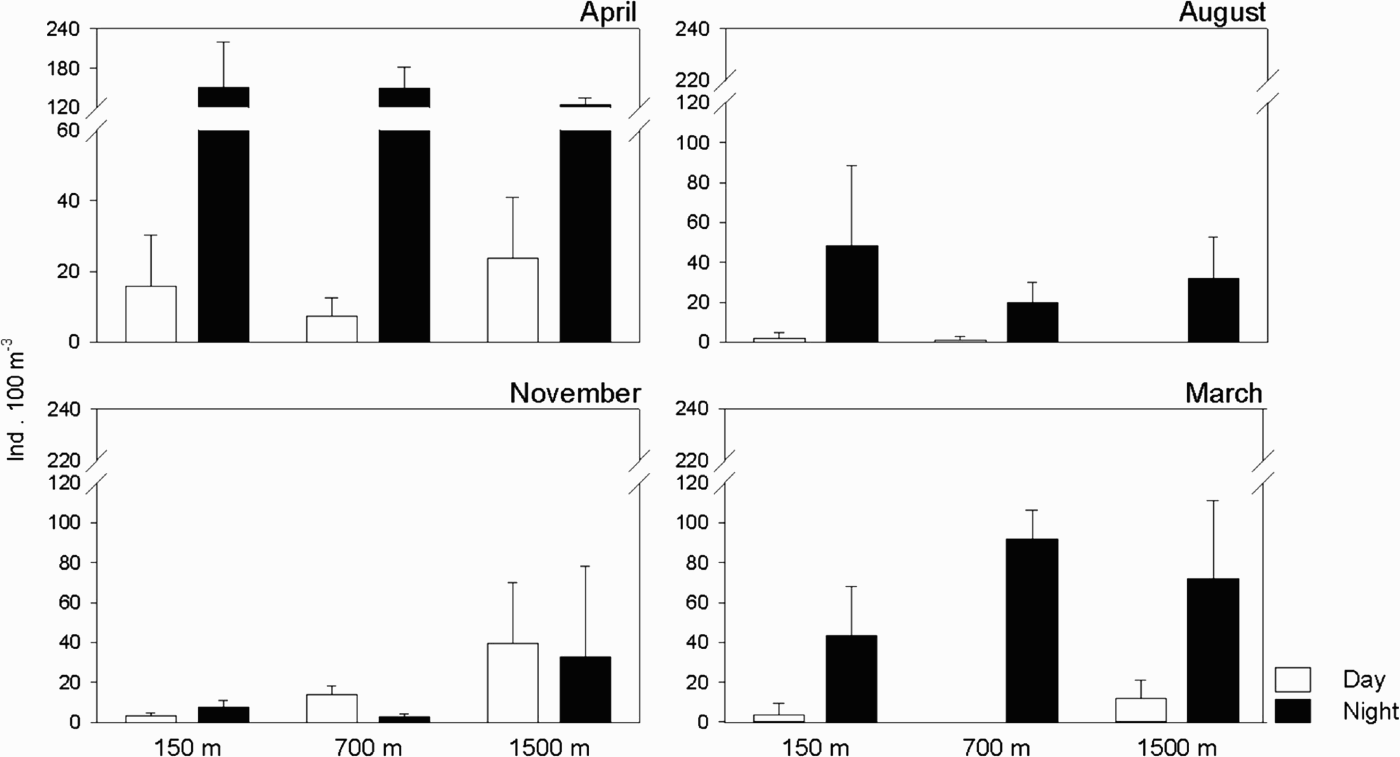
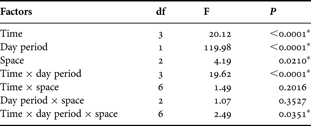
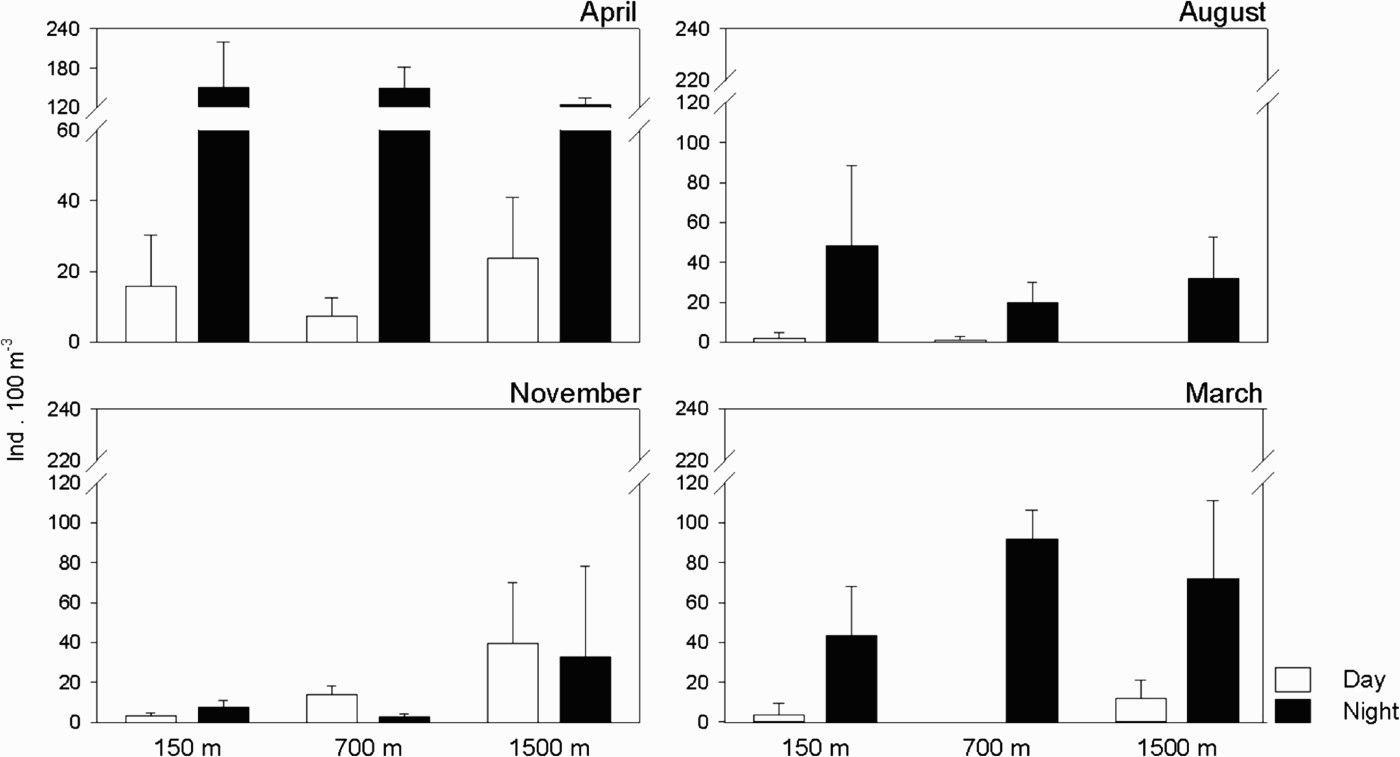
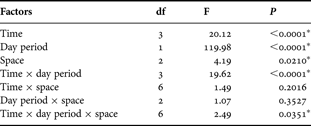
In sampling stations at 150, 700 and 1500 m from the archipelago, densities of decapod larvae fluctuated from 1.0±1.9 ind. 100 m−3 in diurnal samples of August to 141±40.5 ind. 100 m−3 in nocturnal samples of April (Figure 3). In general, the nocturnal densities were higher than during daytime (Figure 3). There was a significant interaction amongst time, day period and space on decapod densities outside the inlet (Table 1). Higher values obtained during daytime in November did not corroborate with the pattern observed in the remaining months. Moreover, ANOVA results showed that sampling distances around the archipelago (space—150, 700 and 1500 m sites) were only a minor factor in the interaction.
Mean decapod larvae density (ind. 100 m−3) collected at the approximate distances of 150, 700 and 1500 m from the archipelago, at day and night periods in April, August and November of 2003 and March of 2004.
Three-way ANOVA to test the effects of time (sampling months), day–night, space (distance sites) and interactions on decapod densities (ind. 100 m−3) around the archipelago. N = 72; df: degrees of freedom; *significant results (P < 0.05).
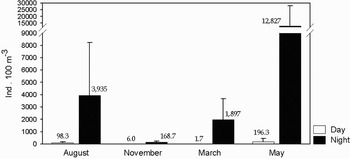
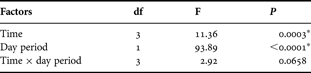
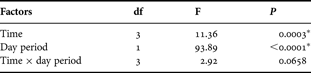
In the inlet, densities of decapod larvae ranged from 1.7±3.0 ind. 100 m−3 in diurnal samples of March to 12,827±15,173 ind. 100 m−3 in nocturnal samples of May (Figure 4). There was no significant interaction amongst time and day period (Table 2). Larval densities were significantly higher in May and August and at nighttime (Table 2).
Mean decapod larval density (ind. 100 m−3) collected in the inlet during day and night periods in August and November of 2003, March of 2004 and May 2005.

Two-way ANOVA to test the effects of time (sampling months), day–night and interaction on decapod densities (ind. 100 m−3) in the inlet. N = 24; df: degrees of freedom; *significant results (P < 0.05).
Considering the months in which samples were performed at the inlet as well as at the approximate distances off the archipelago, larval densities were significantly higher within the inlet than outside (df = 3; F = 17.18 and P = 0.0008 in August; F = 9.99 and P = 0.004 in November; F = 22.73 and P=0.0003 in March) (verified for samples taken during nighttime).
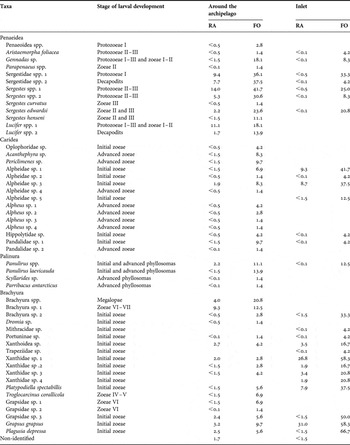
A total of 51 decapod larvae taxa were recorded in this study (Table 3), composed of 13 Penaeidea, 15 Caridea, 4 Palinura, 19 Brachyura, including pelagic (Gennadas sp., Lucifer spp., Sergestes curvatus, S. edwardsi, S. henseni, Acanthephyra sp., Oplophoridae sp.) and benthic species larvae (Table 3). The remaining decapod groups, such as Astacidea, Stenopodidea and Thalassinidea were not recorded.
Larval development stage, frequency of occurrency (FO) and percentage of total abundance (relative abundance (RA)) of decapod larvae identified around the archipelago (150, 700 and 1500 m) and in the inlet in all sampling months. Initial stages: from I to III; advanced: IV or more.

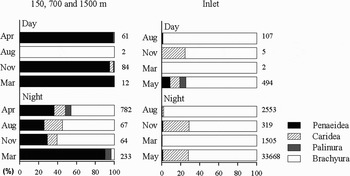
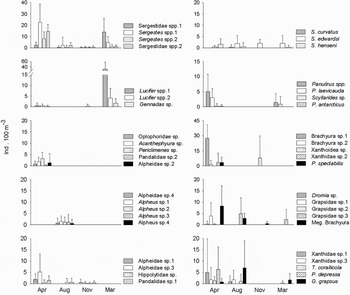
Around the archipelago (150, 700 and 1500 m sites), penaeids were the dominant organisms, reaching between 95 and 100% of all decapod larvae identified in diurnal samples of April, November and March (Figure 5). Sergestid and luciferid protozoeae, zoeae and decapodits were the most frequent and abundant larval forms, making up to 53% of total larval density in open water (Table 3). Most of the Penaeidea larvae identified showed higher densities in April and March or only in March (Figure 6). Caridean and brachyuran zoeae occurred mainly at nighttime samples (Figure 5). Advanced zoeae of Acanthephyra sp. and Periclimenes sp. and initial zoeae of Alpheidae sp.1, Alpheidae sp.3 and Pandalidae sp.1 were the most abundant caridean taxa, while megalopae (Brachyura spp.), Brachyura sp.1 and Grapsus grapsus constituted up to half of the total brachyuran abundance (Table 3). Among caridean larvae, 10 of the 14 taxa identified outside the inlet occurred in only one of the four sampling months, in April or August, and most of them were in advanced stage of development (Figure 6; Table 3). In the waters around the archipelago, brachyuran zoeae were most abundant in April and August. Seven out of 16 taxa were identified only in April, while Grapsus grapsus and megalopae were the only larval forms identified in three of the four sampling months (Figure 6). Palinura phyllosomas represented less than 5% of the total decapod abundance around the archipelago (Table 3) occurring only in nighttime samples of April and March (Figures 5 & 6).
Per cent abundance composition of the major taxa collected around the archipelago (150, 700 and 1500 m) and in the inlet during day and night periods. Numbers indicate the total decapod larvae sampled on each period.

Mean density (ind. 100 m−3) of the taxa collected around the archipelago (150, 700 and 1500 m) in April, August and November of 2003 and March of 2004.

In the inlet, Brachyura was the most significant taxa counting for 80% of total abundance in this habitat (Table 3) and reaching between 70 and 100% in diurnal and nocturnal samples (Figure 5). Grapsus grapsus, Xanthidae sp.1 and Platypodiella spectabilis constituted up to 83% of total abundance of brachyuran community and together with Grapsidae sp.3 and Plagusia depressa were the most frequent taxa (Table 3; Figure 7). Caridean larvae represented approximately 25% of decapod larvae identified in November and May (nocturnal samples) (Figure 5). Alpheidae sp.1 and Alpheidae sp.3 were the only caridean larvae with high frequency and relative abundance (Table 3; Figure 7). Penaeidea and Palinura larvae accounted for less than 1% of total decapod abundance occurring in the inlet especially at May (Figures 5 & 7).
Mean density (ind. 100 m−3) of the taxa collected in the inlet in August and November of 2003, March of 2004 and May 2005.

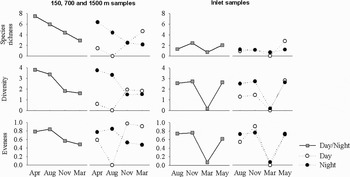
Species richness, diversity and evenness values were higher around the archipelago, particularly in the nocturnal samples of April and August (Figure 8). In the inlet, values were similar in August, November and May. March samples had low specific richness and diversity and high species dominance in both habitats. Lucifer spp. dominated the samples around the archipelago and Grapsus grapsus the samples inside the inlet during this period (Figures 6 & 7).
Temporal and diel variation of specific richness, diversity and eveness around the archipelago (150, 700 and 1500 m) and in the inlet.

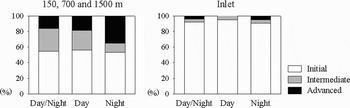
Figure 9 shows the per cent abundance composition of initial, intermediate and advanced stage of larval development. Initial and intermediate/advanced larvae percentage were similar, with higher dominance of advanced larvae in nighttime samples in the open water. On the other hand, approximately 92% of the taxa identified in the inlet were at the first stage of larval development.
Per cent abundance composition of larval development stages of the taxa collected around the archipelago (150, 700 and 1500 m) and in the inlet during day and night periods, considering all sampling months.

Larval densities of pelagic and benthic species presented different patterns of distribution and abundance. Initial penaeid larvae, mostly derived from sergestid and luciferid pelagic shrimps, were found in similar densities inside and outside the inlet, whereas initial larvae of benthic carideans and brachyurans occurred in high densities only inside the inlet (Figure 10). Intermediate and advanced larvae of benthic species were sampled only in open waters, while penaeid intermediate/advanced larvae increased in number with increasing distance from the archipelago (Figure 10).
Mean densities (ind. 100 m−3) of initial and intermediate/advanced stages of development of Penaeidea, Caridea and Brachyura larvae collected at each station, considering all sampling months.

The R-mode dendrogram (Figure 11) showed the presence of two distinct larval groups with only 8% similarity. Group A, composed of initial brachyuran and caridean larvae, with greater densities in the inlet and group B, composed of sergestids, luciferids, phyllosomas, Gennadas sp. and advanced brachyuran and caridean larvae, mostly collected around the archipelago.
Dendrogram using group-average linking of Bray–Curtis species similarity from square-root transformed and standardized density data. 28 species with frequency ≥5% were retained from an original list of 51.

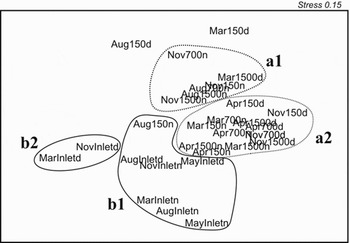
The Q-mode dendrogram divided the sampling sites into two large groups with only 7% of similarity (Figure 12). Group A was composed of samples collected around the archipelago (150, 700 and 1500 m), while group B included inlet samples and nighttime hauls of August at 150 m from the archipelago, since initial brachyuran larvae were the only abundant organisms in these samples. ANOSIM test indicated that groups A and B were statistically different (R = 0.73; P=0.001).
Hierarchical clustering dendrogram for 34 sites (2 sites were withdrawn due to zero density) using group-average linking of Bray–Curtis similarity calculated from root-transformed density data of all 51 taxa. Apr, April; Aug, August; Nov, November; Mar, March; 150, 700 and 1500, sample distances around the archipelago; d, day; n, night.

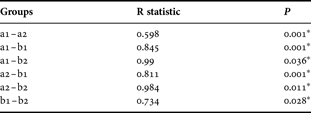
At 20% similarity it was possible to separate samples into four groups (a1, a2, b1 and b2) (Figure 12). ANOSIM test showed smaller statistical R values in groups a1–a2 and b1–b2 (Table 4). Group a1 was composed of lower density samples, in which no initial brachyuran and few initial caridean larvae were identified, with sergestids predominating. On the other hand, group a2 was formed by the most abundant and diverse samples collected around the archipelago. Group b1 included the majority of inlet samples with high decapod larval densities, especially owing to the recently hatched brachyuran zoeae. Daytime March and November inlet samples formed the group b2, which was characterized by the lowest density samples verified in this environment. Additional groups could be tested at higher similarity percentages, however non-metric multidimensional scaling (MDS) analysis showed that the remaining samples were very similar (Figure 13).

Analysis of similarity (ANOSIM) based on the sample groups (a1, a2, b1 and b2) formed at Figure 12. *significant results (P < 0.05).
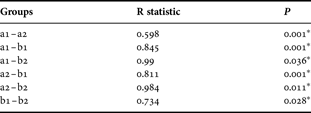
Global test: R = 0.786.
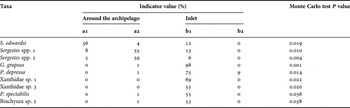
The indicator species analysis (ISA) revealed that Sergestes edwardsi, Sergestes spp.1 and Sergestes spp.2 were good indicator species for the waters around the archipelago and six Brachyura taxa, especially Grapsus grapsus, for the inlet waters (Table 5; Figures 12 & 13).
Indicator species analysis (ISA) results from groups formed in Figure 12, showing only the species with significant results (P < 0.05).

DISCUSSION
Larval identification
Planktonic larvae advection by oceanic currents is one of the most effective ways for the colonization of new areas by benthic organisms. In several cases, the pelagic phase of benthic invertebrates is the first form to arrive in a new habitat, establishing an adult population. Therefore, the presence of larval forms in plankton samples may be a good indicator of the presence of corresponding adults in the area (Boltovskoy, Reference Boltovskoy1981).
In the present work, we identified 51 different decapod larvae, while only 19 adult decapod species are reported for the study area (Holthuis et al., Reference Holthuis, Edwards and Lubbock1980; Sankarankutty et al., Reference Sankarankutty, Oliveira and Ferreira2001; Viana et al., Reference Viana, Ramos-Porto and Torres2004). Among them, only three species (Sergestes edwardsi, Grapsus grapsus and Plagusia depressa) and three genera (Lucifer, Panulirus and Dromia) had their larval forms identified in the present study. New occurrences include seven species (Aristaeomorpha foliacea, Sergestes curvatus, Sergestes henseni, Panulirus laevicauda, Parribacus antarcticus, Platypodiella spectabilis and Troglocarcinus coralicolla) and six genera (Gennadas, Parapenaeus, Acanthephyra, Periclimenes, Alpheus and Scyllarides). Pandalidae and Portunidae larvae were also identified for the first time in St Paul's Rocks. Thus, larval identification pointed out that benthic decapod species richness is likely to be higher than that recorded for the area. Recent research at Arvoredo Island, in south of Brazil (Koettker & Freire, Reference Koettker and Freire2006), also verified that combined benthic and planktonic research provided different and complementary results, reinforcing the idea that ecological and management studies must include the whole species life cycle. Additional larval identifications at specific level were not possible owing to the paucity of larval development descriptions for Brazilian species.
Despite the low diversity values present in shallow water benthic and reef fish species from St Paul's Rocks (Edwards & Lubock, 1983; Feitoza et al., Reference Feitoza, Rocha, Luiz-Júnior, Floeter and Gasparini2003), decapod larvae diversity was high, particularly in the waters surrounding the archipelago. Besides the pelagic decapod community that inhabits this environment, it periodically receives larvae of benthic species from both shallow and deep waters, promoting local diversity enhancement.
Decapod larval densities
Tropical oceanic areas present low primary production as a rule (Thurman & Burton, Reference Thurman and Burton2001) and, comparatively, a reduced zooplanktonic abundance. At St Paul's Rocks, Macedo-Soares et al. (Reference Macedo-Soares, Brandão, Koettker, Menezes, Stumpf, Freire, Mohr, Castro, Costa and Válka2008) reported higher zooplanktonic abundances than those found on the north-east Brazilian coast and on the west equatorial coast of Africa. Decapod larval densities obtained in this study were similar to those of Vitoria–Trindade seamount chain in eastern Brazil (Schutze et al., Reference Schutze, Velho, Razouls and de Plâncton1990), but inferior to those found at tropical coastal areas (e.g. Reeve, Reference Reeve1970; Hopkins, Reference Hopkins1977). On the other hand, since decapod larval densities in open oceanic areas are ~1.0 larva 200 m−3 (Raymont, Reference Raymont1983), we could say that values obtained in this study are relatively high. Biological enhancement in the vicinity of oceanic islands is a well-documented phenomenon (Palacios, Reference Palacios2002). At St Paul's Rocks upwelling events were verified at least during winter and spring (Becker, Reference Becker2001), promoting phytoplanktonic growth and reproduction that sustain the zooplanktonic community in the area.
Temporal variation
The presence of decapod larvae in all sampling months suggests that physical, chemical and biological conditions on the surrounding oceanic area of the St Paul's Rocks allows species reproduction throughout the year. Decapod larvae abundance peaks were also registered in other tropical areas. Hopkins (Reference Hopkins1977) and Reeve (Reference Reeve1970) found such increases in abundance during spring/summer and spring/autumn in Tampa and Biscane bays, respectively. Woodmansee (Reference Woodmansee1958) also noted spring and autumn maxima at Chiken Key. Temperature (both level and rate change), day-length (intensity and periodicity), and food availability (quality and quantity) are major exogenous determinants of invertebrate reproductive cycle (Sastry, Reference Sastry, Vernberg and Vernberg1983). The higher frequency observed for Sergestidae spp.1 and spp.2, Sergestes spp.1 and spp.2, Lucifer spp.1 and Brachyura sp.1 outside the inlet in April and/or March suggests a possible association with warm surface waters. Moreover, the high nocturnal decapod densities in these months could also be related to the food availability, since Macedo-Soares et al. (Reference Macedo-Soares, Brandão, Koettker, Menezes, Stumpf, Freire, Mohr, Castro, Costa and Válka2009) found similar trends for copepods.
In the inlet approximately 92% of the taxa were at the first stage of larval development. This suggests that factors controlling decapod abundances are not necessarily the same inside and outside the inlet. The higher densities verified in August and May in the inlet could be related to the sampling time, since plankton hauls were performed later during these months (around 05:30 pm). November and March sampling occurred around 04:30 pm, under stronger influence of sunlight. There is little information concerning the species reproductive biology from St Paul's Rocks. However, Freire et al. (Reference Freire, Pinheiro, Teschima, Madeira, Koettker, Silva, D'Incao, Mohr, Castro, Costa and Válka2009) reported the presence of ovigerous Grapsus grapsus females in all seasons. Grapsus grapsus larvae occurred in all sampling months and it was the only taxon presenting three abundance peaks inside the inlet, corroborating the observed reproduction periodicity.
Diel variation
At all sampling sites, nocturnal densities were higher than those found during the day emphasizing the significance of diel migration and the probable predominance of nocturnal larval release. Among decapod larvae, diel migrations have been known since the beginning of the 20th Century (Russell, Reference Russell1925, Reference Russell1928, Reference Russell1931), with the predominance of nocturnal migration (Queiroga & Blanton, Reference Queiroga and Blanton2005). In general, penaeid and caridean larvae concentrate around 50–100 m depth during the day, ascending to 0–75 m at nighttime (Criales & McGowan, Reference Criales and McGowan1994), increasing the diversity during nighttime.
Outside the inlet, the plankton hauls collected at 700 and 1500 m in November were the only ones where diurnal samples were more abundant than nocturnal. Sergestidae protozoea were by far the dominant organisms, not only in these samples but in all diurnal hauls around the archipelago. Sergestid females from virtually all pelagic zones release their eggs near the surface; the early stages have little power for diel vertical migration and concentrate on the first 50 m of the water column at both night and day where they can take sufficient amounts of phytoplankton and suspended matter (Omori, Reference Omori1974). On the other hand, advanced larvae were sampled almost exclusively during the nocturnal period, including larvae of the deep-sea species Acanthephyra sp. and Gennadas sp.
In the inlet, the high nocturnal larval densities are associated with spawning events of brachyuran and caridean benthic species, since all the identified larvae from these taxonomic groups were at the first stage of development. By hatching at night, larvae could find, for instance, a reduced number of planktivorous fish (Christy, Reference Christy1982) and other visual predators, since initial zoeae, even from deep water species, tend to migrate to surface waters (Queiroga & Blanton, Reference Queiroga and Blanton2005).
Spatial variation
The spatial distribution uniformity of decapod larvae amongst the three sites around the archipelago was probably related to the small sampling distance (~1500 m) used in the present work. Prior studies verified that zooplankton composition varies in distances up to 30 km around seamounts (Dower & Mackas, Reference Dower and Mackas1996). However, we found large differences in decapod larvae composition, density and diversity in a much smaller scale (~150 m), between the inlet and the surrounding area. The high isolation of St Paul's Rocks, distant from any other colonization spot, as well as the low abundance of benthic caridean and brachyuran larvae at our more distant stations suggests the existence of some kind of larval retention, either biological and/or physical. Recent modelling studies on the Portuguese shelf (Marta-Almeida et al., Reference Marta-Almeida, Dubert, Peliz and Queiroga2006; Peliz et al., Reference Peliz, Marchesiello, Dubert, Marta-Almeida, Roy and Queiroga2007) certainly indicate that diel vertical migration of decapod larvae between water masses moving in different directions may constitute a mechanism that contributes to their retention on the inner shelf near their release sites. Dos Santos et al. (Reference dos Santos, Santos, Conway, Bartilotti, Lourenço and Queiroga2008) also found that horizontal distributions of decapod larvae clearly showed a pattern related to their presumed settlement areas, with inshore species concentrated on the coast and shelf species more widely distributed.
In Easter Island, distant around 3700 km from the Chilean coast, Mujica (Reference Mujica2006a, Reference Mujicab) found the same distributional trend obtained in the present study for pelagic and benthic larvae. In the Florida Keys (24.5°N–81.4°W) caridean larvae decrease in percentage with distance from the coast whereas sergestoids do the opposite (Criales & McGowan, Reference Criales and McGowan1994). At St Paul's Rocks horizontal displacement control is especially important among benthic invertebrate larvae, since the nearest habitat is around 500 km away.
Summing up, this study showed that decapod richness from St Paul's Rocks is higher than that previously recorded for the area. The relative high density values of decapod larvae from St Paul's Rocks is probably related to nutrient input by upwelling events, which provides favourable conditions for reproduction throughout the year. Two different larval assemblages inhabit the St Paul's Rocks marine environment, distinguishing the inlet from the surrounding oceanic waters.
ACKNOWLEDGEMENTS
The authors wish to thank FAPESP (Grant 05/58085-5) and CNPq (Grant 48.0040/2004-4) for financial support. The Master and crew of the RVs ‘Transmar I’ and ‘Transmar II’, CIRM (Comissão Interministerial para os Recursos do Mar) and a number of people are also thanked for assistance with sampling during the expeditions to St Paul's Rocks. Students of Universidade Federal de Santa Catarina who helped with the sorting of samples. We are also deeply indebted to Dr Lohengrin Dias de Almeida Fernandes for helping with larval identification and Arthur Guth for rendering the figures.