Introduction
According to the Diagnostic and Statistical Manual of Mental Disorders (DSM-IV; American Psychiatric Association, 1994), borderline personality disorder (BPD; also called emotionally unstable personality disorder in the WHO Classification of Diseases (ICD-10)) is a complex and severe psychiatric disorder characterised by pervasive instability in emotion regulation, impulse control, self image and interpersonal relationships, recurrent suicide ideation and behaviours, and chronic feelings of emptiness (American Psychiatric Association, 1994). Individuals with BPD may account for 15–20% of psychiatric inpatient populations (Skodol et al. Reference Skodol, Gunderson, Pfohl, Widiger, Livesley and Siever2002). In a disorder characterised by affective instability, including intense anger, patients with BPD often exhibit disturbed behaviours that can be difficult to manage which can generate intense feelings emotions and reactions amongst staff in inpatient settings (Holmgvist, Reference Holmqvist2000). Consequently, staff members have reportedly labelled patients with BPD as ‘evil’ and ‘monstrous’ (Bowers, Reference Bowers2002) and experience a strong desire to create distance between themselves and the patient (Markham, Reference Markham2003), to the extent that some professionals avoid providing any level of care to patients with BPD (McGrath & Dowling, Reference McGrath and Dowling2012).
Markham & Trower (Reference Markham and Trower2003) noted that some staff members consider patients with BPD to be ‘in control’ of their behaviours and to actively create stressors that negatively impact on their experience of the world. Further, since those diagnosed with personality disorders do not conform to the typically held idea of a mentally unwell person (Fincham & Emery, Reference Fincham and Emery1998) and are not traditionally understood via the medical model (Markham & Trower, Reference Markham and Trower2003), behaviours such as self-harming are viewed as a method of ‘attention seeking’ or ‘manipulation’ rather than a sign of distress or a symptom of the disorder (Woolaston & Hixenbaugh, Reference Woolaston and Hixenbaugh2008). In addition, behaviours exhibited by patients with BPD are often viewed as a ‘consequence of character’ (Becker, Reference Becker2000), making it difficult for staff to be empathic towards patients with a diagnosis of BPD (Pfohl et al. Reference Pfohl, Gunderson, Silk, Zimmerman, Williams, Phillips, Robins and Rush1999). Fraser & Gallop’s (Reference Fraser and Gallop1993) observational study found that nursing staff appeared to react to patients with BPD with greater negative intensity and less empathy when compared to those with a diagnosis of affective disorder. Further to this, patients with BPD are considered to be less deserving of care than patients with other diagnoses (Lewis & Appleby, Reference Lewis and Appleby1988) as a result of commonly held beliefs that people with BPD are actually 'not sick' and that they are 'bed wasters' (Nehls, Reference Nehls1998). Such inappropriate attitudes can lead staff members to treat patients with this diagnosis in a ‘belittling or contradictory manner’ (Gallop et al. Reference Gallop, Lancee and Garfinkel1989) and may be responsible for the differential treatment received by BPD patients (Fraser & Gallop, Reference Fraser and Gallop1993).
Despite the findings that inappropriate staff attitudes can lead to the inadequate provision of care and treatment for patients with BPD (Fraser & Gallop, Reference Fraser and Gallop1993; McGrath & Dowling, Reference McGrath and Dowling2012), only a handful of research papers have investigated staff attitudinal change. Previous research has examined the role of staff training in increasing empathy in relation to staff and caregivers working with psychosis (McLeod et al. Reference McLeod, Deane and Hogbin2002) and challenging behaviour (Dowey et al. Reference Dowey, Toogood, Hastings and Nash2006). When knowledge regarding patients’ symptoms and behaviours is imparted to staff, they experience a reduction in negative emotions towards patients, are less likely to attribute challenging behaviour to internal causes (Dowey et al. Reference Dowey, Toogood, Hastings and Nash2006; Kalsy et al. Reference Kalsy, Health, Adams and Oliver2007) and are generally more empathic (McLeod et al. Reference McLeod, Deane and Hogbin2002; McGill et al. Reference McGill, Bradshaw and Hughes2007). It seems feasible that attitudinal change towards BPD patients can be actively achieved by imparting knowledge to staff through educational training.
In 2003, the National Institute for Mental Health in England produced policy guidance on developing services for people with personality disorders which was intended to address the significant problems in the attitude of care providers. Whilst there have been some significant developments in England and Wales in the availability of treatment for those with personality disorders there remains an abundant literature on the unfavourable attitudes held by staff towards patients with BPD (e.g. James & Cowman, Reference James and Cowman2007; Bodner et al. Reference Bodner, Cohen-Fridel and Iancu2011; McGrath & Dowling, Reference McGrath and Dowling2012). Further, research into which framework of staff training can instigate positive attitudinal change is negligible. Following a two day educational workshop on the diagnosis, aetiology, prognosis and treatment of BPD, Krawitz (Reference Krawitz2004) found that mental health staff showed an increased willingness to engage with patients, had increased enthusiasm for their work and greater confidence in their roles, as well as an increase in theoretical knowledge of BPD. In another study (Miller & Davenport, Reference Miller and Davenport1996) significant increases in knowledge and attitudinal change were observed following a training course on the aetiology of BPD, while theoretical knowledge was found to positively correlate with positive staff attitudes towards BPD patients (Miller & Davenport, Reference Miller and Davenport1996). It is possible, therefore, that staff training can increase empathy, have a positive impact on ward milieu and patient experience of treatment (Brickman et al. Reference Brickman, Rabinowitz, Karuza, Coates, Cohn and Kidder1982) and help to support the therapeutic relationship between staff and patients (Shearin & Linehan, Reference Shearin and Linehan1992).
Linehan (Reference Linehan1993) described a biosocial theory to understand BPD, suggesting that it is ‘primarily a disorder of the emotion regulation system’ (p.43). The difficulties of regulating emotions as well as being emotionally vulnerable ‘have their roots in biological predispositions which are exacerbated by specific environments’ (p.43). The ongoing transaction between the individual with emotional vulnerabilities and the invalidating environment (at the most extreme this could include sexual, physical, and emotional abuse) results in BPD as being a pervasive disorder of the emotion regulation system.
In an effort to reframe BPD as a mental disorder with real, tangible biological underpinnings, and highlighting the biological component of the disorder as described by Linehan (Reference Linehan1993), Porr (Reference Porr2011) utilised biological and pharmacological frameworks to establish BPD as a true neurobiological disorder and not as a ‘character flaw’ or as a matter of ‘bad parenting’, as many come to believe. Porr (Reference Porr2011) described each behavioural component of BPD as a ‘symptom’ of the disorder and provided a detailed explanation of the functional abnormalities and dysregulated systems in the brain associated with each 'symptom'. In addition, she included an overview of the anatomical brain structure and neurotransmitter differences that are common in those with BPD. Increased understanding of the biological and neurological origins of these behavioural symptoms can help carers and family members to gain a better understanding of the experience of BPD and replace previous feelings of responsibility, guilt and anger with genuine compassion and empathy regarding the difficulties that their family member experiences (Porr, Reference Porr2011).
Previous studies into staff attitudinal change towards patients with BPD have failed to include samples of staff from a full multidisciplinary team (MDT) or staff working within a secure inpatient hospital setting, despite 15–20% of patients within this setting meeting the diagnostic criteria of BPD (Skodol et al. Reference Skodol, Gunderson, Pfohl, Widiger, Livesley and Siever2002). The primary aim of this study was to investigate whether a brief MDT training session based on Porr’s (Reference Porr2011) neurobiological framework could improve staff knowledge and understanding of BPD, and increase empathy towards patients with BPD. Specifically, it was hypothesised that after attendance at the training, staff on a low secure inpatient unit treating patients with a diagnosis of BPD would: (1) increase their theoretical knowledge of BPD; (2) develop increased feelings of empathic concern towards patients with BPD; (3) develop increased perspective taking towards patients with BPD; and (4) change their locus of origin of BPD to be one that favours biological and genetic causes.
Method
Setting
The study was conducted within a 23-bed low secure unit for patients with a primary diagnosis of BPD. The majority of patients were detained under a section of the Mental Health Act (1983, amended 2007), had a forensic history and a history of disturbed behaviour, particularly self-harm, and emotional dysregulation. The psychological treatment offered is a comprehensive Dialectical Behaviour Therapy programme (Fox et al. Reference Fox, Krawcyzk, Staniford and Dickens2014).
Design
A within-subjects, quantitative questionnaire design was employed to investigate whether the delivery of a training session on the neurobiological underpinnings of BPD had an effect on measures of knowledge, beliefs about the aetiology of BPD, empathic concern and perspective taking. Data was collected at three time intervals: pre and post-training, and at an eight-week follow up. In addition, demographic information was also collected prior to the training.
Procedure
Staff members were notified about the research and training opportunity through emails and posters. Individuals willing to participate were guided through the information sheet and consent form, and the nature and format of the questionnaires were explained. Eight training sessions were held to accommodate diverse shift patterns. The order in which the pre-training, post-training and follow up questionnaires were completed was standardised for all participants and numerical coding was used to ensure confidentiality.
Training
The 90 minute training session utilised a PowerPoint presentation entitled 'The Science of Borderline Personality Disorder' which was delivered by the consultant clinical psychologist. The course content was based on the work of Porr (Reference Porr2011) and topics covered included: an overview of BPD, DSM-IV diagnostic criteria, role of the invalidating environment and neurobiological vulnerabilities, the role of neurotransmitters, architecture of the brain, brain functioning and the related behavioural aspects in BPD.
Measures
Theoretical knowledge
An ad-hoc questionnaire, based on the training course content, was compiled to assess level of knowledge about the neurobiological underpinnings of BPD. Ten multiple choice items (four possible responses for each item) covered: the genetics of BPD; the roles of the pre-frontal cortex and the amygdala; serotonin systems; developmental correlates; BPD and emotional reactions to facial expressions; and the emotional experience of those with BPD.
Mental Health Locus of Origin Scale (MHLO; Hill & Bale Reference Hill and Bale1980)
The 20 item MHLO measures aetiological beliefs about mental health including endogenous beliefs (genetic and physiological factors) and interactional beliefs (psychosocial factors). Items are scored on a six point Likert scale with responses ranging from ‘Strongly Agree’ to ‘Strongly Disagree’. The potential range of scores is from 20 (interactional extreme) to 120 (endogenous extreme). This scale has been validated in previous studies (e.g. Read & Law, Reference Read and Law1999). Subject pronouns were altered with permission from the authors, to reflect beliefs about the diagnosis of BPD and the hospital setting.
Interpersonal Reactivity Index (IRI; Davis, Reference Davis1980)
Empathy was assessed using Empathic Concern and Perspective Taking subscales of the IRI. Each subscale compromises seven items with a five point rating scale with responses ranging from ‘Does not describe me well’ to ‘Describes me very well’.
The Empathic Concern subscale explicitly enquires about respondents' emotional reaction to the negative experiences of others and also feelings of warmth, compassion and concern for others. The Empathic Concern subscale had appropriate test-retest reliability with 0.72 and 0.70 for males and females respectively (Davis, Reference Davis1980).
The Perspective Taking scale contains cognitive items which assess spontaneous attempts to adopt the perspective of other people and see things from their point of view. High scores on the Perspective Taking subscale have been positively related to measures of interpersonal functioning (Eisenberg & Fabes, Reference Eisenberg and Fabes1990). The test-retest reliability for the Perspective Taking subscale was also appropriate, with 0.61 and 0.62 for males and females respectively (Davis, Reference Davis1980). The use of nouns within each item on both subscales was displaced to better suit the inpatient hospital setting after permission was gained from the author. Both of these subscales have robust reliability and validity (Cliffordson, Reference Cliffordson2001).
Statistical Analysis
Statistical analysis was performed with PASW Statistics (SPSS, 2009). Preliminary data analysis showed that the assumption of normal distribution continued to be violated after log, square root and reciprocal transformations had been applied. Accordingly, a series of Wilcoxon signed rank tests were employed. Effect sizes (r) were calculated and interpreted as: r=0.1, small effect size; r=0.3, medium effect size; r=0.5, large effect size (Cohen, Reference Cohen1988).
Mann Whitney U-tests were used to examine differences between changes in scores depending on whether participants were registered or unregistered members of staff, whether participants had or had not received additional training on BPD and whether or not participants had more or less than two years of mental health experience within the current unit setting as depicted by a median split. A Bonferroni correction of p<0.017 was applied to reduce the possibility of a type 1 error.
Results
Participants
Of 44 staff members working on the unit, 34 participated (77.3% response rate). The sample was compromised of 32 females and 2 males with the mean age of 39.41 years (SD 10.45, range 20–60 years).
The participants comprised 23 nursing staff, 4 occupational therapy staff, 2 psychology staff, 1 education and 1 one social work staff member; 3 were administration staff. Of these, 14 participants were registered with a professional governing body, while 20 were not.
The mean number of working hours participants spent per week with BPD patients was 30.2 (SD 11.9). Half of the sample (n=17) reported having received additional training about BPD (mean length of training was 4.5 days; SD 3.8).
Two participants reported having obtained no formal qualifications, eight had obtained a Level 1 or 2 qualification (GCSE or equivalent), eight had obtained a level 3 qualification (A-levels or equivalent), 16 had obtained a level 4 or 5 qualification (degree, postgraduate or equivalent).
Among the 34 participants, 4 members of staff reported having less than 12 months experience in the current BPD unit setting, 11 participants (32.4%) had 1–3 years, 6 participants had 4–6 years, 8 participants had 7–9 years and 5 participants reported having more than 10 years of experience in the current unit setting. In terms of overall experience held within the mental health hospital setting, one member of staff had less than 12 months of experience, 9 had 1–3 years, 7 had 4–6 years, 6 had 7–9 years and 11 staff members reported having more than 10 years of experience within the mental health hospital setting.
Knowledge
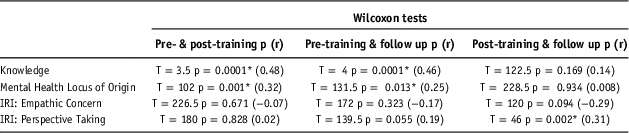
Median (interquartile range; IQR) knowledge scores for pre-training, post-training and follow up assessments were 5(2), 8(2) and 9(3) respectively. There was a statistically significant increase in the level of staff knowledge held about the neurobiological underpinnings of BPD between pre- and post-training (T=3.5, z=−4.891, p<0.017, r=0.48) and also between pre-training and follow up (T=14, z=−4.607, p<0.017, r=0.46). However, there was no significant difference observed between post-training and follow up (T=122.5, z= −1.374, p=0.169, r=0.14; see Table 1). Questions that demonstrated poor levels of knowledge prior to the intervention but improved following training (range 17.6–23%) were concerned with genetics, neuroanatomy and cognitive dysfunction. Changes in knowledge scores between pre- and post-training or between pre-training and follow up did not differ according to professional registration, length of experience in current unit setting or previous training on BPD.
Pre-training, post-training and follow up differences for measures of knowledge, locus of origin, empathic concern and perspective taking following BPD training

*p<0.017
r=Effect size
Mental Health Locus of Origin
Median (IQR) locus of origin scores for pre-training, post-training and follow up assessments were 68(6.75), 72.5(7.5) and 73(11) respectively. Locus of origin scores significantly increased between pre- and post-training (T=102, z=-3.195, p<0.017, r= 0.32) and between pre-training and follow up (T=131.5, z=-2.479, p<0.017, r=0.25) (see Table 1). However, there was no significant difference observed between post-training and follow up (T=228.5, z= −0.083, p=0.934, r=0.008). Changes in MHLO scores between post-training and follow up, or between pre-training and follow up, did not differ between status of professional registration, length of experience in current unit setting or having received previous training on BPD.
Interpersonal Reactivity Index
Empathic Concern
Median (IQR) Empathic Concern scores for pre-training, post-training and follow up assessments were 21.5(6), 19.5(5) and 20(4) respectively. There was no statistically significant difference in Empathic Concern scores for any of the three time intervals despite an overall increase in scores.
Perspective Taking
Median (IQR) Perspective Taking scores for pre-training, post-training and follow up were 21(6), 20 (6) and 21(4) respectively. There was a statistically significant increase in Perspective Taking scores between post-training and follow up (T=46, z=−3.160, p<0.017, r=0.31) but no significant differences were observed between pre- and post-training or between pre-training and follow up. Participants who had not attended previous BPD training showed a greater change in Perspective Taking scores between post-training and follow up (U=77.5, z=−2.345, p<0.03, r=−0.40). There was no difference in Perspective Taking scores depending on status of professional registration or length of experience in current unit setting.
Discussion
This study evaluated a psychology-led training session, aimed at delivering information about the neurobiological underpinnings of BPD to MDT members within a secure inpatient setting. The primary aim of this project was to determine whether attendance at such training would increase staff levels of theoretical knowledge; provoke increased feelings of empathic concern and perspective taking towards patients diagnosed with BPD; and alter their locus of origin to be one that favours biological and genetic causes. Attendance at the training session was associated with increases in theoretical knowledge, perspective taking and locus of origin scores with moderate effect sizes observed in all but one instance (locus of origin, pre-training to follow up). However, there was no significant change in empathic concern.
The results of the study strongly support previous research findings that knowledge about BPD held by staff can be increased through a training intervention (Miller & Davenport, Reference Miller and Davenport1996; Krawitz, Reference Krawitz2004). The current study utilised training materials from a neurobiological framework (Porr, Reference Porr2011) that educate staff about BPD in line with the traditional medical model, therefore portraying BPD as a true disorder with real, tangible symptoms and not a ‘consequence of character’ (Becker, Reference Becker2000). Significant increases in levels of knowledge about the neurological underpinnings of BPD between pre- and post-training assessments, and between pre-training and follow up, suggests that the training enabled participants to retain the information eight weeks after an initial training session.
The hypothesis that attendance at the training session could alter beliefs held about the cause of BPD to one that favoured biological and genetic causes was strongly supported. Increases in locus of origin scores were observed from pre- to post-training, and from pre-training to the eight-week follow up, suggesting that alterations in beliefs about the cause of BPD can remain stable over time after only a brief training intervention is provided.
Implicit in the delivery of the intervention was the belief that teaching individuals about the neurobiological underpinnings of BPD would increase empathy. Increased understanding of the biological and neurological origins of the BPD experience can help family members and carers to feel more empathic towards the difficulties experienced by individuals with BPD (Porr, Reference Porr2011). In the current study, empathy was measured using two subscales: Empathic Concern and Perspective Taking. Significant increases in Perspective Taking scores were observed between post-training and the eight-week follow up, suggesting that an application of knowledge to ward interactions had occurred, allowing core beliefs about BPD to be changed, not simply the acquisition of information from the training. The eight-week follow up interval may have allowed for greater consolidation of the training material and this may have implications for the delivery of future training that is scheduled to have intervals between the sessions. In addition, although staff members who had not attended extra training on BPD exhibited significantly higher increases in scores between post-training and the eight-week follow up, those who had received prior training had higher baseline levels of perspective taking and therefore may have already experienced this shift in their beliefs about BPD patients and perspective taking as a result of this extra training.
The failure to find increased empathic concern is not consistent with previous research into staff training and increases in empathy within mental health professionals (MacLeod et al. Reference McLeod, Deane and Hogbin2002; McGrath & Dowling, Reference McGrath and Dowling2012). However, it may be that the individual components of empathy are not distinct and interdependent but that individual elements (e.g. perspective taking) are exclusive predictors of attitude change (Batson & Ahmed, Reference Batson and Ahmed2009; Boang & Carnelley, in prep.). Also, it is possible that this is due to a failure to include specific empathy exercises in the training materials (e.g. MacLeod et al. Reference McLeod, Deane and Hogbin2002) that are specifically designed to enhance the understanding of the subjective experience of difficulties and mental distress and provoke emotive responses among participants. Moreover, the training materials used were factually based and used academic references. The personal experiences of participants were not emphasised and therefore participants did not elicit any high level of affective responsitivity.
A within-subjects design was utilised and, as such, many confounding variables were controlled for. However, without the use of a control group, it cannot be said with certainty that any observed changes in the variables were a function of the training session rather than being attributable to practice effects from completing the same questionnaires within three relatively close time intervals. Observed changes may be influenced by attendance of the training itself rather than content material and social desirability bias may have also compromised the validity of the observed changes.
It could also be argued that training within the current study was delivered to staff members who work regularly and intensively with patients with the primary diagnoses of BPD and who, therefore, should already be trained and knowledgeable in this area. Despite this, pre-knowledge scores within the current setting only had a median of five correct answers for ten questions, and improvements were still made on knowledge at either post-training or follow up for half of the staff who were knowledgeable prior to the intervention. Moreover, only half of the participants had reported receiving any prior training on BPD. Previous research has shown that within the inpatient setting, where staff members report having most frequent contact with BPD patients, scores on knowledge about BPD tend to be very low (James & Cowman, Reference James and Cowman2007). Therefore, it is feasible to suggest that staff members, even those who work with patients with BPD on a daily basis, can benefit from training on the neurobiological underpinnings of BPD.
The training delivered within the current study was a very brief intervention, with each session only lasting for approximately 90 minutes. For other research studies investigating staff attitudinal and knowledge change, training sessions lasted for two to three days (Krawitz, Reference Krawitz2004; Commons Treloar, Reference Commons Treloar2009). Despite this, it is an encouraging finding that enduring attitudinal and knowledge change can still be instigated within such short amount of time. Moreover, few research studies have been conducted within secure inpatient settings. Few studies have used a multidisciplinary staff sample (Miller & Davenport, Reference Miller and Davenport1996) and most of these have included staff members who do not have had daily contact with patients with BPD (Commons Treloar, Reference Commons Treloar2009). Future research may wish to investigate the impact on any observed changes of: training duration, sample demographics and amount of contact staff members have. The awareness level training programme from the Knowledge and Understanding Framework (KUF; http://www.institutemh.org.uk/-education-/the-knowledge-and-understanding-framework) provides staff members with the underpinning knowledge and understanding required to work more effectively with patients with a diagnosis of personality disorder. KUF training is due to be delivered to staff working on our study unit in 2014 and may address the methodological inadequacies of the current study. Further research should endeavour to evaluate the impact of such training on staff knowledge and attitudes post KUF training. Further, the NHS programme Improving Access to Psychological Therapies (IAPT) is currently running research trial for those with severe mental illness (IAPT for SMI). The project aims to improve access to a range of NICE recommended psychological therapies including those with personality disorders. In terms of staff training and understanding of those diagnosed with BPD, they are recommending that an integrated theoretical approach is used by the whole service.
It may be of importance for further research to investigate the impact of training interventions on altering beliefs about the controllability of behaviour as this has been shown to play a part in shaping staff attitudes (Markham & Trower, Reference Markham and Trower2003; Filer, Reference Filer2005). Previous research has demonstrated that staff members tend to experience BPD patients more negatively if they perceive that patients diagnosed with BPD cannot be treated (Woolaston & Hixenbaugh, Reference Woolaston and Hixenbaugh2008).
The current neurobiological training intervention study adds to a small body of literature on the usefulness of such training in increasing staff knowledge and promoting attitudinal change. While a tradition of utilising psycho-education programmes about personality disorders exists (Banerjee et al. Reference Banerjee, Duggan, Huband and Watson2006), research on staff training about neurobiological underpinnings of BPD has received little interest. Brief training in this area, however, can have a significant impact on the way staff view patients with BPD and challenge beliefs they are 'not sick', 'bed wasters' and 'undeserving of care' (Nehls, Reference Nehls1998). Increasing understanding of, and building on relations with, patients with BPD can also assist in managing risk (Department of Health, 2010) and may also impact on providing effective treatment in this area.
Financial support
This research received no specific grant from any funding agency, commercial or not-for-profit sectors.
Conflict of interest
None.