1 Introduction
Since the 1990s the Dutch health care system has been in transition from supply-side government regulation towards managed competition (Van de Ven and Schut, Reference Van de Ven and Schut2009). A major step in this transition process was the introduction of the Health Insurance Act (HIA) in 2006. The HIA is based on the principles of managed competition within the context of a national health insurance system under which all persons who legally live or work in the Netherlands are obliged to buy, on an annual basis, a basic benefit package from a private health insurer (Enthoven and van de Ven, Reference Enthoven and van de Ven2007). Health insurers had to become prudent buyers of care on behalf of their enrolees and were therefore given the possibilities to selectively contract or vertically integrate with health care providers.Footnote 1
Insurers’ ability to act as prudent buyers of care (contracting high-quality care at a reasonable price) crucially depends on their ability to channel enrolees to selected providers (Pauly, Reference Pauly1987; Sorensen, Reference Sorensen2003; Wu, Reference Wu2009). In turn this depends on the attractiveness of the selected providers to consumers and consumers’ willingness to switch to these providers. Insurers have different possibilities to channel enrolees to selected providers. In the United States, health insurers typically use negative financial incentives to channel enrolees to selectively contracted providers. These incentives are strongest in the case of Health Maintenance Organisations (HMOs). The most restrictive HMOs use purely exclusionary provider networks and do not provide any reimbursement of out-of-network use (except in emergencies). More popular, however, are the less restrictive preferred provider organisations (PPOs) that partially reimburse non-contracted care. Rather than using negative incentives, health insurers may also employ positive incentives to encourage the use of preferred providers, for example, by facilitating utilisation, better service, discounts or bonus payments. Positive channelling incentives may be particularly useful when insurers negotiate favourable contracts with preferred providers, but do not want to restrict their provider network by selective contracting. Moreover, in some markets it may not be possible or credible to exclude providers from a network (Wu, Reference Wu2009).
In this paper, we examine whether insurers in the Dutch health care market have, since the introduction of the HIA in 2006, been able to take up their role as prudent buyers of care and whether they have been able to channel enrolees towards preferred providers. In the Netherlands, the feasibility of insurers taking up this role may differ from the United States because Dutch consumers are not used to restrictions on provider choice and the use of channelling incentives by health insurers. Therefore, we also investigate consumers’ attitudes towards the new role of health insurers and the use of channelling incentives. Our findings are not only relevant in the Dutch context but also for an increasing number of other countries that have introduced some form of managed competition and selective contracting (e.g. Germany and Switzerland) or are contemplating to do so.
First, we briefly review the empirical literature on the purchaser role of health insurers in the United States. Second, we describe the methods we used to investigate whether and how Dutch health insurers are taking up the role of prudent buyer of health care and how Dutch consumers think about this new role. Next, we analyse the developments with respect to insurers’ contracting policies and consumer channelling during the first years of the transition towards managed competition. We then examine the attitudes of enrolees to the introduction of restrictions on provider choice in the Dutch system using survey data from the year before the reform until 2009. We end with a discussion of the results and the most important conclusions.
2 Health care purchasing by health insurers in the United States
There is a vast amount of literature on the emergence of managed care plans and its effects on insurers’ bargaining power. Most literature focuses on the United States since managed care organisations are widely present in the US health care market. During the past decades, managed care plans have grown so fast that since the 1990s they dominate the US health insurance market (Glied, Reference Glied2000). In 2008, about 97% of insured working Americans were enrolled in a managed care plan (Claxton et al., Reference Claxton, Gabel, Dijulio, Pickreign, Whitmore, Finder, Jarlenski and Hawkins2008).
According to Glied (Reference Glied2000), managed care plans in the United States use different mechanisms to contain costs including selective and preferred provider contracting, different payment methods, cost-sharing instruments and methods to monitor utilisation. Selective and preferred provider contracting is commonly used to contain costs (Dranove et al., Reference Dranove, Lindrooth, White and Zwanziger2008; Wu, Reference Wu2009). Studies have shown that prices paid by managed care plans are strongly influenced by the structure of the market, managed care plan’s ability to credibly threat to move market share and the degree to which insurers selectively contract with health care providers (Staten et al., Reference Staten, Dunkelberg and Umbeck1987; Melnick et al., Reference Melnick, Zwanziger, Bamezai and Pattison1992; Smith, Reference Smith1997; Sorensen, Reference Sorensen2003; Zwanziger and Mooney, Reference Zwanziger and Mooney2005). In general, managed care organisations are able to extract higher discounts than traditional fee for service organisations. Several studies show that insurer’s bargaining power is positively affected by their ability to exclude hospitals from their network (Capps et al., Reference Capps, Dranove, Greenstein and Satterthwaite2001, Reference Capps, Dranove and Satterthwaite2003; Town and Vistnes, Reference Town and Vistnes2001). Even though the effectiveness of selective contracting decreased over the period 1990–2003, managed care organisations are still able to play competitive hospitals off against each other to obtain discounts (Dranove et al., Reference Dranove, Lindrooth, White and Zwanziger2008). A recent study by Wu (Reference Wu2009) showed that also partial consumer channelling can have a positive effect on the negotiated discounts by managed care organisations.
In the early years of managed care, plans with exclusive provider networks such as HMOs dominated the market place in the United States. Even though empirical literature, as mentioned above, showed that restrictive networks led to lower prices and more bargaining power for the health insurer, there has been a decrease in HMO enrolment over the years. Enrolees switched from the restrictive HMOs to plans that used partial consumer channelling such as PPOs. PPO enrolment under insured working Americans increased from 16% in 1988 to 58% in 2008 (Claxton et al., Reference Claxton, Gabel, Dijulio, Pickreign, Whitmore, Finder, Jarlenski and Hawkins2008).
This decrease in HMO enrolment is labelled as the managed care backlash. The managed care backlash was caused by consumers turning away from managed care plans using restrictive provider networks. According to Miller (Reference Miller2006), the managed care backlash can be partly explained by a credible commitment problem. Health insurers have a problem to convince consumers being committed to contract good quality care instead of only least cost care. The credible commitment problem may form a barrier for health insurers to restrict provider choice because the ex-ante value of restricted networks is rated below that of open networks.
3 Methods
To investigate the purchasing behaviour of insurers over the period 2006–2009 we performed an extensive review of publicly available information sources including websites of insurers, reports from the Dutch Healthcare Authority (NZa), the federation of patient and consumer organisations, the Ministry of Health and consumer websites. In addition, we interviewed the directors responsible for health care purchasing from each of the four largest health insurers (with a total market share of almost 90%) about their purchasing strategies.
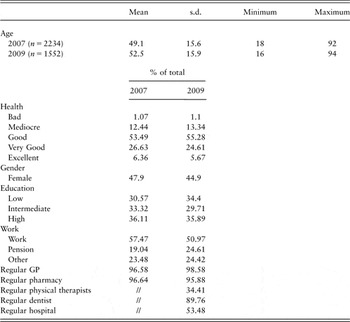
Second, we used annual surveys to examine consumer’s attitudes towards the role of health insurers as their purchasing agents. We used survey data over the period 2005–2009. In 2005 and 2006, we used two surveys that were issued by a major Dutch health insurer. The first survey was issued under a representative panel of the adult Dutch population in 2005 (n = 2006) and 2006 (n = 2003). The second survey, using partly the same questions, was issued among about 803 randomly selected adult enrolees of the insurer (Keuzenkamp, Reference Keuzenkamp2006).Footnote 2 In 2007 (n = 2234) and 2009 (n = 1552), we set out a similar survey under an internet-based household panel that is also representative of the adult Dutch population.Footnote 3 The panellists receive questionnaires biweekly and background characteristics of the respondents such as age, gender, income and health status are known. The background characteristics of the 2007 and 2009 samples are presented in Table 1.
Background characteristics respondents

GP = general practitioner.
In each of the survey, respondents answered a question about their willingness to listen to advice from their health insurer. In 2006, 2007 and 2009 surveys, respondents were also asked questions about their perception of quality differences between health-care providers and their willingness to pay for free provider choice.
4 Insurers’ initiatives with selective and preferred provider contracting
The main goal of the reform of the health insurance system is to stimulate health insurers to increase the efficiency of health care provision by becoming prudent buyers of care on behalf of their enrollees (Van de Ven and Schut, Reference Van de Ven and Schut2009). In this section, we discuss whether and how health insurers have taken up this new role during the first four years after the introduction of the HIA in 2006.
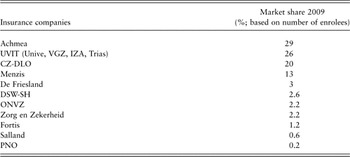
One of the effects of the reforms was rapid consolidation of the insurance market. In 2009, only four large insurance companies and seven smaller insurers were left (see Table 2). Each of the four large insurers has several subsidiaries operating under different labels. The largest four insurance companies (including their subsidiaries) have 90% of the market. According to the health insurers, consolidation was needed to acquire sufficient bargaining power vis-à-vis the large regional hospitals.
Market shares of health insurers in 2009

Source: NZa, Monitor Zorgverzekeringsmarkt 2009 (NZa, 2009).
During the first four years after the reforms, the majority of health insurers did not use selective contracting. Only few insurers tried to exclude providers from their network; but, because of the negative publicity and the fear for reputation damage, most included these providers in their network later on (NZa, 2007). Anticipating the use of selective contracting, health insurers did, however, introduce insurance policies with differentiated reimbursement limits for contracted and non-contracted providers. Typically, reimbursement limits for non-contracted care were set between 80% and 90% of that of contracted care. In 2008 and 2009, several health insurers also use reimbursement limits lower than 80%. Over time, the number of people enrolled in a health plan with differentiated reimbursement limits increased. In 2009, only about 28% of all enrolees still have a health plan that does not differentiate reimbursement between contracted and non-contracted care (NZa, 2009). Furthermore, the percentage of enrolees with reimbursement limits lower than 80% doubled between 2008 and 2009 (NZa, 2009). The actual impact of these negative financial incentives to visit non-contracted providers remained very small, however, as health insurers typically contract more than 95% of all providers.Footnote 4 Two small regional insurers (with a joint market share of 5%) even actively inform (potential) customers that they do not limit provider choice in any way or intend to do so in the future, and for that reason do not use differentiated reimbursement limits.
In 2008, one health insurer (Univé, subsidiary of UVIT) introduced a health plan with a selected network of providers. This plan fully reimburses contracted care including an internet pharmacy and 13 preferred hospitalsFootnote 5 (14% of all hospitals) of which three academic hospitals.Footnote 6 If enrolees visit non-contracted hospitals or pharmacies,Footnote 7 they have to pay 20% of the care out-of-pocket up to a maximum amount of €500/year. The health plan is targeted to young, healthy enrolees as advertisement is primarily through the internet. In 2008, this health plan had 13,000 enrolees of which 75% were between 18 and 30 years old (NZa, 2008a).
Although other insurers are reluctant to use selective contracting, they did start to introduce ‘soft’ positive incentives (e.g. providing advice and information) to encourage the use of preferred suppliers that are selected on the basis of superior service or quality aspects, such as lower waiting times, higher consumer ratings or certificates about meeting certain quality standards. Until 2009, insurers did not use positive financial incentives to encourage the use of preferred providers. As of 2009, insurers are legally permitted to exclude costs of designated preferred providers from the mandatory and voluntary deductibles that people have to pay.Footnote 8 This gave insurers the possibility to introduce positive financial incentives to encourage preferred provider utilisation. In all, 50% of the health insurers (with a total market share of 58%) started to use this legal option to offer a financial bonus in case of preferred hospital utilisation in 2009 (NZa, 2008b, 2009).
Insurers use different strategies to positively influence provider choice. First, two major insurers (CZ-DLO and Menzis) have chosen not to use financial incentives to stimulate preferred provider utilisation. Both insurers mainly focus on the communication of quality information to encourage preferred provider utilisation. Second, the largest health insurer (Achmea) uses positive financial incentives to encourage enrolees to seeking the insurer’s advice about provider choice. Enrolees are exempted from paying the mandatory deductible once they consult Achmea concerning hospital choice. According to Achmea, enrolees have to get used to insurers giving advice about hospital choice. Hence, not the actual decision to visit a preferred supplier but the decision to seek advice from the insurer is ‘rewarded’. Third, three health insurers (UVIT, DFZ and Agis – a subsidiary of Achmea) use positive financial incentives to stimulate their enrolees to visit preferred hospitals. These insurers exempt enrolees from paying the mandatory (and voluntary) deductible once enrolees actually visit the selected hospitals. UVIT argues that the financial incentive is mainly used to influence provider’s behaviour. The fear of losing market share is expected to stimulate providers to improve their quality. Although these initiatives focused on hospital utilisation, insurers are allowed to exempt enrolees from paying the mandatory and voluntary deductible for other forms of care as well.
Furthermore, occasionally health insurers vertically integrated with health care providers. These typically small-scale integrations were mainly set up to decrease local provider shortages or to financially support health care providers. In general, most insurers are reluctant to engage in vertical integration. Although the largest health insurer (Achmea) owned several health centres in the past, it does no longer perceive vertical integration as a future strategy. The second largest insurer (UVIT) explained in an interview that vertical integration is not its main strategy but can be used as an instrument to put pressure on incumbent health care providers to deliver high-quality care. UVIT is currently negotiating with several health care institutions about a possible cooperation. The third major insurer (CZ-DLO) sees integration mainly as an ‘emergency’ option in case the insurer is unable to contract sufficient care for its enrolees. In the past, CZ-DLO participated in an orthopaedic clinic to reduce waiting lists and after waiting lists were sufficiently reduced the participation was terminated. Finally, the fourth largest health insurer (Menzis) is most actively involved in vertical integration. Although Menzis participates in several primary health centres, its CEO states that he does not intend to become an HMO-type insurer. The participation in primary health centres was based on GP shortages and considerations to improve the efficiency of primary care. Menzis neither limits provider choice nor excludes enrolees from other insurers from visiting their health centres.
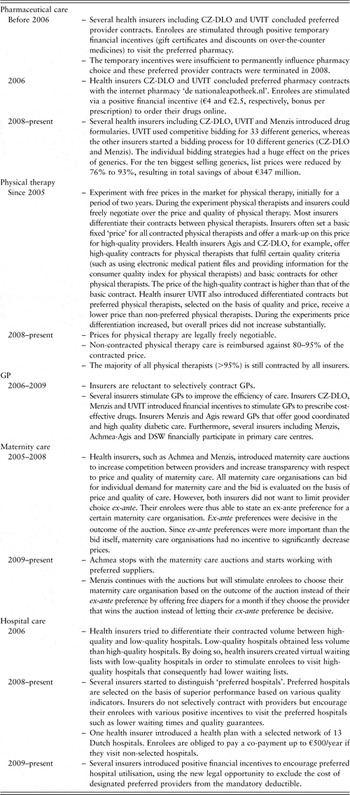
In Table 3, we summarised the main initiatives that the insurers have undertaken over the past few years to manage care for five specific care categories including pharmaceutical care, physical therapy, GP care, maternity care and hospital care. These initiatives illustrate that insurers are slowly but gradually expanding managed care activities and so far have confined themselves to ‘soft’ strategies to influence provider choice.
Main initiatives of health insurers to manage care for five selected care categories

GP = general practitioner.
There may be several reasons why health insurers have been reluctant so far to selectively contract with health care providers. First, the incentives to selectively contract may be too small. As a matter of fact, the financial risk for health insurers to selectively contract with hospitals is still limited. Although the share of hospital services for which prices are freely negotiable has gradually been raised from 10% in 2006 to 34% in 2009, the majority of hospital care is still paid by uniform prices, which are derived from a collectively negotiated budget. In addition, health insurers are still partly retrospectively compensated for losses incurred on hospital care. Nevertheless, health insurers face strong price competition and increasing financial risk because the ex-post compensations were gradually reduced. In 2009, health insurers are at risk for about 67% of total expenses, whereas this percentage is almost 100% for outpatient care (Heida et al., Reference Heida, Stam and Boonen2009). Hence, limited incentives do not provide a sufficient reason for virtual absence of selective contracting.
A second reason for insurers to refrain from selective contracting may be that they have only limited possibilities to differentiate provider contracts. For instance, prices of GPs, pharmacies and hospitals are still largely determined by the government. Although these regulatory restrictions certainly restrict the scope for differentiating contracts, they still leave substantial room for selective contracting. Since most regulated prices are maximum rather than fixed prices, insurers can negotiate lower prices. Nevertheless, maximum prices are likely to restrict the room for price negotiations because such prices may function as focal points or may be set too low to leave sufficient room for price discounts. It is unlikely, however, that regulated maximum prices can explain the absence of any discounts by selectively contracted providers. Moreover, insurers would have also been able to differentiate provider contracts based on performance or quality agreements. Hence, the second reason is also unlikely to provide a sufficient explanation for the apparent lack of selective contracting by health insurers.
A third reason for health insurers’ reluctance to engage in selective contracting may stem from the credible commitment problem that also seems to be responsible for the managed care backlash in the United States (Miller, Reference Miller2006). In the interviews that we held with representatives of the four largest health insurers, all argued that the most important reason to refrain from selective contracting is the fear for reputation damage. Insurers state not having enough information about provider quality to exclude certain hospitals from contracting or to use strong channelling incentives. Health insurer CZ-DLO even issued a press statement to the press that it would not use positive financial incentives to stimulate preferred provider utilisation because of a lack of trust among customers (CZ, 2009). Similarly, health insurer DFZ issued a press statement announcing to stop its experiment to exempt enrolees from paying a deductible in case of choosing a preferred hospital (DFZ, 2009). According to DFZ, the decision was based on negative reactions from the regional patient organisation and because the information on hospital quality was insufficient for granting hospitals a preferred status. Because of the lack of reliable quality information, insurers state to be afraid not being able to convince consumers that the selected hospitals are of good quality. Given this evidence, we conclude that the presence of a credible commitment problem is likely to be the most important reason for the lack of selective contracting by health insurers. In section 5, we examine the presence and relevance of the credible commitment problem further by analysing whether consumers trust health insurers as purchasing agents.
5 Consumers’ attitudes towards health insurers as purchasing agents
Using survey data over the period 2005–2009, we investigated consumers’ attitudes to new role of health insurers and whether these attitudes changed since the introduction of the reform.Footnote 9
First, we asked respondents whether or not they perceived quality differences between providers. We confronted respondents with this question since we expect that perceived quality differences influence provider choice. If reliable information about provider quality is not available, consumers may be less willing to switch to a preferred provider if they expect that provider quality differs. In that case they may prefer the status quo, since the quality of their current provider is known.
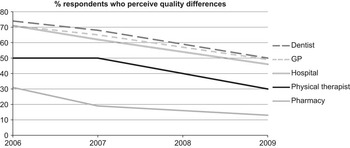
As illustrated in Figure 1, results show that a much higher share of the respondents perceive quality differences between dentists, GPs and hospitals than between pharmacies and physical therapists. Given that reliable information about provider quality was not available during the period 2006–2009, we expect that channelling towards preferred GPs, dentists and hospitals would have been more difficult for insurers than motivating people to switch to a preferred physical therapist or pharmacy.
Perceived quality differences between providers

Figure 1 also shows that the percentage of respondents perceiving quality differences decreases over time for all provider types even though more quality information has become available since the introduction of the reform. Of course, more information does not necessarily have to lead to a greater awareness of quality differences. A possible explanation for the observed downward trend might be that the public attention for quality differences was particularly high during the initial years of the reform.
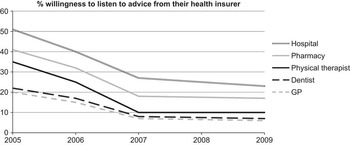
Second, we asked respondents whether or not they were willing to listen to advice from their health insurer concerning provider choice. A higher willingness to listen to advice increases insurers’ possibilities to channel enrolees. Results as depicted in Figure 2 show that respondents are most willing to follow their insurer’s advice concerning hospital and pharmacy choice and are least willing to follow advice concerning GP and dentist choice. Providers for which the loyalty and confidentiality is expected to be high are also those for which enrolees are least willing to follow advice. Almost all (98%) respondents have a regular GP and most of them report having the same GP for more than five years.
Willingness to listen to advice from insurer about provider choice

Furthermore, results show that during the initial years of the reform consumers’ willingness to follow insurers’ advice about provider choice substantially dropped for all provider types. The percentage of respondents who are willing to listen to advice concerning hospital choice decreased from about 50% in 2005 to about 25% in 2007 and 2009. The percentage of respondents willing to listen to advice concerning GP choice decreased from about 20% in 2005 to only 6% in 2007 and then stabilised at this low level. The decreasing willingness to follow insurers’ advice points at a diminishing trust among consumers in the role of insurers as purchasing agent and thus at an increasing credible commitment problem for health insurers.
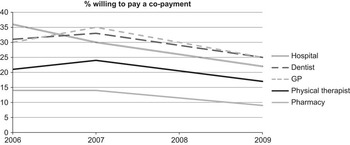
Third, we asked respondents whether they would be willing to pay a co-payment for having a free choice of provider.Footnote 10 As shown in Figure 3, only a small minority of the respondents is willing to pay a co-payment for free pharmacy choice (10–15%) and for free choice of physical therapists (20%), which corresponds with the higher willingness to listen to the insurer’s advice about provider choice. Willingness to pay is highest for free choice of GPs and dentists, which is also in line with our finding that for these type of providers the willingness to listen to insurers’ advice is the lowest. The proportion of respondents who are willing to pay for free provider choice has slightly dropped after the initial years of the reform. The reduction in willingness to pay for free provider choice is consistent with the downward trend in perceived quality differences among providers. If quality differences are perceived as being less important, it makes less sense to pay for retaining free choice. Interestingly, the decreasing willingness to pay for free provider choice may imply that consumers are becoming more sensitive to financial incentives to visit preferred providers. This may increase the scope for insurers to channel enrolees, which could counteract the decreasing willingness among consumers to follow insurers’ advice to use certain preferred providers.
Willingness to pay a co-payment for free provider choice

A potential limitation of our findings is that we cannot rule out that part of the differences in consumer attitudes over time, which can be attributed to sample differences. However, given the substantial changes in consumer attitudes and the fact that the samples were about the same size in each year and representative for the Dutch population, we are confident that differences in samples can account for only a small part of the observed changes. Furthermore, using sampling weights based on the characteristics of the 2007 sample to re-estimate the 2009 results did not alter these results, which sustains our supposition that consumer attitudes between the two samples are not related to background characteristics of the sample.Footnote 11
6 Discussion and conclusion
With the introduction of the new HIA and the gradual transition towards managed competition, insurers are given incentives and instruments to act as prudent buyers of care. A major instrument is the option to selectively contract with preferred providers and to use differentiated reimbursement limits for contracted and non-contracted care. So far, insurers have been very reluctant to use this instrument. Only one insurer introduced a health plan in which enrolees are stimulated by negative financial incentives (co-payments) to visit contracted providers. Most health insurers, however, contract with all providers and use only soft positive (financial) incentives to encourage the use of designated preferred providers, even though restrictive networks and negative financial incentives may sort a larger effect on provider choice.
We distinguished three potential reasons for insurers’ reluctance to engage in selective contracting: a lack of incentives, limited opportunities to differentiate contracts and a credible commitment problem. As pointed out, the first two reasons are not sufficient to explain the lack of selective contracting and the limited use of channelling incentives. By investigating both insurer and consumer attitudes towards selective contracting we find evidence of a substantial credible commitment problem. Insurers refrain from selective contracting because they expect that consumers do not trust them to act as good purchasing agents on their behalf. This expectation by insurers is corroborated by surveys among consumers. We find that a substantial proportion of consumers are not willing to follow insurers’ advice about provider choice. This proportion is particularly high with regard to the choice of GPs and dentists, in which case less than 10% of consumers are willing to follow insurers’ advice. In addition, we find that the credibility gap increased since the beginning of the reform, since the willingness among consumers to follow insurers’ advice about provider choice substantially decreased. We did not investigate the reasons behind the increasing credibility problem, but it seems at least partly caused by the considerable negative publicity about health insurers at the start of the reform, such as a major campaigns by the associations of GPs and pharmacists against the possible interference of insurers in free provider choice, arousing fear that insurers would increasingly ‘sit on the chair of the doctor’. Politicians also contribute to the negative publicity about managed care initiatives. In 2009, the announcement of a vertical integration between a hospital and an insurer even led to a proposal by the vast majority of Parliament to prohibit mergers between hospitals and insurers by law.
The increasing credibility gap seems to explain why several insurers even abstained from using positive financial incentives to encourage the use of preferred providers, although this legal option was explicitly created in 2009. Furthermore, the insurer-credibility problem may explain why health insurers are reluctant to engage in vertical integration with health care providers. Finally, it may also explain why all health insurers adhere to a not-for-profit status (either as mutual companies or as cooperatives), which fact is often stressed in marketing and communication with (potential) enrolees.
In the United States, the credible commitment problem for health insurers seems to be a major cause of the managed care backlash and to raise a substantial entry barrier for vertically integrated health insurers (Miller, Reference Miller2006; Ho, Reference Ho2009). In the Netherlands, however, the problem seems to be even more important because people are not familiar with restrictions on provider choice and with health insurers acting as purchasing agents. Moreover, Dutch patients are used to pay small co-payments, so charging substantial co-payments for using non-contracted providers is likely to be controversial and may be damaging an insurer’s reputation. Hence, within the specific Dutch context implementing managed competition may be particularly difficult. Rather than causing a managed backlash, in the Netherlands the credible commitment problem may even prevent managed care from taking up at all.
As long as insurers cannot solve the credible commitment problem, they will not be able to effectively channel enrolees. If they are not able to channel enrolees, providers may not be willing to negotiate over the terms of a contract. At present, the lack of adequate quality indicators makes it difficult for health insurers to select good quality providers and to provide reliable information to enrolees about the quality of the contracted provider network. Research shows that quality of contracted providers is likely to play an important role in health plan choice once reliable information on quality is readily available (van den Berg et al., Reference Van den Berg, Van Dommelen, Stam, Laske-Aldershof, Buchmueller and Schut2008). In our recent 2009 survey, we also asked respondents whether they would switch to a preferred hospital once the preferred and non-preferred hospitals were equally close, their GP had no ex-ante preference for either hospital and the preferred hospital was selected by the health insurer because of better performance on the basis of objective quality indicators. In this scenario, in which the credibility problem is absent, about 75% of the respondents was willing to switch to the preferred hospital. Only providing information, however, is not sufficient to overcome the credibility gap. It is also necessary that consumers use and trust the information, and believe that the information covers the relevant dimensions of quality. Therefore, providing reliable and understandable consumer information about the quality of the provider network seems crucial to solve the insurer-credibility problem.
Acknowledgements
We would like to thank two anonymous referees for their constructive comments.