Antimicrobial stewardship programs (ASPs) have primarily focused on the optimization of antibiotic therapy, whereas the use of antifungal therapy and antiviral therapy has been relatively ignored.Reference Newland, Gerber and Weissman 1 Antifungal and antiviral medications are often used for both treatment and prophylaxis for high-risk conditions like those in oncology and transplant patients. Furthermore, these agents are frequently associated with adverse drug effects, and they are costly. Hospitalized patients receiving these agents demand closer scrutiny to improve patient outcomes and potentially reduce hospital expenditures.Reference Lestner, Versporten and Doerholt 2 The 2016 Infectious Diseases Society of America and the Society for Healthcare Epidemiology of America ASP guidelines recommend that stewardship should expand to include antifungal therapy.Reference Barlam, Cosgrove and Abbo 3 Although prescribing trends of antifungal and antiviral drugs among children are relatively unknown, data suggest that their use is increasing.Reference Prasad, Coffin, Leckerman, Walsh and Zaoutis 4 The objectives of this study were (1) to characterize antifungal and antiviral prescribing for hospitalized children including comparison between high-risk and non–high-risk groups and (2) to describe variability of antifungal and antiviral prescribing among high-risk children to determine whether there are potentially important pediatric stewardship targets.
METHODS
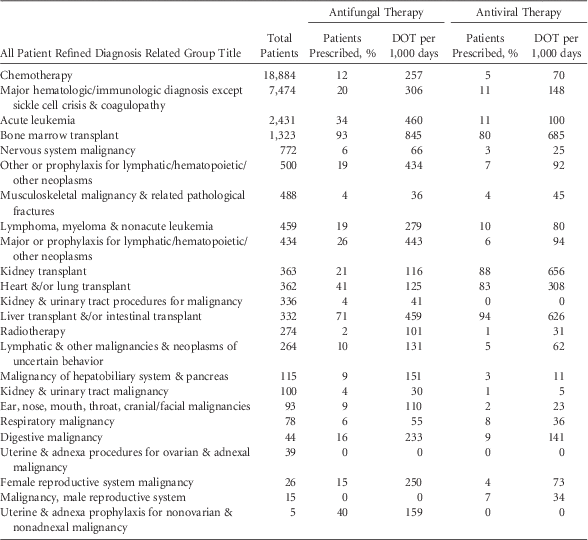
We performed a retrospective cohort study of antifungal and antiviral prescribing in high risk hospitalized patients <18 years of age discharged between January 1 and December 31, 2015. Data were obtained from the Pediatric Health Information System database, a clinical and administrative database that contains inpatient demographic, diagnosis, and prescribing charge data from 47 freestanding children’s hospitals across the United States. We a priori identified children considered to be at the highest risk for fungal or viral infections, including those coded with an All Patient Refined Diagnosis Related Group (APR-DRG; version 32) for oncology, bone marrow transplant, or solid organ transplant (Table 1).
Antifungal and Antiviral Therapy Prescribing Among High-Risk Children in 47 Freestanding Children’s Hospitals

NOTE. DOT, days of therapy.
Antifungal therapy included fluconazole, voriconazole, posaconazole, itraconazole, amphotericin, caspofungin, micafungin, anidulafungin, flucytosine, or terbinafine; antiviral therapy included charges for acyclovir, cidofovir, famciclovir, foscarnet, ganciclovir, oseltamivir, peramivir, ribavirin, rimantadine, valacyclovir, valganciclovir, or zanamivir. Data regarding age, race, gender, and receipt of any systemic antifungal or antiviral therapy were collected. Total days of antifungal or antiviral therapy (DOT) were standardized per 1,000 patient days. Summary statistics were constructed using frequencies and proportions for categorical data and medians and interquartile ranges (IQR) for continuous variables. Analyses were performed with SAS version 9.4 software (SAS Institute, Cary, NC) and Stata version 14.2 software (StataCorp, College Station, TX). This study was not considered human subject research by the Children’s Hospital of Philadelphia Institutional Review Board.
RESULTS
In 2015, there were 784,240 inpatient discharges from the 47 hospitals included in our analysis; 35,211 (4.5%) of these patients were classified as oncology, bone marrow transplant, or solid organ transplant by APR-DRG. These high-risk patients were predominately male (56%) and Caucasian (63%), with a median age of 7.9 years (interquartile range [IQR], 3.6–13.6). Among this high-risk cohort, chemotherapy was the most common APR-DRG (54%), followed by major hematologic/immunologic diagnosis (21%), acute leukemia (7%), and bone marrow transplant (4%). Solid organ transplants including heart, lung, liver, and kidney accounted for approximately 3% of the total high-risk population.
Across all hospitalized patients, only 3% received antifungal or antiviral therapy. In comparison, among the high-risk patients, 19% received antifungal therapy and 12% received antiviral therapy. These high-risk patients received 50% of all antifungal DOT and 46% of all antiviral DOT despite comprising <5% of all hospital discharges. Overall, high-risk patients received 10 times more DOT than non–high-risk patients: 389 antifungal DOT per 1,000 patient days versus 30 DOT, and 244 antiviral DOT per 1,000 patient days versus 22 DOT, respectively.
The highest percentage of prescribed antifungals (% total DOT) occurred in patients hospitalized for bone marrow transplant (20%), chemotherapy (10.5%), and acute leukemia (6.5%). The highest percentage of prescribed antiviral (% total DOT) was used for children hospitalized for bone marrow transplant (24.1%), heart and/or lung transplant (4.8%), and liver and/or intestinal transplant (4.2%). Children hospitalized with a bone marrow transplant were prescribed 845 DOT per 1,000 patient days of antifungal therapy (range, 664–1194) and 685 DOT per 1,000 patient days of antiviral therapy (range, 358–1,048) (Table 1).
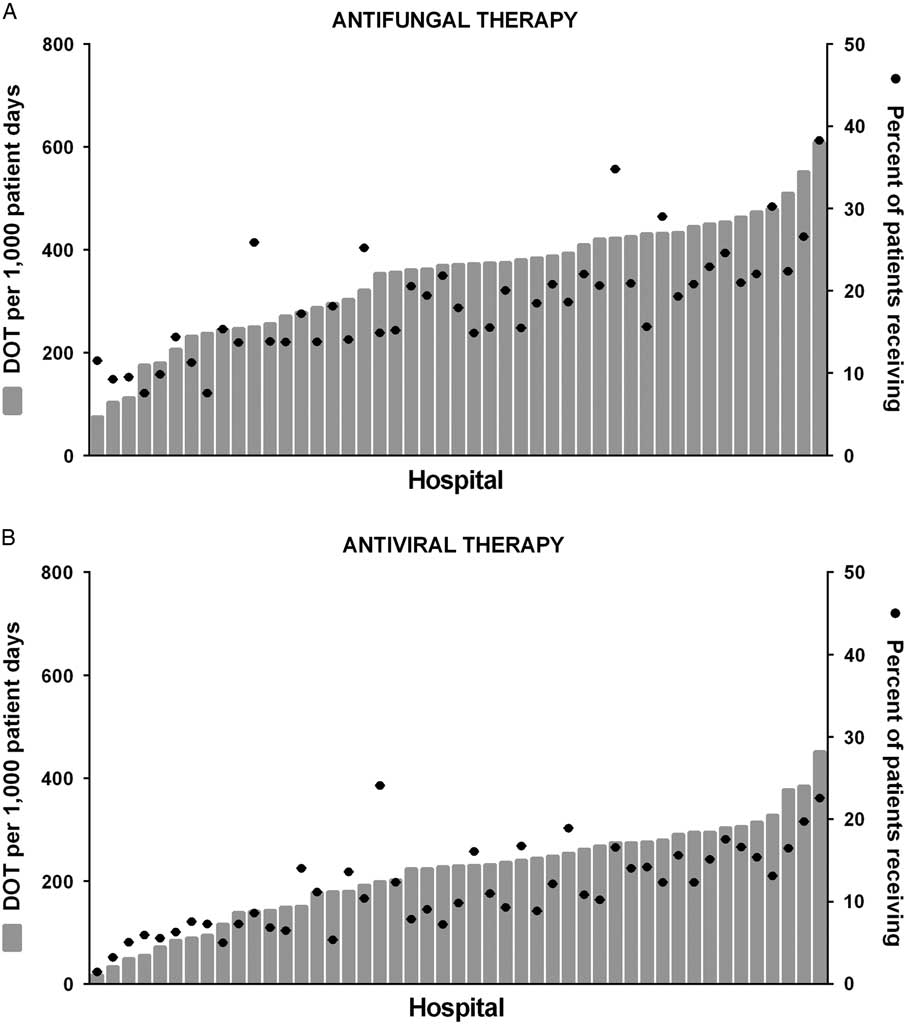
Examination by drug class revealed total DOT rates among high-risk patients as follows: fluconazole, 135 DOT per 1,000 patient days; echinocandins, 127 DOT per 1,000 patient days; voriconazole, 84 DOT per 1,000 patient days; and amphotericin, 24 DOT per 1,000 patient days. Antiviral drugs targeting herpes viruses (ie, acyclovir, cidofovir, famciclovir, foscarnet, ganciclovir, ribavirin, valacyclovir, or valganciclovir) were prescribed 241 DOT per 1,000 patient days. The prevalence and total use of antifungal and antiviral therapy among high-risk patients varied widely across hospitals (Figure 1): antifungal use ranged from 75 to 608 DOT per 1,000 patient days and antiviral use ranged from 18 to 451 DOT per 1,000 patient days across centers. The correlation between AFT and AVT DOT rates across hospitals was 0.58 (P<.001).
Variability in antifungal and antiviral therapy prescribing among high-risk children in 47 freestanding children’s hospitals. Panel A: antifungal therapy. Panel B: antiviral therapy. Gray bars: left y-axis depicts DOT per 1,000 patient days. Black dots: right y-axis depicts percentage of patients who were prescribed therapy. DOT, days of therapy.

DISCUSSION
We examined antifungal and antiviral use among a high-risk pediatric population admitted to 47 children’s hospitals. Our results revealed (1) that this immune-compromised population accounts for most antifungal and antiviral prescribing in hospitals and (2) that variability in the use of these agents exists, even when examining this relatively homogenous cohort.
Variability in antimicrobial exposure has been observed in high-risk pediatric patients, though previous work has focused on antibacterial therapy.Reference Fisher, Gerber and Leckerman 5 Antifungal and antiviral agents represent important stewardship targets because they (1) are often used for the treatment or prevention of relatively high-risk infections, (2) can be associated with a relatively high rate of adverse drug effects, (3) often require challenging therapeutic drug monitoring, and (4) are disproportionately costly relative to utilization.Reference Lestner, Versporten and Doerholt 2 , Reference Ross, Hersh, Kronman, Newland and Gerber 6 , Reference Valerio, Rodriguez-Gonzalez and Munoz 7 Although guidelines have been developed to address antifungal and antiviral therapy in oncology and transplant patients,Reference Freifeld, Bow and Sepkowitz 8 , Reference Groll, Castagnola and Cesaro 9 our data demonstrate that prescribing variability exists and more can be done to standardize practice and minimize unnecessary use.
Antimicrobial stewardship programs have been shown to enhance judicious antibacterial prescribing practices, improve clinical outcomes, and reduce healthcare costs.Reference Barlam, Cosgrove and Abbo 3 Antifungal stewardship can be effective by optimizing therapy and decreasing unnecessary use resulting in cost savings.Reference Micallef, Aliyu, Santos, Brown, Rosembert and Enoch 10 Currently, the available antifungal and antiviral therapies are limited, making stewardship critically important, as efforts to avoid the development of drug resistance and unnecessary adverse drug effects are needed. Invasive fungal and viral infections in the immunocompromised host can be devastating, resulting in high rates of morbidity and mortality. Selecting the most effective therapeutic agent, optimizing therapeutic dosing, and using therapeutic drug monitoring when available are all potentially effective points for stewardship interventions in this vulnerable population.
Our study has limitations. This study was limited to freestanding children’s hospitals and may not be generalizable to other clinical settings. We were unable to discriminate between treatment and prophylaxis, and we did not assess appropriateness of use. Antifungals and antivirals were determined using charge data, not medication administration information. Nonetheless, antifungal and antiviral use varied broadly across hospitals, even when comparing use in similar, high-risk patients. Benchmarking antifungal and antiviral is an important step in identifying targeted stewardship strategies to enhance judicious antimicrobial prescribing.
ACKNOWLEDGMENTS
Financial support: J.L.G. is supported by a Clinical and Translational Science Awards (CTSA) grant from the National Center for Advancing Translational Sciences (NCATS), awarded to the University of Kansas Medical Center for Frontiers: The Heartland Institute for Clinical and Translational Research (grant no. KL2TR000119). The contents are solely the responsibility of the authors and do not necessarily represent the official views of the National Institutes for Health or the NCATS.
Potential conflicts of interest: All authors report no conflict of interest relevant to this article.