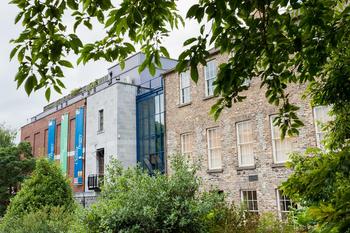
The Chester Beatty Library (Fig. 1) is a vibrant museum with holdings of manuscripts, rare books and other treasures from Europe, the Middle East, North Africa and Asia. This material once formed the private collection of Sir Alfred Chester Beatty (1875–1968), a mining engineer, philanthropist and lifelong collector. What distinguishes the Chester Beatty amongst Irish museums is its focus on global artistic heritage, how the collections are interpreted to promote intercultural understanding, and its endeavour to address issues of cultural identity.
Home of the Chester Beatty Library, the Clock Tower building in the grounds of Dublin Castle ©The Trustees of the Chester Beatty Library, Dublin.

Chester Beatty and his collection
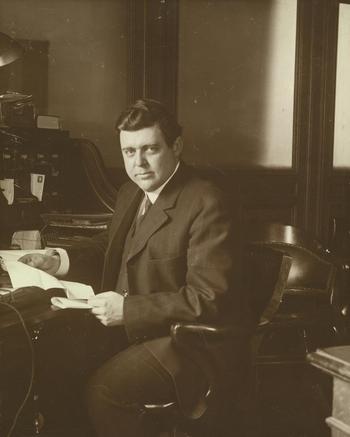
Chester Beatty (Fig. 2) assembled what was widely regarded as the finest private collection of its kind in the 20th century. As a young mining engineer in New York, Beatty was already a discerning collector of European and Persian manuscripts as well as Chinese snuff bottles and Japanese netsuke. It was in the decades following his relocation to London in 1913, however, that he built the greater part of his collection. During a family trip to Egypt in 1914, he developed a fascination for Islamic manuscripts, while a journey to Asia in 1917 added Japanese and Chinese painting to his interests. His eye was drawn to richly illustrated material, fine bindings and calligraphy, but he also sought out texts for their historic value, such as his outstanding biblical papyri acquired in Egypt in the 1920s.
Photograph of Chester Beatty, c.1911 ©The Trustees of the Chester Beatty Library, Dublin.

Beatty's collection developed over his lifetime and so, by the time of his death, he had assembled not just exceptional Islamic, East Asian and biblical manuscripts but also important Persian, Turkish, Armenian and Western European holdings as well as Burmese, Thai and Nepalese manuscripts. Despite the range and variety of the material he acquired, the collection is unified by Beatty's desire to seek out objects of the greatest rarity and finest quality.
When Chester Beatty relocated to Ireland in 1950 he brought his extraordinary collection with him. This businessman and philanthropist certainly understood the ‘soft power of culture’ and to coincide with his move he gifted 90 of his 19th-century Barbizon School paintings to the nation and today they are part of the permanent collection of the National Gallery of Ireland. Over the following 18 years, he presented another 300 paintings, drawings, miniatures and sculptures to the Gallery; and his collection of rare Oriental weapons was donated to the Curragh Military Museum. His greatest gift however – and surely one of the greatest cultural gifts made by any individual to any country – is the collection we hold today in the Chester Beatty Library.
By 1950, at 75 years of age, Chester Beatty was concerned with maintaining the integrity of his collection. Just three years after he settled in Dublin, his purpose-built library opened on Shrewsbury Road, in a leafy suburb south of the city where it remained until 2000 when it moved to the Clock Tower building in the grounds of Dublin Castle.Footnote 1 A modern gallery block was added to the 18th-century structure, creating two permanent galleries for the collection. Now nestled in the centre of the city, the Chester Beatty has become one of the capital's leading attractions and welcomes over 350,000 visitors per year.
Already in the 1980s (and perhaps even as early as the 1970s) there were internal debates as to whether the Chester Beatty should be called a ‘Library’ or a ‘Museum’. Until 2000, it was referred to as the ‘Chester Beatty Library and Gallery of Oriental Art’, but even this did not quite capture the breadth of the collections. In reality, this cultural institution houses Chester Beatty's private library but functions as a museum. While scholars from all over the world visit to study the collections, most resources are focussed not just on research, but also on display, interpretation and public programming. Today, therefore, it is succinctly referred to as the ‘Chester Beatty’.
The Chester Beatty and intercultural engagement
The Ireland that Beatty embraced as his home in 1950 has changed dramatically in the last twenty-five years. The country's economic growth in this time has been accompanied by a rapid change in the demographic profile. With the arrival of people from all over Europe, Africa, and across Asia, Beatty's collections have taken on a new relevance. The Chester Beatty has led the way amongst Irish museums in developing links with its many and diverse communities, both in Ireland and internationally. It has become a portal through which Ireland's increasingly diverse population can become familiar with cultures ‘different’ to their own. Indeed, the museum's active engagement with Ireland's newer communities has meant that it is now recognised as a centre for intercultural dialogue and learning. This contribution to intercultural understanding was acknowledged by President Michael D. Higgins in the speech he made when he opened a special exhibition in 2016 in which he referred to the Chester Beatty as ‘a national treasure of universal value – a most compelling invitation to engage with other cultures and traditions through the brilliance of their artistic and spiritual production’.Footnote 2
The museum has led the way in Ireland with its rich intercultural learning programme, launched over 17 years ago. Through the displays and the accompanying activities, it has sought to enhance visitors’ understanding of the cultures represented in the collections, to engage new multi-ethnic communities, and to promote the sense of a shared human heritage based on shared emotional and spiritual needs.Footnote 3 For example, in 2013, the Chester Beatty introduced ‘community ambassador tours’ in Arabic, Japanese and Mandarin. These are led by native speakers resident in Ireland, who bring a deeper insight and understanding to aspects of the collections, and at the same time act as mediators between the museum and the community. To date, it is the only museum in Ireland offering guided tours in these languages.
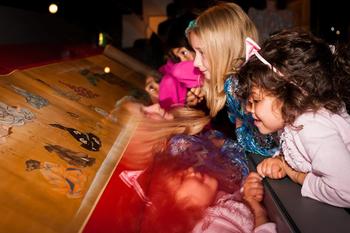
In recognition of the cultural diversity in the classroom today, the Chester Beatty has proactively sought to contribute to the primary and secondary schools’ curricula, and has produced learning resources on world faiths for secondary school students with particular focus on the revised Junior Cert curriculum (religions in the modern world) and the equivalent curriculum in the north of Ireland.Footnote 4 It has further contributed to discussions, highlighting the need to acknowledge cultural diversity, with the National Council for Curriculum and Assessment in the development of the Junior and Leaving Certificate curricula on art. (Fig. 3)
Children engage with the Japanese scroll entitled Poetry Contest of the Zodiac Animals (J 1154) ©The Trustees of the Chester Beatty Library, Dublin.

On an international level, the Chester Beatty is an active member of the Asia-Europe Museum Association (ASEMUS), a cross-cultural network of museums which seeks to promote mutual understanding between the peoples of Asia and Europe through collaborative museum-based cultural activity. Over a number of years, it has helped to co-ordinate one of ASEMUS’ initiatives, the Educational Exchange Outreach Programme. On a modest budget, the member museums manage the exchange of museum educators amongst partner museums from Asia and Europe. This simple yet effective programme provides young educators with the opportunity to exchange best practice ideas in another cultural environment and to bring new ideas and experiences home with them. It naturally strengthens connections and cultural understanding between the two regions.
The Chester Beatty and matters of identity
Irish multiculturalism opens new debates about culture and identity and requires new narratives. As authoritative spaces with the potential to select what objects to preserve and display, museums have a unique role in this regard. In 2016, Ireland commemorated 100 years since the Easter Rising. The Chester Beatty decided to explore what role we have in acknowledging, and responding to, the profile of our community. We organised an international symposium ‘The Role of National Museums in (Re)Negotiating National Identity’ (11–12 February 2016). Jim Cuno (President and CEO of the Getty Trust) looked at the sources and implications of identity politics and cultural heritage, and the manipulation of the latter in pursuit of the former; while Alan Chong (then Director of the Asian Civilisations Museum, Singapore), examined the challenges facing several recent museum projects in Asia, especially in Singapore, as they seek to capture cultural diversity which complicates or even contradicts national myths.
Museums can also foster understanding and mutual respect by providing dynamic opportunities for people to gather, while – as spaces for creativity and discourse – they provide opportunities for a shared emotional experience. (Fig. 4) For many people, a visit to the Chester Beatty is their first step towards understanding a religion or other aspects of a culture and when objects are viewed side-by-side, the similarities rather than the differences between world cultures become apparent. This was nicely illustrated during the exhibition ‘Chester Beatty's A to Z: From Amulet to Zodiac’ (11 July 2014–1 February 2015). A was for Amulet and by displaying exquisite examples of these protective charms from the Christian, Hebrew, Islamic and Hindu faiths alongside one another, the universality of this human need became evident. Engaging with other cultures through their art brings home the understanding that in learning about others, we can learn more about ourselves.
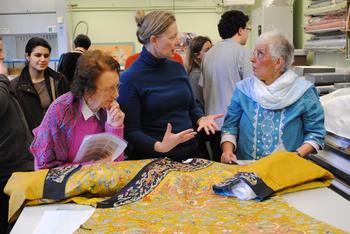
Volunteers learn about a Chinese Imperial Dragon Robe at a training session on Chinese Textiles ©The Trustees of the Chester Beatty Library, Dublin.

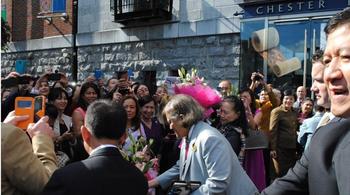
The visit of HRH Princess Sirindhorn of Thailand to the Chester Beatty which took place just two months before Ireland opened an embassy in Bangkok in 2014 provides further interesting insights. This was the first Thai royal visit to Ireland and, an enthusiastic scholar herself, it was natural that she would wish to see some of our important Thai manuscripts. However, the visit took on a wider social dimension. The museum has fostered relations with the local Thai-Irish community for many years. It held its first Thai family day in 2004. Irish parents and children from the Thai adoption group came from all over Ireland to meet other parents of adopted children, as well as to celebrate Thai culture. So when the Princess visited the museum, over 300 members of the Thai community in Ireland gathered to see her and receive her blessing. (Fig. 5)
Visit of HRH Princess Sirindhorn of Thailand visit to the Chester Beatty Library, 2 September 2014 ©The Trustees of the Chester Beatty Library, Dublin.

This visit reveals much about the soft power of culture and the role of the Chester Beatty – both in cultural diplomacy and in community relations. At the same time, by allowing the collections to make cultural and societal links between diverse communities, it demonstrates how the museum has become a trusted gathering place for the newer members of Irish society.
In these ways, and others, the Chester Beatty has the potential to develop new narratives that explore our historic and artistic connections. While based on scholarly research, these stories can be interpreted and communicated at multiple levels that make them accessible. The Chester Beatty – and museums in general – are highly networked, and have the added benefit (and responsibility) of being able to reach large, diverse audiences and therefore to promulgate cross-cultural themes, aided by online resources and social media.
Conclusion
While Irish museums cannot alone create a sense of national identity, by using their collections to tell stories, they can influence the ideas that contribute to our sense of national culture and identity. A national cultural policy has an important role to play in this regard, not least because the supports and rewards it puts in place influence how cultural activities develop.Footnote 5 Funded by government, museums are at the same time both steered by policy and contributors to the debate. If we agree that museums can be places in which a country can present a national narrative, then all museums have an important role to play and not just as tourist attractions, or places to find a little magic amid the hum-drum, but as places that express – or even define – a nation's ethos with regard to diversity.
In 2018, the Chester Beatty celebrates fifty years of Beatty's gift to the nation. In that half century, Beatty's ‘Library’ has come a long way. There is a growing realisation that, as we saw with the visit of the Thai Princess, culture can foster intercultural understanding and mutual respect, and can provide the context to open conversations. That in itself makes culture a great bridge builder, allowing individuals, businesses and politicians to find points of commonality that transcend other barriers. The importance for Ireland of having a collection of the quality of the Chester Beatty is increasingly understood in terms of global relations and cultural diplomacy. Above and beyond the collections’ didactic role, there is an increasing realisation of the museum's influence as a forum for discussions and debates about culture, not only from a historic or artistic point of view, but as a context or backdrop for wider sociological debate around cultural diversity.