Implications
With the increase of pork consumption around the world, people pay more attention to the quality of pork. Therefore, producers focus on producing high quality products for customers. Distillers dried grains with solubles (DDGS) is a co-product fermented from corn starch, and used as a protein source in animals, however, previous researches reported that the high proportion of DDGS in diets may have detrimental effects in pigs. Feed additives are used extensively to improve the cost-effectiveness of animal production. Dietary supplementations with conjugated linoleic acid (CLA) or betaine have attracted the increasing attention for reducing the adverse effects of DDGS in finishing pigs.
Introduction
Corn distillers dried grains with solubles (DDGS) is a co-product fermented from the corn starch used for producing fuel ethanol and carbon dioxide. DDGS is used as a protein source due to the high concentration of protein, compared with the corn. In addition, DDGS contains 100 to 150 g/kg lipids (Rausch and Belyea, Reference Rausch and Belyea2006) and a high proportion of unsaturated fatty acid. The iodine value (IV) of the carcass fat was increased due to the increased unsaturated and decreased saturated fatty acid (SFA) concentration in the fat of pigs fed DDGS (Dahlen et al., Reference Dahlen, Baidoo, Shurson, Anderson, Dahlen and Johnston2011). In addition, the previous research indicated that an inclusion rate of DDGS up to 30% in grower–finisher diets has no negative effects on growth performance and dressing percentage, but affected fatty acid composition by changing C18:2 content and IVs of pork fat (Xu et al., Reference Xu, Baidoo, Johnston, Bibus, Cannon and Shurson2010).
Conjugated linoleic acid (CLA) consists of a group of positional and geometric (cis or trans) isomers of linoleic acid (18:2) with conjugated double bonds. Dietary supplementation with CLA has attracted the increasing attention in the swine production in recent decades. Dietary supplementation with CLA has also been associated with increased the firmness of bellies (Thiel-Cooper et al., Reference Thiel-Cooper, Parrish, Sparks, Wiegand and Ewan2001) and decreased IV (White et al., Reference White, Richert, Radcliffe, Schinckel, Burgess, Koser, Donkin and Latour2009) in finishing pigs. Moreover, the conversion of SFA to unsaturated fatty acids is decreased (Dunshea et al., Reference Dunshea, D’Souza, Pethick, Harper and Warner2005; White et al., Reference White, Richert, Radcliffe, Schinckel, Burgess, Koser, Donkin and Latour2009). Betaine is a nontoxic amino acid derivative distributed widely in nature. Yang et al. (Reference Yang, Lee, Joo and Park2009) reported that dietary betaine significantly reduced unsaturated fatty acid (UFA) and increased SFA. Rojas-Cano et al. (Reference Rojas-Cano, Lara, Lachica, Aguilera and Fernández-Fígares2011) observed that pigs received betaine showed an increased proportion of 16:0 and decreased 18:1 isomers.
Stein and Shurson (Reference Stein and Shurson2009) had concluded that there was no effects of DDGS on growth performance in most experiments, but the general conclusion in pigs fed with 30% corn DDGS indicated that there is not an issue. Su et al. (Reference Su, Wang, Wang, Shi, Shan and Li2013) indicated that diets containing 30% DDGS have some adverse effects on pork freshness and lipid peroxidation. However, supplementation with 1% CLA or 0.1% betain can partially reverse these effects and improve color image of pork during display.
Therefore, the objectives of this study were to evaluate that if 30% DDGS diets had adverse effect on the growth performance and fatty acid composition, and supplementing with CLA or betaine could be a potential strategy to counteract the negative effects of DDGS.
Material and methods
The protocols used in these experiments were approved by the Northeast Agricultural University Institutional Animal Care and Use Committee.
Animals and diets
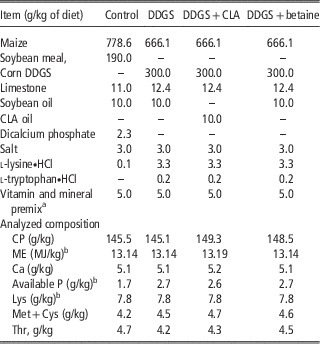
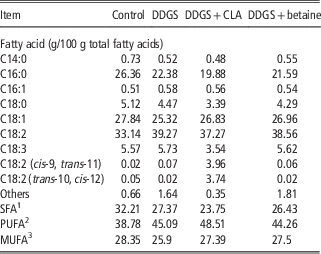
To achieve the objectives of this experiment, 32 crossbred barrows (Duroc×Landrace×Large) with an average initial BW of 60±2 kg were allotted randomly to individual pens. The barrows were assigned to one of four treatments with the following diets: corn–soybean meal (Control, n=8), 300 g DDGS/kg meal (DDGS, n=8), 300 g DDGS/kg meal+10 g CLA/kg (DDGS+CLA, n=8), 300 g DDGS/kg meal+1 g betaine/kg (DDGS+betaine, n=8, crystalline, 96% purity, Sunwin Chemicals, Weifang, China). According to manufacturer’s specifications, the commercial enriched CLA source provided by Auhai (Qingdao, China) contained 60% total CLA isomers (300 g/kg cis-9, trans-11 and 300 g/kg trans-10, cis-12). The pigs were given ad libitum access to feed, and all the diets were formulated to provide similar protein and energy levels, fulfilling the advised nutritional needs to meet or exceed National Research Council (1998) requirements for swine. The ingredient composition and nutrient content of the diets used in the experiment are shown in Table 1 and the fatty acid profile in Table 2. The diets were analyzed for CP, crude fat, Ca and P, and amino acids (Avelar et al., Reference Avelar, Jha, Beltranena, Cervantes, Morales and Zijlstra2010). Each pen was equipped with a feeder and nipple water to allow the pigs free access to feed and drinking water. The temperature (22°C to 26°C) and a cycle of 16 h light : 8 h dark were maintained in the mechanically ventilated room. All the pigs were weighed individually at the beginning of the experiment (day 0) and at day 42 (slaughter). The feed intakes of per pen were recorded at day 42. The average daily gain (ADG), average daily feed intake (ADFI) and gain/feed (G : F) values were calculated.
Composition and nutrient content of experimental diets

DDGS=dried distillers grains with solubles; CLA=conjugated linoleic acid.
a The vitamin premix provided the following per kilogram of complete diet: vitamin A, 7600 IU; vitamin D, 1500 IU; vitamin E, 10 mg; vitamin K3, 2.0 mg; vitamin B1, 1.0 mg; vitamin B6, 1.0 mg; vitamin B2, 3.0 mg; vitamin B12, 12 μg; pantothenic acid, 7 mg; niacin, 12 mg; Zn, 105 mg; Fe, 100 mg; Cu, 20 mg; Mn, 45 mg; I, 0.3 mg; Se, 0.3 mg.
b Calculated value.
The fatty acid profile of the experimental diets

DDGS=dried distillers grains with solubles; CLA=conjugated linoleic acid; SFA=saturated fatty acids; PUFA=polyunsaturated fatty acid; MUFA=monounsaturated fatty acid.
1 SFA=((C8:0)+(C10:0)+(C12:0)+(C14:0)+(C16:0)+(C17:0)+(C18:0)+(C20:0)+(C22:0)+(C24:0)).
2 PUFA=((C18:2)+(C18:3)+(C18:3)+(C20:2)+(C20:4)).
3 MUFA=((C14:1)+(C16:1)+(C18:1 cis-9)+(C18:1n-7)+(C20:1)+(C24:1)).
Carcass and meat quality measurements
At the end of the experiment, feed was withheld to the animals ∼24 h before slaughtering, although the pigs had access to water. All the pigs were transported to the slaughter facilities located 20 km away from the farm and slaughtered, using electro-stunning on day 42. The internal organs were removed, and the hot carcass weights (HCW) were recorded. The dressing percentages were calculated (carcass weight as a percentage of live weight before slaughtering). The backfat thickness was determined at the first rib, tenth rib and last rib. To measure the area of the longissimus muscle (LM), the left side was exposed by a perpendicular cut between the 10th and 11th rib. The longissimus muscle area was traced using acetate paper.
The pH value of the LM was measured using a pH meter at 24 h postmortem by inserting the probe directly into the samples (HI 8424; Beijing Hanna Instruments Science & Technology Co. Ltd, Beijing, China). Instrumental color measurements were recorded for L* (lightness; 0: black, 100: white), a* (redness/greenness; positive values: red, negative values: green) and b* (yellowness/blueness; positive values: yellow, negative values: blue) using a Minolta Chroma Meter, CR-301 (Konica Minolta, Tokyo, Japan). The drip losses of the loin samples were determined using the procedure of Kauffman et al. (Reference Kauffman, Eikelenboom, van der Wal, Merkus and Zaar1986). Duplicate loin samples were trimmed to 3 cm×3 cm×3 cm size and blotted to remove the surface water, and the initial loin weight was determined. The samples were hung vertically in the freezer at 4°C for 24 h before the final loin weight was determined. The percentage of drip loss was calculated by 100×(initial loin weight−final loin weight)/initial weight. The shear force was determined (internal temperature 75°C) using a Warner–Bratzler apparatus (G. R. Electric Manufacturing Co., Manhattan, KS, USA). Samples 1.0 cm width×0.5 cm thickness×2.5 cm length, parallel to the muscle fiber, were prepared from the LM and sheared vertically (Molette et al., Reference Molette, Remignon and Babile2003).
Fatty acid composition analysis
Samples of the backfat from the 9th and 10th rib and of the belly fat were collected for lipid extraction using the Folch method (Folch et al., Reference Folch, Lees and Sloan-Stanley1957), with chloroform : methanol (2 : 1, vol/vol). The lipids extracted from all of the samples were methylated (sodium methoxide) as described by Li and Watkins (Reference Li and Watkins1998): sample was dissolved in dry toluene (1 ml) in a capped test tube, 0.5 M sodium methoxide in anhydrous methanol (2 ml) was added, the solution was maintained at 50°C for 10 min, and glacial acetic acid (0.1 ml) was added followed by deionized water (5 ml). The fatty acid methyl esters (FAME) were extracted into hexane (2×3 ml) and dried over anhydrous sodium sulfate. All of the FAME were analyzed by using a gas chromatograph (Thermo Electron Co., San Jose, CA, USA) equipped with a capillary column SPTM-2560 (Supelco Inc., Bellefonte, USA; 100 m×0.25 mm; 0.25-μm film thickness). The gas chromatograph oven temperature was held at 170°C for 30 min. Then, the temperature was increased at a rate of 1.5°C/min to a temperature of 200°C, 5°C/min to atemperature of 210°C, and 15°C/min to a final temperature of 250°C for 1 min. The injector and flame-ionization detector temperatures were both set at 250°C. Each FAME (1 μl) was injected into the split injection port (30 : 1 split ratio). The FAME were identified by the comparison of their retention times with an authentic standard. The ionization potential of the mass selective detector was 70 eV, and the scan range was 50 to 550 m/z. Fat extractions were run in duplicate to determine percentage of lipids and reported as an average.
Statistical analysis
The treatment effect was assessed by ANOVA according to a completely randomized design with four treatments using the GLM procedure of SAS (SAS Institute Inc., Cary, NC, USA). Least squares treatment means were obtained assuming a mixed model of the effects of dietary treatment. The individual pig was considered the experimental unit for the trait. For all of the tests, the level of significance was 0.05. The least squares means and *s.e.m. were presented.
Results and discussion
Growth performance
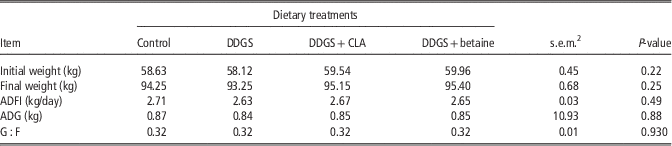
The growth performance in the pigs fed diets containing DDGS, DDGS+CLA or DDGS+betaine diets are shown in Table 3. Feeding DDGS had no effect (P>0.05) on growth performance compared with the control in finishing pigs. This observation agreed with the findings of Xu et al. (Reference Xu, Baidoo, Johnston, Bibus, Cannon and Shurson2010), who concluded that feeding diets containing 300 g DDGS/kg to grower–finisher pigs had no effect on growth performance. Similar to our results, DeDecker et al. (Reference DeDecker, Ellis, Wolter, Spencer, Webel, Bertelsen and Peterson2005) and Widmer et al. (Reference Widmer, McGinnis and Stein2007) reported that the inclusion of DDGS in diets fed to growing-finishing pigs had no effect on growth performance. However, Whitney et al. (Reference Whitney, Shurson, Johnson, Wulf and Shanks2006) and Linneen et al. (2008) reported the decreased growth performance as the increased concentration of dietary DDGS. The research including hundreds of pigs showed that 30% or 45% DDGS in diets reduced the ADG, but did not affect the ADFI or G : F (Cromwell et al., Reference Cromwell, Azain, Adeola, Baidoo, Carter, Crenshaw, Kim, Mahan, Miller and Shannon2011). The possible reasons for these conflicting observations may be that the DDGS used in the experiments was poorer quality (less nutrient digestibility) than expected.
Effect of dietary treatments on the growth performance of finishing pigsFootnote 1

DDGS=dried distillers grains with solubles; CLA=conjugated linoleic acid; ADFI=average daily feed intake; ADG=average daily gain; G : F=gain/feed.
1 Total of 32 barrows with one pig per pen and eight pens per treatment.
2 s.e. of least squares mean.
No differences (P>0.05) were seen in the feed intake, ADG and G : F among the pigs fed the DDGS+CLA or DDGS+betaine diets compared with the control and DDGS diets. Similarly, White et al. (Reference White, Richert, Radcliffe, Schinckel, Burgess, Koser, Donkin and Latour2009) reported that diets containing 0, 200 or 400 g DDGS/kg supplement with 6 g CLA/kg for 10 days before the pigs were slaughtered showed no significant effects on growth performance. In addition, Mitchell et al. (Reference Mitchell, Pursel, Elsasser, Mcmurtry and Bee2005) and Corino et al. (Reference Corino, Musella, Pastorelli, Rossi, Paolone, Costanza, Manchisi and Maiorano2008) reported that dietary supplementation with CLA did not improve growth performance in pigs. In contrast, Thiel-Cooper et al. (Reference Thiel-Cooper, Parrish, Sparks, Wiegand and Ewan2001) reported that CLA improved ADG, and Wiegand et al. (2002) reported that CLA improved feed conversion efficiency in pigs. With respect to betaine, Overland et al. (Reference Overland, Rorvik and Skrede1999) reported that betaine supplementation in swine diets did not affect growth performance. However, Huang et al. (Reference Huang, Xu, Han and Li2008) reported that the ADG was increased with betaine supplementation, but the ADFI and feed conversion ratio were not affected. Yang et al. (Reference Yang, Lee, Joo and Park2009) showed that betaine supplementation could improve growth performance and feed efficiency.
Carcass characteristics
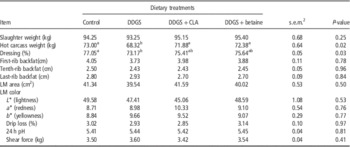
The results for the carcass quality traits are shown in Table 4. The addition of DDGS to the diets produced no difference (P>0.05) in the first-rib, tenth-rib and last-rib backfat and LM area compared with the control. The results of the present study agreed with the reported previous studies (Whitney et al., Reference Whitney, Shurson, Johnson, Wulf and Shanks2006). Yoon et al. (Reference Yoon, Yang, Shinde, Choi, Kim, Kim and Chae2010) reported no effect on the backfat depth in pigs fed diets containing DDGS. However, Xu et al. (Reference Xu, Baidoo, Johnston, Bibus, Cannon and Shurson2010) reported that the backfat thickness of pigs fed corn DDGS was reduced.
Effect of dietary treatments on the carcass and LM characteristics of finishing pigsFootnote 1

DDGS=dried distillers grains with solubles; CLA=conjugated linoleic acid; LM=longissimus.
a,bMeans within a row with different superscripts differ (P<0.05).
1 Total of 32 barrows with one pig per pen and eight pens per treatment.
2 s.e. of least squares mean.
The slaughter weight was not affected (P>0.05) by the addition of DDGS to the diets compared with the control. The dressing percentage and HCW were reduced (P<0.05) by the addition of DDGS to the diets compared with the control. The dressing percentage has been shown decreased in some previous experiments (Whitney et al., Reference Whitney, Shurson, Johnson, Wulf and Shanks2006; Xu et al., Reference Xu, Baidoo, Johnston, Bibus, Cannon and Shurson2010) as the concentration of DDGS in the diet. However, Widmer et al. (Reference Widmer, McGinnis, Wulf and Stein2008) and Yoon et al. (Reference Yoon, Yang, Shinde, Choi, Kim, Kim and Chae2010) did not observe any differences in the dressing percentage between the control group and DDGS diets. The reason for this observation is unknown, but it may be related to the increase in the weight of the visceral organs. Research had shown that feeding fiber could increase the rate of passage, causing increased intestinal growth (Gill et al., Reference Gill, Mellange and Rooke2000).
The slaughter weight, the HCW, first-rib backfat, tenth-rib backfat, last-rib backfat and LM area were not affected (P>0.05) by the DDGS+CLA or DDGS+betaine diets compared with the control and DDGS group. For LM color L*, a*, b*, drip loss, pH and shear force, no effects (P>0.05) of DDGS in the diets were observed. Likewise, no effects (P>0.05) of the DDGS+CLA or DDGS+betaine diets were observed on LM color L*, a*, b*, drip loss, pH and shear force compared with the control and DDGS group. These observations agree with the findings of Whitney et al. (Reference Whitney, Shurson, Johnson, Wulf and Shanks2006), who concluded that feeding diets containing up to 300 g DDGS/kg to grower–finisher pigs had no effect on LM color L*, ultimate pH, 24-h drip loss and Warner–Bratzler shear force values. Similarly, Yoon et al. (Reference Yoon, Yang, Shinde, Choi, Kim, Kim and Chae2010) observed no differences in LM color L*, a*, b* in pigs fed diets containing 150 g DDGS/kg. However, Widmer et al. (Reference Widmer, McGinnis, Wulf and Stein2008) reported a decrease in LM color b* values in pigs fed diets containing DDGS, indicating that the muscle color became bluer as these ingredients were included in the diets.
No effects (P>0.05) of the DDGS+CLA or DDGS+betaine diets were observed on the dressing percentage compared with the control and DDGS diets. These results accorded with the previous studies that no difference was observed in the dressing percentage with CLA supplementation (Lauridsen et al., Reference Lauridsen, Mu and Henckel2005), similarly to the present work indicating no effect of betaine on the dressing percentage (Lawrence et al., Reference Lawrence, Schinckel, Adeola and Cera2002).
Carcass fat quality
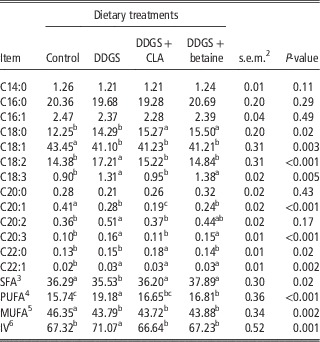
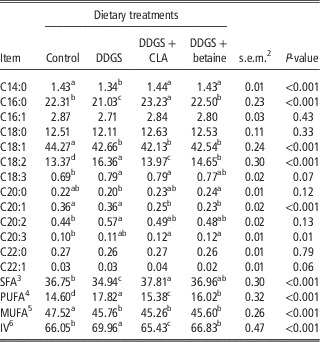
The fatty acid profiles of the backfat and belly fat in the pigs fed DDGS, DDGS+CLA or DDGS+ betaine diets are shown in Tables 5 and 6. For backfat, the pigs fed diets with DDGS showed the significantly increased percentages of C18:2, C18:3, C20:2, C20:3, C22:1, polyunsaturated fatty acid (PUFA) and IV but the decreased (P<0.05) percentages of C18:1, C20:1, monounsaturated fatty acid (MUFA) and SFA compared with the control. For belly fat, the percentages of C18:2, C18:3, C20:2, PUFA and IV were significantly increased (P<0.05) in the pigs fed the DDGS diets, but the percentages of C14:0, C16:0, C18:1, SFA and MUFA were decreased (P<0.05) compared with the control. The fatty acid composition in animal tissues generally reflects the dietary fat composition, and the fat quality of pigs can be altered by changing the dietary fat (Gatlin et al., Reference Gatlin, See, Hansen, Sutton and Odle2002a and Reference Gatlin, See, Larick, Lin and Odle2002b). It has been well documented that the fatty acid profiles of pork fat, particularly PUFA such as C18:2 and C18:3, which cannot be synthesized by animal tissues, reflect the composition of the fat consumed (Gatlin et al., Reference Gatlin, See, Hansen, Sutton and Odle2002a and Reference Gatlin, See, Larick, Lin and Odle2002b). Because DDGS contains 100 to 150 g/kg lipids (Rausch and Belyea, Reference Rausch and Belyea2006) and a high proportion of unsaturated fatty acids (810 g/kg of total) and C18:2 (540 g/kg of total), diets containing DDGS (Table 2) may produce adverse effects on pork quality. Kouba et al. (Reference Kouba, Enser, Whittington, Nute and Wood2003) observed changes in the fatty acid profiles of growing pigs fed high C18:2 diets for only 20 days. In the present study, the pigs fed the diets containing DDGS increased the percentage of C18:2 and PUFA, but the C16:0 and SFA decreased in both the backfat and belly fat. Similarly, Dahlen et al. (Reference Dahlen, Baidoo, Shurson, Anderson, Dahlen and Johnston2011), Benz et al. (Reference Benz, Linneen, Tokach, Dritz, Nelssen, DeRouchey, Goodband, Sulabo and Prusa2010) and Xu et al. (Reference Xu, Baidoo, Johnston, Bibus, Cannon and Shurson2010) observed changes in the fatty acid profiles of pigs fed increased dietary DDGS, specifically demonstrated that the DDGS linearly increased the C18:2 and PUFA content and reduced the SFA. The IV is a measure of the degree of unsaturation of fatty acids in fat and is defined as the number of grams of iodine absorbed by 100 g of fat. The changes in the fat IVs in pigs fed diets containing DDGS are most likely a result of the relatively large quantities of unsaturated fatty acids, particularly C18:2 in corn because the increases in dietary unsaturated fatty acid concentrations will increase the carcass fat IV. In the current study, the IV of the backfat and belly fat increased in pigs fed diets containing 300 g DDGS/kg, which agrees with previous reports (Benz et al., Reference Benz, Linneen, Tokach, Dritz, Nelssen, DeRouchey, Goodband, Sulabo and Prusa2010; Dahlen et al., Reference Dahlen, Baidoo, Shurson, Anderson, Dahlen and Johnston2011), indicating that the IV of fat increased with increased DDGS content in grower–finisher pig diets. Regression analysis in the research has hundreds of pigs indicated that IVs increased 4.3 units for every 10 percentage unit inclusion of DDGS in the diet (Cromwell et al., Reference Cromwell, Azain, Adeola, Baidoo, Carter, Crenshaw, Kim, Mahan, Miller and Shannon2011).
Effect of dietary treatments on the fatty acid profile (g/100 g total fatty acids) of backfat samplesFootnote 1

DDGS=dried distillers grains with solubles; CLA=conjugated linoleic acid; SFA=saturated fatty acid; PUFA=polyunsaturated fatty acid; MUFA=monounsaturated fatty acid; IV=iodine value.
a,b,cMeans within a row with different superscripts differ (P<0.05)
1 Total of 32 barrows with one pig per pen and eight pens per treatment.
2 s.e. of least squares mean.
3 Total SFA=((C8:0)+(C10:0)+(C12:0)+(C14:0)+(C16:0)+(C17:0)+(C18:0)+(C20:0)+(C22:0)+(C24:0)).
4 Total PUFA=((C18:2)+(C18:3)+(C18:3)+(C20:2)+(C20:4)).
5 Total MUFA=((C14:1)+(C16:1)+(C18:1)+(C18:1n-7)+(C20:1)+(C24:1)).
6 Calculated as iodine value=((C16:1)×0.95)+((C18:1)×0.86)+((C18:2)×1.732)+((C18:3)×2.616)+((C20:1)×0.785)+((C22:1)×0.723); (American Oil Chemists’ Society, 1998).
Effect of dietary treatments on the fatty acid profile (g/100 g total fatty acids) of belly fat samplesFootnote 1

DDGS=dried distillers grains with solubles; CLA=conjugated linoleic acid; SFA=saturated fatty acid; PUFA=polyunsaturated fatty acid; MUFA=monounsaturated fatty acid; IV=iodine value.
a,b,c,dMeans within a row with different superscripts differ (P<0.05).
1 Total of 32 barrows with one pig per pen and eight pens per treatment.
2 s.e. of least squares mean.
3 Total SFA=((C8:0)+(C10:0)+(C12:0)+(C14:0)+(C16:0)+(C17:0)+((C18:0)+(C20:0)+(C22:0)+(C24:0)).
4 Total PUFA=((C18:2)+(C18:3)+(C18:3)+(C20:2)+(C20:4)).
5 Total MUFA=((C14:1)+(C16:1)+(C18:1 cis-9)+(C18:1n-7)+(C20:1)+(C24:1)).
6 Calculated as iodine value=((C16:1)×0.95)+((C18:1)×0.86)+((C18:2)×1.732)+((C18:3)×2.616)+((C20:1)×0.785)+((C22:1)×0.723); (American Oil Chemists’ Society, 1998).
For backfat, the percentages of C18:0 and SFA were significantly increased (P<0.05), but the percentages of C18:2, C18:3, C20:1, C20:3, PUFA and IV were decreased (P<0.05) by the DDGS+CLA compared with the DDGS group. The DDGS+betaine diet increased the proportion of C16:0, C18:0, C22:0 and SFA but decreased (P<0.05) the proportion of C18:2, PUFA and IV compared with the DDGS group. For belly fat, the proportions of C14:0, C16:0 and SFA were increased (P<0.05), but the proportions of C18:2, PUFA and IV were decreased (P<0.05) among the pigs fed the DDGS+CLA or DDGS+betaine diets compared with the pigs fed the DDGS diets. Similar changes have been accorded with the result that the increase of SFA and reduction of C18:1 and MUFA fatty acids in the carcass fat due to the dietary CLA (Gatlin et al., Reference Gatlin, See, Hansen, Sutton and Odle2002a and Reference Gatlin, See, Larick, Lin and Odle2002b; Martín et al., Reference Martín, Antequera, González, López-Bote and Ruíz2007). White et al. (Reference White, Richert, Radcliffe, Schinckel, Burgess, Koser, Donkin and Latour2009) indicated that the addition of 6 g/kg CLA to diets containing 200 or 400 g/kg DDGS for 10 days before the pigs were slaughtered reduced the fat IVs. Pompeu et al. (Reference Pompeu, Wiegand, Evans, Rickard, Gerlemann, Hinson, Carr, Ritter, Boyd and Allee2013) indicated the 0.6% CLA was effective in diminishing some of the negative effects, especially on IV, caused by DDGS. Rickard et al. (Reference Rickard, Wiegand, Pompeu, Hinson, Gerlemann, Disselhorst, Briscoe, Evans and Allee2012) reported that CLA increased the SFA and decreased the MUFA in both the jowl and belly samples. This observation is consistent with the observation that CLA may reduce the activity of the Δ9-desaturase enzyme, which is responsible for the desaturation of de novo synthesized fatty acids (Gatlin et al., Reference Gatlin, See, Hansen, Sutton and Odle2002a and Reference Gatlin, See, Larick, Lin and Odle2002b). The DDGS+betaine diets increased the proportion of C16:0 and SFA, but decreased the proportion of C18:2, PUFA and IV compared with the DDGS diet. More recent studies in finishing pigs have also demonstrated decreases in some indicators of body fat (Lawrence et al., Reference Lawrence, Schinckel, Adeola and Cera2002). Rojas-Cano et al. (Reference Rojas-Cano, Lara, Lachica, Aguilera and Fernández-Fígares2011) observed increased proportions of 16:0 and decreased 18:1 in pigs received betaine. However, Martins et al. (Reference Martins, Neves, Freitas and Tirapicos2012) reported another result that feed 1 g/kg of betaine to pigs and saw no effects on body fat deposition. Another study (Hur et al., Reference Hur, Yang, Park and Joo2007) reported a decrease in the proportion of 18:2 and an increase in 18:0 in pigs in response to betaine supplementation. This result agreed with Yang et al. (Reference Yang, Lee, Joo and Park2009), who reported that dietary betaine significantly reduced UFA and increased SFA.
Conclusions
In conclusion, finishing pigs fed diets containing 300 g DDGS/kg showed no detrimental effects on growth performance, but it reduced the dressing percentage and HCW, moreover, it increased the percentage of PUFA and IV, and decreased percentage of SFA and MUFA in the backfat and belly fat. The DDGS diets supplemented with CLA or betaine reduced the negative effects on carcass fat in finishing pigs.
Acknowledgments
This research was supported by the National Basic Research Program (2012CB124703) and China Agriculture Research System (CARS-36).