Introduction
The Australian Institute of Health and Welfare (AIHW) has estimated that 6.5% of people aged 65 years and over have dementia and that the number of people with dementia in Australia in 2003 was 174,700 (Australian Institute of Health and Welfare, 2007). In 2003, dementia accounted for 4% of the total disease burden in Australia and an estimated 94,379 disability-adjusted life years lost (Australian Institute of Health and Welfare, 2007). Rates of dementia among indigenous Australians are much higher than among the non-indigenous population (Smith et al., Reference Smith2008). Among those with dementia, the proportion of people with dementia who have Alzheimer's disease (AD) is not accurately known. However, most estimates suggest that up to about 70% of people with dementia have AD (Brodaty and Gresham, Reference Brodaty and Gresham1989; Howard et al., Reference Howard2007; Rodda et al., Reference Rodda, Morgan and Walker2009)
Although dementia is commonly associated with behavioral and psychological symptoms (Lyketsos et al., Reference Lyketsos, Steinberg, Tschanz, Norton, Steffens and Breitner2000), cognitive impairment is its defining feature. In the absence of disease-modifying treatents, the advent of cognition enhancing drugs (CED) has provided symptomatic improvement for many patients with AD (Birks, Reference Birks2006; Takeda et al., Reference Takeda2006) and given hope to patients and caregivers alike. The dominant pharmacotherapeutic paradigm reflects the evidence that cholinergic deficits are related to cognitive impairment (Bartus et al., Reference Bartus, Dean, Beer and Lippa1982). Among potential pro-cholinergic strategies, only inhibition of the cholinesterase enzymes has demonstrated consistent clinically meaningful benefit in AD (Birks, Reference Birks2006). The cholinesterase inhibitors (donepezil, galantamine and rivastigmine) have been demonstrated repeatedly to be modestly effective at improving cognitive performance. Some studies have also demonstrated improvements in activities of daily living. However, there is debate about whether the cholinesterase inhibitors have consistent behavioral benefits (Howard et al., Reference Howard2007; Rodda et al., Reference Rodda, Morgan and Walker2009). Memantine is an N-methyl-D-aspartate (NMDA)-receptor antagonist that modulates glutamate excitotoxicity. It produces modest cognitive improvement in some people with AD and its use may also be associated with behavioral improvement (Wilcock et al., Reference Wilcock, Ballard, Cooper and Loft2008). Most of the beneficial effects of memantine have been demonstrated in nursing home patients with moderately severe dementia (Winblad et al., Reference Winblad, Jones, Wirth, Stoffler and Mobius2007).
Australia has a universal health insurance system called Medicare that provides coverage to all citizens and permanent residents. Operating within Medicare is the Pharmaceutical Benefits Scheme (PBS), which provides access to pharmaceutical drugs at subsidized prices, subject to certain rules. In 2010, concession beneficiaries are required to pay no more than AUD$5.40 and other Australian residents no more than AUD$33.30 per prescription item (usual supply for one month) for medicines covered by the PBS. Concession beneficiaries are those who receive social security benefits because they hold a Pensioner card, a Health Care card or Commonwealth Seniors Health card. Military veterans, defense personnel and their dependents are covered by a separate scheme – the Repatriation PBS (RPBS) – but still pay only the concession price. Thus, there has arguably been little financial impediment to accessing cholinesterase inhibitor medications for Australian residents.
The four prescription drugs mentioned above are approved for use in the treatment of AD on a subsidized basis in Australia: the cholinesterase inhibitors donepezil, galantamine and rivastigmine; and the NMDA-receptor antagonist memantine. The PBS rules for the prescription of these four drugs are complex. Put briefly, the cholinesterase inhibitor medications are subsidized for the treatment of mild to moderate AD when the presence of this condition has been confirmed by a specialist physician from any branch of internal medicine or by a psychiatrist. For the purposes of the PBS subsidy, mild to moderate AD is considered to include patients with Mini-mental State Examination (MMSE) scores of 10 to 24 inclusive. AD patients with MMSE scores outside of this range are subject to further rules, which we will not describe here (Australian Government Department of Health and Ageing, 2006). To satisfy the PBS rules, the prescribing doctor must submit written evidence of the patient's diagnosis, clinical severity and MMSE score to Medicare. The RPBS rules are similar to the PBS rules although written evidence is not required and approval is granted via telephone. Memantine was listed on the PBS in July 2008 and is subsidized for monotherapy when the patient has moderately severe AD and an MMSE score of 10 to 14 inclusive. However, there was no PBS subsidy for memantine during the study period and it was only available as a private (i.e. unsubsidized) prescription medicine.
Against this background, we investigated trends in the prescribing of cognition enhancing drugs (CEDs) to Australian adults using data from two federal databases.
Methods
Data on the number of prescriptions for cognition enhancers were obtained from the Department of Health and Ageing for the period July 2002 to June 2007. The data were drawn from two sources. The first was the Medicare Australia records of prescriptions submitted for payment of a subsidy under the PBS and RPBS schemes. The second source was the Drug Utilisation Sub-Committee which holds data from an ongoing survey of a representative sample of community pharmacies, which provides an estimate of the non-subsidized use of prescription medicines in the Australian community (Australian Government Department of Health and Ageing, 2008). Aggregated and de-identified data included details of the drug product dispensed and information on the gender and age of the patient. The usage of prescription medicines dispensed to inpatients in public hospitals is not available in this report. In Australia, discharged patients from hospital are generally provided with only a short supply of medication, typically a maximum of one month's supply. Further prescriptions are provided by primary care physicians (known in Australia as general practitioners or GPs) and specialist medical practitioners in the community. Failure to account for hospital discharge prescriptions would be unlikely to have any major effect on the data studied in relation to a long-term disorder such as dementia.
The amount of drug dispensed and supplied was standardized using the defined daily dose per 1000 population per day (DDD/1000 population/day). The defined daily dose is established by the WHO Collaborating Centre for Drug Statistics Methodology. It corresponds to an average daily dose of the drug when used for its main indication in adults (World Health Organization, 2008). The DDD/1000/population/day was calculated for all drugs with an anatomical therapeutic chemical (ATC) code starting with N06DA and N06DX (indicating so-called anti-dementia drugs). The drugs (and DDDs) included donepezil (7.5 mg), galantamine (16 mg), rivastigmine (9 mg) and memantine (20 mg). For example, a value of 150DDD/1000/day would equate to 15% of that population taking a standard dose of the drug each day.
Drug utilization for the period July 2002 to June 2007 (with appropriate half year adjustment) was calculated for the combined source categories (PBS-subsidized, under general co-payment and private prescriptions). Utilization was calculated for four categories of prescribers: geriatricians, primary care physicians, psychiatrists and other specialists. Age-standardized drug utilization by gender was also calculated based on the population in each gender and age stratum. The Australian population was estimated at 21,017,222 at June 2007 (Australian Bureau of Statistics, 2007). Data on the gender and age of persons receiving a prescription were not available before 2002 because date of birth was not verified in prescription data before this year. The chronological timetable of the PBS indications for CEDs was formulated from data extracted from previous PBS Schedules.
Results
The CEDs were listed on the PBS at different times: donepezil and rivastigmine in February 2001, galantamine tablets in November 2001 with the 12 mg tablet being listed in September 2004. The prolonged release capsules of galantamine were listed in December 2004. More recently, and outside the study period, rivastigmine transdermal patches and memantine were listed as subsidized medicines in July 2008.
Overall use of individual CEDs
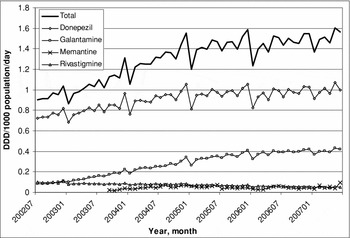
There were 1,583,667 CED prescriptions dispensed in the study period (donepezil 1,026,718; galantamine 395,202; rivastigmine 113,235; memantine 48,512). Overall use of CEDs increased from 0.91 to 1.56 DDD/1000/day, an increase of 58% between 2002 and 2007 (Figure 1). The total CED utilization in 2007 equated to approximately 0.16% of people in the age-standardized population dispensed the defined daily dose. The most widely used subsidized medication was donepezil with 66.1% of the CED market in 2007, followed by galantamine (26.8%) and rivastigmine (3.4%). The use of memantine was 3.8% of the market in 2007 despite not being publicly subsidized for use at that time. The temporal pattern of use differed by medication: there was progressive growth in the use of donepezil; galantamine use reached a plateau in late 2005; and rivastigmine use declined.
Drug utilization (DDD/1000 population/day) of four cognition enhancing drugs, 2002–2007 (memantine not subsidized). DDD = WHO defined daily dose.

There is a higher level of utilization towards the end of each calendar year. This peak is due to safety net provisions introduced to the PBS in November 1986 to ensure that patients with multiple medical conditions, who genuinely need a number of medicines, are not financially prevented from obtaining them. Once the cash-based safety net level is reached, prescriptions on the scheme are either free (concessional patients), or available at the concessional co-payment amount (general patients). The safety net period is the calendar year, and the highs and lows are due to stockpiling of medication by patients once the safety net level is reached, which usually occurs towards the end of the year (Australian Government Department of Health and Ageing, 2008).
CED use by class of prescriber
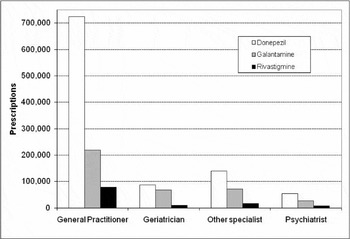
GPs (primary care physicians) prescribe the overwhelming majority of CEDs in Australia (Figure 2) compared to the three other categories of specialist prescribers (geriatricians, psychiatrists, other specialists). However, all prescribers have the same order of CED preference: donepezil, galantamine and rivastigmine. Curiously, Australian geriatricians prescribe relatively more galantamine than their primary care and specialist colleagues.
Drug utilization (based on prescription counts) of each subsidized cognition enhancing drug within four prescriber categories (general practitioner, geriatrician, other specialist and psychiatrist) – data for entire study period.

CED use by gender and age
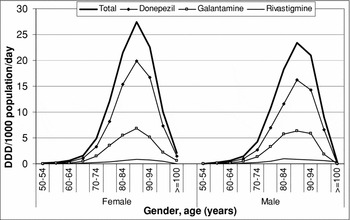
The age-adjusted utilization profiles by gender and age for subsidized CEDs (plus the combined total of same) in 2006 are shown in Figure 3. Combined utilization was higher in females than males. Total CED utilization increased in those aged in their late 60s. Total CED use peaked at 27.46 and 23.41 DDD/1000 population/day for females and males, respectively, aged 85–89 years. Peak use of donepezil in those aged 85–89 was 19.84 and 16.19 DDD/1000 population/day in females and males, respectively. Peak use of galantamine was 6.82 and 6.36 DDD/1000 population/day for females and males, respectively.
Drug utilization (DDD/1000 population/day) by gender and age for subsidized cognition enhancing drugs (and the combined total of same) during 2006 (monthly data averaged over the year). DDD = WHO defined daily dose.

Utilization of different dose formulations
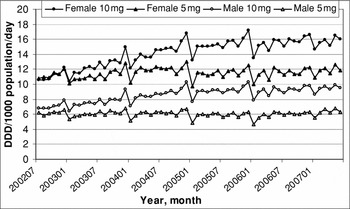
Donepezil is available on the PBS as 5 mg and 10 mg tablets and the higher dose form was preferentially prescribed in both females and males (Figure 4). Despite starting at similar levels in July 2002, the 10 mg tablet was increasingly preferred in both genders (the 5 mg formulation remained quite stable) and the use of both the 5 mg and 10 mg formulations in females was higher than the same formulations in males.
Drug utilization (DDD/1000 population/day) of donepezil by gender and dose (5 mg and 10 mg tablets), 2002–2007. DDD = WHO defined daily dose.

Galantamine was available on the PBS as 4 mg, 8 mg and 12 mg immediate release tablets until November 2006 when they were withdrawn. The 8 mg tablet was the preferred form and use peaked at 0.25 DDD/1000 population/day in December 2004 (data not shown). Coincident with this peak, the prolonged release forms were listed on the PBS. The 16 mg form was preferred and use peaked at 0.27 DDD/1000 population/day in December 2006.
Discussion
Overall CED use in Australia increased by 58% over the five-year period and, among the cholinesterase inhibitors, donepezil was the most widely used agent, followed by galantamine and then rivastigmine. The overall increase in CED usage over the study period is most likely to represent increased uptake of CEDs in those eligible for treatment as prescribers became more aware of the availability of these drugs.
As expected, CED use was greater in those aged 65 years and older with peak use in those aged 85–89 years. As the prevalence of AD is exponentially related to age, it is appropriate for prescriptions of CEDs to peak among people aged 85–89 years, although this age group is at risk of adverse events including symptomatic bradycardia (Park-Wyllie et al., Reference Park-Wyllie, Mamdani, Li, Gill, Laupacis and Juurlink2009). Age-adjusted utilization was slightly higher in females than males, perhaps reflecting higher medical consultation rates in females.
The strength of this study is that it represents the complete capture of all subsidized dispensing of CEDs in the Australian community during the study period. There is complete utilization information by source (subsidized or private), prescriber, gender and age for 2002–2007. These data have been age-standardized so that there is no bias due to differential gender populations in each age group.
However, there are several limitations to the study. Beyond age and sex characteristics, we cannot determine other characteristics of CED users. In particular, we are unable to link the prescribing information to individuals with diagnosed dementia. We are unable to ascertain the actual indication for which the CED was prescribed despite the prescribing rules that govern subsidized use in Australia. The PBS data do not include the small number of prescriptions where the dispensed price is below the patient co-payment. The DUSC data on non-subsidized (i.e. under co-payment and private) prescriptions do not permit prescriber, gender or age stratification. In addition, our data do not capture the use of free medication samples that were provided to physicians by pharmaceutical companies during the study period. These samples are generally of the lowest dose for each medication and are given to patients to initiate therapy, usually for no more than one month.
Reports of CED use in Canada (Mamdani et al., Reference Mamdani, Rapoport, Shulman, Herrmann and Rochon2005; Herrmann et al., Reference Herrmann2007), Europe (Pariente et al., Reference Pariente, Helmer, Merliere, Moore, Fourrier-Reglat and Dartigues2008) and South Africa have shown a similar picture to that observed in Australia (Robinson et al., Reference Robinson, Rowett, Leverton and Mabbott2009). Donepezil was the preferred medication followed by galantamine and rivastigmine. In Europe, prevalence of treatment in patients with dementia ranged from 3% in the Netherlands to 20% in France (Pariente et al., Reference Pariente, Helmer, Merliere, Moore, Fourrier-Reglat and Dartigues2008). It is difficult to make direct comparisons between countries because of large differences in health care systems and health economics. However, in the European Union, prescription and reimbursement criteria vary widely (Oude Voshaar et al., Reference Oude Voshaar, Burns and Olde Rikkert2006): six countries had permitted GPs to initiate treatment with CEDs, whereas eight had not. These authors also noted widely varying MMSE upper and lower limits for CED prescribing among EU countries. Furthermore, they reported major differences in reimbursement, with some countries providing reimbursement for all three cholinesterase inhibitor drugs and some for none.
It is estimated that approximately 200,000 people had dementia in Australia in 2007 (Australian Institute of Health and Welfare, 2007). If 70% of these had AD (Brodaty et al., Reference Brodaty, Sachdev and Anderson2005; Jorm et al., Reference Jorm, Dear and Burgess2005), that would represent 140,000 or 0.68% of the total Australian population of 20.7 million persons in 2007 (Australian Bureau of Statistics, 2007). However, as shown by the results of the current study, CEDs were used by only 0.16% of the total population or no more than 24% of those with AD. Some people with AD will have fallen outside the PBS prescribing rules (i.e. an MMSE score 10–24 inclusive) and it is likely that some CED prescribing occurred “off label” for people who did not actually have AD. Thus, the proportion of people with AD who received a CED is likely to be less than 24%. For example, if prescribers did not distinguish between dementia due to AD and dementia due to other causes, then CEDs would have been prescribed to only 16.5% of people with AD. These CED “coverage” estimates reflect dispensed prescriptions rather than actual patient usage rates, which are likely to be somewhat lower. There is evidence that some people start CEDs but do not persist with them for long (Herrmann et al., Reference Herrmann2007; Robinson et al., Reference Robinson, Rowett, Leverton and Mabbott2009).
The relatively low proportion of potentially eligible AD patients being dispensed CEDs raises questions for patients, prescribers and governments. From the perspective of patients, one could ask whether there is sufficient access to diagnostic and treatment services for people with AD and related dementias. This is particularly pertinent because of the projected rapid rise in people aged 85 years and over in Australia during the four decades to 2050 (Commonwealth of Australia, 2010). It is this group that is most at risk of dementia. This demographic change will be accompanied by a rising dependency ratio, likely making it more difficult for older people to obtain appropriate assistance and care. The labyrinthine prescribing rules appear to have been effective at limiting access to CEDs. Furthermore, it is likely that people from culturally and linguistically diverse backgrounds were under-represented among those prescribed CEDs, although we were not able to judge this from the available de-identified data.
In Australia, the prescribing rules for the four available subsidized CEDs require that the diagnosis of AD be confirmed by a specialist physician (internal medicine or psychiatry). As a consequence, these specialist physicians act as gatekeepers to CED prescribing by GPs (primary care physicians). Despite this, GPs write the overwhelming majority of CED prescriptions in Australia. However, our data do not allow us to determine the proportion of initial prescriptions written by GPs. The pattern of prescribing by specialty is unremarkable apart from the observation that geriatricians demonstrate a greater preference for galantamine than the other classes of prescribers. Although speculative, this is likely to reflect the influence of key opinion leaders among the relatively small group of specialist geriatricians in Australia. More generally, prescribing preferences are likely to reflect drug tolerability and marketing considerations.
Although there is evidence that CEDs may be clinically beneficial (Takeda et al., Reference Takeda2006), the cost effectiveness of these treatments remains uncertain (Loveman et al., Reference Loveman2006). It has been the subject of intensive scrutiny by the U.K.'s National Institute for Health and Clinical Excellence (NICE Technology Appraisal Guidance 111 – Amended, 2009; http://www.nice.org.uk/TA111). These guidelines recommend the use of donepezil, rivastigmine and galantamine for people with mild to moderately severe AD (MMSE score 10–20 inclusive). There was evidence of reduced cost effectiveness among people with AD who had MMSE scores greater than 20. Memantine was not recommended for use apart from in clinical trials. These NICE guidelines are more restrictive than the Australian subsidized indications. It is possible that the NICE guidelines – as well as the findings from the widely publicized AD2000 trial (Courtney et al., Reference Courtney2004) suggesting limited efficacy – might have influenced primary care physicians against prescribing CEDs; however, neither of these reports could have influenced prescribing prior to 2004. Alternatively, the complexity of the Australian PBS/RPBS prescribing rules might have discouraged many doctors. Although there was a progressive increase in prescribing of subsidized CEDs in Australia over the study period, Figure 1 does suggest that this might be reaching an asymptote. If future data collections confirm this trend, then the Federal Government's financial exposure to subsidies for CEDs might be determined mainly by population aging rather than by prescriber behaviour. To the extent that population aging outstrips any rise in the availability of diagnostic and treatment services for people with dementia, federal financial contributions for CEDs might even decline on a population standardized basis. However, if population aging makes it more difficult for people with dementia to consult an appropriately trained specialist, the government strategy of using specialists as gatekeepers might come under increasing strain. It may be time for the Federal Government to reconsider the gatekeeping role of specialists.
The aggregate data reported in this paper provide an overview of CED prescribing patterns in Australia. More detailed analysis of prescribing trends would be assisted by the availability of data on individual prescribers and individual people with dementia. It would be particularly interesting to track individuals over time to examine predictors of drug continuation as it seems likely that many people with dementia discontinue CED treatment after a period of several months. In addition, the availability of individualized data would enable examination of dose titration, drug switching and co-prescribing practices. Such information is now collected for veterans as the Department of Veterans' Affairs has developed the Veterans' Medicines Advice and Therapeutics Education Services (Veterans' MATES) to assist in managing medicine use in the veteran community (see https://www.veteransmates.net.au/VeteransMATES/VeteransMATESServlet?page=index). The high prevalence of co-prescription of cholinesterase inhibitors with anticholinergic medicines has been highlighted recently (Robinson et al., Reference Robinson, Rowett, Leverton and Mabbott2009). It would also be interesting to examine prescriber characteristics as it appears that Australian geriatricians have different CED prescribing preferences to other doctors.
Conflict of interest declaration
No ethics approval was required for this study. G. Byrne has received honoraria or travel grants from Pfizer, Novartis, Janssen-Cilag, Lundbeck, Servier and the National Prescribing Service and he is currently a member of drug advisory boards for Lundbeck, Novartis and Pfizer.
Description of authors' roles
S. Hollingworth designed the study, performed and supervised data analysis and wrote the paper. G. Byrne assisted in interpreting the data and writing the paper.
Acknowledgments
The data in these graphs were produced by the Drug Utilisation Sub-Committee (DUSC), Pharmaceutical Benefits Branch, Pharmaceutical Benefits Division, Commonwealth Department of Health and Ageing. We acknowledge the assistance of Mr Greg Merlo in data analysis.