INTRODUCTION
Schistosomiasis or bilharziasis, is a water borne parasitic infection and, as one of the most common tropical diseases after malaria is placed in the second rank. World Health Organization considers it a Neglected Tropical Disease (NTD) (Fenwick et al. Reference Fenwick, Webster, Bosque-Oliva, Blair, Fleming, Zhang, Garba, Stothard, Gabrielli, Clements, Kabatereine, Toure, Dembele, Nyandindi, Mwansa and Koukounari2009). Schistosomiasis is endemic in 78 developing countries throughout the world and over 240 million persons are infected in rural and semi-urban regions. From this number, about 20 million people have severe complications and approximately 120 million have signs of the infection. It is estimated that 800 million individuals live in endemic and high risk regions throughout the world, and therefore may acquire the disease and among 200 000–280 000 deaths as a result of disease occur annually. Also, more than 85% of cases happened in sub-Saharan Africa (Fenwick et al. Reference Fenwick, Webster, Bosque-Oliva, Blair, Fleming, Zhang, Garba, Stothard, Gabrielli, Clements, Kabatereine, Toure, Dembele, Nyandindi, Mwansa and Koukounari2009; Mo et al. Reference Mo, Agosti, Walson, Hall and Gordon2014). Schistosomiasis is considered as one of the main infections of public health in Eastern Mediterranean Region (EMR) countries and has socio-economic importance. There are two main human Schistosoma species in EMR region, Schistosoma haematobium and Schistosoma mansoni. Schistosoma mansoni exists in 9 out of 23 EMR countries (Egypt, Libya, Saudi Arabia, Oman, Djibouti, Yemen, Sudan, Southern Sudan and Somalia) and S. haematobium exists in 15 EMR countries (Libya, Egypt, Saudi Arabia, Oman, Sudan, Southern Sudan, Yemen, Somalia, Jordan, Morocco, Tunisia, Lebanon, Syria, Iraq and Iran) (WHO, 2013). In recent years a significant decline has been observed in the prevalence of urogenital schistosomiasis in many EMR endemic regions and some of these countries have reached elimination of infection (Al Ghahtani and Amin, Reference Al Ghahtani and Amin2005; EMRO/WHO, 2007; Niaz et al. Reference Niaz, Tanveer and Qureshi2010; Amarir et al. Reference Amarir, El Mansouri, Fellah, Sebti, Mohammed, Handali, Wilkins, El Idrissi, Sadak and Rhajaoui2011; WHO, 2013; Othman and Soliman, Reference Othman and Soliman2015). Based on recent policy by WHO, Iran is categorized among countries that require evaluation in order to verify if interruption of transmission has been achieved and updating planning and implementation purposes (WHO, 2013).
Urogenital schistosomiasis in Iran
In Iran, Khuzestan is the only province in which urogenital schistosomiasis has been reported (Arfaa et al. Reference Arfaa, Bijan and Farahmandian1967; Massoud et al. Reference Massoud, Arfaa, Farahmandian, Ardalan and Mansoorian1982; Mombeni and Kheradmand, Reference Mombeni and Kheradmand2005; Gholamreza et al. Reference Gholamreza, Jafar, Allahbedasht, Nikkhooy, Mohammad and Rokni2008). Of the different species of Schistosomes, only S. haematobium has been reported in Iran so only urinary schistosomiasis has been diagnosed in this area (Arfaa et al. Reference Arfaa, Bijan and Farahmandian1967; Mombeni and Kheradmand, Reference Mombeni and Kheradmand2005; Hamidinia et al. Reference Hamidinia, Maraghi, Azimi, Ai and Shirian2014). The presence of raging rivers, cane sugar fields, hydroelectric and agricultural dams and the optimum temperature and humidity have made Khuzestan a favourable habitat for the snail Bulinus truncatus, which is the intermediate host for S. haematobium (Hamidinia et al. Reference Hamidinia, Maraghi, Azimi, Ai and Shirian2014). According to previous studies, the urogenital schistosomiasis was limited to a few foci of Khuzestan province and it is estimated that 25 000–30 000 individuals were infected (Massoud et al. Reference Massoud, Arfaa, Farahmandian, Ardalan and Mansoorian1982). Iraq, a country located to the west of Iran, is considered as an endemic region for urogenital schistosomiasis (WHO, 2013). In recent years, by the implementation of a national programme for schistosomiasis control, this infection has been eliminated from Iran. The aim of this study was to report some aspects of the control interventions and the process of dramatic reduction of urogenital schistosomiasis in southwestern Iran, Khuzestan province.
MATERIALS AND METHODS
Study region
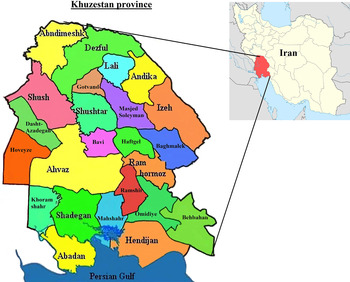
Khuzestan province is located in the southwest of Iran and can be basically divided into two regions, the rolling hills and mountainous regions north of the Ahvaz Ridge and the plains and marshlands to its south. The province covers an area of about 64 055 Km2 and has a population of approximately 4 531 720 inhabitants (2 286 209 male and 2 245 511 female). It is a continuation of the Mesopotamian plain, and is bordered on the south by the Persian Gulf, on the west by Iraq, and on the north and east by the Zagros mountains (Salmanzadeh et al. Reference Salmanzadeh, Foroutan-Rad, Khademvatan, Moogahi and Bigdeli2015). The area is irrigated by the Karoun, Karkheh, Jarahi, Kheirabad, Dez and Maroun rivers (Fig. 1). Khuzestan has great potential for agricultural expansion, which is almost unrivalled by the country's other provinces. Large and permanent rivers flow over the entire territory contributing to the fertility of the land. The Karun, Iran's most effluent river, 850 kms long, flows into the Persian Gulf through this province. The climate of Khuzestan is generally hot and occasionally humid, particularly in the south, while winters are much more pleasant and dry. Summertime temperatures routinely exceed 50°C and in the winter it can drop below freezing, with occasional snowfall all the way south to Ahvaz. Khuzestan province is known to master the hottest temperatures on record for a populated city anywhere in the world. Many sandstorms and dust storms are frequent with the arid and desert-style terrains (http://en.wikipedia.org/wiki/Khuzestan province).
Location of Khuzestan province in Iran.

Data collection
The current data about epidemiological status of schistosomiasis were gathered from Centres for Disease Control and Prevention (CDC) of Khuzestan province, in the southwest of Iran during 1975–2013. This centre is responsible for annual surveillance of urogenital schistosomiasis in high risk regions of the province. Also, active and passive case finding, follow-up of the patients, detection of natural habitats for B. truncatus snails and mollusciciding are the other activities of CDC. Briefly, in the period of surveillance more than 1·3 million urine samples were taken from inhabitants, mainly suspected persons with hematuria and/or bladder irritability symptoms of high risk zones, including: Ahvaz, Andimeshk, Shush, Shushtar and Dezful. All urine samples were gathered between 10:00 a.m and 02:00 p.m for ova detection based on sedimentation method and under light microscope. Also, the aforementioned regions were searched in order to detect B. truncatus habitats.
RESULTS
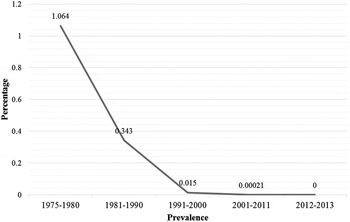
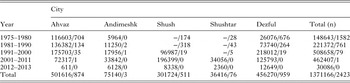
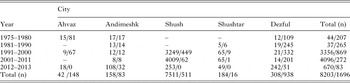
In this retrospective cross-sectional study a significant decrease was seen in number of S. haematobium infections between 1975 and 2013. During these years more than 1·3 million urine samples were examined in five high risk foci of S. haematobium to detect ova. Between the years 1975–1980, 1981–1990 and 1991–2000 there were 1582, 761 and 79 cases of S. haematobium, respectively (Table 1). In 2001, only one case was reported from the west of Ahvaz and indeed this was the last case of urogenital schistosomiasis in Khuzestan and of course, in Iran (Table 1). In the past decade from 2002 to 2013, from more than 0·4 million urine samples taken, no eggs were detected and no patient was diagnosed (Table 1). Also, prevalence of S. haematobium from 1·064% between 1975 and 1980 slumped to 0% in 2012–2013 and total prevalence from 1975 to 2013 was 0·176% (Fig. 2). Despite the absence of urogenital schistosomiasis in Khuzestan province, urine sampling from suspected cases and investigation of previously infected villages and the natural habitats for B. truncatus snail are currently being continued (Table 2). From multiple foci in the past, at present (during 2012–2013) only 83 foci are diagnosed as natural habitats for B. truncatus snail in Khuzestan, 32 foci in Andimeshk and 51 foci in Dezful districts (Table 2).
Prevalence of S. haematobium in Khuzestan province, southwestern Iran (1975–2013).

Number of urine samples for S. hematubium case finding/number of confirmed S. hematubium patients in Khuzestan province, southwestern Iran (1975–2013)

Number of villages investigated for B. truncatus/number of natural habitats for B. truncatus snails detected in Khuzestan province, southwestern Iran (1975–2013)

DISCUSSION
The purpose of current study was to report the process of dramatic reduction of urogenital schistosomiasis in Iran. According to our finding, prevalence of S. haematobium has significantly declined during the four recent decades in the only endemic region in the southwest of Iran, Khuzestan province and showed elimination had been achieved. Previous investigations demonstrated the elimination of urinary schistosomiasis in this region of Iran (Gholamreza et al. Reference Gholamreza, Jafar, Allahbedasht, Nikkhooy, Mohammad and Rokni2008; Mombeni and Kheradmand, Reference Mombeni and Kheradmand2005; Hamidinia et al. Reference Hamidinia, Maraghi, Azimi, Ai and Shirian2014); although, transitional bladder cell carcinoma and schist-ogranuloma of the fallopian tubes due to S. haematobium in Iran were reported (Maraghi et al. Reference Maraghi, Ranjbar and Haddad2004; Ketabchi and Moshtaghi-Kashanian, Reference Ketabchi and Moshtaghi-Kashanian2012). Based on Masooud et al's study in selected high risk regions of Khuzestan province, in the southwest of Iran during 1970–1979, prevalence of urinary schistosomiasis was 8·3% in 1970 and fell to 0·74% in 1979. Moreover, overall incidence of schistosomiasis infection dramatically declined from 3·5% in 1970 to 0% in 1977 (Massoud et al. Reference Massoud, Arfaa, Farahmandian, Ardalan and Mansoorian1982). In a follow-up survey conducted by Gholamreza et al. in some areas of Khuzestan province, out of 3400 urine samples collected during 2005–2007 from villagers residing in the province, no S. haematobium positive cases were seen (Gholamreza et al. Reference Gholamreza, Jafar, Allahbedasht, Nikkhooy, Mohammad and Rokni2008). S. haematobium is still endemic in Iraq, a country located to the west of Iran (WHO, 2013), thus; in order to eradicate disease greater control of traffic between the two countries is required and this process till elimination in Iraq should be continued. According to recommended strategies of WHO, significant advances against schistosomiasis in EMR countries have been achieved during the past four decades (WHO, 2013). Schistosomiasis in some EMR countries has been eliminated like Lebanon, Tunisia, Morocco and Iran and no positive cases have been diagnosed during the past few years (Gholamreza et al. Reference Gholamreza, Jafar, Allahbedasht, Nikkhooy, Mohammad and Rokni2008; Amarir et al. Reference Amarir, El Mansouri, Fellah, Sebti, Mohammed, Handali, Wilkins, El Idrissi, Sadak and Rhajaoui2011; Rollinson et al. Reference Rollinson, Knopp, Levitz, Stothard, Tchuente, Garba, Mohammed, Schur, Person, Colley and Utzinger2013; WHO, 2013; Hamidinia et al. Reference Hamidinia, Maraghi, Azimi, Ai and Shirian2014). Also, some EMR countries such as Jordan, Egypt, Iraq, Oman, Libya, Syria and Saudi Arabia have reached low endemicity. For example in Egypt, prevalence of infection before starting national schistosomiasis control programme (NSCP) in 1967 was calculated approximately 40% and after implementation of this programme, overall prevalence fell down to less than 3%. Also, in Egypt prevalence of S. haematobium between 1988 and 2001 declined from 11·9 to 1·3% (EMRO/WHO, 2007; WHO, 2013; Othman & Soliman, Reference Othman and Soliman2015). Niclosamide molluscicide is widely used for snail control and affects all stages of the snail life cycle (McCullough et al. Reference McCullough, Gayral, Duncan and Christie1980). Despite the negative effects of niclosamide on fishes and environment (Woolhouse et al. Reference Woolhouse, Etard, Dietz, Ndhlovu and Chandiwana1998), it has a key role in control and elimination of disease in some countries like Zanzibar (Knopp et al. Reference Knopp, Person, Ame, Mohammed, Ali, Khamis, Rabone, Allan, Gouvras, Blair, Fenwick, Utzinger and Rollinson2013), Mauritius (Dhunputh, Reference Dhunputh1994), Morocco (Amarir et al. Reference Amarir, El Mansouri, Fellah, Sebti, Mohammed, Handali, Wilkins, El Idrissi, Sadak and Rhajaoui2011), Saudi Arabia (Al Ghahtani and Amin, Reference Al Ghahtani and Amin2005), Tunisia (Rollinson et al. Reference Rollinson, Knopp, Levitz, Stothard, Tchuente, Garba, Mohammed, Schur, Person, Colley and Utzinger2013) and our country, Iran (Massoud et al. Reference Massoud, Arfaa, Farahmandian, Ardalan and Mansoorian1982; Mombeni & Kheradmand, Reference Mombeni and Kheradmand2005; Gholamreza et al. Reference Gholamreza, Jafar, Allahbedasht, Nikkhooy, Mohammad and Rokni2008).
In a study conducted by Amarir et al. (Reference Amarir, El Mansouri, Fellah, Sebti, Mohammed, Handali, Wilkins, El Idrissi, Sadak and Rhajaoui2011) in Morocco, from 2382 individuals participated, no positive cases were reported, which proved elimination. In another survey performed by Niaz et al. in Pakistan, no positive cases (0%) were seen and authors declared Pakistan free from human schistosomiasis (Niaz et al. Reference Niaz, Tanveer and Qureshi2010). These findings are in agreement with our study. In contrast to our results, S. haematobium has a high rate in some countries and is endemic, like Senegal (Meurs et al. Reference Meurs, Mbow, Vereecken, Menten, Mboup and Polman2012), Cameroon (Cunin et al. Reference Cunin, Tchuem Tchuente, Poste, Djibrilla and Martin2003), Nigeria (Chidozie and Daniyan, Reference Chidozie and Daniyan2008; Singh and Muddasiru, Reference Singh and Muddasiru2014), Sudan (Ismail et al. Reference Ismail, Hong, Babiker, Hassan, Sulaiman, Jeong, Kong, Lee, Cho, Nam, Oh and Lee2014), Zambia (Chomba and Mutale, Reference Chomba and Mutale2014), Zanzibar (Rudge et al. Reference Rudge, Stothard, Basanez, Mgeni, Khamis, Khamis and Rollinson2008) and Yemen (Sady et al. Reference Sady, Al-Mekhlafi, Mahdy, Lim, Mahmud and Surin2013).
Virtually the same strategies have been employed in countries, which reached to schistosomiasis elimination. For instance, during the 1950s an interdisciplinary, intersectoral and nationwide collaboration was implemented by the Japanese government, which diminished the rate of Schistosoma japonicum significantly (Kasai et al. Reference Kasai, Nakatani, Takeuchi and Crump2007; Rollinson et al. Reference Rollinson, Knopp, Levitz, Stothard, Tchuente, Garba, Mohammed, Schur, Person, Colley and Utzinger2013). Also, S. haematobium control strategies in Tunisia were launched from 1970 and were focused on interrupting transmission by treatment of afflicted persons, usage from molluscicides in endemic foci, improvement of water resources and agricultural infrastructure (EMRO/WHO, 2007; Rollinson et al. Reference Rollinson, Knopp, Levitz, Stothard, Tchuente, Garba, Mohammed, Schur, Person, Colley and Utzinger2013). Japan and Morocco could be considered as successful models for multi sectoral engagement and cooperation in elimination of S. japonicum and S. haematobium, respectively (Rollinson et al. Reference Rollinson, Knopp, Levitz, Stothard, Tchuente, Garba, Mohammed, Schur, Person, Colley and Utzinger2013).
The urogenital schistosomiasis control programme of Iran
First efforts to control urogenital schistosomiasis in Iran were started in 1959 by Massoud et al. (Massoud et al. Reference Massoud, Arfaa, Farahmandian, Ardalan and Mansoorian1982) and considerable amount of baseline data was collected before experimental and large scale control procedures were presented. Control measures were begun in the high risk regions using a combination of chemotherapy with different antischistosomal drugs and snail control, environmental improvement including sanitary measures, and focal mollusciciding of snail habitats. During several projects for surveillance of urogenital schistosomiasis, selective population chemotherapy and mollusciciding were carried out throughout the surveillance period (1975–2013), but the main activities were concentrated in spring and autumn seasons. During this programme more than 1·3 million urine samples were taken from residents in 5 high risk foci (Ahvaz, Andimeshk, Shush, Shushtar and Dezful) (Fig. 1) under the supervision of CDC of the region and many of the cases were treated. All urine samples were gathered during the years between 10:00 a.m and 02:00 p.m to detect S. haematobium infection. Positive cases were treated with niridazole (30 mg kg BW−1) daily for 4 consecutive days. Because of the side effects of this drug and its poor tolerability it was replaced by praziquantel in the early years of 1980s, (Massoud et al. Reference Massoud, Arfaa, Farahmandian, Ardalan and Mansoorian1982). Follow-up of urine samples was also done for all positive patients to confirm their cure. Each patient had his own folder and all epidemiological data, laboratory findings, prescribed drug and the outcome of the therapy were recorded in it. Also, active case finding was conducted by testing of urine samples from individuals less than 15 years old from numerous villages in different parts of endemic regions with known cases of S. haematobium infection or in areas in which the intermediate snail was detected. All children who were negative in initial exam were reexamined in order to determine the disease incidence at yearly intervals. In addition, reports from physician's offices and hospitals were recorded and treated.
Our success in elimination of S. haematobium originated from constant implementation of disease control, briefly: traffic control between Iran and Iraq (endemic region), campaign with snails as intermediate hosts (B. truncatus), health education, appropriate disposal of feces and urine, pipe borne water for all parts of rural and urban regions. Besides these efforts education programmes were conducted for the people living in the endemic areas to break the transmission cycle through reduced human–water contact and diminished environmental contamination with excreta. Projects for improvements in water supply and sanitation and water-related infrastructures and water resources development were also conducted. Bulinus truncatus are intermediate host snails of S. haematobium in Iran. Bulinus snails live in several habitats like canals, swamps and borrow-pits (Chu et al. Reference Chu, Massoud and Arfaa1968; Massoud et al. Reference Massoud, Arfaa, Farahmandian, Ardalan and Mansoorian1982). The highest snail populations were observed among May–July and October–December months. All habitats of B. truncatus in Khuzestan were investigated two times a year and were treated with molluscicide agents such as niclosamide. At the same time, improvement of environmental hygiene such as safe water supply, draining of the canals and building of standard latrines was considered. The percentage of people who use from optimized water resources is 93·1 and 99·6% in rural and urban regions, respectively in Khuzestan province, southwest of Iran. Also 93·8 and 100% of the rural and urban inhabitants, possess optimized sewage disposal system, respectively. Literacy rate in Khuzestan province was estimated 90·9 (92·1 and 89·8% for males and females, respectively) among people of 15–24 years of age (Rashidian et al. Reference Rashidian, Khosravi, Khabiri, Khodayari-Moez, Elahi, Arab and Radaie2012).
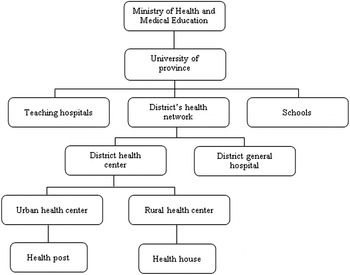
National guideline for urogenital schistosomiasis control was revised in 2006 and schistosomiasis control programme was changed from its previous vertical form to an integrated form in the present health service delivery system. The health service delivery system in the Islamic Republic of Iran is characterized by its tiered design with parallel structure in urban and rural areas. The first tier of delivery encompasses primary health care (PHC) and comprises two levels of care. The first level includes rural health houses with a defined served population of 1400 individuals. Health houses are staffed by Behvarzes (allied health workers). Behvarzes are selected then trained in Behvarz training centres for 2 years, which consists of training and service in health houses. This level also includes rural health centres, which are staffed by a physician and a health worker. These centres supervise a number of health houses with a defined service population of 6000–10 000 individuals. The second level of the PHC tier is the district health centre, which undertakes planning and supervising functions. In urban areas there is a similar structure that includes health posts serving a population of 12 000 individuals, then urban health centres (with a defined service population of 40 000–60 000 individuals) and district health centres (Fig. 3) (Shadpour, Reference Shadpour2000; Mehrdad, Reference Mehrdad2009; Rahbar, Reference Rahbar2009). In Khuzestan there are 26 district health centres, 79 urban health centres, 121 rural health centres, 62 urban-rural health centres, 209 health posts and 859 health houses. By using the capacity of such a health network, PHC is distributed all over the country from the most peripheral villages (health house) to the big cities. Surveillance programmes for many diseases are done through this network and of course it helps the schistosomiasis control programmes in elimination phase for more accurate case finding and early warning if a suspected case is reported. New surveillance system for urogenital schistosomiasis in elimination phase that was recently published by the CDC of Ministry of Health is based on active and passive case findings in previously infected areas, monitoring snails population, distribution and activity using Geographic Information System and Global Positioning System and implementation of appropriate control measures, education including community education and training courses for health care workers, performing practical researches by use of classic, serologic and molecular methods, and also multicentre researches and increasing national, regional and international cooperation.
Diagram of health system network in Iran.

Challenges in elimination phase
The most important challenges for maintaining elimination status includes development of irrigation and agricultural projects such as sugarcane in Khuzestan province, which may lead to increasing snail population (Mowlavi et al. Reference Mowlavi, Mansoorian, Mahmoodi, Pourshojaei and Salehi2009). As urogenital schistosomiasis is eliminated and new medical students are not familiar with the disease, the knowledge of physicians and health workers about this infection is decreasing. Presence of active foci of urogenital schistosomiasis in southern regions of Iraq, increased trans-border traffic and people travelling to visit shrine sites between the two countries are other challenges in elimination phase.
In conclusion, by using a national programme for urogenital schistosomiasis control based on active and passive case findings, patient treatment, population education, conducting training courses for health workers, snail control programmes including sanitary measures, environmental improvement, focal mollusciciding of snail habitats and improvement of water supply for people living in endemic areas, the infection has been eliminated from Iran and this can be a successful model for countries suffering from this disease. It should be mentioned that maintaining long-term monitoring of the situation in light of immigration of infected persons from other areas would be useful. In regard to results of previous surveys in different regions, both microscopic and molecular technique should be applied in future years (Meurs et al. Reference Meurs, Brienen, Mbow, Ochola, Mboup, Karanja, Secor, Polman and van Lieshout2015; Utzinger et al. Reference Utzinger, Becker, van Lieshout, Van Dam and Knopp2015). In future, to prove eradication, studies based on serology methods in people in order to more accurately detect the disease should be designed. Also, molecular evaluation like polymerase chain reaction-based techniques in B. truncatus snails to determine the presence of intermediate stages of parasite is required.
AUTHORS’ CONTRIBUTION
S. S. and S. K. conceived the study; S. S., M. F. R. and S. K. designed the study protocol; M. G. collected the data; M. F. R., S. K. and M. G. analysed and interpreted the data; S. S., M. F. R. and S. K. wrote the manuscript; S. S., M. F. R. and S. K. critically revised the manuscript. All authors read and approved the final manuscript.
ACKNOWLEDGEMENTS
The authors would like to thank all staff at the health care centres in Khuzestan Province. Also, the authors sincerely acknowledge their gratitude to the efforts of Centres for Disease Control in Ahvaz Jundishapur University of Medical Sciences.
FINANCIAL SUPPORT
This study was financially supported by Student Research Committee of Ahvaz Jundishapur University of Medical Science, Iran (NO: 93S87) to M. F. R. and approved by Ethical committee NO: IR.AJUMS.REC.1395.151.
CONFLICT OF INTERESTS
The authors declare no conflict of interests.