
I. INTRODUCTION
Researchers across the globe are currently facing the challenge of developing environmentally friendly, sustainable, and low-cost energy resources. Supercapacitors are an emerging type of electrochemical energy source for storage and conversion devices, because of their high power density and long cycle life. Reference Simon and Gogotsi1 Especially promising are carbon-based supercapacitors; these have attracted much attention because of their light weight, rapid charging, and discharging rates, and bipolar operational flexibility. Reference Zhang and Zhao2 Porous carbon materials are most commonly used as electrode materials for electrical double-layer capacitance (EDLC). Reference Elmouwahidi, Zapata-Benabithe, Carrasco-Marin and Moreno-Castilla3 Ions diffuse and accumulate in the double electrical layer formed along the interface between the electrolyte and the electrode; this wide double layer is attainable because of the large surface area and free pore channels of the electrode material. Another type of electrochemical energy storage device is known as a pseudocapacitance; it relies on the reversible faradaic redox reactions of electroactive species on the electrode surface. Reference Simon and Gogotsi1,Reference Zhang, Hao, Zheng, Ma, Feng and Luo4
Ordered mesoporous carbons (OMCs) are popular carbonaceous materials widely applied in adsorption, electrochemistry, and catalysis because of their unique tunable highly ordered mesoporous framework, large surface area and pore volume, and mechanical stability. Reference Ryoo, Joo, Kruk and Jaroniec5 They are ideal alternatives to conventional porous activated carbon as potential electrode materials for supercapacitors in electronic devices. Reference Zhai, Dou, Zhao, Fulvio, Mayes and Dai6,Reference Gnanakan, Karthikeyan, Amaresh, Cho, Park and Lee7 Uniform mesoporous channels can shorten the distance for ion diffusion, accelerate the electrolyte diffusion, and alleviate pore blockage, because ions accumulate in the micropores. Reference Xiong, Liu, Gan, Lv, Li, Yang, Xu, Hao, Liu and Chen8 However, only a small number of active sites on the surface of OMCs can be used for electrostatic adsorption of electrolyte ions, because of the OMCs’ high hydrophobicity. Consequently, the incorporation of heteroatoms—such as nitrogen, boron, and sulfur—onto the carbon matrix has been proposed. Reference Xu, Zhao, Shen and Guan9,Reference Guo and Gao10 It is well known that the incorporation of nitrogen into a pool of graphitic carbon atoms can greatly affect the physical and surface chemical properties of carbon material. Nitrogen atoms introduced into bulk graphitic sheets and attached to the surface in the form of functional groups significantly improve the electrical conductivity and surface hydrophilicity of carbon material. Reference Zhou, Wang, Key, Ji, Linkov and Wang11 Nitrogen doping can not only lower the valence band, but also increase the chemical stability and electron density at the Fermi level. Therefore, nitrogen doping could ensure good electrical conductivity and maximize the number of active sites on the surface of OMC, which can then be available for charge storage. In addition, nitrogen doping can contribute extra pseudocapacitance through faradaic reactions.
Much research has been carried out, on the preparation of nitrogen-doped OMCs (NOMC) using both hard-template (nanocasting) Reference Goscianska, Olejnik and Pietrzak12,Reference Xia and Mokaya13 and soft-template Reference Liu, Yang, Wang, Lu, Zhao and Qiao14 (solvent evaporation induced self-assembly, EISA) processes. The hard-template procedure involves introducing a suitable precursor into the ordered mesopores of the silica template through impregnation or chemical vapor deposition, followed by carbonization and final template removal. The soft-template strategy generally consists of co-assembly of amphiphilic block copolymers with resin, followed by thermal polymerization and carbonization. Although the hard-template method is more effective in obtaining NOMC with desirable structural ordering than is the soft-template process, large-scale manufacture of NOMC by nanocasting is inconvenient because of its low yield, complex procedure and high cost. Reference Zhai, Dou, Liu, Park, Ha and Zhao15 Various nitrogen-containing organic or inorganic compounds—such as ethylenediamine, Reference Vinu16 melamine, Reference Chen, Zhou, Wang, Zhao and Guan17 urea, Reference Yu, Guo, Muhammad, Wang, Zhang, Li and Zhu18 polyacrylonitrile, Reference Lu, Kiefer, Schmidt and Schüth19 dicyandiamide, Reference Wei, Zhou, Sun, Deng, Xia and Zhao20 acetonitrile, Reference Sánchez-Sánchez, Suárez-García, Martínez-Alonso and Tascón21 and NH3 Reference Lin, Chen, Liu, Yang, Bi, Xu and Huang22 —have been chosen as nitrogen sources for the synthesis of NOMCs.
Ionic liquids (ILs) are a class of nitrogen-containing chemicals usually composed of pyridinium or imidazolium cations with high synthetic flexibility. Reference Welton23 Significant attention has been paid to the application of ILs as neoteric media for material synthesis. Reference Ma, Yu and Dai24 The enormous number of possible combinations of cations and anions would provide many opportunities to synthesize tailor-made mesoporous carbons from ILs. Reference Liao, Liu, Hou, Sun and Dai25 Task-specific ILs (TSILs) with dicyanamide anions would be desirable precursors for nitrogen-doped mesoporous carbons, not only because they are of higher nitrogen content than other TSILs, but also because C–N condensation might result from the cross-linkable dicyanamide anion. Reference Wang and Dai26 Hence, TSILs are expected to be versatile precursors to preparing nitrogen-doped mesoporous carbons with satisfactory nitrogen content, large surface area and ordered meso-channels. Facile direct carbonization of ILs with dicyanamide anions has been applied to produce rich nitrogen-doped mesoporous carbons. Reference Lee, Wang, Luo, Baker and Dai27 However, the pore-size distribution (PSD) of carbons obtained through direct carbonization is wide, and the specific surface area is not high enough (4.6–780.6 m2/g) to make this method practicable. Nanocasting synthesis of NOMCs using ILs with dicyanamide anions as the nitrogen source has been reported as well. Reference Paraknowitsch, Zhang, Su, Thomas and Antonietti28 The specific surface area of the resulting material replicated from an SBA-15 template is 906 m2/g. To the best of our knowledge, to date there have been few reports on the synthesis of NOMC by the soft-template route using ILs featuring dicyanamide anions as the nitrogen source. In our previous research, it was observed that phase separation occurred when resol, soft-template, and pure ILs with dicyanamide anions were directly assembled in an EISA process; this resulted in wide mesopore size distribution. Thus we assembled TSIL (1-butyl-4-dimethylaminopyridinium dicyanamide) functionalized resol, along with a triblock copolymer and tetraethyl orthosilicate (TEOS), to create a rigid framework through a soft-template process, to synthesize functionalized mesoporous carbon. Reference Zhou, Yang, Li, Lei and Zhang29 Despite the high specific surface area of as-made NOMC (2130 m2/g), its nitrogen content is quite low (0.67 wt%). Hence it was a great challenge to facially synthesize rich NOMC with large surface areas, via the EISA route, using ILs with dicyanamide anions as the nitrogen source for supercapacitors.
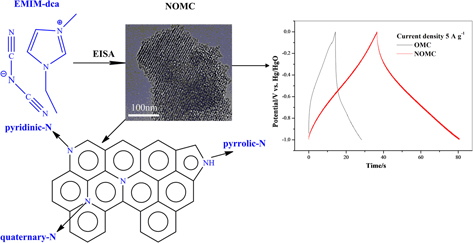
Herein, we report a new approach to synthesizing NOMC with a large surface area and moderate nitrogen content via directly assembling triblock copolymers with resol and TSIL as the nitrogen source. The effects of nitrogen doping on textural and surface chemical characteristics of NOMC were comprehensively investigated. In comparison to pure OMC, the electrochemical performance of NOMC was evaluated with cyclic voltammetry (CV), galvanostatic charge–discharge (GC), and electrochemical impedance spectroscopy (EIS) measurements.
II. EXPERIMENTAL SECTION
A. Reagents and materials
All reagents, including ethyl acetate, AgNO3, NaN(CN)2, NaOH, phenol, formaldehyde, ethanol, TEOS, HCl, and HF were of analytical grade. They were purchased from the Chinese firm Sinopharm Chemical Reagent Co. Ltd. The bromoethane and 1-methylimidazole used in the synthesis of IL were purchased from TCI. Poly(ethylene oxide)-block-poly(propylene oxide)-block-poly(ethylene oxide) triblock copolymer Pluronic F127, as a structure-directing agent or soft template, was supplied by Sigma. All the materials were used as received without further purification. Millipore water was used in all the experiments.
The TSIL 1-ethyl-3-methylimidazolium dicyanamide (EMIM-dca) was synthesized by classical alkylation and two ion exchange steps. Reference Scovazzo, Havard, Mcshea, Mixon and Morgan30 The synthesis strategy of EMIM-dca is shown in Fig. S1 (Supplementary Material). A description of the typical synthetic process is also available in the Supplementary Material.
B. Preparation of NOMC
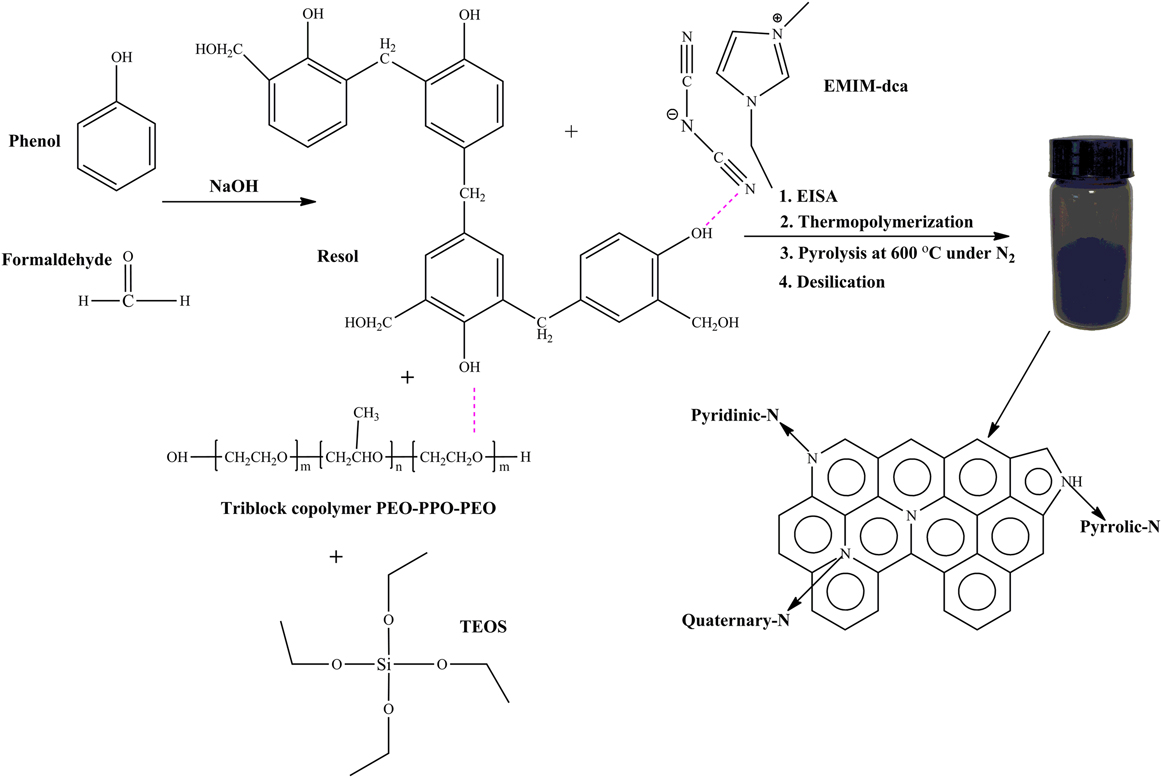
The oligomeric resol precursor was synthesized with a base-catalyzed solution polymerization process using phenol and formaldehyde in advance. Reference Meng, Gu, Zhang, Shi, Yang, Li, Yu, Tu and Zhao31 NOMC was prepared by a modified procedure similar to that reported by Zhao et al. Reference Zhai, Dou, Liu, Park, Ha and Zhao15 The synthesis procedure for NOMC is illustrated schematically in Fig. 1.
Schematic illustration of synthesis procedure for TSIL-based NOMC.
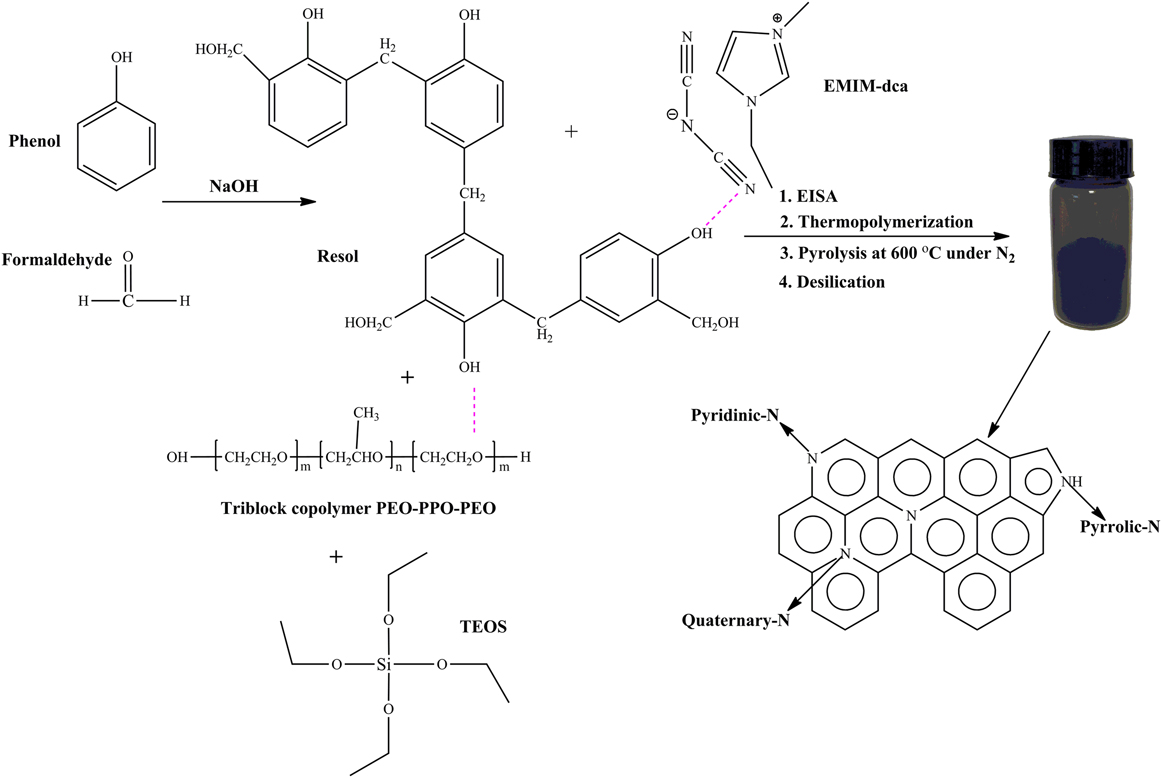
The procedure consists of the solvent evaporation-induced co-assembly of F127, soluble resol, EMIM-dca, and TEOS, along with thermopolymerization, pyrolysis, and desilication. In a typical experiment, 6.4 g of F127 was first dissolved in a mixture of 40 g of ethanol, 4.0 g of 0.2 M HCl solution, and 4.0 g of EMIM-dca solution (25 wt%) with stirring. Then, 8.32 g of TEOS and 20.0 g of resol ethanol solution (20 wt%) were slowly dropped into the mixture. The resulting transparent solution was poured into dishes after the mixture was agitated for about 2 h at 40 °C. The ethanol and water in the open dishes were evaporated for over 6 h at 50 °C. The films from EISA were heated in an oven at 100 °C for 24 h to obtain a thermoset product. The polycondensate scraped off the dishes was pyrolysized at 600 °C under an N2 atmosphere for 6 h with a ramp rate of 1 °C/min. An HF solution (20 wt%) was used to remove the silica in the finely ground char for 24 h under strong stirring. The final product was designated NOMC. To obtain a material to compare with NOMC, pure OMC was prepared as well. Its preparation procedure was identical to that of the NOMC, except for assembling triblock copolymer polyethylene oxide (PEO)–PPO–PEO with resol without the EMIM-dca solution.
C. Physical characterization
Small-angle X-ray diffraction (SXRD) was conducted to examine the microcrystal character of the as-prepared OMCs on a Thermo ARLSCINTAGX’TRA diffractometer (Thermo Fisher Scientific, Waltham, Massachusetts) using Cu Kα radiation (λ = 0.154 nm) over a 2θ angle range of 0.5–6°. The morphology of the mesoporous carbons was observed on a thermal field emission scanning electron microscope (FESEM; Hitachi SU-70, Hitachi Corp., Tokyo, Japan) and a transmission electron microscope (TEM; FEI Tecnai G2 Sphera, FEI Company, Eindhoven, The Netherlands). Nitrogen adsorption/desorption isotherms were performed at 77 K on a Micromeritics ASAP 2020 analyzer (Micromeritics, Norcross, Georgia) to obtain the textural properties of the mesoporous carbons, such as specific surface areas (S BET), PSDs, total pore volumes (V tot), micropore volume (V micro), and average pore size (D T). Elemental analysis of C, N, and H in the mesoporous carbons was carried out on a Flash EA 1112 Elemental Analyzer (Thermo Fisher Scientific). X-ray photoelectron spectroscopy (XPS) analysis was performed to investigate the surface-chemistry properties of the mesoporous carbons on a Kratos Analytical AMICUS system (Kratos Analytical Ltd., Manchester, United Kingdom) using a monochromatic Al Kα X-ray source. Wide survey spectra were recorded, providing the surface elemental composition. C 1s hydrocarbon peak at a binding energy of 284.6 eV was used to calibrate the binding energies.
D. Electrochemical measurements
CV and GC tests were carried out to evaluate the electrochemical performances at a Bio-logical VMP3 electrochemical workstation (France) at ambient conditions using a three-electrode system in 6 M KOH aqueous solution. An Hg/HgO electrode and platinum foil were used as the reference and counter electrodes, respectively. The working electrode was fabricated with a mixture containing active materials, acetylene black and polytetrafluoroethylene, with a mass ratio of 8:1:1, which was well mixed to form homogeneous slurry and then pressed onto nickel foam that served as a current collector. The typical mass loading for active materials in each electrode was about 5 mg/cm2. The CV and GC measurements were performed in a potential window between −1.0 and 0 V. The specific capacitance was calculated from the galvanostatic discharge curves according to the following formula:
 $${C_{\rm{s}}} = {{I \times \Delta t} \over {m \times \Delta V}}\quad ,$$
where C s is the specific capacitance (F/g); I is the galvanostatic discharge current (A); ∆t is the discharging time (s); m is the mass of the active material in the working electrode (g); and ∆V is the potential window (V).
The EIS measurements were recorded on a Zahner electrochemical workstation (Germany) in a frequency range from 100 kHz to 0.01 Hz, with an alternating current amplitude of 5 mV.
III. RESULTS AND DISCUSSION
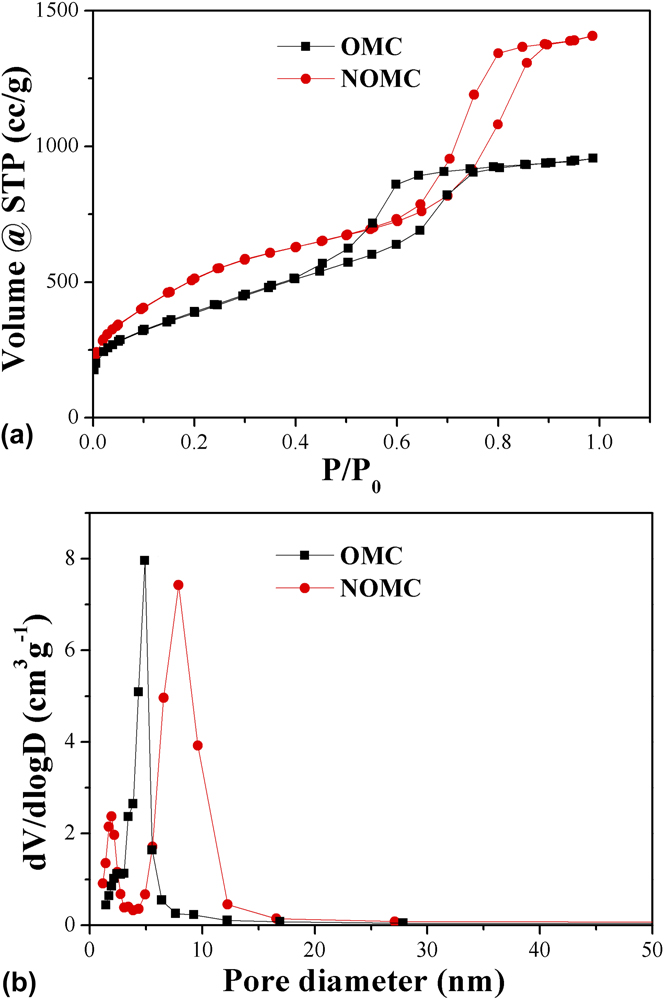
The nitrogen adsorption–desorption isotherms of the OMCs are displayed in Fig. 2(a). These curves show typical type-IV isotherms according to the IUPAC classification. Distinct broad H1 hysteresis loops at high relative pressure reveal the presence of mesopores. Large nitrogen uptakes at the relative pressure of (P/P 0) ≈ 0.4–0.8 for OMC and 0.6–0.9 for NOMC can be observed on the isotherms, implying that numerous mesopores had developed. The well-defined and sharp steps are associated with nitrogen filling of the mesopores owing to capillary condensation.
Nitrogen adsorption–desorption isotherms (a) and PSDs (b) of OMCs.
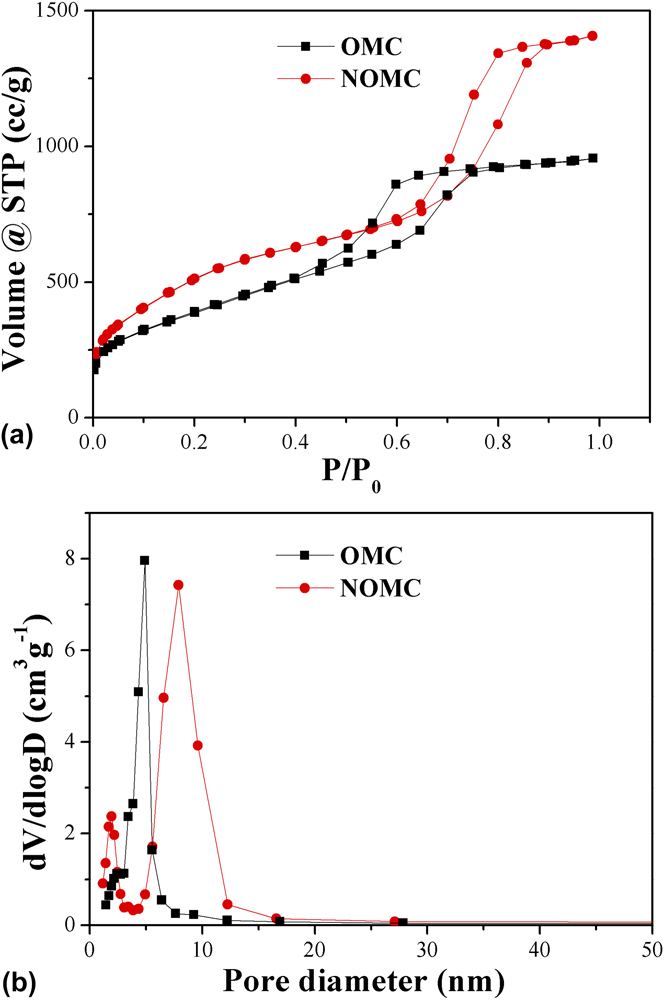
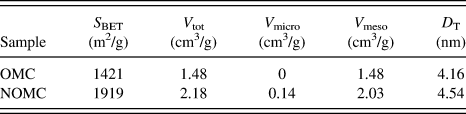
The textural properties of the OMCs are shown in Table I. The specific surface area and corresponding pore volume of the OMC were found to be 1421 m2/g and 1.48 cm3/g, respectively, lower than those of NOMC with the values of 1919 m2/g and 2.18 cm3/g. The pore volume as well as the specific surface area of carbonaceous materials has a positive effect on electrochemical capacitance. The average pore size of OMC is lower than that of NOMC as well. The larger mesopores of NOMC are more beneficial to the development of free pore channels for the diffusion of electrolyte ions than are those of OMC.
Textural properties of carbons.

S BET: Brunauer–Emmett–Teller (BET) surface area; V tot: total pore volume at P/P 0 = 0.99; D T: average pore size calculated from 4V tot/S BET.
The PSD of the NOMC in Fig. 2(b) exhibits a uniform mesopore size distribution and clear bimodal pore structure, with two distinct maxima at around 2 and 9 nm. It is believed that interactions between the oxygen-containing oligomer precursor and the F127 surfactant, and self-assembly of the hydrophobic segments, results in the mesoporous structures. Reference Xie, Dong, Zhang, Guo and Ding32 The larger mesopores (about 9 nm) can be ascribed to the large micelles formed among F127, resol, and EMIM-dca during the ESIA process. The hydrophilic PEO groups in the amphiphilic block copolymer F127 can interact with the hydroxyl groups of resol through hydrogen bonds (O—H⋯:O) with a binding energy of about 21 kJ/mol, and the hydroxyl groups of resol can interact with EMIM-dca through hydrogen bonds (O—H⋯:N) with a binding energy of about 29 kJ/mol, allowing the formation of large micelles through cooperative self-assembly. In addition, a few small micelles generated between F127 and EMIM-dca through hydrogen bonds (O—H⋯:N) might contribute to the formation of smaller mesopores and a small number of micropores.
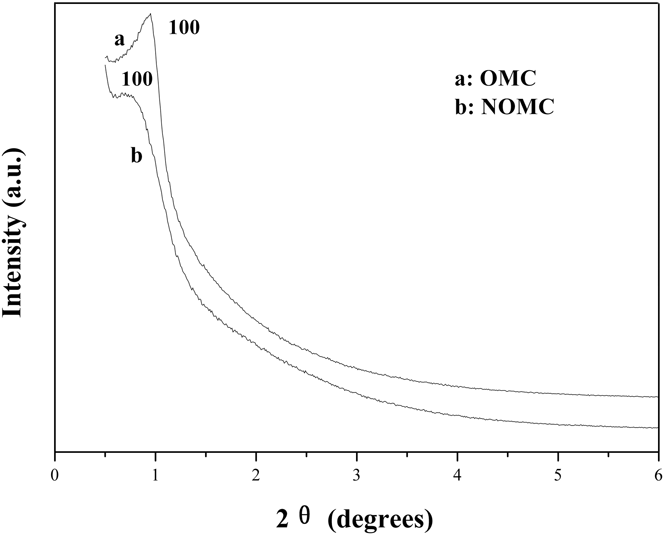
Figure 3 shows the SXRD patterns of OMC and NOMC. The typical highly OMCs usually show an intense diffraction peak at 2θ = ∼1°, corresponding to the characteristic peak in the (100) lattice plane of mesoporous materials. OMC presents an obvious (100) diffraction peak at 2θ = 0.95°, indicating that the OMC had a long-range ordered open-framework mesoporous structure. By contrast, a weak diffraction peak at 2θ = 0.7° in the sweep range was observed for NOMC, implying that the NOMC had a poorer structural ordering than did the OMC. This difference might result from the formation of mesopores at different scales, and indicate that a collapse of pores occurred in the process of EISA and pyrolysis. The SXRD patterns do not display the (110) or other bands, because of the limitations of the diffractometer.
SXRD patterns of OMC and NOMC.

The morphology of as-made OMCs was further examined by FESEM and TEM observations. FESEM images of the OMC and NOMC samples in Figs. 4(a) and 4(b) reveal that the OMC and NOMC both consisted of numerous mesopores. The TEM image shown in Fig. 4(c) for OMC clearly exhibits parallel well-ordered stripe-like mesopores in large domains, indicating the formation of an ordered hexagonal mesoporous structure. However, some less ordered mesoporous arrays with worm-like distortion are observed in Fig. 4(d) for NOMC, a result consistent with the SXRD patterns.
FESEM and TEM images of OMC (a and c) and NOMC (b and d).

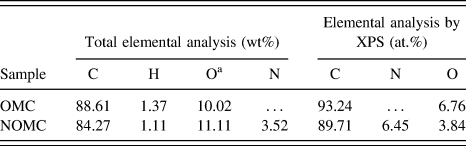
EA and XPS were used to investigate the nitrogen content and surface nitrogen configuration of NOMC. The bulk and surface elemental compositions of the synthesized mesoporous carbons obtained by EA and XPS are listed in Table II. The nitrogen contents of the NOMC determined by EA and XPS were 3.52 wt% and 6.45 at.%, respectively, indicating that the EMIM-dca successfully incorporated nitrogen into the carbon framework. It is well known that the electronegativity of nitrogen is higher than that of carbon, and a nitrogen atom can offer an extra lone electron pair for conjugation with the π-conjugated rings. Thus EMIM-dca doping makes the NOMC surface more electrochemically active than the OMC surface, and leads to a reversible redox reaction in the electrolyte solution.
Elemental analysis of mesoporous carbons.

a By difference.
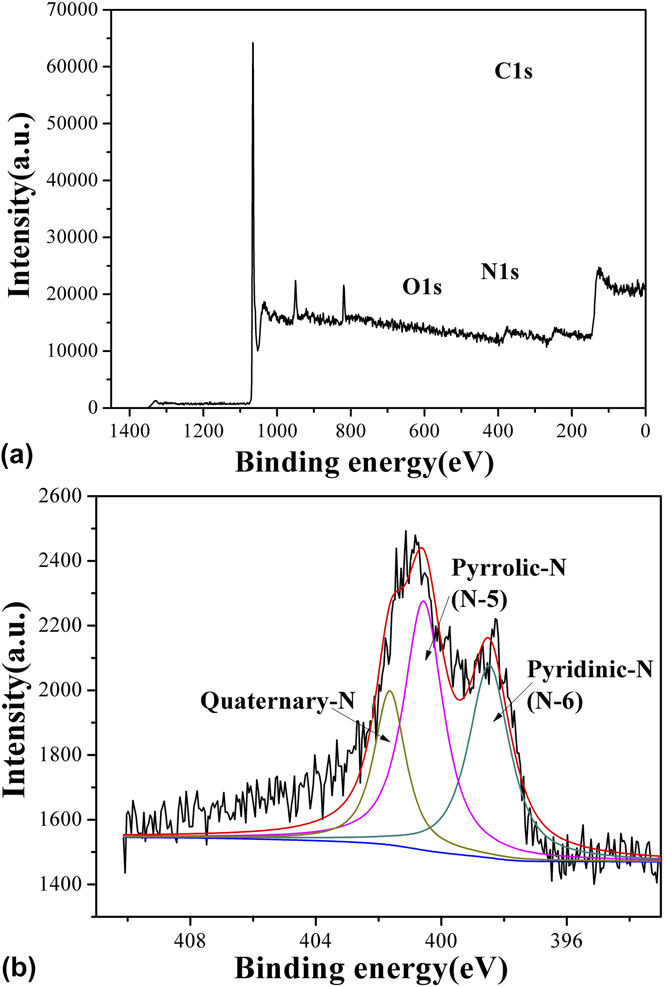
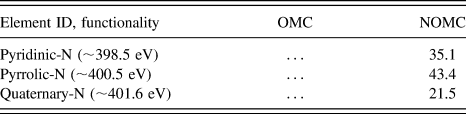
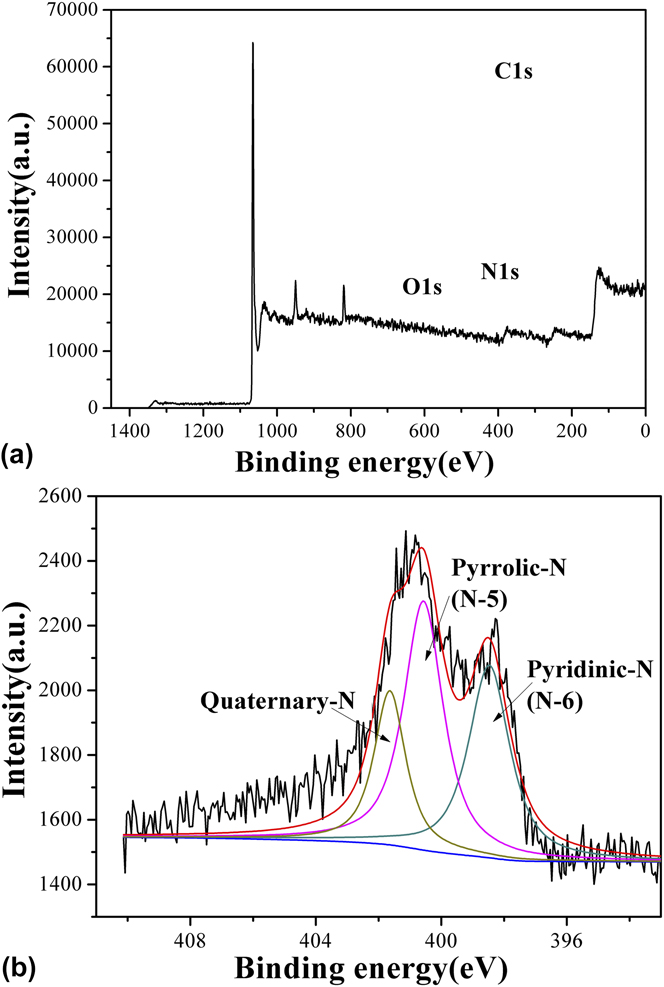
The surface nitrogen composition and main configuration of nitrogen dopants on the NOMC were also studied with XPS spectroscopy. The survey spectrum of NOMC given in Fig. 5(a) illustrates the main elements (C, O, and N) on the NOMC surface. The high resolution N 1s spectrum of NOMC shown in Fig. 5(b) is deconvoluted into three peaks, revealing the existence of three main types of nitrogen functionalities: pyridinic-N (N-6) at binding energy of 398.5 eV, where the N atom is sp 2 hybridized with two C atoms; pyrrolic-N (N-5) at binding energy of 400.5 eV, where the N atom takes the place of a C atom in a five-membered ring; and quaternary-N (N-Q) at binding energy of 401.6 eV, where the N atom has an sp 3 hybridization with three C atoms and is incorporated into a graphene layer. Reference Lin, Chen, Liu, Yang, Bi, Xu and Huang22,Reference Chen, Zhou, Wang, Zhao and Guan33 The detailed XPS analysis from the deconvoluted spectra listed in Table III suggests that pyridinic-N and pyrrolic-N are the dominant components of nitrogen for NOMC. Previous studies have proposed that pyridinic-N and pyrrolic-N species could attract more electrolyte ions and consequently introduce pseudocapacitance through faradaic redox reactions. Reference Soin, Roy, Sharma, Thundat and Mclaughlin34
Survey (a) and high resolution N 1s XPS spectrum (b) of NOMC.
Detailed XPS analysis of carbons: ratio of nitrogen configuration/%.

CV, GC, and EIS tests were used to evaluate the electrochemical characteristics of the as-prepared OMCs in 6 M KOH aqueous electrolytes at ambient temperature. Figure 6(a) shows a representative comparison of the CV curves of OMC and NOMC tested at a scan rate of 20 mV/s. The NOMC had a much higher voltammetric current and larger area enclosed by the CV curve than did the OMC, implying a higher specific capacitance for NOMC. CV profiles of the NOMC at scan rates of 10–1000 mV/s are shown in Fig. 6(b). Slightly distorted and quasirectangular voltammetry curves were observed at the low scan rates of 10 and 20 mV/s, suggesting the formation of an electrical double layer and equivalent series resistance (ESR) in 6 M KOH aqueous electrolytes. The rectangular shape of the CV curves for NOMC becomes obviously distorted with increasing scan rate, indicating that an uncompensated resistance results from limited ion diffusion and confined electrical conductivity at high sweep rates. In addition, nitrogen doping by EMIM-dca introduces extra pseudocapacitance through faradaic reactions into the NOMC electrode system. Electrical charges cannot be utilized sufficiently because they have insufficient time to transfer within the mesopores of NOMC when the voltammetric current is high.
(a) Representative comparison of CV curves of OMC and NOMC at a scan rate of 20 mV/s in a 6 M KOH aqueous solution; (b) CV curves of NOMC at scan rates of 10, 20, 50, 100, 200, 500, and 1000 mV/s; (c) comparison of GC curves of OMC and NOMC at a current density of 5 A/g; (d) GC of NOMC at different current densities; (e) specific capacitance versus current density of OMC and NOMC; (f) cycling life of NOMC at a constant current density of 5 A/g.

GC behaviors of the NOMC were investigated at various current densities, from 1 to 50 A/g. Figure 6(c) gives the comparison of GC curves of OMC and NOMC at a current density of 5 A/g. The NOMC possessed a rather longer discharge time than OMC, implying that the specific capacitance of NOMC was higher than that of OMC. All the GC profiles of NOMC display approximately symmetrical triangular shapes as shown in Fig. 6(d), suggesting a desirable electrochemical reversibility and almost ideal EDLC behavior for NOMC. A small internal resistance can be deduced from the insignificant voltage drop in the discharge curves of NOMC as well. The specific capacitances of NOMC and OMC calculated from the GC curves are shown in Fig. 6(e). NOMC presents a specific capacitance for 426.9 and 370.2 F/g at the low current densities of 1 and 2 A/g, respectively, which are much higher than those for the OMC (138.6 and 113.7 F/g). It is exciting to observe that the specific capacitance of NOMC was about triple that of OMC. What’s more, when discharge current density increased to 20 A/g, NOMC still retained a high specific capacitance of 154.6 F/g. The specific capacitance of NOMC was also much higher than that of the reported NOMC using dicyandiamide (227 F/g at a current density of 0.2 A/g), Reference Wei, Zhou, Sun, Deng, Xia and Zhao20 urea (148 F/g at a current density of 1 A/g), Reference Panja, Bhattacharjya and Yu35 or cyanamide (230 F/g at a current density of 0.5 A/g) Reference Shi, Zhang, Lv, Deng, Elzatahrya, Zhao, Shi, Zhang, Lv and Elzatahrya36 as a nitrogen source. The superior specific capacitance observed in NOMC can be ascribed to the synergetic effects of large specific surface areas, and the presence of various nitrogen species on the NOMC surface derived from EMIM-dca, which could intensify the electrostatic adsorption of electrolyte ions for energy storage in the EDLC, and offer a reversible faradaic reaction for pseudocapacitance, respectively. However, the NOMC with a slightly high surface area shows a more than triple increase in capacitance compared with the undoped OMC. Thus, it may be deduced that pyridinic-N and pyrrolic-N species generated on the NOMC surface during the synthesis process played a more dominant role in enhancing capacitance than did pristine OMC. And the pseudocapacitance in NOMC is the major contributor toward the significant capacitance increase compared with the electrical double-layer capacitance. The introduction of nitrogen from EMIM-dca into the carbon framework resulted in edge defects on the NOMC surface. Pyridinic-N and pyrrolic-N species present on the graphitic edge defects of the carbon matrix may participate in surface faradaic reactions and enhance the pseudocapacitance in alkaline electrolytes by the following electrochemical processes Reference Xu, Hou, Cao, Wu and Yang37 on the NOMC surface:
 $${{\rm{C}}^*}{\rm{\!-\!N}}{{\rm{H}}_2} + 2{\rm{O}}{{\rm{H}}^ - } \leftrightarrow {{\rm{C}}^*}{\rm{\!-\!NHOH}} + {{\rm{H}}_2}{\rm{O}} + 2{{\rm{e}}^ - }$$
 $${{\rm{C}}^*}{\rm{H\!\!-\!\!N}}{{\rm{H}}_2} + 2{\rm{O}}{{\rm{H}}^ - } \leftrightarrow {{\rm{C}}^*}{\rm{ = NH}} + 2{{\rm{H}}_2}{\rm{O}} + 2{{\rm{e}}^ - }$$
where
 ${{\rm{C}}^*}$
stands for the graphitic framework.
The durability of the NOMC was also evaluated by a repetitive GC measurement of the as-made electrode at a current density of 5 A/g over 2000 cycles. The NOMC showed a specific capacitance of 225.2 F/g at the first cycle and 220.5 F/g at the 2000th cycle, as depicted in Fig. 6(f). This result indicates that NOMC retained almost 98% of its initial capacitance after 2000 charge/discharge cycles. The inset is the comparison of GC profiles of the first and 2000th charge–discharge cycles, which show almost the same shape and discharge time. It is thus suggested that NOMC could be a promising electrode-material candidate for supercapacitors, because of its high capacitances and relatively good cycling stability.
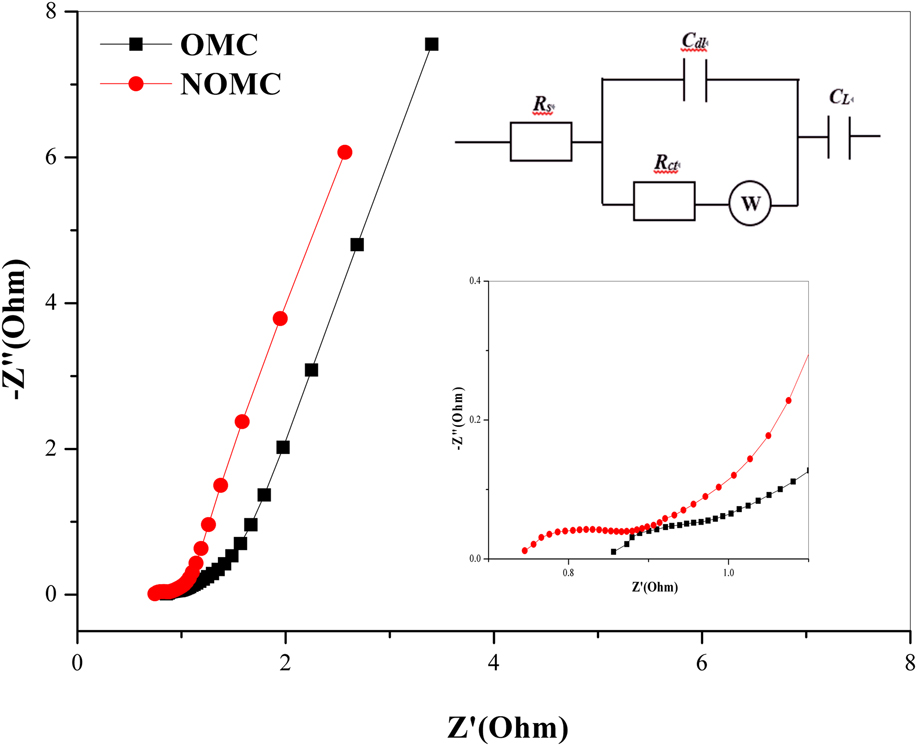
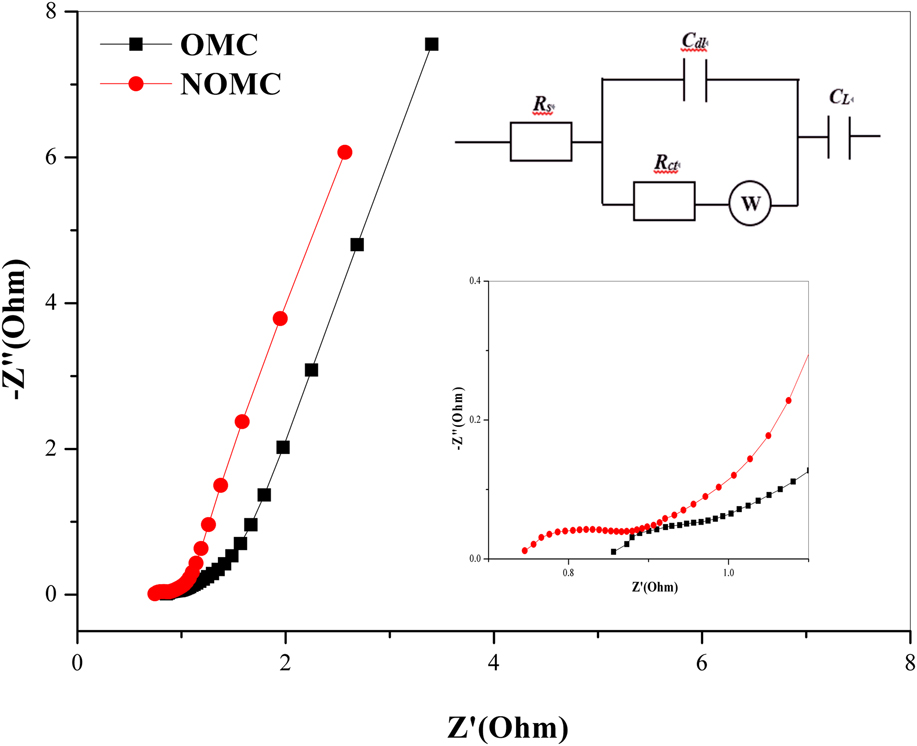
EIS measurement was used to further investigate the resistive behavior of the NOMC and OMC electrodes for supercapacitors. A Nyquist plot representing the real (Z′) and imaginary (Z″) parts of impedance was used to analyze the EIS data. The Nyquist plots in Fig. 7 exhibit similar curves for OMC and NOMC. Three different parts can be observed in the Nyquist plots: a semicircle at high frequencies, a slash at about 45°, and a steep line at low frequencies. The inset in Fig. 7 is the equivalent circuit used to fit the EIS curves, where R s is the solution resistance, R ct is the charge transfer resistance, C dl is a double-layer capacitor, W is the Warburg impedance, and C L is the limit pseudo-capacitor. Reference Yang, Wu, Chen, Dong, Hu and Wang38 R s and R ct can be obtained from the intercept and diameter of the semicircle on the real axis (Z′) at the high frequency region, respectively. It can be assumed that R s is influenced by the electrolyte resistance, and the intrinsic and interfacial resistance of the current collector and mesoporous carbon. Reference Meher and Rao39,Reference Kim and Yang40 The R s of NOMC was slightly less than that of OMC. The R ct of OMC and NOMC were approximately 0.15 and 0.25 Ω, respectively. Both the R s and the R ct of NOMC were lower than those of OMC, and can be ascribed to the large specific surface area and surface nitrogen-containing functional groups of NOMC. At the low-frequency region, the slash can be attributed to Warburg impedance. The ESRs of NOMC and OMC obtained from the intercept of the line on the real axis (Z′) at the low-frequency region were about 0.9 and 1.2 Ω, respectively. The conductivity of electrode material can be evaluated via the ESR as well. NOMC exhibited higher conductivity than OMC, and resulted from nitrogen functionalities by the EMIM-dca dopant.
Nyquist plots of NOMC and OMC. Insets are the equivalent circuit used for fitting the EIS data and an enlarged view of the Nyquist plots at high frequencies.
IV. CONCLUSIONS
In summary, we demonstrated a new approach to preparing NOMC with relatively high specific surface area and unique bimodal mesoporous structure, by using EMIM-dca as a nitrogen source via an EISA process. Owing to its high specific surface area, bimodal mesoporous structures and surface nitrogen-containing functionalities, NOMC exhibited rather good electrochemical performance, such as high specific capacitance (370.2 F/g at a current density of 2 A/g), good rate capability (154.6 F/g retained at a large current density of 20 A/g), and desirable cycling stability (∼98% retained at a current density of 5 A/g after 2000 continuous charge–discharge cycles) in 6 M KOH aqueous electrolyte. It is believed that TSILs are versatile precursors for preparing diverse nitrogen-doped mesoporous carbons as promising electrode materials for supercapacitors.
Supplementary Material
To view supplementary material for this article, please visit https://doi.org/10.1557/jmr.2016.473.
ACKNOWLEDGMENT
The authors are grateful for financial support from the National Natural Science Foundation of China (Project No. 21406044).