Introduction
Nutritional and energy resources acquired during larval feeding in insects are utilized by both the pupa and the adult (Aguila et al., Reference Aguila, Hoshizaki and Gibbs2016). Some factors that can affect this transition of nutrients from the larvae to adult, include the microstructure of the food matrix, the molecular organization of the nutrients, enzymatic activity, water content, temperature, moisture, and viscosity. The food matrix plays an essential role in the macronutrient balance of the larval diet and its transition through the developmental stages, shaping some important adult life-history traits (Littlefair and Knell, Reference Littlefair and Knell2016).
The food matrix has been described as the complex assembly of nutrients and non-nutrients interacting physically and chemically that influences the release, mass transfer, accessibility, digestibility, and stability of many food compounds (Cohen, Reference Cohen2004, Reference Cohen2015; Crowe, Reference Crowe2013). Artificial food matrix for the rearing of insects is formed by mixing raw ingredients with different physical structures embedded in a semisolid, gel, or liquid matrix (Aceituno-Medina and Hernández, Reference Aceituno-Medina, Hernández, Montoya, Toledo and Hernandez2020). The state of the microstructure of artificial diet and the interactions between their components may favor or hinder their nutritional response in vivo (Parada and Aguilera, Reference Parada and Aguilera2007), as well as their bioaccessibility (Hernández et al., Reference Hernández, Ruiz-Montoya, Toledo, Montoya, Liedo, Aceituno-Medina and Perales2018) and bioavailability (Capuano et al., Reference Capuano, Oliviero, Fogliano and Pellegrini2018). In Dipterans, storage protein synthesis occurs during the last instar (Chrysanthis et al., Reference Chrysanthis, Marmaras and Christodoulou1981, Reference Chrysanthis, Kaliafas and Mintzas1994), acting as a form of amino acid storage for adult development (Levenbook, Reference Levenbook, Kerkut and Gilbert1985). These are the major soluble proteins in the larval and pupal stages (Brock and Roberts, Reference Brock and Roberts1981). Their concentration in the larval and adult hemolymph is influenced by diet's protein levels and bioavailability (Frias et al., Reference Frias, Barbosa and Lourenço2016). Increasing bioavailability and allocation of larval food resources improves survival and reproduction due to the efficient digestion and assimilation of nutrients that, once absorbed, exert a positive effect on the growth and life-history traits of the insects (Carbonell-Capella et al., Reference Carbonell-Capella, Buniowska, Barba, Esteve and Frigola2014).
The digestibility of proteins is dependent on both internal and external factors. Internal factors include amino acid profile, solubility, folding and crosslinking. External factors include the presence of secondary molecules such as emulsifiers and antinutritional factors (Joye, Reference Joye2019). Enzyme activity is an internal factor that is necessary for protein degradation in the gut; while the enzyme inhibitors are considered as external factors. Both, enzyme activity and enzyme inhibitors modify the digestibility of diets. The midgut of insects contains proteases and amylases that are involved in several physiological, biochemical processes and promote food digestion and nutrient absorption of proteins and carbohydrates. On the other hand, corncob derivatives contain enzyme inhibitors, including trypsin and α-amylase inhibitors (Samtiya et al., Reference Samtiya, Aluko and Dhewa2020). This can suppress the activities of the larval insect midgut protease, then disrupt the digestive system and decrease the survival rate and/or delay the growth of insects (Zhao et al., Reference Zhao, Li, Leng, Wang and Li2019).
Previously, Rincón-Betancurt et al. (Reference Rincón-Betancurt, Aceituno-Medina, García-Fajardo and Hernández2020) suggested that the particle size of the bulking agent contributes to the regulation of the carbon: nitrogen ratio and food intake of Anastrepha obliqua (Macquart) larvae, affecting the absorption and excretion of protein. While the coconut fiber used as a bulking agent increases protein bioavailability in the larval diets (Aceituno-Medina et al., Reference Aceituno-Medina, Rincón-Betancurt, Martínez-Salgado and Hernández2019). Hence, the physical structure and composition of the food matrix could modify the bioavailability of protein in the larval and adult hemolymph. Considering that A. obliqua females show facultative autogeny (Polloni and Telles, Reference Polloni and Telles1989), and that females may be particularly sensitive to larval dietary protein requirements, as has been observed in Drosophila (Andersen et al., Reference Andersen, Kristensen, Loeschcke, Toft and Mayntz2010), we chose female A. obliqua as a model to explore the relationship between protein storage and larval dietary protein bioavailability and its transition to adult. Our study aimed to determine the effect of the larval nutrition condition in response to the bulking agent and its particle size on the hemolymph´s protein composition during the metamorphosis of A. obliqua.
Materials and methods
Biological material
The eggs of A. obliqua flies used in this study were provided by the Moscafrut fruit fly mass rearing facility (SADER-SENASICA) located in Metapa de Domínguez Chiapas, México. Anastrepha obliqua has been mass-reared since 2002 following the procedures described by Orozco-Dávila et al. (Reference Orozco-Dávila, Quintero, Hernandez, Solis, Artiaga, Hernandez, Ortega and Montoya2017) for at least 174 generations, with a reintroduction of wild material in 2011.
Macrostructure of the food matrices
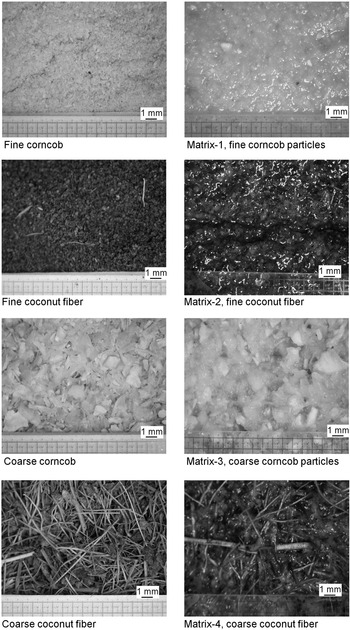
The impact of bulking agent type and particle size on the macrostructure and changes in the nutritional composition of the food matrix was determined using two types of bulking agents and two-particle sizes. We prepared four different food matrices: Matrix-1, fine (<0.210 mm) corncob particles (Mafornu, Cd. Guzmán, Jalisco, México); Matrix-2, fine (<0.210 mm) coconut fiber (Coirtech, S.A. de C.V. Tecoman, Colima, México); Matrix-3 coarse (>0.250 mm) corncob particles; and Matrix-4, coarse (>0.250 mm) coconut fiber (fig. 1). The coconut fiber and corncob were milled by the manufacturer to obtain different particle sizes. To obtain the two-particle sizes, the samples of milled corncob and coconut fiber were passed through a series of stacked sieves (US Standard sieve) with progressively smaller openings from top to bottom (10, 12, 70, and 80). All the material retained on and above sieve 12 corresponded to coarse particles (0.250–420 mm), and we classified the content on and above sieve 80 as fine particles (0.177–0.210 mm).
Representative images documenting the macrostructure food matrix based on different types and particle sizes of the bulking agents for the development of larvae of Anastrepha obliqua under artificial rearing conditions (n = 3).

Experimental unit
Consisted of a tray of 20 × 15 × 4 cm with 500 g of diet sown with ~4150 eggs. Nine replicates were used for each type of food matrix, considering each experimental unit as a replicate. The eggs used for each replicate corresponded to eggs laid by a different cohort of adults (n = 9 cohorts).
Food matrix preparation
The proportion (w/w) of nutrients in the food matrix was the same in the four diets except for the bulking agent. The percentage of inclusion of the bulking agent for each food matrix was 18 and 10% for fine and coarse particles, respectively. The food matrix was prepared by mixing the bulking agent with the others solid ingredients: 8.33% corn flour (Maíz Industrializado del Sureste, Arriaga, Chiapas, México), 6.33% Torula yeast (Lake States, Div. Rhinelander Paper, Rhinelander, WI, USA), 9% saccharose (Ingenio Huixtla, Chiapas, México), 0.33% sodium benzoate (Cia. Universal de Industrias, S.A. de C.V., México), 0.18% nipagin (Mallinckrodt Specialty, Chemicals Co., St. Louis, MO, USA), and 0.43% citric acid (Anhidro Acidulantes FNEUM, Mexana S. A. de C.V., Morelos, México) (Orozco-Dávila et al., Reference Orozco-Dávila, Quintero, Hernandez, Solis, Artiaga, Hernandez, Ortega and Montoya2017). The water content varied for each food matrix depending on the bulking agent and particle size; all food matrices were adjusted to a moisture content between 57.4–65.4%.
Each of the wet-food matrixes was distributed in containers with 500 g each, which were sown with 0.25 ml of A. obliqua 3-days old eggs (~4150 eggs) suspended in 2.5 ml of a 0.4% guar gum solution that was poured on each diet. The containers were kept at 27 ± 1°C and 85% RH for nine days until larval development was complete. The diet was then diluted with water and the larvae were recovered with a sieve (mesh size 14). The larvae were then placed on coconut fiber (50% powdered/50% short fiber: CF Coirtech, Colima, México) to promote pupation (Aceituno-Medina et al., Reference Aceituno-Medina, Rivera-Ciprian and Hernández2017) and kept at 25 ± 1°C and 80% RH for 14 days. Two days before adult emergence, the pupae were separated from the coconut fiber with a sieve (mesh size 14) and weighed.
Proximate composition of the food matrix
Thirty-six food matrices were prepared and each was considered a replicate: nine matrices for fine corncob powder, nine for fine coconut fiber, nine for coarse corncob powder, and nine for coarse coconut fiber (fig. 1). From each type of particle size, three food matrices were randomly selected for the bromatological assays according to the method proposed by Rincón-Betancurt et al. (Reference Rincón-Betancurt, Aceituno-Medina, García-Fajardo and Hernández2020). Three samples of 35 g were taken from each selected food matrix. The bromatological assays of the fresh food matrices were performed 2 h after their preparation and before the seeding of eggs.
Crude fiber
Crude fiber was determined based on the protocol described in NMX-Y-094-SCFI (2012) with some modifications. First, two grams of the food matrix were digested with 200 ml of a solution 0.128 M of H2SO4. This mixture was boiled for 30 min. Then, the samples were filtered and washed with acetone. Subsequently, alkaline digestion was performed with 200 ml of a solution 0.313 M of NaOH and boiled for 30 min, followed by final filtering and acetone washing steps. Residues were calcined at 600°C for 30 min. Crude fiber was estimated as the difference between the initial and residual weight of the samples. The tests were carried out in triplicate for each replicate (n = 3).
Gross energy
We evaluated this parameter based on the protocol described by the American Society for Testing and Materials (ASTM, 1974). A total of five grams of wet sample from each food matrix was weighed in a cup, put in an oven at 105°C for 12 h. One gram of dry sample was put into a small cup, then passed through a 10 cm long platinum wire and put again into a bomb calorimeter (IKA C7000, Staufen, Germany). The samples were burned and left for 5 min. Then the final temperature was recorded. Benzoic acid was used as a standard for calibration (26.4 MJ kg−1). The tests were carried out in triplicate for each replicate (n = 3).
Crude protein
The determination of crude protein (total nitrogen) was conducted using a 1-g sample of the food matrix according to the standard Kjeldahl procedure (method 984.13) (AOAC, 1990; NMX-Y-346-SCFI, 2007). The tests were carried out in triplicate for each replicate (n = 3).
Non-protein nitrogen
This was calculated by subtracting protein nitrogen from total nitrogen. The protein nitrogen was separated by precipitating the protein in the samples using 10% trichloroacetic acid. For this, the samples were weighed, then 50 ml of distilled water was added and allowed to stand for 30 min. Ten milliliters of 10% trichloroacetic acid was added, allowed to stand for 30 min, and then filtered. The precipitate which contained true protein was washed twice with 90% trichloroacetic acid solution. Finally, the protein nitrogen in the sample was determined by the standard Kjeldahl procedure (method 984.13) (AOAC, 1990; NMX-Y-346-SCFI, 2007). The tests were carried out in triplicate for each replicate (n = 3).
True protein
This was determined according to the standard Kjeldahl procedure and bicinchoninic acid (BCA) method (Smith et al., Reference Smith, Krohn, Hermanson, Mallia, Gartner, Frovenzano, Fujimoto, Goeke, Olson and Klenk1985). Five grams of diet were dried (drying oven DGH9070A, Luzeren, Proveedor de Laboratorios S.A. de C.V. México City, México) at 105°C for 24 h, then are diluted in 20 ml of sodium hydroxide 0.1 N and centrifuge at 3000 g for 15 min, the supernatant contains the protein. Purified bovine serum albumin (BSA) was used as standard (5 to 2000 μg protein ml−1). Briefly, 25 μl of protein standard or sample are added to the micro-well followed by the addition of 200 μl BCA working reagent (1:8). The microplate was incubated at 37°C for 30 min. Absorbance was determined at 562 nm using a Multiskan Go Reader. The tests were carried out in triplicate for each replicate (n = 3).
Ammoniacal nitrogen
This was determined according to the NOM-242-SSA1 2009. Ten grams of sample was weighed and transferred to 800 ml digester tubes and 2 g of magnesium oxide were added. The samples were disaggregated by circular movements and subsequently poured into a Kjeldahl flask and connected to distillation equipment. They were boiled for 10 min and the sample was allowed to stand for 25 min. The distillate was received in a 500 ml Erlenmeyer flask containing 25 ml of boric acid and a few drops of the Wesslow indicator. The coolant was washed with distilled water and the solution was titrated with sulfuric acid. The result is expressed in mgN2/100 g. AN = ((V1 − V2)/PM) × N × 14 × 100. AN = Ammoniacal nitrogen, V1 = ml of 0.1 N sulfuric acid required in the titration of the sample, V2 = ml of 0.1 N sulfuric acid required in the titration of the blank, N = Normality of sulfuric or hydrochloric acid, SW = Weight of the sample. 14 = Milliequivalent nitrogen.
Apparent and real Protein availability in larva
Following Darragh and Hodgkinson (Reference Darragh and Hodgkinson2000) we adopt the terms ‘protein apparent availability by larva’ as an underestimate of the amounts of the protein available in the food matrix for each larva according to an initial density of larvae sown.

In contrast, ‘protein real availability by larva’ reflects the absolute amount of the protein available in the food matrix for each live larva.


Crude fiber/ crude protein ratio (F/P)
This ratio was estimated using the data obtained from the proximate composition of the food matrix as an indirect indicator of the Carbon/Nitrogen ratio in the food matrix.
Trypsin inhibitor activity
This was determined as described by Kakade et al. (Reference Kakade, Rackis, McGhee and Puski1974). One gram of each food matrix was extracted with 50 ml of 0.01 N NaOH. The time of extraction was 1 h. Portions of 1.8 ml were adjusted to 2.0 ml with water. Subsequently, we added 2 ml of trypsin solution to each test tube and placed them in a water bath at 37°C. Then added 5 ml of BAPNA (N-α-Benzoyl-DL-arginine-4-nitroanilide hydrochloride) solution, previously warmed to 37°C. Ten minutes later, the reaction was terminated by adding 1-ml of 30% acetic acid. After thorough mixing, the content of each tube was filtered (Whatman No. 3) and the concentration of the filtrate was measured at 410 nm against a reagent blank. One trypsin unit (TU) is defined as an increase of 0.01 absorbance units at 410 nm per 10 ml of the reaction mixture under the conditions used herein. Trypsin inhibitor activity is expressed in terms of trypsin units inhibited (TUI). The tests were carried out in triplicate for each replicate (n = 3).
α-amylase inhibitor activity
It was determined following Wong et al. (Reference Wong, Batt and Robertson2000) and Ademiluyi et al. (Reference Ademiluyi, Oboh, Boligon and Athayde2014). One gram of each food matrix was extracted with 50 ml of 0.01 N NaOH. Dilution (0–200 μl) of the sample extract was added to 500 μl of 0.02 M sodium phosphate buffer (pH 6.9 with 0.006 M NaCl) containing (0.5 mg ml−1) porcine pancreatic α-amylase and was incubated for 10 min at 25°C. Then added 500 μl of 1% starch solution in 0.02 M sodium phosphate buffer (pH 6.9 with 0.006 M NaCl) and the reaction mixture was incubated for 10 min at 25°C. Subsequently, 1.0 ml of dinitrosalicylic acid was added and the reaction was terminated by boiling in a water bath for 5 min. After cooling, 10 ml of distilled water were added and the absorbance reading was taken at 540 nm using a Multiskan Go Spectrophotometer (Thermo Scientific, Finland). The α-amylase inhibitor activity was expressed as an inhibition percentage. The total protein content of the enzyme solution was determined according to the Bicinchoninic Acid method. Inhibition (%) = (1 − B/A) × 100, where A = absorbance of the control and B = absorbance of the reaction mixture. The tests were carried out in triplicate for each replicate (n = 3).
Nutritional parameters
Protein in the hemolymph
Samples of 20 larvae or 20 adults were randomly selected from each food matrix. One microliter of hemolymph was obtained by puncturing third instar larvae of eight-day-old, collected 4–8 h before the first pupation (Aceituno-Medina et al., Reference Aceituno-Medina, Rincón-Betancurt, Martínez-Salgado and Hernández2019) when the appearance of the gut being empty in wandering larvae (Chrysanthis et al., Reference Chrysanthis, Marmaras and Christodoulou1981, Reference Chrysanthis, Kaliafas and Mintzas1994), or newly emerged adult (<2 h-old) and transferred to Eppendorf tubes (Tabunoki et al., Reference Tabunoki, Dittmer, Gorman and Kanost2019). Proteins were precipitated with 1-ml of trichloroacetic acid (TCA, 10% w/v). The samples were then centrifuged for 10 min at 3000 g, discarding the supernatant, and the pellet was resuspended in 1-ml of 1 M NaOH. The samples were stored at 5°C until use. Total protein was determined with the bicinchoninic acid (BCA) method, and concentration measured at 562 nm using a spectrophotometer (Multiskan GO Thermo Fisher Scientific, Finland). We calculated total protein with a bovine serum albumin (BSA) calibration curve of 0.5–30 μg ml−1 (QuantiPro ™ BCA Assay Kit, Sigma Aldrich® Catalog No. QPBCA). The tests were carried out in triplicate for each replicate (n = 3).
Protein in the feces
Larval feces were collected from three groups of 100 eight-day-old larvae (third stage). The larvae were starved for 24 h and then separated from the diet and placed in a container without food in order to empty their digestive tracts. The larvae were then removed and the feces were collected by washing with 5 ml of distilled water. Feces were dried at 105°C for 24 h and samples of 0.3–0.5 mg were then weighed. Subsequently, 5-ml of 0.3 N NaOH were added. We estimated total protein according to the bicinchoninic acid (BCA) method described above.
Hemolymph protein profiles
The SDS-PAGE qualitative profile of the protein was determined by placing the hemolymph samples in a 1.5 ml tube with 20 μl of 1% (w/v) phenylthiourea and 100 μl of PBS (Phosphate-Buffered Saline). Subsequent centrifugation at 8000 g for 10 min. The supernatant was recovered and aliquots were prepared with a buffer consisting of 0.5 M Tris-HCl pH 6.8, 10% (w/v) glycerol, 0.5% (w/v) bromophenol blue, and 10% (w/v) SDS (Sodium Dodecyl Sulphate) as a denaturing agent. Each aliquot corresponded to 5 μg of protein, previously determined with the BCA method (Smith et al., Reference Smith, Krohn, Hermanson, Mallia, Gartner, Frovenzano, Fujimoto, Goeke, Olson and Klenk1985). The aliquots were heated at 90°C for 10 min. Polypeptide separation was performed using an SDS-PAGE gel with a 4–15% polyacrylamide gradient. Electrophoresis conditions were 200V for 50 min. The gel was stained with Coomassie Blue R-250 and the molecular weight of the obtained bands was compared with the molecular marker of 25–250 kDa pre-stained SDS-PAGE Standards Broad Range BIORAD, Catalog No. 161-0318 (Laemmli, Reference Laemmli1970). The tests were carried out in triplicate for each replicate (n = 3).
Life-history traits
These were assessed following the procedures of the international product quality manual for sterile fruit flies (FAO/IAEA/USDA, 2014; Aceituno-Medina et al., Reference Aceituno-Medina, Rincón-Betancurt, Martínez-Salgado and Hernández2019). Nine replicates (n = 9 cohorts) were performed for each type of diet, with each experimental unit (EU) considered as a replicate. Yield (EU = 500 g diet sown with ~4150 eggs), larval weight (EU = 3 g larvae), and emerged flies (EU = 100 pupae) were the variables measured to compare the effect of the diets, and they were estimated for each replicate (cohort).
The yield was expressed as the mean number of larvae in one gram of diet, which was estimated using triplicate counts for each replicate and was used to determine the total number of recovered larvae in the total grams of diet.
Mean larval weight was estimated by counting the total number of individuals in three samples of three grams of larvae, with 9000 mg of larvae for each replicate.
Adult emergence was assessed from three samples of 100 pupae of 13 days of age for each replicate. Each sample group was kept in a cylinder container (140 mm high and 80 mm in diameter) and the number of emerged flies was quantified five days later (estimated emergence time for 95% of flies).
Statistical analyses
Data were assessed using a Shapiro-Wilks test and homogeneity of variance was evaluated with Bartlett's test for normal data as well as a Fligner-Killeen's test for non-normal data. Trypsin and α-amylase inhibitor activity, larval and adult hemolymph protein, yield (No. larvae/ g-diet), larval weight (mg), and adult emergence (%) showed a normal distribution and homogeneous variance. Thus, we analyzed these variables with an ANOVA. The variables protein in the diet (mg g−1 of diet) and protein in the feces (μg larva−1) with non-normal distribution and nonhomogeneous variance were analyzed using a general linear model (GLM) (Crawley, Reference Crawley2013). We conducted all analyses in R Statistical Software (R Development Core Team, 2014).
Results
Proximate composition of the food matrix
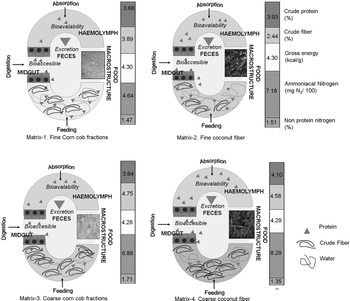
Coconut fiber and corncob powder particle size affected (F = 8.53; df = 3.32; P = 0.0059) the physical structure of the food matrix by modifying its proximate composition: the corncob matrices showed higher nonprotein nitrogen than the coconut fiber (F = 120,969; df = 3,32; P < 0.0001), in contrast, the content of ammoniacal nitrogen was higher in the coconut fiber matrices (F = 375,441; df = 3,32; P < 0.0001). All the food matrices showed similar gross energy, but slightly lower in the coarse corncob matrix (F = 10.67; df = 3,32; P < 0.0001). The coarse food matrices showed higher crude fiber (F = 47,239; df = 3,32; P < 0.0001) and crude protein (F = 9,406,632; df = 3,32; P < 0.0001) than the fine food matrices. The coconut matrices showed higher crude protein, while the corncob matrices showed higher crude fiber. The coarse food matrices showed a higher F/P ratio (F = 4700; df = 3,32; P < 0.0001) (fig. 2).
Schematic diagram showing the effect of food matrix macrostructure on proximate composition, bioaccessibility and bioavailability of the protein of different food matrices used for the development of larvae of Anastrepha obliqua under artificial rearing conditions (n = 3).

Determination of anti-nutritional factors
Trypsin inhibitor activity was significant (F = 33.41; df = 3,8; P < 0.0001) and corresponded to 1.20 ± 0.167, 1.60 ± 0.188, 0.56 ± 0.044, and 0.69 ± 0.125 for corncob fine powder, coconut fine fiber, corncob coarse powder, and coconut coarse fiber, respectively. The α-amylase inhibitor only showed activity for fine corncob food matrices (25.06 ± 1.83). Food matrices prepared with coarse corncob and fine and coarse coconut fiber did not show α-amylase inhibitor activity.
Macrostructure of the food matrices
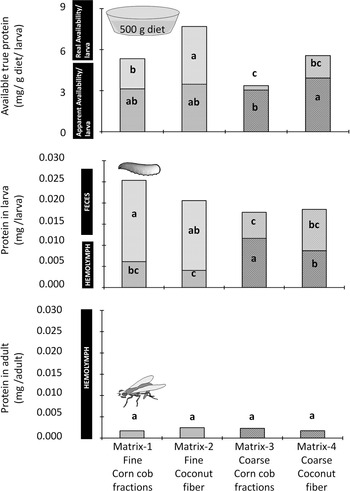
The physical structure of the food matrix was defined by the interaction between the coconut fiber and corncob powder particle sizes. It affected the available true protein (apparent + real) per larva in the food matrix. The highest values corresponded to the food matrix based on fine coconut fiber, while the lowest values corresponded to coarse corncob and coarse coconut fiber (F = 12.38; df = 1,8; P = 0.0079).
Nutritional parameters of larvae and adults
The highest values of larval hemolymph protein content corresponded to the food matrix based on a coarse corncob and the lowest values to the food matrix based on fine coconut fiber (F = 18.05; df = 1,8; P = 0.0028) (fig. 3). Nevertheless, adult hemolymph protein was not affected by the interaction of bulking agent with particle size (F = 3.60; df = 1,8; P = 0.0942), bulking agent (F = 0.11; df = 1,8; P = 0.7421), and particle size (F = 0.02; df = 1,8; P = 0.8875). With respect to protein content in the feces, the highest values corresponded to the food matrix based on fine corncob fractions, while the lowest values corresponded to the food matrix based on coarse corncob fractions (F = 50.76; df = 1,8; P < 0.0001) (fig. 3).
Diet-larva-adult protein transition during the development of Anastrepha obliqua in different food matrices (n = 20).

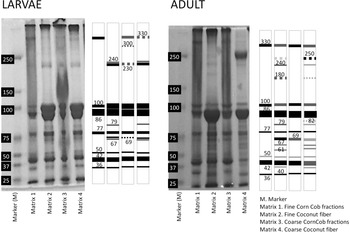
SDS gel of hemolymph samples from third-stage larvae and newly emerged adults reared on different food matrices showed 45 fractions with fairly well-defined bands ranging from ~30 to ~401 kDa in larvae and adults (fig. 4). In our experiment, 7, 10, 11 and 12-protein bands were regularly resolved in the hemolymph of larvae reared on the food matrix based on fine corncob fractions, coarse corncob fractions, fine coconut fiber, and coarse coconut fiber, respectively; while 7, 8, 15 and 16-protein bands were resolved in the hemolymph of adults reared on the four food matrices. Pairwise comparisons revealed that the larvae reared in coarse corncob showed three different bands in comparison with larvae reared in a fine corncob food matrix. While only one new band was revealed between larvae reared in a coarse and fine coconut food matrix. The pairwise comparisons for adults revealed that adults emerged from larvae reared in coarse corncob showed only one band in comparison with adults emerged from larvae reared in a fine corncob food matrix. A similar result was observed for adults emerged from larvae reared in coarse and fine coconut food matrix (fig. 4).
Acrylamide Gradient SDS-PAGE comparing SDS-PAGE of the hemolymph protein of third-instar larvae and adults of Anastrepha obliqua that developed in different food matrices (n = 3).

The comparison of protein band profiles between larvae and adults reared on the four food matrices, in adults emerged from larvae reared in fine corncob, the number and weight of the bands remained (7-bands). In adults emerged from larvae reared in coarse corncob the number of bands reduced from 10 to 8, the bands located at 230 and 300 kDa disappeared. In adults emerged from larvae reared in fine coconut food matrix the number of bands increased from 11 to 15, appearing new bands located at 40, 61, 180 and 250 kDa. In adults emerged from larvae reared in coarse coconut food matrixes, the number of bands increased from 12 to 16, new bands located at 40, 61, 180 and 250 kDa appeared, and bands located at 67 and 230 kDa disappeared.
The protein bands exhibited differences in staining intensities between larvae and adults reared on the four food matrices. We observed the most striking difference in the 42–100 kDa range, where most of the abundant hemolymph proteins migrated. The general similarity of the patterns and staining density of these particular bands in the different samples studied suggests that they are possibly homologous. We detected an intense band of ~250 kDa in the hemolymph of adults from larvae reared on the coarse coconut fiber food matrix; however, the same was only slightly observed in adult hemolymph from larvae reared on the fine coconut fiber food matrix, but it was absent in the corncob fraction food matrix treatments.
Life-history traits
Coconut fiber and corncob powder particle size did not affect larval weight (F = 2.43; df = 3,32; P = 0.0832), but affected larval yield (F = 7.06; df = 3,32; P = 0.0009) and adult emergence (F = 6.24; df = 3,32; P = 0.0018) (Table 1).
Effect of the food matrix on the life history traits of Anastrepha obliqua

Discussion
The food matrix is a complex assembly of nutrients and non-nutrients interacting physically and chemically that influences the release, digestibility, and stability of food compounds (Cohen, Reference Cohen2004, Reference Cohen2015; Crowe, Reference Crowe2013; Aguilera, Reference Aguilera2019). This complex assembly also modifies the structures of these components at micro-, meso-, and macroscopic scales (Capuano et al., Reference Capuano, Oliviero, Fogliano and Pellegrini2018), which affect the friability of the food matrix, also the growth, development and mobility of the larvae through the diets and its access to the diet components (Cohen, Reference Cohen2015). In our study, true protein bioavailability was greatly modified by the bulking agent and its particle size. The physical structure of the food matrix affect the content of crude fiber, crude protein, non-protein nitrogen, ammoniacal nitrogen, and α-amylase and trypsin inhibitors. Our diets, constituted with fine and coarse bulking agents, required different quantities of these agents to have adequate consistency, which is important because the insects require a suitable environment that does not asphyxiate the eggs and promoted the newly hatched larvae feeding. Despite our study having the limitation of unhomogenized quantity of each bulking agent in each food matrix, we did find a collateral effect on the proximate composition of the food matrix, affecting the crude fiber/crude protein ratio (F/P). An appropriate amount of crude fiber contributed to the regulation of nutrient intake, improved the digestive capacity and the absorption of essential nutrients, increased the feed conversion ratio and the digestibility coefficient, and promoted growth (Sun et al., Reference Sun, Zhang, Li, Asham, Sun, Zhao, Wu and He2019). Surprisingly, in food matrices with a high F/P ratio, we found that higher larval density resulted in higher individual larval weight, larval yield, and adult emergence. Larvae that developed in the coarse corncob food matrix, with a high F/P ratio, showed a lower concentration of protein in the food matrix and their feces, but had high hemolymph protein; whereas larvae that developed in the fine food matrices showed higher mortality during the first stage, this contributed to increase the availability of protein for the alive larvae. However, the larvae that completed their development showed increased protein concentration in their feces and decreased hemolymph protein. In contrast, Drosophila larvae reared on a low-protein food matrix showed low hemolymph protein levels (Handke et al., Reference Handke, Poernbacher, Goetze, Ahrens, Omasits, Marty and Lehner2013). In Heliothis virescens (Lepidoptera: Noctuidae), larvae stored a large amount of protein from a protein-rich food matrix (Telang et al., Reference Telang, Buck and Wheeler2002). This suggests that a food matrix containing a high F/P ratio is more balanced. The amount of fiber acts as a diluent and volume expander for other nutrients, expanding the contact area between food ingredients and digestive enzymes, thus improving the digestion and absorption of nutrients (Sun et al., Reference Sun, Zhang, Li, Asham, Sun, Zhao, Wu and He2019). Therefore, we could associate it with the effect of crude fiber concentration in fine food matrices and the modification of the F/P ratio, since a low F/P ratio could affect the content by reducing the bioavailability of amino acids such as methionine and cysteine (Palma et al., Reference Palma, Fernandez-Bayo, Niemeier, Pitesky and VanderGheynst2019).
Furthermore, high concentrations of anti-nutritional factors, such as trypsin and α-amylase inhibitors, in fine food matrices reduce or inhibit metabolizable energy and protein and amino acid digestibility (Lazarevic and Jankovic-Tomanic, Reference Lazarevíc and Janković-Tomanić2015). They also prevent proteolysis in the midgut of insect larvae, leading to starvation and subsequent death (Kansal et al., Reference Kansal, Gupta, Koundal, Kuhar and Gupta2008), which explains the reduction in larval survival in A. obliqua. The partial suppression of the effect of trypsin inhibitors is a synergistic mechanism between the enzymatic regulation of the larvae and the microbial activity of the food matrix itself (Ben-Yosef et al., Reference Ben-Yosef, Pasternak, Jurkevitch and Yuval2015), allowing acquires nutrients (Ben-Yosef et al., Reference Ben-Yosef, Pasternak, Jurkevitch and Yuval2014), and the microorganisms serves as a food (Nguyen et al., Reference Nguyen, Kim, Park and Hwang2019). Once ingested, α-amylase inhibitors interfere with the digestion of proteins and carbohydrates, leading to limited availability of amino acids and energy and causing growth retardation (Lawrence and Koundal, Reference Lawrence and Koundal2002). They also decrease pupal weight and female fecundity (Borzoui et al., Reference Borzoui, Nouri-Ganbalani and Naseri2017). Previous studies indicate that concentrations of >61 amylase inhibitor units / g of an artificial diet based on corncob completely inhibit the growth and development of A. obliqua larvae (O. Rincón-Betancurt, personal communication, January 2021); while in this study, we found that 25.06 amylase inhibitor units / g of an artificial diet based on coarse corncob decrease yield and adult emergence. Besides, the higher porosity of the coarse food matrix favors the diffusion of oxygen, providing a suitable place for biofilm formation by non-fermentative microorganisms and improves its enzymatic activity (Dzionek et al., Reference Dzionek, Wojcieszyńska and Guzik2016). In some insect species, larval aggregations also provide adaptive benefits to individuals due to heat generation, enhancing food assimilation by affecting enzymatic and bacterial activity (Green et al., Reference Green, Simmonds and Blaney2002).
We did not determine the diversity and abundance of microorganisms in our study, but we evaluated the concentration of ammoniacal nitrogen as an indicator of microbial activity. Similarly, Van Dung et al. (Reference Van Dung, Shang and Yao2014) found that increasing ammoniacal nitrogen levels in the food matrix with coarse bulking agents indicate high protein degradation levels. The microorganisms could use the non-protein nitrogen (NPN) and replace a portion of the total protein requirements of the larvae (Hirayama et al., Reference Hirayama, Konno and Shinbo1996).
As expected, adult flies emerged with similar protein reserves. Thus, adult hemolymph protein content was independent of the food matrix F/P ratio. Similarly, in the grasshopper Schistocerca americana Drury, protein levels are balanced during metamorphosis (Hahn, Reference Hahn2005); and C. capitata, emerged adults showed a similar load of lipids and proteins independent of their content in the larval diet (Nestel et al., Reference Nestel, Nemny-Lavy and Chang2004). Anastrepha obliqua larvae and adults reared on diets prepared with fine and coarse bulking agents, coconut fiber, and corncob showed qualitative differences in hemolymph protein profile by SDS-PAGE, with differences in protein band number, intensity, and width. These differences could have resulted from the interaction between nutrients and microbial metabolism, providing essential nutrients such as vitamins, amino acids, and lipids. Thus, the bioavailability of dietary components increases because microbes, dead or alive, improve the food matrix (Keebaugh et al., Reference Keebaugh, Yamada, Obadia, Ludington and Ja2018).
Similar levels of total protein in the hemolymph during the transition from larva to adult may suggest that proteins in the food matrix of coconut fiber are easily incorporated into the hemolymph and body proteins compared to those from the corncob food matrix. The differences in the hemolymph protein band profiles of A. obliqua larvae and adults could be explained by the protein bioavailability in each food matrix. It could also explain the similarities between the hemolymph protein profiles of larvae and adults reared on fine and coarse matrices of coconut fiber, but not the differences between those reared on fine and coarse corncob matrices.
Although the SDS-PAGE revealed 45 fractions with well-defined bands ranging from ~28 to ~401 kDa in larvae and adults, we found the main differences between the samples from different food matrices within the 75–100 kDa range. The estimated molecular weight values of 90–100 kDa are close to those obtained in SDS-gels for larvae of C. capitata (Mintzas and Rina, Reference Mintzas and Rina1986), suggesting they might be monomers of major larval serum proteins-1, 2, and 3, which are used during the larva to pupa transition for the formation of new pupal and imaginal tissues, whereas the bands located at 40–45 kDa could be associated with vitellogenin-1 and 2, respectively (Rina and Mintzas, Reference Rina and Mintzas1988). Bands located at 90–100 kDa were significantly more intense in the hemolymph of larvae and adults reared on a food matrix based on coconut fiber than those reared on a food matrix of corncob fractions. This could be related to the high bioavailability of hemolymph proteins, which are strongly regulated during the last stage and correspond up to 70% of total hemolymph protein. Interestingly, in the hemolymph of adults reared on the coarse coconut fiber food matrix, we found one band with a molecular weight around ~250 kDa, which could be associated with storage proteins such as lipophorins or hexameric proteins (Zhang et al., Reference Zhang, Dong, Wang, Wu, Song, Gu, Zhao and Xia2014).
Even though, in the fine bulking agents matrices we observed high first-instar larval mortality, however the larvae that completed its development exhibited elevated weight. This finding indicates that larvae could have different metabolic pathways to exploit nutrients resources depending on the larval environment. The weight of the larva in a food matrix will depend on water content and its impact on soluble carbohydrates present in the crude fiber, with possibly a higher concentration in a fine food matrix. The effective water diffusivity in foods, as well as free water content, highly depend on pore structure or particle size distribution (Fundo et al., Reference Fundo, Quintas and Silva2015). This affects the water/solute interactions, and is involved in nutrient transport, dispersion and dissolution of the solutes (Matveev et al., Reference Matveev, Grinberg and Tolstoguzov2000). The influence of water on the structure of the food matrix affect microbial growth, degradation reactions, enzymatic activity (Aguilera, Reference Aguilera2019) as the hydrolysis of proteins, carbohydrates, simple sugars and other metabolites from soluble and insoluble fibers as part of key functions in the gut of insects (Palma et al., Reference Palma, Fernandez-Bayo, Niemeier, Pitesky and VanderGheynst2019). As fly larvae feed on diets high in carbohydrates, gut microbes can metabolize starch, sugars and fibers into organic acids such as short-chain fatty acids and/or simple alcohols (Cohen, Reference Cohen2015). In addition, a decrease in the bioavalability of protein and an increase of carbohydrates could in turn increase the rate of lipid synthesis and storage (Hyun et al., Reference Hyun, Song, Song and Kim2015). For example, C. capitata larvae increase in weight when they are reared on both protein-rich diets and carbohydrates-rich diets (Nash and Chapman, Reference Nash and Chapman2014). Findings from our study indicate that fine food matrices could facilitate the bioavailability of soluble carbohydrates and favor lipid synthesis and storage, contributing to the increase or larval weight. While in coarse food matrices, a high bioavailability of the protein could have favored the increase of larval weight.
This study has demonstrated that the hemolymph protein was a reliable parameter to evaluate the nutritional status of the larvae. Protein profiles in hemolymph and fat body should be integrated to explore the interaction between the metabolic processes that occurs during metamorphosis from larva to adult. Our study determined that the macrostructure of the food matrix changes the composition of the hemolymph protein in the adult due to the level of bioavailable nutrients, regardless of the total concentration of protein in the hemolymph of the larva. Future studies that investigate changes in proteins or other macromolecules during the development, growth, and metamorphosis of insects should include bioavailability and protein profiles as reliable nutritional parameters to evaluate the efficiency and effectiveness of artificial diets for insect mass-rearing.
Acknowledgements
We are grateful to Margoth García for the technical support. This work was part of the bachelor thesis of the first author (ORB). This project was funded by the Moscafrut Program SADER-SENASICA Project ‘Formulación de dietas larvarias – SDM-004/2013-2018’.
Conflict of interest
The authors declare no competing or financial interests.