The newly acquired electoral significance of states in recent India is attributed to the fact that political articulation and mobilization tend to swerve predominantly around primordial identities. As most of the identity groups that turn into voting categories remain confined to a state or a sub-region within it, mobilization in the shape of the politicization for electoral purposes takes place invariably at the state level.Footnote 1 What has imparted impetus to this process of federalization of electoral politics is the emergent fragmented nature of the party system under the single plurality electoral system in the ‘post-Congress polity which acts as incentive to the powerful community/regional leaders to form their “own” parties’.Footnote 2 The state level parties have gained electorally over the polity-wide parties by succeeding in creating a ‘core voting constituency’ of a numerically significant cluster of region-based caste/communities, which allows them to either win or remain a relevant party. The rise of state level parties has also brought focus on the considerable power and influence wielded by the state level political leadership.Footnote 3 In a patronage democracy such as India, castes/communities acting as ‘political’ categories tend to cling to their ‘own’ parties and leadersFootnote 4 in the ‘realistic’ hope of being the beneficiary of the direct and indirect transfer of public resources and for the ‘feel good’ factor (Chandra, Reference Chandra2004, Reference Chandra2012).Footnote 5
The newly found importance of the states, state level parties, and leadership has led to an attempt to develop a coherent and systematic theoretical framework for studying state level electoral politics in a comparative mode. Such attempts have for a considerable period been discouraged on the grounds that because of the ongoing ‘de-centering’ of India's polity, each state has been showing its distinct pattern of party system as well as electoral outcomes making it difficult to compare or develop a general theoretical framework that can be used to theorize state level electoral politics. Such an argument gets credence because electoral patterns across the states have shown extreme fluidity in the nature of electoral permutations and combinations involving the parties and the leadership. A counter argument in favour of exploring comparability among the regional states for election studies is that states have been under the same electoral system in a parliamentary-federal polity. Thus, despite the salience of the state/ region-specific nature of electoral politics and the presence of distinct voting publics, a careful study of the emerging trends in Indian politics does reveal certain commonalities across the states in terms of their electoral politics even as exceptions remain. Important among them can be listed thus: emergence of historical-cultural regions as electoral regions, growing presence of state level issues, parties and leadership, social cleavages acquiring political forms, especially in the form of newly mobilized identity groups, and finally the emergence of electoral coalitions with growing ascendance of state parties.
Situating Punjab
The above trends have long been visible in Punjab. First, three distinct historically, socially and culturally constituted regions in the state namely Malwa, Doaba, and Majha have long emerged as the electoral regions, each having its own specificities in terms of its politics and leadership that come to play particularly in assembly elections.Footnote 6 Second, there has been a legacy of politicization and mobilization of social cleavages in the state for electoral purposes since colonial days. Caste, kinship, region, language, and religion with some variations have continued to remain latent factors shaping the dynamics of party competition and electoral outcomes in the state. Third, since the cessation of militancy in the early nineties, the state has been witness to emergence of a stable bipolarity because of pre-electoral alliances. Since 1997, the Congress in alliance with the Left parties or alone has been pitted against the SAD-Bharatiya Janata Party (BJP) electoral alliance. Even before, there were attempts to secure electoral alliances especially after reorganization of the state in 1966 (refer the alliance between SAD and Bharatiya Jan Sangh (BJS) or between SAD and now defunct Janata Party or even between the CPI-CPM and SAD during pre-militancy period). Fourth, the state has been witness to what can be termed as unveiling of a process of ‘federalization of party system’ in the sense that SAD, a state level party has been the dominant partner in a long-standing coalition with BJP being a junior partner since 1997 (Kumar, Reference Kumar2004; Singh, Reference Singh2014). Symptomatic of the polity wide trend towards the federalization of party system, the state unit of the Congress, a national party, has been most vocal in raising the state specific issues in the elections such as river water sharing with neighboring states.Footnote 7 Fifth, as for the emergent practice of an identity based ‘patrimonial’ mode of electoral politics, the state has been witness to the rise of politics of competitive populism/patronage in a closely contested electoral arena with the party in power enticing electorates, with particular focus on the party's voting constituency.Footnote 8
Punjab's ‘exceptionalism’ has been evident in the absence of assertion from below despite high level of electoral participation.Footnote 9 Unlike most Indian states, where in terms of ‘presence’ and empowerment, completely new generations of political entrepreneurs and parties claiming to represent the marginal communities/regions have come up in recent decades, mostly landless scheduled castes constituting 31.9% of the population have failed so far to take the ‘electoral route’ to empowerment.Footnote 10 As will be discussed below, there has been long-term electoral dominance of numerically sizable and landholding Jat Sikh peasantry irrespective of the parties in power.
Making of a Panthic party
In order to understand the way the electoral system has evolved in the state, one needs to have a longer view of the life and times of the Shiromani Akali Dal (SAD),Footnote 11 the oldest surviving state level party in India that has had an organizational base across all the three electoral regions of post-partition Punjab. SAD projects itself as the ‘natural party’ of the Sikhs in Punjab and in India. The party along with the Shiromani Gurudwara Prabandhak Committee (SGPC) and Akal Takht views itself as the custodian of the cultural, religious, and political interests of the community. This is the argument of the present article that SAD more than any other party has influenced the politics of the state in a decisive way since the partition days.
A 175-member SGPC was formed on 15 November 1920 when a meeting of the Akali Jathas (congregation) constituted for the purpose of gurdwara reforms took place at Amritsar. In the meeting, a decision was taken to set up Shiromani Akali Dal to act as an institutional-political arm of the SGPC (Narang, Reference Narang, Singh and French2014: 339). The party was set up with four objectives in mind, which continues to be relevant: (a) to bring the Sikh gurudwaras under Panthic control; (b) to do away with the entrenched position of the Mahants, thus ending their irresponsibility; (c) to utilize the property and income of the gurudwara for the purpose for which they were founded; and (d) to practice the Sikh religion according to the teachings of the Sikh Gurus as enshrined in the Adi-Granth (Singh, Reference Singh2005: 32).Footnote 12 In its formative years, the party actively assisted the Sikh community in its effort to free the gurdwaras from the clutches of Mahants, who enjoyed colonial regime support, and bring all of them under the supervision of the SGPC by actively mobilizing the community. The agenda was also to restore the Sikh tradition of worship in the Sikh gurdwaras.
After the passage of All India Gurdwara Act, 1925 that brought the Sikh gurdwaras in the state under the SGPC, and in the rapidly changing political scenario of the country, the party took upon itself the task of serving the political interests of the Sikh community. Introduction of the Montague–Chelmsford Reforms, 1919 that introduced a communal electorate, firmed up the resolve of SAD to ensure fair representation of the Sikh community in the proposed legislative bodies.
Consequent to the passage of Government of India Act 1935, opportunity came when provincial legislative assemblies were established in the provinces, based on a limited franchise involving community-based voting. SAD contested 1937 elections in alliance with the Congress, hoping to corner the seats reserved for the Sikh community. The Unionist Party representing the landed peasantry interests and having the support among both Muslims and Sikhs, however, secured the majority by getting 96 out of 175 seats in the Punjab provincial legislative assembly. Congress won 18 seats, whereas Muslim League got only two seats (Kapur, Reference Kapur1986: 52).Footnote 13 With communal temper on the rise, the Muslim League won 75 out of 85 seats reserved for Muslims in the subsequent 1946 provincial elections, showing its growing influence as the party rooted for the partition of the country (Talbot, Reference Talbot1980: 65). The electoral success of Muslim League changed the political scenario of colonial Punjab as until then the Unionist party (also called Zamindara party) had dominated the political scene. As the partition seemed imminent, SAD was able to win 21 seats with the Congress and the Unionist Party winning 51 and 21 seats respectively in the 1946 assembly elections.Footnote 14 As the demand for partition gained momentum, SAD, conscious of the presence of the sizable Sikh community settled in the western part of Punjab especially in the canal coloniesFootnote 15 and scattered in other parts of eastern Punjab, opposed the creation of Pakistan vehemently. The party feared the loss of land and forced migration in offing for the community, an apprehension that proved to be true. The party led ‘death to Pakistan’ movement after the talks with Muslim League failed to assure the protection of Sikh interests in case of partition.
Demand for Punjabi Suba
Once partition happened, SAD set out to fulfill two immediate objectives: to ensure adequate share for the Sikhs in terms of political power; and promotion of the Punjabi language in Gurumukhi script (Grewal, Reference Grewal, Grewal and Banga1998: 74). Refusal of the constituent assembly to concede to the Akali leadership demand for a separate communal electorate led SAD to start the Punjabi Suba movement as early as in August 1950. The immediate provocation was the rejection of Punjabi as their language by the non-Sikhs in the 1951 census, which led the State Reorganization Commission to consider Punjabi as a dialect rather than a language and thereby did not recommend the reorganization of the state. The Akalis considered it as ‘an overt and deliberate political act designed to undercut linguistic basis of Punjabi suba demand’ (Brass, Reference Brass1974: 327). The dominant Hindu majority, Brass (Reference Brass1974) argues, ‘unable to assimilate the Sikhs into their fold, adopted the tactic of avoiding their language so that the Sikhs, a minority people by religion, might become a minority by language as well’ (pp. 298, 327). The Hindu–Sikh divide was also evident in the conflicting assertions about what should be the script of Punjabi language: Gurmukhi or Devnagari (Sarhadi, Reference Sarhadi1970: 211). Arguably, the language controversy was symptomatic of a ‘deeper quest for recognition and power’ on part of sizable Sikh community led by Akali Dal (Deol, Reference Deol2003: 94). The fallout of these developments was the concern on the part of both the communities (Hindu and Sikh) living in the state for their distinct identities (Oberoi, Reference Oberoi1994: 416). As a result, notion of Punjabiyat linked inextricably to the aspiration to secure a Sikh territorial homeland within Indian Union, which was reflected in the slogans like ‘Khalsa ka Bolbala’/‘Raj Karega Khalsa’ (Lamba, Reference Lamba1999).Footnote 16
The rejection by the centre of demand for a Sikh majority Punjabi Suba brought the Akalis in sharp confrontation with the ‘Hindi-Hindu’ lobby and in the process communalized its approach to Punjab politics. Mobilization of Hindu segments by the Arya Samaj, its appeal to the Hindus to register Hindi and not Punjabi as their mother tongue, its emphasis on the Vedic tradition; and attempt to distance the Hindus from Sikh traditions contributed in a significant way to the crystallization of Sikh identity as the basis of Punjabiyat. It sowed the seeds of a communal identity and politics based on that identity. As a result, Akali leadership started asserting the demand to recognize the Sikhs as a quam (nation) in terms of their culture and language as distinct from the Hindus and raised the demand for a ‘self-determined political status’ for the Sikhs (Anand, Reference Anand and Narain1976: 263; Nayar, Reference Nayar and Weiner1968).
What further led to the ire of the Akalis was the electoral dominance of the Congress in Hindu majority post-partition Punjab. The Congress took advantage of the newly introduced single plurality electoral system based on universal franchise. In the first three assembly elections held in 1952, 1957, and 1962, the Congress won around 60% of the vote. Even the efforts on the part of the Akali Dal to mobilize Sikh support based on Punjabi Suba could get the party only 19 seats with only 11.7% of the vote in the 1952 assembly elections. In the 1956 elections, a desperate SAD merged itself with the Congress in the hope then that the Congress governments at both the centre and the state would allow the creation of Punjabi Suba. With the demand dubbed as communal and opposed by the state unit of the Congress led by Pratap Singh Kairon, then chief minister and a regional satrap, the Akalis decided to resurrect the party. However, many erstwhile Akali MLAs as a part of the Congress government refused to resign and join back the Akali Dal. As a result, a much-weakened and under-prepared SAD fared badly in 1962 assembly elections. The growing Hindu–Sikh divide helped Bharatiya Jana Sangh, which was able to win nine seats in 1962 elections, up from two seats in 1952 elections.
Electoral support base
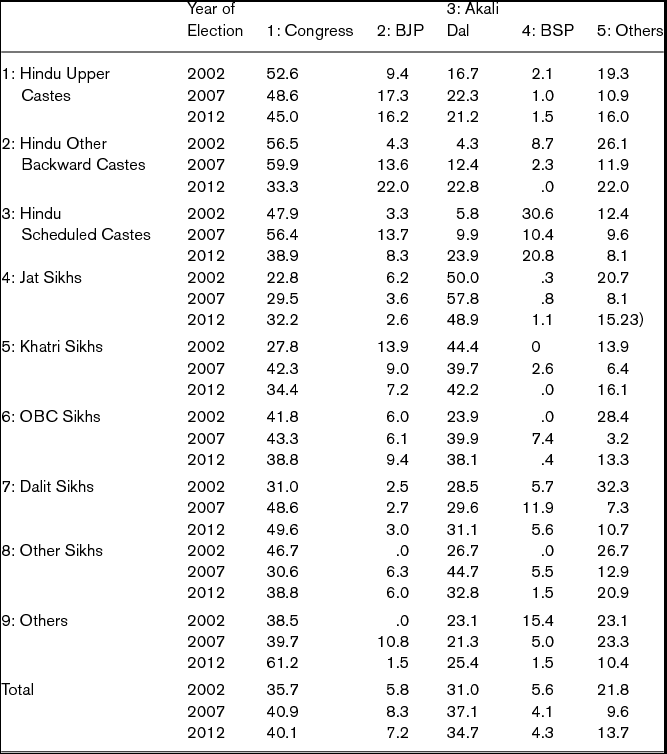
In spatial terms, SAD as a self-projected farmer's party received its core electoral support from rural Punjab, inhabited mostly by Sikhs; a trend that continues even now as revealed in different CSDS-NES survey data (Table 1).Footnote 17 Just to illustrate this point, in the assembly elections held since 1967 to 2007, Akali Dal has had a clear edge in 28 of the state's assembly constituencies, all being predominantly rural in nature even after third delimitation exercise in 1973 that had tried to bring together both rural and urban segments while demarcating the constituencies’ boundaries (Kumar, Reference Kumar and Sridharan2014: 226).Footnote 18 Failure of the SAD to secure majority Sikh vote despite pursuing a Panthic agenda could be attributed to the party being closely identified with the landed Jat Sikh peasantry. Akali effort to consolidate Sikh vote was somewhat negated due to heterogeneity within the Sikh community in terms of different castes and class and sub-region. The divide increased in the wake of the green revolution (Puri, Reference Puri and Grover1995: 49). In terms of its social profile, until the 1950s, SAD leadership had come mainly from the urban upper castes/middle class Sikhs. The Jat Sikh dominance in the party leadership commenced with the emergence of Sant Fateh Singh who replaced Master Tara Singh, an urban-based upper caste Khatri (Bajwa, Reference Bajwa1979: 25). Since then the Jat Sikhs, a numerically strong and land-owning community, which gained prosperity during green revolution, has dominated the party leadership structure and has emerged as its core social constituency. Politically, Jats – and after 1966, Jat Sikhs – became the single most important social group in village Punjab. Emergence of Sant Fateh Singh, who was from Malwa region, also led the gradual shift of the Akali Leadership base from the Doaba and Majha region to larger Malwa region. Prominent among them were Giani Kartar Singh, Master Tara Singh, Udham Singh Nagoke, and Giani Bhupinder Singh.Footnote 19 Jat Sikh community's ascendance as the most powerful community in post-1966 Punjab can be attributed to their land ownership in a predominantly agrarian economy and their numerical predominance. The capital intensive and market oriented Green Revolution with its ‘betting on the strong policy’ further helped the big landholding Jat peasantry and led to a situation of greater landlessness as the big landlords started purchasing the lands of the small and marginal farmers whose landholdings were not compatible with capital intensive irrigation. The overwhelming importance of the Jat Sikhs in the political leadership role was also visible in the Congress party by the seventies as the Jat Sikhs emerged as the dominant community even as the party has symbolically put up the non-Jats in the party posts.Footnote 20 The lopsided nature of polity can be illustrated by referring to the sociological origins of the lawmakers, elected from the state. Out of the 1,248 Legislative assembly members elected from the state from 1967 to 2012, a sizable 44% of them belong to Jat Sikh community whereas Khatris/Aroras constitute 22%. That leaves the OBC MLAs at only 9%. The ascendance of the Jat Sikh community in post-1966 Punjab considerably weakened the political role of other castes among the Sikhs, especially artisan castes like the Tarkhans or the Ramgarhias (carpenter and ironworkers), Chimbas (tailors), and Kumhars (potters); and the dalit castes, like the Chamars (tanners) and Chuhras or Balmikis (sweepers) also called Mazhabis and Ramdasias (Jodhka, Reference Jodhka2000b: 392). Like the other backward castes, scheduled castes candidates have also been able to win only from reserved seats (right now, 34 out of 117 seats in Assembly and 4 out of 13 seats in the Lok Sabha are reserved for the scheduled castes) (Kumar, Reference Kumar and Sridharan2014: 307).
A prolonged and bitter struggle over the linguistic issue as well as on the creation of Punjabi Suba resulted in a perceptible communal divide in terms of the electoral choices in the state. It enabled SAD to emerge as the main contender of the Congress party. However, SAD leadership realized quickly that the party would always find it difficult to come to power on its own even after the Punjab state reorganization bill created a Punjabi-speaking state with nearly 54% Sikh and 44% Hindu (Kapur, Reference Kapur1986: 216). To compound Akali problem, the rival Congress successfully claimed to represent interests of both the Hindus and the Sikhs by projecting itself as a secular catchall party holding the middle ground in its effort to ‘cut off the support base of all other political parties, instead of seeking to accommodate them’ (Sharma, Reference Sharma1986: 640). Assembly elections held just after the reorganization in 1967 gave an early indication about the rural–urban, regional, as well as religious divide in terms of the electoral choices of the people that remains a reality of Punjab politics even now though in diminished form. Akali Dal could get only one-fifth of votes and 24 seats in the assembly of 104 members. The cross-communal/ spatial social base of the Congress in the state was evident as it succeeded in getting more Sikh candidates elected than SAD. The electoral support of sizable dalits having different religious allegiance for SAD remained uncertain, a trend that continues even now as CSDS election studies data show. To compound its problem, there was also an internal conflict of endemic nature within the party over strategy and tactics as well as the leadership issue. Given all the above factors, it was a very difficult task for SAD to secure a majority on its own. In 1969 and 1977 assembly elections, Akali Dal won 43 and 58 seats respectively, which was an improvement. Bharatiya Jan Sangh (BJS), another ethnic party secured the urban Hindu vote, as the party was supportive of trading and business classes’ interests. What was also common between SAD and BJS was that they contested on the plank of ‘anti-Congressism’, complemented each other's social support base, and were thus potential ‘natural allies’, something that is true of the present-day SAD–BJP alliance in place since 1997.
The SAD–BJS alliance set the pattern of sharing of power between the representatives of the two communities to strike a social balance, which neither could establish on their own. SAD succeeded in forming a coalition government in an alliance with the BJS and the Communist Party after the first two assembly elections in the reorganized Punjab in 1967 and 1969. Deep-rooted ideological and programmatic divide between BJS and SAD was apparent as the former regarded ‘the Sikhs as part and parcel of the Hindu society’ (Brass, Reference Brass1974: 333). In order to sustain the partnership, SAD and BJS even agreed to have a three-language policy in 1969 replacing Sachar formula under which both Hindi and Punjabi received recognition as official languages of the state. Punjabi, of course, became the first compulsory language and medium of instruction in all the government schools whereas Hindi and English became the second and third language, implemented from class 4 and 6 respectively.
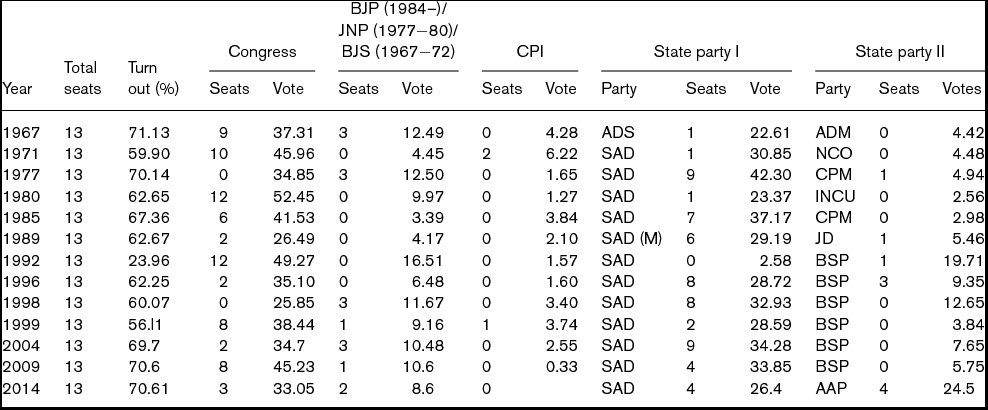
The steamroller majority of the Congress in the 1972 assembly elections riding on the ‘Indira wave’ further brought the realization among the Akalis to not only retain the core social constituency support but also remain in a coalitional arrangement. The Akali victory in 1977 was, however, also due to the mass support for the SAD–Janata Party combine for their role in resisting unpopular emergency imposed by the Congress.Footnote 21 Significantly, even when the Congress facing backlash got merely 17 seats in the same election, it polled 33.6% of votes, which was higher than Akali Dal's 31.4%. It confirmed the stable core support base for the Congress across all the three regions in the state. Significantly, there has never been a whitewash of the two contending parties as happened in Tamil Nadu, even when the elections have been plebiscitary in nature as in 1977 or in 1985 after Longowal–Rajiv Gandhi Accord, a fact underlining the intense campaigning and high turnout in the elections (Tables 2 and 3).
Party voted for Assembly Elections: 2002–2012 (All figures in percentage)

CSDS-Lokniti Post-Poll surveys.
Source: CSDS Data Unit.
Summary of Lok Sabha elections in Punjab, 1967–2014 (vote in percentages)

Note: In the 1989 elections, one seat was won by the BSP, which secured 8.62% vote, Independents won 3 seats. In 1998, the Janata Dal won one seat and secured 4.18% votes.
Source: CSDS Data Unit.
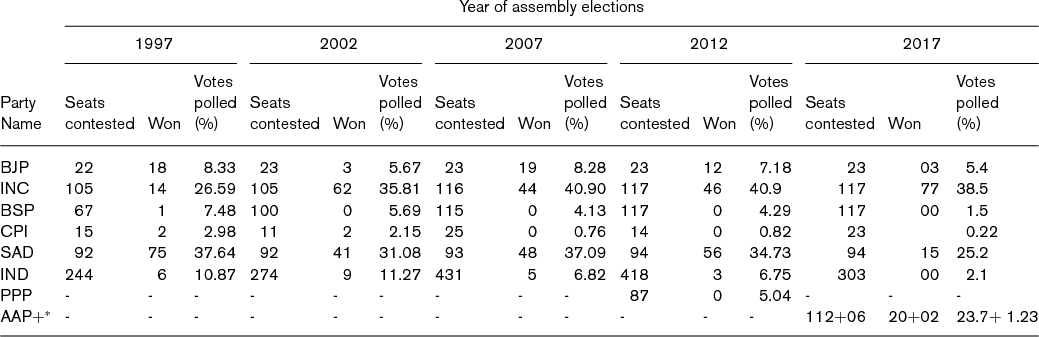
Performance of political parties from 1997 onwards in assembly elections in Punjab
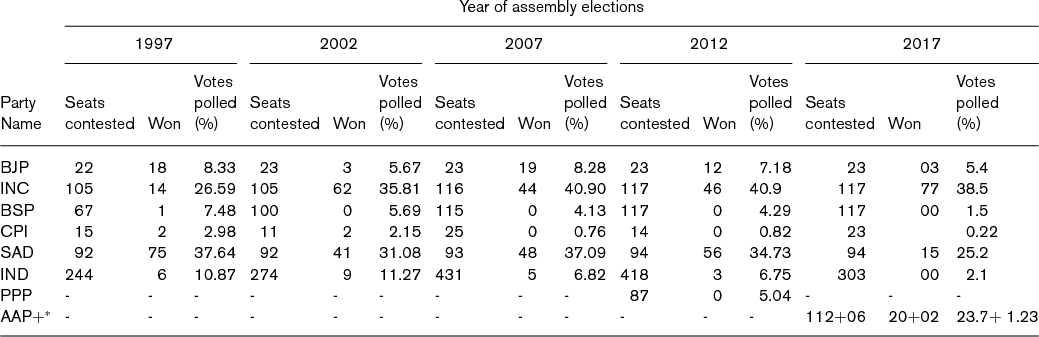
Source: Election Commission of India.
*AAP+ includes the alliance pattern LIP which secured 2 seats in 2017 elections it contested on 6, AAP was not formed at the time of 2012.
Anandpur Sahib Resolutions
The need to consolidate the Sikh majority vote led SAD to raise demand for the state's autonomy. This thinking found expression in the form of the Anandpur Sahib resolutions of 1973 and 1978. The repeated interference by the centre in the affairs of the state, such as the dismissal of Prakash Singh Badal, led the Akali Dal-Janata Party (mainly constitutive of the former Bharatiya Jana Sangh members) government and subsequently the Congress leaders such as Giani Zail Singh to encourage factionalismFootnote 22 within Akali Dal by encouraging the radical elements which vitiated the atmosphere in the state. Personalized and centralizing politics of Indira Gandhi that attempted to stifle the local voices gave rise to anti-centre sentiment.
The core of the Akali demands relating to the political, economic, and social relationship between the centre and the state of Punjab were reflected in the Anandpur Sahib Resolutions adopted by the working committee of the Akali Dal in October 1973. The resolution incorporated seven objectives aimed at establishing the ‘pre-eminence of the Khalsa through creation of a congenial environment and a political set up’ (Singh, Reference Singh1981: 346). The demands raised were: transfer of the federally administered city of Chandigarh to Punjab; the readjustment of the state boundaries to include certain Sikh majority Punjabi-speaking territories, presently out-side but contiguous to Punjab; demand autonomy for all the states of India with the centre retaining jurisdiction only over external affairs, defense, and communications; introduction of land reforms as well as subsidies and loans for the peasantry as well as measures to bring about heavy industrialization in Punjab; the enactment of an all-India gurdwara act to bring all the historic gurudwaras under the control of the SGPC; protection for the Sikh minorities living outside the state; reversal of the new recruitment policy of the centre under which the recruitment quota of Sikhs in the armed forces fell from 20% to 2% (Singh, Reference Singh2005: 111–125; Kumar, Reference Kumar2009: 173)). The working committee of the party added two new demands to the Anandpur Sahib resolutions in February 1981 after which a set of 45 demands were submitted to the centre in September of the same year. These included, among others, the halting of reallocation of available waters of riparian Punjab to non-riparian states (Pettigrew, Reference Pettigrew1995:5).
Radical sikh politics
The repeated failures in the negotiations with the centre that began in October 1981 led to the intensification of the second phase of Akali agitation as militancy gradually crept in, receiving support from the radical elements within the Akalis. The escalating ethnic violence and the failure of the centre either to meet the demands of moderate Akalis or to resurrect democratic institutions and rights ultimately led to catastrophic Operation Bluestar when the Indian army carried out an operation to flush out the militants holed up in the revered Golden temple at Amritsar followed by Operation Woodrose carried out in villages to track down the suspected militants. Militancy in Punjab that was already simmering received further impetus after these repressive acts of the Indian State (Dyke, Reference Dyke2009). The anti-Sikh riots that followed in Delhi and other parts of India after the assassination of Indira Gandhi by her Sikh Guards led to further alienation of the Sikh community as the accused remained unpunished.
The post-Bluestar period witnessed clear ascendance of the radical autonomist forces as the moderate forces lost credibility and legitimacy in a highly surcharged atmosphere that brought back the memory of Sikh persecution. Not only the moderate Akali Dal but also the Congress became irrelevant as the latter was dubbed as a Hindu party. It took some time for the moderate Akali leadership to overcome the tumult and trauma of these events. Moderate Akali leaders, most of who were only released in March 1985, after spending months in jail during the post-Bluestar period, attempted to save Punjab from rising religious fundamentalism and militancy in the form of the Rajiv–Longowal Accord on 24 July 1985. The SAD, however, failed to capture the mainstream space for the next five years or so. The party suffered because a segment of its core voting constituency as well as leadership shifted loyalty to the ultra-radical elements.
The SAD government led by Surjit Singh Barnala, which came to power after winning the assembly elections held on 25 September 1985, was unable to get the Congress-ruled centre to fulfill any of its promises made under the accord, such as the transfer of Chandigarh to Punjab by 26 January 1986. The backing out of the Congress, fearful of losing votes in the neighbouring Hindi speaking states, and facing the pressure of hardliners within the party, especially after the assassination of Longowal, meant that the Barnala led SAD government was viewed as ineffective in fulfilling the Panthic agenda.Footnote 23 The coming together of pro-militant organizations in the form of United Akali Dal and the targeted killings of the Hindus by the militants further weakened the Barnala government. The incidents of human rights violations by the state police and para military forces also underlined the weakness of the government. Entry of the state police in April 1986 to flush out the militants from the Golden Temple premises under operation Black Thunder saw the desertion of Prakash Singh Badal and G. S. Tohra led factions from the SAD and the government. The Barnala government was dismissed and President Rule was imposed in the state in May 1987 on the eve of the Haryana assembly elections. The state remained under the President's rule for close to five years, necessitating constitutional amendment.Footnote 24 During this turbulent period, the SAD came under the firm control of the extremists and elements supportive of militancy. The situation remained the same even after the victory of the SAD (Simarjit Singh Mann) in November 1989 parliamentary elections in six out of eight seats contested, securing 29.19% of the votes. The SAD now clearly stood for the right to self-determination that subsequently found expression in the form of the Amritsar declaration. The marginalization of the two moderate factions of Akali Dal led by Prakash Singh Badal and Surjit Singh Barnala was evident as the two factions managed to win only 6.65% of the votes and could not win a single seat.
Return to normal politics
It was only in the mid-1990 that normal politics appeared to be making a comeback in Punjab. The process started in true earnest with the holding of assembly elections in 1992, despite the threats of the militants and boycott of the SAD. The polling percentage was a little over 20%. However, the Congress government led by Beant Singh credited itself with flushing out militancy from the state, mainly with the help of the Punjab police led by KPS Gill. The militants by then had lost whatever little sympathy they had among the masses due to their criminal acts. Even after the assassination of Beant Singh in August 1995, militancy has not been able to make a comeback, despite the efforts of external forces inimical to India.
Elections for panchayati raj institutions and municipalities held in 1995 witnessed massive 82% voting. It marked the return of competitive politics with Akali Dal also contesting. The resurrection of moderate Akali leadership was primarily because militancy had ended by the end of 1993. In an attempt to keep the upper hand, the radicals formed SAD (united) in 1994, uniting as many as six factions of Akali Dal, namely Akali Dal (Panthic), Akali Dal (Mann), Akali Dal (Kabul), Akali Dal (Babbar), Akali Dal (Talwandi), and Akali Dal (Manjit Singh). It was primarily due to the efforts of Bhai Manjit Singh, the then acting Jathedar of Akal Takht, seat of temporal power for the Sikhs. However, the moderate Akali Dal faction remained separated under the leadership of Prakash Singh Badal. Gradually, however, as the urge for peace and Hindu–Sikh unity became strong, Akali Dal (Badal) emerged as the dominant faction being able to integrate almost all the constituents of United Akali Dal over the course of time with the notable exception of Akali Dal (Mann).
Typical of the party's faction ridden history, SAD even after winning 1997 elections in alliance with the BJP suffered from a split on the eve of 1999 parliamentary elections. Significantly, even after securing a majority on its own in the 1997-assembly elections for the first time, the SAD chose to have a coalition government keeping the long-term perspective and showing how the Hindu-Sikh unity and peace agenda had come to replace the ethnic agenda of the party.Footnote 25 The split happened as Gurcharan Singh Tohra, the president of the SGPC for close to two decades, raised the banner of revolt against Prakash Singh Badal, then chief minister. Sarb Hind Shiromani Akali Dal, formed under the leadership of Tohra on May 30, 1999 formed an electoral alliance with other factions namely Akali Dal (Mann), Akali Dal (Panthic), and Akali Dal (Democratic). The different factions fought both the Lok Sabha and the assembly elections separately in 1999 and 2002 respectively, contributing to the dismal performance of the Akalis in both elections. Congress, which had a poor run in 1996, 1998 Lok Sabha, and 1997 assembly elections, was able to make an electoral comeback in 2002, taking advantage of division in the Akali vote. Even over the past one and half decades, in the state, dominated by the colossal figure of Prakash Singh Badal as undisputed topmost Akali leader, different variants of Akali Dal have continued to exist like SAD (Amritsar), SAD (1920), to name a few. However, they all have been on the margin just like the Dal Khalsa, another Sikh rightwing party.
Significantly, emergence of the sharp and shrill politics of Hindutva in the 1990s did not make the SAD go back to its strident ethnic/autonomist agenda. Apart from the moderating influence of the Prakash Singh leadership over the party, it has been the electoral compulsion to remain aligned with the BJP (Jodhka, Reference Jodhka2000a; Verma, 1999). One of the constant themes in their successive common minimum programmes has been to secure ‘peace, brotherhood, and communal harmony’.Footnote 26 The emergence of state level political parties and the formation of coalition governments at the centre since 1991, having both the national and the state parties (including the Akali Dal as a constituent of Vajpayee led NDA successive governments), have brought a turnaround in the Akali mindset. The dire financial situation of the state that has continued to worsen since the militancy days as the state's debt keep mounting due to huge subsidies given for electoral dividend also compel the SAD to seek cooperation with the centre especially when the party is in power.
The last one and half decades has witnessed the rise of person-centric leadership within SAD as Badal and his family have controlled the party, the SGPC, and the Akal Takht. Besides, giving legitimacy and religious sanction, the SGPC has also been the major source of electoral funding. Since their inceptions, SGPC and Akal Takht as the highest temporal and religious seats of the Sikh community have enjoyed a fair degree of autonomy in relation to the party. Once a cadre based and ideologically driven party degenerated into a ‘family party’, like other ‘original’ state level parties, i.e. National Conference in Jammu and Kashmir and DMK in Tamil Nadu.
Electoral shift
A major shift in the electoral politics of the state has been visible in the way SAD has set its electoral agenda after coming out of political oblivion in the post-militancy period. Governance and development related regional issues have come to dominate not only the SAD but also other national parties’ manifestos as well as campaigns. Besides the popular disenchantment with extremism, the shift in Akali agenda could particularly be due to the emergence of a new generation of voters and leadership. Both have little memory of the gruesome events that took place in the state during militancy and have very little concern with the ‘gurdwara politics/dharma yudh morcha politics’ or the affairs of SGPC. On the part of older leadership, there is a realization that the party has been able to become relevant and even winnable only with the revival of the democratic process. The SAD giving up its confrontationist mode of politics against the centre despite most of the demands mentioned in the Anandpur Sahib resolutions, such as the SYL issue or status of Chandigarh remaining unresolved is also due to the growing dependence of highly indebted state to the centre for subsidizing the high cost agrarian economy. Punjab of late has been facing economic stagnation after the Green Revolution, leaving behind its adverse impact, such as depleting water table, soil salinity, industries that have shifted to the neighbouring states.
End of bipolarity?
The political scenario in the state can quickly change if the SAD–BJP alliance breaks down, as speculated after the success of BJP in 2014 elections. Since then, the BJP has registered impressive gains even when going solo in the assembly elections in the neighboring states of Jammu and Kashmir, Haryana and Rajasthan. The BJP has been asking for a greater number of assembly seats to contest,Footnote 27 as it is no longer dependent for remaining in power at the centre on its regional allies (though the party needs support in Rajya Sabha as of now). The one deterrence to the BJP taking any drastic step, besides its limited support base, could be apprehension that the breakup might strengthen the position of the Congress, its rival coalition-making party at the centre, at least in near future. Arguably, electoral alliance with the BJP has benefitted SAD more than it has helped the BJP. The BJP has been viewed as being an ineffective partner in the coalition government and thus unable to benefit its traditional urban social constituency. The BJP state unit has also been forced to underplay its ideological thrust, thus further alienating its core caste-Hindu support base, whereas the SAD with its statewide organizational presenceFootnote 28 has so far been able to retain its core Panthic support baseFootnote 29 despite advocating, of late, an inclusive political and economic agenda.Footnote 30 Further, alliance has not only allowed the SAD to have higher number of seats in the coalition but also play a decisive role in allotting the seats in accordance with the party's strength. Thus, not only has the SAD been able to give higher representation to the Sikhs in terms of tickets distribution but also in the coalition government, whenever the alliance has come to power. SAD has also allotted to itself the maximum number of seats under the coalitional arrangement in the politically most significant Malwa region where the party has been on stronger ground.
Conscious of the possibility of a breakup with the BJP and the natural urge to emerge as a single majority party in the state, there has been consistent effort on part of the SAD, especially since Sukhbir Singh Badal ascendancy as the president of the party, to expand its support base while retaining its core-voting constituency.Footnote 31 This has been evident in the way the party has given tickets to Hindu candidates in the last two assembly elections.Footnote 32 Hindus have also found place in the party's organizational bodies over the last decade. Realizing that Punjab has been rapidly urbanizing, the party has, of late, made efforts to present an all-inclusive agenda that has been targeting the urban Punjab and the middle classes living there. In addition, the regionalist party has now been keen to expand its spatial base beyond Punjab to the areas where the Sikhs are in large number such as Haryana, Delhi, and possibly in the Terai area of Uttarakhand.Footnote 33
Emergence of the Aam Aadmi Party (AAP) in the 2014 electionsFootnote 34 has put a question mark over the longevity of the bipolar system in the state. Irrespective of its long-term electoral prospect, AAP, the product of Anna Hazare led ‘India against corruption’ movement has succeeded in undermining the credibility of the SAD even within its core constituency by effectively raising the issues like prevalence of rampant mafia style corruption and massive drugs addiction afflicting the unemployed/unemployable youth during the Akali regime. Repeated cash crop failures due to the use of spurious pesticide/seeds leading to farmers’ indebtedness and suicides, emergence of the Malwa cotton belt as the cancer belt, faulty system of purchase of food grains by the government have all led to a sense of alienation among the landed Sikh peasantry, the core-voting constituency of the party as it has been in power for the last two terms. Akali leadership no longer can simply get away by blaming the Congress rule at the centre or to militancy. What has also hurt the SAD ability to shape the politics of the state any longer is the deliberate attempt of the party leadership to weaken the party by undermining inner-democracy and keeping the sizable lower castes out from leadership roles. It also shares blame for consciously destroying the autonomy of the SGPC and the Akal Takht, the two powerful Sikh institutions. Arguably, the recent electoral success of a nascent AAP reflects the electorates looking beyond entrenched parties under a stifling bi-polar polity.
About the Author
Ashutosh Kumar is a Professor in the Department of Political Science, Panjab University, Chandigarh (India). He has been associated with CSDS-Lokniti, Delhi as state coordinator for Punjab. His research interests are in the areas of the state politics/electoral politics of India with focus on Punjab.