




Multiple birth families are families in which two or more children are born from the same pregnancy, including twins, triplets, and higher order multiples, encompassing the parents or primary care figures, siblings, and the multiple birth children (Burlingham et al., Reference Burlingham, Maguire, Hibberd, Turville, Cowdell and Bailey2024). It has been recognised that these families often face significant emotional, practical and financial pressures in the early years, placing unique demands on formal and informal support systems (Burlingham et al., Reference Burlingham, Maguire, Hibberd, Turville, Cowdell and Bailey2024). These pregnancies are associated with an increased risk of postnatal depression and anxiety among parents (Wenze et al., Reference Wenze, Battle and Tezanos2015).
Multiple births represent an increasingly important demographic and public health phenomenon. Across many high-income countries, twinning rates have increased dramatically since the late 20th century. For example, twinning rates have doubled in many developed countries since the 1970s, rising from around 9−10 to 16−21 twin births per 1000 deliveries in countries such as England and Wales, France, Germany and Denmark, and have increased globally by around one-third since the 1980s, largely due to delayed childbearing and medically assisted reproduction (Monden et al., Reference Monden, Pison and Smits2021; Pison et al., Reference Pison, Monden and Smits2015). There are unprecedented numbers of twins being born worldwide, with one in every 42 babies being born a twin, and the highest natural twinning rates continuing to be observed across many sub-Saharan African countries (Monden et al., Reference Monden, Pison and Smits2021).
Multiple births remain a significant public health issue in the United Kingdom (UK). In 2024, the UK multiple birth rate was 13.9 per 1000 maternities, equivalent to approximately 9500 multiple birth maternities annually and almost 20,000 babies born as twins, triplets or higher order multiples. Although rates have declined from a peak of 15.9 per 1000 maternities in 2014, they have remained relatively stable in recent years, averaging 14.19 per 1000 maternities between 2020 and 2024 (National Records of Scotland, 2025; Northern Ireland Statistics and Research Agency, 2025; Office for National Statistics, 2026). These figures represent thousands of families experiencing unique challenges associated with multiple births each year.
Management of multiple pregnancies is guided by the National Institute for Health and Care Excellence (NICE) Guideline Twin and Triplet Pregnancy (2024) and the NICE Quality Standard Multiple Pregnancy: Twin and Triplet Pregnancies (2019). This reflects the increased risks associated with these pregnancies, including prematurity, low birth weight, delivery complications and associated longer term health challenges (Pison et al., Reference Pison, Monden and Smits2015; Whittaker et al., Reference Whittaker, Greatholder, Kilby and Heazell2023). Sadly, UK surveillance data for babies born in 2024 reported a twin stillbirth rate of 8.52 per 1000 total births and a twin neonatal mortality rate of 6.53 per 1000 live births, compared to the singleton stillbirth rates of 3.03 per 1000 and neonatal mortality rates of 1.23 (Gallimore et al., Reference Gallimore, Matthews, Page, Smith, Fenton, Knight, Smith, Redpath and Manktelow2026). This discrepancy highlights the ongoing vulnerability of this population. Although stillbirth rates have declined steadily among singleton births, falling from 4.07 per 1000 total births in 2013, the twin stillbirth rate has remained persistent, with twins experiencing an almost threefold greater risk of stillbirth than singletons in 2024 (Gallimore et al., Reference Gallimore, Matthews, Page, Smith, Fenton, Knight, Smith, Redpath and Manktelow2026).
Shaped by social, cultural and family contexts, parenthood encompasses the roles, responsibilities and identities associated with raising children, while fatherhood refers to the experiences, practices and identities associated with being a male parent (Dermott & Miller, Reference Dermott and Miller2015; Williams, Reference Williams2020). Within the context of multiple birth families, fatherhood may be experienced differently, as fathers are often required to adopt a highly active caregiving role from the outset due to increased caregiving demands, the desire to bond with their children, and limited support options (Burlingham et al., Reference Burlingham, Maguire, Hibberd, Turville, Cowdell and Bailey2024; Heinonen, Reference Heinonen2024; Twins Trust, 2024).
Illustratively, the first month following a multiple birth can be particularly intensive for parents. For example, those breastfeeding multiple births require substantially more partner support and time to do so (Bai et al., Reference Bai, Cheng, Shan, Zhang, Li and Wang2024). More broadly, research and service evaluations consistently identify the first year following birth as the period in which multiple birth families experience the greatest challenges and support needs (Alamad et al., Reference Alamad, Denton and Harvey2018; Turville et al., Reference Turville, Alamad, Denton, Cook and Harvey2022; Twins Trust, 2024).
These realities unfold among wider national and international landscapes that shape parenting and fatherhood through structural and cultural contexts. Comparative research shows that national policies on parental leave, childcare support, and attitudes towards gender roles influence how fathers participate in caregiving and distinguish expectations and possibilities for paternal involvement (Miller et al., Reference Miller, Plantin and Westerling2025; O’Brien & Wall, Reference O’Brien and Wall2017). With a need to understand how structural and cultural contexts shape fathers’ early caregiving experiences to inform appropriate support policies, it is notable that Burlingham et al.’s (Reference Burlingham, Maguire, Hibberd, Turville, Cowdell and Bailey2024) rapid review found no UK-based studies focusing exclusively on fathers.
Interestingly, the UK provides a particularly important context in which to examine multiple birth fatherhood. The UK lags many European countries and other advanced economies in providing supportive conditions for fathers, offering multiple birth fathers no additional paternity leave provisions (European Parliament Research Service, 2026; Women and Equalities Committee, 2025). Fathers of multiples receive enhanced leave entitlements in a growing number of European countries, including Finland, Croatia, France, Spain and Sweden, with Sweden providing additional leave for each additional child born in a multiple birth, for example (European Parliament Research Service, 2026; Försäkringskassan, 2024; Gobierno de España, Reference de España2019; Gouvernement de la République Française, 2022; Lammi-Taskula, Reference Lammi-Taskula, Arnalds, Duvander and Lammi-Taskula2025).
This is concerning as evidence demonstrates the value of supporting fathers’ involvement in early caregiving. Extended paternity leave improves father–child relationships, increases father involvement and enhances parental wellbeing, including reduced rates of maternal postnatal depression (Petts & Knoester, Reference Petts and Knoester2019, Reference Petts and Knoester2020; Tamm, Reference Tamm2019). More flexible workplace arrangements also benefit employers, employees and families, contributing to improved retention and reduced gender pay gaps (Andersen, Reference Andersen2018). Countries offering relatively longer paternity leave report healthier and happier families and lower postnatal depression rates (Aidukaite & Blaziene, Reference Aidukaite and Blaziene2022). This reinforces the need for support tailored to the increased caregiving and financial demands of multiple birth fatherhood (Burlingham et al., Reference Burlingham, Maguire, Hibberd, Turville, Cowdell and Bailey2024).
Social capital theory originates from the discipline of sociology, referring to the resources embedded within social relationships and networks that individuals can access and mobilise to achieve desired outcomes (Bourdieu, Reference Bourdieu and Richardson1986; Coleman, Reference Coleman1988). From a social capital perspective, experiences of fatherhood are shaped not only by individual circumstances but also by the social, cultural and institutional contexts in which support networks are formed and which resources are accessed (Bourdieu, Reference Bourdieu and Richardson1986; Coleman, Reference Coleman1988). Illustratively, men’s experiences in the perinatal period are strongly influenced by gendered norms and by structural, relational and cognitive resources surrounding family life and the availability of support (Connell, Reference Connell1995; Darwin et al., Reference Darwin, Domoney, Iles, Bristow, Siew and Sethna2021; Putnam, Reference Putnam, Crothers and Lockhart2000). For example, in 2020, Williams noted that the World Health Organisation (WHO) and NICE (2014) had yet to recognize men’s mental health as a perinatal period priority. As of 2026, fathers have begun to be acknowledged in the UK but remain outside of dedicated clinical guidance (NICE, 2014; reviewed 2025). Therefore, understanding multiple birth fatherhood across different national settings is needed for developing rich understandings of how relationships, support systems, social norms and policy environments influence fathers’ experiences and support needs.
Although developed within organizational research, Nahapiet and Ghoshal’s (Reference Nahapiet and Ghoshal1998) conceptualization of social capital as comprising structural (social connections and networks), relational (trust, reciprocity and support), and cognitive (shared understanding and meaning) dimensions closely reflects the earlier sociological understandings of social capital. Consequently, the framework has been applied beyond organizational settings in health, community and social research to examine how those dimensions influence wellbeing, support and access to resources (Kawachi et al., Reference Kawachi, Subramanian and Kim2008; Moore & Kawachi, Reference Moore and Kawachi2017). Given the likely importance of factors like support networks and interpersonal relationships in shaping the experiences of fathers of multiples, the framework provided a useful lens through which to examine how the fathers in this study reported accessing and mobilising practical, emotional and informational resources.
Although the literature on fathers of multiples remains relatively limited, a growing international evidence base has begun to document their experiences. Research from Finland and the United States suggests that fathers of multiples experience both considerable joy and rewards alongside significant practical, emotional and relational challenges, including intensive caregiving demands, fatigue, concerns about family wellbeing, balancing work and family responsibilities, and feelings of exclusion from maternity and child health services (Heinonen, Reference Heinonen2022, Reference Heinonen2024; Heinonen et al., Reference Heinonen, Häggman-Laitila, Moilanen and Pietilä2016; Wenze et al., Reference Wenze, Battle and Tezanos2015).
Collectively, existing evidence highlights both the important role fathers play within multiple birth families, and the influence of national context on paternal experiences, yet fathers remain underrepresented within the literature, particularly in the UK. This study addresses this gap by examining the experiences of UK fathers of twins and triplets, contributing to wider international discussions on involved fatherhood, paternal invisibility and father-inclusive perinatal support (Burgess & Goldman, Reference Burgess and Goldman2022; Heinonen, Reference Heinonen2024). Although research on multiple birth families has expanded internationally, it remains largely focused on mothers, pregnancy outcomes and child development (Burlingham et al., Reference Burlingham, Maguire, Hibberd, Turville, Cowdell and Bailey2024). As the first study known to the authors to focus specifically on UK multiple birth fathers, it extends the emerging international evidence base on fatherhood within multiple birth families.
Materials and Methods
Research Design
Here we report the findings from phase 2 of a two-phase multiple-method qualitative design. Namely, an online, open-ended survey (with closed-ended questions for demographics) to explore multiple birth fathers’ experiences of fatherhood and early-years support in the UK. While recognizing the diversity of family forms and parenting experiences, the present study focuses specifically on fathers’ experiences within multiple birth families.
Research question
What are the experiences and support needs of multiple birth fathers in the UK during pregnancy and the early years of parenting?
Aim
To advance understandings of multiple birth fathers’ parental experiences during the early years and their experiences of support in the UK.
Objective
Address research gaps identified by Burlingham et al. (Reference Burlingham, Maguire, Hibberd, Turville, Cowdell and Bailey2024) regarding multiple birth family parenting and early years experiences with support, focusing on fathers in the UK.
Inclusion criteria
Adults (18+); self-identification as a multiple birth father; lived in the UK during the early years of parenting (first 1001 days from conception to 2 years of age); any sexuality, marital status, ethnic background or socioeconomic background; ability to read English and to access the internet
Survey development
A bespoke qualitative survey was developed collaboratively with stakeholder input. The content was informed by the study aims and the existing literature relating to fatherhood, multiple birth families and support needs. The draft survey was reviewed by four Twins Trust staff members with experience of supporting multiple birth families and subsequently discussed with three fathers of multiples. Twins Trust (2024) is a leading multiple birth charity in the UK. Feedback focused on the relevance, clarity and ordering of questions, as well as the prioritization of topics considered most important to fathers’ experiences. Revisions were made following each stage, resulting in a survey designed to maximise relevance and accessibility for the target population.
Sample
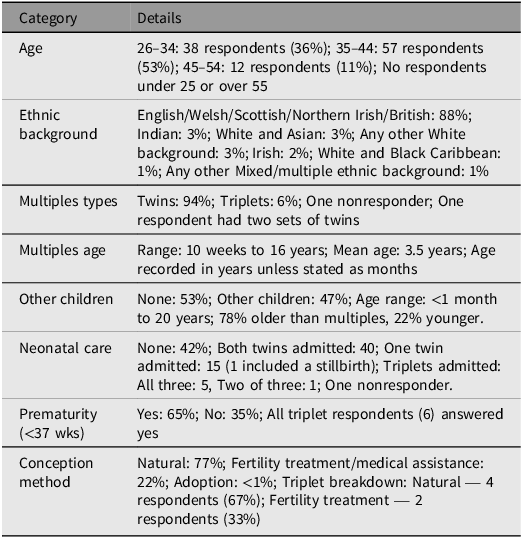
Participants were recruited via the Twins Trust’s Dads of Multiples Facebook page (500+ members). Recruiting through an established online peer–support organisation has been shown to effectively support recruitment from specific demographics and reduce the necessary recruitment period, while also enabling access to a geographically dispersed group (Whitaker et al., Reference Whitaker, Stevelink and Fear2017). Private groups with highly specific purposes also somewhat protect against the growing phenomenon of fake participants, although not guaranteed (Jean Louis & Thompson, Reference Jean Louis and Thompson2025). The survey remained open for 5 weeks, and 107 responses were received. Due to funding and time constraints, data saturation did not guide the sample size. This is consistent with contemporary qualitative guidance, as saturation is not considered an appropriate or achievable goal in reflexive thematic analysis, which prioritises depth, richness and meaning-making (Braun & Clarke, Reference Braun and Clarke2022). Instead, sample adequacy was informed by ‘information power’, whereby the more relevant, specific and rich the data are for addressing the study aim, the fewer participants are required (Malterud et al., Reference Malterud, Siersma and Guassora2016). Participants were anonymised automatically on submission and were eligible for a £10 voucher upon survey completion (100 available). Measures were taken to discourage multiple submissions, although anonymity introduced a minor duplication risk. Table 1 reports demographic information.
Demographic information

Table 1. Long description
The table presents demographic information of survey participants in a structured format with two columns: Category and Details. The Categories include Age, Ethnic background, Multiples types, Multiples age, Other children, Neonatal care, Prematurity, and Conception method. The Details column provides specific data for each category. For Age, the data is divided into three ranges: 26-34, 35-44, and 45-54, with corresponding respondent counts. Ethnic background lists various groups with their respective percentages. Multiples types include Twins and Triplets with percentages and additional notes. Multiples age provides a range and mean age. Other children data includes percentages of respondents with no other children and those with other children, along with age ranges. Neonatal care details the percentage of respondents with no neonatal care and those with various levels of care. Prematurity indicates the percentage of premature births. Conception method lists natural, fertility treatment/medical assistance, and adoption with corresponding percentages.
Data collection
Twins Trust, the leading UK multiple birth charity, reviewed the survey instrument before dissemination. Responses were recorded in OnlineSurveys and exported to Excel and NVivo for analysis. The survey was designed to take 10–15 minutes, though completion time varied due to open-ended questions. The combination of closed and open-ended items enabled both descriptive insights and demographic profiling, illustrating how mixed-format questionnaires can generate structured population data while capturing nuance (O’Cathain & Thomas, Reference O’Cathain and Thomas2004).
Data Analysis
The analysis followed Braun and Clarke’s (Reference Braun and Clarke2022) reflexive thematic analysis, understanding coding and theme development as an interpretive process shaped by the dataset, the researchers’ assumptions and their analytical skills. Because different researchers inevitably bring different perspectives, this approach emphasizes reflexive, thoughtful engagement with the data. Here, multiple researchers contributed to the analysis, consistent with the view that qualitative analysis does not aim to produce a single ‘correct’ reading (Braun & Clarke, Reference Braun and Clarke2022). [A1] generated descriptive statistics, which [A2] verified. [A1 and A2] independently inductively coded and themed the data, then compared interpretations and decided on the final themes. [A3] reviewed the preliminary themes, and all the authors collaboratively refined them through iterative discussion.
To better understand the sociological drivers behind the findings, the authors engaged with Nahapiet and Ghoshal’s (Reference Nahapiet and Ghoshal1998) tripartite model of structural, relational and cognitive social capital. This approach is consistent with recognized qualitative practice where inductively coded data can be reinterpreted through theoretical frameworks (Braun & Clarke, Reference Braun and Clarke2022).
Owing to the larger sample size and the focus on patterns of meaning rather than participant-level comparison, as intended by reflexive thematic analysis, quotations are presented without participant identifiers. Consistent with qualitative reporting guidance, quotations are used to illuminate and support analytic interpretations rather than to facilitate participant counting (Braun & Clarke, Reference Braun and Clarke2022; Sandelowski, Reference Sandelowski1994). All quotations are presented verbatim. The authors reviewed the presentation of quotations and ensured that a broad range of participants are represented across the reported themes. Additional quotations are presented in Table 2.
Quotations

Table 2. Long description
The table has 10 rows and 4 columns. The columns are labeled Theme, Subtheme, Quotation, and Page. The table presents quotations without participant identifiers, focusing on patterns of meaning. Each row lists a theme, subtheme, quotation, and page number. The quotations are used to support analytic interpretations and represent a broad range of participants. The table includes themes such as ‘Incapacitating and unpredictable pain,’ ‘The relentless emotional toll,’ ‘Mental health,’ ‘Self-care,’ ‘Surviving mentally,’ ‘Visibility of needs,’ ‘Instrumental support needs,’ ‘Length of need,’ ‘Seeking the support of family and friends,’ and ‘Addressing the deficit.’ Each theme is broken down into subthemes with corresponding quotations and page numbers.
Ethical Considerations
Ethical approval for the study was granted by the University Faculty Academic Ethics Committee ([name redacted]/#12977/sub1/Fu/2024/Mar/[Faculty redacted] Pilot Application 2024). The survey was conducted in accordance with the principles of the Declaration of Helsinki, the Data Protection Act 2018, General Data Protection Regulation (GDPR) 2016, and University research governance procedures (Data Protection Act 2018; European Parliament & Council of the European Union, 2016; World Medical Association, 2013).
Participation was entirely voluntary. Recruitment was facilitated through Twins Trust via a post in the Twins Trust Dads of Multiples Facebook group. Before accessing the survey, participants were provided with a participant information sheet outlining the purpose of the study, what participation involved, how the data would be used, potential risks and benefits to participating, confidentiality arrangements, their right to withdraw and the withdrawal process. Participants were required to provide informed consent electronically before proceeding to the survey. Participants were informed that they could stop completing the survey at any time without penalty. Following submission, participants were issued with a unique survey receipt number that enabled withdrawal of their data prior to analysis using an administrative email address to avoid identifying information (such as email) being given to the researchers.
Given the potentially sensitive nature of discussing parenting experiences and support needs, information regarding support services was provided at both the beginning and end of the survey. Participants were signposted to Twins Trust’s Twinline service, NHS support services and relevant family support organisations should participation raise any concerns or distress.
The survey was designed to maximise anonymity. No directly identifying information was collected within survey responses, and participants were advised not to disclose identifying details within open-ended responses. Any potentially identifying information included in free-text responses was removed during data preparation. To facilitate administration of participant vouchers while preserving anonymity, email addresses were collected through a separate form that was accessible only to an independent administrator. Researchers did not have access to these email addresses and were therefore unable to link participant identities to survey responses.
The survey collected limited special category personal data, including information relating to ethnicity and maternal and infant health experiences (e.g., prematurity and neonatal care). These data were collected only where relevant to the research objectives and were processed in accordance with the Data Protection Act (2018) and the UK General Data Protection Regulation (GDPR) 2016 (European Parliament and Council of the European Union, 2016). Survey responses were pseudonymized at the point of submission through the assignment of unique participant identification numbers, with any potentially identifying information removed from free-text responses before analysis at the data cleaning stage. Access to the data was restricted to the research team and stored on encrypted, password-protected University systems. No identifiable personal or health information was reported in publications or presentations arising from the study. Following completion of the project, anonymised datasets will be retained and destroyed in accordance with the university’s data retention policy.
Gender identity was not collected, and participants were included through self-identification as fathers; therefore, we cannot know whether participants were cis, trans or nonbinary. However, the study was not designed to explore gender-diverse parenting experiences. Research in this area suggests that transgender and nonbinary parents often navigate distinct contexts and benefit from research specifically designed to account for this (Goldberg, Reference Goldberg2020).
Verbatim quotations have been used in reporting the findings to illustrate analytic themes. Quotations were selected based on their ability to clearly represent patterns identified across the dataset rather than the characteristics of individual participants. All quotations were reviewed to ensure that they could not reasonably identify participants before publication.
Rigor and Reflexivity
All authors were female and have experience with qualitative and quantitative methods, with A1 and A2 having lived experience within multiple birth families. These positionalities informed their topic sensitivity and supported empathetic and informed data engagement. Reflexive awareness was maintained throughout, with the researchers considering how their experiences and assumptions might shape interpretation during analysis. Participants were not known to the researchers before recruitment, limiting any influence of pre–existing relationships and social desirability bias (Bergen & Labonté, Reference Bergen and Labonté2020).
Trustworthiness was considered using Lincoln and Guba’s (Reference Lincoln and Guba1985) criteria of credibility, transferability, dependability and confirmability. Credibility was enhanced through stakeholder review of the survey by Twins Trust staff and multiple birth fathers to assess its suitability and comprehensibility, collaborative coding and regular discussions between researchers. Transparency around transferability was supported through the inclusion of a large sample of fathers from multiple birth families and detailed contextual reporting. Dependability was promoted using a documented analytical process and systematic coding procedures. Confirmability was enhanced through researcher reflexivity, co-analysis and discussion of interpretations among the research team, alongside the inclusion of verbatim quotations both in the text and within an additional table.
Results
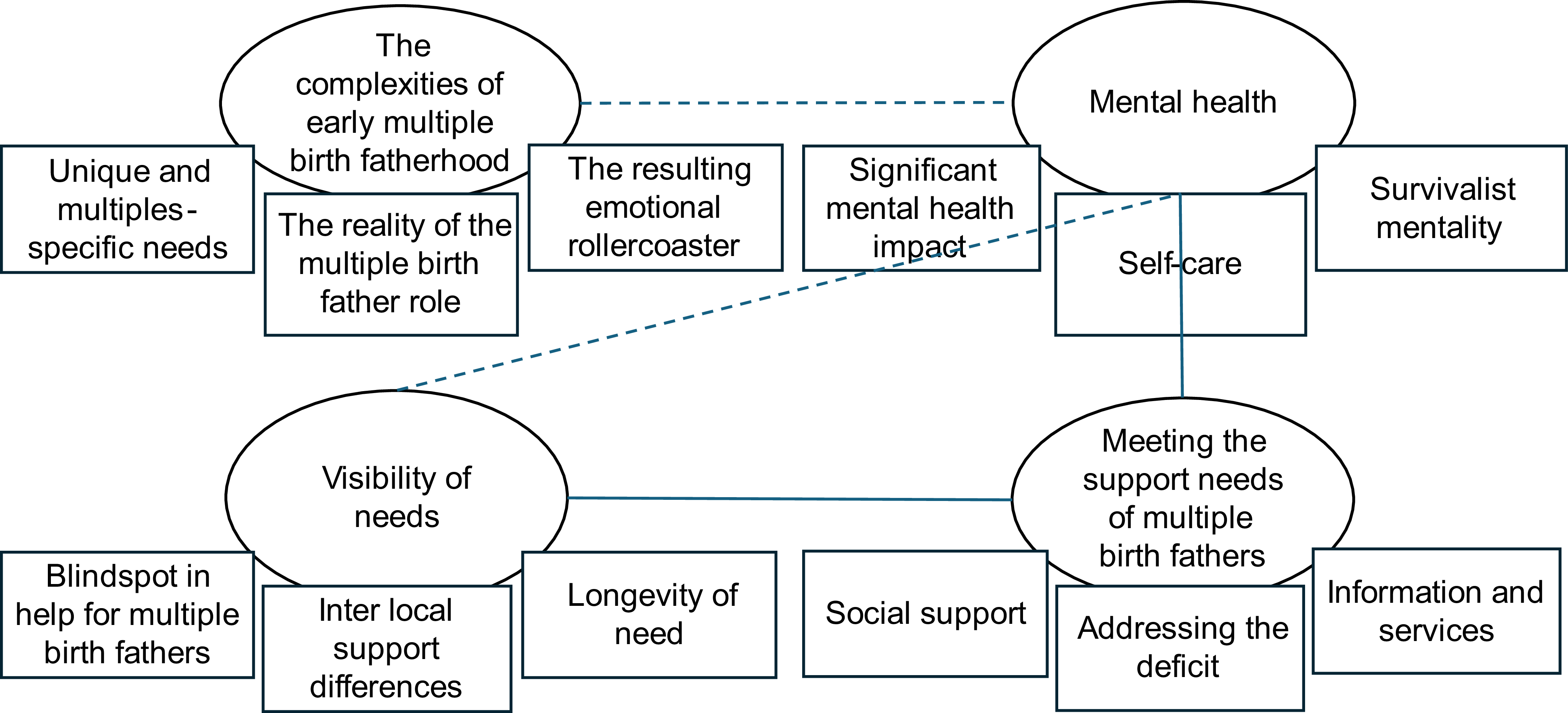
Four main themes emerged from the initial analysis: ‘the complexities of early multiple birth fatherhood’, ‘mental health’, ‘visibility of needs’ and ‘meeting the support needs of multiple birth fathers’. Within each theme emerged three subthemes, which are presented in turn. For respondents, 51% felt their needs were different to their partners’. Figure 1 displays the themes. Table 2 displays additional quotations.
Thematic map.
Note: Ovals = themes. Rectangles = subthemes. Subthemes related to each theme overlap with the relevant oval. Solid lines reflect ‘Meeting the support needs of multiple birth fathers’ positively impacting the other two themes. Dashed lines reflect the themes negatively impacting one another.

The Complexities of Early Multiple Birth Fatherhood
The early years of raising multiples brought complexities and challenges. Respondents conveyed the realities of multiple birth fatherhood, juggling practical, emotional and financial demands. This impacted their lives in substantial ways, triggering a range of emotions. Three subthemes emerged: ‘unique and multiples-specific needs’, ‘the reality of the multiple birth father role’ and ‘the resulting emotional rollercoaster’. Largely, respondents felt that these complexities had not been conveyed to them effectively or accurately, being poorly understood by those outside of their circumstances.
Unique and multiples-specific needs
Often the word ‘unique’ was invoked to describe the experience of having multiples, noting that ‘having multiples is so unique that unless you have them, you cannot really empathise or sympathise in the same way’. While many expressed pride and joy, fathers also emphasised the experience’s intensity: ‘it’s unique, and I love it, but when it’s hard, it’s doubly hard’. Respondents felt it was difficult to relate to or be understood by singleton fathers, expressing that ‘I have friends who are fathers of single babies who share their experiences with me, and it makes me realise how different being a father of multiples can be’, their lives seemed ‘so much more straightforward’.
The reality of the multiple birth father role
Many respondents were time-poor, getting little sleep and feeling exhausted, noting how the ‘first year — has been mainly pure survival mode’ with ‘not more than 3−4 hours of sleep’. Lastly, financial strain was common, resulting from buying multiples of everything and childcare costs. Fathers noted that ‘the financial implications of being a twin parent cannot be overstated’ and that ‘although both my wife and I work, and I earn an above-average salary, there have been times of extreme financial stress’.
The resulting emotional rollercoaster
These pressures produced an emotional landscape that fathers described as a ‘real rollercoaster’. The combination of exhaustion, competing demands and limited time meant fathers experienced ‘incredibly tough times’, yet this was balanced by moments of joy and pride. Many described the experience as ‘extremely challenging but also incredibly rewarding’ with ‘amazing memories … but also the hardest times of our lives!’.
Mental health
For some respondents, the demands of raising multiples had significant negative impacts on their mental health, which they felt were not reflected in the support available. Three subthemes were identified: ‘significant mental health impact’, ‘self–care’ and ‘survivalist mentality’.
Significant mental health impact
Respondents described how the demands of the early years often compounded and negatively impacted their mental health, often finding inadequate support. Fathers shared that they ‘found mental health really struggled, didn’t have any real support to manage’ and some ‘needed to access mental health support after 8 weeks or so … totally exhausted and stretched to breaking point’. Multiple birth pregnancies present a higher risk of prematurity, disability and neonatal or special care admission, and the fathers experiencing these events had additional emotional strains. One father noted that ‘the initial trauma surrounding [the babies’] premature birth was very difficult mentally, as I had to navigate becoming a first-time father with the stress of neonatal care’. Fathers were cognisant of not giving elder children ‘as much attention as we would have liked’ and that ‘parent guilt is 10x more with multiples — it’s really hard to meet all of their needs’. Furthermore, fathers worried for their partner and navigating supporting them, ‘my partner was struggling, and I wasn’t prepared or had the knowledge to fully help’.
Self-care
Respondents often struggled to find the time or energy to meet their own needs. This could bring a sense of loss for activities they enjoyed or of their prebirth identity. One father went ‘from playing sport/exercising 4/5 times a week to once, if I’m lucky’, noting how ‘[it] is a hard transition in the short term, particularly when the babies don’t give much in return’. The challenges of multiple birth parenthood could lead to strained personal and familial relationships. Respondents noted that ‘relationships may suffer, as multiples are very stressful’ and that ‘relationships will be pushed to the absolute limit’. Some expressed that ‘I’ve lost a lot of my identity, it feels, and it’s very hard’. Others advised to ‘make time for self-care’, while acknowledging the difficulty of that.
Survivalist mentality
To cope, many respondents described adopting a ‘survivalist mentality’, focused on ‘getting through the day’. Some fathers did not seek external support for mental health challenges, suffering in silence and saying they ‘pretty much got on with it on our own’ or received ‘very minimal support for myself [while] focused on supporting my wife, raising the children and earning a living’. Several reflected that: ‘I probably should have’ sought help. Others found that when they did seek support, it was inadequate: ‘When I sought support through more traditional routes (i.e., my GP), I found most of the provision generic and unhelpful.’
Visibility of Needs
Although experiences varied, some respondents faced a lack of multiples-specific support across hospitals, workplaces, the community, and policy, including paternity leave. Notably, experiences of local support services varied widely. Some fathers expressed having a good social support network, while others did not. Furthermore, some fathers experienced a longevity of need and significant challenges. Three subthemes emerged: ‘the blind spot in support for multiple birth fathers’, ‘interlocal support differences’ and ‘the longevity of need’.
The blind spot in support for multiple birth fathers
Many respondents had received little to no support offers during the early years and felt overlooked, stating that ‘all the support is aimed at mums’ and that ‘there’s no safeguards in place to check how [fathers] are doing’. Peer support, antenatal groups and social media spaces were often perceived as mother-focused: ‘My wife has contact with many other twin mums … family and friends seem much more easily accessible for mums’. Fathers also felt their role was not recognised by various professional services, with assumptions that dads were more ‘hands off’: ‘No community professional has ever asked about my wellbeing … it’s naturally assumed I do less childcare.’
Interlocal support differences
Across workplaces and local services, support varied considerably between respondents. Some respondents had flexible employers, noting that ‘flexibility at work was a big help’, while others faced inflexibility and a lack of understanding, stating ‘It was a real challenge to get flexitime as a father to look after children regularly’ and ‘no support from work, despite needing more flexibility’. Experiences with professional support were similarly mixed. Some respondents had positive experiences with hospital and community support, noting ‘generally my experience of accessing support has been very positive’ and that ‘the NHS saved our children’, while others had negative experiences. Health visiting support ranged from ‘fantastic’ to ‘universally useless’, with some fathers reporting only a single visit, or professionals with no knowledge of supporting multiple births.
Longevity of need
Not all fathers felt they needed ongoing support, with some noting that ‘now that the twins are older (they are eight), I think we’re much happier, the relationship with my wife is much better’ or that ‘things definitely got easier when they came towards the end of [the early] period’. Nevertheless, some fathers described a continued need for support, including during subsequent pregnancies, disability diagnoses, or school transitions. There was a view that available support lacked longevity: ‘the support wanes, which is difficult as the needs of looking after multiples do not diminish because they are older’.
Meeting the Support Needs of Multiple Birth Fathers
Fathers’ experiences and emotional wellbeing were notably better when they received positive, informed and impactful support. Alongside professional support, fathers also valued social support, including that from family, friends, and peer networks. Again, there were disparities in access to and availability of social support. Respondents expressed interest in developing existing online networks to include local support networks, both in-person and online, and highlighted the need for multiples–specific information and services. Three subthemes are discussed: ‘Social support’, ‘Addressing the deficit’ and ‘Information and services’.
Social support
Fathers valued social support, though their networks varied considerably. Those with strong support described it as transformative: ‘Family and friends have been amazing, and we’d be much worse off without their time and help.’ Fathers without such support felt it would have made a significant difference: ‘I would have spent far more time setting up a support network before the birth if I knew what I know now.’ Many felt that people without multiples ‘don’t really seem to get it’ and that ‘offers of support from family/friends were not as forthcoming as we experienced with our singleton’.
Addressing the deficit
Fathers voiced a need to address the gaps in all social support options for multiple birth fathers, wanting flexible approaches and different modes of support. They expressed the need for ‘local chapters so we can have dad meetups with and without twins to build a real network’. Reflecting the time-poor reality of multiple birth fatherhood, respondents showed interest in having ‘one-to-one calls and activities’ and ‘more offline asynchronous messaging and discussion groups’. Flexibility around work and family arrangements was important. Although many had not heard of existing peer–support services, they expressed strong interest in such provision.
Information and services
Fathers described the information and services that they felt would be helpful, focusing on addressing their invisibility and the support deficits they experienced. Respondents wanted advice on subjects including ‘how to support their partner’, ‘how to restart doing things for yourself without feeling guilty for leaving your partner’, baby and parental sleep, and finances, alongside avenues for securing better financial support. As above, mental health support availability, promotion and access were all deficits that fathers wanted addressed, with a respondent stating they needed ‘any and all mental health support’. Fathers wanted clearer signposting and support that recognised the specific challenges of multiple birth fatherhood: ‘More impetus on letting fathers know that there is support available.’
Discussion
Nahapiet and Ghoshal’s (Reference Nahapiet and Ghoshal1998) social capital framework provides a useful lens for understanding the drivers and multilevel forces behind the fathers’ parenting experiences (Burgess & Goldman, Reference Burgess and Goldman2022). The framework distinguishes between structural (institutional resources and formal supports), relational (interpersonal ties, trust and reciprocity) and cognitive social capital (shared meanings, norms and identities). Across the dataset, deficits in structural support, uneven relational resources, and a lack of shared understanding from those without multiples were discussed as key social determinants of mental health and wellbeing. These multilevel deficits mirror international patterns of paternal invisibility and gaps in father–inclusive perinatal care, while also being influenced by mechanisms coloured by the context of the UK (Burgess & Goldman, Reference Burgess and Goldman2022).
For participants, structural social capital was weakened by limited statutory paternity leave, limited financial support, slow, suboptimal or absent referral pathways for paternal mental health, and variable employer responsiveness. Fathers of twins in Finland have similarly reported requiring greater recognition within maternity and child healthcare services, more tailored support, and service provision that better reflects the realities of simultaneously caring for multiple infants (Heinonen, Reference Heinonen2022, Reference Heinonen2024). Both studies therefore highlight the importance of structural support systems that recognize fathers as active caregivers within multiple birth families, despite participants having experience with different healthcare systems. Finland has a tax-funded, decentralized universal healthcare system organized through wellbeing services counties, compared to the point-of-access National Health Service model used in the UK (Wendt, Reference Wendt2009).
However, while Heinonen’s (Reference Heinonen2022, Reference Heinonen2024) work primarily emphasised fathers’ inclusion within healthcare services, fathers in the present study additionally highlighted the influence of UK-specific policy and employment factors, particularly limited paternity leave, financial pressures and inconsistent access to support. This difference could be indicative of Finland’s more extensive state welfare and family support systems, illustrating the centrality of this support to multiple birth families (Lammi-Taskula, Reference Lammi-Taskula, Arnalds, Duvander and Lammi-Taskula2025). The variation in support available was also a key topic of discussion within this study, while the Finnish work does not report the same levels of variation (Heinonen, Reference Heinonen2022, Reference Heinonen2024). This finding does reflect wider work conducted in the UK that highlights the local variation in maternity and health service provision, particularly for multiple births (Hibberd et al., Reference Hibberd, Burlingham, Denton, Turville, Bagness and Bailey2022; Ockenden, Reference Ockenden2026).
Despite a few exceptions, including France, Spain, Croatia, Sweden, and Finland, most European countries do not provide additional time or flexibility to fathers of multiples (European Parliament Research Service, 2026; Forsäkringskassan, 2024; Gobierno de España, Reference de España2019; Gouvernement de la République Française, 2022; Lammi-Taskula, Reference Lammi-Taskula, Arnalds, Duvander and Lammi-Taskula2025). Interestingly, Belgium and Portugal provide additional maternity leave considerations but do not extend the policy to fathers (European Parliament Research Service, 2026). Existing work has highlighted an underlying tension between traditional assumptions that position mothers as primary caregivers and fathers as secondary supporters, and the realities of multiple birth family life (Twins Trust, 2024). This work shows how such constraints reduce access to formal support and intensify early years pressures in the UK.
Research on multiple birth families consistently demonstrates that the simultaneous care of two or more infants often necessitates a highly collaborative model of parenting, in which successful family functioning relies on shared caregiving, strong coparenting relationships and mutual support between parents (De Roose et al., Reference De Roose, Beeckman, Eggermont, Vanhouche, Van Hecke and Verhaeghe2018; Kotera et al., Reference Kotera, Kaluzeviciute and Bennett-Viliardos2022; Pierce, Reference Pierce2014). These findings presented here are broadly consistent with Kotera et al. (Reference Kotera, Kaluzeviciute and Bennett-Viliardos2022), who identified finance, mental and physical health-related concerns and support networks as important issues for parents of triplets in both Japan and the UK. The present study extends this evidence through a substantially larger fathers-only sample, suggesting that these challenges are not restricted to triplet families and remain highly relevant for fathers of twins. Furthermore, the fathers in this sample directly related their poorer experiences with support networks to what they felt was a systematic overlooking of their role by professionals and partners. While De Roose et al. (Reference De Roose, Beeckman, Eggermont, Vanhouche, Van Hecke and Verhaeghe2018) did work with 101 mothers, and Pierce (Reference Pierce2014) with eight mothers of triplets, this work provides a strong companion piece as it revealed barriers to cooperative parenting that the mothers may be unaware of, such as the triple pressure of work, fatherhood and caring for the birthing partner.
Recent research has worked with nurses and health visitors around the provision of support for multiple birth families (Heinonen et al., Reference Heinonen, Kaprio, Trias and Vehviläinen-Julkunen2026; Turville et al., Reference Turville, Alamad, Denton, Cook and Harvey2022). Turville et al. (Reference Turville, Alamad, Denton, Cook and Harvey2022) found that health visitors lacked sufficient training and therefore expertise to provide equitable support for multiple birth families compared to singletons, and Heinonen et al. (Reference Heinonen, Kaprio, Trias and Vehviläinen-Julkunen2026) confirmed that this was also true for the majority of staff in multiple birth clinics in Finland. The work here raises the voices and experiences of fathers to highlight how they are disadvantaged by staff lacking both specialist knowledge and being less likely to have been engaged meaningfully with fathers and father-specific considerations.
While population–level evidence on the relationship between paternity leave and mental health is mixed, subgroup analyses suggest that longer, more accessible leave can improve paternal wellbeing and reduce inequalities (Huerta et al., Reference Huerta, Adema, Baxter, Han, Lausten, Lee and Waldfogel2013; Humphreys et al., Reference Humphreys, O’Neill, Filippi and Courtin2025). For multiple birth families, whose caregiving intensity is inherently higher, policy reform that extends duration, broadens eligibility and promotes concurrent parental leave is warranted. Importantly, evidence suggests that uptake of statutory reform is most effective when supported by shifts in societal norms and employer practices that can sustain behavior change (Aidukaite & Blaziene, Reference Aidukaite and Blaziene2022). Policy process theory and positive deviance approaches suggest that ‘policy windows’ are important junctures that allow effective local practices, such as employer flexibility, specialist multiple birth midwives, and localized financial support schemes, to be identified and scaled (Hibberd et al., Reference Hibberd, Burlingham, Denton, Turville, Bagness and Bailey2022; Kingdon, Reference Kingdon1995). A recent Women and Equalities Committee’s (2025) review into shared parental leave signals a potential policy window. Supporting change, the findings presented here illustrate how pre-existing local mechanisms, driven by employer, council, or Trust awareness, were seen to have made sizable wellbeing differences for many. As above, the finding that the fathers in this study have focused more on significant impacts on their mental health compared with some of the international studies provides additional credence to statutory reform.
For some participants, experiences involving mechanisms of relational social capital included inconsistent professional engagement and uneven informal support networks. Some fathers felt marginalized within maternity pathways, while others described highly positive interactions with health professionals. This work illustrates how the broader experiences of fatherhood identified by Baldwin et al. (Reference Baldwin, Malone, Sandall and Bick2018) and Bateson et al. (Reference Bateson, Darwin, Galdas and Rosan2017) can be made more challenging through multiple birth fatherhood. For example, compared with the fathers in the Baldwin et al. (Reference Baldwin, Malone, Sandall and Bick2018) study, the fathers reported many of the same challenges, but at a greater intensity, frequency and duration, beyond their initial expectations.
For participants, inconsistent or dismissive responses from peers or professionals could weaken existing relational protections, such as access to a primary healthcare professional. In such circumstances, it is understood that professional assumptions like fathers being ‘secondary’ caregivers can limit help–seeking, as reported by Connell (Reference Connell1995) and Darwin et al. (Reference Darwin, Domoney, Iles, Bristow, Siew and Sethna2021). Here, fathers’ accounts of feeling invisible reflect how relational social capital is shaped not only by interpersonal interactions but also by the gendered design of services and the assumptions that follow.
Fathers also emphasised the importance of connecting with peers who were also multiple birth parents, representing the positive impact of cognitive social capital on their experiences (Nahapiet & Ghoshal, Reference Nahapiet and Ghoshal1998). Many participants described feeling that these mutual experiences were necessary for there to be a deep understanding of the realities of their lives, sometimes leading to frustration, isolation or withdrawal from parents with singletons. Social identity theory helps explain this dynamic, in which identifying with others who share similar life experiences allows for stronger emotional bonds, validates experiences, and facilitates mutual support (Galdas et al., Reference Galdas, Cheater and Marshall2005). Cognitive social capital appears particularly fragile for multiple birth fathers who may face practical and social barriers to engaging in peer support. Kotera et al. (Reference Kotera, Kaluzeviciute and Bennett-Viliardos2022) similarly reported that parents of triplets valued connections with other multiple birth families and regarded shared lived experience as an important source of support. Consequently, this work supports these findings with a larger sample and suggests the importance of these bonds to fathers of twins as well as triplets.
While conducted some time ago, the themes and challenges identified in Jenkins and Coker’s (Reference Jenkins and Coker2010) work disappointingly remain present on the international stage, including difficulties accessing multiples-specific support, isolation within existing peer groups, and exhaustion. The fathers in this study described similar issues with awareness and access to appropriate peer support networks, highlighting how some challenges remain unresolved despite a greater focus on paternal involvement. Unlike the existing studies, the sole focus on multiple birth fathers meant that specific issues relating to peer support for multiple birth fathers could be more intricately considered. Here, some fathers noted that their wives had access to more peer support options, and traditional structures such as mum-groups and play and chat groups did not necessarily make fathers feel welcome or capitalize on the fathers’ interests around sport to allow for more relaxed discussions around the challenges they were experiencing.
This reflects wider sociological discussions regarding the gendered nature of parenting support, whereby parenting spaces and services have historically been constructed around maternal identities and participation, often leaving fathers positioned as peripheral participants (Connell, Reference Connell1995; Dermott, Reference Dermott2008). The findings here also suggest that, despite the additional caregiving pressures, the men’s help-seeking and peer support preferences remain activity-based or purpose-oriented, where conversations can develop more organically during a shared activity rather than through direct discussion of emotions or parenting challenges alone (Galdas et al., Reference Galdas, Cheater and Marshall2005; Darwin et al., Reference Darwin, Domoney, Iles, Bristow, Siew and Sethna2021).
Findings from this survey show that many multiple birth fathers are navigating a complex mix of expectations about what ‘good fatherhood’ looks like. Here, the multiple birth fathers were juggling increased caregiving demands for their babies and for their partners alongside significant financial pressures and demands on their time. This aligns with Lewington et al. (Reference Lewington, Lee and Sebar2021), who show that contemporary fathers often feel caught between traditional masculine norms and newer expectations of emotionally engaged, hands-on parenting, but further explains why multiple birth fathers may feel these pressures more intensely.
In part, strengthening structural and relational social capital requires systematic training for professionals who encounter multiple birth families, including midwives, nurses, GPs and health visitors, to create formalized, timely and informed touchpoints (Clifford–Taylor, Reference Clifford-Taylor2025; Turville et al., Reference Turville, Alamad, Denton, Cook and Harvey2022). Indeed, embedding father–inclusive policies or performance indicators within commissioned services would likely further improve paternal visibility (Burgess & Goldman, Reference Burgess and Goldman2022). However, the broader research gap around multiple birth families limits the evidence available to inform education and commissioning (Burlingham et al., Reference Burlingham, Maguire, Hibberd, Turville, Cowdell and Bailey2024). Even more broadly, maternity care remains predominantly mother–focused despite policy shifts toward family–centred models (Shorey & Ang, Reference Shorey and Ang2019), and perinatal staff can face barriers like a lack of training, time or confidence to meaningfully engage fathers (Baldwin et al., Reference Baldwin, Malone, Sandall and Bick2018; Burgess & Goldman, Reference Burgess and Goldman2022; Darwin et al., Reference Darwin, Domoney, Iles, Bristow, Siew and Sethna2021), reinforcing these deficits.
The consistency of findings across studies from Finland, Belgium, Germany, Japan, the US and the UK suggests that many challenges associated with multiple birth fatherhood may transcend national contexts, although the resources available to fathers appear strongly shaped by local policy, service and cultural environments. Notable differences were evident in the relative prominence of particular challenges. The present study provides the first in-depth exploration of UK multiple birth fathers and revealed a more frequent emphasis on mental health difficulties, financial pressures, employment demands and unmet support needs.
Policy and Practice Implications
While some hospitals have developed better provision of multiples-specific support, it varies nationally (Hibberd et al., Reference Hibberd, Burlingham, Denton, Turville, Bagness and Bailey2022). This study has highlighted and explored how a persistent ‘blind spot’, seen in the international arena, in multiple births support, is echoed in the lives of UK-based fathers and national policy and practice. Fathers should be included across the perinatal and parental support landscapes, with professionals attentive to their physical and mental wellbeing.
To address gaps, we recommend:
-
• Multiples-specific education and training for professionals to raise awareness of fathers’ experiences and support early identification of distress.
-
• Father-inclusive perinatal and postnatal care, recognising systemic influences of masculinity and caregiving norms.
-
• Timely, accessible, and tailored mental health support.
This research underscores the need for policy reform in several areas:
-
• Paternity leave: Duration should reflect the complex demands of multiple birth parenting, enabling fathers to bond with their children and support their partners.
-
• Workplace flexibility: Employers should be guided by policy to offer adaptable working arrangements.
-
• Financial support: Enhanced assistance is needed to offset the substantial costs of caring for two or more infants simultaneously, including childcare, equipment, and healthcare-related expenses.
Strengths and Limitations
A key strength is the researchers’ lived experiences of multiple birth families, which informed the study design and reflexivity. Collaboration with Twins Trust enhanced the study’s relevance and alignment with the needs of the multiple birth family community. The online qualitative survey enabled access to a geographically dispersed population, generating a sizable dataset to explore a breadth of experiences.
However, several limitations should be acknowledged. Recruitment through Twins Trust’s peer-support networks may have introduced selection bias, attracting fathers who were already engaged with support services or who had the time, resources and digital literacy to participate in the study. All respondents were English-speaking and had internet access, and the sample lacked age diversity, with no participants aged under 25 or over 55. Representation of triplet and higher-order multiple families was limited, and only one family had adopted their multiples. These factors may limit transferability; however, the study provides insights into an under-researched population.
Conclusion
This study offers new insights into how intensified practical, emotional and financial demands shape multiple birth fathers’ wellbeing in the UK. Fathers described navigating early parenthood with limited statutory entitlements, inconsistent professional engagement and limited social networks. Interpreted through a social capital lens, these accounts reveal interconnected deficits in structural, relational and cognitive resources that constrain fathers’ visibility, access to support and capacity to safeguard their mental health. Although grounded in the UK context, these patterns reflect wider international gaps in father–inclusive perinatal care. Comparisons with studies from Finland, Belgium, Germany, Japan and the United States suggest that while many challenges associated with multiple birth fatherhood transcend national boundaries, UK fathers appear to place particular emphasis on financial strain, mental health difficulties and unmet support needs, highlighting the influence of policy and service contexts on parental experiences. Addressing these deficits requires coordinated structural and social change, namely a strengthening of available resources to promote healthier outcomes for these families.
Acknowledgments
This study received internal funding from Birmingham City University. The authors thank Twins Trust for their support and experience with this study. The authors thank all the multiple birth fathers who participated in this study for their time.
Funding statement
The author(s) received no financial support for the research, authorship, and/or publication of this article.
Competing interests
The author(s) declared no potential conflicts of interest with respect to the research, authorship and/or publication of this article.
Declaration of generative AI and AI-assisted technologies in the manuscript preparation process
During the preparation of this work the authors used Microsoft Co-pilot to improve language and readability. The authors reviewed and edited the content as needed and take full responsibility for the content.


 Open access

