1. Introduction
Among the hottest policy issues currently discussed by global leaders in national legislations and international summits, foreign aid and oil taxation occupy a fairly important place. Persistent revenue discrepancies between high- and low-income countries sustain a demand for higher international redistribution through foreign aid. Important budget deficits faced by many high-income countries in the wake of the global economic crisis, as well as environmental concerns, are likely to lead to tax increases, in particular, taxes on oil products. These taxes affect the revenues of oil exporting countries, some of which are low-income countries and recipients of foreign aid. The joint impact of aid and oil taxes on the revenues of both developed and developing countries needs to be understood and taken into account by policy makers in order to avoid inefficiencies resulting from policies offsetting the effects of each other. This paper analyzes the interaction of oil-rich and oil-poor countries via oil taxation and foreign aid policies and shows that an inefficiency arises from lack of coordination.
Industrialized countries collect considerable fiscal revenues by highly taxing oil products. The part consisting of taxes in the final price of a barrel was around 45 per cent in the G7 countries in 2007 (OPEC, 2008). These fiscal revenues represent 6.5 per cent of governments' earnings in the EU15 and 6 per cent in the OECD (International Energy Agency, 2001). However, these taxes capture a part of oil producing countries' rents. According to the Organization of the Petroleum Exporting Countries (OPEC), G7's fiscal revenues from oil products taxation between 2003 and 2007, US$ 2,585 billion, exceeded oil producers' US$ 2,539 billion revenues (OPEC, 2008). These figures suggest, for example, that during this period the G7 captured around US$ 15 billion per year from the oil revenues of a country such as Nigeria, which produces 3 per cent of the oil consumed in the world.Footnote 1
Many oil producers are low- or middle-income countries with important inequality levels. The average per capita Gross National Income (GNI) in the 19 countries with the largest crude oil reserves per capita was less than US$ 5,800 in 2005 (PennWell Corporation, 2004; World Bank, 2010). In these countries, oil rents often benefit a small, powerful group, while the rest of the population remains poor. In Nigeria, for example, 70 per cent of the population live on less than one dollar a day. In 2006, this country received nearly US$ 10 billion of foreign aid from the G7 (OECD, 2010). This amount is comparable with our estimation of US$ 15 billion captured by the G7 from Nigeria through oil taxes. In the same year, the G7 disbursed US$ 114 million to Algeria, US$ 94 million to Ecuador, US$ 48 million to Iran and US$ 25 million to Venezuela (OECD, 2010).
Oil taxes are very low or even negative in low-income oil producing countries. For example, in Nigeria, Algeria, Iran and Venezuela, oil is subsidized. The gap in the oil tax rates between developed oil consuming countries and developing oil producing countries is statistically significant (Bacon, Reference Bacon2001).
The gap in oil tax rates between high-income oil consuming countries and low-income oil producing countries leads to inefficiencies in the global allocation of oil. When the final price of oil differs across regions, oil is not used where it is most productive.
The situation depicted above suggests a lack of coordination between rich oil consuming countries and poor oil producing countries. High oil taxes in rich countries distort the allocation of oil and take back through fiscal revenues some of the foreign aid transfers to those poor countries.
This paper proposes a theoretical framework capturing the stylized facts described above and suggests a welfare improving policy coordination mechanism. The theoretical framework is based on standard assumptions borrowed from development and resource economics literatures.
Development economists have extensively studied the motivations and the impact of foreign aid in the past decades. They have shown that aid is given for a combination of altruistic and self-interest motives, the weight between the two varying with the donor (Alesina and Dollar, Reference Alesina and Dollar2000; Berthelemy, Reference Berthelemy2006). The altruistic motivation is related to a moral demand for redistribution when income gaps are important. In this context, foreign aid plays a similar role at the international level to progressive income taxes and social security institutions at the national level (Mosley, Reference Mosley1987). The selfish motivation for aid giving is the defense of the donors' own interests. These interests can be geopolitical (Alesina and Dollar, Reference Alesina and Dollar2000; Stone, Reference Stone2004; Dreher and Jensen, Reference Dreher and Jensen2007), commercial (Fleck and Kilby, Reference Fleck and Kilby2006; Villanger, Reference Villanger2006) or security related (Azam and Thelen, Reference Azam and Thelen2008). Lahiri et al. (Reference Lahiri, Raimondos-Møller, Wong and Woodland2002) suggest another selfish trade related motive for aid: aid may reduce the recipient's optimal tariff. Then, tying the aid to a reduction in the recipient's tariff is Pareto improving. In contrast, the present paper suggests aid and the donor's tariff to be complementary for achieving some redistribution objective. As we shall see, tying the donor's tariff to the redistributive objective will then turn out to be Pareto improving. Following Azam and Laffont (Reference Azam and Laffont2003), we assume a purely altruistic motivation for aid giving and we model foreign aid as a lump sum transfer that reduces the donor's revenues and increases those of the recipient by the same amount. In this paper, aid has no other impact than revenue redistribution from the donor to the recipient. In particular, it does not affect the recipient country's policies or growth rate.Footnote 2
Resource economists have extensively studied the effects of non-renewable resource taxation using dynamic models of resource depletion.Footnote 3 Some scholars have focused on the redistributive impact of such taxes. The seminal paper by Bergstrom (Reference Bergstrom1982) shows that, by taxing oil consumption, oil consuming countries can extract the entire oil rent from an oil producing country which is not using the resource itself: specifically, a constant ad valorem tax applied on the entire consumption of a costlessly extracted non-renewable resource induces the producer price (unit resource rent) to decrease while affecting neither the final price, nor the extracted quantity, at any date. The fixity of reserves gives consumption taxes a rent capturing dimension. Brander and Djajic (Reference Brander and Djajic1983) show that this rent-extraction ability is mitigated if oil producers can use the resource themselves. Sinn (Reference Sinn2008) makes it clear that the strong distributional effect of oil taxation stems from the inelasticity of the resource supply induced by the exhaustibility constraint. This literature convincingly accounts for the gap between oil tax rates in oil importing and oil exporting regions and for the related rent capture by the former at the expense of the latter. This reasoning is robust to the introduction of environmental considerations. Amundsen and Schöb (Reference Amundsen and Schöb1999) show that the incentives of oil importing countries to overtax oil use remain even if the resource use generates a flow of local pollution. Daubanes and Grimaud (Reference Daubanes and Grimaud2010) consider the case of a global stock of pollution. In this paper we abstract from pollution externalities generated by oil use in order to focus on the redistributive effect of taxes. Under some restrictions, Bergstrom's (1982) exposition highlights the isomorphism between the tax competition problem in a Hotelling model and in a static model where oil supply is perfectly inelastic. Following Bergstrom and the above conventional literature on the issue, we adopt a dynamic representation of oil extraction.Footnote 4 On top of the inter-country heterogeneity in oil endowments examined by this environmental economics literature, we consider intra-country heterogeneity, i.e., the coexistence of rich resource holders and poor workers in the oil producing country. Moreover, we introduce international altruism and international redistribution instruments.
We formalize the interactions between a rich oil importing country (North) and a poor oil exporting country (South) using a dynamic general equilibrium model of resource depletion. The model is based on the following assumptions. Both countries produce a final good using labor and oil. The North is composed of high-productivity workers, while the South is composed of low-productivity workers and oil owners. Northern workers are altruistic towards southern workers. The policy instruments used by the authorities are oil taxes and foreign aid. We show that, without coordination, the northern government overtaxes oil, extracts rents from the southern oil owners and disburses foreign aid to the southern workers. After investigating the inefficiencies of this equilibrium, we show that a coordination mechanism that consists of a contract proposed by the northern authorities to the southern authorities can correct them. Through such a contract, northern authorities reduce taxes on oil from the South. This increases global output due to a more efficient allocation of oil. It also reduces northern fiscal revenues and leaves higher rents to the oil owners. As a counterpart, southern authorities redistribute the additional oil rents to the southern workers, thus reducing the need for foreign aid. We show that this redistribution scheme increases efficiency and is Pareto improving.
The rest of the paper is organized as follows. The model is presented in section 2. The general equilibrium for given policy instruments is solved in section 3. The choice of oil tax rates and foreign aid by the governments in the absence of coordination is examined in section 4. The coordination mechanism is presented in section 5. Section 6 discusses a number of real world issues that are absent from our model. Finally, section 7 concludes.
2. The model
At each date t ≥ 0, one final good is produced in both countries using labor and oil. The aggregate production functions areFootnote 5

where A i is an index of labor productivity, L i is the quantity of labor employed and R i is the quantity of oil used by the final sector firms of country i.
The index of labor productivity in the South is a constant fraction of that in the North. The growth rate of these indexes is exogenously given and constant:Footnote 6, Footnote 7

Oil is extracted at no cost from a finite initial stock Q 0:

The northern population is composed of L N identical agents who are each endowed with one unit of labor. The southern population is composed of one group of L S workers (southern poor) who are each endowed with one unit of labor and one group of resource holders (southern rich) who own the oil stock Q 0. The size of the latter group is normalized to unity. The population of each group, and thus their labor quantity, is assumed to be constant over time; there is no inter-group mobility.Footnote 8
All individuals are infinitely lived. The instantaneous consumption levels of the northern workers, the southern poor and the southern rich are respectively denoted by C N, C SP and C SR. The lifetime preferences of the representative agents of each group are represented by the utility functions:


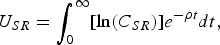
where 0 < ρ< 1 is the intertemporal discount rate common to all groups and δ ≥ 0 is the altruism rate of the northern citizens towards the southern poor.
The global constraint on the use of the final good is

There are world competitive markets for the final good and for oil, a world competitive financial market and local competitive labor markets.Footnote 9 The final good price is normalized to unity and we denote by p, r, w N and w S, the world oil price, the interest rate and the wages in the North and South respectively.
We assume that the northern government represents the northern citizens whereas the southern government only represents the resource holders, who constitute an elite close to the power.Footnote 10 The governments seek to maximize the utility function of the group they represent.
The authorities can impose constantFootnote 11 ad valorem taxes on the local use of oil. We denote the oil tax rates by θi > −1, i = N, S. Then, the consumer oil prices are (θN + 1)p in the North and (θS + 1)p in the South. The fiscal revenues θNpR N and θSpR S are respectively redistributed to the northern citizens and to the southern resource holders.
Finally, we assume that the northern government can make a lump sum transfer F(t) ≥ 0 of foreign aid to the southern poor. We assume that foreign aid grows at the same rate as the northern citizens' revenue.Footnote 12
At date zero, the two governments set their policies non-cooperatively. Given these policies, the decentralized equilibrium realizes from date 0 onward, which determines the lifetime utility of the three groups. The problem must be solved by backward induction. First, we characterize the competitive general equilibrium for given oil tax rates and foreign aid. Second, we determine the Nash equilibrium policies.
3. Competitive general equilibrium for given policies
The final sector firms of country i = N, S maximize their profits  with respect to the quantity of labor employed, L i, and the quantity of oil used, R i. In equilibrium, the firms equalize the marginal productivity of each input to its price:


It is worth noting that a necessary condition for global optimality is θN = θS. If the tax rates differ across countries, the national marginal oil productivities are not equalized. Then world output could be increased by differently allocating oil between North and South.
The extraction sector firms maximize their profits 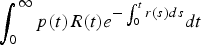 with respect to the flows of extracted oil R(t), t ≥ 0, under the exhaustibility constraint (3). In equilibrium, oil is managed as an asset and its extraction satisfies the standard Hotelling rule:

The instantaneous budget constraints of the representative northern citizen, southern poor and southern rich are, respectively,



where B i is group i's amount of financial assets, i = N, SP, SR.
Each household maximizes its utility U i, i = N, SP, SR, under its budget constraint and the no-Ponzi-game necessary condition:

The first-order conditions of the households' maximization problem lead to the standard Ramsey-Keynes conditions:

The financial market is in equilibrium at date 0 if B N(0) + B SP(0) + B SR(0) = 0. Under this condition, the initial debt of each group is an arbitrary endowment. We assume that it is nil for all groupsFootnote 13: B N(0) = B SP(0) = B SR(0) = 0.
Proposition 1
The following properties are satisfied in equilibrium.
1. National production levels Y N and Y S, as well as consumption levels of the three groups C N, C SP and C SR, grow at the same rate g = (1 − α)x − αρ.
2. The ratio of production levels Y N/Y S is a decreasing function of the ratio of oil tax rates (θN + 1)/(θS + 1).
3. For given production levels Y N and Y S and a given level of foreign aid F, θN has a positive effect on C N, a negative effect on C SR and no effect on C SP, whereas θS has no effect on the consumption levels.
Proof. See the online Appendix.
According to the first property, the growth rate in the two countries stems from exogenous technical progress and resource depletion but, under our assumptions, is constant, independent of oil tax rates and of the level of foreign aid. This equilibrium property simplifies our analysis a good deal, since it reduces governments' optimization problems to the maximization of utilities at date 0.Footnote 14
The second and third properties disentangle two effects of oil tax rates on the revenues of the three groups: a location effect on national production levels and a pure distributional effect on consumption levels.Footnote 15
The location effect is that of the relative oil tax rates on the repartition of the final good production between North and South. If oil taxes increase in the North, northern firms become less competitive since one of their inputs becomes relatively more expensive. Then northern firms will use a lower share of oil extracted at each date. Since the other input, labor, is immobile, a decrease in oil use implies a lower final good production. Therefore, a unilateral increase in θN decreases Y N and increases Y S, with the opposite being true for θS.
The distributional effect is that of the absolute oil tax rates on the repartition of oil rents between fiscal authorities and resource holders. Oil taxes decrease the equilibrium price of oil, transferring some of resource holders' rents to the fiscal authorities. This transfer positively affects the consumption level of northern households, who benefit from the northern fiscal revenues, and negatively affects the consumption level of southern oil owners, who lose rents.
Precisely, one can see from the first-order conditions (8) that the total payment for oil by the final sector firms, p(θN + 1)R N + p(θS + 1)R S, is equal to αY N + αY S. This payment is composed of three parts: p(R N + R S) = α(Y N/(θN + 1) + Y S/(θS + 1)) is the resource holders' oil revenue; θNpR N = αθNY N/(θN + 1) is the northern fiscal revenue, redistributed to the northern households; and θSpR S = αθSY S/(θS + 1) is the southern fiscal revenue, redistributed to the resource holders. The resource holders' net revenue is then equal to αY N/(θN + 1) + αY S. From these expressions we can see that, for given production levels Y N and Y S, the northern oil tax θN decreases resource holders' net revenue and increases northern households' fiscal revenue. This is a pure distributional effect. Moreover, we can see that θS does not influence resource holders' revenues. The reason for this is that θS shifts part of the oil rents into southern fiscal revenues, both of which are earned by the resource holders. Their total revenue is therefore not affected by this tax.
Overall, the northern tax rate θN has a negative effect on northern households' labor earnings since it decreases northern production Y N, and a positive effect on their fiscal earnings since it increases northern fiscal revenues, αθNY N/(θN + 1). The northern government will face this tradeoff when choosing the tax rate. Moreover, the altruistic northern government will have to take into account the positive effect of θN on the southern workers' labor earnings, but not its negative effect on the resource holders' revenues.
Let us denote by C N (θN, θS, F)(t), C SP (θN,θS,F)(t) and C SR (θN,θS)(t) the equilibrium consumption levels of the three groups at date t as functions of the tax rates and of the level of foreign aid. Their expressions are computed in the online Appendix, available at http://journals.cambridge.org/EDE. The following section examines the choice of instruments by the governments at the Nash equilibrium.
4. Equilibrium policies
In this section we assume that the northern and southern governments set their policies non-cooperatively.
The northern government chooses the oil tax rate θN and the level of foreign aid F(t) ≥ 0 that maximize northern agents' lifetime utility, taking as given the equilibrium consumption functions C N (θN,θS,F)(t) and C SP (θN,θS,F)(t) and the southern government's strategy θS:

The southern government chooses the tax rate θS which maximizes the resource holders' lifetime utility, taking as given the equilibrium consumption function C SR (θN,θS)(t) and the northern government's strategy θN:

From Proposition 1, C N (θN,θS, F)(t), C SP (θN,θS,F)(t) and C SR (θN,θS) (t) grow at the same rate, which does not depend on governments' policies. Therefore, governments' optimization problems reduce to the maximization of date 0 utilities (see online Appendix for formal proof).
Let us denote by θNe, θSe and F e(t) the Nash equilibrium strategies.
Proposition 2
Equilibrium policies satisfy the following properties:
1. The oil tax rate is strictly positive in the North and nil in the South: θNe > θSe = 0.
2. Foreign aid is positive if the North is sufficiently altruistic: F e(t) > 0 if δ > δ.
Proof. See the online Appendix.
Proposition 2 shows that, in the absence of coordination mechanisms, the two governments set different oil tax rates. This is due to the asymmetric oil endowments of the groups that they represent.
The southern government has no incentives to tax oil. From Proposition 1, for given production levels Y N and Y S, θS is neutral to the consumption level of the oil owners, C SR (θN, θS)(t). The fiscal revenues that could be collected with a positive tax rate and redistributed to the resource holders are exactly equal to the loss in oil revenue that this tax would cause them. Moreover, we have seen that an increase in θS would shift some final good production to the North, increasing Y N with respect to Y S. This would increase the share of oil consumed by the northern firms, on which the South levies no taxes. Taxing oil would therefore induce a net loss for the resource holders. Hence, θSe = 0 is a dominant strategy for the southern government. This is true for any northern strategy and will thus be valid all along in the sequel. This is a noticeable difference from studies which assume the southern government to maximize the entire surplus of southern residents, including workers, and where the optimal tax for the resource exporting country is found to be negative (e.g., Bergstrom, Reference Bergstrom1982).Footnote 16
The northern government can use the oil tax to capture rents from the resource holders and transfer them to the northern citizens. From Proposition 1, for given production levels Y N and Y S, θN increases C N (θN,θS,F)(t) and decreases C SR (θN,θS )(t). As northern households do not internalize the negative effect of θN on resource holders' consumption levels, they would like to set the highest possible tax rate. However, we have also seen in Proposition 1 that θN decreases northern households' labor earnings because it shifts some final good production to the South. This limits the northern ability to capture oil rents through oil taxation. Therefore, θNe is positive but not infinite.
The northern government can also use the oil tax to increase southern workers' consumption levels, since by shifting some productive activities to the South, θN increases their labor earnings. This redistribution possibility increases the optimal tax rate for the altruistic North.
In fact, the altruistic northern government can use two redistribution instruments to increase southern workers' consumption levels. One the one hand, it can use foreign aid F, which is a lump sum transfer. This transfer decreases northern households' consumption and increases that of the southern workers by the same amount. On the other hand the North can use the oil tax θN, which allows a non-lump sum transfer to the southern poor. An increase in θN increases southern workers' labor earnings and decreases those of the northern workers, but not necessarily by the same amount. This redistribution mechanism modifies the marginal productivities of oil in the North and South, and is not efficiency neutral.
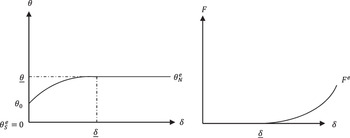
Figure 1 illustrates how the rate of altruism δ affects the choice of these two redistribution mechanisms. The tax rate θ0 > 0 is the one that maximizes northern households' total revenue. This tax rate is implemented when the North is not altruistic, i.e., when δ = 0. The optimal northern tax rate θNe increases with the altruism rate up to  , which is implemented for an altruism level
 . For
 , foreign aid is nil and redistribution is done through oil taxation, which is the cheapest redistribution instrument on this segment. For
 remains equal to
 , and F e becomes positive and strictly increasing with δ. On this segment, foreign aid is the cheapest redistribution mechanism.
Equilibrium policies

It is worth noting that redistributing revenues to the South by decreasing its own competitiveness with high oil taxes may not be very attractive in a more-than-two-country framework. In that case, high oil taxes in the North would favor all other countries and not exclusively the targeted group of poor. That is why, although this effect arises in our model, we will focus on foreign aid as the main redistribution scheme, i.e., on the cases where  and F e > 0.
We show in the online Appendix that  is defined by
 and
 is defined by
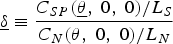 When
 , the equilibrium level of foreign aid splits the total revenue of the northern workers and the southern workers, C N
 , according to the weight of each group in the northern utility function:

Figure 1 also illustrates the gap between  and
 . This gap in taxation leads to different consumer prices of oil in the North and South:
 . This implies that the national marginal productivities of oil are not equalized. Global output could be increased if a larger share of oil were used in the North, where its marginal productivity is higher. The equilibrium allocation of oil between North and South is therefore inefficient.
Our model features the two opposite revenue transfers described in the introduction between developed oil consuming countries and developing oil producing countries. The North gives foreign aid to the southern poor and captures oil rents from the southern rich. Oil taxes are strictly higher in the North, leading to an inefficient allocation of oil between northern and southern firms. The following section proposes a policy coordination mechanism aimed at reducing this inefficiency.
5. Equilibrium policies with the coordination mechanism
The inefficiency of the equilibrium described in the previous section stems from the incentives of the North to overtax the resource in order to capture oil rents from the resource holders. One way of correcting this inefficiency is to reduce the incentives to capture those rents.
A reduction of the northern oil tax rate would lead to a more efficient allocation of oil and increase global production, but the resulting revenue increase would unevenly benefit the three groups. Resource holders' rents would increase while the total revenue of the northern residents and the southern poor would decrease. As the North does not internalize resource holders' consumption, it has no incentives to lower its tax. However, if some of the resulting oil rents were redistributed to the poor population for which the North is altruistic, it might be willing to lower the tax. This is the basis of our coordination mechanism.
Consider the following contract proposed by the northern authorities to the southern authorities. The contract specifies the northern tax rate θN and the amount of national aid I(t) ≥ 0 to be transferred from the resource holders to the southern poor.
Southern authorities will accept the contract if and only if it increases resource holders' utility.Footnote 17 Moreover, the result that a zero tax is dominant from the southern government's perspective still applies, so that θSc = 0 holds. Hence, their participation constraint is

The optimal contract for the northern government solves
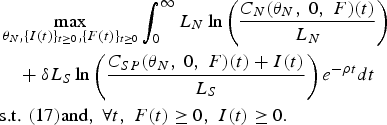
As I(t) enters the North's utility function with a positive sign, the South's participation constraint will be binding. This implies that all the oil rents resulting from the decrease in the northern oil tax will be redistributed to the poor: ∀ t,  . Thus, I(t) grows at the same rate as all the other variables and the North's optimization problem is reduced again to the date zero utility maximization.
We denote the optimal contract by (θNc,(I c(t))t≥0) and the optimal level of foreign aid when the contract is used by F c(t).
Proposition 3
Equilibrium policies with the coordination mechanism satisfy the following properties:
1. Coordination improves global efficiency:
 and if .
2. Internal redistribution is always positive and foreign aid is positive if the North is sufficiently altruistic: I c > 0, and F c > 0 if
.
 and
 if
 .
 .
Proof. See the online Appendix.
Proposition 3 shows that the constraint I(t) ≥ 0 (which is equivalent to  , since
 is decreasing in θN) is never binding. This means that the North can always obtain a strictly higher payoff by using the contractual coordination instrument. The reason for this is the following. Without the contract, the North captures some of resource holders' rents by overtaxing the resource at the expense of its own competitiveness, while helping the southern poor with lump sum foreign aid. By transferring oil rents to the southern poor, the contract allows the altruistic North to benefit from oil rents, while increasing its own competitiveness. It is a more efficient revenue redistribution scheme.
At the altruism threshold rate  , the optimal contractual tax rate in the North becomes nil and the possibility of revenue redistribution through the contract is exhausted. If northern altruism is greater than this threshold, foreign aid is used to complement the redistributive role of the contract.
We show in the online Appendix that  is given by
 . When
 , the level of foreign aid F c splits the net revenue of the northern workers and the southern poor,
 , according to the weight of each group in the northern citizen's utility function:
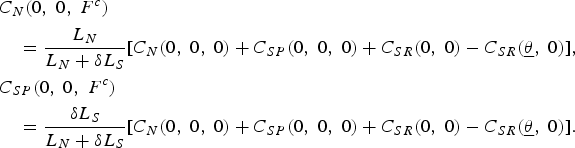
Figure 2 illustrates the North's choice of these instruments in the case where  .
Equilibrium policies with the coordination mechanism

Proposition 3 shows that the coordination instrument restores global efficiency, i.e.  when the North is sufficiently altruistic, i.e., when
 .
It is worth noting that the complete restoration of efficiency stems from the use of an additional instrument by a strategic agent (the northern government), who is not benevolent – in particular, who does not care about the welfare of the oil owners. This result is surprisingFootnote 18 and it deserves some particular attention. It can be explained in the following way. The contract allows the northern government to manipulate the split of world output between the different groups. We show in the online Appendix that when the contract is used by a sufficiently altruistic North, its optimization problem amounts to maximizing global output Y minus a fixed rent that cannot be captured, which is oil owners' consumption in the absence of the contract,  . Since the North is led to maximize world output minus a fixed quantity, it is not willing to introduce distortional taxes that would decrease world output.
Beyond the improvement of global efficiency shown in Proposition 3, let us examine the effects of the contract on the welfare of each group. The welfare of the North is obviously improved by the availability of an additional instrument.Footnote 19 Resource holders' welfare is unchanged as their participation constraint is binding. The contract has three effects on the consumption of the southern poor. First, it decreases their wages because some of the final good production moves to the North. Second, it decreases the amount of foreign aid they receive. Third, it introduces a positive amount of national aid. Proposition 4 shows that the overall effect on their revenue is always positive.
Proposition 4
The introduction of the coordination mechanism leads to a Pareto improvement of the equilibrium allocation.
Proof. See the online Appendix.
The coordination mechanism suggested in this paper improves global efficiency and welfare. It offers a more efficient redistribution scheme to help the poor living in oil exporting countries. Although this solution has good properties, it relies on a theoretical model that abstracts from some real world issues which are discussed in the following section.
6. Discussion
The above analysis has shown that the interactions between rich oil consuming countries and poor oil producing countries via oil taxation and foreign aid policies results in an inefficiency of the oil allocation. This inefficiency arises because the possibility of capturing oil holders' rents by northern oil taxation induces the northern government to overtax oil; this tendency is magnified by the northern altruism towards the poor in the oil producing region, even when oil taxation coexists with foreign aid transfers in favor of the latter.
The possibility of correcting this inefficiency through the coordination mechanism described in section 5 is theoretically interesting for two reasons. First, it highlights that the source of the economic problem is a lack of coordination between the two regions. Second, while our abstract setting focuses on the main features of the problem, the corrective contract on the North's initiative may serve as a basis for more realistic proposals.
In the current context, no mention of oil taxes can avoid a discussion of their environmental dimension. This will be done briefly below; as we will argue, the mechanism of the contract of section 5 must survive environmental considerations absent from the setting of this paper. Some other real world issues absent from our theoretical model are worth discussing: credibility of the redistribution of oil rents by the southern government, recipient targeting, donor coordination, transparency, transfer visibility and transaction costs. This will be done thereafter.
For reasons that were unrelated to environmental concerns,Footnote 20 the US Congressional office suggested in 1986 the idea of lowering the tariff on oil imported from some low-income countries. In that proposal, there was no condition on the redistribution of the resulting extra-rents within these countries. More recently, Sala-i-Martin and Subramanian (Reference Sala-i-Martin and Subramanian2003) suggested that oil revenues in Nigeria be equally shared among the whole population, but without specifying any compensation for the elite monopolizing the oil rents. The mechanism of section 5 combines the ideas of lowering oil taxes with a better redistribution of the oil rents, but it further takes into account the interests of all groups involved, thus introducing the necessity of political feasibility.
Our theoretical analysis also abstracts from global pollution externalities caused by oil consumption. Would our coordination mechanism still be welfare improving if environmental concerns are taken into account? First, in the presence of a global quantity based environmental regulation, to which industrialized countries seem to give priority, taxes should not pursue any environmental objective and our analysis would carry over without any further adjustment.
Otherwise, were oil taxes set in order to pursue this environmental objective, the same forces as in the present paper would be at work: oil-poor countries would still tend to tax at higher levels than oil-rich countries. This is the message delivered by Amundsen and Schöb (Reference Amundsen and Schöb1999) and Daubanes and Grimaud (Reference Daubanes and Grimaud2010). As emphasized in the latter paper, in a Hotelling model the environmental effect of oil taxes depends on their dynamic pattern, while global efficiency requires homogeneous after-tax price levels. A globally efficient allocation of polluting inputs is always a prerequisite to environmental efficiency. More generally, as long as marginal damages from oil use are independent of where oil is consumed, the price unicity principle must hold. Thus, overtaxation by northern countries, for whatever reasons,Footnote 21 can still be corrected by the contractual mechanism at the root of section 5. Were the optimal level of oil taxation strictly positive,Footnote 22 the mechanism should target it, instead of a zero level as in section 5. The intuition survives as long as the gap between regions' taxes offers efficiency gain from tax convergence. This may not necessarily imply the convergence of northern taxation to the southern level. Whether a contractual solution of this kind can induce southern regions, if taxing at suboptimal levels, to increase their taxes, is a more intricate question that we leave unexplored. Efficiency gains from tax convergence, again, leave opportunities to provide such incentives, though.
The theoretical interest of contractual mechanisms should not hide the practical difficulties of such solutions. In the following paragraphs, we discuss critical assumptions of our analysis and argue that coordination mechanisms of the kind introduced in section 5 are not devoid of practical relevance.
Our framework assumes that the additional oil rents resulting from lower taxes in the North will effectively be redistributed to the poor population in the oil exporting country. This is a strong assumption given the poor institutions and non-representative governments of many oil exporting countries. In a dynamic contract setting, this commitment problem could be overcome given the repeated nature of donor–recipient interactions. If industrialized countries lowered oil tax rates and observed that the resulting oil revenues in the South did not benefit the poor population, they could always go back to the non-coordinated equilibrium policies. This credible threat may be sufficient to induce southern authorities to respect their redistribution commitments.
There is another consideration. Observability is always an issue, not only under contractual schemes, but also, and in much the same way, under any form of foreign aid destined to a particular group. Hence, the efficiency gains from coordination are irrespective of the degree of observability.
An important issue absent from our two-country model is the targeting of recipients. While foreign aid can easily be targeted to a recipient, lowering oil taxes in a world with several oil exporting countries would enrich all such countries and not only those that the donor is willing to favor. Targeting low-income countries could be implemented by lowering tariffs on oil originating from those countries exclusively.
Symmetrically, our one-donor–one-recipient model focuses on the necessity of coordination between donor and recipient policies. However, coordination between different donors is not less important. A unilateral decrease in oil taxes by one industrialized country may have little effect on the equilibrium oil price and it may create oil price gaps with other industrialized countries, leading to other distortions. The issue of donor coordination deserves more attention in future research.
In this paper, taxes and aid are collected and redistributed at no cost. In reality, these transfers entail non-negligible costs of public funds. While a second-best setting would blur the main message that coordination can improve efficiency, it is worth noting the following. If costs of public funds increased with the amount of taxes collected and redistributed, then contractual coordination mechanisms, by reducing those amounts, would further have the benefit of reducing transaction costs.
Relatedly, since policy coordination also reduces foreign aid transfers, it makes international redistribution less visible. Visibility may matter, especially if the motivation of foreign aid is not purely altruistic. To overcome this problem, the amounts indirectly transferred through contractual mechanisms such as the one suggested here could be included in some extended definition of foreign aid.
7. Conclusion
This paper points out the inefficiency that arises when oil importing donor countries (North) and oil exporting recipient countries (South) interact through oil taxation and foreign aid policies. In the absence of coordination, the North overtaxes oil use with a view to capturing rents from the oil owners in the South. The northern tendency to overtax oil is magnified by its willingness to redistribute oil rents to the poor population in the South via foreign aid. The gap between oil taxes in the North and in the South entails a global distortion of the allocation of oil.
We show how a well-designed policy coordination mechanism reduces this inefficiency. It consists of a contract proposed by the northern authorities to the southern authorities, by which the former lower oil taxes and the latter redistribute the resulting oil rents to the poor. This coordination mechanism increases global output by reducing distortions in the allocation of oil. A larger share of oil is used by the final sector firms in the North, where its productivity is higher. The opposite revenue transfers between North and South are reduced, while revenue redistribution from southern rich to southern poor is increased. Northern workers earn higher direct revenues due to the improved competitiveness of northern firms; they earn lower fiscal revenues from oil taxation and they redistribute less foreign aid to the southern workers. Oil owners earn higher rents, but they redistribute them to the southern poor. Southern poor earn lower direct revenues and receive less foreign aid, but they benefit more from the oil rents. We show that the introduction of such a coordination mechanism is Pareto improving.
By drawing attention to the efficiency gains of coordination between oil importing donor countries and oil exporting recipient countries, this paper is intended to inspire future research on policy coordination mechanisms. In particular, it would be interesting, both from a theoretical and a policy perspective, to further examine the benefits of such coordination schemes when account is taken of oil polluting character as well as of heterogeneity among donors and among recipients, of asymmetries of information and of commitment problems.
 its growth rate over time.