INTRODUCTION
Human impacts on the environment are increasingly disturbing the ecology of host–parasite relationships, whether through climate change (Kutz et al. Reference KUTZ, HOBERG, POLLEY and JENKINS2005) or more directly through habitat modifications such as deforestation (Patz et al. Reference PATZ, DASZAK, TABOR, AGUIRRE, PEARL, EPSTEIN, WOLFE, KILPATRICK, FOUFOPOULOS, MOLYNEUX and BRADLEY2004). Human-driven habitat alterations have even been reported to play a role in the emergence of infectious diseases giving rise to epidemics (Guerra et al. Reference GUERRA, SNOW and HAY2006). For example, logging and road building have coincided with an upsurge of leishmaniasis in humans in Latin America (Desjeux Reference DESJEUX2001), possibly as a result of the adaptation of sand fly vectors to these disturbed habitats (Patz et al. Reference PATZ, GRACZYK, GELLER and VITTOR2000). The consequences of these disturbances for wild host–parasite systems are however largely unknown (Gillespie & Chapman Reference GILLESPIE and CHAPMAN2006, Gillespie et al. Reference GILLESPIE, CHAPMAN and GREINER2005, Vaz et al. Reference VAZ, D'ANDREA and JANSEN2007) and effects on natural host–parasite interactions may be complex, particularly for vector-borne infections, which involve more than two co-evolving species. When investigating the consequences of forest degradation on the risk of Lyme disease, Allan et al. (Reference ALLAN, KEESING and OSTFELD2003) found that fragmentation increased the density of competent rodent hosts and thereby indirectly the density of infected larval ticks, thus heightening the risks of transmission of the disease to susceptible hosts. Anthropogenic changes of the environment may hence threaten wild populations not only through habitat loss, but by perturbing interspecific interactions they may also exacerbate selection acting on natural populations and increase extinction risks. For this reason, it is essential to understand how human-induced habitat differences affect host–parasite dynamics in the wild and define the underlying land-use factors that may act to modify these interactions.
In this study, we explored the habitat specificities of haemosporidian parasites (Plasmodium and Haemoproteus spp.) in wild bird populations of the rain forests of southern Cameroon. Species of Plasmodium and Haemoproteus (Haemosporida, Apicomplexa) infect vertebrate hosts and blood-sucking dipteran insects, the vectors of the parasites (Atkinson & Van Riper Reference ATKINSON, VAN RIPER, Loye and Zuk1991). The primary vectors of avian Plasmodium spp. are mosquitoes belonging among others to the genera Culex, Aedes, Culiseta, Anopheles and Mansonia (Bequaert Reference BEQUAERT1954, Valkiūnas Reference VALKIŪNAS2005), whereas Haemoproteus spp. are transmitted by blood-sucking biting midges (Culicoides) (Kettle Reference KETTLE1982, Valkiūnas & Iezhova Reference VALKIŪNAS and IEZHOVA2004) and louse-flies (Pseudolynchia, Microlynchia and Ornithomyia) (Bequaert Reference BEQUAERT1954, Kettle Reference KETTLE1982, Valkiūnas Reference VALKIŪNAS2005). Although Haemoproteus spp. have traditionally been considered to be relatively host-specific and Plasmodium spp. more generalists (Hellgren et al. Reference HELLGREN, WALDENSTROM, PEREZ-TRIS, SZOLLOSI, HASSELQUIST, KRIŽANAUSKIENĖ, OTTOSSON and BENSCH2007, Ricklefs & Fallon Reference RICKLEFS and FALLON2002), recent evidence suggests that more or less closely related lineages within both genera may actually exhibit a wide range of host-species with vertebrate-host specificity being frequently broader than host-family level (Beadell et al. Reference BEADELL, COVAS, GEBHARD, ISHTIAQ, MELO, SCHMIDT, PERKINS, GRAVES and FLEISCHER2009, Križanauskienė et al. Reference KRIŽANAUSKIENĖ, HELLGREN, KOSAREV, SOKOLOV, BENSCH and VALKIŪNAS2006). The level of host specificity for haemosporidian parasites may actually depend, in part, on the vector-host association (Gager et al. Reference GAGER, LOAIZA, DEARBORN and BERMINGHAM2008, Hellgren et al. Reference HELLGREN, BENSCH and MALMQVIST2008).
We tested the hypothesis that habitat differences between pristine and human-altered rain forests were associated with different levels of parasite infections in resident bird populations. Since different bird species may display different levels of infection and because host species composition may vary between mature sites and agroforests, we controlled for changes in host abundance when examining association patterns between forest type and parasite prevalence. We sampled individuals from three rain-forest bird species (Andropadus latirostris, Strickland 1844; Andropadus virens, Cassin 1857; and Cyanomitra obscura, Jardine 1843) from two mature forests and two agroforest sites in southern Cameroon during June and July 2005, just prior to the breeding season. In Cameroon, the amount of mature forest is decreasing, while the proportion of secondary forest is increasing as a result of human activity related to logging and slash-and-burn agriculture (Laurance Reference LAURANCE1999). Many of the same bird species inhabit these two types of habitat (Louette Reference LOUETTE1981), yet very little is known about how deforestation can affect parasite prevalence in these populations.
METHODS
Sample sites and habitat characterization using remote-sensing data
Fieldwork took place in June and July 2005 at four sites in Cameroon. Locations and dates of fieldwork for the two mature sites are: Zoebefame (2°39′31″ N, 13°23′49″ E), 24–27 July; Bobo Camp (2°39′17″ N, 13°28′16″ E), 19–22 July; and for the two agroforest sites: Ndibi (2°43′50″ N, 9°52′19″ E), 27 June–4 July; Nkwouak (3°52′1″ N, 13°18′58″ E), 7–12 July. All sites are at similar elevation (600–700 m) and annually undergo two dry seasons and two rainy seasons. The smaller wet season takes place between March and June and is followed by a smaller dry season between June and August, a greater wet season between August and November and finally a greater dry season between November and March. We presented parasite prevalence data from Ndibi from previous years elsewhere (Sehgal et al. Reference SEHGAL, JONES and SMITH2005).
Mature forest sites were located at least 30 km from the nearest road or human settlement and based on ground surveys showed little or no signs of human disturbance. The forest stands were characterized by a layered closed canopy with tall emergent trees and a relatively open understorey. Agroforest sites were adjacent to human settlements and consisted of a mixture of cocoa and coffee trees. These sites had significant disturbance associated with wood harvesting, burning and various other forms of cultivation. The agroforest stands typically had much denser understorey and more broken open canopy than the mature forests. Greater tree cover and vegetation biomass at mature sites were confirmed by remote-sensing observations (for a review see Turner et al. Reference TURNER, SPECTOR, GARDINER, FLADELAND, STERLING and STEININGER2003). Optical satellite data, expressed as the percentage of tree canopy cover with 500-m spatial resolution, can distinguish open (e.g. shrublands, savannas), fragmented and deforested areas from closed forests (Hansen et al. Reference HANSEN, DEFRIES, TOWNSHEND, SOHLBERG, DIMICELI and CARROLL2002). Microwave remotely sensed data, expressed in decibels (dB), increases with increasing moisture and the overall vegetation biomass (Saatchi et al. Reference SAATCHI, NELSON, PODEST and HOLT2000). Tree canopy cover values (moderate-resolution imaging spectroradiometer surface reflectance of the year 2001, aggregated to 1 km) were: Bobo = 78%, Zoebefame = 81%, Ndibi = 45%, Nkwouak = 68%. Overall vegetation biomass values (Japanese Earth Resource Satellite data in 1996, aggregated to 1 km) were: Bobo = −6.88 dB, Zoebefame =−6.88 dB, Ndibi = −9.70 dB and Nkwouak = −8.85 dB.
Field methods
At each site, 15–20 mist nets (12 m, 30 × 30-mm mesh) were erected to capture birds. Netting took place generally between daybreak (06h00) and midday (12h00), except during periods of excessive sun, in which nets were closed earlier. Captured birds were weighed with a 50-g Pesola spring balance, measured, marked with a uniquely numbered aluminium band, and released, following methods described by Smith (Reference SMITH1990). Blood samples (1–3 drops) were collected from the brachial vein and stored in lysis buffer (10 mM Tris-HCL pH 8.0, 100 mM EDTA, 2% SDS). We captured 220 birds belonging to the following three species (taxonomy according to Borrow & Demey Reference BORROW and DEMEY2005): yellow-whiskered greenbul (Andropadus latirostris, Pycnonotidae, n = 71), little greenbul (Andropadus virens, Pycnonotidae, n = 82) and olive sunbird (Cyanomitra obscura, Nectariniidae, n = 67). We calculated the relative abundance of each species at each of the four sites by dividing the total number of individuals of a given species captured by the total mist net hours at that site. Mist net hours were calculated as the number of net metres run multiplied by the number of hours nets remained open. Relative abundance is expressed in number of birds × 100/mist-net m × h.
All three avian species or related species are common in both mature and agroforest sites and are found throughout equatorial Africa. In a recent study on little greenbul, A. virens, Smith et al. Reference SMITH, MILÁ, GRETHER, SLABBEKOORN, SEPIL, BUERMANN, SAATCHI and POLLINGER(2008) found significant differences in morphology, colour plumage and song between individuals captured in mature and secondary forest sites in Cameroon, suggesting that each forest type harbours distinct populations. Populations of A. virens can further be distinguished by analysis of amplified fragment length polymorphism, suggesting that, despite detectable gene flow (Smith et al. Reference SMITH, WAYNE, GIRMAN and BRUFORD1997), they remain genetically distinct and individuals rarely move between habitats. This is further corroborated by long-term banding studies suggesting little movement of individuals between habitats (T. B. Smith unpubl. data). Less information is available for A. latirostris though long-term banding studies suggest it may be more vagile (Smith unpubl. data). Interestingly, A. virens tends to be found at higher densities in secondary than in mature forests, while the reverse is true for A. latirostris (Louette & Bijnens Reference LOUETTE and BIJNENS1995). Both bulbul species feed on fruit and insects (Keith et al. Reference KEITH, URBAN and FRY1992). The olive sunbird, C. obscura, feeds on both nectar and insects and is one of the more common forest sunbirds (Fry et al. Reference FRY, KEITH and URBAN1988). The distribution of our three target species across mature and disturbed forests and the relatively restricted movement of individuals between habitats make them good model species for examining the consequences of forest disturbance on natural host–parasite systems.
Parasite screening using PCR
DNA was extracted from whole blood following a DNeasy kit protocol (Qiagen, Valencia, CA, USA). To amplify a portion of the cytochrome b gene, we used primers L15183 and H15909 and methods described by Szymanski & Lovette (Reference SZYMANSKI and LOVETTE2005). We used 0.25U Taq (Qiagen, 201203) in 25 μl volume and ran our amplifications as follows: 50 s at 95 °C, 50 s at 53 °C and 60 s at 72 °C (35 cycles). The PCR products were run on 2% agarose gels and stained with ethidium bromide for UV detection. Negative infections were confirmed by repeated PCR. PCR products were purified using a MinElute Qiagen kit following manufacturer's instructions. We identified lineages by sequencing the fragments (BigDye (R) version 1.1 sequencing kit, Applied Biosystems, Foster City, CA, USA) on an ABI 3730 capillary sequencer (Applied Biosystems). Unresolved sequences showing double peaks in the electropherograms were examined for putative multiple infections by cloning (TOPO-cloning kit, Invitrogen) and sequencing (Pérez-Tris & Bensch Reference PÉREZ-TRIS and BENSCH2005). We sequenced 6–10 clones from each sample for which we suspected a multiple infection. We kept only the sequences found several times in independent PCRs, either within the same individual or in several different individuals. We however discarded all unique sequences, which only differed from verified sequences by one nucleotide. Indeed, a single nucleotide divergence may, for example, be attributed to a Taq polymerase incorporation error during amplification. All other unique sequences were also discarded.
Parasite screening using microscopy
We prepared three blood slides for each individual captured. Blood slides were air dried within 5–10 s after their preparation. In a humid environment, we used a battery-operated fan to aid in the drying of the blood films. Slides were fixed in methanol in the field and then stained with Giemsa in the laboratory. The slides were examined for 10–15 min at low magnification (×400), and then at least 100 fields were studied at high magnification (×1000). The approximate number of screened red blood cells was 5 × 10⁵ in each blood film; the microscopy took approximately 20–25 min per slide. Blood slides were examined with an Olympus BX61 light microscope equipped with an Olympus DP70 digital camera and analysed with the imaging software AnalySIS Five. Parasites were identified according to Valkiūnas (Reference VALKIŪNAS2005). Representative blood slides were deposited in the Institute of Ecology, Vilnius University (Vilnius).
Phylogenetic and statistical analyses
Sequence divergence was computed using PAUP 4.0b10 (Swofford, D., 2000, PAUP 4.0b7a, Phylogenetic Analysis Using Parsimony (and other methods), Sinauer, Sunderland, MA). We used Bayesian analysis to construct a phylogeny of parasite cytochrome b lineages. We first determined the model of sequence evolution that best fitted the data using MrModeltest (Nylander, J. A. A., 2004, MrModeltest version 2, Evolutionary Biology Centre, Uppsala University, Uppsala, URL http://www.csit.fsu.edu/~nylander/). Bayesian analysis of the sequence data was then conducted with MrBayes version 3.1.2 (Huelsenbeck et al. Reference HUELSENBECK, RONQUIST, NIELSEN and BOLLBACK2001) using the model of sequence evolution obtained from MrModeltest (GTR+G), and partitioning sites by codon position. Two Markov chains were run simultaneously for 2 million generations and sampled every 100 generations. We confirmed chain convergence using TRACER 1.3 (Rambaut, D. & Drummond, A. 2003, Tracer v1.3., URL http://tree.bio.ed.ac.uk/software/tracer.) and excluded trees generated prior to stationarity. We also generated a phylogeny of haplotypes using the neighbour-joining method and Kimura two-parameter genetic distances as implemented in the program MEGA2 (Kumar et al. Reference KUMAR, TAMURA and NEI2004). Node support for the neighbour-joining tree was determined through 10 000 bootstrap replicates.
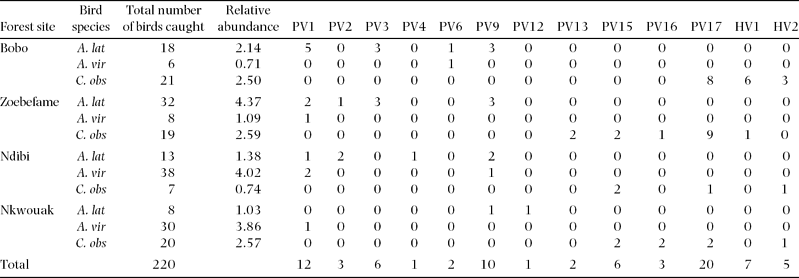
The prevalence of infection with Haemoproteus spp. was too low to permit analysis. The prevalence of infection with each of the individual Plasmodium spp. was similarly prohibitively too low to permit analysis at level of each individual lineage (Table 1). Furthermore, over 70% of all recorded Plasmodium spp. infections were closely related malaria parasites belonging to the subgenus Novyella, which appears to predominate in African rain-forest passerines (Valkiūnas et al. Reference VALKIŪNAS, IEZHOVA, LOISEAU, CHASAR, SMITH and SEHGAL2009). Consequently, we pooled all infections involving a Plasmodium spp. and categorized each bird as either being infected or not. We used generalized linear mixed models in Genstat (release 9, Rothamsted Experimental Station, Harpenden, UK) with binomial error structure and logit link function to examine: (a) whether bird species differed in infection levels with Plasmodium spp. lineages; and (b) whether the relative abundance of host species and forest type was associated with different probabilities of infection with Plasmodium spp. In all analyses, site was specified as a random factor to account for a lack of independence of measures within each site.
Total number of birds caught and relative abundance of each bird species expressed in number of birds × 100/mist-net m × h. The three bird species are: Andropadus latrisrostris (A. lat.), Andropadus virens (A. vir.) and Cyanomitra obscura (C. obs.). The number of birds infected by each mitochondrial lineage of Plasmodium and Haemoproteus spp. detected by PCR is also indicated for each site; PV1, PV2, PV3, PV4, PV6, PV9, PV12, PV13, PV15, PV16, PV17 are the 11 Plasmodium spp. lineages and HV1 and HV2 are the two Haemoproteus spp. lineages. Bobo and Zoebefame are the two mature forest sites and Ndibi and Nkwouak are the two agroforest sites.

RESULTS
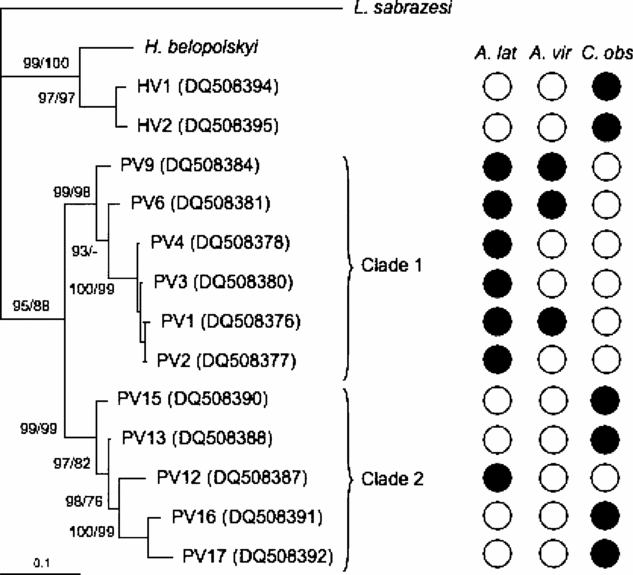
We determined haemosporidian parasite prevalence in 220 individuals belonging to three different species of African rain-forest bird. Thirteen verified mitochondrial lineages were found using PCR (eleven Plasmodium and two Haemoproteus lineages) with numbers of individuals infected ranging from 1 to 20 (Table 1). We conducted BLAST (basic local alignment search tool) analysis of each sequence but found no identical matches of any of the lineages we identified. All sequences are deposited in GenBank (see Figure 1 for the accession numbers). The phylogenetic tree revealed the existence of two monophyletic Plasmodium spp. clades of high support (Figure 1). The topologies obtained from Bayesian inference and neighbour joining were almost identical and included only minor topological differences within clades, so only the Bayesian tree is reported on Figure 1. Mean uncorrected sequence divergence between the two Plasmodium spp. clades was 0.076 (SD = 0.010), and between Plasmodium and Haemoproteus lineages was 0.125 (SD = 0.015). The two monophyletic Plasmodium spp. clades displayed interesting host-genus specificity, since parasites of clade 1 infected only the Andropadus species and parasites of clade 2 infected mostly C. obscura (Figure 1). Indeed, in the latter case, only PV12 was found to infect A. latirostris. Haemoproteus lineages were found only in C. obscura and the prevalence of the infection was too low to test for any association with habitat characteristics. Interestingly, the microscopy approach allowed us to link three Plasmodium spp. lineages identified using PCR with morphospecies belonging to the subgenus Novyella: PV9 corresponded to Plasmodium multivacuolaris, PV15 to Plasmodium megaglobularis and PV17 to Plasmodium lucens (Valkiūnas et al. Reference VALKIŪNAS, IEZHOVA, LOISEAU, CHASAR, SMITH and SEHGAL2008b, Reference VALKIŪNAS, IEZHOVA, LOISEAU, CHASAR, SMITH and SEHGAL2009).
Phylogenetic relationships among haplotypes from the 13 malaria parasites (PCR detection) found in three species of rain-forest bird in Cameroon (A. lat.: Andropadus latirostris, A. vir.: Andropadus virens and C. obs.: Cyanomitra obscura), based on Bayesian analysis of Cyt b sequences. The tree corresponds to the consensus topology of 30 002 trees obtained after 2 million generations based on the GTR+G model of sequence evolution. A sequence from Leucocytozoon sabrazesi (Mathis & Léger 1910) (AB299369) was used as outgroup. We also added a sequence from Haemoproteus belopolskyi (Valkiūnas 1989) (DQ630006). The two highly supported monophyletic Plasmodium spp. clades are indicated on the figure. GenBank accession numbers of all sequences are indicated. Numbers along branches correspond to node support from Bayesian analysis (left) and bootstrap analysis of the neighbour-joining reconstruction (right). The presence of each parasite lineage in the three species of rain-forest birds is indicated by black solid fill. PV9 corresponds to the morphospecies Plasmodium multivacuolaris, PV15 to Plasmodium megaglobularis and PV17 to Plasmodium lucens (Valkiūnas et al. Reference VALKIŪNAS, IEZHOVA, LOISEAU, CHASAR, SMITH and SEHGAL2008b, Reference VALKIŪNAS, IEZHOVA, LOISEAU, CHASAR, SMITH and SEHGAL2009).

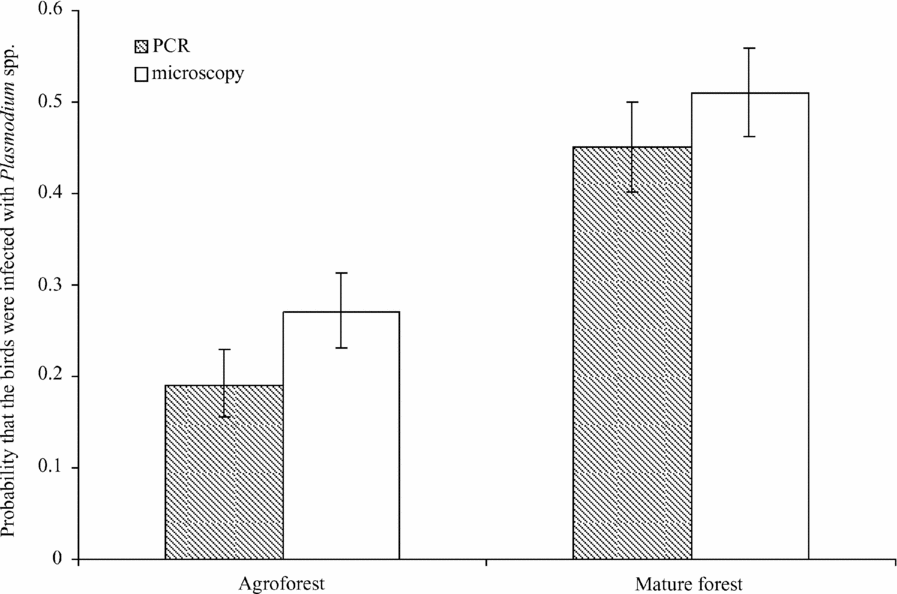
Bird species displayed significantly different levels of Plasmodium spp. infections, both when considering PCR data (generalized linear mixed model, χ2 = 22.9, P < 0.001; mean percentage infected individuals predicted by the model, NA. latirostris = 40%, NA. virens = 8%, NC. obscura = 47%) and microscopy data (generalized linear mixed model, χ2 = 23.8, P < 0.001; predicted means: NA. latirostris = 51%, NA. virens = 15%, NC. obscura = 52%). Forest type, however, was significantly associated with differences in the prevalence of Plasmodium parasites, both when using PCR data (generalized linear mixed model, host relative abundance: χ2 = 8.72, P = 0.003, forest type: χ2 = 16.0, P = < 0.001, Figure 2) and microscopy data (generalized linear mixed model, host relative abundance: χ2 = 2.34, P = 0.13, forest type: χ2 = 12.47, P < 0.001, Figure 2). In both cases, birds were more likely to be infected in mature forest sites than in agroforest sites.
Probability that the birds were infected with Plasmodium parasites for both habitat types (mature forests and agroforests) modelled using a generalized linear mixed model with site as a random factor. Figures show back-transformed mean probabilities of infection (± SE) for Plasmodium spp. detected by PCR and microscopy.

DISCUSSION
Undisturbed tropical forests were found to display significantly higher prevalence of infection with avian Plasmodium spp. (all lineages pooled), both when using PCR and microscopy methods of detection. The discrepancies in the prevalence of haemosporidian blood parasites that we detected when using microscopy and PCR methods are not surprising and have been reported in previous studies (Krone et al. Reference KRONE, WALDENSTROM, VALKIUNAS, LESSOW, MULLER, IEZHOVA, FICKEL and BENSCH2008, Pérez-Tris et al. Reference PÉREZ-TRIS, HELLGREN, KRIŽANAUSKIENĖ, WALDENSTRÖM, SECONDI, BONNEAUD, FJELDSÅ, HASSELQUIST and BENSCH2007, Valkiūnas et al. Reference VALKIŪNAS, BENSCH, IEZHOVA, KRIŽANAUSKIENĖ, HELLGREN and BOLSHAKOV2006a). This highlights the benefit of using a combination of both methods to evaluate the prevalence of haemosporidian blood parasites (Hellgren et al. Reference HELLGREN, WALDENSTROM, PEREZ-TRIS, SZOLLOSI, HASSELQUIST, KRIŽANAUSKIENĖ, OTTOSSON and BENSCH2007, Križanauskienė et al. Reference KRIŽANAUSKIENĖ, HELLGREN, KOSAREV, SOKOLOV, BENSCH and VALKIŪNAS2006, Valkiūnas et al. Reference VALKIŪNAS, IEZHOVA, KRIŽANAUSKIENĖ, PALINAUSKAS, SEHGAL and BENSCH2008a). In any case, our results suggest that forest density and structure may influence interactions between species and play a role in the transmission and/or maintenance of infections.
In a recent study, Wood et al. (Reference WOOD, COSGROVE, WILKIN, KNOWLES, DAY and SHELDON2007) detected a correlation between small-scale spatial variation determined by GIS analysis, and differences in malaria prevalence in a temperate woodland population of blue tits (Cyanistes caeruleus). Parasite prevalence significantly fluctuated by up to six-fold over 1 km, suggesting that individuals of a same population may, in fact, be exposed to considerable variation in the risk of infection. The likely role of landscape in heterogeneous disease dynamics highlights the need to incorporate habitat structure in ecological and epidemiological studies of natural host–parasite systems (Wood et al. Reference WOOD, COSGROVE, WILKIN, KNOWLES, DAY and SHELDON2007). An interesting difficulty is to estimate the most relevant scale at which habitat characteristics should be incorporated into assessments of risk or incidence of infection (Ostfeld et al. Reference OSTFELD, GLASS and KEESING2005), especially as spatial structure should differentially impact species with varying habitat range and dispersal abilities.
Forest type was associated with differences in the prevalence of Plasmodium spp. after we removed the effects of changes in the relative abundance of avian hosts, suggesting that habitat effects on infection patterns do not solely result from changes in host species composition between mature and agroforests. Changes in tropical habitats have been previously reported to correlate with changes in species interactions that were not merely attributable to differences in species richness (Tylianalis et al. Reference TYLIANALIS, TSCHARNTKE and LEWIS2007). Furthermore, correlations between habitat characteristics and parasite prevalence independent of host-density effects have been reported elsewhere. For example, Gillespie & Chapman (Reference GILLESPIE and CHAPMAN2006) detected a significant influence of habitat degradation on the prevalence of gastrointestinal parasites recovered from primate faeces that was not driven by changes in host density. In any case, the pattern detected in this study is actually not surprising in the case of arthropod-borne diseases, as habitat effects may also be mediated via effects on vector populations. Our results do not however preclude any indirect effects of host abundance, especially as host density is known to positively correlate with parasite prevalence (Morand & Poulin Reference MORAND and POULIN1998, Packer et al. Reference PACKER, ALTIZER, APPEL, BROWN, MARTENSON, O'BRIEN, ROELKE-PARKER, HOFMANN-LEHMANN and LUTZ1999). Infection levels may, in fact, also depend on changes in the abundance of other susceptible host species. Larger screenings of parasite infections in rain-forest birds of Cameroon that were conducted in parallel with this study, established that six of the Plasmodium spp. lineages described here were recorded only in certain bird species or bird families, suggesting that they may actually display stringent host-species or host-family specificity (PV1, PV2, PV6, PV9, PV16, PV17) (unpubl. data). These screenings also demonstrated that the other five lineages were found to infect several bird families and hence characterized as generalists (unpubl. data). Because we pooled all Plasmodium spp. lineages due to small sample sizes, it is possible that habitat effects on other avian hosts may, to a certain extent, be driving changes in parasite prevalence between forest types.
Effects of habitat on parasite prevalence may be explained by five non-mutually exclusive hypotheses; the predictions from which can be tested in future studies. First, the lower levels of infection with Plasmodium spp. in forests of lower vegetation biomass may be explained in part by the fitness cost associated with Plasmodium spp. infections (Merino et al. Reference MERINO, MORENO, SANZ and ARRIERO2000, Valkiūnas et al. Reference VALKIŪNAS, ŽIČKUS, SHAPOVAL and IEZHOVA2006b). Higher vegetation density, especially in times of drought, may indeed protect weakened birds from increased predation risk and thereby increase the number of malaria-infected individuals at mature forest sites. Second, since vegetation is also thought to be crucial in providing cover for dipteran breeding sites (Mercer et al. Reference MERCER, SHEELEY and BROWN2005), it is possible that mature forests also offer better vector breeding grounds than agroforests.
Third, increased competition among insect vectors in agroforests may cause a decline in the abundance of vectors susceptible to avian Plasmodium spp., resulting in a decreased prevalence of infection. Recent studies have demonstrated that the mosquito Anopheles darlingi, which is the primary malaria vector for humans in the Amazon, was encountered in altered habitats but was absent from intact sites (Tadei et al. Reference TADEI, THATCHER, SANTOS, SCARPASSA, RODRIGUES and RAFAEL1998), and that biting rates increased by almost 300% in disturbed habitats (Vittor et al. Reference VITTOR, GILMAN, TIELSCH, GLASS, SHIELDS, LOZANO, PINEDO-CANCINO and PATZ2006). Furthermore, larval studies suggest that the increase in A. darlingi abundance is due to an increase in suitable breeding sites in secondary forests (Vittor et al. Reference VITTOR, GILMAN, TIELSCH, GLASS, SHIELDS, LOZANO, PINEDO-CANCINO and PATZ2006). The transmission cycles of native pathogens have been shown to be altered by such new vectors (Juliano & Lounibos Reference JULIANO and LOUNIBOS2005). If lower prevalence in agroforests results, at least in part, from an intensification of vector competition, then we would expect breeding sites in agroforests to favour vectors preferentially feeding on humans at the detriment of those preferentially feeding on wild birds.
Fourth, the decreased prevalence of infection in agroforests could also be explained by changes in the feeding habits of insect vectors, especially in vectors that are relatively non-selective in their food preferences (Walsh et al. Reference WALSH, MOLYNEAUX and BIRLEY1993). In fact, both agroforest sites (Ndibi and Nkwouak) were close to human settlements (~0.5 km) and human-biting rates of mosquito increased noticeably at those sites compared with mature forest sites (pers. obs.). As a result, mosquitoes may preferentially feed on novel hosts in agroforest sites, such as humans or other animal species (e.g. domestic animals), thereby decreasing the risk of disease transmission to wild birds. This could be tested through the molecular identification of vertebrate hosts in dipteran blood meals. Last, there may be an increase in the density of alternative hosts in agroforest, which are less susceptible to infection (or incompetent). This may consequently result in a decrease in the prevalence and in the risk of infection through a ‘dilution effect’ (Ostfelt & Keesing Reference OSTFELT and KEESING2000, Schmidt & Ostfeld Reference SCHMIDT and OSTFELD2001, Yahner Reference YAHNER1988).
Here we show that forest type may have notable effects on host–parasite interactions. Our system is particularly complex because it involves many players: several species of avian host, several species and even genera of parasites and dipteran vectors. To fully understand the impact of habitat differences and modifications on these coevolutionary interactions, future efforts will focus on intense sampling of vertebrates (avian, mammalian and reptilian) and dipterans diversity and abundance in order to identify the potential changes in vector abundance and in vector meal preference. Further research will also be required to more fully examine the influence of spatial variation on parasite–host interactions. A weakness of the present study is that only four sites were compared and the two mature forest sites were adjacent. Nevertheless, our preliminary results emphasize the need to incorporate environmental abiotic and biotic characteristics when examining host–parasite dynamics or, more generally, when examining interactions among species. Furthermore, they stress the need to take into account both species abundance and complex species interactions when evaluating the ecological impacts of habitat degradation and planning effective conservation actions. This is particularly imperative given the increasing trend in emerging infectious diseases (Jones et al. Reference JONES, PATEL, LEVY, STOREYGARD, BALK, GITTLEMAN and DASZAK2008).
ACKNOWLEDGEMENTS
We thank the Government of the Republic of Cameroon for permission to conduct the field research. We thank D. Anye, T. Chaser and T. Dietsch for assistance in the field. We also thank R. Ricklefs, two anonymous referees and the Editor for their insightful comments on a previous version of the manuscript. The research was funded by the joint NSF-NIH Ecology of Infectious Diseases Program award EF-0430146 and by the Lithuanian State Science and Studies Foundation.