Introduction
Opisthorchiasis is a serious public health problem in parts of Eastern Europe and South-East Asia, caused by several species of the genus Opisthorchis (Sripa et al., Reference Sripa, Sithithaworn and Sirisinha2003). Approximately 10 million people are infected with O. viverrini, a species mostly reported from Thailand, Vietnam, Cambodia and Lao PDR, whereas about 1.2–1.5 million people are expected to be infected with O. felineus in Eastern Europe, including Russia, Belarus, Kazakhstan and Ukraine, with speculation that about 79.8 million people are at risk from opisthorchiasis (Keiser & Utzinger, Reference Keiser and Utzinger2009). Mostly, people with opisthorchiasis show no symptoms, but heavy infection may lead to cholangiocarcinoma of the bile duct (Sripa et al., Reference Sripa, Kaewkes, Sithithaworn, Mairiang, Laha, Smout, Pairojkul, Bhudhisawasdi, Tesana, Thinkamrop, Bethony, Loukas and Brindley2007). In cases of heavy infections in pigs, extensive proliferation in the pancreatic duct epithelium with folds or crypts projecting into the lumen and periductal fibrosis have been observed (Sinha, Reference Sinha1968).
The genus Opisthorchis (Platyhelminthes: Trematoda: Opisthorchiida: Opisthorchiidae) includes many species, of which only four, namely O. viverrini, O. felineus, O. noverca and O. guayaquilensis, are known to infect humans, with the latter two species being of rare occurrence (Kaewkes, Reference Kaewkes2003). Opisthorchis spp. are parasites of piscivorous vertebrates, mostly canids, felids and humans, since their infective metacercarial stage exists in piscine intermediate hosts (Yamaguti, Reference Yamaguti1975). In India, only one species, O. noverca Braun, 1902 (also known by various synonyms – Opisthorchis caninus Lewis and Cunningham, 1872; Distomum conjunctum Cobbold, 1875; Amphimerus noverca (Braun, 1902) Baker, 1911; Paropisthorchis indicus Stephens, 1912) has been reported as a common parasite occurring in the bile duct or pancreatic duct of pigs and dogs (Bhalerao, Reference Bhalerao1931; Sinha, Reference Sinha1968; Sahai, Reference Sahai1969; Yamaguti, Reference Yamaguti1971; Sahai & Srivastava, Reference Sahai and Srivastava1978; Mehra, Reference Mehra1980). In north-east India the species has been reported to occur frequently in pigs, with one accidental case report from cattle (Roy & Tandon, Reference Roy and Tandon1992). In India, human infection by O. noverca has only been reported twice (in 1876 and 1878) by McConnell (Mas-Coma & Bargues, Reference Mas-Coma and Bargues1997).
In trematode taxonomy, a wide variety of species have been conventionally described on the basis of their adult morphology. In recent times the use of DNA-based polymerase chain reaction (PCR) technology has emerged as an authentic molecular tool to differentiate morphologically alike but genetically discrete species (Prasad et al., Reference Prasad, Tandon, Chatterjee and Bandyopadhyay2007). Molecular markers of the nuclear ribosomal DNA internal transcribed spacer 2 (rDNA ITS2) and mitochondrial cytochrome oxidase I (mt COI) have been used collectively to categorize the molecular phylogeny of various trematode species, such as O. viverrini, O. felineus, O. lobatus, Clonorchis sinensis, Fasciola hepatica, Paragonimus spp. and Schistosoma spp. (Ando et al., Reference Ando, Sithithaworn, Nuchjungreed, Tesana, Srisawangwong, Limviroj and Chinzei2001; Kostadinova et al., Reference Kostadinova, Herniou, Barrett and Littlewood2003; Park, Reference Park2007; Attwood et al., Reference Attwood, Fatih and & Upatham2008; Katokhin et al., Reference Katokhin, Shekhovtsov, Konkow, Yurlova, Serbina, Vodianitskaia, Fedorov, Loktev, Muratov, Ohyama, Makhneva, Pel'tek and Mordvinov2008; Thaenkham et al., Reference Thaenkham, Nuamtanong, Vonghachack, Yoonuan, Sanguankiat, Dekumyoy, Prommasack, Kobayashi and Waikagul2011; Lymbery & Thompson, Reference Lymbery and Thompson2012). Analysis of the secondary structure of ITS2 and amino acid sequences has also been used as an additional tool to resolve taxonomic issues for various eukaryotic taxa, including liver flukes (Prasad et al., Reference Prasad, Tandon, Biswal, Goswami and Chatterjee2009; Wiemers et al., 2009; Thaenkham et al., Reference Thaenkham, Nuamtanong, Vonghachack, Yoonuan, Sanguankiat, Dekumyoy, Prommasack, Kobayashi and Waikagul2011; Tatonova et al., Reference Tatonova, Chelomina and Besprosvannykh2012). Further, compensatory base-pair changes (CBCs) or hemi-CBCs (hCBCs) have been used effectively to validate the phylogenetic relationship of intimately related species (Ruhl et al., Reference Ruhl, Wolf and Jenkins2010).
Since O. noverca is considered zoonotic, there is a need to characterize the species on a molecular basis for authentic identification and discrimination from the South-East Asian species. The present study aims to characterize O. noverca (the species reportedly prevalent in India) molecularly, using rDNA ITS2 and mtDNA COI gene markers so as to validate its identity as a separate species. ITS2 secondary sequence and structure showing hCBCs, along with COI-translated amino acid sequences, were also used as additional tools to strengthen the analysis results.
Materials and methods
Molecular analysis
Live adult Opisthorchis flukes were collected from the hepatobiliary duct of freshly slaughtered pigs (Sus scrofa domestica) at local abattoirs of Shillong (25.57°N, 91.88°E) in the state of Meghalaya, north-east India. For morphological study, stained whole-mount permanent preparations of the recovered flukes were made following standard protocols for fixation and staining. For the purpose of DNA extraction the flukes were singly immersed in a lysis buffer (1% sodium dodecyl sulphate (SDS); 25 mg proteinase K) and incubated at 37°C overnight. DNA was then isolated from individually lysed flukes by the standard phenol–chloroform technique (Sambrook & Russell, Reference Sambrook and Russell2001).
The rDNA region spanning the ITS2 and mitochondrial DNA region comprising COI were PCR amplified from the total genomic DNA obtained from the fluke using universal trematode primers (designed for Schistosoma spp.), namely 3S and A28 for ITS2 (Bowles et al., Reference Bowles, Blair and McManus1995) and JB3 and JB4.5 for COI (Bowles et al., Reference Bowles, Hope, Tiu, Liu and McManus1993).
PCR amplification was performed in a thermal cycler (Applied Biosystems 3130; Gurgaon, Haryana, India) for 36 cycles – denaturation for 1 min at 94°C, annealing at 70 s at 55°C (ITS2) and 52°C (COI), 1 min at 72°C; then 10 min incubation at 72°C and final cooling at 4°C. PCR products (three replicates for each marker) were purified by using Genei Quick PCR purification kit (Darmstadt, Germany) and sequenced (in both directions using PCR primers on an automated sequencer) by DNA sequencing services of Macrogen, Korea. The sequences were deposited in GenBank and their accession numbers acquired.
To establish a more direct PCR procedure for species discrimination and identification, a specific primer set was designed, using Primer3 plus (Untergasser et al., Reference Untergasser, Nijveen, Rao, Bisseling, Geurts and Leunissen2007), targeting unique regions of the ITS2 sequence. The designed primer set (forward and reverse) is as follows:
OnF1: 5'-GGGCTGACTGCCTAGATGAG-3'
OnR1: 5'-GCGTGGTAGCCTGGTTAGTT-3'.
The designed primers were examined for taxon-specific amplification with PCR conditions similar to those used for amplifying ITS2 sequences. The primers were tested against O. noverca isolates and also against all enteric parasites of pigs that commonly occur in the region, i.e. Artyfechinostomum sufrartyfex, Gastrodiscoides hominis and Fasciolopsis buski.
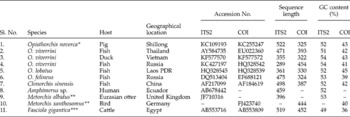
ITS2 and COI sequences for species of Opisthorchis and other closely related digenean trematode parasites, including the outgroup Fasciola gigantica, were retrieved from GenBank, based on the similarity search result in BLAST. The GC content for the dataset under study was calculated using the Oligocalculator available online (http://www.pitt.edu/~rsup/OligoCalc.html). The sequences included in the analysis, along with the details of the host and geographical locations of respective isolates, are depicted in table 1.
The geographical location, host, accession numbers, sequence length and GC content of Opisthorchis and other digenean species; *sequences from the present study; **, COI sequences retrieved as the minus strand from GenBank, were reverse complemented into the positive strand for analysis; and ***, outgroup.

Multiple sequence alignment (MSA) was done by ClustalW with default parameters in MEGA5 (Tamura et al., Reference Tamura, Peterson, Peterson, Stecher, Nei and Kumar2011). Sequence similarities were estimated using BioEdit (Hall, Reference Hall1999). For treating gaps and missing data the pairwise deletion was chosen.
Phylogenetic analysis
Phylogenetic trees were constructed for ITS2, COI and COI-translated amino acid sequences through Maximum Likelihood (ML) method in MEGA5. The best-fit models were searched for each marker and phylogenies constructed based on the best-fit model chosen for ITS2 (K2P; InL value = –1199.005), COI (HKY+G; InL value = –1279.299) and amino acids (JTT; InL value = –746.317). In all trees F. gigantica was used as the outgroup.
For secondary-structure phylogenetic tree construction, ITS2 secondary structures in Vienna (dot bracket) format were retrieved from the Mfold web server (Zuker, Reference Zuker2003) using folding temperature at 37°C (fixed); minimum free energy (mfe) folding algorithms and sequences with highest negative free energy. ITS2 secondary sequence alignment was done by PETfold (Seemann et al., Reference Seemann, Menzel, Backofen and Gorodkin2011) showing reliability score of base pairing and conservation of sequences. Amino acid sequences, translated from COI DNA sequences, were aligned by ClustalW with default parameters in MEGA5. The secondary-structure alignment tree was achieved at the RNA sequence-structure level with the help of the pipeline consisting of the ITS2 database, the sequence-structure alignment editor 4SALE (Seibel et al., Reference Seibel, Muller, Dandekar, Schultz and Wolf2006) and the phylogentic reconstruction tool ProfDistS (Wolf et al., Reference Wolf, Ruderisch, Dandekar and Müller2008), using the profile neighbour-joining (PNJ) method. ITS2 sequences were analysed using Hidden Markov Model (HMM)-based annotation in the ITS2 database having a 5.8S tailing region at the 5′-end and a 28S tailing region at the 3′-end, which is an important aspect for getting the four-helix secondary structure (Keller et al., Reference Keller, Schleicher, Schultz, Muller, Dandekar and Wolf2009).
Results
The flukes recovered from the pig hosts morphologically resembled O. noverca (voucher number: paratype NEHU/2–TM/29, deposited in the helminthological collection of the Department of Zoology, North–Eastern Hill University (NEHU)). The distinct features of O. noverca are: presence of body spines, ovary irregularly lobed or with three lobes, testes rounded or lobate and present in the posterior third portion of the body, and two groups of vitellaria with eight clusters of follicles in each group.
The PCR-amplified ITS2 and COI regions of the parasite DNA had a sequence length of 522 bp and 325 bp, respectively; their GenBank accession numbers are KC109193 (ITS2) and KC255247 (COI). The designed specific primer set (OnF1 and OnR1) was also tested for specificity on the genomic DNA of A. sufrartyfex, G. hominis and F. buski, the three potentially zoonotic trematodes occurring in the north-eastern region of India. The specific primer amplified only the ITS2 region with the PCR product of O. noverca (~300 bp) and did not show any cross-amplification with the other tested fluke species.
For sequence analysis, the ITS2 and COI sequences were compared with those of Opisthorchis species and other closely related digenean trematode parasites (table 1). In all, 42 sequences of ITS2 and 126 of COI were retrieved for O. felineus isolates that showed high sequence similarity (98–100%) among themselves. Regarding O. viverrini, of the nine ITS2 sequences retrieved, the Thailand isolate (AY584735) and Laos PDR isolates (HQ328548, HQ328549 and HQ328550) showed 100% similarity, as did the sequences of isolates from Vietnam (KF577570 and KF577571) and Russia (KC427197 and KC427196). However, the O. viverrini isolate from Savannakhet, Laos (AF408147) showed only 32.6–40.8% similarity with other isolates of the species. With regard to O. viverrini COI, of the 19 sequences retrieved, a low intra-specific variation was evident as the isolates exhibited 99–100% sequence similarity. In view of the low intra-specific variation in ITS2 and COI sequences of these species, only those isolates that showed >99% sequence similarity were taken for further analysis.
MSA results showed that ITS2 sequences comprised 33% conserved, 66% variable and 60% parsimony-informative sites, whereas COI sequences had 37% conserved, 58% variable and 15% parsimony-informative sites. In ITS2 sequences, the pairwise sequence similarity was seen to be the highest (95.5%) between O. noverca and O. viverrini (AY584735 and KC427197 isolates) and lowest (35.6%) between O. noverca and Metorchis albidus. For COI sequences, the highest similarity (83.6%) was seen between O. noverca and O. viverrini and lowest (65.2%) between O. noverca and Metorchis xanthosomus (table 2).
Similarity matrices based on percentages of ITS2 (below the diagonal) and COI (above the diagonal) sequences of O. noverca and other species of the Opisthorchiidae; ID, diagonal; *, sequences from the present study.

To explore the evolutionary lineage and interrelationship of O. noverca with other taxa of family Opisthorchiidae, phylogenetic trees were constructed, taking F. gigantica as an outgroup for all analyses.
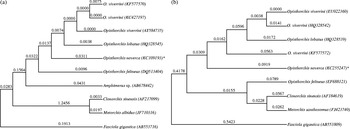
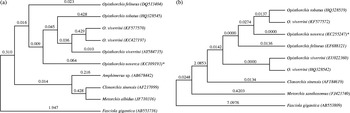
The ITS2 tree topology depicted a visibly informative clade that grouped all the species belonging to family Opisthorchiidae, showing Opisthorchis species grouping with Amphimerus sp., and representative species of Metorchis and Clonorchis falling into separate clades (fig. 1a). The COI tree and all dataset trees generated from the ITS2 secondary structure and amino acid sequences of COI were in congruence with one another, overall supporting O. noverca to be a valid separate species of Opisthorchiidae phylogeny (figs 1b, 2a, b).
Maximum Likelihood (ML) phylogenetic trees based on the rDNA and mtDNA sequences depicting the relationship of Opisthorchis noverca with other species of Opisthorchis and closely related digeneans, to show (a) ITS2 and (b) COI sequences.

ML phylogenetic trees based on primary sequence–secondary structure alignment and translated COI sequences depicting the relationship of Opisthorchis noverca and other species of Opisthorchis and closely related digeneans: (a) ITS2 secondary structure and (b) amino acid sequences.

To authenticate the phylogenetic analysis based on primary data, further analysis was carried out on ITS2 secondary structure and COI amino acid sequences. Results from the secondary-sequence data clearly indicate the grouping of O. noverca with other Opisthorchis species. Analysis of ITS2 secondary sequences indicates reliability of the base pairing and conservation among the bases, with a total of eight gaps in the alignment in between positions 80–90, 200–210 and 250–260. In amino acid sequence analysis also, nine positions out of 81 positions include one gap, showing a low (0.11%) variation rate.
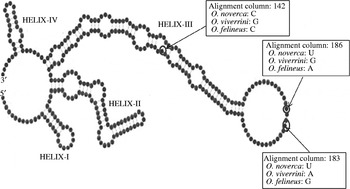
For prediction of ITS2 secondary structure, sequences of only O. noverca, O. viverrini (AY584735) and O. felineus were considered; sequences of O. lobatus and two other isolates of O. viverrini (KF577570 and KC427197) were not included in the analysis as they did not satisfy the HMM–based annotation criteria used by the ITS2 database for sequence annotation. The ITS2 sequence length after annotation of O. noverca, O. viverrini and O. felineus turns out to be 299 bp, 297 bp and 300 bp, with the minimum free energy of the species being − 109.80 kcal/mole, − 117.80 kcal/mole and − 117.90 kcal/mole, respectively. The secondary structure of all these species satisfies all hallmarks of a canonical secondary structure (four-helix) model. The nucleotide lengths of all helices, U–U mismatches and UGG motifs in respect of all Opisthorchis species included in the study are presented in table 3. In the conserved secondary structure (fig. 3), the Helix-I region is seen to be fully conserved across the three species; the Helix-II region shows 21 base changes including 13 hCBCs. Helix-III (longest amongst the four helices) is seen to be highly variable, with 72% variability among the three species; three positions (i.e. alignment column positions 142, 183 and 186) in Helix-III show fully variable nucleotide bases with 15 hCBCs. Helix-IV shows the presence of hCBCs, which are non-wobble base pairs and are completely missing in Helix-I. The consensus secondary structure of all three species exhibits 51% consensus, with no CBCs.
A comparison of ITS2 secondary structures in three species of Opisthorchis; bp, base pairs; *, sequences from the present study.

Consensus secondary-structure model of O. noverca, O. viverrini and O. felineus; circles indicate the highly variable bases.

Discussion
Morphologically, the various Opisthorchis spp. differ from one another mainly in the extent of vitellaria, shape and position of testes and ovary, and body spination (Yamaguti, Reference Yamaguti1971). Characteristically, O.viverrini shows the presence of vitelline follicles that extend in columnar groups posteriad beyond the ovary (which is oval or slightly lobed), and markedly lobed testes (Mas-Coma & Bargues, Reference Mas-Coma and Bargues1997; Thaenkham et al., Reference Thaenkham, Nuamtanong, Vonghachack, Yoonuan, Sanguankiat, Dekumyoy, Prommasack, Kobayashi and Waikagul2011); in O. felineus, vitelline glands form bunches that are located laterally behind the ventral sucker, testes are four- to five-lobed and the ovary is smooth-edged and weakly lobed (Mordvinov et al., Reference Mordvinov, Yurlova, Ogorodova and Katokhin2011). In O. lobatus, vitelline follicles do not extend beyond the ovary, testis lobes are irregular in shape and size, and the ovary has 3–4 finger-like lobes (Thaenkham et al., Reference Thaenkham, Nuamtanong, Vonghachack, Yoonuan, Sanguankiat, Dekumyoy, Prommasack, Kobayashi and Waikagul2011). On the basis of morphological characters, O. noverca shows remarkable differences from the other Opisthorchis spp., with the presence of body spination, in the shape of testes and ovary and extent of vitelline glands. The taxonomic status of O. noverca has been described based on morphological data alone (Mehra, Reference Mehra1980) but there is no information available so far on molecular characterization of this Indian opisthorchiid fluke. The disease related to O. noverca is undoubtedly underestimated, due to confusing aetiology or lack of reporting of diagnosed cases (Mas-Coma & Bargues, Reference Mas-Coma and Bargues1997).
In the present study we characterized O. noverca using the molecular rDNA ITS2 and mt COI marker regions. For the fluke under study, the GC content of ITS2 and COI sequences was found to vary from 49 to 54% and 36 to 45%, respectively (table 1). More than 50% GC content signifies its role in forming the base pairing of the 5′-terminus of ITS2 and the 3′-terminus of 28S segments, and in destabilizing the base pairing in the helical segments in the secondary structure, and reflects the grouping pattern among the species in the phylogenetic tree (Tandon et al., 2011).
Because of the absence of intra-specific polymorphism and presence of inter-specific heterogeneity, ITS2 regions are considered ideal for designing specific primers (Bazsalovicsova et al., Reference Bazsalovicsova, Kralova–Hromadova, Spakulova, Reblanova and Oberhauserova2010). The primers designed for O. noverca (OnF1/OnR1) showed PCR amplification for the parent fluke only and thus proved to be taxon specific.
In MSA analysis, a considerable degree of variability of base sequences was evident among the various Opisthorchis species. The O. noverca sequences showed a high similarity value (indicative of homogeneity) with O. viverrini. High similarity values are congruent with low genetic diversity among O. felineus isolates (Katokhin et al., Reference Katokhin, Shekhovtsov, Konkow, Yurlova, Serbina, Vodianitskaia, Fedorov, Loktev, Muratov, Ohyama, Makhneva, Pel'tek and Mordvinov2008; Brusentsov et al., Reference Brusentsov, Katokhin, Brusentsova, Shenkhovtsov, Borovikov, Goncharenko, Lider, Romashov, Rusinek, Shibitov, Suleymanov, Yevtushenko and Mordvinov2013). As the intensity of virulence is influenced by the degree of genetic variability among the species, presumably O. noverca may also possess a similar virulence to that shown by O. viverrini (Schulenburg & Ewbank, Reference Schulenburg and Ewbank2004; Shylla et al., Reference Shylla, Ghatani, Chatterjee and Tandon2011), although further studies are required to ascertain this aspect.
In phylogenetic analysis, the ITS2- and COI-based trees showed slightly different grouping patterns with regard to the clading of O. noverca (fig. 1a, b). This may be attributed to the difference in the rate of evolution; mtDNA shows a higher rate of evolution compared to nuclear rDNA (Brown et al., Reference Brown, George and Wilson1979). The secondary-sequence trees for both markers were also congruent with the trees based on primary sequences, but with some deviations in the grouping pattern and branch length (fig. 2a, b). In the ITS2 secondary sequence, any variation that does exist is mostly confined towards the 3′-end only. Also, in COI-translated amino acid sequences very few variations are observed as compared to the primary sequence; these sequences, being more conserved than nucleotide sequences, are better suited for phylogenetic analysis (Hwang & Kim, Reference Hwang and Kim1999).
The ITS2 secondary structure, with four helices, has certain distinct characteristics, such as Helix-III being the longest of all helices and having a UGGU motif at the 5′-apex, with some deviations such as UGGGU, UGG and GGU; and a U–U mismatch in Helix-II (Schultz et al., Reference Schultz, Maisel, Gerlach, Muller and Wolf2005). Our present results showed that the three Opisthorchis spp. have only the UGG motif in their Helix-III. The folding pattern of the ITS2 region can be used to compare the species in a genus (and genera in a family) to find out the single secondary (conserved) structure common to them all, which is preserved by the pairing pattern of CBCs and hCBCs. The latter provide direct evidence about the phylogenetic evolution supporting the ITS2 secondary-structure model (Coleman, Reference Coleman2003). The presence of numerous hCBCs but no CBC in helices, as emerged in the present study, denotes that helices are less conserved among themselves. The hCBCs may be regarded as stable substitutions, recommending that the wobble base pair (e.g. G–U) is not a drawback when compared with canonical base pairs (Harrington et al., Reference Harrington, Biffin and Gadek2009) and that the fast-evolving hCBC pathway may lead to faster adaption processes as compared to changes implicating CBCs in the speciation process (Caisova et al., Reference Caisova, Marin and Melkonian2011).
Results of the present study based on molecular characterization of the marker genes and their phylogenetic analysis, supplemented with their secondary structures, strongly corroborate that the Indian opisthorchiid, O. noverca is a distinct and valid species of the genus Opisthorchis. Further exploratory studies are warranted to determine intra-specific variations and genetic variability among various host/geographical isolates of O. noverca, using additional molecular markers.
Financial support
The study was supported by The Indian Council of Medical Research (ICMR)-sponsored project ‘Molecular characterization of food-borne trematodes and cestodes prevailing in Northeast India’, sanctioned to V.T. and B.R. et al.; the Department of Information Technology (Government of India)-supported project on ‘North-East Parasite Information and Analyses Centre: an in-silico approach (NEPIAC)’ sanctioned to V.T. and D.K.B.; and Departmental Special Assistance (University Grants Commission–Special Assistance Programme) – Phase II in the Department of Zoology at North-Eastern Hill University, Shillong.
Conflict of interest
None.