Introduction
The World Health Organization (WHO) has estimated that more than half a million maternal deaths take place worldwide annually, about 174,000 of which occur in South East Asia (WHO, 2005). The availability of effective family planning is recognized as an important strategy to help reduce maternal mortality through the reduction of unwanted pregnancies, especially among high-risk groups such as women under age 18 or over age 34, those with more than three children or primigravida women (MacCauley et al., Reference MacCauley, Robey, Blanc and Geller1994; Kasmiyati & Kentner, Reference Kasmiyati and Kentner1998; WHO, 2004a; United Nations Population Fund (UNFPA), 2005; United States Agency for International Development (USAID), 2006). It is estimated that one in three deaths related to pregnancy and childbirth worldwide could be avoided if all women had access to contraception (UNFPA, 2005).
Indonesia, located in South East Asia, has an estimated population of almost 240 million, 70% of which live in rural areas (United Nations Economic and Social Commission for Asia and the Pacific (ESCAP), 2008; United States Department of State, 2009). Women make up half of the population, and of these, about two-thirds are of reproductive age (WHO, 2004b). Maternal mortality in Indonesia remains a significant problem; Indonesia's maternal mortality ratio (MMR) is one of the highest in the region, estimated by the WHO to be 390 per 100,000 live births in 2000 (WHO, 2004a). The risk of maternal death in Indonesia is 45 times higher than in developed countries (WHO, 2003a).
Reducing fertility has been a major goal of the Indonesian government. Indonesia's total fertility rate (TFR) was 2.6 in 2007, representing a decrease of more than one-half in the past 30 years (Demographic & Health Surveys, Reference Casterline and Sinding2007). Although a number of factors have contributed to the decline, including older age at marriage and increasing education levels, the reduction has been largely attributed to the dramatic increase in contraceptive prevalence (Kasmiyati & Kentner, Reference Kasmiyati and Kentner1998; United Nations Economic and Social Commission for Asia and the Pacific (ESCAP), 2002; Demographic & Health Surveys, 2007). Since the establishment of the Indonesian National Family Planning Program in 1970, the contraceptive prevalence rate (CPR) for married women has more than tripled from 18% to the current rate of 57% in 2007 (Demographic & Health Surveys, 2007).
Despite the accomplishments of the National Family Planning Program, improvements still need to be made. In the past 10–15 years there has been only a slight increase in the modern CPR and the MMR has not declined (WHO 2004a, 2004b, 2006). A substantial proportion of Indonesian women who want to stop childbearing are not using contraception (Demographic & Health Surveys, 2007; Kasmiyati & Kentner, Reference Kasmiyati and Kentner1998; WHO, 2006). The current unmet need for family planning is 9% (Demographic & Health Surveys, 2007). Of approximately 4.5 million annual births in Indonesia, about 7% of births are unwanted and another 10% are mistimed (United Nations Department of World and Economic Affairs, 2007). Even in regions where fertility rates have declined, Indonesia's health system faces problems reaching remote communities with inadequate access to health services, including reproductive health services (WHO, 2004a).
Theoretical framework
The supply and demand model serves as the theoretical framework for this study. This model, which has been applied to the study of fertility and contraceptive use, suggests that both individual characteristics and structural factors influence the demand for and the supply of children and, therefore, indirectly influence the regulation of fertility. Fertility decisions are based on a couple's perception of the value of an additional child, which varies greatly according to current living conditions and opportunities within societies (Easterlin, Reference Easterlin1975; Bulatao & Lee, Reference Bulatao, Lee, Bulatao and Lee1983). ‘Demand’ refers to the family size and composition a couple would have under ideal circumstances. It has many dimensions, such as number, sex and spacing of surviving children, and is affected by personal preferences, community influences and social norms (Heer, Reference Heer, Bulatao and Lee1983). Demand affects contraceptive use through socio-cultural and attitudinal factors, such as considering children to be potential economic assets and attaching high value to large families (Schoemaker, Reference Schoemaker2005).
The demand for more children has been positively associated in studies with a woman's age, woman's education, length of marriage, urban residence, number of living children, the number of living sons and child loss (Campbell & Campbell, Reference Campbell and Campbell1997; Bankole & Westoff, Reference Bankole and Westoff1998; Islam & Bairagi, Reference Islam and Bairagi2003; Roy et al., Reference Roy, Ram, Saha and Khan2003). Studies have also found a negative association between the desire for more children and contraceptive use (De Silva, Reference De Silva1991; Roy et al., Reference Roy, Ram, Saha and Khan2003; Schoemaker, Reference Schoemaker2005). Contraceptive use has been associated in Asian countries with women's age, education, income, number of living children, age at marriage, duration of marriage, number of living children, experience of child mortality, knowledge and availability of contraceptives (Khan, Reference Khan1996; Mahmood & Ringheim, Reference Mahmood and Ringheim1996; Thang & Huong, Reference Thang and Huong2003; Schoemaker, Reference Schoemaker2005). Perceived spousal and community support of contraception and communication between spouses have also been positively linked to contraceptive use in several developing countries (Mahmood & Ringheim, Reference Mahmood and Ringheim1996; Bankole & Singh, Reference Bankole and Singh1998; Kadir et al., Reference Kadir, Fikree, Khan and Sajan2003; Gipson & Hindin, Reference Gipson and Hindin2007).
Significance
Fertility preference and intention indicators have been used extensively to determine the extent of women's unmet need for family planning in numerous Asian settings because of their utility as predictors of future reproductive behaviour (De Silva, Reference De Silva1991; Tan & Tey, Reference Tan and Tey1994; Westoff & Bankole, Reference Westoff and Bankole1995; Casterline & Sinding, Reference Casterline and Sinding2000; Islam & Bairagi, Reference Islam and Bairagi2003; Roy et al., Reference Roy, Ram, Saha and Khan2003, Reference Roy, Sinha, Koenig, Mohanty and Patel2008). If fertility intentions accurately predict subsequent reproductive behaviour, exploring fertility preferences and intentions can suggest policies that may be effective in assisting women in meeting their reproductive goals. Since a substantial proportion of women who do not want any more children are not using contraception, identifying women who are less likely to use contraceptives is crucial to developing effective family planning programmes. If these women do not intend to continue childbearing but do not perceive themselves to be at risk for an unintended pregnancy, providing contraceptive information and services could be an important strategy to reducing the unmet need for family planning, as well as preventing unwanted pregnancies and maternal deaths among these groups. The main objective of this paper was to analyse the predictors of the desire for more children and current contraceptive use among women of reproductive age in an isolated community in Bali, Indonesia.
Research questions
This study's two main research questions were: (1) what are the predictors of the desire for more children? and (2) what predicts contraceptive use? The analysis was designed to identify the key characteristics of women who desired children and the predictors of contraceptives use, especially addressing whether or not the desire for more children affected current contraceptive use, taking into account other factors that are known to affect contraceptive use.
Methods
The study community
Bali's three million inhabitants are Hindu, in contrast to the rest of Indonesia which is predominantly Muslim. Bali's level of socioeconomic development is relatively high compared with most of the other islands in the Indonesian archipelago. Similar to the national trend, Bali's TFR has decreased from 5.96 children in 1970 to its current level of 2.14, reached in 1994 (Demographic & Health Surveys, 2007). The modern CPR for married women in Bali is slightly below 60.0% (Demographic & Health Surveys, 2007). However, there are significant variations in contraceptive use across the different regions of Bali.
The study community was located in a remote area in east Bali made up of nineteen villages with a total population of approximately 13,000. The residents are poor, illiterate farmers who belong to the same Hindu caste of agricultural workers. Contraceptives are subsidized by the government but users pay a co-payment of about US$0.50. A local male government family planning outreach worker provides family planning information through monthly visits to the more remote villages. According to a household survey, the most popular methods of contraception are: the Depo-Provera shot (52.6%), the Norplant (28.6%) and the IUD (9.5%), oral contraceptives (5.2%) and sterilization (3.9%).
The sample
The data for this study came from a survey conducted in 2002–2003 by a local non-governmental organization, the East Bali Poverty Project. Every female at least 12 years of age was eligible. Each survey was completed in approximately 30 minutes and was conducted in the local language (Balinese) at the respondent's home. The response rate was 90% and the total number of respondents of this survey was 2423. The average age of respondents was 35 (range of 12–80) and 85.0% were married.
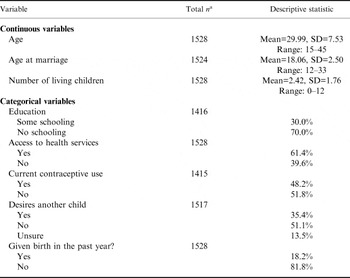
The analysis for the present study was conducted using a sub-sample of married women of reproductive age, defined as ages 15–45 (n=1528). Only about a third (35.4%) of women in this sub-sample reported the desire for more children. Yet, more than a half (51.8%) were not using any form of modern contraception. Of those who reported the desire for another child, more than a half wanted only one more child. Of special importance is the high level of unmet need for family planning. Of those who reported wanting no more children, 41% were not using any form of modern contraception. Moreover, among the 13.5% of women who reported unsure fertility intentions, about two-thirds (61.9%) were not using contraceptives.
Variable selection
Two dependent variables were analysed. The first dependent variable was the desire for more children. The survey question, ‘Do you want more children?’ had three response choices: yes, no and unsure. The variable was dichotomized into ‘yes’ and ‘no.’ Based on a similar study, women who were unsure were included in the ‘yes’ category because they were not considered to be strongly motivated to avoid a birth (Roy et al., Reference Roy, Ram, Saha and Khan2003). The second dependent variable was contraceptive use at baseline. Formative research confirmed that the Indonesian word for contraceptives, keluarga berencana, or ‘KB’, was understood to mean only modern contraceptive methods as opposed to non-modern methods, such as use of medicinal plants.
The following independent variables were included in the analysis: age, age at marriage, education, number of living children, regular access to health care and recent birth. Fertility intention, measured as the desire for more children, was also analysed as an independent variable that potentially affected contraceptive use. The age of the mother was categorized into younger (15–26), middle (27–32) and older age (33–45) groups, according to the age distribution of the sample. ‘Age at marriage’ and ‘number of living children’ were continuous variables. Educational level was dichomotized into ‘did not attend school’ and ‘attended some school’. To measure access to health services, including family planning, women living in villages that received regular visits from an outreach worker or who lived within three km of the local government health clinic were considered to have regular access to health care services, while those who did not receive regular visits from the outreach worker or who lived more than three km from the clinic were considered to not have regular access. ‘Recent birth’ was dichotomized as women who had given birth within one year prior to the survey and those who had not.
Results
Univariate analysis
The descriptive statistics for the sample of 1528 married women of reproductive age included in the analyses are shown in Table 1. The mean age of women in the sub-sample was 30 years (range 15–45) and the mean age at marriage was 18 years (range 12–33). The mean number of living children a woman had was 2.4. As seen in Table 2, a woman's desire for more children declined significantly by the number of living children she had. It appears that the desired family size is between two and three children since more than a half of women who had two or more living children reported the desire to stop childbearing. Forty-two women (25.6%) who had no living children reported no desire for more children. Given that bearing at least some children is generally considered to be desirable in this community and the fact that over half of women in this group were aged 40–45, it is likely that these women reported no desire for more children because of their older age and/or perceived or true inability to conceive.
Description of sample of married women of reproductive age (n=1528)

a Total numbers are not the same due to missing data.
Desire for more children by total number of living children (n=1499)

Bivariate analysis
Several significant differences emerged between women who reported the desire for more children, including those who were unsure about their desire for more children, and those who reported not wanting more children. First, among women in the youngest age group (aged 15–26), 77.9% reported the desire for more children compared with 45.8% among those aged 27–32 and 24.9% among those aged 33–45 (p<0.001). Among women who had some education, 60.7% reported the desire for more children while only 42.5% of those with no education reported wanting additional children (p<0.001). Significant differences in fertility preference also existed among women who had regular access to health services. Among women who had regular access to health services, 50.7% desired another child compared with 45.6% of those who did not have regular access (p<0.05). Fertility preference also differed by number of living children; on average women who reported the desire for more children had 1.65 living children while women who reported not wanting more children had 3.11 living children (p<0.001). Among women who had recently given birth, 61.6% desired more children while only 46.1% of those who had not recently given birth desired more children (p<0.001). Finally, significant differences were not found in fertility preference based on age at the time of marriage.
Significant differences were found between women who used contraceptives and those who did not. Among women in the youngest age category, 42.1% used contraceptives compared with 56.8% among women in the middle age category and 43.5% in the oldest age group (p<0.01). Among women who used contraceptives, the mean number of living children was 2.71, while the mean number of living children among women who did not use contraceptives was 2.25 (p<0.001). In addition, among women with regular access to health services, 51.3% used contraceptives compared with 42.0% of women who did not have access to health services (p<0.001). Significant differences in contraceptive use also existed with regard to recent birth; among women who had given birth in the previous year, 40.5% reported contraceptive use while 49.4% of those who had not had a recent birth reported use of contraceptives (p<0.01). Finally, among women who reported the desire for more children, about one-third (34.9%) were contraceptive users while 58.6% of those who said they did not want additional children used contraceptives (p<0.001). No differences were found with regard to age at marriage or education.
Multivariate analysis
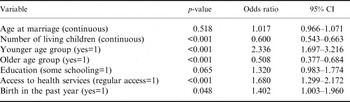
Binary logistic regression was used for modelling the dichotomous dependent variables. The following seven variables were forced into the regression model in order to analyse their independent effects on desire for more children: age at marriage, number of living children, dummy variables for younger age (ages 15–26) and older age (ages 33–45), education, access to health services and recent birth. Five of the variables remained significant after controlling for the other factors (see Table 3). As expected, age was negatively associated with the desire for more children where the odds of a woman in the youngest age group to desire more children was over twice as that of women in the middle age group (adjusted odds ratio [OR]=2.34, 95% confidence interval [CI]=1.697, 3.216], and for a woman in the oldest age group the odds was only about half of that of those in the middle age group (OR=0.51, 95% CI=0.377, 0.684). Also as expected, the number of living children was negatively associated with the outcome; an increase of one in the number of living children reduced the odds of the desire for more children by 40% (OR=0.60, 95% CI=0.543, 0.663). In addition, access to health services was positively associated with the desire for more children. Women who had regular access to health services had an odds of wanting more children that was 1.68 times greater than that of those who lived in villages with no regular access to health services (OR=1.68, 95% CI=1.299, 2.172). Finally, recent birth was also found to be significantly associated with the desire for more children. The odds of a woman who had recently given birth to want additional children was 1.4 times greater than that of those who had not recently given birth (OR=1.40, 95% CI=1.003, 1.960). Age at marriage and education were not found to be significantly related to the desire for more children when controlling for the other factors.
Predictors of the desire for more children (n=1528)

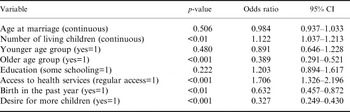
The following eight variables were forced into a multivariate logistic regression model to predict current contraceptive use: age at marriage, number of living children, dummy variables for younger and older age, education, access to health services, recent birth and the desire for more children. As shown in Table 4, five of the variables remained significant after controlling for the other variables. Older age was found to be significantly associated with current contraceptive use; older women had an odds of using contraceptives that was less than half that of women in the middle age group (OR=0.39, 95% CI=0.291, 0.521). The number of living children was found to be associated with contraceptive use; an increase of one in the number of living children increased the odds of using contraception by 12% (OR=1.12, 95% CI=1.037, 1.213). Access to regular health services was also found to be significantly positively related to contraceptive use, where the odds of a woman who had access to health services using contraceptives was 1.7 times that of a woman who did not have regular access to health services (OR=1.71, 95% CI=1.326, 2.196). Women who had given birth in the past year had a significantly smaller odds of using contraceptives compared with women who had not given birth in the last year (OR=0.63, 95% CI=0.457, 0.872). Women who wanted more children had an odds of using contraceptives that was only about one-third that of those who reported not wanting more children (OR=0.33, 95% CI=0.249, 0.430). Age at marriage, younger age and education were not significantly related to current contraceptive use.
Predictors of current contraceptive use (n=1528)

Discussion
The analysis results showed younger women, those with regular access to health services and women who had given birth within the past year to be significantly more likely to report the desire for more children. Women who had a higher number of living children were less likely to want additional children. In addition, older women were found to be significantly less likely than younger women to report the desire for more children.
In the second regression model, the number of living children and regular access to health services were found to be significantly positively associated with the use of contraceptives. As expected, women who reported the desire for more children were less likely to use contraceptives. In addition, even though older women were found to be about half as likely as women in the middle age group to want more children, they were about 40% less likely to use contraceptives. Finally, having a birth in the past year was found to be significantly negatively associated with contraceptive use.
While fertility preference is, on average, consistent with contraceptive use, studies have found that a significant proportion of women who have no desire to continue childbearing do not, in fact, use contraceptives. This study identified specific groups of women who may have an unmet need for family planning. First, women in the oldest age category (33–45 years) were least likely to report contraceptive use even though they were least likely to desire additional children. It is possible that many of these women are actually not fecund and therefore have no need for contraception. However, it may also be that a high proportion of these women have incorrectly assumed that they were not at risk of pregnancy based on their age, infrequent menstruation or other signs. This false assumption, combined with failure to use contraceptives, places this group at very high risk for unintended pregnancy. It is known that older women, especially high-parity women, are also at higher risk for maternal complications than younger women or women with fewer children.
Second, postpartum women were less likely than other women to report contraceptive use. Although postpartum women were found to be more likely to want more children than women who had not had a recent birth, it is likely that they did not intend to have children immediately. In one study in Indonesia, only 3.3% of postpartum women intended to give birth again within one year (Ross & Winfrey, Reference Ross and Winfrey2001). Consistent with other studies' findings, it is likely that postpartum women in this study incorrectly assume that they are not at risk of conception because they have not begun menstruation again following the birth of their last child (Casterline & Sinding, Reference Casterline and Sinding2000; Ross & Winfrey, Reference Ross and Winfrey2001; Roy et al., Reference Roy, Sinha, Koenig, Mohanty and Patel2008). Research has established that a high proportion of postpartum women have an unmet need for contraception because many women have experienced the return of menses, do not abstain from intercourse and do not use contraception, despite their desire to avoid another pregnancy (Thapa et al., Reference Thapa, Kumar and Cushing1992; Ross & Winfrey, Reference Ross and Winfrey2001). In fact, low perception of risk of pregnancy has been identified as one of the main causes for unintended pregnancy among postpartum women, accounting for as much as a quarter of the unmet need for family planning (Westoff & Bankole, Reference Westoff and Bankole1995). In Bali, the postpartum abstinence period only lasts 28 days, and breast-feeding, while highly prevalent, is not exclusive. Therefore, postpartum women also represent a group at risk for unintended pregnancy because of their low rates of contraceptive use.
The results also demonstrated the influence of access to health services on women's fertility intentions. Women who had regular access to health services were twice as likely to desire more children than women without regular access. This suggests that women who have access to health services may feel more confident that they would be able to obtain maternal health services, such as delivery care during childbirth, and thus are more willing to have additional children. The lack of delivery care contributed to the high rate of maternal morbidity and infant mortality in this community. In the formative research for this study, numerous women communicated that they were afraid to ‘risk another pregnancy’ or to have more children because of the high rates of complications during childbirth and the lack of skilled birth attendants in their villages. Therefore, it is likely that women who live in villages where access to formal health care providers is available feel more confident in their ability to have successful birth outcomes. In remote and resource-constrained communities, reducing the barriers that women face to accessing services can impact the use of prenatal care, delivery care and family planning, as well as help women meet their fertility intentions. The reduction of obstetric complications may also be an important step to help women achieve their reproductive goals.
However, it must be acknowledged that providing access to regular primary health care services may not be enough to meet women's reproductive needs, especially family planning. Previous studies have determined that inadequate access to services is not one of the predominant causes of unmet need and is less often cited as a reason for non-use of contraception than other factors, such as opposition from family and community members, health concerns about side-effects and lack of knowledge about contraceptive methods (Bongaarts & Bruce, Reference Bongaarts and Bruce1995; Westoff & Bankole, Reference Westoff and Bankole1995; Casterline & Sinding, Reference Casterline and Sinding2000). These findings support other studies that have found that offering specialized clinics or regular visits by a family planning outreach worker may be necessary in order to address barriers to seeking reproductive health services (Freedman, Reference Freedman1997; Addai, Reference Addai2000; Glei et al., Reference Glei, Goldman and Rodriguez2003; Yanagisawa et al., Reference Yanagisawa, Oum and Wakai2006; Roy et al., Reference Roy, Sinha, Koenig, Mohanty and Patel2008). Such programmes may also aid women who are unsure about their fertility plans to make definitive plans regarding fertility and may help reduce the unmet need for contraception among those who wish to stop childbearing.
Strengths and limitations
This study has several important strengths. The close relationship between local village leaders, community members and researchers contributed to the integrity of the data collection effort. The data were collected by locals who are trusted by the community members and their unique input was incorporated into the study design and materials, enhancing the content validity and cultural appropriateness of the data collection method. Another important strength is the high rate of participation in the survey (90%). However, two limitations must be acknowledged. First, the survey did not specify a time period for the desire for more children, such as in the next 2 years, commonly used in other similar surveys. Secondly, it would have been helpful to measure intention to use contraception instead of current contraceptive use in order to better understand reproductive behaviour over time.
Conclusions
Married women of older age, who have no access to health services, and/or who have recently given birth in this remote area of Bali are less likely to use contraceptives even though they probably do not desire more children in the near future or at all. Meeting the unmet need for family planning among these groups by making family planning information and a variety of contraceptive choices available is a key approach to promoting women's reproductive health, as well as increasing contraceptive uptake and decreasing fertility rates in this area of Bali, and perhaps in other similarly remote communities in developing countries. It could also be an important step to reducing maternal morbidity and mortality. A woman's ability to decide on the timing and number of births she will have is a fundamental right. Improving women's reproductive health must include supporting a woman's ability to control her fertility, including the use of contraception. It is of critical importance to reduce the unmet need for family planning in order to assist women in meeting their reproductive goals as well as to protect their health and human rights.
The impact of cultural institutions and community-level norms should be examined in future studies on fertility preferences in developing countries where the level of unmet need for family planning is high. Future research should also examine the desire for more children and contraceptive use over longer time periods in order to better understand the long-term influences on fertility decision-making, especially in the context of socioeconomic development and fertility transitions.
Acknowledgment
The principal author would like to thank the Balinese research assistants and residents of the study community for their important contribution to this study.