Other than for the terrorist attack which disrupted them and Mark Spitz's seven gold medals in the swimming pool, the 1972 Munich Olympic Games are primarily known for their architecture and design. The centre-piece of Munich's Olympic architecture, the 75,000 square-metre sweeping Olympic roof by Günter Behnisch and Partners (B+P) and the Olympic colour scheme, emblem, posters and pictograms by Otl Aicher are still credited along with other elements with creating a positive image of the Federal Republic in the 1960s and early 1970s.Footnote 1 While the roof's openness and transparency came to symbolize the positive attributes of West German democracy, Aicher's designs successfully conveyed a sense of the Federal Republic as a modern and well-organized, yet informal and easy-going society.
From conception to completion, this first opportunity for the Federal Republic to represent itself to the world through a ‘mega-event’Footnote 2 on its own soilFootnote 3 was largely the brainchild of Willi Daume.Footnote 4 Daume, the head of West German sport, first saw his chance with the International Olympic Committee (IOC) in 1965; quickly convinced Munich's young and dynamic mayor Hans-Jochen Vogel to put his city forward; helped secure government funding; and as president of the 1972 Organizing Committee worked tirelessly to make the Games a success. Among his many crucial decisions was the championing of Aicher as the Games’ ‘design commissioner’ (Gestaltungsbeauftragter) in 1966 and B+P as their architects – the latter winning a national competition in 1967. Daume was equally at home in the worlds of sport and art, and Aicher seems to have shared an instinctive understanding with him, later describing him as someone who saw the world as he did himself. For Aicher, Daume was an Augenmensch, someone who ‘thought with his eyes’.Footnote 5
Despite the importance of the graphic design in 1972, relatively little has been written about it, compared to Munich's Olympic architecture.Footnote 6 This is all the more surprising, since, while much of the roof's architectural symbolism came about by accident rather than design, Aicher left nothing to chance. Rather, in contrast to the manifold technical compromises which affected the execution of B+P's original design over the years, he succeeded in translating his political, historical and philosophical ideas more or less directly into creative practices. The same can be said of the Olympic Park, created by landscape architect Günther Grzimek. Despite the significance of this artificial landscape for the overall appearance of the Munich site, Grzimek's contribution has been even less recognized.Footnote 7 However, his work can similarly be described as deeply political and philosophical, if perhaps less original in that he often followed Aicher's intellectual lead. This is hardly surprising given his long-standing friendship with Aicher and his connections to the Hochschule für Gestaltung at Ulm in Southern Germany, the leading post-war college of design that Aicher had co-founded in the 1950s.
As this article will show, Aicher and Grzimek's work in Munich was informed by a sober and functionalist aesthetics in the tradition of the Weimar Bauhaus and as exemplified by its post-war successor in Ulm. We will suggest that the site Aicher and Grzimek created in Munich should be interpreted as a translation into graphic and landscape design of progressive ideas regarding freedom and participation in West German society and democracy. Their activities reflected a broader ‘discourse of democracy’ (Demokratiediskurs) which was characteristic of a general change in social values in West German society in the 1960s towards an emphasis on individual fulfilment and quality of life.Footnote 8 This discourse aimed to address what analysts and commentators such as the social theorists Ralf Dahrendorf and Jürgen Habermas observed to be the political modernization deficits of the Federal Republic, an industrial society which in many other respects was dynamically modernizing. Its spokesmen sought to extend the scope of democracy beyond the realm of the state and its institutions by rooting it more firmly in society and increasing the freedom and participation of the individual. This deepening of democracy was to be achieved through egalitarian reforms and the reduction, or even elimination, of authoritarian structures in areas of everyday life from education to work to leisure and recreation.Footnote 9 Despite claims to the contrary, this discourse was not initiated by the ‘1968ers’ who (over-)intensified it, but rather by an earlier political generation, the ‘1945ers’, whose leading proponents like Aicher (1922–91) and Grzimek (1915–96) brought it to fruition.Footnote 10
Aicher's and Grzimek's translation of these ideas into graphic and garden design was characterized by the rejection of all static and monumental elements. In Munich, increased individual freedom and participation were created and expressed by an emphasis on motion, human proportions and the creation of areas and spaces that were free from the everyday constraints of modern industrial society. At the same time, Aicher and Grzimek did not question the fundamentals of twentieth-century technical modernity but rather reaffirmed and reinforced them. Their work in Munich was therefore typical of a 1960s technocratic optimism and belief that democracy could be improved and social issues and problems solved through the careful planning of experts like themselves.Footnote 11 As we shall show, in the process they somewhat paradoxically drew on a tradition from a dictatorial rather than democratic period of German history: the Olympic Gesamtkunstwerk inaugurated in Berlin in 1936.
Moreover, Aicher's and Grzimek's work – along with other initiatives such as the pedestrianization of Munich's city centre and the improvement of public transport – must be seen as a key example of how Olympic host cities can fast-track their urban development and energetically employ the Games as a springboard for an agenda of improvement and regeneration.Footnote 12 In making use of a brown-field site in the north of the city, in an area characterized by industry, sewage works, garbage dumps, railway yards, military installations and airports, the Olympic Park played a vital role in Munich's environmental renewal.Footnote 13 It provided a further recreational space for the inhabitants of a city which had grown disproportionately during the post-war era: within a decade and a half its population had risen from 830,000 in 1950 to c. 1.2 million in 1965, the year of the bid.Footnote 14 In 2009 (when the population had increased modestly to c. 1.35 million) the park continued to fulfil a crucial function as a rare green space in a sea of concrete. Although Munich projects an image of being a ‘village of a million citizens’ (Millionendorf), it possesses fewer parks and is much more urbanized than Germany's other metropolises.Footnote 15
Let's start with a brief look at why and how Aicher and Grzimek became involved with the Munich Games. Despite Daume's backing, the choice of Aicher as the Games’ designer was not uncontroversial. In typical provincial fashion, conservative sections of the Munich art and design establishment resented the appointment of a largely self-taught graphic designer and ‘outsider’ from neighbouring Baden-Württemberg.Footnote 16 However, not least due to the support of progressive figures such as Werner Wirsing (the chair of the Bavarian section of the Deutscher Werkbund) and Herbert Hohenemser (Munich's assessor of culture),Footnote 17 Vogel, who with Daume influenced all key decisions, also quickly backed the appointment.Footnote 18
At the time, Aicher was already well known as an important contributor to international modernism in industrial design. The high points of his work were consumer durables (with Hans Gugelot) for the electrical company Braun and his modernization of the corporate image of Lufthansa.Footnote 19 Moreover, he had co-founded a design school, the Ulm College, with his wife, the writer Inge Scholl, the surviving sister of Hans and Sophie Scholl, organizers of the ‘White Rose’ resistance movement to which Aicher himself had belonged. The school, conceived in the tradition of Bauhaus modernism, established an overarching aesthetic vision for post-war West Germany which was ‘cool, functional, rational [and] without pathos’Footnote 20 and followed Aicher's core belief ‘[n]o more art. The street is more important than the museum.’Footnote 21 Aicher and Scholl saw its task as aiding the spiritual regeneration of post-fascist Germany by establishing a progressive and democratic industrial culture.Footnote 22 In typical Bauhaus fashion the design school was to teach the West German public what was ‘good, beautiful and practical’. The sober appearance of its industrial products and architecture sought to negate the legacy of emotional manipulation left by the monumentalizing aesthetics of National Socialist art and architecture.Footnote 23 This harmonized with Daume's view that in 1972 ‘the bombastic Third Reich style of [the] 1936 [Berlin Olympics] was naturally out of the question’.Footnote 24
Grzimek in turn had a distinctly lower and, one might add, less heroic profile. Seven years older, he seems to have been more directly affected by Nazi propaganda than Aicher. In fact, as his biographer Andreas König suggests, his post-war encounter with Aicher was crucial for his political development and the introduction of a democratic vision to his professional practice as a garden architect. Aicher's influence therefore helped turn him into one of the few progressives within an overall conservative profession.Footnote 25 As the director of the Ulm communal Cemetery and Garden Office since the late 1940s and a member of Aicher's circle, Grzimek also became closely involved with the college of design, serving on its advisory board for a number of years.Footnote 26 However, while the two were to work together congenially in Munich, their previous connection seems to have played no role in his appointment for the Olympics. Rather Grzimek, who at the time held the chair for landscape culture at the college of arts in Kassel, was asked to join B+P's team because of his previous collaboration with the firm on the Ulm School of Engineering which the latter built in 1963.Footnote 27
Aicher described the intentions behind his Munich Olympic design in a paper from 1975 as wanting to inspire a sense of freedom and invite athletes and visitors alike to participate in the Olympic idea. He sought to contribute to ‘a festival of world experience, of the sensual experience of humanity as a whole’.Footnote 28 The Munich Park aimed to create an atmosphere that encouraged visitors from around the world to perceive the Olympic venues as a playground in which they could interact freely with each other, regardless of their nationality, race or creed. In essence, Aicher's was an ‘appeal to relaxed, cheerful human interaction, to a rather unstaged human celebration’.Footnote 29
Such ideas were in keeping with the basic Bauhaus and Ulm College principle of ‘good form’ asserting a positive influence upon people's emotional well-being and social interaction, but they had more specific political implications as well. In particular, they chimed well with two promises from Munich's bid to the IOC in 1966: first, that the 1972 Olympics should become ‘Games of [the Federal Republic's] good relations with European states’ (which with the rise of détente increasingly meant Eastern Europe and the GDR); and secondly, that Munich should host inclusive ‘one world’ Games in which the participation of the ‘young sporting nations and peoples in Africa, Asia and Latin America’ would be especially promoted at every level.Footnote 30
Moreover, the focus on inclusiveness was also typical of more general attempts in the Federal Republic to widen participation in sports such as the German Sports Association's (DSB) so-called ‘Golden Plan for Health, Play and Recreation’ of 1960. Contemporary discussions about the relationship between performance-oriented and mass sports in industrial society resonated as well.Footnote 31 Most prominently, Daume, while critical of the negative features of performance-oriented sport such as political interference, defended performance-oriented sport against the labour–leisure dialectic of New Left critics who viewed it as ‘the capitalist deformation of play’.Footnote 32 Inspired by Johan Huizinga's 1938 book Homo Ludens, Daume insisted that in contrast to the ‘functional’ (zweckgebunden) effort required by labour, the ‘work’ of sport was essentially ‘pure’ (zweckfrei). The line promulgated at the highest level in 1960s West Germany, therefore, likened sport and the Olympics to play and related activities that ‘ma[d]e life worthy of living, like music and painting, poetry and philosophy’.Footnote 33 Moreover, sport was to be the great cultural common denominator. In 1968, in a speech fittingly entitled ‘Sports for all’, Daume demanded its democratization and as president of the DSB worked tirelessly towards equal access for all members of society to sports facilities, including elite sports such as tennis, sailing, golf and horse-riding.Footnote 34
Aicher shared Daume's belief in sport's ludic character, building on Ludwig Wittgenstein's notion that all of human culture is grounded in play and the definition of rules of play: ‘Culture and social programmes are the result of rules developed through play. Play is the outcome of conflicts, opposites and struggles as defined by rules’, he wrote in 1991.Footnote 35 For Aicher, rather than restricting freedom, the setting up of clear and unambiguous rules made freedom possible in the first place: ‘The freedom of play does not result from leaving rules to chance. Only their strict application permits the full range of variations.’Footnote 36
This strict application of rules informed Aicher's designs for the Munich Games. His most fundamental tenet was ‘uniformity through affinity’ (Gleichheit durch Verwandschaft), i.e. the creation of a uniform appearance by using standardized design elements which nonetheless offered many variations,Footnote 37 a principle very influential at the Ulm College, appearing, for instance, at the heart of Gugelot's modular furniture which consisted of standardized interchangeable parts.Footnote 38 One of its main applications on the Munich Olympic site were Aicher's pictograms, a sign language system to help international visitors find their way around the venues. It depicted the twenty-one sports disciplines and was complemented by around a hundred generic signs which were combined according to a simple grammar. Rather than representing human bodies figuratively, the pictograms reduced them to their main constituent parts and positioned these within an exact orthogonal and diagonal grid of co-ordinates.
While the pictograms were not originally Aicher's idea – he picked up on a similar system of signs developed by Masaru Katsumi for the 1964 Tokyo GamesFootnote 39 – he gave them a particular twist. First, the very strict and simple rules of representation led to a level of abstraction which made them extremely accessible and, therefore, ‘democratic’. Along with Adrien Frutiger's fresh and modern Univers, a simple (in Aicher's words, truly ‘universal’) font which was used for all Olympic publications from lunch vouchers to winner's certificates,Footnote 40 these generic signs were clearly Aicher's homage to the ‘democratic’ graphic styles of the Bauhaus and Ulm: he used standardized letters with no upper case in all his own publications. Finally, they showed bodies in motion which clearly distinguished them from the static, monumental aesthetics of Berlin 1936.
Yet Aicher's aim to influence visitors on an emotional level for the sake of harmony, democracy and participation brought him, paradoxically, back to the most infamous Games of Olympic history. During a study-visit to the Olympic Museum in Lausanne, he realized that the enveloping of visitors’ senses he intended for Munich had only previously been achieved in Berlin. The 1936 Games were, as Aicher put it, ‘not just a sports event’ like Los Angeles in 1932 but a ‘world festival’ (Weltfest): ‘For the first time the Games had their own campus where sports venues were integrated into a landscape, the bell that called the youth of the world, the dome of light and a particular emphasis on the decorative arts.’Footnote 41 Moreover, the organizers had made ample use of the Nazi regime's modes of visual self-representation: ‘[its] neo-classicist architecture, the monumental dimensions of the venues, the naturalist sculptures, the colours red and gold, [the] symbols of youth and power’.Footnote 42 The end result amounted to a Wagnerian Gesamtkunstwerk which, following Hitler's admonition to the organizers ‘to win world opinion to [Germany's] side through great cultural accomplishments’,Footnote 43 left many of the Games’ visitors in a state of awe and admiration.
While Aicher studiously avoided the term Gesamtkunstwerk, he made it clear to the Munich organizers from the beginning that Berlin 1936 would have to serve both as a positive inspiration and a negative foil: ‘The appearance of the Olympic Games in Munich has to match the positive aspects of Berlin while at the same time making the negative ones irrelevant.’Footnote 44 Simultaneously embracing and rejecting Berlin, then, Aicher projected Munich as its photographic negative. Under the heading ‘What does Munich want?’, he wrote:
There will be no displays of nationalism and no gigantism. Sport will not be seen in relation to military discipline or as preparation for it. Pathos will be avoided. . .Depth is not always expressed in seriousness. Lightness and nonconformity are also indicators of a respectable subjectivity. The Munich Olympic Games shall have the character of informality, openness, lightness and cheerfulness.Footnote 45
In order to create a positive mood among visitors to Munich, very similar techniques to those used in 1936 came into play. The end result was an equally planned and perfectly executed Gesamtkunstwerk. While the rejection of rigidity and all things monumental was a basic creed among post-war architects and designers in the Federal Republic, the projected ‘reversal of Berlin’ (Umkehrung von Berlin)Footnote 46 provided Aicher with a context to emphasize flow and movement and human proportions. Not surprisingly, the aesthetic effect of the pictograms perfectly harmonized with the posters Aicher designed to advertise the sports events themselves. Hanging either side of specially designed walls, monochrome action shots overlaid with distinctive and contrasting colours produced a ‘flicker’ effect when passed by vehicles and pedestrians.Footnote 47 The contrast to the motionless naturalism of Georg Kolbe and Arno Breker's looming statues of athletes on the Berlin Reichssportfeld, the site of the 1936 Games, could not have been more dramatic.
Otl Aicher's sports posters

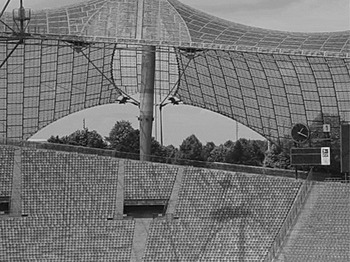
Stadium interior: roof pylon with rainbow design

Olympic Park and roof

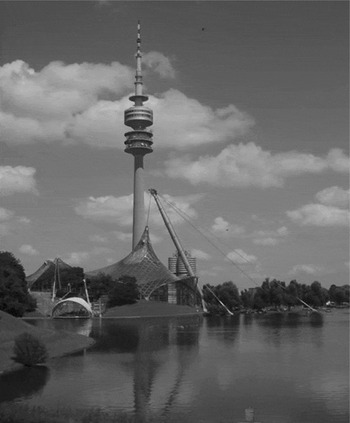
Olympic lake, roof and television tower

The most striking feature of the 1972 look were the bright Olympic colours, in which the posters and all other printed matter appeared. Anticipating Desmond Tutu's notion of South Africa as the rainbow nation by some 30 years, Aicher painted Munich as the ‘Games under the rainbow’. Avoiding the red and gold of the Nazi dictatorship (save some minor use of the former in a bright, strident hue), the core colours of light blue and green, supported by silver and white, and supplemented by yellow, orange, dark green, blue and occasionally even brown defined the Munich palette. The Olympic colours were omnipresent in ever-changing combinations – from the official guide to occasional bands on the pylons and masts that held the stadium roof in place – and, most dramatically, arched above the closing ceremony in the form of a luminous plastic rainbow crafted at considerable expense by sculptor Otto Piene. For Munich's chief designer, the rainbow ‘symbolized utmost aestheticism and appearance combined with playful momentariness’. It was ‘no beacon [fanal] but a symbol for an optimistic psychological climate’ and offered visitors to the Games the chance ‘to experience humanity as one, as a model for a society without borders and violence’.Footnote 48
For all this, Aicher's eye was drawn primarily to light blue and its supporting cast of green, white and silver. The sky-blue shade, in which the pictograms were drawn, had much to recommend it. Not only did opinion polls confirm it as Bavaria's most popular colour (it featured heavily in the state's flag), but as ‘the colour of peace’ and ‘the colour of youth’ it exuded political and social significance as well. Despite the yellow and black background to the city's coat of arms (which supported the Münchner Kindl, a girl wearing a monk's habit), Munich was widely known as ‘the white and blue capital’ (weißblaue Hauptstadt). This Aicher attributed less to the state flag than to the region's landscape itself. As ‘the colour of the radiant sky’, of lakes and alpine silhouettes, light blue was ‘the colour’, indeed the very essence of ‘the landscape of Upper Bavaria’. Under certain climatic conditions, especially when warm Foehn winds blow northward from Italy, Munich enjoys ‘radiant and clear days with a deep blue sky’Footnote 49 which bathe the Alps in light blue and create an illusion of close proximity to the city. These colours, as the organizers were wont to repeat, contrasted with the other dominant hues selected for the Games: the silvery white and the light green of the region's lakes, hills and meadows.
The emphasis on informality, openness, lightness and cheerfulness, which Aicher suggested should be the overall characteristic of the 1972 Games, also became the determining feature of the design of the Olympic Park. This artificial landscape on a previously drab, brown-field site fulfilled a key promise made in the city's application to the IOC, to provide a green backdrop for Olympic Games.Footnote 50 Its broad outline came from architects B+P, who integrated an existing natural elevation, the Olympic mountain, into their submission for the national architectural competition and envisioned an artificial lake at its feet. However, the detailed landscape design and its translation into a lively green space were largely down to Günther Grzimek.
Grzimek's philosophical approach to landscape architecture can be summed up in a few key ideas, the essence of which resemble Aicher's. Like the designer, Grzimek had no time for art, in his case Gartenkunst, but like Aicher he was interested in the ‘design of everyday life, of the human environment, of industrial culture and the behaviour of society’.Footnote 51 Grzimek therefore was a strict functionalist too who rejected unnecessary decorative and ornamental elements in his garden planning, favouring instead a quantifiable ‘user value of the green’ (Nutzwert des Grüns) and its ‘output’ (Leistungsgrün).Footnote 52 In Munich 1972 this meant his focus extended beyond the immediate occasion itself and primarily concentrated on the site's post-Olympic function as a green space for Munich's citizens.
For Grzimek, green public spaces would be typically used in modern industrial society by the individual in need of physical relaxation and psychological recreation from work, either on their own or in contact with others. According to different users’ requirements and preferences, public parks had to provide a range of spaces for privacy and communication, openness and closure, movement and stillness. In Munich, Grzimek brought together a multitude of natural elements, which could be found in Bavarian nature, such as a mountain, hills and valleys, slopes, ridges and plains, water, marsh and shore, trees, groves and bushes, lawns and meadows. This variety was intended to allow the public to enjoy the park in manifold ways. For example, ‘[o]ne c[ould] promenade, observe, see and be seen’.Footnote 53 The mountain offered especially varied opportunities: ‘There are numerous points on the mountain where. . .one can rest and lay down for a while without being observed.’Footnote 54 In short, Grzimek believed that as a landscape designer he could play a part in the creation of what could be called a ‘concrete utopia’.Footnote 55 The park was intended to lead to, as he put it in the jargon of the time, the ‘relaxation of coercive social relations in favour of free, “playful” communication’.Footnote 56
In its focus on the expansion of individual freedoms the Olympic Park was conceived as ‘an article of daily use for democratic society’.Footnote 57 Indicatively, visitors were ubiquitously invited to walk on the lawns (Dieser Rasen darf betreten werden!),Footnote 58 a reversal of the traditional no-trespassing sign. Moreover, within the specific context of Munich parks, the site marked the twentieth-century completion, or even the crowning achievement, of a development in garden planning which in previous times had reflected social exclusivity rather than participation. These were the aristocratic and bourgeois parks of Nymphenburg Palace and the English Garden with which the Olympic Park was physically connected via a stream leading to the artificial Olympic lake, a symbolic connection of which Grzimek was acutely aware.Footnote 59
As far as the political and historical dimensions of the Munich Olympic Park are concerned, it is instructive again to draw comparisons with the site of the 1936 Games. With the exception of some neatly trimmed lawns, the Reichssportfeld had very little vegetation, its flat plateau dominated by architecture, the imposing Olympic stadium, large geometric squares and broad, imposing avenues.Footnote 60 The reverse holds for the rich artificial woods and parklands on its slopes and the wooded park at Döberitz at Berlin's western outskirts where the Olympic village was located.Footnote 61 Here nature dominated architecture. As opposed to the undulating artificial landscape of the Munich site, which sought to combine architectural and natural elements in a fluid harmony, the Berlin site therefore achieved its dramatic effect by creating a marked contrast between the two.
Thus, while both Olympic sites appeared very different, they were, in fact, based on a similar functionalist understanding of the role of the garden architect and landscape designer. Moreover, in order to achieve their task the respective creators used similar techniques. Perhaps this is not surprising since Grzimek learnt his trade at Berlin University in the 1930s under the designer of the 1936 venues, Heinrich Wiepking.Footnote 62 Wiepking, the most prominent German landscape architect of the inter-war years, was a cultural conservative who quickly succumbed to Nazism after 1933. Working for Heinrich Himmler's Reich Commissariat for the Strengthening of Germandom during the war, he became a vocal proponent for the acquisition of ‘living space’ as part of the Generalplan Ost, suggesting, for example, the draining of the Pripet Marches in Russia to turn them into ‘German peasant land’.Footnote 63 Before 1939 his primary aim was to re-create ‘German landscapes’ on domestic soil through the exclusive use of domestic plants and fauna. These were meant to heal the ‘sick city person’ and to overcome what he perceived, in typical Weimar cultural pessimist fashion, as the destruction of unity between individual and landscape by modern technology and civilization. At the 1936 Olympic Games the replanting of large poplars, up to 70-year-old oak trees and thousands of white beech trees, birches, larch trees and other local species led to ‘ancient’ German parklands at the edge of the Reichssportfeld and in Döberitz.Footnote 64
While similarly planting robust domestic trees and shrubs himself, though seedlings and young trees rather than fully grown plants, Grzimek in turn created a landscape which affirmed rather than rejected industrial modernity and city life. In contrast to Wiepking's Olympic landscape and a local park like the eighteenth-century English Garden, which were conceived in order to allow city-dwellers to escape from their urban surroundings, the Munich Olympic Park was purposefully integrated into the cityscape. The 63-metre-high Olympic mountain, whose naked peak Grzimek accentuated by planting dwarf pines and oaks upon it was a case in point. As Grzimek observed: ‘The mountain, the highest open elevation in Munich, is particularly rich in optical experiences. To the North one views the Olympic facilities, to the South the city of Munich, and – weather permitting – one can enjoy a panorama of the Alps.’Footnote 65 Similarly, a visual link to the city was made along the walkways and pathways which traverse the park by planting lime trees, a local species which typically lined Munich's boulevards.Footnote 66 In essence, ‘[w]hile visitors f[ou]nd themselves in an autonomous green space. . ., they remain[ed] within [the city's] confines’.Footnote 67 It might have taken a number of years for the park to mature into a lush and fully developed green environment, but even in 1972 a foreign observer noted that the Olympic venues had ‘very little of that awful rawness that haunts so many building sites’.Footnote 68
In conclusion, Aicher and Grzimek's work on the Munich Olympic site reflected a discourse of individual freedom and participation that characterized the changes of values of West German society in the 1960s. While imbued with a belief in planning and wholly affirmative of technology, industrial and urban society, they used the Olympic project to create a space for relaxation, recreation and positive human interaction, both for visitors of the Games and Munich's citizens afterwards. With high-performance Olympic sports taking place in the stadium and the neighbouring venues, the park was an ideal place to emphasize human proportions and movement, play and enjoyment, to improve visitors’ well-being and, by extension, enhance the quality of individual life in West German society. The means used by Aicher and Grzimek to achieve these ends derived from a sober functionalism rooted in the traditions of the Weimar Bauhaus and its West German successor at Ulm. In 1972, this rationalist aesthetic negotiated the problematic legacy of Berlin 1936, whilst at the same time subtly benefiting from it. Therefore, while the Munich Olympic Park became a high-profile playground for modern democracy and the emerging leisure society (Freizeitgesellschaft), as a perfectly planned and executed Gesamtkunstwerk it must also be located within a tradition inaugurated under diametrically opposed political and social conditions.
To remain for a moment on the darker side of German history: it has recently been suggested there might be a direct link between the general architectural layout of the site and the infamous terrorist attack on the Olympic Village which claimed the lives of 11 Israeli athletes and coaches on 5 September 1972.Footnote 69 It is understandable that such views were expressed by the press in the immediate aftermath but, seen historically, they are far from objective or accurate. Neither Aicher's designs, Grzimek's Olympic Park, B+P's architecture for the Olympic venues, nor any of the ideas which informed their work, had any connection with the attack. Nor can the architects of the Olympic Village, Erwin Heinle and Robert Wischer, be held even indirectly responsible for the success of the attack. Even conceding that the layout of the venues might have contributed to an overall and perhaps naïve mood of optimism, it is important not to conflate the belief in positive human interaction with the reasons for the Israeli deaths, i.e. the negligence and gross incompetence of those in charge of security at the Munich Games.
Despite the violence that marred the event itself, it is clear that the Olympic Park developed very much along the lines anticipated by Aicher, Grzimek and others. For inhabitants and tourists to Munich alike, it proved a lasting attraction and can claim to have been Europe's most popular leisure facility in the late twentieth century. Statistics vary, but taking a conservative estimate: by 1977, it had drawn in over 21 million paying customers and untold numbers of casual visitors – a total estimated in 1982 to have reached 120 million.Footnote 70 As Daume proudly noted as early as 1979, ‘In Munich there are no “Olympic ruins”‘Footnote 71 – a judgment which holds true 30 years on. In addition to an estimated 10 million annual recreational users, it continues to attract large numbers to sports and cultural events, even after the city's two football clubs (FC Bayern München and TSV 1860 München) moved to a new purpose-built stadium in 2005. Whilst it was this Allianz Arena that staged a number of matches at the 2006 FIFA World Cup (including the opening game and one of the semi-finals), the Olympic Park provided the location for one of the largest ‘fan scenes’, with one million visitors celebrating throughout the tournament. And every July, it hosts the Tollwood summer music and culture festival. It is hardly surprising, then, that the 1972 ensemble forms the centre-piece of Munich's campaign to win the 2018 Winter Olympics,Footnote 72 which, if successful, would make it the first city in Olympic history to host both Summer and Winter Games.