Introduction
The sugar beet weevil (SBW) (Bothynoderes punctiventris Germar) is a significant pest in sugar beet in Eastern Europe. It produces one generation per year. The adult weevil overwinters in the previous year's sugar beet field, reappearing in spring when the soil surface (top 10 cm) is warmed to 8–10°C (Maceljski, Reference Maceljski2002). A mass appearance of weevils occurs on sunny days when the air temperature reaches 15–25°C, and the soil surface temperature warms to 25–35°C. The weevils emerge from the soil and begin to migrate in search of newly-planted sugar beet fields. The weevils mate after intensive feeding on sugar beet seedlings. They deposit eggs in the soil close to the sugar beet plants. The larvae develop in the soil, feeding on the roots of the sugar beet, rarely causing serious damage. After pupation and development of the adult form, they remain in the soil until the following spring; part of the population can remain in diapause for 2 years. The greatest damage is caused by adults. According to Maceljski (Reference Maceljski2002), in 1 day, a single adult individual can damage and destroy 50% of the plants that have emerged per square meter; SBWs at an abundance of 0.1–0.3 weevils m−2 (i.e., 1000–3000 weevils ha−1), at Meier et al. (Reference Meier, Bachmann, Buhtz, Hack, Klose, Märländer, Stauss and Weber1993) BBCH (Biologische Bundesanstalt, Bundessortenamt and CHemical industry) scale 12–14, can completely destroy a crop, requiring resowing (Maceljski, Reference Maceljski2002; Sivčev et al., Reference Sivčev, Tóth, Tomašev and Ujváry2006).
The development and ecology of the SBW has been studied in Germany (Tielecke, Reference Tielecke1952; Auersch, Reference Auersch1954), the Czech Republic (Rozsypal, Reference Rozsypal1930), Romania (Petruha, Reference Petruha1959, Reference Petruha1971), Bulgaria (Bogdanov, Reference Bogdanov1965), and Serbia (Čamprag, Reference Čamprag1973, Reference Čamprag1984; Sekulić et al., Reference Sekulić, Kereši and Radonjić2005). Most of the information is 50-plus years old. There are some observations on the SBW life-cycle in Croatia from 1929 (Kovačević, Reference Kovačević1929), when a serious outbreak of SBW occurred in Croatia. From then until the end of the 20th century, SBW was not a significant pest in Croatia. No one had developed a degree-day model for SBW. In the past 10–15 years, SBW has become the most significant economic pest in sugar beet in eastern Croatia (Drmić et al., Reference Drmić, Tóth, Lemić, Grubišić, Pospišil and Bažok2017). In the same period, the number of insecticides available for its control has been reduced. Bažok et al. (Reference Bažok, Buketa, Lopatko and Likar2012) suggested that the increased occurrence of SBW in eastern Croatia is the result of a warmer climate during the last 10 years, the absence of the secondary effects of insecticides used to control them, and the intensive cultivation of sugar beet. Due to the specific morphological structure of weevils, their large feeding capacity, and the small leaf area of the plants (seedlings) at the time of insecticide application, insecticides often give very poor results. Additionally, if the insecticide treatment is not applied in warm sunny weather, a large proportion of the weevils are unaffected, since they remain hidden in the upper layer of soil, due to the unfavorable weather. Thus, repeated insecticide treatment is often required (Bažok et al., Reference Bažok, Buketa, Lopatko and Likar2012). Because of this, it is necessary to consider non-pesticide control measures, and develop a strategy to control SBW. Knowledge of the pest's phenology would allow for the successful implementation of control measures, in accordance with the principles of integrated pest management (IPM).
The impact of climate change on insect communities encompasses effects on species’ life-cycles (Musolin, Reference Musolin2007; Kocmánková et al., Reference Kocmánková, Trnka, Eitzinger, Dubrovský, Štĕpánek, Semerádová, Balek, Skalák, Farda, Juroch and Žalud2011), or on the synchrony between the host plant and herbivore (Junk et al., Reference Junk, Eickermann, Görgen, Beyer and Hoffmann2012). SBWs are already known to be significant in Serbia, Hungary, Romania, Bulgaria, and other Eastern European countries, but this pest is becoming increasingly abundant in other EU countries, such as Germany (Schumann, personal communication, 2016), the Czech Republik (Muska & Krejcar, Reference Muska and Krejcar2009), and Croatia, probably due to changing climates (fig. 1).
Map of B. punctiventris Distribution (source: EPPO Global Database, 2018).

In order to determine the capacity of SBWs to spread to new territory and endanger sugar beet production in other countries, it is important to establish how different climatic factors (air and soil temperature, and the amount of precipitation) can influence their phenology, and which of those influences the pest's development the most.
This study aimed to establish the dynamics of adult emergence, develop a degree-day model for adult emergence prediction, determine the timing of the different developmental stages of the pest, and record the changes in sex ratios during the beet-growing season, so as to compose a SBW phenology model for eastern Croatia.
Materials and methods
Research area
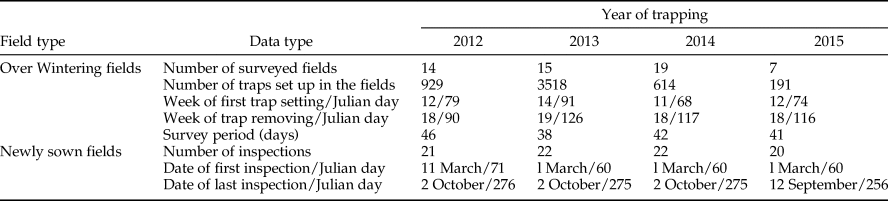
This study was implemented over 4 years (2012–2015) in the vicinity of the village of Tovarnik (eastern Croatia) (fig. 1). In the spring of 2012, the borders of the research area, which included 111 fields, were determined. Every year, a study was undertaken over a total area of 6 km2 (i.e., approximately 600 ha), and in 2014, the study was performed over a total area of 14.8 km2 (see table 1). The enlargement in 2014 occurred because of the small area of sugar beet cultivation in the original study area in 2013. The research area in 2012, 2013, and 2015 extended between 45°12′34.22″N and 19°06′59.86″S (northwestern point), and 45°11′05.02″N and 19°08′40.41″S (southeastern point). The AW area in 2014 was situated between 45°12′32.50″N and 19°06′26.59″S (northwestern point), and 45°11′05.02″N and 19°08′40.41″S (southeastern point).
Data on SBWs trapped in overwintering fields, and on the soil surveys for different life stages in newly-sown sugar beet fields, Tovarnik, 2012–2015.

The ‘old’ sugar beet fields were identified in the study area. These numbered 14 (2012), 15 (2013), 19 (2014), and 7 (2015); the number of fields and placed traps depended on the number of fields in which sugar beet had been cultivated the previous year (table 1). The fields varied in size from less than 1 to 130 ha. The fields in Tovarnik are characterized by chernozem soils with low proportions of humogley (Bogunović, Reference Bogunović1987). Based on their composition, the area belongs to the loess soils of chernozem (Bogunović et al., Reference Bogunović, Vidaček, Racz, Husnjak and Sraka1996).
Climatic conditions
For all of the study years, climatic data were collected from the two closest weather stations of the Croatian Meteorological and Hydrological Service (located in Gradište, 45 km away from the study area: 45°52′N, 18°58′E, and in Vukovar, 27 km away from Tovarnik; 45°21′N, 19°01′E). The climate data used comprised average air temperature (°C), the average daily temperature of the soil at 10 cm, and the sum of precipitation (mm) collected from the meteorological stations between 1 January and 31 December each year.
SBW phenology
Dynamics of adult emergence
In order to establish the time interval when the weevil emergence was the most abundant, we analyzed the adult capture data among 8 weeks (12th–19th week). To catch adult insects, pheromone-baited pitfall traps (Plant Protection Institute, CAR HAS, Budapest, Hungary) were used. The modified pitfall trap (TAL) is a trapping tool suitable for detecting and monitoring adult SBWs (Tóth et al., Reference Tóth, Sivčev, Tomašev, Szarukan, Imrei and Ujváry2002). The trap comprises a roof, catching container, and two climb-up ramps; the pheromone bait is placed in the trap, under the roof. This design is recommended for catching insects that predominantly crawl on the soil surface, i.e., the SBWs B. punctiventris and Conorrhynchus mendicus Gyllenhal. These traps have a high catch capacity, and their efficiency is retained even when catching large numbers of insects.
Trapping was performed at the overwintering sites of the SBWs, in fields where sugar beet had been cultivated the previous year. The traps were set up at soil surface level, arranged in blocks, with each block containing four replicates of each treatment. The individual pitfall traps within the blocks were separated by 15–20 m, and the blocks were sited 25–30 m apart. The traps were placed in the spring, immediately after conditions become favorable for the SBWs to emerge, i.e. when the soil surface (top 10 cm) was warmed to 8–10°C (Maceljski, Reference Maceljski2002). The traps were installed between 10 and 20 March in 2012, 2014, and 2015, and 1 and 10 April in 2013 (table 1), and were left for 5–7 weeks and emptied weekly. The SBWs are attracted by the pheromone, fall into the trap, and get caught. Pitfall traps were set up at a rate of 15 traps ha−1. The number of traps depended on the size of the overwintering fields in a particular year. The trapped SBWs were counted. The last samples were collected in early May.
Monitoring the appearance of SBW eggs, larvae, and pupae
Every 10 days, 10 sugar beet plants and their surrounding soil (from about 15 cm around the plant) were excavated from the newly-sown sugar beet fields, and carefully surveyed for different life stages. The first soil survey was on 11 March 2012, and on 1 March 2013, 2014, and 2015. In each of the years, except for 2013, four fields were surveyed. In 2013, two fields were surveyed. Each survey was replicated four times on each date. On each survey date, the number of eggs, larvae, pupae, and adults per plant were recorded. Egg-laying females make a hole near the sugar beet plants (up to 10 cm apart). Most of the larvae found in the early stages of development were located at a depth of 10–20 cm, and 10–15 cm distant from the sugar beet root zone. The number of surveys depended on the year (table 1).
Sex ratio
Out of each weekly trap collection described above, 100 adult SBWs were separated out. At each collection, samples were taken from four fields. The adults were separated by sex, based on their phenotypic characteristics (the shape of the end of the abdominal ventral side of males and females), as described by Čamprag (Reference Čamprag1984) and Tielecke (Reference Tielecke1952). Females were recognized by their more chitinized back plate at the end of the abdomen. The last interior segment is not visible externally in the females, while two plates can be seen in the males.
In addition to this, males are smaller, longer, and lighter, the third foot segment of the front leg is larger and longer than in females, and the final segment of the antenna is longer and thinner, with a longitudinal cavity.
Data analysis
Climatic conditions
Data on average air and soil temperatures, and the sum of precipitation among years were subjected to variance analysis (ANOVA). The results were then estimated using Tukey's HSD mean separation on a standardized summary, using ARM 9® software (ARM 2016 GDM® software, Revision 2016.2, 6 May 2016) with mean separation. Where appropriate, data were arc sin √x transformed.
Dynamics of adult emergence
Data on SBW emergence were expressed as a percentage of the total SBW catches for each week. The percentages of weevil catch in different weeks were compared among weeks by ANOVA (ARM 2016 GDM® software, Revision 2016.2, 6 May 2016), and means separation was estimated using Tukey's HSD test. In order to establish the timing of the first weevil emergence, we calculated the degree day accumulation (DDA) for the period of weevil emergence (biofix 1 January). The DDA (a simple average approximation method) from 1 January to the SBW's emergence was calculated (after Wilson & Barnett, Reference Wilson and Barnett1983) by:
 $$\eqalign{{\rm DDA} &= ({\rm high}\;{\rm soil}\;{\rm temperature\ (}{\rm ^\circ} {\rm C)} \cr&\quad+ {\rm low}\,{\rm soil}\,{\rm temperature}({\rm ^\circ} {\rm C}))/2- 5{\rm ^\circ} {\rm C}}$$
A threshold of 5°C for the soil temperature at 10 cm depth was used, since many authors have reported that the first adults can be observed when the soil temperature at 5–10 cm rises to between 6 and 10°C (Pintér, Reference Pintér1953; Manninger, Reference Manninger1967; Čamprag, Reference Čamprag1984; Maceljski, Reference Maceljski2002). The calculation was done in early spring when the temperatures were not too high, and no upper threshold was applied.
Linear development model
A least squares linear regression was used to establish the relationship between development rate and temperature over the linear portion of the development curves. The data management software ARM 2016 (GDM® software, Revision 2016.2 6 May 2016) was used. The value of the correlation coefficient was ranked, using the very precise Roemer-Orphal scale (0.0–0.10, no correlation; 0.10–0.25, very weak; 0.25–0.40, weak; 0.40–0.50, modest; 0.50–0.75, strong; 0.75–0.90, very strong; 0.90–1.0, full correlation) at the 95% confidence level (Vasilj, Reference Vasilj2000).
Appearance of eggs, larvae, and pupae
For each inspection date in each year of the study, data on the proportions of each developmental stage were compared among the stages by ANOVA, and the mean separation was estimated using Tukey's HSD test. Based on our counts of the different stages (adult, egg, larvae, and pupae) of the SBWs, we composed a phenogram that allows us to develop control strategies for particular developmental stages.
Sex ratio
For each week of inspection, the sex ratio, i.e., the ratio of females to males was determined.
Results
Climatic conditions
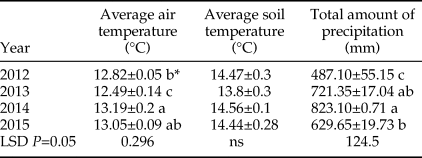
There were significant differences in average yearly temperature and total precipitation among the years, but no differences in average yearly soil temperature. The warmest year was 2014, and this also had the highest amount of precipitation. Contrary to 2014, precipitation was extremely low in 2012.
SBW phenology
Dynamics of adult emergence
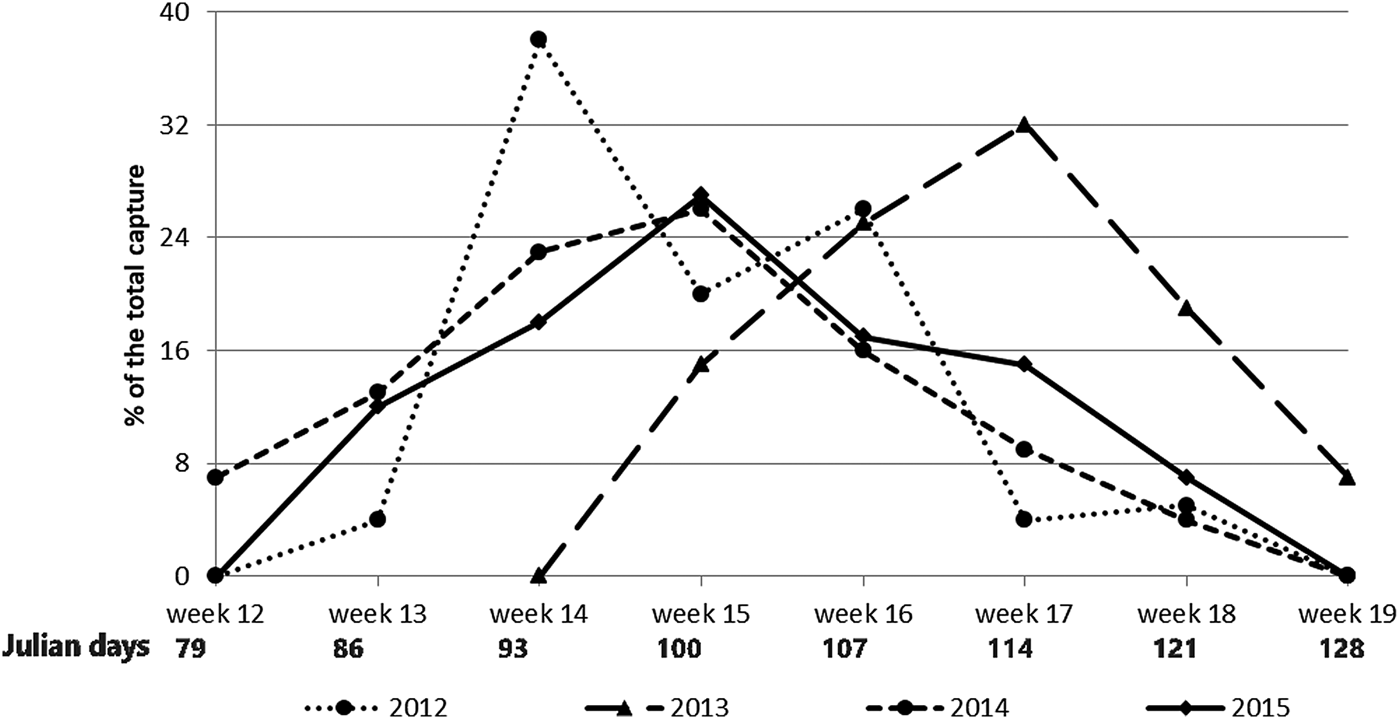
The highest proportion of SBW emergence was recorded in the 14th week of 2012, while in 2014 and 2015, the highest proportion was recorded one week later, in the 15th week of the year. In 2013, the emergence started later in the season, due to lower temperatures in early spring and prolonged snow cover (until the end of March). We recorded the first catch in the 15th week, and the highest catch in the 17th week of the year (fig. 2).
The dynamics of SBW adult emergence from overwintering sites expressed as a proportion of the number of collected weevils per week in the total capture, Tovarnik 2012–2105.

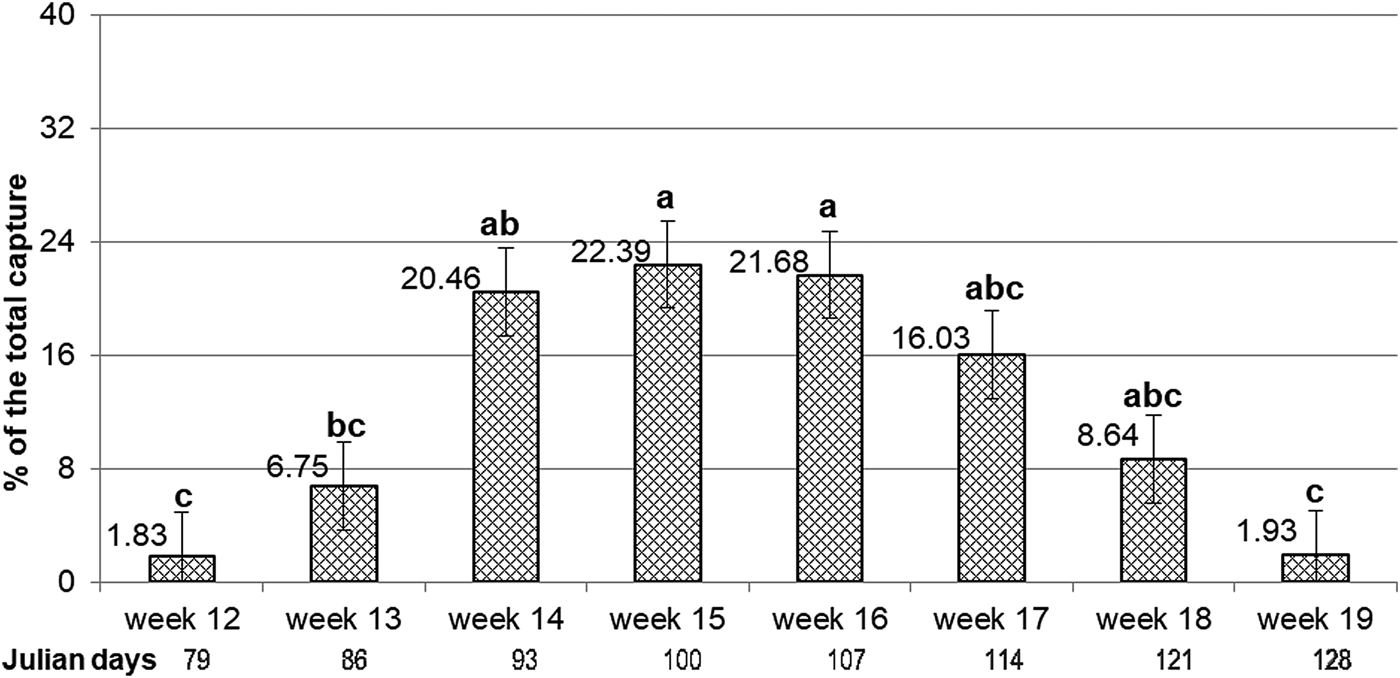
The largest proportion of the weevil catch was recorded in the 15th and 16th weeks (22.39 and 21.68%, respectively), and the lowest at the beginning (12th week: 1.83%) and the end (19th week: 1.93%) of the observation period (fig. 3).
Average adult SBWs captured (% of total capture) during the 8-week survey of fields where sugar beet had been cultivated in the previous year (2012–2015) (HSD P = 5% = 13.64).

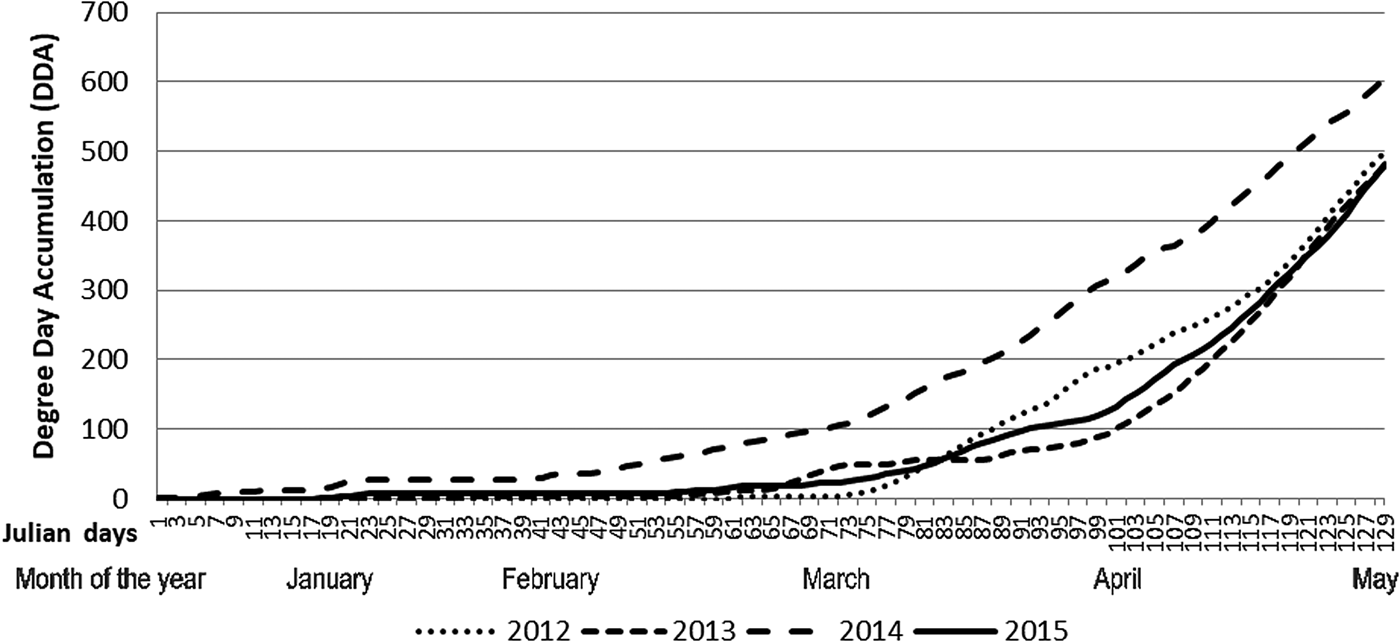
The DDA for the first 130 Julian days (JDs), for soil temperatures at 10 cm depth, showed similar parameters in 3 out of the 4 years (fig. 4). In 2014, the DDA increased relatively faster. This was the result of a warmer January, February, and March in 2014.
DDAs (°C) for soil temperature at 10 cm depth, 2012–2015 (the thermal threshold of 5°C was used, biofix date 1 January).

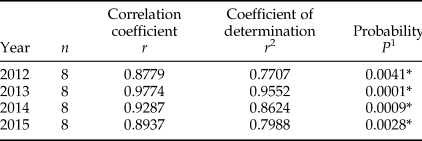
The correlation coefficients between the DDA and the average proportion of adult emergence from the soil ranged from 0.8779 to 0.9774, described as ‘very strong’ to ‘full’, according to Roemer and Orphal (in Vasilj, Reference Vasilj2000). The correlation coefficients were significant at the level of 99% in all 4 years (table 2).
Correlation coefficients and coefficients of determination for the dynamics of the emergence of SBW (y) on mean DDA (x) for soil temperatures at 10 cm depth, established for each year of investigation.

*Significant at the level of 99%.
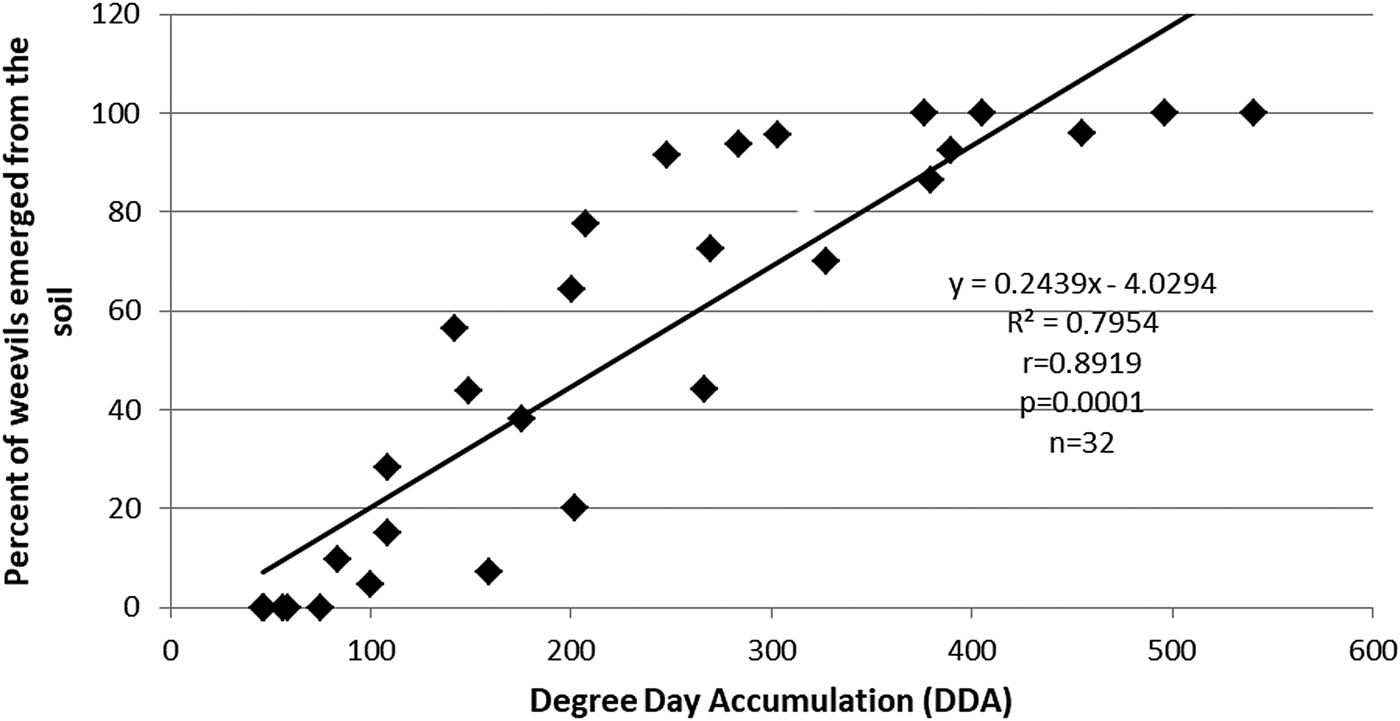
Due to this, a regression analysis was carried out jointly (fig. 5). The regression line is linear, described by the equation:
 $$y = 0.243{\rm} x-4.0294,$$
where x is the DDA and y is the percentage of total SBW emergence.
Regression analysis of the dynamics of the SBW's emergence from the soil (y) versus DDA for soil temperatures at 10 cm depth (x), Tovarnik, 2012–2015.

Appearance of adults, eggs, larvae, and pupae
The average proportion of each weevil stage found in visual inspection over the 4 years of the study is shown in fig. 6.
Average proportions of the different developmental stages of SBWs (adults, eggs, larvae, and pupae) established from soil surveys (2012–2015).

When analyzing the average proportions of the different developmental stages of SBWs established in the surveys (2012–2015), we can see that adults dominated up to JD 122, and after JD 255. The proportions of the other developmental stages increased from JD 122 up to JD 255. During a 50-day period (JD 164–215), the proportion of larvae was significantly higher than the proportions of the other developmental stages. During a 1-month period (July), larvae dominated the total population (over 60%).
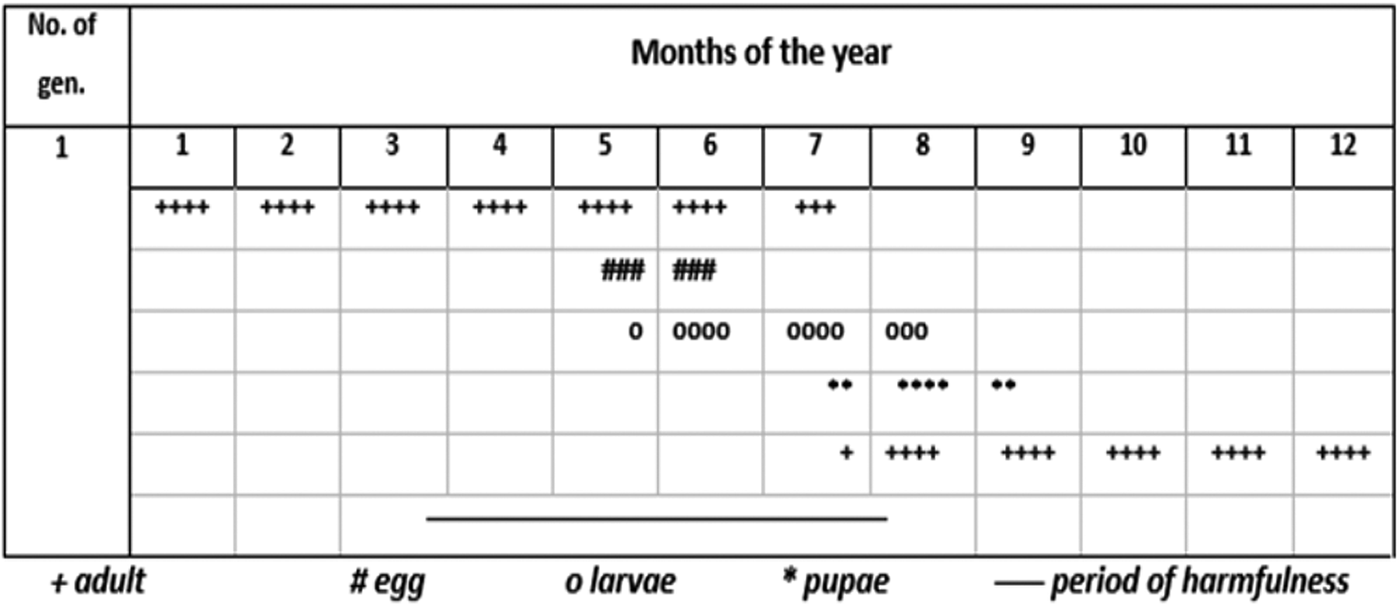
Adults were present in the fields from March (JD 61) through the entire sugar beet growing season (until JD 275), with two peaks in appearance, one in spring (JD 110–150, corresponding to April and May), and the second in autumn (JDs 220–250, corresponding to August and September). The lowest proportion of adults in the total population was determined in July (between JDs 184 and 204). In August, the proportion of adults in the total population increased (fig. 6). Based on these results, a phenogram of SBW development in eastern Croatia was composed (fig. 7).
Phenogram of SBW development, Croatia (2012–2015).

The researched phenology of SBW in Croatia confirmed similarity to the results on life cycle investigated in neighbouring countries; Hungary, Romania and Serbia (Manninger, Reference Manninger1967; Petruha, Reference Petruha1971; Čamprag, Reference Čamprag1984).
Sex ratio
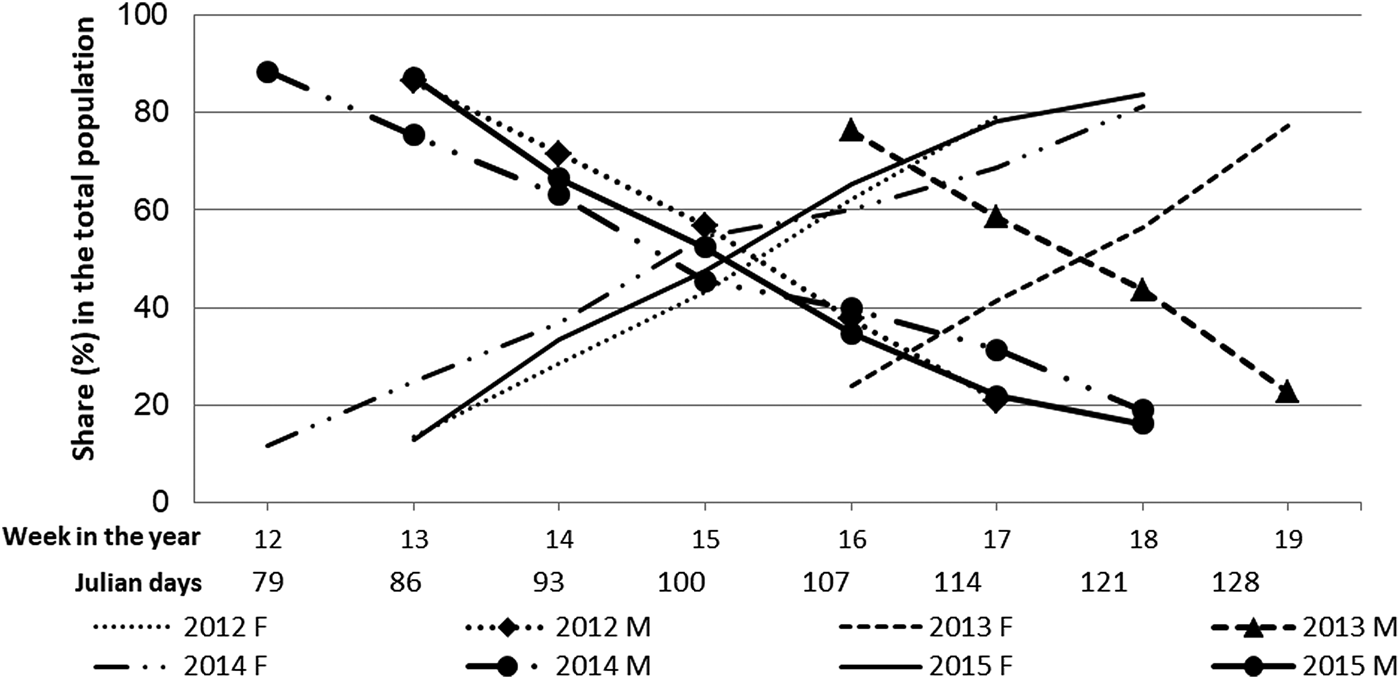
The sex ratios of the emerged SBWs, based on the samples collected from overwintering sites over 4 years, are presented in fig. 8.
Proportions of females (F) and males (M) in the total populations of SBWs established in the samples collected on different JDs, 2012–2015.

At the start of emergence, almost 90% were males. After 3–4 weeks, the proportion of males to females was equal, and, in the following 3 weeks, the proportion of females increased. The same scenario was determined for all 4 years of the study. The only difference was in 2013 when emergence was delayed. In 2013, the emergence lasted only 4–5 weeks, and then the proportions followed the same tendencies, but in a shorter time.
Discussion
Climatic conditions
The climate prevailing in Croatia is temperate/mesothermal (Cf), with dry winters (w), and overall relatively high amounts of precipitation. Penzar & Penzar (Reference Penzar and Penzar2000) reported that eastern Croatia, where the study area of Tovarnik is situated, is a Cfwbx climate type (according to Köppen's classification), in which b indicates that the warmest month averages below 22°C, but that at least 4 months average above 10°C, x denotes that there is only one maximum rainfall event, which mainly occurs in early summer (June).
The average yearly air temperature for the last 40 years in eastern Croatia is 11.4°C (Čačija, Reference Čačija2015), and the average total amount of rainfall was 673.74 mm (Čačija, Reference Čačija2015).
Weather conditions expressed as average air and soil temperatures, and the total amount of precipitation, varied among the investigated years (2012–2015) (table 3).
Comparison of the averaged climatic data in the studied area of Tovarnik, 2012–2015.

*Means followed by same letter are not significantly according to Tukey's HSD test (P = 0.05).
According to the Croatian Meteorological and Hydrological Service, in 2012, Croatia was characterized as having an extraordinarily hot and dry year; this was the only year during the study in which the conditions were not favorable for mass reproduction. Compared with the rest of the 40-year period, 2012 was significantly drier and warmer than the 40-year average. There was also a somewhat greater amount of precipitation in 2013 than the 40-year average, and a higher average air temperature, while 2014 was characterized as warm and moist. The amount of rainfall was 25% higher than the 40-year average in 2014, whilst 2015 was characterized as a moderate year.
Phenology and population characteristics
Dynamics of adult emergence
The DDA for 1% of emergence was calculated as 20.7. According to the DDA data, 1% of emergence occurred in 3 out of the 4 years in March, on the 18, 8, and 10 March in 2012, 2013, and 2015, respectively. Although in 2013 the emergence of 1% of SBWs occurred on 8 March 8 (based on the DDA), we did not observe the weevil emergence until the beginning of April, since the snow was covering the soil until the end of March. In 2014, due to an extraordinarily warm January, the occurrence of 1% of weevils happened on 20 January. Since there was no available food in the fields, we did not follow this emergence so early in the season. In terms of the eastern part of Croatia, soil temperatures usually reach 6–10°C at the end of the first and beginning of the second week in March. The second 10 days of March is the most appropriate period for SBW emergence, but factors, such as snow and food availability, have to be taken into account when predicting this. To date, the most appropriate SBW forecast method is visual inspection. The obtained data are useful for developing a pest forecast model. The first emergence date can be calculated using the degree-day model, this date being the start date for visual inspection of the newly-sown sugar beet field.
According to the established regression line, the emergence of 50% of the SBWs may occur when the DDA reaches 222. This happened under our conditions on 14, 23, and 21 April 2012, 2013, and 2014, respectively.
Emergence was completed when the DDA reached 428. This happened on 4 May 2012 and 6 May 2013 and 2015, and 24 April 2014.
Our findings correspond with those reported by other authors. Peak SBW emergence takes place in sunny weather when the average air temperature reaches 15–25°C and the soil surface temperature reaches 25–35°C (Petruha, Reference Petruha1959). In Hungary and Romania, the highest percentage of emergence was recorded in late March and early April, under similar conditions to ours, according to Kovačević (Reference Kovačević1929). In 1923, in Czechoslovakia, SBWs continued to emerge from the soil until mid-August, and in 1924 until mid-June, although most of them appeared in mid-May when they migrated to new beet plantations and paired (Rozsypal, Reference Rozsypal1930). In Vojvodina (an area similar, in terms of climate and edaphic conditions, to eastern Slavonia) in 1981, was observed the dynamics of pest emergence, which resulted in a maximum catch (32.65% and 41.4%, respectively) of adults at the end of the first 10 days of April, in the 14th week (Radin, Reference Radin1982), only 1 week earlier than we determined in our study. Deep autumn ploughing reduces the population, and somewhat accelerates emergence from the soil in spring (Pyatnitzkiï, Reference Pyatnitzkiï1940). In our research, we noted an earlier emergence of adults from the fields that were not covered by crops in spring, but we did not analyze the difference.
Appearance of eggs, larvae, and pupae
Our results do not correspond entirely with the results of Čamprag (Reference Čamprag1963), who researched SBW phenology in Vojvodina (Serbia) and reported that a few individuals could be found in the first half of August. The first eggs were observed on JD 102 and JD 122 in 3 years, respectively, and JD 132 in 2014. Eggs were not observed in the field until JD 154 (2012), JD 173 (2013), JD 183 (2014), and JD 203 (2015). Although the development stage of eggs takes 10–15 days, due to the extended time of weevil emergence under the prevailing conditions, eggs were found during JDs 52–71. The decreased presence of eggs in 2012, compared with the other 3 years, might be explained by the average air temperature in June being the highest in 2012, compared with the other 3 years. This high temperature (average 22.85°C) was accompanied by relatively low precipitation (36.85 mm); these conditions may have stopped egg-laying. Additionally, oviposition in 2012 started 20–30 days earlier, compared with the other 3 years, which also may have influenced its earlier termination. The optimum temperature for egg laying is 25–29°C (Bogdanov, Reference Bogdanov1961).
The first larvae were found on JDs 122 or 132, depending on the year. In 2012 and 2015, the first larvae were found 10 days after the first eggs, while in 2013 and 2014, we found the first eggs and the first larvae in the same survey. Since the interval between the surveys was 10 days, we may conclude that embryonic development lasted for less than 10 days, or it is possible that, when conducting the survey, due to the large sampling area, we did not pick up any of the plants infested with eggs. The last larvae were found on JD 245 in 3 years of the investigation. The only exception was 2013, when the last larvae were found on JD 265.
The first pupae were found on JDs 143, 153 in 3 years, and on JD 163 in 2014, respectively. This means that the shortest larval development lasted between 20 and 30 days, which is much shorter than reported by Petruha (Reference Petruha1959), who determined the shortest larval development of 45 days. The longest larval development time under our conditions (calculated as the interval between the first and last date when larvae were observed in the field) lasted for approximately 120 days (4 months), which is significantly longer than the data presented by Petruha (Reference Petruha1959), who found larval development lasted for up to 91 days. Since the first pupae were found between JDs 143 and 163, we might conclude that a part of the adult population recorded in July consisted of freshly developed adults. This can be observed in the field from their body shape and other properties. It is difficult to state exactly what the shortest period of development from egg to adult was, but we suggest that approximately 60 days was the shortest period. This corresponds to data presented by Petruha (Reference Petruha1959), who reported that the overall development from egg to adult took 67–148 days. Steiner (Reference Steiner1936) reported a period of 133 days. In Romania, the development lasts from 70 to 82 days (Petruha, Reference Petruha1971); in Bulgaria, it is about 75 days (Bogdanov, Reference Bogdanov1965); in Hungary, it is about 3 months (Manninger, Reference Manninger1967); and in the area of Vojvodina, it ranges from 2.5 to 3.5 months, but is usually about 3 months (Čamprag, Reference Čamprag1984).
The adult population started to increase at the beginning of August (JD 210), so we might conclude that the increase in the adult population was a result of the completion of adult development from pupae. The proportion of the larval population in September was 20% or less. Similar results have been reported by Auersch (Reference Auersch1954) in eastern Germany, from the mid of September, when 6% larvae, 22% pupae, and 72% adults were found. In Turkey, in mid-September, Steiner (Reference Steiner1936) found 57% larvae, 33% pupae, and 10% adults.
Our data correspond best with data reported by Čamprag (1984). In mid-September, 1959, in the area of Vojvodina, the proportions of the developmental stages were 14.8% larvae, 27.2% pupae, and 58% adults. The largest proportion of larvae in 2012 (47.22%) was found in the soil survey on JD 154, along with the largest proportion of pupae (11.11%). The developmental stages were shifted in 2013, which deviated from the usual weather conditions when the largest proportion of larvae (94.23%) was found on JD 214, and the largest proportion of pupae (22.22%) on JD 234. Furthermore, in 2014, 64.1% larvae were recorded on JD 193, and 30.43% pupae on JD 203. In 2015, on JD 183, there were 68.42% larvae, and on JD 173, 21.43% pupae.
Based on these results, we composed a phenogram of SBW development in Croatia (fig. 7). The phenology is similar to that reported from neighbouring countries (Serbia, Hungary, Romania: Manninger, Reference Manninger1967; Petruha, Reference Petruha1971; Čamprag, Reference Čamprag1984). We would expect this because the climatic conditions are similar in these countries. Although several authors in Croatia (e.g., Kovačević, Reference Kovačević1961; Maceljski, Reference Maceljski2002) have reported on the SBW life-cycle, they used available data from other countries, and simply assumed that the phenology in Croatia corresponded with that in neighbouring countries. Herein, we have confirmed this.
Sex ratio
The number of males and females should be approximately equal in a biotope (Kovačević, Reference Kovačević1961). If males prevail in the population, the further spread of the population is endangered, whereas if females prevail, a population increase would be expected. From a biological point of view, insect species in which females prevail have better biotic potential because males can pair with more than one female.
In this study, we recorded the sex ratio during the entire period of SBW emergence from the soil, and found that the sex ratio of the emerged SBW, after overwintering, was changing. In the early stages of emergence, males dominated over females. After migration to the newly-sown sugar beet field, the population becomes dominated by females. Summarising the results obtained over the 4 years of study, we can say that up to week 15, the proportion of males to females did not significantly differ; before this, males were significantly more dominant, but starting from the 16th week, females became significantly more dominant (fig. 8).
The appearance of different sexes in an insect population depends on the biological characteristics of the species. Protandry is the tendency for males to emerge before females (Bulmer, Reference Bulmer1983), and it is common in insects with discrete, non-overlapping generations, in which females mate only once, soon after emergence. In these circumstances, males that emerge early will have more opportunities to mate than those that emerge late, meaning that protandry would be expected to evolve through sexual selection. Common cases of protandry in the European corn borer (Ostrinia nubilalis Hubn.) (Bažok et al., Reference Bažok, Igrc Barčić, Kos, Gotlin Čuljak, Šilović, Jelovčan and Kozina2009) and the western corn rotworm (Diabrotica virgifera virgifera LeConte) have been reported in the literature and proved under Croatian conditions (Igrc Barčić et al., Reference Igrc Barčić, Bažok and Maceljski2003). A weekly review of samples (4 × 100 individuals) gave the same results as in Bogdanov (Reference Bogdanov1965) from Bulgaria. In 2012 and 2015, we explored the equalization in the ratio of the sexes in the 15th week. Our results partially correspond to data reported by Manolache & Moklova (Reference Manolache and Moklova1961) under conditions in Romania. From emergence until mid-April, the ratio was 63:37 in favor of males, while the ratio from the second half of April to the end of May changed in favour of females (47:53). In our study, we did not establish the sex ratio of the SBW in autumn.
Conclusions
SBW development in eastern Croatia is very similar to that in neighbouring countries (Serbia and Hungary); however, this study provides new insight into SBW biology. The DDA for weevil emergence can be calculated, based on soil temperature at 10 cm depth, by using a temperature of 5°C as the thermal threshold. The first emergence starts when the DDA reaches 20 (the first 20 days of March); however, the emergence depends on the existing snow layer, as well as on the availability of food. Emergence was completed when the DDA reached 428, usually in the first week of May. The largest proportions of specimens emerging from overwintering occurred in the 14th and 15th weeks of the year. Since overwintering adults were targeted by all of the control measures, the obtained results provide very important information on the relationship between SBW emergence and soil temperature.
Male SBWs emerged first and dominated in the weevil population up to the 15th week of the year. The SBWs had an equal sex ratio in the 15th week of the year. After that, the SBW population was dominated by females.
Overwintering adults were present in the fields up to early July. Newly developed adults emerged from the soil in July. The average time of SBW development for all stages lasted about 3–4 months. Although the development stage of the eggs took 10–15 days, due to the extended time of SBW emergence, under the prevailing conditions, eggs could be found, on average, for 102 days (between JDs 112 and 214). Larvae development occurred for 143 days (between the 122th and 265th JDs), and pupae development extended up to 102 days (between JDs 143 and 245).
This study provides important data for understanding the population dynamics of SBWs, and for developing potential population dynamic models and pest forecasting on a regional scale.
Acknowledgements
This study was financed by two grants: Croatian Science Foundation Grant 09/23 ‘Technology transfer in sugar beet production: Improvements in pest control following the principles of integrated pest management (IPM)’, and IPA grant number 2007/HR/16IPO/001-040511 ‘Enhancement of collaboration between science, industry and farmers: Technology transfer for integrated pest management (IPM) in sugar beet as the way to improve farmer's income and reduce pesticide use’.