INTRODUCTION
Dolphins have populated human imagination for centuries. In Brazil, they are strongly associated to cultural transmission, especially in the Amazon region. Three species of dolphins are found in the Amazonian river mouth: the Amazonian pink dolphin or ‘boto’ (Inia geoffrensis), the tucuxi (Sotalia fluviatilis) and the boto-cinza (Sotalia guianensis) (Siciliano et al., Reference Siciliano, Alves, Lima, Colosio and Silva2005).
The trade of love charms of Amazonian dolphins represents a serious threat to the survival of this species. A previous study (Best & da Silva, Reference Best and da Silva1989) identified the Amazonian river dolphin (Inia geoffrensis) as the species from which samples were frequently traded in two public markets, the ‘Ver-o-Peso’ of Belém (Pará State) and the Municipal Market of Manaus (Amazonas State, Brazil).
Nowadays molecular markers are considered one of the best forensic tools to identify cetacean species and their illegal trade. With the progress of the molecular techniques, DNA can be recovered from almost any biological source, even products that have been dehydrated, cooked or canned (Baker & Palumbi, Reference Baker, Lento, Cipriano and Palumbi1994).
In order to determine the taxonomic status as well as the geographic origin of these specimens, we improve a method of DNA extraction from samples of dolphin genitalia, which were either dehydrated or conserved in perfume tubes containing ethanol, and the cytochrome b from the mitochondrial DNA was analysed.
MATERIALS AND METHODS
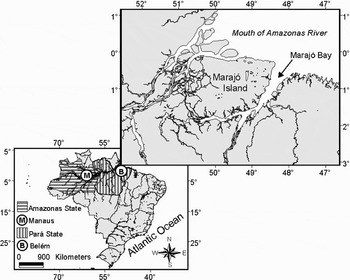
Twenty-one samples provided by residents of the city of Belém and vicinities (Pará State, Brazil) (Figure 1), presumably purchased in the ‘Ver-o-Peso’ Market (Belém) or the Manaus Municipal Market were analysed. In addition, we compared our sequences to one sample collected from Sotalia fluviatilis captured in Rio Tarumã (GenBank Accession no. EF457551), an affluent of the Rio Negro (Amazonas State, Brazil) and one sample from an estuarine dolphin (Sotalia guianensis) incidentally captured off Amapá State (GenBank Accession no. EF457552). Tissue samples were removed from dehydrated genitalia or from genitalia conserved in alcohol and processed following a modified protocol of the standard phenol-chloroform extraction procedure (Sambrook et al., Reference Sambrook, Fritsch and Maniatis1989). Under continuous agitation, 30 mg of tissue were digested in 500 µl of lysis buffer (100 mM NaCl; 10 mM TRIS pH7,5), 25 µl of SDS 20%, 3 µl of Rnase (20 mg/ml) and 3 to 5 µl of Proteinase XIV (20 mg/ml) for 2 h, subsequently disrupted inside a 1.5 ml microcentrifuge tube with a plastic rod, and incubated at 37°C for at least 12 h. Following incubation, DNA extraction was carried out by the standard phenol-chloroform protocol (Sambrook et al., Reference Sambrook, Fritsch and Maniatis1989). DNA was diluted in 30 µl of sterile water.
Northern Brazilian region indicating the cities of Manaus and Belém. In detail the Marajó Bay area is indicated in the surroundings of Belém.

The complete cytochrome b gene (1140 bp) was PCR-amplified with primers CB-out1 (5′AATGAYATGAAAARYCATCGTTG-3′) and CB-out2 (5′TCTTCCTTGAGTCTTAGGGAG-3′; Cassens et al., Reference Cassens, Vicario, Waddell, Balchowsky, Van Belle, Ding, Fan, Lal Mohan, Simões-Lopes, Bastida, Meyer, Stanhope and Milinkovitch2000). Amplifications were carried out in 50 µl reactions containing 250 ng to 1.0 µg of DNA, dNTPs (0.5 mM/ml), primers (0.3 pmol/µl), Taq DNA polymerase (Invitrogen, 0.04 U/µl) and amplification buffer under the following conditions: 94°C (1 min), and 35 cycles at 94°C (1 min), 55 °C (1 min) and 72°C (90 s).
Four primers were used for sequencing: CB-out1 and CB-out2, which were used as external primers, and two internal primers: CB-in1 (5′-TTRTTRGATCCTGTTTCRTG-3′) and CB-in2 (5′-TGAGGACAAATATCATTYTGAG-3′; Cassens et al., Reference Cassens, Vicario, Waddell, Balchowsky, Van Belle, Ding, Fan, Lal Mohan, Simões-Lopes, Bastida, Meyer, Stanhope and Milinkovitch2000). The PCR products were purified with ‘GFXTM PCR DNA and Gel Band Purification’ kit (Amersham Pharmacia), and both strands were sequenced in ABI Prism 3730 automatic sequencer. Sequences were edited with Sequencing Navigator 3.3 (Applied Biosystems Inc., 1994).
The phylogenetic analyses were performed using the software Molecular Evolutionary Genetics Analysis (MEGA3; Kumar et al., Reference Kumar, Tamura and Nei2004) in order to construct a p-distance and a neighbour-joining (NJ) tree. Subsequently sequence data were analysed with PAUP* 4.0b (Swofford, Reference Swofford2003) and a phylogeny was constructed with a heuristic search with 100 random stepwise addition sequences and the Maximum Parsimony (MP) optimality criterion. Support for this phylogeny was estimated with 1000 bootstrap replicates.
The MP and NJ analyses also included sequence data from GenBank, one S. fluviatilis (AF304067), one S. guianensis (DQ086827), one I. geoffrensis (AF304068) and one Tursiops truncatus (AF084095) as outgroups.
RESULTS AND DISCUSSION
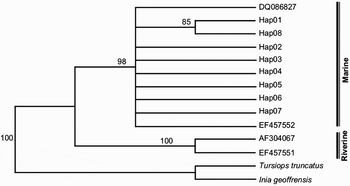
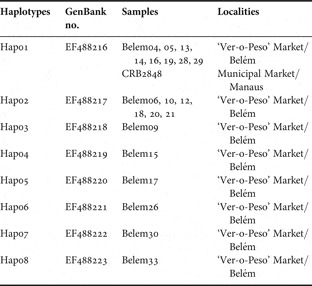
Analysis of the complete cytochrome b gene (1140 bp) of all 21 market-samples showed eight different haplotypes (Table 1). The MP and NJ analyses showed identical topologies, with Sotalia splitting into two strongly supported groups (Figure 2), one comprising the marine S. guianensis and the eight haplotypes from all market-samples and another, comprising the riverine S. fluviatilis haplotypes from GenBank.
Maximum Parsimony phylogenetic tree between eight market-sample haplotypes. Numbers are bootstrap values higher than 50%. See acronyms in Table 1.

Cytochrome b haplotypes (Hap) of Sotalia guianensis.

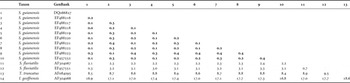
Genetic p distance between haplotypes of the S. guianensis clade ranged from 0.0 to 0.004, showing a narrow range of variation as was the case of S. fluviatilis haplotypes (0.007), while distance estimates between S. guianensis and S. fluviatilis haplotypes ranged from 0.021 and 0.033 (Table 2), indicating that market samples belonged to marine specimens. These findings argued against the postulation of Best & da Silva (Reference Best and da Silva1989) who considered that samples of the ‘Ver-o-Peso’ Market (Belém) and the Municipal Market of Manaus corresponded to the Amazonian river dolphin (Inia geoffrensis), in agreement with information provided by local traders.
Genetic p distance × 100 between haplotypes of Sotalia (bold face), Tursiops truncatus and Inia geoffrensis.

Our findings, that market samples originated from the estuarine dolphin (S. guianensis), indicated that this marine species is probably under higher pressure than the Amazonian river dolphin (I. geoffrensis) and the tucuxi (S. fluviatilis) and efforts should be done to monitor their populations. These marine dolphins have been incidentally captured in gill-nets set off Marajó Bay and Amapá State coast, a region of intensive fishing activities. Thus, we suggest that such activities should also be monitored directly through regular onboard research or indirectly by the forensic analyses using molecular markers in the market products, in order to evaluate the real impact of these activities to the species conservation.
Nevertheless, long term social programmes and environmental education must also be implemented in the local community (fishery and non-fishery people) in order to intend to replace this commercial activity and change the local mentality in the near future. These complementary actions are the only way to avoid more dolphins being captured and killed. It is important to mention that cetaceans are protected against commercial whaling in Brazil since 1986 (Portaria no N-11 de 21/fev./1986 e Lei no 7.643 de 18/dez./1987).
The mtDNA analysis has been established since 1999 by the International Whaling Commission as the official method to control illegal trade of products from protected cetacean species. As previously pointed out by Baker et al. (2000) and Baker & Palumbi (Reference Baker and Palumbi1994), this report shows the utility of molecular techniques for identifying the origin of commercialized samples from cetacean species in South American markets.
ACKNOWLEDGMENTS
We thank Dr. Hector Seuanez for kindly reviewing early drafts of the manuscript. Thais Sholl has a scholarship from Programa PIBIC/ENSP/FIOCRUZ. Field trips to Belém were sponsored by Projeto Piatam Mar Piatam Oceano. Samples were transported under permit 078/2006 (DIFAP/SUPES-PA). This is contribution no. 3 of Grupo de Estudos de Mamíferos Aquáticos da Amazônia/GEMAM – Projetos Piatam Mar Piatam Oceano.