In May of 1762 the cellar master to King George III of Great Britain and Ireland purchased red port for the first time. Insignificant as this purchase may seem, it marked a change for the royal household because port was not found in the cellars of either of the young king's Hanoverian predecessors. Nor was this change minor. One month later, port surpassed luxury claret, if only slightly, as the most commonly served wine within the royal household, and for the rest of the decade these two wines, which dominated the royal household accounts, were purchased and consumed in almost equal amounts.Footnote 1
To be sure, the court of George III was not the ultimate arbiter of fashion and good taste in mid-eighteenth-century England, but in this instance the move toward port reflected the beginning of a broader trend among the English elite. For example, George Spencer, the fourth duke of Marlborough, lord chamberlain of the royal household from 1762 to 1763, and lord privy seal from 1763 to 1765, also embraced port. In fact, as lord chamberlain, and therefore head of the royal household in 1762, Marlborough may have been responsible for the change in the royal cellars, even if in theory the cellar was the domain of the lord steward. After all, the king himself was a moderate drinker, enjoying claret and hock (Rhenish wine) at his own table, but without strong opinions for others. He may have been happy to follow the advice of his good friend Marlborough, who clearly had a penchant for port: an account of wine delivered to Marlborough's three homes in the period from January 1763 to December 1767 reveals a breathtaking amount of wine, almost half of which was port. Langley Park, the duke's hunting lodge in Buckinghamshire received 3,636 bottles of wine, 43 percent of which were red port. Marlborough House, the duke's palatial London residence received 7,728 bottles of wine, 47 percent of which were red port. Finally, Blenheim Palace, the duke's magnificent pile in Oxfordshire, received the most wine of all, a remarkable 9,108 bottles in five years. Port was the dominant wine, comprising 53 percent of the total.Footnote 2 No other wine came close in any of Marlborough's cellars. Even claret (red wine from Bordeaux), which was generally the preferred wine of the English elite, hovered around 10 percent of the total in all three homes. In fact, by purchasing—and presumably serving—so much port, the royal household and Marlborough were going against the aristocratic grain; they were embracing an established symbol of the English middle ranks, and of middle-ranking men in particular. Yet, two decades later, the royal and ducal penchant for port was unexceptional. By the 1780s port was no longer a middling-sort wine; it was also the preferred wine of the most politically and socially elite men in England.
This article asserts that port's ascent of the English social ladder was the result of the complex interplay between Portuguese government intervention in the production of port, the shifting symbolic needs of elite English consumers, and technological innovation. In particular, the second of these three factors caused port to become the dominant wine among all classes of English wine drinkers even prior to the outbreak of the French Revolution. In other words, the established symbolism of port as a wine of middle-ranking Englishmen was the primary cause of port's ultimate popularity with the English male elite, so that by the 1780s port could legitimately be called the “Englishman's wine.”Footnote 3 To be sure, port was not consumed in any significant amount by the so-called lower orders. Nor is there much evidence of middling and elite women drinking port, except in small amounts and usually at dinner parties prior to their withdrawing for tea and conversation. Meanwhile, the men stayed at the table and drank to the point that conversation could be difficult. But among English wine drinkers, the vast majority of whom were middling and elite men, port (in all its variations) transcended party, class, age, and regional divides.
To place this article within ongoing historiographical debates about consumption and material culture, I am arguing against Thorstein Veblen's model of emulation-driven consumption, in which the middling sorts strive constantly to keep up with the wealthy and powerful, while the latter strive constantly to stay one step ahead.Footnote 4 Instead, as many other scholars of early modern British history have shown, not all consumption patterns moved from the top down.Footnote 5 For instance, among ingestible commodities, coffee and port were first fashionable among the middle ranks before being taken up by the elite, while tea, cocoa, and tobacco, which were first consumed by the English aristocracy, spread all the way down to the poor without ever being forsaken by the elite.Footnote 6 However, this article also shows that emulation does drive some consumption but, again, not always from the top down. Elite Englishmen began to drink more port than claret in the second half of the eighteenth century in part because port was an established symbol of the middling ranks. And the motive for this change in elite taste was to maintain political power. In sum, consumer practices are complex, complexly motivated, and never move in only one direction.
On a more specific level, I am arguing that the taste for wine was linked to competing conceptions of masculinity, conceptions that were integral to political debates and largely based on social status. Like the British clothing historian David Kuchta, I see taste as an important component of establishing masculine credentials and, hence, political legitimacy.Footnote 7 But whereas Kuchta seems to de-emphasize class conflict as the engine of the “fashion wars” he so aptly describes, I stress the importance of class within the debates over masculinity and political legitimacy. After all, the conceptions of masculinity over which competing political groups argued were largely class based.
While Pierre Bourdieu saw elite consumption as a way of naturalizing established class hierarchies, I argue for a more dialectical approach to understanding consumption habits, one which can explain the changing meanings of commodities over time.Footnote 8 For instance, because taste is a statement that helps to establish and naturalize the social order, taste is a battleground for those who want to change the social order. Members of the ruling elite must, on occasion, change their tastes to address and rebut the charges against them. But since such changes in taste are a compromise, or synthesis, the ruling elite does not give over entirely to the other side. As Bourdieu notes, elite consumption habits must retain something that gives the consumer distinction, otherwise the elite are no different from those over whom they claim the right to rule. And this is where elite tastes, which might on the surface look the same as those of their social inferiors, are different. Among elites, taste emphasizes the quality, rarity, and “authenticity” of the things they consume, while cost is downplayed as irrelevant (even though it is not). That, at least, is one of the lessons taught by the elite English taste for port.
Finally, this article is a product of the recent ideas and arguments in cultural history. It is, therefore, an attempt to reconcile the “new cultural history” and its critics, by which I mean it is an attempt to write cultural history that acknowledges the importance of politics and the existence of deep-seated social structures.Footnote 9
Port: The Wine of the Middling Sorts
Port was the preferred wine of what the Tory economist Charles Davenant called the “Middle Rank of Men (who must always be reckoned the Greatest Consumptioners)” throughout the early and mid-eighteenth century.Footnote 10 Records from livery company banquets, barristers’ personal papers, clerics’ wine orders, and undergraduate students’ diaries abound with evidence showing that red (and to a far lesser degree white) wine from the Douro Valley in northern Portugal flowed abundantly among England's middle ranks.Footnote 11 By contrast, aristocratic cellar records from the same period reveal a paucity of port and a copious supply of claret.Footnote 12 For instance, in the period 1720–39, the members of the London Barber-Surgeons Company spent nearly three-quarters of their wine budget on port, which was generally the least expensive wine on the market, while John Hervey, the first earl of Bristol, spent only 11 percent of his wine budget on port. Meanwhile, Hervey spent half of his wine budget on luxury claret, which along with champagne and burgundy was generally the most expensive wine on the English market.Footnote 13 Even more tellingly, Sir Robert Walpole, Britain's first prime minister (1721–41), preferred luxury claret and especially Chateau Haut Brion to all other wines. But when Walpole hosted his “public tables,” which were attended by merchants and barristers from the City, he served vast amounts of red port and white Lisbon wine. Footnote 14
Port was popular among the middle-ranking men for a variety of reasons but perhaps most of all because it was relatively inexpensive and because of its reputation—certainly among Whigs—as a “patriotic” wine. A series of import duties placed on French wines beginning in the 1690s, along with occasional embargoes on French wine during times of war, meant that claret, recently the most popular wine in England, became expensive, sometimes difficult to procure without considerable government connections, and, of course, unpatriotic because it came from France. By way of contrast, Whig-dominated Parliaments kept down the tariff on Portuguese wines, and even a predominantly Tory Parliament ratified the so-called Methuen Treaty of 1703, which guaranteed that Portuguese wines were taxed upon import at least one-third less than French wines. Just as important, Portugal was England's wartime ally and remained so throughout the eighteenth century and beyond. By 1783, therefore, the customs duties on Portuguese wines stood at £46 per tun, Spanish and Italian wines £47, Rhenish and Hungarian wines £50, and French wines £96.Footnote 15
Theoretically, Spanish, Italian, Rhenish, and Hungarian wines could have rivaled Portuguese wines for the English middling market. However, two long wars against Spain during the first half of the eighteenth century (1702–13; 1739–48) brought embargoes against Spanish wines and a loss of familiarity among English consumers. Meanwhile, Italian wines were thought not to travel well, and Rhenish and Hungarian wines cost more to transport before their arrival in England. The result was that Portuguese wines were not only the most patriotic to those who hated France, but they were the most affordable wines on the English market. For example, in the early 1730s, Walpole paid his wine merchants 5s. per bottle of champagne, 4s. per bottle of claret or burgundy, 3s. per bottle of sack (i.e., sherry), 2s. 6d. per bottle of white French wine, 2s. per bottle of white lisbon, and finally, 1s. 8d. per bottle of port.Footnote 16 Tavern prices from London reveal a similar spread, with claret at the top and port at the bottom.Footnote 17
So port was patriotic, and it was cheap, but it was also popular among English middle-ranking men for its alcohol content. As early as 1698 one anonymous pamphleteer predicted that port wines would oust claret as the tavern wine of England because “they have body, that is strength, and that now a day pleases, for our people love to have their heads and stomachs hot, as soon and as cheap as they can.”Footnote 18 Daniel Defoe made a similar observation in 1726, when writing on behalf of the distilling industry. He argued that regardless of social rank, people in England were drinking increasingly stiff drinks, so why not give consumers what they wanted?Footnote 19 While Defoe's motives were transparent, his observation seems to have been correct; people were demanding stronger drinks, and this probably had to do with the recent popularization of distilled beverages, from English gin for the poor, to Jamaican rum for the middling sorts, to French cognac for the very wealthy. Footnote 20
The German traveler Baron von Archenholz made this connection in 1789 when he wrote about what he called the “common people” he observed in English taverns: “It is their attachment to strong liquors that makes them so very fond of Port wine. … In London they like everything that is powerful and heavy.”Footnote 21 The wine critic and amateur wine historian André Simon drew out the connection even more by highlighting the fact that port was a hybrid: “The consumption of gin and other spirits [in the eighteenth century] increased to such an extent that it practically killed the taste for beverage wines, whilst the taste for ardent spirits created an unparalleled demand for a new type of wine, a blend of wine and spirit, which became under the name of ‘port’ the national wine of England.”Footnote 22
Finally, it is important to stress that port was popular among the English middle ranks because port was a common name for a variety of wines. Even in the twenty-first century, port wines come in numerous styles, although all of them are sweet and fortified. In the eighteenth century there was even less consistency of style; port was a production region more than a type of wine, although most of it was fortified with brandy as a way to slow down fermentation and to keep it from spoiling on its long voyage from high in the Douro Valley to Oporto and on to England.Footnote 23 But aside from its strength, port could be red, white, rosé, or even brown (when madeirized). It could be rich (i.e., sweet), medium rich, or dry, and of course its quality varied from year to year, producer to producer, shipper to shipper, and merchant to merchant.Footnote 24 The sheer variety of port made it popular among the middle ranks of men because port offered choices to a group of consumers who were themselves diverse, even if bound by similar consumption habits.
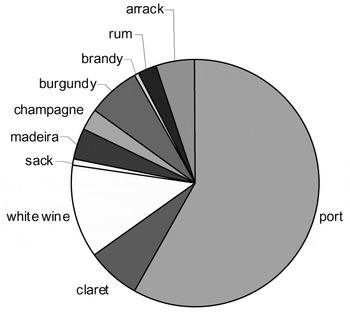
By 1750, Portuguese wines comprised over 70 percent of all English wine imports, and most of that wine was port. Footnote 25 Indeed, by the middle of the eighteenth century port was an established institution among English middle-ranking men. For this reason, the prominent London printer and bookseller James Dodsley thought it worth his financial while to publish The Cellar-Book: or, the Butler's Assistant, in keeping a Regular Account of his Liquors in 1766. This was the first commercially available cellar-record book in English, and it evinces what one wine writer calls the “democratization of the wine cellar in England—that is, from the aristocracy to the middle classes.”Footnote 26 But just as important as the increasing availability and popularity of wine cellars in England is what Dodsley's book tells us about the taste of the middle ranks. The elite, after all, would not have needed such a book, as their own butlers had been trained in how to keep a cellar record. The Cellar-Book was meant for aspiring gentlemen and was meant to be both descriptive and prescriptive. The introduction includes a sample page intended to instruct the butler or “common servant” on how to use the cellar book and what the gentleman's cellar should contain (in bottles): to wit, it should contain 400 port, 48 claret, 85 white wine [unspecified], 4 sack, 29 madeira, 19 champagne, 48 burgundy, 235 ale, 60 cider, 4 brandy, 18 rum, and 34 arrack.Footnote 27 In other words, a middle-ranking Englishman with a modest wine cellar could expect to purchase and drink almost twice as much port as all other wines combined (fig. 1). Footnote 28
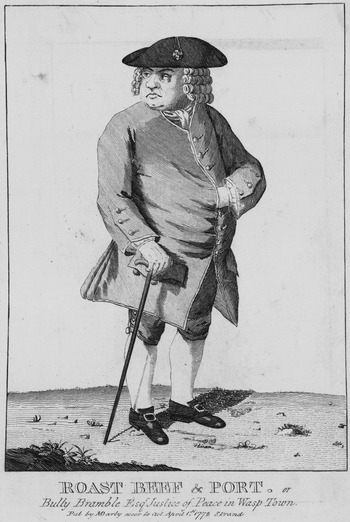
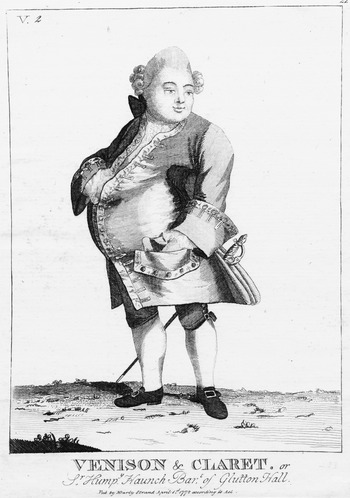
Port's status as the preferred wine of English middle-ranking men in the early and mid-eighteenth century is indisputable, but port went beyond that: it was also a symbol of English middle-ranking men, just as claret was a symbol of English male aristocrats. These class affiliations can be seen in two anonymously engraved cartoons from 1772 sold by Matthew Darly, the leading London print publisher of the era. In one print entitled “Roast Beef and Port,” the engraver depicts “Bully Bramble Esq., Justice of the Peace in Wasp Town” (fig. 2 ). A dour-faced and portly Mr. Bramble walks with a cane, while resting his unoccupied hand on his ample stomach, between the buttons of his long but unembroidered waistcoat, whose pockets look heavy with coins. He wears a neck-length wig without ribbons and a black tricorn hat. In contrast, the other print is entitled “Venison and Claret” and depicts “Sir Humphrey Haunch, Baronet of Glutton Hall” (fig. 3 ). Even more portly than Bramble, Sir Humphrey smiles, while resting one hand on his bulbous stomach and the other in a waist pocket. His waistcoat is embroidered, his wig beribboned, his head unadorned, and, as a nobleman, he carries a sword. According to these droll caricatures, port was the wine of the middling sort, those who made their money in urban trade; claret was the wine of the aristocracy, or those who made their money from landownership. Of course, the gentry also made their money from landownership, but here too, within the gentry, a distinction was to be made between the large and small landowners. As Susannah Centlivre joked in her play, A Gotham Election, which was published in 1714, the well-to-do gentry
Dodsley's “gentleman’s” wine and spirit cellar, 1760s. Source: The Cellar-Book: or, the Butler's Assistant, in keeping a Regular Account of his Liquors (printed for J. Dodsley in Pall Mall, 1766).

preferred claret, while the poorer sort drank port.Footnote 29 Thus, port's real symbolic strength did not lie in its Whiggishness. Port may have been born as a symbol of the opposition Whigs, but by the mid-eighteenth century it was a symbol of another opposition party, the English middle ranks.
Crisis on the Douro: How Port Got Better
The success of port on the English market was hardly inevitable. In fact, the port wine industry almost collapsed in the 1750s. This near disaster for producers, brokers, shippers, and merchants occurred because the success of port contained the seeds of its own demise. English consumption of port soared from an average of roughly 8,000 tuns per annum during the War of the Spanish Succession (1702–13) to roughly 12,000 tuns per year in the three decades that followed—a 50 percent increase—and demand continued to grow.Footnote 30 However, the high level of demand for port on the English market could not be met every year due to the natural variations in production and the relatively small area of the Douro Valley under cultivation; the steep, schistose hillsides that would one day constitute
“Roast Beef and Port” (1772). Courtesy of the Lewis Walpole Library, Yale University.

“Venison and Claret” (1772). Courtesy of the Lewis Walpole Library, Yale University.

Portugal's most famous demarcated wine region were only beginning to be laboriously converted from scrub forests to vineyards. This situation, says the eighteenth-century wine merchant John Croft, “induced the English factors and Wine coopers to try the expedient of adulterating, and teaching the Portugueze to sophisticate the wines … which was done principally with the juice of the elder-berry.”Footnote 31
Indeed, there is a host of evidence that adulteration had become a regular means of stretching the wines of the Douro to meet English demand. Nor was this practice only undertaken in Portugal; “wine brewers” in England were equally guilty. Instruction books for vintners on how to rectify “pricked” (i.e., spoiled) wine had long been available in England and throughout Europe.Footnote 32 However, as the English government steadily increased the tariff on all wines in the late seventeenth century, a new sort of instruction manual emerged. These were guidebooks for how to increase the quantity of imported wine by adding English ingredients or, indeed, how to make “foreign” wine from English ingredients alone.Footnote 33 As a fortified wine that was not always well made in Portugal, port was particularly susceptible to adulteration and imitation. Croft identified one such culprit as “Raisin Wine … generally made of the very worst sort of raisins that come from Smyrna compounded with British spirits, extracted from malt.”Footnote 34
The increase in adulterated wines was such a concern for honest members of the wine trade that it became a problem for the British government as well. In 1733 Walpole proposed to transfer the duties on wine and tobacco from Customs to the Excise because he was aware that much more wine was being sold in England and Scotland than paid customs duties. This disparity was a result of fraud, smuggling, and, in England in particular, adulteration.Footnote 35 As one defender of the government's proposal wrote: “A second kind of Fraud [false declaration being the first] is known to the whole Town; and it is by a Composition that is made of several Ingredients, the Juice of Elder Grains, Wild Mulberries, and Cyder, which sell to the Vintners at a third or fourth Part cheaper than Wine sells at; and they, in their Retail, sell it mix’d with Wine, for real Wine, as many People complain they do, and especially the Wine Merchants.”Footnote 36 The purpose of transferring the duty from Customs to the Excise was that excisemen would have the right to inspect vintners’ cellars and thereby ferret out the falsely declared, the smuggled, and the faked. Consequently, the bill had few defenders in the wine trade. Tobacco merchants, whose regulation Walpole also wanted to move from Customs to the Excise, took a similar view. These powerful interest groups cried out that their liberties would be violated by snooping excisemen, and they rallied the Tories in Parliament to their cause. When some “country” Whigs voted with them, the excise bill was defeated. Footnote 37
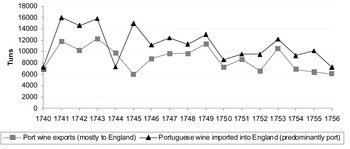
But for English wine merchants the defeat of Walpole's excise bill was a pyrrhic victory. The flood of stretched, adulterated, and locally brewed “port” in England began to diminish the reputation of the genuine article. Not surprisingly, this was followed by a gradual decrease in demand that became a precipitous drop by 1750. Between that year and 1756, Portuguese wine imports into England declined by 20 percent in comparison with the average annual amount imported in the 1740s. Oporto wine export figures for the same years reveal precisely the same percentage decline.Footnote 38
As it happened, not all of port's competition came from English counterfeiters; some of it also came from within Portugal.Footnote 39 In a declining market English wine shippers in Oporto were in a powerful position; they could pick and choose the wines they wanted from the Douro, and to keep costs down they could supplement their stocks with cheaper wines from adjacent wine-growing regions. The Douro farmers then had to offer their wines at a lower price in order to stay competitive with producers from neighboring regions, and by 1754 the cost of a pipe of port in the wine country had fallen from £5–£8 (in the 1740s) to roughly £2–£3 (fig. 4). Footnote 40
With fewer orders from England, plenty of wine in stock, and an ability to get cheaper wine from adjacent regions, the English factors in Oporto were in no rush to buy Douro wines that they could not sell. Instead, they sent an accusatory circular to the Douro wine brokers, who acted as agents for the English factors as well as salesmen for the Portuguese growers. The missive and its response, both from September 1754, have often been mentioned in histories of the port wine trade, principally because the crisis they precipitated resulted in the creation of the state-run company that controlled and dominated the port wine industry for decades to come.Footnote 41 However, the letters have not been examined by historians for
Port before Pombal: crisis on the Douro, 1740–56. Sources: port wine exports, Joseph James Forrester, A short treatise on the unequal and disproportionate imposts levied on port-wine, shipped from Oporto to Great Britain (London, 1850), table B, 19–20; Portuguese wine imported into England, Elizabeth Boody Schumpeter, English Overseas Trade Statistics, 1697–1808 (Oxford, 1967), table 16.

what they reveal about the problems faced by various groups within the nascent port wine industry and the changing nature of port wine itself.
In brief, the factors told the brokers that the state of the trade was deplorable and getting worse. They said that the reputation of port wines, once held in great esteem in England, had fallen below all other kinds of wine.Footnote 42 Proof of their assertion lay in the fact that although the population of England was increasing, the demand for port was diminishing and, they claimed, would soon disappear altogether. Obviously, the end of demand would be calamitous to everyone in the port trade, and therefore all should “unite in applying such a timely and effectual remedy as will remove the universal opinion in England, that Oporto wines are injurious to health—an opinion so strong in the minds of many, that some even account them poisonous.”Footnote 43 According to the factors, the problems lay squarely on the shoulders of producers, who were cutting corners in production to save money and increase their profits. Such behavior, said the factors, resulted in poor quality wines that did not keep well.Footnote 44 Moreover, the factors accused the growers of adding brandy during fermentation. The resulting wine, claimed the factors, was subject to secondary fermentation and unpleasant tastes. The remedy was not to stop fortifying the wines, said the factors. Rather, it was to add brandy only after the fermentation was complete and to use only high-quality brandy.Footnote 45 The factors concluded that if producers adhered to their instructions for improving the wines, then the trade in England would revive and that they would refuse to purchase any wines where their “recommendations [were] not attended to.”Footnote 46
To this missive the brokers responded immediately, defensively, and furiously. Unlike the English factors in Oporto who usually traded in a variety of goods other than wine, such as English cloth and dried codfish from the North Atlantic, along with salt, dried fruit, and olive oil from Portugal, the brokers were not general traders. Their livelihood, and those of the growers they represented, depended almost entirely upon the sale of Douro wines. Therefore, what was an economic downturn for the factors was an impending disaster for the growers and brokers. In responding to the factors, the brokers acknowledged the crisis at hand but placed the blame squarely on the “English Factory alone … by their endeavouring to secure themselves increasing profit, and not leaving any advantage to the cultivator.”Footnote 47 In particular, argued the brokers, it was the instructions that the factors had given the growers that were responsible for the decline of port's once exalted reputation among English consumers.
Specifically, the factors had encouraged the use of brandy to check fermentation (and thereby retain grape sugar) and elderberry to darken the wine, so that the resulting wine “should burn in the stomach; that, thrown in the fire, it should flash like gunpowder; that its colour should be deep as ink; that its sweetness should be like the sugar of Brazil, and its aromatic flavour as the spices of India. … It was by these diabolical instructions of the Factory, that the wine growers were compelled to load their wines with elderberry, brandy, and sweets, or run the risk of not selling their wines except for common use.”Footnote 48
The most obvious proof of their argument, stressed the brokers, was that the wine growers would not willingly incur the additional expense of fortifying and adulterating their wines if they had not been instructed to do so and did not think such actions would increase the sale price. Furthermore, the brokers asserted that the English factors could not deny that they too fortified and adulterated their wines because they, the brokers, handled many of the factor's orders for brandy, elderberries, sweetened wines, and sour wines, which they would blend together to make various styles of port for the English market. The brokers were confident that if English wine merchants and consumers had this information, they would know whom to blame for the low quality of the wine and the subsequent fermentations. They would then demand from the factors only unadulterated Douro wines, and factors in turn would purchase only this type of wine from the growers. The brokers then concluded with a threat of their own. “If this is not to be,” they averred, “as the Douro subsisted forty years ago without an English Factory, and as the Brokers then lived without their commissions, so now we will return to our lands, and you, Gentlemen to Britain.”Footnote 49
Along with fierce accusations and mutual blame, there are several historical ironies within these two antagonistic letters. The most significant irony, of course, is that adding brandy during fermentation and blending wines from various vineyards and vintages are essential practices in the production of most modern port wines. However, in 1754 these practices were not fully mastered, and to the degree that they were understood, the English factors wanted to be in control. What is also clear from these letters is that the demand for good Douro wines had outrun supply, and factors, brokers, and growers, all looking to make a profit, had rushed in to fill the gap by making wines they called “port.” And because there was no regulation of the industry, no one was actually breaking the law. In other words, what happened to port was a classic economic scenario. Increased demand led to increased production, much in the form of inferior, adulterated, or nongenuine wines. This, in turn, led to a decline in overall quality and eventually decreased demand. The decreased demand meant a decline in prices, and while everyone involved in the industry was in economic trouble, the producers were in the most tenuous position of all: having staked their livelihood on the sale of their wines, they could not simply take a loss and rely on their other commercial ventures to keep them afloat.
To those interested in the taste of eighteenth-century port, there is another intriguing point that emerges from this debate. It seems that the English factors had an ideal type of port in mind (and occasionally in cask), which, if we are to believe the description of the brokers, looked, smelled and tasted very much like modern vintage port: dark, strong, aromatic, spicy, and sweet. A wine somewhat like that could be produced naturally in optimal years, when the grapes had a long, hot growing season and when the fermentation was relatively cool and protracted. In this situation, brandy added after the fermentation had stopped would help to ensure that a secondary fermentation did not take place during transport or warm weather and that the wines were protected against spoilage. However, these climatic conditions would not have occurred every year, and in many years the wine would have fermented itself out to dryness at a rapid rate, leading to a strong, coarse wine. The problem for grower and shipper alike was how to meet the demands of English consumers for this type of port when conditions were not optimal, and, of course, this was only one of many types of port that consumers desired. Indeed, until the practices of fortification and blending were better understood (and controlled), meeting the vast array of consumer demands was always going to be a problem. The result was experimentation, adulteration, blending, and in almost all instances, more brandy.
Pombal and the Douro Company
In 1755, the Portuguese brokers took their complaints to earthquake-ravaged Lisbon, where they were warmly received by the prime minister, the future Marquês de Pombal (a title he received in 1770). Pombal was in need of money to rebuild the Portuguese capital, and he had long regarded the English dominance of the port wine trade with envy and suspicion. The crisis on the Douro played right into his hands. Having gleaned much about commerce and trade while living in London as the Portuguese ambassador to the court of St. James (1738–43), Pombal planned a series of state-run companies that would restructure Portuguese finances entirely, and one of these companies was to control the port wine trade.Footnote 50
When the English factors got wind of the plans, they too sent a representative to Lisbon. According to Croft, who was now writing about events in his own lifetime, Pombal not only dismissed English complaints out of hand but berated the factors “for treating Portugal as scurvily and insignificantly as if it was the most petty Republic imaginable, and not a Kingdom that had an indispensable right to make its own domestic laws.”Footnote 51
On 10 September 1756, the Companhia Geral da Agricultura dos Vinhos do Alto Douro (hereafter, the Company) was established by royal decree.Footnote 52 According to the founding charter, the Company was to maintain the quality, price, and reputation of port wine by demarcating a growing zone and delimited areas within the zone according to their quality, by establishing fixed prices for the different quality Douro wines, by prohibiting the blending of demarcated wines with wines from outside the zone, by limiting the production and sale of each grower, by limiting the use of manure within the better quality zones, and by prohibiting the growth of elder trees within the entire demarcated zone—this last order being enforced upon the pain of transportation to Brazil. The Company, acting as traders, had the right of first refusal on all wines and held a monopoly on trade to Brazil, the city of Oporto, and indeed to all nations except Great Britain and Ireland.Footnote 53 These laws were to be enforced by a complex hierarchy of officials, ranging from a single president at the head to multiple deputies, judges, clerks, commissioners, bailiffs, and wine tasters.
The English factors were left with the right to export wines to Britain and Ireland, but these wines could only be wines from the Douro that had been passed by the Company as “factory” wines (i.e., wines from the best demarcated vineyards) and approved for export in Oporto by an official taster. Significantly for the English factors, Britain and Ireland were the only sizable markets for port other than Portugal and its colonies, although the English were never heavily involved in this inter-Portuguese trade. In other words, but for their ability to drive down the price of wine from the producer, very little had been taken away from the factors. Nevertheless, the factors were irate. They vociferously protested these impositions on what had been essentially their monopoly, but Pombal had no sympathy and turned them out. Meanwhile, the British prime minister, William Pitt the Elder, wanted to stay on good terms with Portugal during the Seven Years' War (1756–63) and therefore turned a deaf ear to the factors’ entreaties for diplomatic pressure.
Despite English complaints, which persisted into the mid-nineteenth century, there can be little doubt that the Company, at least initially, had a beneficial effect on the quality of port shipped to Britain and on the quality of port wine more
Port: the Englishman's wine, 1757–91. Sources: port wine exports, Joseph James Forrester, A short treatise on the unequal and disproportionate imposts levied on port-wine, shipped from Oporto to Great Britain (London, 1850), table B, 19–20; for Portuguese wine imported into England, Elizabeth Boody Schumpeter, English Overseas Trade Statistics, 1697–1808 (Oxford, 1967), tables 16, 17.

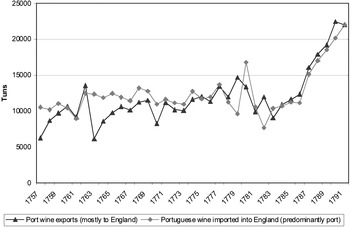
generally (fig. 5).Footnote 54 The most convincing argument for the benefits the state-controlled Company conferred on the port trade is the immediate increase of port exports. From roughly 6,000 tuns per year in 1756, port wine exports (over 75 percent of which were to England) climbed to a nearly 9,000 tuns per year average throughout the 1760s, to more than 12,000 tuns during the 1770s, and to over 20,000 tuns by the beginning of the 1790s.Footnote 55 Not surprisingly, as most Portuguese wine in England was port, English import figures for Portuguese wine during this same period show a similar trajectory.Footnote 56
However, the improved quality of port through regulation of the industry does not by itself explain the increasing popularity of port among English wine consumers, nor, as one wine trade historian proposed, does the final Gin Act of 1751 or the temporary prohibition of gin distillation in England during the harvest shortages of 1757, 1759, and 1760.Footnote 57 These events may have been contributing factors to port's popularity in England, but the time gap between gin's rapid decline (1751) and the beginning of port's resurgence on the English market (1757) is too far apart to suggest that port was a strict replacement for gin among English consumers. In fact, the bulk of English gin drinkers in the first half of the eighteenth century came from the urban (and mostly London) poor.Footnote 58 When they were forced by price and availability to stop drinking so much gin, they did not suddenly have the money to drink wine. Instead, port increasingly dominated the English market during the second half of the eighteenth century because port got better and because elite men joined the middling sorts in their fondness for port.
The Political Need for Port
Why would elite men begin to drink a wine that they had formerly considered uncouth and the province of the middling sorts? Certainly, the improved quality mattered for the aesthetically judgmental consumers, but better quality, independent of other factors, cannot explain why port became increasingly fashionable among the elite. Indeed, improved quality of a commodity never guarantees increased sales. There has to be greater demand as well, and for that to occur, and be sustained, there must be an incentive to consume over and above the desire simply to try a product because it has, according to others or to its own advertising, improved in quality. Happily for port producers and shippers, just such an incentive emerged in England during the Seven Years’ War.
As early as the 1730s, social and political critics among England's swelling middle ranks began to appropriate the late seventeenth-century Country and Whig critique of luxury and effeminacy and turned it against the Whig oligarchy led by none other than the claret-loving Sir Robert Walpole. “Effeminacy” in this context denoted a “degenerate moral, political and social state that opposed and subverted the vaunted ‘manly’ characteristics—courage, aggression, martial valour, strength—that constituted patriotic virtue.”Footnote 59 Admiral Vernon's resounding victory over the Spanish at Porto Bello in 1739 was seen as a vindication of the sort of aggressive and martial masculinity that the antiwar Walpole was said to shun in favor of trade, luxury, and “polite” behavior.Footnote 60 In the immediate aftermath of the Jacobite rising of 1745–46, the novelist Eliza Haywood censured the gentlemen officers in the British army for their supposed effeminacy, despite the fact that they proved particularly brutal in their victory over the hapless Highland clansmen. Footnote 61
During the 1750s and the initial years of the Seven Years’ War, the trickle of such class and gender-based criticism became a torrent.Footnote 62 After calamitous losses to the French in the Ohio River Valley, the lack of manly virility among the British officer class (which corresponded to the landed classes) came under sweeping attack.Footnote 63 Criticism of the officer class grew worse still with the failure of Admiral Byng to relieve the British garrison at Minorca in May 1756. Anti-Byng rioters across England made clear their perception that the loss of Minorca to the French had everything to do with the effeminacy of the elite, a claim that was affirmed by Byng's own aristocratic parentage.Footnote 64 Effigies of Byng were carefully dressed with the sartorial symbols of a courtier.Footnote 65
In the past twenty years, numerous historians have demonstrated how a “virulent strand of anti-aristocratic sentiment” entered political discourse during these crisis years.Footnote 66 The Reverend John Brown of Newcastle summarized much of middle-ranking opinion on the matter in 1757 when he stated that the “internal strength of a Nation will always depend chiefly on the Manners and Principles of its leading Members.” The problem, to critics like Brown, was obvious: the current “luxurious and effeminate Manners in the higher Ranks, together with a general defect of Principle … operate powerfully, and fatally,” in the conduct of national affairs. Military losses were the result of a navy and army guided not by honor but by effeminacy, said Brown, that is, a nation wherein courage, principle, sacrifice, and liberty are forsaken for vanity, frivolity, selfishness, and the underlying element of all corruption, luxury.Footnote 67
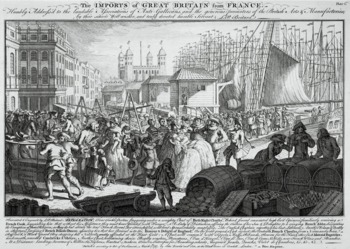
French luxuries corrupted most of all, because according to this English masculinist rhetoric, France was the embodiment of an effeminate nation. A print entitled The Imports of Great Britain from France, published in May 1757—two months after Admiral Byng was executed for failing “to do his utmost”—highlights and links the cultural and material causes of Britain's descent into effeminacy. It depicts hordes of French cooks, dancers, priests, tradesmen, and coquettes disembarking in the port of London, having safely passed England's national defenses, symbolized by the Tower of London in the background. Stevedores have already unloaded the ship of its corrupting cargo, which lies on the dock, ready to contaminate England. Among the products listed and depicted are cheese, muffs, ribbons, cambrics, gloves, perfume, and, most prominent of all in the foreground, large casks of clearly labeled champagne, burgundy, and claret (fig. 6 ).Footnote 68
This print clearly links the supposed effeminacy of the elite to their consumption habits, and perhaps the most important of these habits was the consumption of expensive French wines. Thus, for people who accepted this gendered critique of the English elite, the “politeness” of luxury claret—or any other commodity for that matter—was no longer a positive attribute, because politeness itself was deemed frivolous and effeminizing and not, as by design, a sign of one's superior aesthetic sensibility. As one historian has recently argued, it was precisely during the Seven Years’ War (1756–63) that politeness as a model of gentlemanly conduct began to be rejected on the grounds that it was incompatible with the supposedly masculine national character of England.Footnote 69
The rejection of polite behavior and polite commodities happened gradually, but the effect on the reputations of different wines was quite clear. Take, for example, Samuel Johnson's declaration on wines at a London dinner party hosted by Sir Joshua Reynolds on 7 April 1779. Johnson, who was almost completely abstemious at the time, harangued his fellow diners with his great contempt for claret, which all the others were drinking at that moment. Having made his point, Johnson was persuaded by his companions to drink a glass, “that he might judge,” writes Boswell, “not from recollection, which might be dim, but from experience.” Johnson complied, then quickly ejaculated: “Poor stuff ! No, Sir, claret is the liquor for boys; port for men; but he who aspires to be a hero (smiling,) must drink brandy.”Footnote 70 Johnson went on to say that few men were heroic enough to handle brandy, implying that drinking port was proof enough of one's manliness, while claret drinkers were clearly not real men.
These gendered reputations of competing wines helped to create the demand for port among the English elite. We have seen already how in the 1760s the fourth duke of Marlborough purchased and served far more port than claret. Of course, one man's preference does not make a trend, but records from Christie's auction house, which begin in 1766, confirm port's climb from middling to middling and elite status. The first listing of port in a Christie's sale comes from among the goods of “Mr. Wilson, an Innkeeper and Farmer” at Petersfield, Hampshire, in 1768. Similarly, a 1769 auction of the property of “Captain Fletcher from the West Indies” contained red port, along with tent, calcavella, “old” madeira, “fine” madeira, and “old” hock. Of course, an innkeeper and a captain from the West Indies are precisely the type of middle-ranking Englishmen one would expect to
The Imports of Great Britain from France (1757). Number 169. Courtesy of the Trustees of the British Museum.

see drink port in the mid-eighteenth century. However, by the 1770s, port began to appear in more prestigious Christie's auctions. In 1772, for example, the earl of Granard's auctioned wines included bottled port, claret, champagne and white burgundy, a hogshead (252 quart bottles) of madeira, and a pipe (504 quart bottles) of port. In 1778, the sale of the earl of Kerry's wines included undisclosed amounts of “fine old port,” claret “fine flavour,” champagne, burgundy, Rhenish, red cape, white cape, Rivesalte, and cherry brandy.Footnote 71
In other words, by the 1770s port was not just a supplementary wine for the British and Irish aristocracy to be given to servants and laborers as a form of payment. It was an esteemed wine in elite wine cellars. Port's new status among the elite enabled Sir Edward Barry, Fellow of the Royal College of Physicians and of the Royal Society, to assert in 1775 that “port wines are now universally preferred to the French claret.”Footnote 72 Whether Barry meant to include women in this claim is uncertain, but it may have been true nonetheless. For instance, in 1777, Isabella Widdrington of Hauxley, Northumberland, a spinster, wrote to her sister Mrs. Mills, who lived near Durham, asking her to relay an order to Mrs. Mills's husband, a wine merchant. The order consisted of two gallons of brandy, twelve dozen pint bottles of the “best Frontignac,” and a hogshead of port.Footnote 73
Of course, port was not “universally preferred,” as no wine can ever be the favorite of every single consumer in a large and economically diverse market such as England. Moreover, Christie's records and private cellar records from the 1770s reveal that most aristocratic wine drinkers still preferred expensive French wines to port, but, significantly, the relative amount of port in their cellars was rising. Therefore, what Barry's statement reveals is an awareness that port was increasingly esteemed by the most fashionable consumers and not just the middle ranks. For example, receipts from the London tavern keeper Luke Reilly in 1777 show that Richard Brinsley Sheridan—having just struck gold with The School for Scandal—drank two to three bottles of wine per visit and that the wine was usually port, and less often madeira, mountain, claret, or even, to count distilled wine, brandy.Footnote 74 By 1780 Sheridan would leave the theater and become a radical Whig politician, where his great nemesis was William Pitt the Younger. But despite their tremendous political animosity, both men could agree on port. In the year beginning July 1784, Pitt purchased approximately 5,200 bottles of wine, of which port constituted nearly half (46 percent) and claret a mere 11 percent.Footnote 75
The consumption of port in England among both the elite and middle ranks was clearly abetted by the British-French Commercial Treaty of 1786 (the Eden Treaty), which was promoted by Pitt as a way to diminish smuggling and expand legal trade and, hence, increase customs revenue. Significantly, the Eden treaty both simplified and reduced the import duties on wine, so that Portuguese and Spanish wines paid £31 per tun, French wines £47, and wine from all other countries £35. As seen in figure 5, the result was a sharp rise in Portuguese wine imports, from roughly 11,000 tuns to 15,000 tuns between 1786 and 1787. However, this dramatic increase in the absolute amount of port constituted a small decline in the relative amount. To be precise, Portuguese wine constituted 76 percent of all English wine imports in the decade 1777–86 and 74 percent during the five years in which the Eden Treaty operated without hindrance (1787–91). Meanwhile, French wine imports, which constituted 3 percent of all English wine imports in the decade prior to the Eden Treaty, increased to 3.5 percent during the next five years. In other words, the only dramatic effect of the Eden Treaty upon the wine trade in England was to increase the overall volume of imports by roughly half.
The actual contours of English taste did not change at all. The elite were still the only significant consumers of claret after 1786, but like the middle ranks, they also drank more port. A surviving wine bill from the London vintners Christie and Barrow in 1790 for Spencer Perceval, one of Pitt's political protégés and a future Tory prime minister, reveals a predilection for port: it comprised 61 percent of his total purchases.Footnote 76 In the period 1792 to 1804, Henry Gage (third Viscount Gage)—a prominent Sussex landowner and son of General Thomas Gage, the last royal governor of Massachusetts—purchased the equivalent of nearly 19,000 bottles of wine, of which port constituted 48 percent. Sherry and madeira ranked next in volume, while claret accounted for only 3 percent of the total.Footnote 77 Similarly, in the years 1796 to 1806, port was the most prominent wine in the cellars of the senior common room at Christ Church College at Oxford. Indeed, at that time, sherry was the only other wine to be found in what was perhaps the most aristocratic of Oxford colleges.Footnote 78 A quote from an article in The Times in February 1798 confirms port's preeminent status among the future leaders of the nation: “To which University,” said a lady, some time since, to the late sagacious Dr. Warren, “shall I send my son?” “Madam,” replied he, “they drink, I believe, near the same quantity of port in each of them.”Footnote 79
While some of the elite predilection for port after 1793 can be attributed to the war against revolutionary France that began in that year (and that officially annulled the Eden Treaty), most cannot. As the evidence shows, the aristocratic and elite move toward port began as far back as the 1760s, a full generation before the war began. Instead, the change in elite taste from claret to port had everything to do with maintaining political power. As middle-ranking charges of “effeminacy” began to stick to the ruling elite in the late 1750s, members of the besieged elite needed to address their critics. One way to do so was to drink a symbolically middle-ranking wine like port, because to drink port was to drink a glass of English manliness, which was precisely what middle-ranking critics said the ruling elite lacked. And without true English manliness, which the aristocracy no longer had the power and prestige to define, the elite, especially the aristocrats among them, were no longer politically legitimate. After all, to be a “woman” or a “boy” was to be politically disqualified.
With so much at stake, the gradual switch from claret to port was by no means the only politically motivated change in taste made by the besieged and anxious English elite. For example, fashion historians have identified a shift in men's clothing beginning around 1750, from brightly colored, flamboyant clothing to darker, simpler men's suits.Footnote 80 The historian John Carl Flugel referred to this trend as the “Great Masculine Renunciation,” and like the shift from claret to port, elite male renunciation of silk and lace for worsted and cambric mirrored the fashion of the middling sorts.Footnote 81 Similarly, architecture and decorative arts historians have shown how simple, neoclassical designs began to replace more ornate rococo styles around the mid-eighteenth century.Footnote 82 In short, for the English elite to maintain power over an increasingly assertive middle rank of society, they had, symbolically at least, to consume like the middle ranks. In this sense, there was an embourgeoisement of English elite taste, even if the elite consumed better quality port, more expensively tailored clothing, and larger and better quality houses and objects with which to fill them.
What's in a Bottle?
The increased demand for port from the English elite coincided with, and in fact probably helped to propel, a technological change that made port a markedly finer wine. That technological change was the development of the cylindrical bottle. The esteemed, early twentieth-century wine writer André Simon opined that, “port could not be drunk with any degree of satisfaction from the cask, when quite young, like Claret, Moselle or even Sherry, and its consumption did not increase appreciably until the cylindrical bottle had evolved purposely to make binning possible: until binning became possible Vintage Port was impossible.”Footnote 83 Despite Simon's own feelings on the matter, most port in the eighteenth century was consumed with very little if any bottle age and within a year or two of production. Most English consumers enjoyed it fiery and tannic, but no doubt they noticed a difference when the wine had time to mellow.
Before the invention of the cylindrical bottle, bottle aging was highly impractical. In the seventeenth century bottles were onion-shaped, and by the mid-eighteenth century they had become more mallet shaped. In both cases the form supplied the function, which was to transport the wine from the cask to the table, and once on the table to provide a solid container that would not tip easily on frequently uneven surfaces. Some expensive French, Italian, and Rhenish wines were bottled, corked, and sealed during the eighteenth century, but bottling generally took place once the wine in cask was deemed ready to drink. Bottling was a way to slow down the aging process that occurred while the wine was in wood. The result for these luxury wines was that the amount of time in bottle was often less than the amount of time in cask. And when bottle aging did occur, it was a highly impractical use of space. Mallet-shaped bottles could not be stacked on top of one another, so storing bottles required an awkward stacking frame or baskets full of sawdust for packing.
While bottle aging was impractical, cask aging was extremely expensive for shippers in Portugal. Some cask aging already occurred in Oporto during the eighteenth century, but aging required enough capital for the shipper not to need to sell his wines immediately, lodges for the wine to age in, and a ready supply of wine with which to keep the casks topped up. Thus, throughout the eighteenth century most port shipped to England was less than a year old; however, toward the end of the century increasing amounts of older wine (two and three years old ) were blended in with the new wine before shipping.Footnote 84 This type of blending would have helped to mellow a fiery young port, but as the amount of brandy in port was also increasing as the century wore on, blending with older wines would not have been as efficacious as aging the wine in bottle for many years.
Similarly, for consumers in England to cask age their wines, they needed both the space in their cellars in which to keep the large casks, and the capital with which to purchase them. In contrast to the problems of cask aging, once the cylindrical bottle was available, what the consumer needed, assuming he could afford the wine, was a small cellar and time. In other words, the cylindrical bottle made aging possible in part because it enabled producers, shippers, and merchants to shift the cost of aging wine onto the consumer. The consumer, in turn, did not need to buy an entire pipe of port, although those who could afford it usually did.
The stackable, cylindrical bottle allowed wines to be stored on their sides efficiently for many years. A bottle laid on its side kept the cork moist and tight and therefore the wine in and the oxygen out. One historian of port wine dates the development of the cylindrical bottle precisely to 1768, but evidence from antique bottles suggests that the cylindrical bottle did not come to prominence in one year; it developed gradually during the third quarter of the eighteenth century.Footnote 85 Corks, of course, were also necessary for the aging process, but these had been used as bottle stoppers in England since at least the sixteenth century. Even more importantly, the invention of the corkscrew sometime in the mid-seventeenth century allowed corks to be driven flush with the rim of the bottle.Footnote 86 Thus, during the third-quarter of the eighteenth century all the technological conditions were right for wine to be bottle aged, and the strongest wines benefited from this aging most of all.
The results of these new conditions were almost immediate and are seen in the emergence of vintage port, the first mention of which comes from a Christie's sale in April 1773. The vintage was 1765, and the port came from the cellar of a “Gentleman's house” on Mortimer Street near Cavendish Square.Footnote 87 Top-quality claret, champagne, burgundy, and Rhenish wine had been sold by the vintage throughout much of the eighteenth century, but port had not been considered worthy of such careful production and marketing. The late eighteenth century is too early to speak of modern port, which was a development of the mid-nineteenth century, but by the third quarter of the eighteenth century expensive, luxury port had arrived on the English market and was there to stay.
The fact that luxury port existed by the third quarter of the eighteenth century should not blind us to the fact that some, perhaps much, port in England was still coarse, adulterated, or counterfeit. Writing in 1775 Barry stated that port wines, although now preferred to claret, “are frequently adulterated here, which is not to be imputed to the Portugal merchants; and it is well known, that large quantities of nominal port wines are made here, without any Port wine in them.”Footnote 88 A French visitor in 1765, Pierre-Jean Grosley, was even more explicit, saying that the port wine drunk in taverns was a combination of turnip juice, wild berries, beer, and litharge (lead oxide), and this he learned from a vintner.Footnote 89 But he also said that one of the only two good bottles of wine he had during his six-week stay in England was a bottle of port imported direct from Lisbon by a French banker living in London; the other was a bottle of Macon brought directly from Burgundy. The former wine, which he called port in its “pure and natural state,” was of a “deep colour, but lively, and of a very high spirit.” It “resembled the best claret in right order, such as is drank at Bourdeaux itself.”Footnote 90
If a Frenchman living in London could procure an excellent bottle of port, surely savvy and well-to-do English consumers, who drank a great deal more port than the French, knew where to go in London to find a superior bottle. For the most part though, wealthy English consumers purchased their wine from high-end merchants; they did not go to the tavern looking for top-quality wine. Nevertheless, the peripatetic John Byng, nephew of the unfortunate admiral, said that it was possible to find a good bottle of port in a London tavern if you were known by the proprietor. He himself thought the “light [King’s] Lynn” kind of port found in east Midlands taverns better than the “London heavy cut.”Footnote 91
Byng's remarks remind us that while the style of port continued to vary, by the later eighteenth century the overall quality was improving enough that, at its best, port could compete with French wines for the most discerning English palates. In contrast, early eighteenth-century port had little to recommend it but its cheapness, its strength, and, for some, its reputation as a patriotic wine. These factors had been enough to make port popular among the middle ranks but not enough to make port fashionable wine among the English elite, be they Whig or Tory. During the later eighteenth century, however, elite fashion began to change: port was made with greater care, and the quality of wine shipped to Britain and Ireland improved. This qualitative improvement coincided with a need among the English elite to behave in a way that the middle classes defined as more “English” and “manly” and less “effeminate” and “French.” This demand on English elite men meant adopting certain middle-class habits and tastes; it meant drinking less claret and more port. In turn, elite men demanded a type of port in their own (self ) image: high-quality, aged, and refined, but strong and manly nonetheless. Indeed, with quality port available, the elite could behave like the middling sorts without actually having to drink a middling-sort wine. To a casual observer of English consumption habits, the socially divided society did not look so divided after all. Everyone was a John Bull now. The elite were drinking a “man's wine” and, as evidence reveals, a great deal of it.Footnote 92
To be sure, even at the end of the eighteenth century only a small amount of port was fine wine, and none of it was modern port. As late as 1824 the reputable Scottish physician and historian of wine Alexander Henderson wrote that port was a dry wine, and the debate over whether port should be dry or sweet, neat or fortified, continued until the mid-nineteenth century.Footnote 93 But whatever port tasted like on the palate—and apparently this taste varied as much as the quality—in the late eighteenth century it was appreciated by the entire spectrum of English wine drinkers for the solid English manliness that its consumption represented. So much was this the case that in 1787 Croft could write: “An Englishman of any descent [sic] condition, or circumstances, cannot dispense with it after his good dinner, in the same manner as he uses a piece of Cheshire cheese for digestion sake.”Footnote 94 Precisely because port had been such a prominent symbol of middle-ranking men, it became, by the last decades of the eighteenth century, “the Englishman's wine.”