1 Introduction
Task-based Language Teaching (TBLT) research (Ellis, Reference Ellis2003; Samuda & Bygate, Reference Samuda and Bygate2008) has long explored effective strategies for helping learners develop L2 skills which are transferable to the real world. Recently, scholars (González-Lloret & Ortega, Reference González-Lloret and Ortega2014; Hampel & Hauck, Reference Hampel and Hauck2006; O’Dowd & Ware, Reference O’Dowd and Ware2009) have sought to identify ways in which tasks can be used in computer-mediated communication to maximize L2 learning. In these environments, tasks must include the objectives of developing language and digital literacy skills simultaneously, learning how to interpret and, at later stages of language learning, contribute to computer-mediated communities effectively (Hauck, Reference Hauck2010; Kurek & Hauck, Reference Kurek and Hauck2014; Stein, Reference Stein2004).
A promising area of inquiry connects multimodality and task-based pedagogy, but further research is needed to expand our understanding of task design and L2 learners’ experience with tasks in computer-mediated environments (Hampel, Reference Hampel2010; Hauck, Reference Hauck2010). Especially urgent are studies that describe and critically reflect on tasks carried out in multimedia and multimodal environments (O’Dowd & Ware, Reference O’Dowd and Ware2009). This research is eminently apropos, since much of the student population entering L2 courses at US universities belongs to a so-called Generation Z that is very computer savvy and expects technology to play a significant role in their education (González-Lloret & Ortega, Reference González-Lloret and Ortega2014).Footnote 1 For them, the ready availability of the internet provides tremendous potential for learning via multimodal sites of authentic L2 communication.
The present case study aims to contribute to this body of research by examining how tasks based on authentic internet-based resources can facilitate L2 learning among first-year learners of German. To this end, the next section explores the relationship between TBLT, computer-mediated L2 learning, and research on multimodality. Then, the rationale for and design of pedagogical tasks are described using the weekly television-series, Rosenheim-Cops, for beginner L2 learners of German at a US university. The next section explains how the tasks were realized in a first-year German language course, and critically reviews the benefits and limitations of the tasks and the multimedia environment for the study’s participants. A number of insights provided by this study and suggestions for future research are offered in conclusion.
2 Review of the literature
2.1 TBLT and technology
TBLT research is a principled approach to L2 teaching that emphasizes using real-world language that is also meaningful for learners (Ellis, Reference Ellis2003; González-Lloret & Ortega, Reference González-Lloret and Ortega2014; Hampel, Reference Hampel2010; Samuda & Bygate, Reference Samuda and Bygate2008). Accordingly, tasks should help learners develop linguistic (e.g. lexical and grammatical choice), sociolinguistic (e.g. function), discourse (e.g. genre), or strategic (e.g. non-verbal compensation for gaps in knowledge) competence. These competencies are required for successful communication in real-world situations. In order to foster realistic and meaningful language use, TBLT research (Ellis, 2003; González-Lloret & Ortega, 2014; Samuda & Bygate, 2008) has identified several key criteria for effective L2 learning tasks:
-
1. meaning is primary: tasks must foreground interpreting or making meaning;
-
2. real-world L2 use: learners should engage in language activities similar to those completed by native speakers in comparable communicative contexts;
-
3. learner-centered tasks: L2 learning goals should align with what learners need to achieve in and beyond the classroom;
-
4. holistic language learning: tasks should draw on multiple real-world contexts to integrate form, function, and sociocultural meaning; and
-
5. clearly defined communicative outcome: the purpose of tasks and the language needed to complete them must be shared with learners.
Task cycles are often organized around pre-tasks, tasks, and language focus post-tasks (Ellis, Reference Ellis2003). Pre-tasks prepare learners linguistically, discursively, sociolinguistically, and strategically for tasks which mirror real-world communicative events. The subsequent language focus stage helps learners reflect on what they have learned. Throughout this task sequence, meaningful language use – both in terms of content and interest to the learner – and experiential learning are emphasized. Recently, research has begun exploring the role of TLBT and technology, offering new ways of connecting learners with real-world L2 use (González-Lloret & Ortega, Reference González-Lloret and Ortega2014; Hampel & Hauck, Reference Hampel and Hauck2006; O’Dowd & Ware, Reference O’Dowd and Ware2009).
Computer-mediated communication, blogs, wikis, and gaming environments have been demonstrated to foster L2 learning (Blake, Reference Blake2007; Sauro, Reference Sauro2011) and intercultural awareness (Chun, Reference Chun2011; O’Dowd & Ware, Reference O’Dowd and Ware2009). However, for technology-mediated tasks to be effective, they must be pedagogically sound, focusing first and foremost on the language learning needs of students: “no matter how exciting new technologies for language learning may seem, they can become nothing more than entertainment unless their design, use, and evaluation are guided by viable educational and language developmental rationales” (González-Lloret & Ortega, Reference González-Lloret and Ortega2014: 3). Most importantly, the original, authentic purpose of the technological resources should be reflected in the learning tasks (González-Lloret, Reference González-Lloret2014).
Language tasks also need to help learners become increasingly more active participants in digital communication, “mov[ing] along a continuum from informed reception of technology-mediated input through thoughtful participation in opinion-generating activities and up to creative contribution of multimodal output” (Kurek & Hauck, Reference Kurek and Hauck2014: 120). Informed reception is an initial stepping stone while creative contribution is an ideal learning outcome, with each stage incorporating reflection by the learners whereby they explore and solidify knowledge they have gained while interacting with multimodal information (Kurek & Hauck, Reference Kurek and Hauck2014). Over the course of L2 learning, students ideally end up at the autonomous, active contributing end of the continuum, learning how to interact with peers on websites, in fora, sharing information with native speakers of the L2 during a study-abroad program, for example. The information learners interpret and (eventually) contribute to is multimodal, requiring learners to make sense of and make sense in multiple semiotic modes that in concert create meaning (Kress & van Leeuwen, Reference Kress and van Leeuwen2001). It follows then, that multimodal literacy is an essential skill for meaning-making, but while young people are seemingly perpetual consumers of technology, they are often “tech-comfy” instead of “tech-savvy” (Pegrum, Reference Pegrum2011: 10) and need explicit guidance for developing the critical literacy skills to be able to use multimedia resources effectively (Fuchs et al., Reference Fuchs, Hauck and Müller-Hartmann2012).
2.2 Multimodal pedagogy
Research on multimodality originates in communication and media studies, but has recently been adopted in computer-mediated L2 research, as the proliferation of studies – and the publication of this special volume of ReCall – indicates (Hampel, Reference Hampel2010; Hampel & Hauck, Reference Hampel and Hauck2006; Hampel & Pleines, Reference Hampel and Pleines2013; Hauck, Reference Hauck2010). Kress and van Leeuwen define multimodality as:
the use of several semiotic modes in the design of a semiotic product or event, together with the particular way in which these modes are combined – they may for instance reinforce each other (“say the same thing in different ways”), fulfil complementary roles [e.g. when pictures complement a story in a children’s book] or be hierarchically ordered [e.g. dramatic music in an action movie] (2001: 20).
Nowadays, much of real-world communication is multimodal. Friends send text messages with images and interact via social media sites; all of these components form different layers of semiotic modes, combined in various ways, reinforcing or complementing one another (Norris & Maier, Reference Norris and Maier2014). They are also created and interpreted in a way that is shared with other members of certain social groups: visuals (e.g. texts, symbols, images, clothing, fonts), sounds (e.g. speech, music), and actions (e.g. proxemics, gestures) – all index meaning (Jewitt, Reference Jewitt2014).
Multimodal sites of communication in which individuals explore how multiple semiotic systems work in combination to create meaning (Kress & van Leeuwen, Reference Kress and van Leeuwen2001) can provide ideal opportunities for L2 learning as well. Websites designed for authentic audiences – that is, not purely or primarily for pedagogical purposes – contain language, sound, and visual information that reflect how communication is created for and by real-world users of the L2. In the Western world, multimodal communication is commonplace among many young people. They use cell phones, tablets, and laptops to stay informed about the world, interact with friends and family or access entertainment, share their lives on social networking sites, and receive and process course materials (González-Lloret & Ortega, Reference González-Lloret and Ortega2014). Such digital platforms offer a rich variety of meaning-making resources, including verbal or written texts, images, icons, emoticons, symbols, hyperlinks, and a variety of sound (music, sound effects, etc.). Multimodal communication, however, can easily overwhelm L2 learners, particularly in the early stages therefore multimodal materials need to be used carefully in pedagogical contexts (Hampel & Hauck, Reference Hampel and Hauck2006; Stein, Reference Stein2004).
2.3 Multimodal analysis as pedagogical approach
Stein (Reference Stein2004) remarked that multimodal L2 pedagogy represents a seismic shift from the single modality of spoken language to incorporate multiple modes. Hampel and Hauck (Reference Hampel and Hauck2006) echo this claim by noting that:
Learners in general and language learners in particular have always been required to shift semiotic material outside their modal “comfort zone” and to transpose information from oral input, written text, and visual clues. However, the varying degrees of embeddedness of modes in the new media and the resulting modal complexity turn language acquisition in virtual environments into a new challenge. (Hampel and Hauck: 11)
As suggested, language tasks that use multimodal resources need to encourage and facilitate informed reception, thoughtful participation, or creative contribution by L2 learners (Hampel & Hauck, Reference Hampel and Hauck2006). While authentic websites can offer ideal opportunities for holistic L2 learning informed by TBLT pedagogy (Samuda & Bygate, Reference Samuda and Bygate2008), they require careful scaffolding for beginner L2 learners. Otherwise, the cultural embeddedness of authentic language, potentially unfamiliar images and sounds may remain inaccessible (i.e. too difficult) for L2 learners. An equally important challenge for L2 pedagogy lies in the very nature of authentic resources: as soon as we use authentic communication for pedagogical purposes – for example, by requiring learners to write a message on Facebook – the authentic resource can lose the very authenticity we wish to tap into.
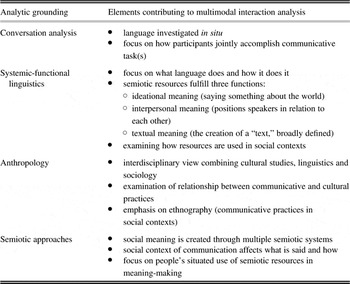
Multimodal analysis can offer useful guidelines for meeting these challenges and make authentic websites accessible to L2 learners by drawing their attention, step by step, to the multiple semiotic systems through which communication is realized. Jewitt’s (Reference Jewitt2014) model for multimodal interaction analysis that combines elements of conversational, analytic, anthropological, systemic-functional linguistic, and social semiotic approaches, can guide the overarching design of multimodal L2 tasks. Table 1 offers a select summary of her model.
Elements of multimodal interaction analysis

Jewitt’s (Reference Jewitt2014) model provides a possible organizational framework for interpreting interwoven semiotic resources embedded in specific cultural contexts. While L2 learners at the beginners level are not ready to conduct in-depth research, multimodal interaction analysis (Jewitt, Reference Jewitt2014; Kress & van Leeuwen, Reference Kress and van Leeuwen2001) can offer an entry-point for them to analyze authentic L2 websites, which was the focus of the present project.
3 The project
3.1 Research questions
Using the interconnected theoretical framework discussed in the literature review (Hampel, Reference Hampel2010; Hauck, Reference Hauck2010; Jewitt’s Reference Jewitt2014; Kress & van Leeuwen, Reference Kress and van Leeuwen2001), the present study sought answers to two research questions:
-
1. In what ways are first-year learners of German able to analyze an authentic website and its ancillary online resources using tasks informed by multimodal pedagogy?
-
2. What challenges do participants encounter when conducting their analyses of the website?
3.2 Participants
Thirty undergraduate students in two first-year German courses at a US university participated in the study for four weeks shortly before the end of their first year of language study. A survey at the beginning of the term revealed that three participants were majoring in Literature, the rest were students of Natural Sciences, Engineering, Information Technology or other disciplines. Some students were taking the course to fulfil major requirements (there is no university-wide L2 requirement at our institution), and about a third of the participants had been accepted into a study-abroad program, had an internship lined up, or had specific plans to travel in a German-speaking country in the near future. Thus, learners expressed great interest in engaging with the proposed authentic resources. All participants were comfortable with technology and used several devices daily for personal and school-related communication.
3.3 The pedagogical rationale for Rosenheim-Cops
This section offers a rationale for selecting Rosenheim-Cops and examines the resources available for this TV-program, which include the TV-station’s official websites affiliated sites such as Amazon.de (the German partner of the US corporation), and Facebook.
3.3.1 Rationale for selecting Rosenheim-Cops
The TV-show selected for this class had to meet several criteria. First, since the course is part of a larger curriculum that is not task-based and relies on a textbook, the show had to connect to vocabulary and themes covered in concurrent chapters. Second, it had to be available and regularly accessible through the internet with stable technical support. Third, it had to be of interest to the learners. Rosenheim-Cops is a popular detective series in Germany, set in the Bavarian city of Rosenheim. A new episode airs every Tuesday evening on ZDF (Zweites Deutsches Fernsehen). The stories are fast-paced and humorous, and provide many themes that are relevant to language learners (e.g. ordering food and using computers). Subtitles are available in German, providing learners with useful bimodal input. Finally, there had to be ample resources to provide and structure information pertaining to the setting, characters, and events, as well as to other viewers’ perception of the show.
3.3.2 Official resources for Rosenheim-Cops
Websites generate a complex web of interconnected multimodal discourses, such as written and spoken text, images, and sounds (Kress, Reference Kress2010; Norris, Reference Norris2004). Rosenheim-Cops is no exception. It has official websites (i.e. created by the TV-channel and program) but also links the reader/viewer/user to other related sites, with their integrated multimodal resources. The main portal is through the TV-station’s website.Footnote 2 Links on the main page guide readers to other programs: on news, culture, feature films, sports, or travel shows, for example. The site uses a minimalistic sans serif font, which makes it look modern.
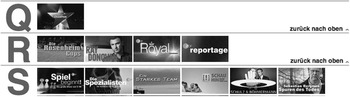
The show can be reached either through a link to the TV-program or through a program listing from A to Z in the top right-hand corner of the website. The latter approach is less daunting for beginner L2 learners, although the former offers more opportunities for unstructured individual exploration. Clicking on any of the letters brings up a small image of the TV-program, which acts as a visual hyperlink to the show. Participants in this study were excited to see some familiar names, some of which keep the English original titles (e.g. Mad Men), while others are Germanized to some extent (e.g. Raumschiff Enterprise (Star Trek)). The images serve an important function in orienting the viewer: they index comedy or drama by means of font, characters, or symbolism, as Figure 1 illustrates.
Sample German TV-shows on ZDF

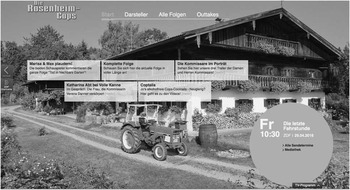
On the TV-show’s site, there is a steady background picture of the show’s setting, a link to the most recent episode and to the trailer of the next episode (Figure 2). There are additional links to a “making of” video (Hinter den Kulissen) and a weekly “Coptails” recommendation by one of the regular characters, Joe, who is the owner of the café lounge called TimesSquare, an important public space in the series, where casual exchanges convey personal information about the characters, and occasionally important cues in the investigation come to light.
Rosenheim-Cops web portal

The interlinked portals – to ZDF, the alphabetical listing of programs, and Rosenheim-Cops itself – present culturally contextualized linguistic information. For example, time expressions and abbreviations for the days of the week are covered early on in the textbook, but here they become relevant, real-world constructs representing actual language as social action. The short summaries visible on the hyperlinked content boxes and the images complementing them can serve as advanced organizers, activating learners’ lexical and referential background knowledge. The brief summary of the most recent episode, located in the main content zone, presents key characters (other than the detectives) and the central problematic to be investigated.
The “making of” videos offer humorous repetitions of scenes and bloopers, which can help humanize learning for our students, demonstrating that even native speakers make mistakes; they also reiterate useful phrases. The film, the websites, and the complementary multimodal resources provide additional cultural contexts and layers (i.e. different types and modes) of information (Norris & Maier, Reference Norris and Maier2014) that learners can explore. For example, the videos and the surrounding information (e.g. titles and summaries) illustrate the influence of English on modern German. These layers of meaning, of cultural practices can be examined by beginner L2 learners, and affiliated websites offer further learning opportunities.
3.3.3 Affiliated resources for Rosenheim-Cops
In addition to the official websites of Rosenheim-Cops, Amazon.de has reviews of the show by viewers who watch it for pleasure, with a target audience of fellow viewers. These reviews provide their own multimodal contributions for L2 learners to explore. The familiar star-based rating system and genre of reviews help students interpret the accompanying textual information: a summary of key events or characters, and good or bad descriptions/descriptors.
Similarly, the Facebook site of Rosenheim-Cops links viewers to endless ideas they can pursue. The main page has an image of the Alps, information about the show (e.g. genre, a link to the show’s website, number of followers), photo albums, and a discussion zone where viewers leave messages, including text, images, and hyperlinks. The icon for the show and the photos of main characters provide a connection to and coherence with the official ZDF website. Additionally, the page has links to the main characters’ professional websites, to the Bavarian film city (one of Europe’s biggest film-making centres), and to other German shows.
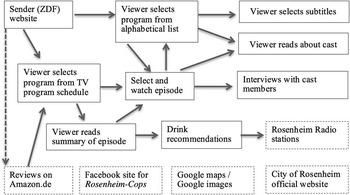
There are further websites that provide social, cultural, historical, and geographical contexts for Rosenheim-Cops. Rosenheim and Bavaria have official tourist websites, offering background information to the setting of the show. Google maps and Google images serve as additional, multimodal sources of information that can enhance L2 learning through mutually reinforcing and complementary multimodal paths, as illustrated in Figure 3.
Multimodal, interconnected websites for Rosenheim-Cops Note: solid lines on the boxes indicate webpages directly linked to and accessible from the sender’s website; dashed-lined boxes indicate related, but not directly linked, websites

3.4 Pedagogical tasks
The present study combines the principles of TBLT and research on multimodality, calibrated to the needs and abilities of early learners of German as a foreign language. Pre-, during- and after-viewing tasks were primarily completed in class, typically through pair or group work, followed by whole-class interaction to ensure participants were able to understand the TV-show. Table 2 illustrates how the main principles of TBLT (Ellis, Reference Ellis2003; Samuda & Bygate, Reference Samuda and Bygate2008) mapped onto tasks based on Rosenheim-Cops for this study.
Mapping TBLT principles onto a German TV-series

The main point of each film-based task was that language was analyzed in a situated context with multiple layers of meaning created by various modes (Norris & Maier, Reference Norris and Maier2014). Learners explored these layers to see what meaning each might contribute: sound, body language, movement, spoken or written language, or other images. Based on Jewitt’s model (Reference Jewitt2014), the following features emerged from Rosenheim-Cops for analysis:
-
∙ background images of private and public buildings, use of space
-
∙ how people interact with nature (flowers around a house, fishing, etc.)
-
∙ clothing preferences
-
∙ hierarchy among co-workers (represented through verbal and non-verbal communication)
-
∙ music (especially the giddy theme song juxtaposed to the content of murder and crime)
-
∙ recurring characters provide insights into relationships, identities (contextualize practices)
-
∙ contrast of subtitles to speech (reveals register differences in formal/informal narration)
-
∙ interactions (e.g., greetings, leave-taking, sociolinguistic preferences, jargon, slang)
-
∙ types of feedback (content and language choice) on Facebook and Amazon.de reviews.
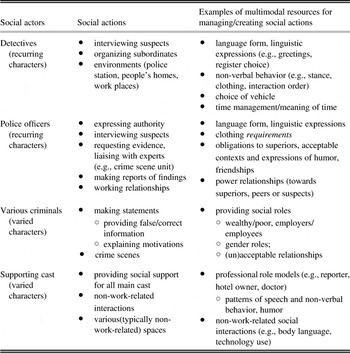
These features were then examined by applying multimodal interaction analysis (Kress, Reference Kress2010; Norris, Reference Norris2004), which examines the roles of the social actors and actions, and the multimodal cultural resources needed to interpret these actions, to Rosenheim-Cops (Table 3).
Multimodal analytic approach applied to Rosenheim-Cops

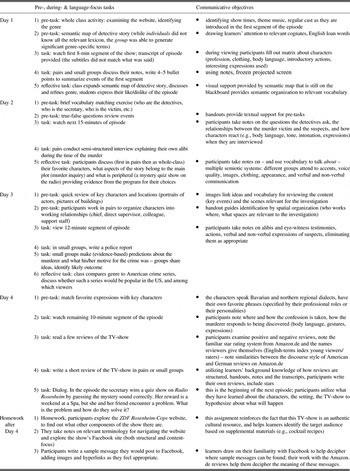
In order to explore these social actors, social actions, and multiple semiotic resources, tasks focused on global- and detail-oriented comprehension; multimodal analysis; and pre-, during- and post-viewing sequences, and each could serve as a pre-task for subsequent activities. Each of the two episodes was shown over the course of four class sessions, in order to provide sufficient time for building relevant vocabulary, preparing and reviewing character analyses, and writing summaries of various components of the story. All instruction was in German, although English was not prohibited. Table 4 offers a sample task layout for one of the episodes watched.
Task chart – Das mysteriöse Geräusch (The mystery sound)

After the first episode was viewed, some tasks were reformulated. For example, fewer tasks were needed to analyze key characters because many of them recurred, and new vocabulary was added to reflect new social actors, social actions, and communication spaces (Jewitt, Reference Jewitt2014).
3.5 Data collection
Data collection took place during a four-week period towards the end of participants’ first year of studying German. The data comprised their responses on:
-
∙ a short survey regarding their practices and comfort level with technology;
-
∙ a handout that contained:
-
○ questions activating background knowledge (vocabulary, genre, etc.);
-
○ content questions ensuring comprehension during and after viewing each episode;
-
○ questions drawing learners’ attention to the different modes of the show;Footnote 3 and
-
○ questions asking about learners’ experience with the authentic materials (e.g. difficulties with comprehension, whether they enjoyed watching these shows).
-
-
∙ a follow-up focus-group discussion with each class (voluntary participation); and
-
∙ written assignments:
-
○ a dialog written in pairs, synthesizing genre, content, personal characteristics, and speech patterns of characters;
-
○ a collaboratively written “screen play” about a problem two main characters had to solve (based on a theme bridging two episodes); and
-
○ a review for Amazon.de, written individually, utilizing appropriate linguistic and genre-specific features but reflecting learners’ own opinions.
-
In this section, research on multimodality and TBLT guided the design of the tasks used in this study, which helped learners navigate the complex system of websites relating to Rosenheim-Cops. As the following section discusses, learners were able to interact with these authentic multimodal systems effectively, in spite of their beginner status.
4 Findings
The following discussion is organized according to the two research questions framing this study.
4.1 Research question 1
The first research question examined the ways in which first-year learners of German were able to analyze an authentic website and its ancillary online resources using tasks informed by multimodal pedagogy. Three topics emerged from the data: (1) semiotic awareness, (2) access to relevant referential knowledge and multimedia literacy, and (3) the ability to engage with authentic materials.
4.1.1 Semiotic awareness
Learners’ responses on the handout systematically revealed that tasks helped raise their awareness of how modes and meaning-making work in the L2. That is, the tasks seemed to facilitate semiotic learning, even among early L2 learners. For example, they were able to interpret that police officers in the lower ranks had a different dress code than the detectives, and that the very strict police chief wore rather traditional, conservative clothing, echoing his personality. Learners also noted that friends in the lower ranks used informal forms of “you” between themselves, whereas two detectives at the same rank referred to each other with the formal “you” because one character had just joined the team. Furthermore, learners noted that long-time acquaintances (Frau Hofer and Frau Stockl) retained the formal “you” and used it even when they went to the spa to relax. Most students acknowledged during the focus-group discussion that the questions – and the pre- and post-viewing discussions in small groups – helped draw their attention to phenomena that they otherwise would not have noticed.
The German subtitles further raised learners’ awareness of the connections between different semiotic systems. For example, all learners noted that the subtitles helped them follow language and content, but also clarified how characters’ actions interplayed with their body language (e.g. power relationships). If the subtitles had been in English, participants added, they would have been paying attention to them at the exclusion of other semiotic layers. Humor was also typically indexed by laughter, which made them attend to the subtitles to figure out what the joke was. With the help of transcripts, participants later analyzed who was allowed to joke, and with whom. The written transcript of the episode also helped participants understand the dialog, reference unusual words (e.g. Gerichtsmedizinerin – coroner), and check characters’ names or the sequence of events.
After watching both episodes, participants reflected on how much the multimodality of the TV-series helped them understand what was going on in the story, adding layers of information: attitudes, identity issues depicted in language choice, for example. In contrast to reading a printed text, watching the actors perform what they were saying in specific locations provided crucial clues for comprehension. The actors’ websites and interviews with them on the show’s official website allowed participants to consider how much their off-screen personality was echoed by the on-screen one.
4.1.2 Accessing referential knowledge and multimedia literacy
On the handout and during the focus-group discussion, learners also reported relying on existing schemata to navigate the website of Rosenheim-Cops, the reviews on Amazon.de, and the Facebook page. For example, their existing knowledge of website organization helped them find the TV-show and recognize relevant links to the current episode, where to find a summary of it, and that the reviews pertained to the series rather than an individual episode.
Similarly, learners were able to apply information they had learned in language classes. Without exception, participants were able to draw on their knowledge of the German time system in official communication (24-hour clock) when figuring out when the episodes were to be broadcasted or how long they lasted. They also noted variation in phrases they learned from their textbook (e.g. greetings), which were realized differently among various characters. For example, one character comes from Northern Germany and uses a greeting typical for that region (“moin-moin”); in contrast, the other characters use greetings more common in Bavaria (“Servus” or “Grüss Gott”). About half of the students made the observation that the subtitles did not match the actual dialog; they used the simple past (typical of formal writing and speech) and omitted almost all greetings, while the conversations were mostly in the present perfect tense (typical of spoken or informal written language). This issue had been covered previously in the course, and it was recognizable for the students in situ.
Equally importantly, participants were able to tap into multimedia literacy skills they had developed in their first language (L1) in order to engage with the authentic resources relvant to the tasks in this study. Using Pegrum’s (Reference Pegrum2011) framework, several literacies were observabed. First, all learners navigated the target websites successfully (using laptops in the computer lab), even though they had never visited the sites before. They were able to find relevant links on the main official site to Rosenheim-Cops (search literacy) and stayed focused on the assigned tasks (filtering literacy). When writing their own reviews, they were able to identify positive and negative reviews on Amazon.de and model their own reviews on them, which they subsequently shared with their peers, creating new collective knowledge (information and network literacy). Finally, because tasks guided learners to examine cultural practices, language, and interaction in concrete cultural contexts, learners were able to identify similarities and differences between their own cultural practices and what they observed in the show (cultural and intercultural literacy). Since students represented an array of majors and diverse cultural backgrounds, they brought multiple interpretive filters with which to notice and analyze information.
4.1.3 Authentic resources
A further interesting aspect of the exercise was authenticity and task design. Most learners reported that they enjoyed working with real-world, authentic material that native speakers experience, even if, for the learners, the first segment was daunting. Breaking the episode into smaller segments and bracketing each with pre- and post-tasks made the exercise more manageable for learners. One could argue that such in-depth analytic tasks are not likely performed by native speakers, therefore these tasks are inauthentic. However, adult native speakers do, in fact, complete such analyses, interpreting multiple layers of images, sounds, language, and behaviors. They merely process this information quickly and automatically as part of socialization (Kress & van Leeuwen, Reference Kress and van Leeuwen2001), whereas L2 learners have to learn how to do such analyses explicitly.
Participants also enjoyed reading reviews on Amazon.de, agreeing or disagreeing with viewers’ comments, identifying and later adopting (for their own reviews) characteristics of the genre and expressions the reviewers used. Both the TV-show and the reviews allowed them to experience language modeled in socially-mediated contexts instead of being limited to the pedagogically prepared language samples used in typical textbooks (including that of the present author). Several students particularly enjoyed the challenge of authentic language, as CB’sFootnote 4 comment on the reaction questions illustrates: “I thought the show was challenging, but in a good way. I only got the general concept of everything but we need to step up our German and this is a great way to do it.” Similarly, SE “found the show helpful with learning new words… but the interviews and the Fb page were more helpful with learning how words are used in conversation, so more common words I need to know” (SE, one of the students going to Europe after the term ended). Although participants were not yet able to move beyond “informed reception of technology-mediated input” (Kurek & Hauck, Reference Kurek and Hauck2014: 120), they were able to recognize the usefulness of such linguistically and culturally contextualized resources.
Similarly, learners’ reviews mirrored authentic samples from Amazon.de, which are quite varied in length and focus. Some are short, some are long; some offer details about the plot, others review the actors’ performance. Tasks – if they are claimed to be real-world relevant, in line with TBLT (Ellis, Reference Ellis2003) – should have similar flexibility. Participants’ written movie reviews did, in fact, vary significantly. Several students in the focus-group discussions explained that they had identified a review they liked (e.g. in focus, language, style) and tried to emulate it. The narrative frame that participants used (present tense, simple past, conversational past) also varied, echoing the stylistic variation found in Amazon.de reviews. Thus the task had real-world relevance in that participants applied meaning and function to specific linguistic forms in line with their own communicative preferences (Ellis, Reference Ellis2003; Samuda & Bygate, Reference Samuda and Bygate2008). Having said that, participants unanimously stated that they would never normally write a review on Amazon.de, and therefore task-authenticity had its limitations. Although participants overwhelmingly reported enjoying and benefitting from working with Rosenheim-Cops, not all of their experiences were positive, however, as the discussion in Section 5 makes clear.
4.2 Research question 2
The second research question sought to identify the challenges participants encountered when conducting their analyses of the websites they explored. These centered on two related phenomena: participant variability and learner buy-in.
4.2.1 Participant variability
An important finding was the difference in learners’ ability to interpret, talk about, and build on the content of the episode and its embedded multimodal layers. By the end of the first year, there was already considerable variation among participants in terms of their language skills,Footnote 5 and variability was reflected in their performance on the tasks completed for this study as well. While it was a positive experience for most learners, five participants found the authentic language overwhelming and reported that they had “difficulty understanding even the gist, let alone any significant details of the plot” (RL – reaction questions). That some of their peers were able to follow events became a source of significant concern for these learners. Overlapping with feelings of frustration, they tended to respond to questions often or almost completely in English and were subsequently less likely to participate in small-group or whole-group discussions, which were typically in German.
Surprisingly, language perception varied among the participants. Although the instructors, who were language experts, noted both cognates (e.g. diskutieren – to discuss or das Rezept – recipe) or English borrowings (stalking or der Stalker), many learners in this study were unable to recognize such links between the L1 and L2. Hearing the dialog and watching the German subtitles provided crucial multimodal reinforcement for this lexical recognition skill, but participants’ cognitive abilities were not as instructors might have imagined.
Finally, participants brought their own personal preferences to the task, which helps make it more real-world on the one hand but limits its potential benefits on the other. This was the issue with tasks requiring participants to visit other websites. One student noted that she “did not find the other links interesting because this was not [her] favorite show, and [she] didn’t care about the extra information” (SL – reaction questions). Another student wrote that since he never looked up links to the shows he liked, he “really disliked having to do this for a show we only watched in class” (SQ – reaction questions).
4.2.2 Learner buy-in
While none of the study’s participants were planning to major in German, all of them were on the course out of interest. Therefore, the analytical skills and culturally situated insights they gained were considered to be a worthy endeavor. These tasks, however, did not feel relevant for two participants. Although they acknowledged that valuable L2 learning might have been taking place, they would have liked to do more worksheets to practice grammar, and felt that the TV-show did not meet their expectations for course activities. This was a curious finding, since the handouts and tasks asked questions using the two narrative structures for describing past events, the focal grammar structure in the chapters covered at the time; this fact was shared explicitly with the learners (Samuda & Bygate, Reference Samuda and Bygate2008). The police report, summary, and sequencing tasks reiterated and practiced these forms in a social context, but since they did not look “familiar”, learners did not recognize them as opportunities for practicing language form.
Several students also noted during the focus-group discussion that although they were very interested in watching authentic materials, they found the simplicity of the plots and the humor in Rosenheim-Cops “a bit hokey”. Another student felt that the light tone of the show was inappropriate for murder, while others found this “dark humor” appealing: “I was surprised by how funny [the show] was when I understood what was happening” (TH – reaction questions).
5 Discussion and conclusions
This paper aimed to provide a critical analysis of the potential of web-based instruction for fostering multimodal L2 learning through task-sequences that helped learners participate in social action – viewing a German TV-show – which members of another culture perform. By drawing on available background knowledge and learning how to conduct multimodal analyses (Jewitt, Reference Jewitt2014) learners could explore the resources related to Rosenheim-Cops and become social actors in the L2 themselves, even if only temporarily. In line with González-Lloret and Ortega’s (Reference González-Lloret and Ortega2014) observation, these college students were not only comfortable with multimodal authentic resources that combine images, sound, and text but also excited about exploring this environment in a language course.
Given that this is a case study with a small cohort of participants, the findings are not to be generalized. Instead, the data serve to highlight the possibility of research on TBLT in computer-mediated environments (Ellis, Reference Ellis2003; González-Lloret & Ortega, Reference González-Lloret and Ortega2014; Hampel, Reference Hampel2010; Hampel & Hauck, Reference Hampel and Hauck2006; Hauck, Reference Hauck2010; Samuda & Bygate, Reference Samuda and Bygate2008) and on multimodality (Jewitt, Reference Jewitt2014; Kress & van Leeuwen, Reference Kress and van Leeuwen2001) to inform L2 pedagogy and help learners develop the skills to navigate and benefit from the rich resources that computer-mediated discourse can offer. With this objective in mind, the data yielded several interesting insights into the way multimodal resources can positively affect the experience of beginner L2 learners. First, carefully designed tasks fostered semiotic awareness by drawing learners’ attention to layers of meaning embedded in socially contextualized communication. Opportunities to engage with complex communicative models are essential for helping learners understand that communication is layered social action, where different modes complement or reiterate each other to convey social action (Jewitt, Reference Jewitt2014; Kress & van Leeuwen, Reference Kress and van Leeuwen2001). Second, through guided tasks, including small- and large-group discussions, participants were able to use their existing multimedia literacy skills (Pegrum, Reference Pegrum2011) to facilitate their engagement with authentic resources. Third, these skills, together with reiterative tasks (during-viewing or post-viewing tasks served as pre-viewing tasks for further tasks, recycling and expanding information) made even full episodes of Rosenheim-Cops accessible to students.
The findings also highlighted problems in utilizing authentic multimodal resources. The challenges lie in learner variability in terms of linguistic skills, the willingness to engage with tasks beyond what they perceive to be pedagogically valuable, or personal preferences. Exploring other resources that are considered “hip” by L2 learners may be a solution to the third insight detailed in the last paragraph. Especially considering the diverse language abilities, it is important to provide beginner L2 learners with sufficient scaffolding (e.g. background information, subtitles in the L2) in order to avoid input overload. Open-ended tasks could also help engage learners and enable individuals to explore different shows. This approach is more likely to ensure that materials match learners’ authentic communicative goals in and beyond the classroom (Ellis, Reference Ellis2003; Samuda & Bygate, Reference Samuda and Bygate2008); however, this flexibility would have to be balanced against the instructor’s workload.
The findings in this study need verification by further research, including measuring gains in language (e.g. sociolinguistic appropriateness, linguistic accuracy), in cross-cultural and cultural literacies (see Pegrum, Reference Pegrum2011), and learner motivation, especially vis-à-vis using authentic multimedia resources. Future research should compare different TV-programs and filmic materials in order to see if extensive exposure to the same series or to varied shows might yield better awareness of social actors, social actions and resources. In addition, learning outcomes at different proficiency levels merit further investigation, exploring how learners utilize multimodal resources and which tasks are ideal at various stages of L2 development. This participant group was not ready to adopt full participatory roles (e.g. by posting reviews or commenting on the show on Facebook), but more advanced learners could be guided to do so, since multimodal communication ultimately requires agency on the part of the speaker/user (Hampel & Hauck, Reference Hampel and Hauck2006; Kress, Reference Kress2010; Pegrum, Reference Pegrum2011). Nonetheless, learners in this study seemed to benefit from the multimodal resources of a German TV-show and its related websites by completing tasks designed to explore different layers of meaning (e.g. textual, auditory, symbolic). These tasks also provided sufficient interpretive scaffolding that these beginner L2 learners were able to decipher language as socially situated action (Jewitt, Reference Jewitt2014). This awareness is crucial in a world that expects individuals “to operate within increasingly multilingual, multicultural, multimodal, multigenre, and multiuser contexts.” (Kurek & Hauck, Reference Kurek and Hauck2014: 123).