INTRODUCTION
Isopods of the family Bopyridae are known to be holoparasites, having several families of decapod crustaceans as definitive hosts (Markham, Reference Markham, Gore and Heck1986). These organisms display a free swimming epicaridean larva that attaches itself to an intermediate host (a calanoid copepod), later metamorphosing into a microniscus (Dale & Anderson, Reference Dale and Anderson1982). This larva metamorphoses to a free swimming cryptoniscus, leaves the copepod and acts as the infective stage of the definitive host. The first cryptoniscus settling on the decapod metamorphoses into a female, while other settling cryptonisci metamorphose into males (Reinhard, Reference Reinhard1949). Commonly, the definitive host will display a single female bopyrid, either in the branchial chamber or clinging to its abdomen, and will be accompanied by one (sometimes two) dwarf males (Anderson, Reference Anderson1990). Bopyrids are known to interfere with gonad maturation of their hosts and, regardless of the degree of inhibition, the decapod reproductive potential is always substantially reduced (O'Brien & Van Wyk, Reference O'Brien, Van Wyk and Wenner1985). In this way, it is commonly accepted that bopyrid infection leads to the ‘reproductive death’ of the host (Van Wyk, Reference Van Wyk1982).
Bopyrid isopods have already been reported infecting penaeid and caridean shrimps, thalassinids, palinurid lobsters, anomurans and brachyurans, with ratios between the number of parasite species:host species per decapod group averaging 10% (see Markham, Reference Markham, Gore and Heck1986 for further detail). However, only a surprisingly reduced number of stenopodid species have been recorded infected by bopyrid isopods: Microprosthema validum Stimpson, 1860 (family Spongicolidae) infected by Argeiopsis kensleyi Boyko & Kazmi, Reference Boyko and Kazmi2005, Richardina spinicincta A. Milne-Edwards, 1881 (family Stenopodidae) infected by an unidentified Argeiopsis (J.W. Goy personal observation) and Stenopus hispidus (Olivier, 1811) (family Stenopodidae) infected by A. inhacae Kensley, Reference Kensley1974. So far, no study has ever addressed if stenopodids are also castrated by bopyrids, as recorded in other decapod groups infected by these parasites. The present work evaluates the existence of parasitic castration induced by the bopyrid isopod A. inhacae (subfamily Argeiinae) parasitizing the branchial chamber of S. hispidus.
MATERIALS AND METHODS
Thirty Stenopus hispidus (15 males and 15 females) with total length (distance between the rostrum anterior end and the telson posterior edge) between 50 and 75 mm were imported from the Philippines and unparasitized shrimps were separated from those carrying bopyrid isopods in their branchial chamber. Since all 6 shrimps carrying parasitic isopods (4 on the left side and 2 on the right side of the cephalothorax) were females, they were paired with 6 unparasitized male shrimps. These male shrimps were previously paired with 6 unparasitized females for 75 d, in order to ascertain their ability to produce sperm and fertilize egg clutches. The average intermoult period of unparasitized females was accessed. The average number of newly hatched larvae per egg clutch of each female was counted and compared to results in the literature to assure that male sperm was of good quality. Only after verifying that these males could successfully fertilize unparasitized females were they paired with females carrying bopyrid isopods. Shrimps were kept paired in 30 l aquaria at 26ºC, 35 salinity, with a photoperiod of 12 h light:12 h dark and fed ad libitum 4 times per day with the frozen food Marine Cuisine® (manufactured by San Francisco Bay Brand®). Parasitized females and unparasitized S. hispidus males were also kept paired for 75 d and the average intermoult period of unparasitized females was also monitored. After performing the reproductive trials, parasitized females were stored in ethanol for external morphology observation. Females carrying their bopyrid parasites have been deposited in the Instituto Nacional de Investigação Agrária e das Pescas (IPIMAR) in Lisbon, Portugal (number IPIMAR/S/Sh(P)/02/2007).
RESULTS
The average intermoult period recorded for unparasitized females was 14 ± 2 d, with shrimps displaying the typical Stenopus mating behaviour (see Zhang et al., Reference Zhang, Lin and Creswell1998) and fertilizing egg clutches. During the experimental period (75 d), all unparasitized females produced either 3 or 4 viable egg clutches, each clutch averaging 612 ± 84 newly hatched larvae (N = 22 egg clutches). Concerning parasitized females, the average intermoult period recorded was also of 14 ± 2 d. Parasitized Stenopus hisidus females were never recorded displaying the typical ‘dorsal bright green spot’, an evidence of the presence of large vitellogenic oocytes in developing ovaries, as recorded for unparasitized females. The mating behaviour of parasitized females paired with unparasitized males was recorded 21 times (on average there were 3 to 4 observations for each pair, all being recorded immediately after female ecdysis). No behavioural differences were recorded between these observations and the ones performed to survey the mating behaviour of unparasitized shrimp pairs. Parasitized females were not able to produce any clutch of eggs during the experimental period. During the breeding trials no parasitized females ever lost their bopyrid parasite.
DISCUSSION
Since all male Stenopus hispidus used in the present work were able to successfully mate with unparasitized females, which produced viable egg clutches, the present results reveal that the parasitic isopod A. inhacae induces the parasitic castration of female S. hispidus. This study reinforces the idea that bopyrid infections generally lead to the ‘reproductive death’ of the decapod host, although the simultaneous hermaphroditic shrimps of the genus Lysmata (Caridea: Hippolytidae) appear to be the exception to the rule (Calado et al., Reference Calado, Bartilotti and Narciso2005, Reference Calado, Vitorino and Dinis2006). Although no parasitized males were used in this study, it is possible that Argeiopsis inhacae may also castrate them, since the reproductive potential of male and female specimens of other decapod species infected by bopyrid isopods is equally affected. Whether the infection by A. inhacae on S. hispidus is heavily sex-biased towards females, or is just a coincidence due to the limited number of surveyed specimens, remains an open question.
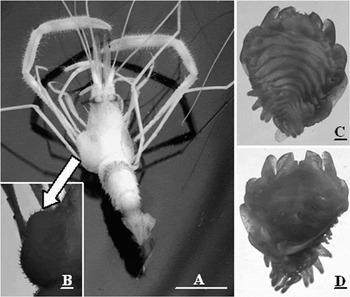
The observation of host morphology did not reveal any difference from that of unparasitized S. hispidus females, apart from the large bulge on the cephalothorax caused by the presence of the bopyrid isopod (Figure 1). Concerning A. inhacae external morphology, female specimens observed in the present study displayed morphological features more similar to specimens described by Kensley (Reference Kensley1974) from south-eastern Africa, than from those described by Adkinson et al. (Reference Adkinson, Heard and Clark1982) from the Philippines, namely uniramous uropods and crenulated distal segment of oostegite 1. As already noted by Boyko & Kazmi (Reference Boyko and Kazmi2005), the present observations highlight the need to collect further material and perform a detailed evaluation on the morphological variability recorded among the specimens of A. inhacae.
(A) Female Stenopus hispidus infected by the bopyrid isopod Argeiopsis inhacae on the left side of the cephalothorax (dorsal view); (B) detail of host deformed cephalothorax; (C) female A. inhacae in dorsal view; and (D) female A. inhacae in ventral view. Scale bars: A, 10 mm; B, C & D, 1 mm.

The fact that none of the parasitized females ever lost its bopyrid parasite during ecdysis reinforces the importance of the adaptations developed by branchial ectoparasites during host ecdysis (Cash & Bauer, Reference Cash and Bauer1993).
Although S. hispidus is one of the few circumtropical decapod species, parasitized specimens have only been recorded in south-eastern Africa (Kensley, Reference Kensley1974), the Philippines (Adkinson et al., Reference Adkinson, Heard and Clark1982 and present study), Ambon Island (Indonesia) (J.W. Goy personal observation, one parasitized male) and Hawaii (J.W. Goy personal observation, one parasitized female). The absence of records of parasitized S. hispidus in Atlantic waters may either be due to the lack of systematic sampling or simply due to the absence of the calanoid copepod acting as intermediate host for A. inhacae. The last hypothesis may be supported by the fact of the genera in the subfamily Argeiinae being mainly concentrated in the Indo-West Pacific (Markham, Reference Markham, Gore and Heck1986).
Acknowledgement
The authors thank the Fundação para a Ciência e a Tecnologia (scholarships SFRH/BPD/18009/2004 and SFRH/BD/16695/2004) from the Portuguese government for their financial support.