Firms with political influence are important in today’s democracies (Zingales Reference Zingales2017). These political corporations affect policies and increase resource misallocation (Faccio, McConnell, and Masulis Reference Faccio, McConnell and Masulis2006; Claessens, Feijen, and Laeven Reference Claessens, Feijen and Laeven2008; Goldman, Rocholl, and So Reference Goldman, Rocholl and So2013; Colonelli and Prem Reference Colonelli and Prem2017, Faccio and Hsu Reference Faccio and Hsu2017). Yet, how these firms emerge and persist over time is currently unknown. We study the case of political corporations in Chile and show that these can be traced back in time to the sale of state-owned firms during the Pinochet dictatorship (1973–1990). In contrast to the idea suggested by Boycko, Shleifer, and Vishny (Reference Barberis, Boycko, Shleifer and Tsukanova1996, Reference Boycko, Shleifer and Vishny1997), privatizations may politicize instead of “depoliticize” firms.
The core of our analysis is based on the fact that the sale of state-owned firms is plagued by controversies regarding prices and the identity of buyers. In Russia, for example, firms were sold underpriced to people who stripped them down and used the money to bribe politicians and block reforms (Black, Kraakman, and Tarassova Reference Black, Kraakman and Tarassova2000). Similar controversies can be found in Argentina, China, India, Mexico, Serbia, Turkey, Uganda, and the United Kingdom.Footnote 1 Despite their ubiquity, research studying controversial privatizations is scarce.Footnote 2 Finding an appropriate context is challenging because we need to observe comparable firms with different privatization processes and measure their behavior over an extended period.
Pinochet’s privatizations were also controversial because of prices and the identity of buyers (Mönckeberg Reference Mönckeberg2001). For example, one of the largest mining companies in the world was sold underpriced to Pinochet’s son-in-law. Using new data, we characterize Pinochet’s privatizations and find that some firms were sold underpriced to politically connected buyers. We then compare similar firms that were privatized differently and find that those sold to connected buyers benefited financially from Pinochet. Once democracy arrived, they formed connections with the new government, financed political campaigns, and were more likely to appear in the Panama Papers. These findings reveal how dictatorships can influence young democracies and document how privatization reforms may help political corporations to persist over time.
We begin the analysis by constructing several datasets. Listed firms were required to annually report their activities to a regulatory agency. We digitize these reports including balance sheets, income statements, debt with banks, and the names of owners and board members. These are the largest firms in Chile. Then, using the names of firms privatized by Pinochet, we identify those with annual reports. To characterize their privatization, we collect data on buyers and sale prices. Finally, we use the names of owners, board members, and politicians to detect connections to the new democratic governments (1990–present), to identify firms engaged in campaign finance, and to measure tax avoidance revealed by the Panama Papers.
We classify firms into types of privatizations using a data-driven algorithm. Using book values, balance sheets, and the identity of buyers and board members before privatization, we construct relative measures of underpricing and closeness to Pinochet. The former reveals differences in sale prices. The latter shows different people involved in the sales, from those closely connected to Pinochet to those without a relationship. These variables allow us to employ a clustering algorithm to detect two groups of firms. When comparing these, we find a group of firms sold underpriced using people close to Pinochet, that is, “controversial privatizations.”Footnote 3 We crosscheck the classification delivered by the algorithm using the names of firms mentioned in two well-known investigations (Marcel Reference Marcel1989; Mönckeberg Reference Mönckeberg2001).
After constructing the data, we compare firms with controversial privatizations to other privatized firms before they were sold. The two types of firms had similar indebtedness and performance. This similarity suggests that controversies were unrelated to firm behavior and industry dynamics. There are, however, differences in firm size for which we control. The day after the 1988 referendum, which ended the Pinochet regime, firms with controversial privatizations experienced an 8-percentage-point decrease in abnormal stock returns. This result is consistent with controversial firms obtaining benefits from Pinochet (Fisman Reference Fisman2001).
Motivated by the reaction of investors, we study the evolution of economic and political outcomes by comparing controversial and otherwise similar uncontroversial privatizations within industries. First, we focus on the short run after privatization and study debt financing between privatized firms and state-owned banks, since previous research has shown companies may use these institutions to extract rents.Footnote 4 Second, we study the political behavior of firms after Pinochet left power (1990–2005) by analyzing the relationship between controversial firms, political connections, campaign finance, and tax avoidance.
Our analysis reveals that firms with controversial privatizations acquired more loans from state-owned banks toward the end of the regime (1988–1990). In contrast, we do not observe these differential interactions between controversial firms and other types of banks. This result is consistent with our stock market findings and constitutes additional evidence suggesting these firms were benefiting from the regime. Our econometric strategy uses the unexpected outcome of the 1988 referendum and an analysis of loans from the main state bank, private banks, and international banks before and after the referendum. In addition, controversial firms grew faster than other privatized firms in the same industry during the dictatorship.
Next, we show that firms with controversial privatizations formed connections with the new governments, financed political campaigns, and were more likely to appear in the Panama Papers. Controversial firms employed politicians 25 percentage points more often and substituted connections from the old to the new democratic regime after democratization: in 2005, controversial firms employed 40 percentage points more politicians of the new government. This finding is important because political connections increase resource misallocation (Cingano and Pinotti Reference Cingano and Pinotti2013) and produce rents for connected individuals (Blanes i Vidal, Draca, and Fons-Rose Reference Blanes i Vidal, Draca and Fons-Rosen2012). Finally, controversial firms were 31 percentage points more likely to engage in campaign finance and 36 percentage points more likely to appear in the Panama Papers.
Our findings are robust and driven by the connections of buyers. Results are robust to different classification methods, estimation techniques, and additional control variables, and they are robust to account for the effect of unobservable variables using coefficient stability methods (Altonji, Elder, and Taber Reference Altonji, Elder and Christopher2005; Oster Reference Oster2019). In addition, results are explained by the political connections of the buyers of firms. In contrast, the pre-privatization connection of firms is empirically unrelated to the financial benefits during the dictatorship and the political behavior in democracy. However, given that we cannot fully discard the presence of unobserved characteristics driving both controversies and political behaviors, we cannot distinguish between privatization reforms creating or facilitating the persistence of political corporations.
The main contribution of this paper is to show how privatization reforms can help political corporations to emerge and persist over time. Previous research has shown that corrupt privatizations have a negative effect on firm performance (Fisman and Wang Reference Fisman and Wang2014), political reasons are usually behind the origins of these reforms (Boycko, Shleifer, and Vishny Reference Boycko, Shleifer and Robert1994; López-de-Silanes, Shleifer, and Vishny Reference López-de-Silanes, Shleifer and Vishny1997), and privatizations might be used to gain political support (Bel Reference Bel2010). However, there is little empirical work outside of these contributions and the role of firms as vehicles to preserve economic and political power has been relatively overlooked. We add to this literature showing how firms sold to politically connected buyers may extract rents from the state using the credit market and avoiding taxes, and may attempt to influence politics by forming new connections and engaging in campaign finance.
This paper also constitutes an example of how authoritarian regimes can affect the functioning of young democracies, namely, using policies to take control of firms and transmit their economic and political power. Why and how authoritarian regimes affect democracies is a long-standing theoretical question in the social sciences (O’Donnell and Schmitter 1986; Linz and Stepan Reference Linz and Stepan1996; Acemoglu and Robinson Reference Acemoglu and Robinson2008; Acemoglu, Ticchi, and Vindigni Reference Acemoglu, Ticchi and Vindigni2010). But only recently scholars have been able to empirically document the legacies of non-democracies. Previous research emphasizes the importance of local politicians inherited from a dictatorship (Martínez Bravo Reference Bravo2014; Martínez Bravo, Mukherjee, and Stegmann 2017) and the role of elites during transition (Albertus and Menaldo Reference Albertus and Menaldo2014, Reference Albertus and Menaldo2018). Similar legacies could arise from corrupt democracies.
This paper also contributes to the literature studying political corporations (Zingales Reference Zingales2017), the persistence of elites (Acemoglu and Robinson Reference Acemoglu and Robinson2008), and the “revolving door” in politics (Blanes i Vidal, Draca, and Fons-Rose 2012). As emphasized by Zingales (Reference Zingales2017, p. 113), large firms are important political actors throughout the world but “the commonly prevailing view of the firm ignores all elements of politics and power.” We contribute to this literature by showing the origins of political corporations. In doing so, our analysis constitutes an example of the dictatorial origins of elites attempting to capture a democracy (Grossman and Helpman Reference Grossman and Helpman1994; Ellman and Wantchekon Reference Ellman and Wantchekon2000; Acemoglu and Robinson Reference Acemoglu and Robinson2008; Acemoglu, Ticchi, and Vindigni Reference Acemoglu, Ticchi and Vindigni2011). Our results emphasize the importance of the revolving door to explain elite persistence and provide one policy-related mechanism behind the “iron law of oligarchy” (Michels Reference Michels1915).
Finally, our work sheds light on mechanisms that businesspeople linked to authoritarian regimes may use to extract rents. Earlier theoretical work has emphasized that rent extraction might foster stable political coalitions (Brough and Kimenyi 1986). Recent empirical work has shown how rent extraction is exacerbated in authoritarian regimes (Hodler and Raschky 2014; Burgess et al. Reference Burgess, Jedwab, Miguel and Morjaria2015). More closely related, Atanasov (Reference Atanasov2005) shows that as much as 85 percent of firm value was extracted during Bulgaria’s mass privatization in the 1990s. We contribute to this literature by showing evidence of rent extraction using state-owned banks, political connections, electoral campaigns, and tax avoidance. Our analysis highlights how market and institutional structures can influence firm behavior by affecting the marginal returns and costs of lobbying in new democracies. Dictatorships create economic rents to be protected and political connections lower the costs of exerting influence.
THE PRIVATIZATIONS OF THE PINOCHET REGIME
Augusto Pinochet led a dictatorship from the 1973 coup d’état against President Salvador Allende until March 1990; 17 months after citizens rejected his continuation in office in a referendum known as the “1988 plebiscite” (5 October 1988). Following an agreement between the regime and the opposition, a presidential election with candidates from all parties was held in December 1989. The opposition won and Chile returned to democracy. Despite contentious debates about Pinochet’s legacy, there is little evidence testing the persistent effects of his policies.Footnote 5
The economic policies implemented by Pinochet aimed to decrease government spending, control inflation, decrease trade tariffs, and sell state-owned firms. A group of economists—known as the “Chicago Boys”—designed and implemented these policies and their effects are now a source of controversy among supporters and critics of the regime. Supporters argue that the macroeconomic stability and high growth rates in the 1990s were a direct consequence of the regime’s policies. Critics point to corruption during the Pinochet years and the currently high level of inequality. One of the most important controversies lies around privatizations.
The privatization process had several objectives. First, the regime was influenced by economists who believed in the efficiency of private property, a popular sentiment among right-wing parties after the economic instability during Allende’s government (1970–1973). One of the regime’s goals was to privatize firms previously nationalized by Allende. There were also political reasons to unite businesspeople behind the government, particularly after the 1982 economic crisis, and to gain their support before the 1988 plebiscite.Footnote 6 There is limited evidence suggesting that privatizations were used as a financing tool.
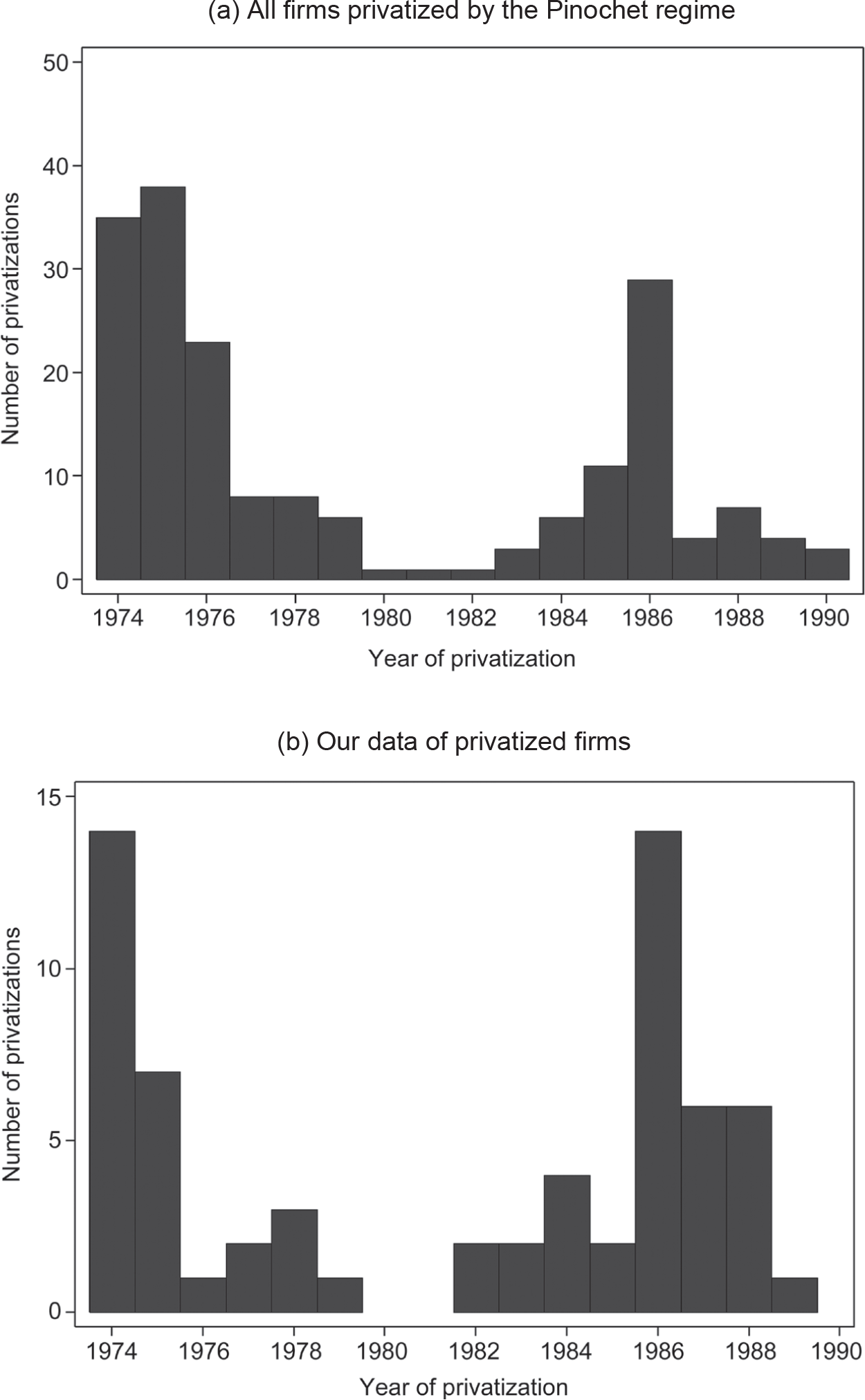
Mass privatizations are difficult to implement. To gain popular support, the regime used Margaret Thatcher’s framing of “popular capitalism” and justified the process as a “diffusion of property to make Chile a country of owners” (Huneeus Reference Huneeus2006, p. 314).Footnote 7 The regime sold firms in two rounds. The first came in the second half of the 1970s, was organized by the Production Development Corporation, and aimed at re-privatizing companies expropriated by Allende. The second round used the popular capitalism strategy and began after the 1982 economic crisis, when the state gained control of several firms. Figure 1(a) plots the number of privatizations per year, where these two waves are visible.
PRIVATIZATIONS BY YEAR

There is limited information about the implementation of privatizations. A commission called by the Congress after the return to democracy produced the most detailed account (Congress Report Reference Report2004). The second chapter highlights three key characteristics. First, information about firms being sold and their sale prices was scarce, debilitating the quality of the process. Second, firms were sold using different methods, and the explanation for the method chosen is mostly unclear. Some firms were sold using public auctions, prequalifying interested buyers, negotiating prices, and allowing buyers to use credit. But data on interested buyers, prequalifications, and bids unfortunately is missing. When the number of buyers was expected to be low, the firm was sold using a direct sale (Hachette and Lüders Reference Hachette and Lüders1992). Packages of shares were also sold gradually in the stock market “to avoid concentration of economic power and unjustified subsidies” (Marcel Reference Marcel1989, p. 31). Third, the legal framework to regulate the process allowed the sales to unfold the way they did: almost everybody was legally able to buy shares and the procedure was loose enough for people to negotiate the price and the method of payment.
Although Pinochet’s privatizations are perceived as relatively successful (Galal Reference Galal1994), some sales have generated controversies, permeating the debate about Pinochet’s legacies. Given the amount of assets sold—approximately U.S. $3.6 billion according to Meller (Reference Meller1998, p. 268)—the controversy is understandable. On one hand, critics argue that some privatizations were used to transfer resources from the state to a handful of buyers who were close to Pinochet. On the other hand, supporters argue that privatizations increased firm performance and benefited the economy. We gather the most comprehensive firm-level data to shed light on this debate.
DATA CONSTRUCTION
We use annual firm-level data digitized from administrative documents kept by Chile’s regulatory agency Superintendencia de Valores y Seguros, an independent institution equivalent to the Securities and Exchange Commission in the United States.Footnote 8 By law, all firms listed in the Chilean stock market have to submit yearly reports. These firms are among the largest in the country.
The reports reveal balance sheets, income statements, debts, and the names of board members and owners. The information was standardized in 1985, and thus firms have reported the same variables since then. Before that year, however, firms reported balance sheets, income statements, and other scattered information. We digitize the reports and standardize the monetary information to 1998 Chilean pesos using the consumer price index of the Central Bank. The Online Appendix presents an example of a report. All reports were audited and have been used by well-known investigations of the period.Footnote 9
Next, we match the reports with the 387 firms privatized by Pinochet (Congress Report Reference Report2004).Footnote 10 We found 50 firms in our data and the list of privatized firms. The remaining 337 firms were small, unlisted private companies with only a few shareholders. These firms were not mandated to submit reports and their information remains undisclosed. Among the 50 firms with reports, we find popular companies sold underpriced to buyers connected to Pinochet. For example, the dataset includes the Chemical and Mining Society of Chile, sold to Pinochet’s son-in-law and recently involved in corruption scandals, and the National Electricity Company, sold to a former dictatorship collaborator. The data also include companies mentioned by Marcel (Reference Marcel1989) and Mönckeberg (Reference Mönckeberg2001), the latter a bestselling book studying Pinochet’s privatizations. Although data limitations prevent us from a thorough comparison of firms with and without reports, we know the latter were privatized, on average, three years earlier and the former were presumably larger and relatively more important in the economic history of the country.
Controversial Privatizations
We classify firms into types of privatizations using a k-means cluster analysis with two variables that characterize the privatization process of a firm. First, we collect information about the people involved in the sale and construct a measure of “social distance” to the Pinochet regime. Second, we use multiple historical sources to recover sale prices and construct a measure of underpricing that can be compared across firms. We say a privatization was “controversial” if a firm was sold relatively underpriced and the transaction involved people connected to Pinochet.
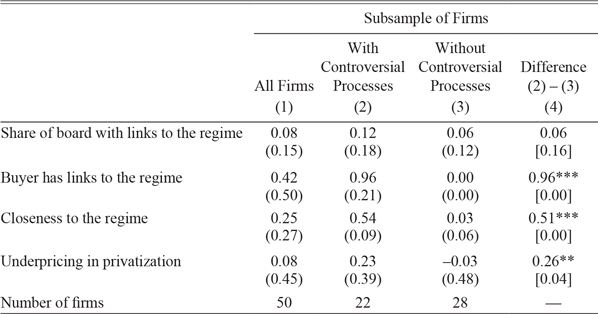
The first variable is the social distance between people involved in the sale and Pinochet. To construct it, we proceed in two steps. In the first step, we identify the buyers and study their relation to the regime. We classify a buyer as linked to the regime if they had worked for the regime before the privatization. Similarly, in the second step, we use the names of board members, study their job history prior to the privatization, and identify those who had previously worked for the regime. The Online Appendix provides details about this procedure. Table 1 presents summary statistics. Overall, 8 percent of board members and 42 percent of buyers had worked for Pinochet. Then, we combine both measures linearly to create a one-dimensional metric of “closeness to the Pinochet regime.”
CHARACTERIZATION OF PRIVATIZATION PROCESSES

Notes: Averages and standard deviations (in parentheses) are in Columns (1)–(3), and p-values for a double size t-test are in square brackets in Column (4). Significance levels: *** p < 0.01, ** p < 0.05, * p < 0.1.
Source: Own construction based on firm reports collected by the Superintendencia de Valores y Seguros.
The second variable measures the extent of underpricing. There are unfortunately no records of auctions, participants, or bids in these sales. Therefore, to construct it, we compare the price per share paid in the privatization with the book value per share, which we obtained by dividing the book value of equity in the year before the privatization over the number of shares available, ensuring all prices are in comparable currencies and taking inflation values into account. For companies that were returned to their previous owners without payment, and for bankrupt companies, we assume that the price per share and book value per share coincide. Thus, our underpricing variable is the ratio between the difference in book value and privatization price per share over the book value per share. Hence, higher positive values indicate more underpricing. This measure allows us to compare prices across privatizations. Again, Table 1 presents descriptive statistics.
To provide some validation for the underpricing variable, we constructed two alternative measures. The first one combines the prices paid by buyers with the present value of future cash flows. To estimate future cash flows, we use the pre-privatization ones, available only for a subset of firms. The second measure combines the same prices with estimates of firm value, available for a small number of firms. These estimates were calculated by contemporaneous consulting companies or by other researchers. The Online Appendix provides more details. Reassuringly, our underpricing variable is positively correlated with both of these alternative measures (p-values of 0.09 and <0.01, respectively). We interpret these correlations as providing some validity for the underpricing variable we use throughout the analysis.
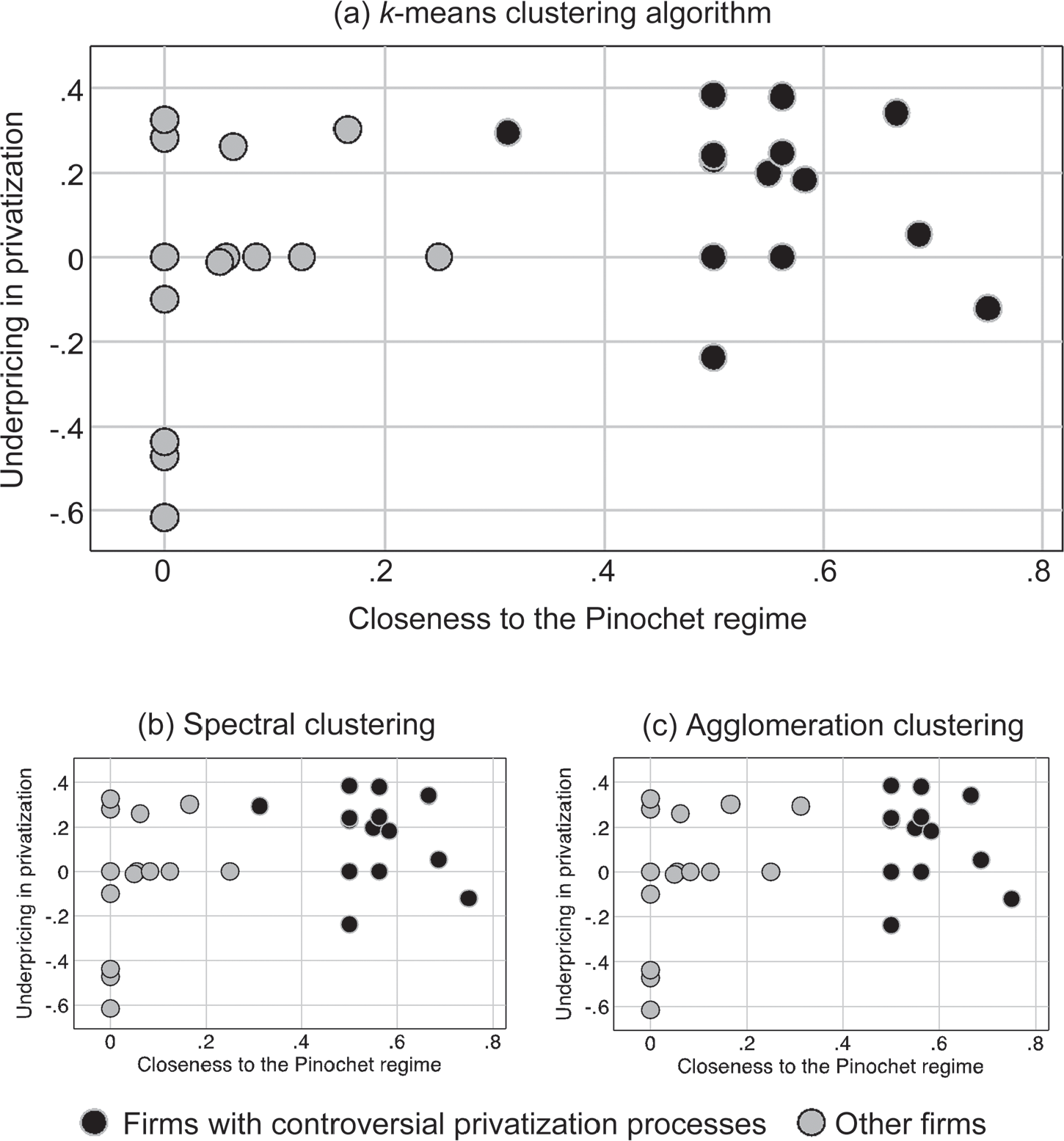
The last step employs a k-means clustering algorithm (Steinhaus Reference Steinhaus1957) using underpricing and closeness to the regime as inputs. This algorithm is an unsupervised learning approach that classifies firms in groups. We chose it due to its simplicity and wide use in empirical research. Figure 2(a) presents results. The y-axis measures relative underpricing and the x-axis the closeness to the regime. As can be seen, and confirmed statistically in Table 1, there is a group of firms sold underpriced and those involved in the sale had close ties to the regime.Footnote 11 The algorithm finds 22 firms that had, under our definition, controversial privatization processes. Marcel (Reference Marcel1989) and Mönckeberg (Reference Mönckeberg2001) classified all these controversial privatizations as “corrupt” due to underpricing, which serves as a partial check to the approach.
DETECTING CONTROVERSIAL PRIVATIZATION PROCESSES

Politics in Democracy
To study how privatized firms evolved, we first analyze firm-level economic outcomes. We then look at three dimensions that can be affected by firms: the dynamic formation of political connections, campaign finance, and tax avoidance (Fisman Reference Fisman2001; Claessens, Feijen, and Laeven Reference Claessens, Feijen and Laeven2008; Zucman Reference Zucman2013).
We construct datasets that measure (1) which firms formed political connections, (2) which firms contributed to political campaigns, and (3) which board members appeared in the Panama Papers. The first uncovers the employment of politicians as board members. We collect the names of all people working as ministers and similar high-level positions during the Pinochet dictatorship, calling them “politicians of the old regime.” We also gather the names of all ministers and similar high-level positions of La Concertación, the coalition in power in the 1990s, calling them “politicians of the new regime.” Then we gather the names of all board members in our data and identify politicians using a probabilistic record-matching algorithm.Footnote 12 Using this approach, we create an indicator for firms with connections to the old and new regimes.
We also use recently declassified documents with the names of firms contributing to political campaigns and avoiding taxes using tax havens. We observe legal and illegal campaign contributions separately. The latter is a list of firms that illegally financed political campaigns in the 2013 presidential election. The Chilean tax authority made it public in 2014.Footnote 13 The list reveals, for example, that SQM—a firm with a controversial privatization—transferred resources to candidates before the election. Overall, 37 and 19 percent of firms in our data financed political campaigns legally and illegally, respectively. For comparison, less than 1 percent of privatized firms outside of our data contributed to campaigns legally and none contributed illegally.
To measure tax avoidance, we match the list of board members in democracy with the list of people who appeared in the Panama Papers using the same probabilistic record-matching algorithm. We found 13 board members who worked in 15 firms, 10 of which were controversial.
RESULTS
This section presents five findings. First, there were few differences across firms with and without controversies before their privatization. Second, the stock market value of firms with controversies decreased temporarily after the announcement of the transition from dictatorship to democracy. Third, firms with controversies obtained more loans from state banks before the transition. Fourth, firms with controversial privatizations grew at a higher rate during the dictatorship. Five, controversial firms formed political connections with the new regime, engaged in campaign finance, and their boards were more likely to appear in the Panama Papers.
Before and during Privatization
How different were firms before privatization? To answer this question, we use the reports before the privatization year of each firm. To gain statistical accuracy about firms’ fundamentals, we take three-year averages of the logarithm of assets, logarithm of sales, return over equity, and leverage. We chose these variables because they were available for all firms. In addition, we constructed the changes in these variables by taking the difference between year one and three before privatization to study pre-trends, we constructed Tobin’s q, and we collected the dates when firms were established. We compare these ten variables and the privatization year.
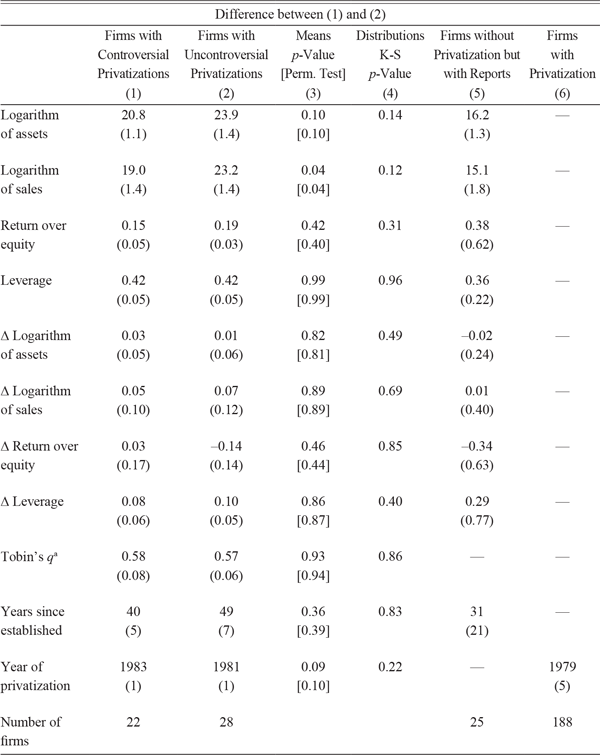
Table 2 compares firms. In addition to firms in our data, we include two other groups: firms without privatization but with reports and firms with privatization but without reports. For the former group, we present summary statistics before the average privatization year in the firm’s industry, but the patterns are similar if we use nearby years. For the latter group, there is unfortunately little information and, therefore, we can only observe their privatization year and industry. The Online Appendix presents the distribution of firms by industry in our data and for all privatizations, where we see that our data over-represent the manufacturing industry and under-represent the wholesale and retail trade industry, but other industries (e.g., electricity and mining) are well represented.
FIRMS BEFORE PRIVATIZATION

Notes: Are there observable differences between firms with controversial and uncontroversial privatization processes before privatization? This table provides evidence by presenting averages of variables in the reports before the year each firm was privatized. Column (3) presents the p-value for differences in means across groups in Columns (1) and (2). Column (4) compares distributions in Columns (1) and (2) and presents the p-value from the K-S test (Kolmogorov Reference Kolmogorov1933; Smirnov Reference Smirnov1933). For reference, Column (5) presents descriptive statistics for firms that were not privatized and have annual reports; we use the average privatization year in the firm’s industry. Column (6) presents the privatization year for firms without reports. We present standard deviations in parenthesis and p-values with and without correction for inference in a small sample. More details are given in the Data Construction and Results sections.
Source: Own construction based on firm reports collected by the Superintendencia de Valores y Seguros.
a Sub-sample of 41 firms.
Each row in Table 2 presents the average and standard deviation of 1 of 11 variables. Columns (1) and (2) examine controversial and uncontroversial privatizations separately. Column (3) presents p-values for differences in means across groups, with and without correction for small sample inference.Footnote 14 Column (4) uses the Kolmogorov–Smirnov (K-S) test to compare the distribution of variables across groups (Kolmogorov Reference Kolmogorov1933; Smirnov Reference Smirnov1933). Columns (1)–(4) show few statistically significant differences in profitability, growth prospects as measured by Tobin’s q and asset growth, indebtedness, or firm age before privatization. The exception is firm size; we observe controversial firms were, on average, smaller. Although our ability to detect differences across firms may be affected by the sample size, the majority of differences are also of relatively small economic magnitude.Footnote 15 When compared to firms in our data, Column (5) reveals that firms privatized by the regime were significantly larger, older, and had lower performance, but had similar debt compared to other firms with reports but not privatized.
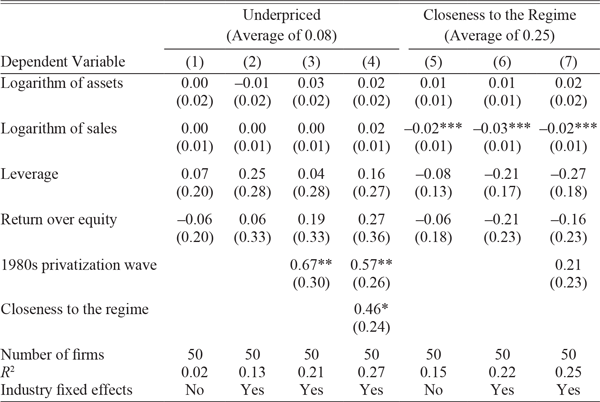
To improve our understanding of privatization characteristics, Table 3 presents different regression specifications using underpricing (Columns (1)–(4)) and closeness to the regime (Columns (5)–(7)) as separate dependent variables, and pre-privatization variables and industry fixed effects as predictors. All in all, we observe that firms sold in the 1980s exhibited significantly more underpricing (p-value < 0.05) and the underpricing was larger when the buyers were close to the regime (p-value < 0.10). In contrast, the importance of pre-privatization variables is economically smaller. These results suggest that there might be a relationship between both privatization characteristics that we discuss below.
UNDERSTANDING PRIVATIZATION CHARACTERISTICS

Notes: What pre-privatization variables predict privatization characteristics? This table presents estimates from cross-sectional regressions using privatization characteristics as dependent variables, that is, underpricing or closeness to the regime, and pre-privatization variables as predictors. More details are given in the Data Construction section. Robust standard errors are in parentheses. Significance levels: *** p < 0.01, ** p < 0.05, * p < 0.1.
Source: Own construction based on firm reports collected by the Superintendencia de Valores y Seguros.
In sum, we interpret Tables 2 and 3 as evidence that, although the privatization decision may have been driven by firm dynamics, the type of privatization—that is, controversial versus uncontroversial—seems not to have been driven by firms’ behavior. In what follows, we present several econometric exercises supporting this interpretation.
The Stock Market
We use the framework of Fisman (Reference Fisman2001) to test whether firms with controversial processes benefited financially from Pinochet. We study the stock market value of controversial firms after an exogenous shock that increased the probability of political transition.Footnote 16 If controversial firms benefited from the dictatorship, we expect to see a decrease in their value after the unexpected outcome of the referendum that ended the dictatorship. This referendum was held on October 5 of 1988 and had Pinochet running to remain in office for the next eight years (with yes or no votes). The regime wanted to validate themselves as democratic in front of the international community. Both the rejection of Pinochet’s continuation and the regime’s acknowledgement of results were unexpected.Footnote 17
To measure changes in the stock market, we digitize daily stock prices of listed firms from the newspaper El Mercurio, available at Chile’s National Library. We restrict attention to firms that were traded for at least four months before the plebiscite to analyze abnormal returns (i.e., the difference between returns and expected returns):
 $$A{R_{it}} = {R_{it}}-\left( {{a_i} + {b_i}{R_{mt}}} \right),$$
where R it is the stock return of firm i on day t, R mt is the market return on day t, and we estimate the parameters a i and b i using pre-plebiscite data. As for robustness, we also looked at cumulative abnormal returns, defined as Σt=0t=jAR it (see Campbell et al. Reference Campbell, Lo and Craig MacKinlay1997 for details). The usage of pre-plebiscite data leaves us with 41 firms, 20 of which were controversial. We present estimates of the following regression graphically:
 $$CA{R_{ijt}} = {b_t}Controversia{l_i} + {d_t}{X_i} + {n_{jt}} + {e_{ijt}},$$
where CAR ijt = Σk = 0tAR ik is the cumulative abnormal return for firm i, which operates in industry j, from the day of the plebiscite up to t days; Controversial i is an indicator for controversial firms; X i represent pre-privatization controls (i.e., assets, sales, return over equity, and leverage); n jt is a set of industry fixed effects; and e ijt is a mean zero error term. The parameter of interest is b t and measures the differential cumulative abnormal return for firms with controversial privatizations. All parameters in Equation (2) are indexed by t because we estimate it separately for t = 1, 3, 5, 8, and 10.
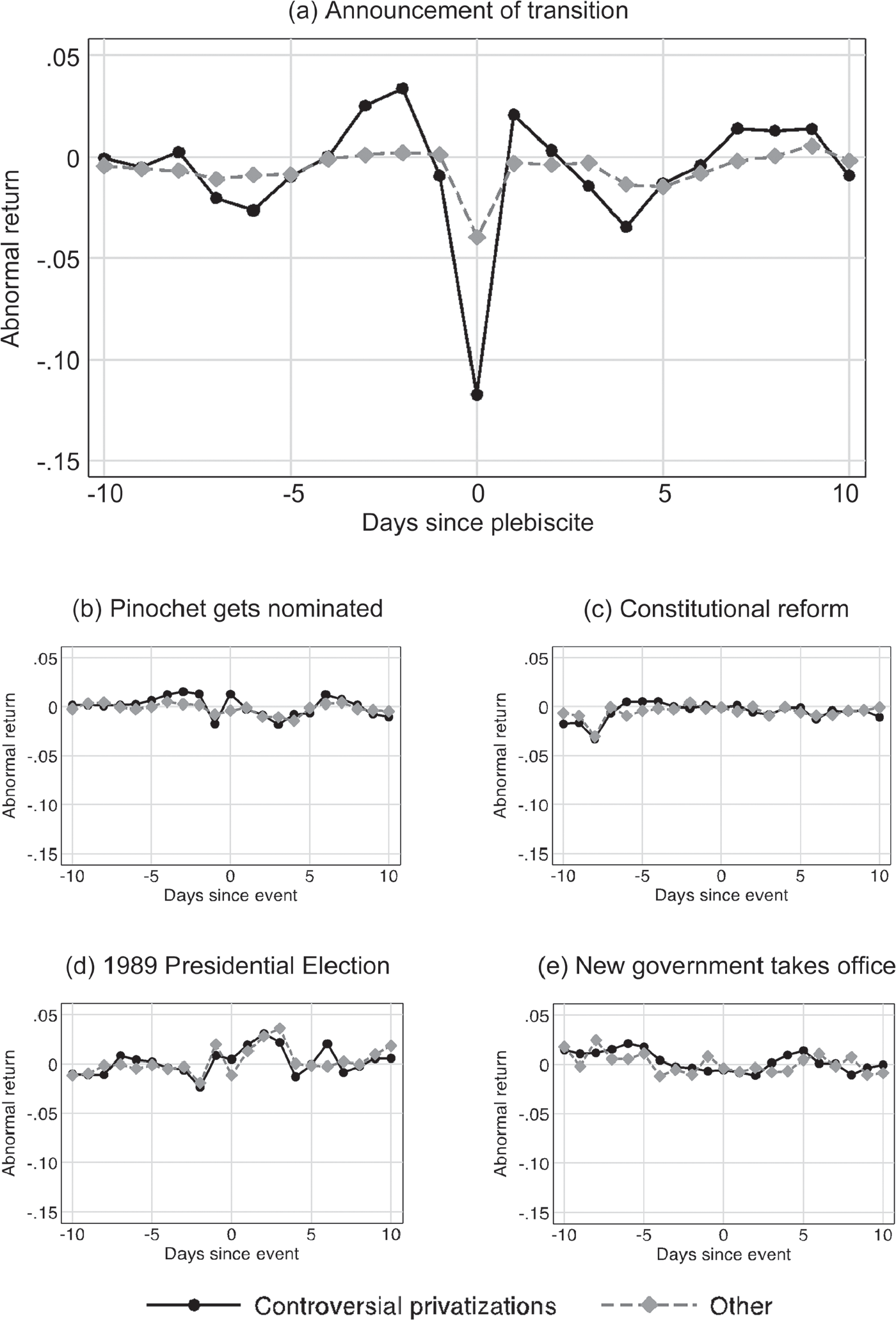
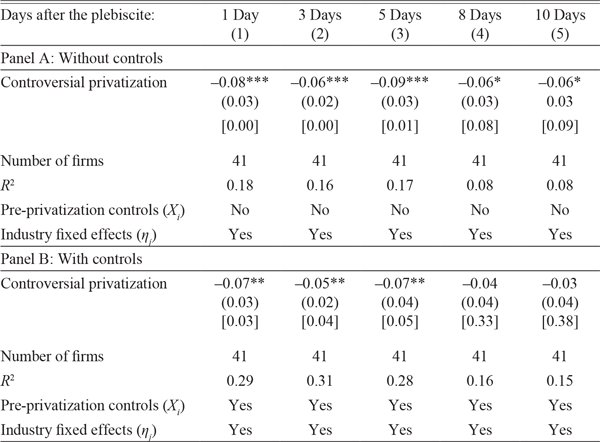
Figure 3(a) presents daily abnormal returns by type of privatization, and Table 4 the corresponding regression estimates. Consistent with our hypothesis, we find a statistically significant decrease in abnormal returns among controversial firms the day after the plebiscite. The drop in abnormal returns corresponds to approximately 7.5 percentage points (Column (1) of Panel A in Table 4, p-value < 0.01), it lasts for at least ten days, and it is robust to the inclusion of pre-privatization controls. Moreover, these results are similar when accounting for a potential non-normality in the distribution of abnormal returns and the cross-sectional correlation between stocks in the day of the event (Kolari and Pynnönen Reference Kolari and Pynnönen2010). When compared to prominent estimates in the literature, we calculate that this drop in returns is larger than the one in Fisman (Reference Fisman2001) and similar to those in Ferguson and Voth (Reference Ferguson and Voth2008) and Acemoglu et al. (Reference Acemoglu, Johnson, Kermani, Kwak and Mitton2016).
THE STOCK MARKET

THE STOCK MARKET

Notes: Does the value of firms with controversial privatization processes change after the unexpected announcement of Chile’s transition to democracy on October 5, 1988? Each column in Table 4 provides evidence by presenting ordinary least squares (OLS) estimates (Equation (2) in the paper). We collected data on stock prices from the newspaper El Mercurio. Our sample decreases from 50 to 41 firms, because in order to calculate abnormal returns,we need to observe stock prices four months before the event we study and we do not observe these for 9 firms. More details are given in the Results section. Robust standard errors are in parentheses, and p-values correcting for small sample inference are in square brackets. Significance levels: *** p < 0.01, ** p < 0.05, * p < 0.1.
Source: Firm reports collected by the Superintendencia de Valores y Seguros and stock prices published in the newspaper El Mercurio.
Figures 3(b)–3(e) show that these patterns are particular to the announcement of the transition. We observe similar abnormal returns around other important political events, namely, the day when Pinochet was nominated to be on the ballot at the plebiscite (30 August 1988), the last constitutional reform in dictatorship (30 July 1989), the 1989 presidential election (14 December 1989), and when the new government took office (3 March 1990). As highlighted in prior literature, the behavior of Chilean investors is also consistent with controversial firms having disproportionately benefited from their connections to Pinochet’s regime.
The Credit Market under Dictatorship
The credit market can reveal whether firms with and without controversial privatizations were receiving a differential treatment from the regime. To study this market, we use information about firms’ outstanding debt with Banco del Estado (Bank of the State, the only state-owned bank in the country) and other types of banks.Footnote 18 We study firm debt financing with these banks in the period between October 1988 and March 1990. In particular, we estimate the following regression before and after the plebiscite:
 $${Y_{ijt}}^k = {b_t}^kControversia{l_{ij}} + {d_t}^k{X_{ij}} + {n_{jt}}^k + {e_{ijt}}^k$$
where i indexes firms, j industries, t periods, and k the type of bank (i.e., state-owned, private, or international). The dependent variable Y ijtk is an indicator for firms with outstanding debt with bank k in period t, the average interest rate with this bank, leverage, or the logarithm of total debt. We study two periods, before and after the plebiscite: 1986–1987 and 1988–1990. All regressions include pre-privatization controls X ij (i.e., assets, sales, return over equity, and leverage) and industry fixed effects by period, n jt. The coefficients of interest b tk measure the within-industry differences among controversial privatizations in the outcome of interest while controlling for pre-privatization differences. Note that we allow coefficients to differ by period and bank type.
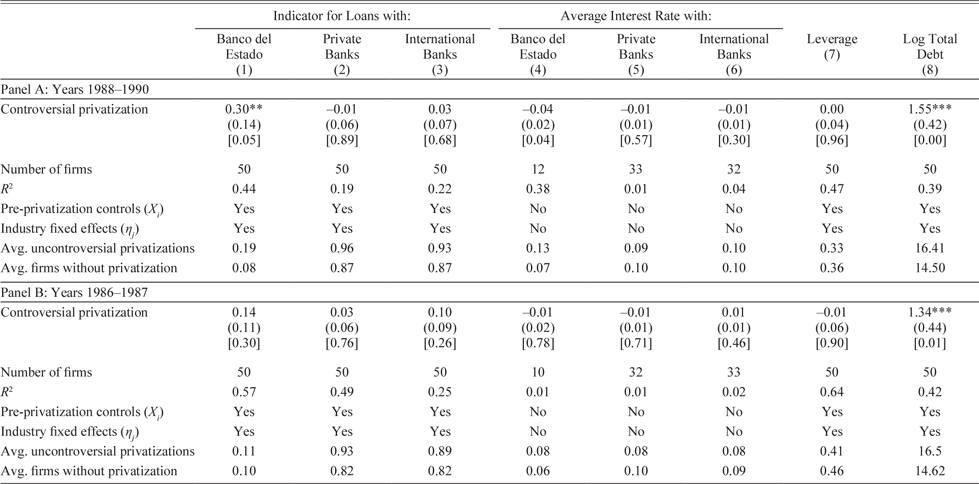
Table 5, Panel A presents estimates of Equation (3) after the plebiscite. Column (1) shows that controversial privatizations were 30 percentage points more likely to have loans from Banco del Estado between 1988 and 1990 (p-value < 0.05), when it was known Pinochet would be leaving. This result is consistent with the findings in Khwaja and Mian (Reference Khwaja and Mian2005) and suggests that the dictatorship used the credit market to benefit these firms; it is also consistent with the evidence in González and Prem (Reference González and Prem2019), which finds that firms in Pinochet’s social network obtained more loans from state-owned banks between 1988 and 1990. Column (4) shows that these loans had 4 percentage points lower interest rates, but this estimate relies on a smaller sample and it is only statistically significant when using small sample inference. In contrast, we do not observe any of these patterns between controversial firms and private or international banks and point estimates are of significantly smaller economic relevance (Columns (2), (3), (5), and (6)). Finally, Column (7) shows that there are no statistically significant differences in leverage between privatizations, which suggests firms either substituted loans across banks or increased their equity in this period, and Column (8) shows that controversial firms had more total debt.
THE CREDIT MARKET

Notes: Each column presents estimates of Equation (3) where we measure the dependent variable in 1988–1990 (Panel A) or in 1986–1987 (Panel B). Dependent variables measuring loans, interest rates, and leverage (debt over assets) are own construction from firm-level reports. Banco del Estado is the main state-owned bank in Chile. More details are given in the Results section. Robust standard errors are in parentheses, and p-values correcting for small sample inference are in square brackets. Significance levels: *** p < 0.01, ** p < 0.05, * p < 0.1.
Source: Own construction based on firm reports collected by the Superintendencia de Valores y Seguros.
Although the reader might be concerned that controversial privatizations were potentially different in unobservable dimensions, and this is the reason why we observe a different credit market for these firms, the evidence suggests this was probably not the case. Table 5, Panel B presents estimates of Equation (3) using reports before the plebiscite and we do not find statistically significant differences in state loans or interest rates. Moreover, most point estimates are economically smaller than in Panel A and patterns with other banks are again similar across types of firms. Interactions between controversial firms and the state bank seem to have changed over time, but we can only reject the similarity of coefficients in Column (1) of Panels A and B with a p-value of 0.11 when we use a pooled panel specification. Point estimates also suggest total debt increased in 1988–1990, but we cannot reject that it remained similar. Because of this and other concerns below, we discuss additional robustness checks.
The Beginning of Democracy
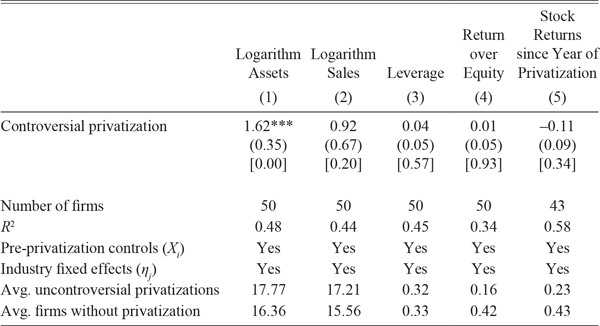
Controversial privatizations differed significantly at the very beginning of democracy. We consider a version of Equation (3) with time-invariant coefficients and measuring the dependent variable in 1990. To be consistent, we consider the same four firm-level outcomes (assets, sales, return over equity, and leverage) and also stock returns since the year of privatization. Note that we again control for pre-privatization variables and include industry fixed effects in our estimation.
Table 6 presents the results. Columns (1) and (2) show that controversial firms grew faster than other firms in the same industry during the dictatorship. Given that we are controlling for previous size and these firms were smaller, this result means that controversial firms partially caught up in terms of size. Results using the logarithm of sales as a dependent variable confirm this faster growth, although the point estimate is not statistically significant. In contrast, Columns (3) and (4) show that there was little difference in indebtedness levels (i.e., leverage) and profitability (i.e., return over equity). Finally, Column (5) shows that stock returns since the year of privatization were statistically similar between controversial and uncontroversial firms, although the point estimate suggests that the stock returns of controversial firms were lower.
THE BEGINNING OF DEMOCRACY

Notes: Each column in Table 6 presents estimates of Equation (3) with outcomes at the beginning of democracy, that is, at the end of the year 1990. More details are given in the Results section. Robust standard errors are in parentheses, and p-values correcting for small sample inference are in square brackets. Significance levels: *** p < 0.01, ** p < 0.05, * p < 0.1.
Source: Own construction based on firm reports collected by the Superintendencia de Valores y Seguros and stock prices published in the newspaper El Mercurio.
Overall, the results reveal that firms with controversial privatizations grew significantly more in dictatorship but experienced little improvement in their profitability.
Politics in Democracy
Are controversial firms influencing politics in democracy? We focus on three sources of distortions: the employment of politicians, the financing of political campaigns, and tax avoidance. We begin by studying employment of politicians as board members, empirically associated with rent extraction (e.g., Khwaja and Mian Reference Khwaja and Mian2005; Goldman, Rocholl, and So Reference Goldman, Rocholl and So2013) and thus an important source of misallocation (e.g., Cingano and Pinotti Reference Cingano and Pinotti2013). Because misallocation affects total factor productivity (Hsieh and Klenow Reference Hsieh and Peter2009), understanding the formation of these connections is critical.
We study the evolution of political connections in a dynamic fashion. We estimate Equation (3) using as the dependent variable an indicator for firms that employed at least one politician for their board. To capture dynamics, we measure this employment in different points in time and use three types of politicians: (1) former politicians of the Pinochet regime who enjoyed significant political power at the beginning of democracy and who we call “politicians of the old regime”; (2) politicians of the new democratic incumbent coalition opposed to Pinochet called Concertación, who we call “politicians of the new regime”; and (3) any of the previous politicians, who we call “any politician.”
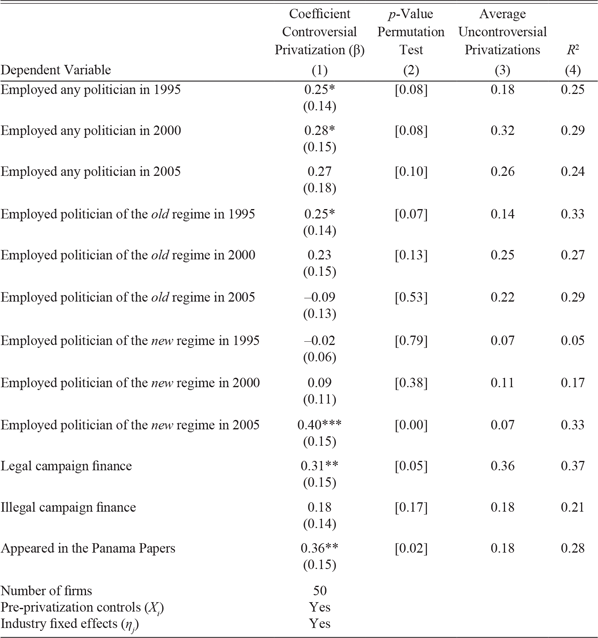
Table 7 shows that controversial firms were 25 percentage points more likely to employ any politician after the dictatorship, 25 percentage points more likely to employ a politician from the Pinochet regime at the beginning of democracy, and 40 percentage points more likely to employ politicians of the new regime after 15 years of democracy. These coefficients represent economically large magnitudes and the dynamics are revealing. Controversial firms substituted connections from the old to the new regime after a decade in democracy. These connections reverted almost perfectly, and in 2005, we observe more than half of the controversial firms in our data having connections to the new democratic coalition. In contrast, politicians of the old regime were no longer in these firms by 2005.
POLITICS IN DEMOCRACY

Notes: Each row in Table 7 presents estimates of Equation (3). The “old regime” corresponds to the Pinochet regime (1973–1990), and the “new regime” corresponds to the period after 1990. More details are given in the Results section. Robust standard errors are in parentheses, and p-values correcting for small sample inference are in square brackets. Significance levels: *** p < 0.01, ** p < 0.05, * p < 0.1.
Sources: Own construction based on firm reports collected by the Superintendencia de Valores y Seguros and campaign finance data published by Servicios de Impuestos Internos.
Controversial firms may also distort the political arena via financing political campaigns. This is the case studied in Claessens, Feijen, and Laeven (Reference Claessens, Feijen and Laeven2008), which shows that Brazilian firms that contributed to political campaigns had higher stock returns because they benefited from preferential access to bank financing. In addition, political contributions have also been found to affect public procurement (Baltrunaite forthcoming). Although perhaps intuitive, this type of analysis has been relatively scarce because data on campaign contributions can be difficult to obtain.
The list of firms that illegally financed political campaigns was revealed after an extensive investigation by the Chilean tax authority. Accusations of illegal campaign financing before the presidential election of 2013 were the motivation behind that investigation. The illegality of these transfers took the form of monetary payments from firms to politicians for “services” that were never delivered. These interactions were summarized, and the list of firms participating was publicized in the press. We also observe the list of firms that contributed to campaigns legally between 2005 and 2013. We construct two indicator variables, one for illegal and another one for legal campaign finance. We observe that 46 percent of firms in our data legally contributed to political campaigns in the period between 2005 and 2013, and 22 percent contributed illegally in 2013.
We follow the same econometric strategy and estimate Equation (3) using an indicator for legal or illegal campaign finance as the dependent variable. The last rows in Table 7 present results. Estimated coefficients show that controversial privatizations were 31 percentage points more likely to legally finance political campaigns (p-value < 0.05) and 19 percentage points more likely to contribute illegally, although the latter result is not statistically significant at conventional levels (p-value 0.19). These differences are economically meaningful. On one hand, only 37 and 19 percent of uncontroversial privatizations contributed legally and illegally (Column (3)). On the other hand, more than 68 and 37 percent of controversial privatizations did. These results suggest that controversial firms indeed seem to have attempted to exert influence in the political arena.
The last row in Table 7 shows that firms with controversial privatizations employed board members in democracy who were 36 percentage points more likely to appear in the Panama Papers (p-value 0.02). This difference is large, as more than half of controversial firms employed at least one board member who appeared in these documents. In contrast, only 18 percent of uncontroversial firms employed a board member from the list. We highlight that this is a legal behavior, but it nevertheless decreases tax revenues and it is therefore important to study.
Robustness and Omitted Variables
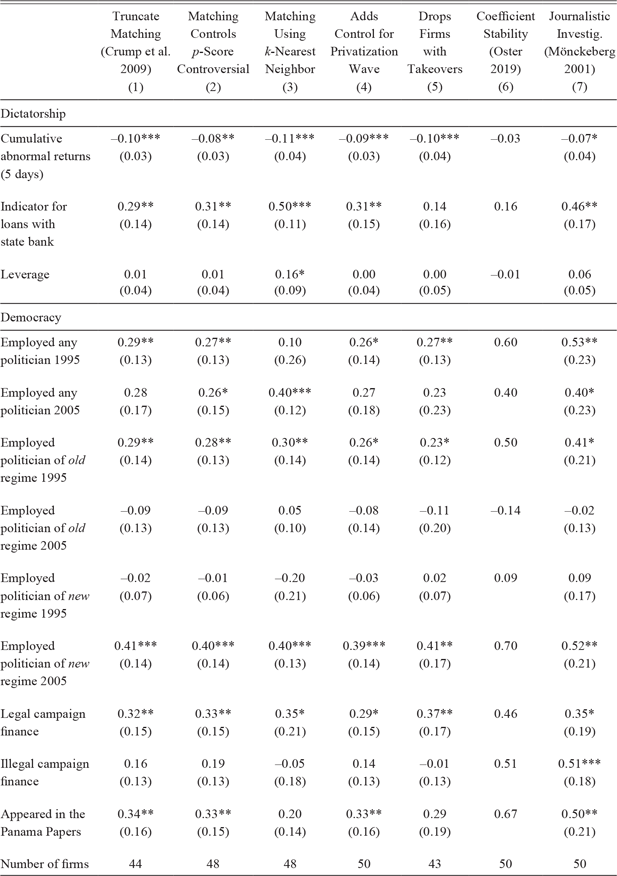
A variety of econometric exercises suggest our findings are robust and the effect of unobservables is minimal. We begin by showing similar estimates when we include additional control variables or exclude particular firms from the estimation. Additionally, the effects of controversies are similar or, if anything, larger if we use the processes studied by Marcel (Reference Marcel1989) and Mönckeberg (Reference Mönckeberg2001) to define controversial privatizations. Finally, we show results are also robust to the use of modern matching estimators and techniques that adjust for the effect of unobservables, suggesting omitted variables are not driving our results. Table 8 presents all of these additional results.
ROBUSTNESS OF RESULTS AND OMITTED VARIABLES

Notes: Each estimate comes from a different estimation strategy. See the Results section for details. Robust standard errors are in parentheses. Significance levels: *** p < 0.01, ** p < 0.05, * p < 0.1.
Sources: Own construction based on firm reports collected by the Superintendencia de Valores y Seguros and stock prices published by the newspaper El Mercurio.
We begin showing robustness to additional controls. Scholars have argued the two waves of privatization were different from each other, as the former privatized firms nationalized by Salvador Allende and the latter privatized long-standing state-owned firms. To check for this potential confounding factor, we constructed an indicator that identifies the “privatization wave” of a firm and included it as an additional control. Column (4) shows that the results controlling by wave are similar. Another potential confounder could be a change in the controller of a firm, but Column (5) shows similar results if we eliminate the few firms that changed controllers between 1990 and 2005.Footnote 19
A different classification of firms and the exclusion of single firms from estimation provide more robustness to the results. First, our clustering algorithm could have captured unobservable variables, so it is important to check if results are driven by the procedure we chose. Besides using other clustering algorithms, we also classified firms as controversial if these were mentioned as corrupt by Marcel (Reference Marcel1989) or Mönckeberg (Reference Mönckeberg2001), who argue 8 of our 50 firms were sold underpriced.Footnote 20 Column (7) in Table 8 shows results are larger using their classification. Second, we checked if results changed when we exclude one firm at the time from the estimation. Results in the Online Appendix confirm that our estimates are not driven by single observations.
Another threat is the omission of variables that could be correlated with controversies and explain the outcomes of interest. Two econometric techniques suggest the estimates are robust and the effect of omitted variables is minimal. First, we use matching techniques to perform improved comparisons. Operationally, we calculate the probability of controversies in a privatization using pre-privatization variables and industry fixed effects. Then, we perform three estimations, one in which we follow Crump et al. (Reference Crump, Joseph Hotz, Imbens and Oscar2009) and restrict the sample to firms that have similar probabilities of controversies (Table 8, Column (1)), another in which we simply control for the probability of controversies (Column (2)), and a last one in which we create a counterfactual for each firm using the k-nearest neighbors (Column (3)).Footnote 21 The second strategy uses the predictive power of observable variables to adjust the coefficient of interest by considering the effect of unobservables. This “coefficient stability approach”—first proposed by Altonji, Elder, and Taber (Reference Altonji, Elder and Christopher2005) and refined by Oster (Reference Oster2019)—again delivers similar estimates (Table 8, Column (6)).
We conclude that the evidence suggests the existence of a preferential treatment flowing from the regime to controversial privatizations, and these firms operated as political corporations in the democracy period.
DISCUSSION AND INTERPRETATION
Are results explained by characteristics of the buyers or by characteristics of the firms? Maybe buyers used whatever firm they could buy to channel their economic and political objectives. Or maybe firms had some characteristic (e.g., they were politically connected before privatization) that made them obtain benefits from Pinochet, grow more, and be more political after the return to democracy.
This section begins by providing evidence suggesting that both underpricing and closeness to the regime appear to be statistically relevant. However, we emphasize that a potential causal relationship between these two characteristics makes it difficult to gauge their relative contribution. The section ends with a discussion using an econometric decomposition of previous estimates. Our conclusion is that the political connections of the buyers are more likely to explain our results.
Privatization Characteristics
To estimate the relative importance of privatization characteristics, we use a version of Equation (3) in which we unbundle controversies:
 $${Y_{ijt}} = {b_1}Closenes{s_i} + {b_2}Underpricin{g_i} + d{X_{ij}} + {n_j} + {e_{ijt}}$$
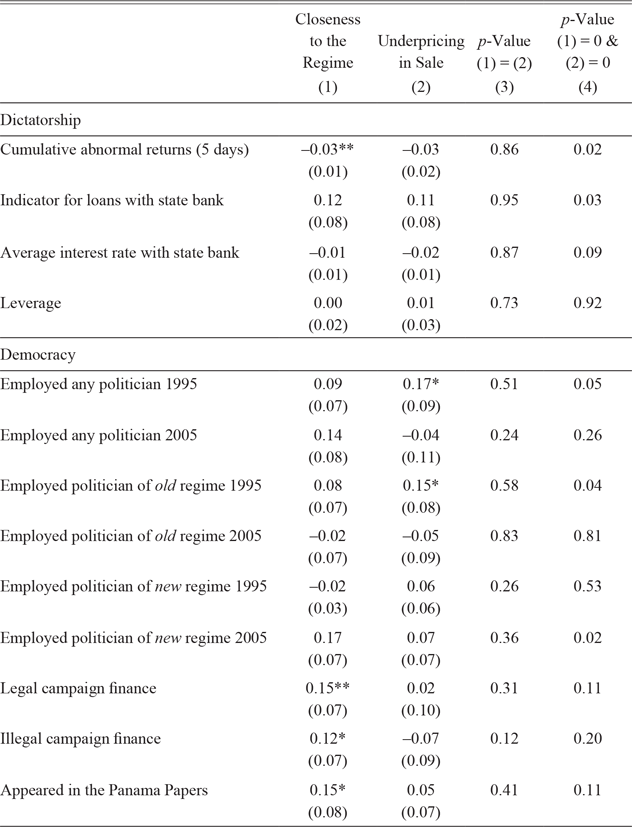
where Y ijt is one of the economic or political outcomes from previous sections, X ij represents pre-privatization controls, n j indicates industry fixed effects, and e ijt is a robust error term with a mean of zero. The variables that characterize privatizations are closeness to the regime and underpricing. When estimating Equation (4), our goal is to gauge the relative importance of b 1 and b 2. To accomplish this, we compare the statistical significance and magnitude of these estimates. For the former, we simply test if b 1 and b 2 are statistically different from zero. For the latter, we use standardized effects, that is, we compare the response of each outcome to a change of 1 standard deviation in each of these variables. The standard deviation of underpricing is 0.45 and the standard deviation of the closeness-to-the-regime variable is 0.27.
Table 9 presents estimation results of b 1 (Column (1)) and b 2 (Column (2)) for all outcomes in the paper, the p-value for the hypothesis b 1 = b 2 (Column (3)), and the p-value for the multiple hypothesis b 1 = 0 and b 2 = 0 (Column (4)). Both privatization characteristics are negatively associated with outcomes. When trying to gauge their relative importance, however, a mixed picture emerges. On one hand, the coefficient is generally larger in magnitude for underpricing. On the other hand, the coefficient associated with closeness to the regime is a more precise estimate, as we observe more statistically significant results at conventional levels for this variable.
UNBUNDLING THE IMPORTANCE OF PRIVATIZATION CHARACTERISTICS

Notes: Each row in Table 9 presents two OLS estimates from a single regression that includes pre-privatization controls and industry fixed effects. See the Discussion and Interpretation section for details. Robust standard errors are in parentheses. Significance levels: *** p < 0.01, ** p < 0.05, * p < 0.1.
Sources: Own construction based on firm reports collected by the Superintendencia de Valores y Seguros and stock prices published by the newspaper El Mercurio.
The main challenge to interpret the similar econometric importance of privatization characteristics is the potential causal relationship between them. It is plausible that a firm was sold underpriced because the people involved in the sale were linked to the Pinochet regime. In particular, there are two possible interpretations. First, people involved in an underpriced sale had an arguably tighter connection and this is why prices were low. If true, then the characteristics of buyers should be the main explanation for our results. Second, there is some characteristic of these firms that made them attractive for individuals linked to Pinochet. Are findings explained by people involved in the sale or by some firm characteristic?
Politically Connected Buyers and Politically Connected Firms
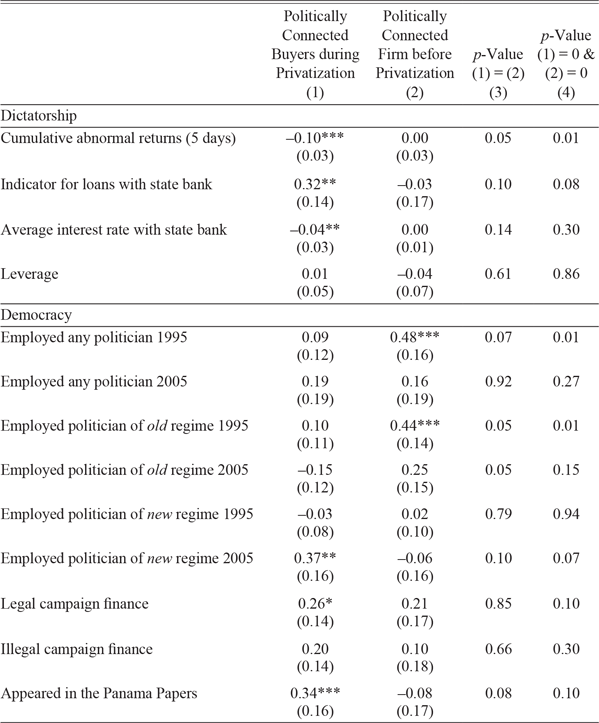
We now examine the relative importance of politically connected buyers versus pre-privatization political connectedness of firms. Figure 2 shows that all firms classified as controversial were bought by people close to Pinochet. Board members and buyers compose this “closeness-to-the-regime” variable. Table 1 shows that controversial firms had significantly more politically connected buyers: 96 percent versus none. In contrast, the share of board members linked to the regime before privatization is similar across firms before privatization. To study the relative importance of buyers and firms, we omit the underpricing variable—which could be contaminated by the buyers and, hence, be a “bad control”—and estimate the following regression:
 $${Y_{ijt}} = {w_1}Buyer \ connectio{n_i} + {w_2}Board \ connectio{n_i} + d{X_{ij}} + {n_j} + {e_{ijt}}$$
where Buyer connection i is an indicator that takes the value of one for firms bought by someone linked to Pinochet, and Board connection i is an indicator that takes the value of one for firms with board connections to Pinochet before the corresponding privatization process. The latter is our definition of political connections in the previous section and the one used in González and Prem (Reference González and Prem2019). The remaining variables are defined as before.
Before presenting estimates, it is useful to provide descriptive statistics and check for pre-privatization differences. On one hand, the set of firms bought by connected buyers is almost the same as the set of controversial firms. On the other hand, there are 18 firms with political connections and 32 unconnected firms before privatization. The Online Appendix compares pre-privatization characteristics between firms with and without politically connected buyers and between firms with and without political connections before privatizations, respectively. The comparison in the former is almost identical to the one in Table 2. The comparison in the latter reveals that politically connected firms had lower leverage and were more likely to have been privatized during the 1980s.
Table 10 presents estimates of Equation (5). When analyzing w 1, there are two econometric patterns across outcomes. First, the benefits firms obtained during the dictatorship period seem to be entirely explained by the political connections of the buyers. Notably, their connections are able to explain the decrease in the stock market value and the additional loans these firms obtain from the state bank. Second, the formation of connections to the new democratic regime and the appearance in the Panama Papers are also driven by buyers’ connections: firms with a connected buyer are 37 percentage points more likely to employ a politician of the new regime toward 2005 and 34 percentage points more likely to hire board members with money in tax havens.
THE IMPORTANCE OF POLITICALLY CONNECTED BUYERS

Notes: Each row in Table 10 presents two OLS estimates from a single regression that includes pre-privatization controls and industry fixed effects. There are details in the Discussion and Interpretation section. Robust standard errors are in parentheses. Significance levels: *** p < 0.01, ** p < 0.05, * p < 0.1.
Sources: Own construction based on firm reports collected by the Superintendencia de Valores y Seguros and stock prices published by the newspaper El Mercurio.
Two patterns emerge from the analysis of w 2. In the first place, none of the coefficients associated to benefits during the dictatorship is statistically different from zero and the point estimates are of small economic magnitude. Firms with political connections before privatization are also not more likely to appoint board members who appeared in the Panama Papers. In addition, there is a significant persistence in the connections to the old regime. In particular, these firms were 39 percentage points more likely to be connected to a politician of the old regime in 1995 and this number decreases only to 28 percentage points in 2005. This pattern is in stark contrast to the one among firms with politically connected buyers.
What would have happened if politically connected buyers bought a different set of firms? This is a difficult question to answer. Table 10 suggests that buyers would have behaved similarly in other firms, but it might be the case that unobserved firm characteristics explain why buyers bought the firms they bought. Our analysis cannot fully rule out characteristics of firms that are unobserved to us as econometricians but observed by the buyers of firms. If politically connected buyers were acquiring certain firms precisely because they were political in the past, then our findings reveal how privatization reforms facilitate the persistence of these firms over time. Because political connections prior to the privatization cannot explain our results, the evidence suggests that controversial firms transformed into political corporations. Unfortunately, we cannot fully rule out other unobserved political characteristics of firms.
Finally, we would like to highlight potential explanations for the behavior of connected buyers after the dictatorship period ended. Why were they exerting influence in the new democratic period? We believe there are at least two reasons. First, connected buyers seemed to have benefited from the dictatorship. If these benefits translated into a better position of their firms in the market, then they acquired economic rents that needed to be protected. An example would be the acquisition of government contracts during the dictatorship that are not guaranteed in the new democratic period. Lobbying could help to perpetuate these contracts, making the returns to lobbying potentially higher for controversial firms. Second, the political connections of controversial firms can be particularly valuable in new democracies that are still under the influence of the previous regime. Augusto Pinochet remained a powerful political force in the years after the transition, acting as commander in chief of the army (1973–1998) and then senator for life (1998–2002). The institutional framework made the cost of exerting influence lower for controversial firms, at least until 1998 when Pinochet was detained in London. Both of these explanations imply that controversial firms were more likely to make efforts to influence politics.
CONCLUSION
We have studied the privatization program implemented by the Pinochet dictatorship in Chile and found evidence of firms sold to politically connected buyers transforming into political corporations operating in democracy. While Pinochet was still in power, we found that these firms had higher stock market valuation and had access to more loans from state banks. After Pinochet left power, firms sold to connected buyers formed dynamic political connections, financed political campaigns, and decreased tax revenues by avoiding taxes. These findings are important because they reveal how authoritarian regimes can transfer their economic and political power using firms as vehicles and affect the functioning of young democracies.
These results have at least two implications. First, they suggest that benefits from regulating privatization processes may be greater than previously thought. There may be significant benefits from policies that increase competition among potential buyers or demand minimum requirements to buy state-owned firms. Second, our findings suggest caution when interpreting the effects of democratizations. Indeed, the functioning of a new democracy depends on how and if dictatorships manage to transfer their economic and political power across regimes.
We believe our findings open new and interesting questions about privatization. For example, although we have shown how privatizations implemented in dictatorship can influence politics even after democratization, whether and when these effects will disappear are still open questions. Recent scandals in campaign finance in Chile have made incumbent politicians design regulations that attempt to decrease the influence of firms in politics.