


Introduction
Obsessive-compulsive disorder (OCD) is characterized by the reoccurrence of unwanted thoughts, images, impulses, or doubts that evoke distress, and rule-bound, prolonged, repeated, or excessive actions performed to reduce distress and/or ameliorate harm (American Psychiatric Association, 2022). Anxiety is viewed as a central component of this distress, but during the obsessive-compulsive cycle people also report powerful feelings of guilt and shame, which is consistent with the fact that obsessional themes tend to reflect moral systems and are tied to deeply held core values (Chiang and Purdon, Reference Chiang and Purdon2023; Rachman, Reference Rachman1998; Rowa and Purdon, Reference Rowa and Purdon2003; Rowa et al., Reference Rowa, Purdon, Summerfeldt and Antony2005). People with OCD typically have an overvalued sense of responsibility, a pre-disposition to experience guilt, and heightened levels of morality, empathy, and cautiousness (e.g. Hellberg et al., Reference Hellberg, DuBois, Myers, Rodriguez, Butcher, Ojalehto and Abramowitz2023; Rachman and Hodgson, Reference Rachman and Hodgson1980; Salkovskis, Reference Salkovskis1985; Salkovskis, Reference Salkovskis1989). Furthermore, fears of transgressing values through acts of omission or commission, and of the ensuing guilt are also significant sources of distress in OCD (Chiang and Purdon, Reference Chiang and Purdon2023; Chiang et al., Reference Chiang, Purdon and Radomsky2016; D’Olimpio et al., Reference D’Olimpio, Cosentino, Basile, Tenore, Gragnani and Mancini2013; Mancini and Gangemi, Reference Mancini and Gangemi2004; Mancini and Gangemi, Reference Mancini and Gangemi2015). In sum, OCD is often characterized by concern about being the cause of harm via acts of commission and omission that violate deeply held values, resulting in intense anxiety, guilt, and shame.
The gold standard treatment of OCD is exposure with response prevention (ERP), in which the obsession is deliberately triggered, and the person sits with the distress it arouses without doing their compulsion or using other safety or avoidance strategies. The rationale behind ERP is that the compulsion terminates exposure to the obsession, both preventing habituation to the distress it evokes, and promoting new learning. Exposure allows the distress to decrease over time (habituation model) and/or allows for new learning about the meaning and importance of the obsession and the need to do the compulsion via expectancy violations (inhibitory conditioning model) (e.g. Jacoby and Abramowitz, Reference Jacoby and Abramowitz2016). ERP is often conducted within the context of cognitive behaviour therapy (CBT) which in addition directly addresses the appraisal of the meaning and importance of the obsession via cognitive restructuring and behavioural experiments (see Purdon, Reference Purdon and Wenzel2021a). However, when treatment refusal and drop-out rates are considered, only about 50% of people experience clinically significant benefits of these interventions (e.g. Öst et al., Reference Öst, Havnen, Hansen and Kvale2015; Öst et al., Reference Öst, Enebrink, Finnes, Ghaderi, Havnen, Kvale, Salomonsson and Wergeland2022). This suggests that the working model for ERP and CBT for OCD may be under-specified.
Aims
We propose that integrating social functionalist models of the moral emotions with leading psychological models of OCD may cast new light on the nature and intensity of distress elicited by intrusive thoughts, the factors contributing to avoidance and compulsions, and offer new strategies for its treatment. To date the literature on moral distress and moral injury has been viewed as primarily relevant to post-traumatic stress disorder (PTSD). We propose that the concept of moral injury has a bearing on our understanding of the development and persistence of OCD. We then identify avenues for future research and, finally, explore the treatment implications of viewing OCD as a condition that in some is characterized by sensitivity and reactivity to actual or anticipated moral pain.
Moral emotions
Social functionalist frameworks for understanding human emotions highlight the role of evolutionary pressures in shaping emotional experience, which include pressures associated with the survival of the individual and the sustainability of social groups (Graham et al., Reference Graham, Nosek, Haidt, Iyer, Koleva and Ditto2011; Haidt, Reference Haidt, Davidson, Scherer and Goldsmith2003; Keltner et al., Reference Keltner, Haidt, Shiota, Schaller, Simpson and Kenrick2006). The evolutionary advantages of being a member of a thriving social group are held to have moulded the development of ‘moral emotions’, which reinforce collaboration and cohesion, suppress selfishness, and, in general, ‘make social life possible’ (Haidt, Reference Haidt2008; p. 70). Like other emotions, moral emotions are elicited rapidly, often in advance of conscious thought, and influence the nature and intensity of subsequent appraisals and judgements (Drescher and Farnsworth, Reference Drescher, Farnsworth, Currier, Drescher and Nieuwsma2021; Haidt, Reference Haidt, Davidson, Scherer and Goldsmith2003; Haidt, Reference Haidt2008).
Haidt (Reference Haidt, Davidson, Scherer and Goldsmith2003) proposed a taxonomy of moral emotions involving four primary groups: the other-praising group (e.g. awe, elevation, gratitude), the other-suffering group (e.g. compassion), the other-condemning group (e.g. anger, moral disgust, contempt), and the self-conscious group (e.g. shame and guilt). The latter two are of especial relevance to OCD. The other-condemning emotions arise when a person is seen as having violated the rights, freedoms, and dignity of the self or close affiliates. Haidt (Reference Haidt, Davidson, Scherer and Goldsmith2003) states, ‘as guardians of the moral order, anger, moral disgust, and contempt all motivate people to change their relationships with moral violators’ (p. 859).
Moral disgust is characterized by a revulsion towards actions or desires that violate social rules or norms around sanctity, particularly those related to uses of the body (e.g. sexual practices or drug use) (Haidt et al., Reference Haidt, McCauley and Rozin1994) and is evoked when we judge a person to have intended to cause harm or to have been reckless about potential harms. Moral disgust is thought to serve as a powerful deterrent to violating cultural norms (Taylor and Uchida, Reference Taylor and Uchida2022). Contempt is elicited by perceptions that another person is unable or unwilling to meaningfully contribute to the success of the group; that is, incompetent. Contempt ‘paints its victims as buffoons worthy of mockery or as non-persons worthy of complete disregard … and therefore weakens other moral emotions, such as compassion’ (Haidt, Reference Haidt, Davidson, Scherer and Goldsmith2003; p. 858). The object of contempt will be treated with less warmth, respect, and consideration in future interactions.
The self-conscious moral emotions (e.g. shame and guilt) help individuals anticipate and manage the possibility that their own actions could violate social codes, thereby forestalling or disarming other-condemning emotions from group members (Haidt, Reference Haidt, Davidson, Scherer and Goldsmith2003). Shame involves global self-appraisals and is elicited when a person believes that they will be judged as fundamentally worthless, flawed, or blameworthy, and motivates people to hide from notice, thereby reducing risk of overt rejection, punishment, or attack. Guilt is elicited when an individual believes they have caused harm, loss, or distress to another person and motivates apologizing, confessing, or making amends.
Moral challenges, moral injury, and PTSD
Litz and Kerig (Reference Litz and Kerig2019) proposed a continuum of morally relevant experiences and corresponding responses. They noted that in everyday interactions we frequently encounter moral challenges – ongoing but minor or impersonal morally relevant experiences that cause mild and transient discomfort. Less frequently, we encounter moral stressors, which are more notable and focal experiences of moral violation that can lead to moderate, somewhat persistent experiences of moral distress. Morally injurious events involve severe violations of core assumptions about how humans should relate to one another, and result in moral injury (MI) – i.e. markedly distressing and functionally impairing alterations in emotional experience, beliefs and assumptions about self, others, and the world, and damaged or broken relationships with other people.
Moral injury
The concept of MI was introduced by Jonathan Shay (Reference Shay1994), who drew on Homeric literature to illuminate the moral dimensions of the experiences of Vietnam war veterans. He identified three necessary conditions for the creation of a potentially morally injurious experience: (1) a betrayal of what’s right, (2) by someone who holds legitimate authority, (3) in high stake situations. Litz et al.’s seminal 2009 paper on moral injury and moral repair in war veterans identified potentially morally injurious events (PMIEs), which included: ‘perpetrating, failing to prevent, bearing witness to, or learning about acts that transgress deeply held moral beliefs and expectations’ (p. 700). Echoing Shay’s idea that these experiences must involve ‘high stakes’, Litz et al. (Reference Litz, Stein, Delaney, Lebowitz, Nash, Silva and Maguen2009) specified that the transgressive act must ‘severely and abruptly contradict’ (p. 700) personal or shared expectations about moral behaviour.
Since its inception, the concept of MI has been closely tied to PTSD as it was developed to elucidate and explain the moral dimensions of traumatic experiences (Griffin et al., Reference Griffin, Purcell, Burkman, Litz, Bryan, Schmitz, Villierme, Walsh and Maguen2019; Litz et al., Reference Litz, Stein, Delaney, Lebowitz, Nash, Silva and Maguen2009; Litz, Reference Litz2025). However, in more recent conceptualizations MI extends beyond trauma exposure alone, encompassing emotional, cognitive, and behavioural reactions that vary depending on the nature of the morally injurious event, the context in which it occurred, and individual difference variables (Litz, Reference Litz2025; Litz and Walker, Reference Litz and Walker2025). This conceptualization is consistent with Hall et al. (Reference Hall, Everson, Billingsley and Miller2022) who found that MI was associated with a wide range of adverse mental health outcomes beyond PTSD, including depression, anxiety, suicidality, and substance use.
Post-traumatic stress disorder and moral injury
The constructs of MI and PTSD have considerable overlap. According to Farnsworth (Reference Farnsworth, Currier, Drescher and Nieuwsma2021), MI and PTSD involve (1) exposure to a precipitating stressor, (2) automatic and involuntary stress reactions, and (3) maladaptive coping responses that exacerbate and prolong distress and functional impairment. In his model, the automatic and involuntary stress reactions in MI involve natural and expectable experiences of moral distress, defined as ‘expanded social, psychological, and spiritual suffering’. An MI develops when, following the PMIE the individual engages in ‘costly and unworkable attempts to manage, control, or cope with the experience of moral pain’ (Farnsworth et al., Reference Farnsworth, Drescher, Evans and Walser2017 Reference Farnsworth, Drescher, Evans and Walser; p. 392). The efforts to control moral pain include situational and experiential avoidance, emotional numbing, rumination on the causes, meanings, and implications of the event, and changes in interpersonal behaviours, such as social withdrawal, all of which align with PTSD (Griffin et al., Reference Griffin, Purcell, Burkman, Litz, Bryan, Schmitz, Villierme, Walsh and Maguen2019; Litz et al., Reference Litz, Stein, Delaney, Lebowitz, Nash, Silva and Maguen2009). Furthermore, in MI and PTSD people typically experience intrusive, unwanted, distressing memories of the evoking incident, engage in overt avoidance, develop entrenched and over-generalized incident-altered beliefs about self, others, and the world, and experience increased frequency and intensity of negative emotion, and decreased ability to access positive emotion, especially in the context of interpersonal relationships (Currier et al., Reference Currier, Holland and Malott2015; Drescher and Farnsworth, Reference Drescher, Farnsworth, Currier, Drescher and Nieuwsma2021; Litz et al., Reference Litz, Stein, Delaney, Lebowitz, Nash, Silva and Maguen2009; Litz, Reference Litz2025).
More recently, Litz and Walker (Reference Litz and Walker2025) proposed a social-functional framework in which moral injury is conceptualized as a multi-dimensional outcome arising from exposure to potentially morally injurious experiences and ensuing moral emotions, changes in perceptions of self and others, social disconnection, and efforts to cope and repair. Within this framework, moral injury is not defined solely by the objective characteristics of an event but by the enduring psychological, social, and moral consequences that follow exposure to it. It has been proposed that different subsyndromes of MI may emerge depending on the nature of the morally injurious event (Griffin et al., Reference Griffin, Purcell, Burkman, Litz, Bryan, Schmitz, Villierme, Walsh and Maguen2019; Litz et al., Reference Litz, Stein, Delaney, Lebowitz, Nash, Silva and Maguen2009; Shay, Reference Shay2014). When the self is the moral agent responsible for causing actual or potential harm to another ‒ either deliberately through acts of commission (e.g. causing death or injury through morally indefensible excessive use of force), unwillingly through acts of omission (e.g. obeying orders not to intervene despite believing intervention is morally necessary), or inadvertently through mistakes with grievous consequences ‒ the resulting moral injury is likely to involve self-conscious moral emotions such as guilt and shame, internalizing symptoms, and potentially self-directed harm, including self-injury and self-handicapping (Bryan et al., Reference Bryan, Bryan, Morrow, Etienne and Ray-Sannerud2014; Litz et al., Reference Litz, Stein, Delaney, Lebowitz, Nash, Silva and Maguen2009; Griffin et al., Reference Griffin, Purcell, Burkman, Litz, Bryan, Schmitz, Villierme, Walsh and Maguen2019; Tangney et al., Reference Tangney, Stuewig and Mashek2007).
Alternatively, if the MIE involves the self as a moral ‘patient’ or victim (Gray et al., Reference Gray, Schorr, Nash, Lebowitz, Amidon, Lansing and Litz2012) ‒ as in cases of sexual or physical assault, or betrayal by a figure of rightful authority ‒ the moral injury may manifest quite differently (Drescher et al., Reference Drescher, Foy, Kelly, Leshner, Schutz and Litz2011; Shay, Reference Shay2014). If the victimization MIE involved life threat or serious personal harm, the sequelae may overlap substantially with PTSD and be diagnosable as such (Frankfurt and Frazier, Reference Frankfurt and Frazier2016; Litz et al., Reference Litz, Stein, Delaney, Lebowitz, Nash, Silva and Maguen2009). In contrast, if the victimization involved betrayal in the absence of personal life threat, the moral injury may manifest primarily in intense other-condemning moral emotions such as anger, moral disgust, and bitterness, alongside pre-occupying ruminations about retribution and externalizing symptoms, similar to what has been described in post-traumatic embitterment disorder (Farnsworth et al., Reference Farnsworth, Drescher, Evans and Walser2017; Griffin et al., Reference Griffin, Purcell, Burkman, Litz, Bryan, Schmitz, Villierme, Walsh and Maguen2019; Linden, Reference Linden2003; Linden, Reference Linden, Linden and Maercker2011).
Moral injury and OCD
We propose that OCD can involve a distinct form of moral suffering, characterized by sensitivity and reactivity to the potential of committing, or being seen as committing, a morally blameworthy or abhorrent act, either in thought or in deed, by omission or commission, that is harmful and will elicit disgust, anger, and/or contempt from others. The fears include that of committing a morally reprehensible, irresponsible, incompetent, etc. act, of the ensuing feelings of guilt and shame, and of the anticipated responses of others, such as disgust, loathing, rejection, loss of trust; that is, other-condemning emotions.
For example, one of the authors was treating a parent of a young child for severe checking compulsions around the safety and security of the child’s environment. One evening while their spouse was away the client was putting the child to bed and knocked a metal thumbtack from a bulletin board onto the carpet. The client had an instant flashforward of the child gravely ill with tetanus, the doctors shaking their heads in disgust at the client’s neglect, and the client feeling overwhelmed by shame and powerless to explain how they could have let this happen. The spouse then rushes in and looks at him in disgust and fury. The client spent two hours scouring the floor for the thumbtack, both to prevent it being stepped on, but also to prevent the anticipated shame, social rejection, and loss of credibility.
The fear of being morally responsible for damaging events may contribute to distressing experiences of guilt and shame, and more broadly to the ‘expanded social, psychological, and spiritual suffering arising from … costly and unworkable attempts to manage, control, or cope with moral pain’ (Farnsworth et al., Reference Farnsworth, Drescher, Evans and Walser2017; p. 392) that characterizes moral injury. Finally, given the perceived stakes, people with OCD seek a high degree of certainty that the compulsion has been done properly and achieved its purpose. This orients people to reasons to doubt whether the compulsion has achieved its goal, which are exhaustive, and there is no natural terminus for the behaviour. This could be leaving people with the fear that a morally injurious event may have happened or will happen without a secure feeling that their efforts have prevented or at least ameliorated it (see Purdon, Reference Purdon2018, for a review). In this paper, we review extant research and theory linking OCD to moral emotions and explore the conceptual and clinical implications of understanding these experiences through a moral injury framework.
Morality and OCD
It is generally accepted that obsessions are rooted in intrusive thoughts that are universally experienced. Those prone to developing OCD over-interpret the thought as meaningful, important, and as requiring immediate action, often because it poses a moral threat (see Purdon, Reference Purdon2023). Themes of morality in OCD arise in four different areas. First, obsessions often take the form of doubts, images, urges, and thoughts involving harm, either through omission (e.g. failing to notice a can was dented and serving one’s family contaminated food) or commission (e.g. swerving into the next lane while driving). Rachman and Hodgson (Reference Rachman and Hodgson1980) noted that such thoughts tend to reflect moral themes. Rachman (Reference Rachman1998) further observed that the perceived ‘victims’ of this harm are typically helpless, such as children, the elderly, innocent, trusting people, or, in the case of religious obsessions, sacred. Purdon and Clark (Reference Purdon and Clark1999) argued that whereas most people are able to assimilate the thought (‘Even a person like me can have a thought like this’, ‘I know a person like me would never act on this thought or want it to happen’) those prone to developing OCD accommodate it (‘Having this thought means I am (or maybe am) a bad/immoral/dangerous/untrustworthy/irresponsible/incompetent person who could cause this to happen’, ‘Maybe I secretly want this to happen’). In an elaboration of his model, Rachman (Reference Rachman1994, Reference Rachman1998) argued that appraisal of thoughts as signifying that the person may be ‘mad, bad, dangerous or immoral’ will capture attention, evoke strong negative emotions, and require action to prevent or ameliorate the harm they represent.
Second, according to leading models of OCD, people prone to developing OCD tend to hold beliefs about their obsessional thoughts that reflect moral themes. The first type of belief is ‘thought action fusion’ (TAF), which includes beliefs that having the thought will increase the probability of acting on it or it otherwise happening (‘probability fusion’) and/or that having a thought is the equivalent to carrying out a prohibited action (‘moral fusion’) (Rachman and Shafran, Reference Rachman and Shafran1999). The second is over-valued beliefs about personal responsibility for harm, such as ‘Failing to prevent (or failing to try to prevent) harm to self or others is the same as having caused the harm in the first place’, ‘Responsibility is not attenuated by other factors (e.g. low probability of occurrence)’, and ‘Not neutralizing when an intrusion has occurred is similar or equivalent to seeking or wanting the harm involved in that intrusion to happen’ (Salkovskis, Reference Salkovskis1985; p. 579).
Third, recent research suggests that many individuals with OCD experience a distinct internal ‘OCD voice’ that is neutral and dominant in tone and authority and with which they engage in an internal dialogue (Bowman et al., Reference Bowman, Eschenwecker, Rowa and Purdon2026; Chiang, Reference Chiang2020). In this preliminary work, the voice was found to have an omnipotent moral authority that issued warnings of potential harm and violation of norms, expectations, and responsibilities; that is, it spoke very much like the voice of conscience itself. Furthermore, according to the Interpersonal Circumplex model, a dominant assertion from one party pulls for submission from the other, who is seeking to avoid conflict (e.g. Pincus et al., Reference Pincus, Hopwood, Wright, Rauthmann, Sherman and Funder2020).
Gilbert proposed that external relationships can be enacted internally, with dominant parts of the self-attacking submissive parts (Gilbert, Reference Gilbert2001; Gilbert et al., Reference Gilbert, Birchwood, Gilbert, Trower, Hay, Murray, Meaden, Olsen and Miles2001). Bowman et al. (Reference Bowman, Eschenwecker, Rowa and Purdon2026) speculated that if the OCD voice embodies that of an important attachment or authority figure people may feel that disobeying or failing to appease it may be viewed as ill-advised, disrespectful, or arrogant, and as risking social sanction. It has long been noted that people with OCD are more concerned about being responsible for harm than simply avoiding harm (Rachman, Reference Rachman1976a; Rachman, Reference Rachman1976b; Salkovskis, Reference Salkovskis1985; Salkovskis, Reference Salkovskis1989). In a diary study of compulsions, Dean and Purdon (Reference Dean and Purdon2021) found that a central goal of the compulsion was to avoid being held by others to be responsible for harm, which was rated as substantially more important than the goals of avoiding harm and of holding oneself responsible for harm. This is consistent with Pozza et al. (Reference Pozza, Dèttore, Marazziti, Doron, Barcaccia and Pallini2021), who found that fear of disappointing others was a strong predictor of OCD symptoms in a large sample of sufferers, over and above other known factors.
Fourth, obsessions often threaten deeply held personal values and the sense of self. Rowa and colleagues found that participants’ most distressing obsessional thoughts were those that contradicted important values the most (Rowa and Purdon, Reference Rowa and Purdon2003; Rowa et al., Reference Rowa, Purdon, Summerfeldt and Antony2005). In Chiang and Purdon (Reference Chiang and Purdon2023), people with OCD were asked what it would mean about them if the obsessional doubt were true (e.g. if they in fact had left the stove on). They reported it would mean they were immoral or flawed in character (bad, irresponsible, untrustworthy, incompetent, careless, lazy, etc.). That is, they appraised failure to prevent harm as reflecting global, stable, negative qualities. Rachman and Hodgson (Reference Rachman and Hodgson1980) proposed that those prone to developing OCD are more likely to experience guilt and have heightened levels of morality, empathy, and cautiousness. They labelled this constellation of traits ‘tender conscience’. Those with tender conscience have a highly empathic sense of the impact of harm on others and thus view themselves as more culpable than the average person if their own acts of omission or commission result in harm (e.g. ‘I of all people, fully understand the impact of this and am honour-bound to do everything I can to neutralize/prevent it’).
These processes can give rise to a feared self-view, a set of qualities that individuals fear is part of themselves or may become so in the future (Carver et al., Reference Carver, Lawrence and Scheier1999; Markus and Nurius, Reference Markus and Nurius1986; Oyserman and Markus, Reference Oyserman and Markus1990). Feared self-concepts have been proposed as particularly relevant in OCD and may reflect the internalization of persistent moral doubts (Aardema and Wong, Reference Aardema and Wong2020). Indeed, individuals with OCD may interpret intrusive thoughts as revealing something fundamentally wrong or dangerous about their character (Ferrier and Brewin, Reference Ferrier and Brewin2005). Similarly, Bhar and Kyrios (Reference Bhar and Kyrios2007) found that people with OCD fear that their self-worth, morality, and loveability is in question. These fears trigger intense emotions such as guilt and shame, which in turn, may serve to reinforce feared self-beliefs and newly accommodated schemas, creating a self-perpetuating cycle in which moral emotions are not only outcomes but also perceived confirmations of being ‘bad’ or defective.
Moral emotions in OCD
Guilt
Given the centrality of morality in OCD, it is unsurprising that moral emotions, particularly guilt and shame, have been implicated in its development and maintenance. The role of guilt in OCD has received limited empirical attention, but available findings suggest a meaningful association between guilt and obsessions involving harm, sex, or blasphemy. Importantly, this guilt is not necessarily tied to actual wrongdoing but often reflects the anticipation or perceived potential to cause harm. That is, individuals with OCD may experience guilt not because they have caused harm, but because they fear they could be held responsible for it (Foa et al., Reference Foa, Amir, Bogert, Molnar and Przeworski2001; Salkovskis et al., Reference Salkovskis, Wroe, Gledhill, Morrison, Forrester, Richards, Reynolds and Thorpe2000). In this sense, guilt reflects a violation of internalized moral standards or a failure to meet perceived obligations (Beck, Reference Beck1976; Shafran et al., Reference Shafran, Thordarson and Rachman1996) and may become inflated when individuals feel responsible for preventing even hypothetical harm, which is usually the case in OCD (Freeston et al., Reference Freeston, Ladouceur, Thibodeau and Gagnon1996; Lopatka and Rachman, Reference Lopatka and Rachman1995).
Some theorists have proposed that it is not guilt per se, but a heightened fear of experiencing guilt, that plays a critical role in OCD (Mancini and Gangemi, Reference Mancini and Gangemi2004; Chiang et al., Reference Chiang, Purdon and Radomsky2016). Chiang and Purdon (Reference Chiang and Purdon2019) found that fear of guilt was associated with the need for more information before making a decision and predicted greater difficulty making decisions, lower confidence that the right decisions were made, and less satisfaction with decisions. This excessive sensitivity to guilt, conceptualized as a trait-like fear of moral failure, may help explain the persistent nature of compulsions, as individuals struggle with uncertainty about whether they have done enough to avoid blame (Mancini and Gangemi, Reference Mancini and Gangemi2004; Steketee et al., Reference Steketee, Quay and White1991).
Accordingly, obsessions may be understood as expressions of hypervigilance to moral failure, while compulsions function as efforts to prevent or atone for such failures. This interpretation aligns with findings suggesting that individuals with OCD often adhere not only to internal moral standards but also to perceived external expectations, striving to avoid negative moral judgement by others (Dean and Purdon, Reference Dean and Purdon2021; Mancini and Gangemi, Reference Mancini and Gangemi2004). For example, excessive cleaning may be performed not only to neutralize contamination fears, but also to prevent being held responsible if someone were to become ill, a pre-emptive strategy aimed at preserving one’s moral identity (Reuven et al., Reference Reuven, Liberman and Dar2014).
Shame
Whereas guilt involves negative evaluation of a specific behavior, shame involves a negative evaluation of the global self (Tangney and Dearing, Reference Tangney and Dearing2002; Tracy and Robins, Reference Tracy and Robins2004). In other words, whereas guilt might arise from the thought, ‘I can’t believe I did that!’, shame arises from the thought ‘I can’t believe that I did that!’. Shame can be understood as a tainted state of being, that, unlike guilt, cannot be readily resolved by reparative acts. Shame may arise when individuals interpret the presence of obsessional thoughts as indicative of a fundamentally flawed or immoral self (Berle and Phillips, Reference Berle and Phillips2006; Weingarden and Renshaw, Reference Weingarden and Renshaw2015), which may contribute to avoidance, concealment of symptoms, and premature termination of treatment (Newth and Rachman, Reference Newth and Rachman2001). Individuals with OCD often experience fear of receiving compassion, which may impede their ability to respond flexibly to moral concerns as well as seek support and permit themselves to be soothed (Merritt and Purdon, Reference Merritt and Purdon2021).
The relationship between TAF and moral emotions further support this conceptualization. Although TAF has been closely linked to guilt, where the mere thought of an action is seen as morally equivalent to performing it (Rachman, Reference Rachman1993; Salkovskis, Reference Salkovskis1985), it may also elicit shame when individuals view intrusive thoughts as evidence of being inherently immoral or dangerous (Weingarden and Renshaw, Reference Weingarden and Renshaw2015). Experimental and correlational studies have shown that guilt and shame are particularly prominent in unacceptable/taboo obsessions (e.g. Laving et al., Reference Laving, Foroni, Ferrari, Turner and Yap2023; Simonds and Thorpe, Reference Simonds and Thorpe2003; Visvalingam et al., Reference Visvalingam, Crone, Street, Oar, Gilchrist and Norberg2022). These themes are more likely to be perceived as moral transgressions, thereby eliciting intense moral emotions.
Anger
Research on anger in people with OCD has produced mixed findings, with limited evidence that they experience more frequent or intense anger than those with other mental health difficulties, particularly when depression is controlled for (e.g. Cludius et al., Reference Cludius, Mannsfeld, Schmidt and Jelinek2021; Radomsky et al., Reference Radomsky, Ashbaugh and Gelfand2007). However, to our knowledge, there have been no studies of the lived experience of anger in OCD. Based on our clinical observation we speculate that self-directed anger could arise from having committed a transgression (e.g. the morally repugnant obsession, the possibility of having made an inadvertent act of omission or commission) or being the cause of a future transgression, with limited power to prevent it. We may see other-directed anger in two circumstances. First, when executing a compulsion people are often concentrating on ensuring the compulsion achieves its goal and they can become angry when others interrupt or rush them. Second, people can become angry when others fail to accommodate their compulsions or refuse to follow rules. In both circumstances the anger may be akin to that experienced by people who experience or witness a PMIE after warning people in charge about its possibility and have been ignored, trivialized, or discounted. However, when the MI lies in fear of failing to prevent or ameliorate harm the transgression is imaginal and vague; the event may have happened/may happen and the details will be unclear (that is, there are only imagined possibilities as to the sequelae). The dominant emotional responses may be more likely to be anxiety/fear/panic and guilt and shame as there is not a clear target for anger.
Formulation
The individual with OCD who grapples with guilt, shame, and the fear of being exposed to the judgements and social retribution of others differs in important ways from the military veteran described in perpetration-based presentations of moral injury. In standard depictions of moral injury, the precipitating morally injurious events are typically high-intensity, high-stakes, milestone experiences in the individual’s past that involved actual harm or a credible risk of harm to others. In OCD, by contrast, ordinary decisions, actions, omissions, and even intrusive thoughts may become imbued with profound moral significance. Decisions or actions that might not be perceived as morally salient by others, let alone registering as ‘moral challenges’ or ‘moral stressors’ as defined by Litz and Kerig (Reference Litz and Kerig2019), may be experienced with the subjective intensity typically reserved for morally injurious events.
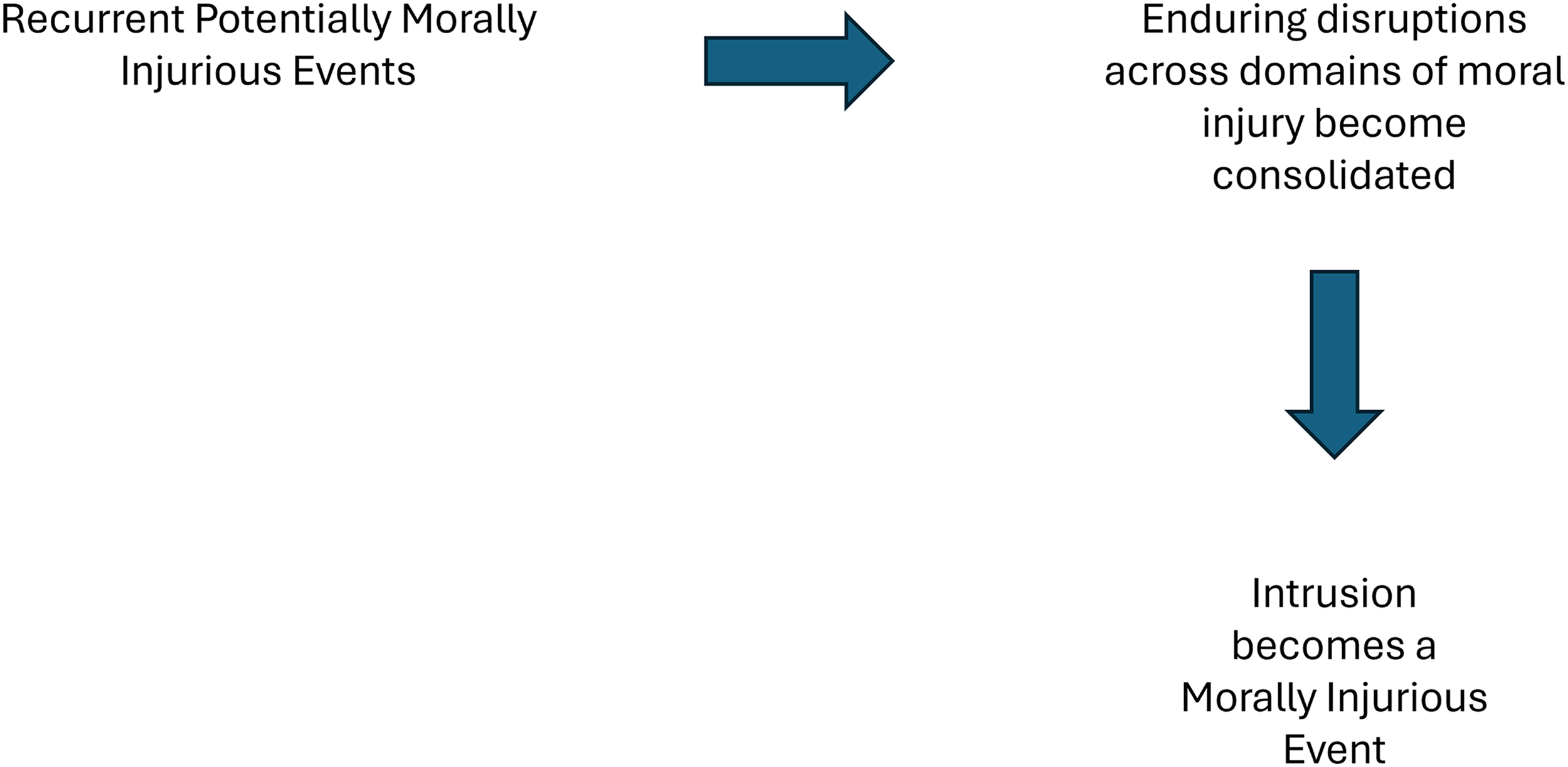
The individual with OCD may live in a state of ongoing moral alarm regarding their capacity to cause harm, their responsibility for preventing it, and/or the possibility that they have already violated important values, without a ready means of preventing or ameliorating that harm. In standard perpetration-based MI presentations, the sufferer’s feelings of guilt and shame would often be readily comprehensible to others if the circumstances were known. In OCD, the source of guilt, shame, and fear is frequently viewed as excessive, illogical, or puzzling, despite being experienced as deeply significant by the sufferer. Moreover, the settled certainty of culpability that often characterizes perpetration-based moral injury is replaced in OCD by chronic ambiguity and doubt regarding one’s moral status. In OCD, intrusive thoughts may be experienced as morally injurious when they are interpreted as evidence that one has, or could, transgress core moral values (see Fig. 1). The persistence of obsessions continually calls into question the individual’s moral character which may significantly erode self-trust. Tender conscience and overvalued responsibility may cause the boundary between thoughts, intentions, and actions to become blurred, extending the role of moral injury in OCD to obsessions beyond those categorized as repugnant.
From intrusion to potentially morally injurious event.

These same characteristics may also render some individuals with OCD particularly vulnerable to moral injury-related distress. Heightened responsibility, guilt proneness, empathy, and tender conscience may increase the likelihood that intrusive thoughts, doubts, and uncertain outcomes are experienced as morally significant and interpreted as threats to moral identity. The resulting interaction among moral appraisals, moral emotions, and attempts to manage or prevent moral pain may contribute to persistent moral distress, even though the precipitating experiences differ substantially from the objectively high-stakes, real-world morally injurious events that have traditionally been the focus of the moral injury literature. This conceptualization is compatible with the broader framework proposed by Litz and Walker (Reference Litz and Walker2025), which emphasizes that enduring moral suffering reflects the interplay among moral emotions, self-perception, interpersonal functioning, and efforts at moral repair, rather than being understood solely in terms of the characteristics of the precipitating event.
The emotional consequences of this process parallel those described in moral injury: intense anxiety, guilt, and shame, accompanied by enduring self-doubt. Guilt may reflect perceived failures to prevent harm, while shame stems from the appraisal of the self as fundamentally dangerous, bad, incompetent, or untrustworthy. As in moral injury, these moral emotions are not transient but reinforce feared self-beliefs, erode identity coherence, and perpetuate cycles of compulsive behaviors aimed at moral repair or prevention. In this way, recurrent obsessions may function as ongoing sources of moral distress whereby each recurrence of the obsession can feel like a fresh transgression, cumulatively undermining trust in one’s self, judgement and moral character, and threatening one’s belongingness status in valued groups (see Fig. 2).
How potentially morally injurious intrusions become morally injurious.

This perceived threat to belongingness combined with lack of trust in one’s own judgement and character may contribute to withdrawal from valued relationships and communities, narrowing the individual’s social world to avoid anticipated moral condemnation or rejection (Shay, Reference Shay1994). At the same time, repeated questioning of one’s moral character may progressively undermine confidence in one’s own judgement and moral reliability. The erosion of self-trust may be particularly relevant in OCD because feared moral failure can involve both acts of commission and omission. Intrusions involving possible acts of commission may lead individuals to question their intentions, impulses, or character, whereas fears involving omission may foster doubt about their judgement, vigilance, or ability to act when action is required. Over time, individuals may lose trust in themselves both as moral agents and as moral safeguards, increasing reliance on compulsions as means of establishing certainty, demonstrating responsibility, and preventing anticipated moral failure. Furthermore, in the absence of a natural terminus for their compulsion, people rely on an internal felt sense that it is safe to stop. This feeling is often elusive, resulting in repetition of the act. However, repetition erodes confidence in memory, sensory, and cognitive processes which produces a general mistrust of one’s own judgement about physical realities (e.g. Jondani et al., Reference Jondani, Yazdkhasti and Abedi2023; for a review, see Purdon, Reference Purdon2018). Together these factors may fuel peoples’ perception that they are uniquely vulnerable to causing moral transgressions.
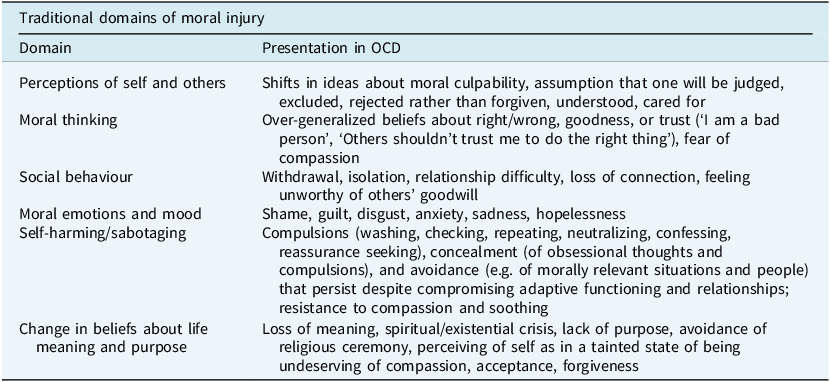
This framing helps explain why obsessions are so distressing, persistent, and identity-threatening. The feared self, ‘bad’, ‘dangerous’, or ‘immoral’ identified by Rachman (Reference Rachman1994, Reference Rachman1998) and the ambivalent and feared self since identified (Aardema and Wong, Reference Aardema and Wong2020; Ahern et al., Reference Ahern, Kyrios and Moulding2015) becomes reinforced through guilt, shame, and self-doubt. Compulsions, in turn, can be understood not only as safety behaviors aimed at preventing feared outcomes but also as forms of moral repair, attempts to atone, seek reassurance, or avert moral failure. Thus, the distress of OCD may not simply derive from exaggerated threat appraisals, but from the deeper fear of being, or becoming, a bad or immoral person, and at risk of committing an unforgiveable act, the shame from which would be unbearable, while also being vilified or rejected by one’s social group. In Table 1 we present how symptoms of OCD can map onto the six domains of moral injury identified by Litz and Walker (Reference Litz and Walker2025).
Mapping OCD symptoms onto MI domains

Table 1. Long description
A table mapping OCD symptoms to moral injury domains. The table has two columns: Domain and Presentation in OCD. The Domain column lists six traditional domains of moral injury: Perceptions of self and others, Moral thinking, Social behaviour, Moral emotions and mood, Self-harming/sabotaging, and Change in beliefs about life meaning and purpose. The Presentation in OCD column describes how these domains present in OCD. For Perceptions of self and others, it mentions shifts in ideas about moral culpability and assumptions of being judged or rejected. For Moral thinking, it highlights over-generalized beliefs about right/wrong and fear of compassion. For Social behaviour, it notes withdrawal, isolation, and relationship difficulties. For Moral emotions and mood, it lists shame, guilt, disgust, anxiety, sadness, and hopelessness. For Self-harming/sabotaging, it describes compulsions, concealment of thoughts, and avoidance of morally relevant situations. For Change in beliefs about life meaning and purpose, it mentions loss of meaning, spiritual crisis, and avoidance of religious ceremony.
Viewing OCD through the lens of moral injury highlights the centrality of moral pain rather than simply anxiety reduction and situates these experiences within a broader moral and existential context. This framework does not replace established cognitive behavioral and exposure-based treatments, but enriches them. By explicitly addressing moral emotions and identity concerns, clinicians may be able to enhance engagement, reduce treatment ambivalence, and promote recovery that extends beyond symptom reduction to include restoration of integrity, coherence, and dignity.
Research implications
An essential first step in research on MI within the context of OCD is to conduct a qualitative study of the lived experience of OCD which includes questions in the domains of MI identified by Litz and Walker (Reference Litz and Walker2025). These data could be used to develop a measure of MI as it manifests within OCD. We have argued that any type of obsession could be a PMIE, but it is possible that some subtypes may be more prone to this presentation than others. We note that a key difference between MI as currently understood and MI as it may manifest in OCD is that there is a near constant state of fear of committing or recommitting a PMIE and the PMIEs are imaginal rather than real world. Thus, existing measures of MI may not capture it within the context of OCD as they do not directly take into account: (1) that the PMIEs are imaginal in nature; (2) the uncertainty as to whether the action taken to prevent or neutralize the PMIE has succeeded; (3) that the PMIE will repeat multiple times a day so even ‘successful’ compulsions only afford relief until the next occurrence of the PMIE; and (4) that the PMIE can be internal (e.g. repugnant thought). Development and validation of an OCD MI measure would be helpful for developing our understanding of MI within the context of OCD. A third area of research could explore the extent to which the presence of MI within OCD is related to treatment outcome factors, such as treatment buy-in and engagement.
Clinical implications
This formulation has several clinical implications.
Implications for assessment
It could prove beneficial to include at intake questions as to: (1) whether the primary distress comprises moral emotions; (2) whether the obsession is viewed as transgressive in and of itself; (3) whether failure to resolve the intrusion is considered transgressive; (4) the extent to which fear of being responsible for causing harm is central to the client’s distress; (5) how the obsessions have affected their sense of their own moral culpability and subsequent beliefs about right/wrong, goodness, and trust; (6) how OCD is affecting people’s social relationships and sense of belonging and meaning in life; and (7) avoidance of morally relevant situations and the range of compulsions used to manage moral distress, which otherwise might be overlooked in standard OCD assessment.
Implications for treatment
The first implication is that there is merit in incorporating the MI framework into the CBT formulation when relevant. This would include explaining the concept of MI and normalizing feelings of guilt and shame as understandable responses to fear a transgression has or will happen. This addresses the moral emotions and moods domain of MI. The OCD voice can be described in terms of a threat-detection and warning system operating in overdrive, misfiring in response to internally generated cues such as intrusive thoughts (Rachman, Reference Rachman2002; Salkovskis et al., Reference Salkovskis, Wroe, Gledhill, Morrison, Forrester, Richards, Reynolds and Thorpe2000). This establishes the rationale for dethroning the OCD voice as a moral authority, which has relevance for self-trust, moral emotions and mood, and self-sabotaging domains of MI. Second, clients may benefit from strategies to develop ‘moral readiness’ as preparation to resisting the OCD demands and engaging in exposure-based interventions (Purdon, Reference Purdon and Wenzel2021a, Reference Purdon and Woud2021b). It is noteworthy that exposure-based interventions are less effective when the distress evoked by the obsession primarily comprises disgust (e.g. Mitchell et al., Reference Mitchell, Coifman and Olatunji2024); if moral emotions such as shame and guilt function similarly during exposure, interventions that rely primarily on fear extinction may not fully address the client’s distress. Moral readiness can begin with a discussion of the extent to which compulsions are consistent with important values but compromise other deeply held values (e.g. checking compulsions reflect caring/responsibility but chronic lateness due to excessive checking violates the deeply held value of being conscientious and reliable). Next can follow a discussion about the extent to which each set of values are being realized at present, with focus on whether the compulsions are in fact succeeding at fulfilling a core value. At this point it can be noted that there is a 100% chance that one set of values is being compromised to stave off a vague, uncertain outcome relevant to another set of values. Furthermore, compulsions are seldom direct ways of advancing core values. For example, scouring the floor of a child’s bedroom for a dropped thumbtack is a less direct way of expressing love and of being a good parent than is spending the time reading to one’s child. Thus, reading rather than checking could be the moral choice. This addresses the social behaviour and self-harming sabotage domains of MI.
Third, people with OCD tend to see the feared outcome as happening in a flash, neglecting all the steps that would have to happen for the event to occur. As per Purdon (Reference Purdon and Wenzel2021a, Reference Purdon and Woud2021b) a second strategy would be to identify the factors that would have to be in place for the feared outcome to occur (e.g. one would have to fail to turn off a burner after use, fail to see the burner light, the burner light would need to fail, etc.). It can be informative to assess the OCD-driven ideas about the probability of each factor, calculating the overall probability of the feared event, and contrasting that probability with the 100% probability that the compulsions are compromising other values, while also recognizing that a risk-free life is impossible.
With respect to repugnant obsessions, discussion could include the opportunity for moral decision making at each stage; that is, in many cases the person would have to make a series of conscious decisions that violate deeply held values before the final transgressive act occurs. Clinicians can also borrow from treatment of panic disorder in which the idea that one is capable of losing control and engaging in undesirable behaviour is addressed. It is important to note that the goal of such discussion is not to provide reassurance but rather to develop the insight that resisting a compulsion that definitely compromises one set of values to stave off a very uncertain, low probability outcome that compromises other values could in fact be the more moral choice. This strategy addresses the feared self and perceptions of the self as untrustworthy and has the potential to help clients develop a greater sense of purpose and efficacy.
Implications for active treatment
First, if the central emotional response to the obsession is disgust, exposure may be less effective in addressing OCD symptoms. Instead, addressing self-disgust via psychoeducation about thoughts and over-generalized ideas about their meaning and importance as indices of morality may be more useful This framework also introduces targets for exposure other than the obsessional thought, including exposure to trusting the self, to seeking support, and to accepting kindness and compassion from others (see Purdon, Reference Purdon and Woud2021b). Rather than targeting the distress evoked by the obsession, exposure could target uncertainty over whether enough has been done to atone for or prevent a transgression. When the obsession occurs, the client can be instructed to do the compulsion in a normative way (e.g. 30 s hand wash, ask for assurance once) terminating before they get the ‘right’ feeling and then sit with the uncertainty. This builds tolerance for the feeling of uncertainty and developing the ability to recognize and exercise appropriate diligence. Behavioural experiments and behavioural activation can be directed at building social networks, positive experiences, experiences that give a sense of purpose, and to opting for direct ways of advancing important goals rather than opting for the compulsion. At the same time, cognitive restructuring could target moral thinking and ‘stuck points’ such as over-generalization of beliefs arising from the MI. These strategies would address all MI domains.
Cognitive behaviour therapy can be complemented by compassion-focused interventions for addressing the ‘inner critic’ which involves recognition of the protective intentions of harsh internal voices while also developing insight into their excessive, maladaptive impact on psychological functioning (Gilbert, Reference Gilbert and Baldwin2005, Reference Gilbert2009; Neff and Germer, Reference Neff and Germer2013). This is accomplished by collaboratively adopting a stance of curiosity towards the OCD voice, and acknowledging its aim to prevent harm and maintain moral standing, while gradually undermining its status as a moral authority. Cultivating self-compassion can help individuals view their suffering through a lens of humanity rather than moral failure (Gilbert, Reference Gilbert2009; Gilbert and Procter, Reference Gilbert and Procter2006). Imagined dialogue with a compassionate yet firm moral authority is a key component of adaptive disclosure therapy (AD; Litz et al., Reference Litz, Lebowitz, Gray and Nash2017), a manualized, time-limited psychotherapy developed for military service members and veterans who experienced combat-related moral injury and traumatic loss; this specific intervention may have some utility in moral injury-informed OCD treatment. Finally, Pugh’s (Reference Pugh2019) chairwork, in which the person role plays themselves and the voice, could be an important complement to standard CBT. These strategies target the moral thinking and perceptions of self and other domains of MI.
Summary and conclusions
Taken together, advancing and empirically testing this moral injury-informed framework may help refine theoretical models of OCD and open new avenues for addressing the moral and identity-based dimensions that shape its onset, maintenance, and treatment response. Integrating these dimensions into existing CBT and ERP approaches may help address sources of distress that are not fully captured by a primary focus on anxiety and threat, with the potential to improve treatment engagement and outcomes and extend the benefits of these interventions to a broader range of people with OCD. More broadly, a moral injury-informed framework imparts dignity to those struggling with OCD by recognizing that the origins of their struggles lie in the human capacities for conscience, responsibility, empathy, and moral integrity.
Data availability statement
Data availability is not applicable to this article as no new data were created or analysed in this study.
Acknowledgements
None.
Author contributions
Martha Giraldo O’Meara: Conceptualization (equal), Project administration (lead), Writing - original draft (equal), Writing - review & editing (equal); Shannon Gifford: Conceptualization (equal), Writing - original draft (equal), Writing - review & editing (equal); Christine Purdon: Conceptualization (equal), Writing - original draft (equal), Writing - review & editing (equal).
Financial support
This research received no specific grant from any funding agency, commercial or not-for-profit sectors.
Competing interests
The authors declare none.
Ethical standards
Not applicable to this article.


 Open access


Comments
No Comments have been published for this article.