There have been many international publications about the response to the 2014–2016 Ebola epidemic. However, few have described the experiences of local health care facilities in West Africa, their response, and how and whether they were able to recover services. A critical element of the public health response to a disease outbreak is to maintain health services while preventing the services from spreading the epidemic.1–Reference Takahashi, Metcalf and Ferrari3
Long-term underinvestment in health services in Liberia resulted in health care facilities that were resource constrained. They could not support effective IPC practices to prevent EVD transmission within their doors. Health care facilities lacked personal protective equipment (PPE), isolation facilities, and even faced shortages of chlorine disinfectant.Reference Arwady, Bawo and Hunter4, Reference Nyenswah, Kateh and Bawo5
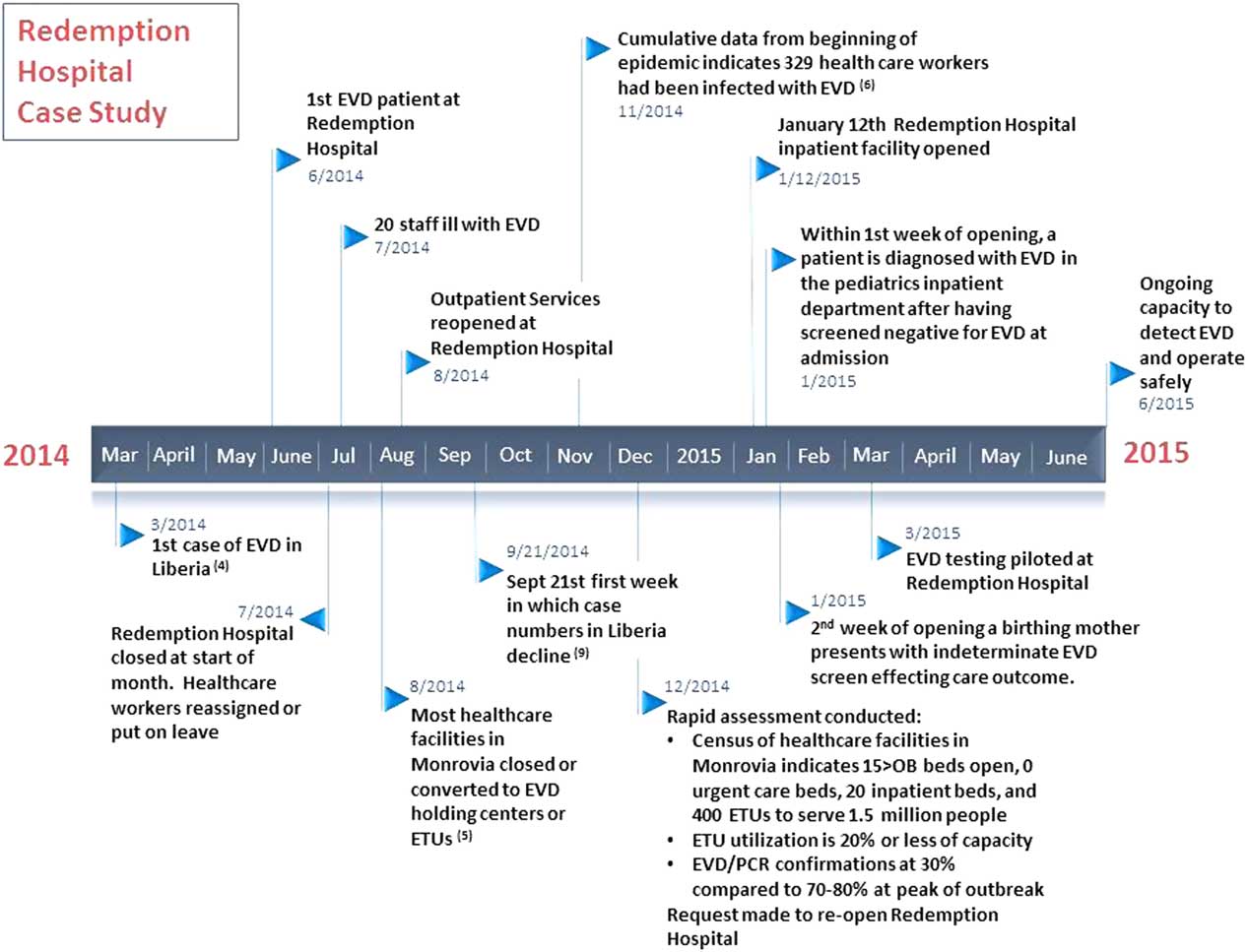
EVD, first seen in West Africa in December 2013 in Guinea, spread quickly in the region.Reference Takahashi, Metcalf and Ferrari3–Reference Nyenswah, Kateh and Bawo5 By June 2014, a nurse working in the largest public hospital in Liberia, Redemption Hospital, was diagnosed with EVD. Redemption Hospital is a secondary level health facility that cared for 15,000 patients per month before the outbreak. Within the month, 20 Redemption staff members became ill, and 12 died. Qualitative interviews by an author found that health care workers were fearful of their work environment, and community members were afraid to seek treatment. By August 2014, most health care facilities in Monrovia, Liberia’s capital city, had closed, including Redemption Hospital.Reference Nyenswah, Fahnbulleh and Massaquoi6 See Figure 1 for a summary timeline.
Summary Timeline of the EVD Outbreak Redemption Hospital, Liberia, 2014–2016.

In response to the epidemic, Liberia’s Ministry of Health (MOH) and international partners opened Ebola treatment units (ETUs). The ETUs’ primary purpose was to quarantine all suspected or confirmed EVD cases to reduce transmission. Despite the influx of supplies, the ETUs were not equipped to meet medical needs beyond basic EVD care. As a consequence, combined with the closure of most health care facilities, critical preventive and curative services, such as routine vaccinations, prenatal care, facility-based births, emergency care for trauma, and inpatient care for acute illness, were not available in the city.Reference Nyenswah, Kateh and Bawo5, Reference Nyenswah, Fahnbulleh and Massaquoi6
METHODS
Re-Establishing Health Services
Starting the week of September 21, 2014, the number of EVD cases began to decline.7–Reference Nyenswah, Westercamp and Ashraf Kamali9 As the trend continued, there was growing concern that the unmet routine medical needs of the population were going to overshadow EVD. An environmental scan by the authors using phone interviews with those in charge with health facilities, on-site visits and record reviews at ETUs, and community focus groups and qualitative interviews was conducted in December 2014 and estimated that there were fewer than 15 obstetrical beds, no urgent care capacity, and only 20 inpatient pediatric care beds available to serve all 1.5 million people in Monrovia. ETU utilization was at 20% only or less of capacity, and a review of ETU patient records indicated EVD, confirmed by polymerase chain reaction (PCR) lab testing in only 30% of patients compared with 70%–80% at the peak of the outbreak. Psychosocial team interviews in the community revealed stories of women dying during labor and delivery and patients unsuccessfully seeking medical care at ETUs and closed health facilities. This assessment indicated an urgent need for health services and provided evidence that investments into the creation of additional ETUs were not needed. The MOH and international donors agreed to reprogram a portion of EVD response funds to reopen health facilities and re-establish health services. The Inpatient Department at Redemption Hospital was chosen as the first MOH facility to reopen.
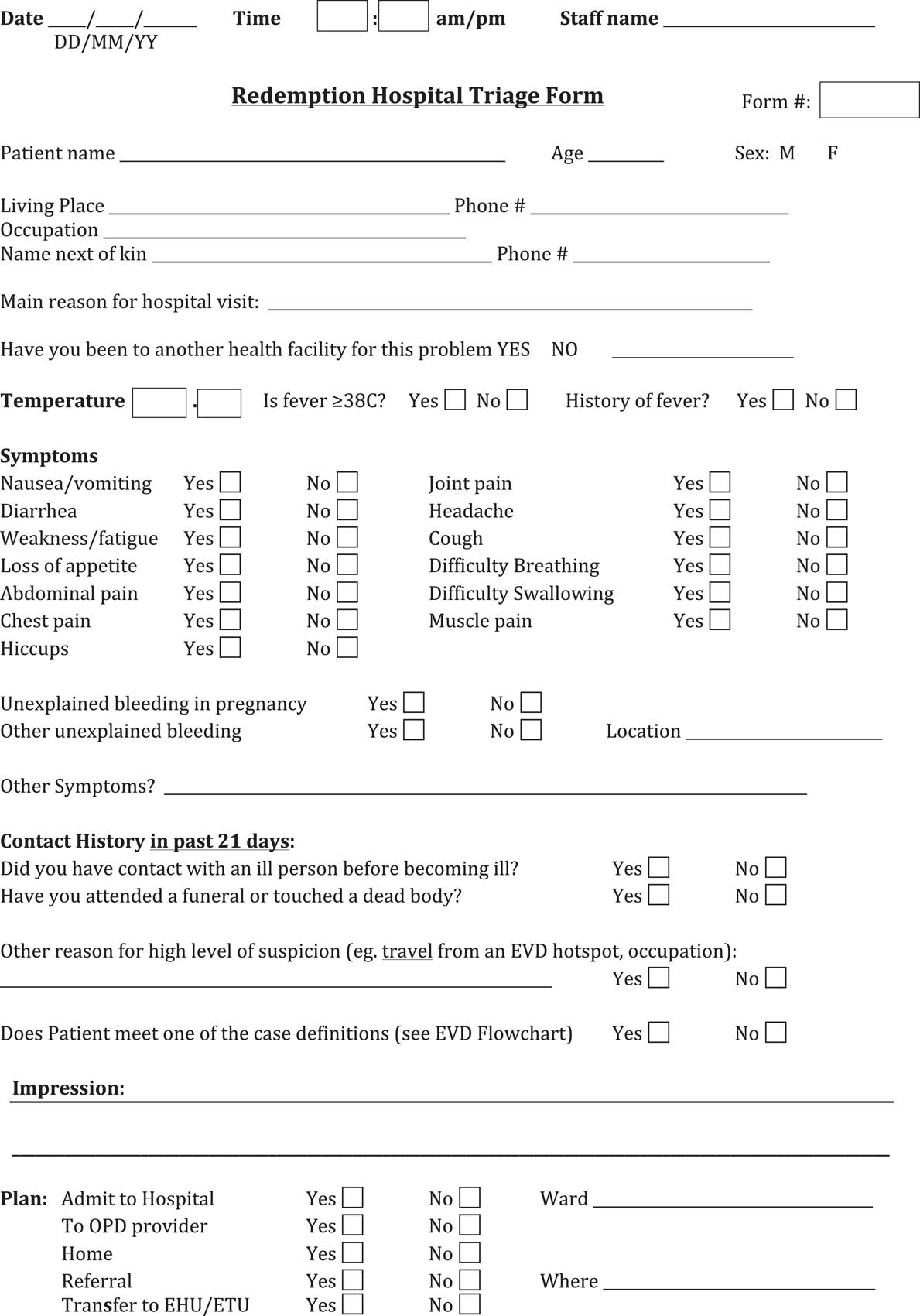
The hospital required extensive cleanup and renovation to support new IPC guidelines.10 An influx of supplies, additional staff, and training and support for all employees were essential as well. Table 1 summarizes the changes that were needed to reopen the facility and which of these changes were sustained 2.5 years later in July 2017. Re-establishing health services required the development of an EVD screening tool to assess symptoms and exposure history to keep EVD cases out of the facility (Figure 2). Suspect cases were referred to an ETU until resources were developed to isolate and test patients within the hospital.
Infrastructure and Practice Changes at Redemption Hospital During EVD Outbreak in Liberia, 2014–2016

EVD = Ebola virus disease; IPC = infection prevention and control; OBGYN = obstetrics and gynecology; PCR = polymerase chain reaction; and PPE = personal protective equipment.
EVD Screening Tool Redemption Hospital, Liberia, 2014–2016.

Trust-building between the hospital and the community was critical. The epidemic shattered the community’s confidence in health services. Many blamed health care facilities as the source of the epidemic and believed that the staff did not want to see patients anymore. A 2-way conversation between the hospital and the community was initiated to discuss how things would be different in the facility as it reopened. On January 12, 2015, the hospital reopened limited inpatient services.
RESULTS
Managing Risk
With the reopening, lines formed outside of the hospital entrances. Each entrance included a newly built triage space with barriers that kept patients and families 3 m away from staff that screened all for EVD using the screening tool (see Figure 2). The staff screened patients by first taking their temperature to ascertain fever using non-contact clinical thermometers. Staff then verbally inquired about an array of symptoms based on the case definition of EVD, symptoms not common to only EVD, but also malaria, liver disease, bleeding with pregnancy, parturition, gastroenteritis, and almost any viral or bacterial infection. Finally, the staff verbally inquired about EVD contact history in the past 21 days. A positive confirmation of any 2 or more of the previous factors was considered a positive screen for EVD and a “suspect” case. The national policy required that patients with a positive screen for EVD be transferred to an ETU for a laboratory test to confirm or disprove diagnosis. This policy restricting EVD lab testing to ETUs was made early on during the epidemic when prevalence was high, to encourage safe testing, accurate data collection for surveillance purposes, and to quarantine cases.
Careful monitoring and quality improvement of the infection control and screening practices were necessary. Staff re-administered the EVD screen to admitted patients to compare the information gathered at triage with their current status. In the early weeks of reopening, frequently, the rescreening revealed additional patients who met the case definition. Two patients admitted within the first 2 weeks of reopening highlight the challenges of the process. The first case involved a child admitted with fever whose family denied EVD symptoms or exposures at initial screening. This lack of honesty was frequent because families feared a transfer to an ETU. They knew that ETUs offered limited medical care and were frightened that their child might be exposed to EVD if transferred to an ETU. Interviews in the community revealed that, during these months of the outbreak, it had become commonplace to take acetaminophen/paracetamol to mask a fever before presenting to a health care facility. In this instance, after admittance to the pediatric ward, the child began to exhibit “wet” symptoms (vomiting and diarrhea). Only then did the family become more forthcoming (history of fever, vomiting, and diarrhea). The hospital transferred the patient to an ETU where EVD was laboratory confirmed. Seven hospital employees, triage and ward nurses, were placed in home quarantine for 21 days as a result of this exposure within the facility. With staff capacity strained, questions arose about the viability of keeping the doors open to serve the community. Ultimately, none of the quarantined staff were infected, but this scare led to changes to improve the quality of interviews at screening.
A week later, a woman screened negative at triage and was admitted in active labor. Hours later, when reassessed, she was believed by some staff to be a suspect EVD case. The ETU was reluctant to accept her given its limited capacity to provide obstetrical care. An exception was made to the “no testing outside of an ETU” rule, and the ETU staff came to the hospital to draw her blood for testing. Her test results were “indeterminate” for EVD, which required that she be transferred to the ETU until follow-up tests could be conducted. Hospital authorities were concerned that the entire obstetrics and gynecology staff might need to be placed on quarantine, which would necessitate closing the unit. The next day, retesting in the ETU was negative for EVD, and the patient returned to Redemption Hospital. By then, the baby died in utero from unknown causes.
These cases illustrate the challenges presented by a sensitive, but nonspecific, screening test based on subjective accounts by the patient and family and as understood by different screeners. Consequences for patients or staff could be dire in this environment of uncertainty and changing policies. Discerning EVD from other widespread conditions with overlapping symptoms like malaria and gastrointestinal illnesses was difficult. Obstetrics was particularly problematic because most patients present with bleeding, 1 of the screening signs for suspect EVD. The 24–48 hours required for a definitive EVD laboratory test from an ETU was not acceptable with the falling EVD prevalence and the need to reinstate health services. The desire to provide medical care was at odds with the fear of exposure. As such, Redemption Hospital staff, the MOH, International Rescue Committee, the World Health Organization, and the Centers for Disease Control and Prevention collaborated to expand EVD testing beyond the confines of ETUs to allow Redemption Hospital to draw samples from people with ambiguous symptom screens.
Increased access to testing was a gradual process. Laboratory testing first became available with blood draws inside of the hospital and transported to central laboratories. Then, 3 months after reopening, with proper training, supplies, and equipment, the hospital laboratory began EVD-PCR testing. The in-hospital isolation and testing of suspect cases enabled safe operations over the long term as intermittent cases were effectively managed during the long tail of the outbreak as flare-ups occurred.Reference Fink and Gladstone11
DISCUSSION
During outbreaks of severe, potentially fatal, communicable diseases, health care facilities need to maintain their core functions even when the clinical environment is full of uncertainty.1, 2 The lack of health care for common problems during a prolonged disease outbreak is associated with even higher morbidity and mortality than the outbreak itself.Reference Takahashi, Metcalf and Ferrari3 Closure of health care facilities by plan or default creates desperation and begins to reduce the likelihood that people will cooperate with public health measures to control the epidemic, such as case detection and social distancing.Reference Abramowitz, McLean and McKune12
The key to maintaining open doors during an outbreak is high confidence in IPC practices. To do this may require facility renovation and developing a screening process to isolate suspect cases because the availability of laboratory testing will always be delayed. In low resource settings syndromic screening, using symptom based and exposure reporting is the best first step as health facilities try to function. New IPC practices responding to the mode of transmission must be adopted, and access to IPC supplies such as bleach, gloves, and PPE is essential. Additional staff may be needed to implement the changes.
Continuous engagement of staff during an outbreak is critical to safe health services. With the loss of so many coworkers, intensive staff involvement in decision-making, training, supportive supervision, and targeted quality improvement efforts is required to restart or continue operations. The staff needs to be able to express their concerns and receive support so they can gain confidence that they can limit their risk of exposure. Exploring the idea of “safe uncertainty” and risk reduction is a useful operational approach.
It is equally important to engage the community to get feedback about the acceptability and compliance with public health measures. Community conversations to monitor rumors and assess perceptions and motivations are important. The extent to which community members feel they will get compassionate medical care and protection from exposure to a contagion can increase the odds that they will honestly report exposures and symptoms, making screening more reliable.2, Reference Abramowitz, McLean and McKune12
False-positive screening results in the overuse of scarce resources delay treatment of the actual cause of disease and can result in patient exposure to disease when isolated with confirmed cases. False-negative screening can result in the exposure of staff and patients to the contagion, possibly necessitating the closure of services. An unshakable commitment to maintaining operations is needed to persevere in this environment.
So that proper precautions are implemented, the ability to discern risk is a critical component of IPC. Diagnostic success becomes a certainty only when accurate point-of-contact laboratory testing is available.Reference Moschos13 Policies that define the availability of laboratory testing must adjust to the arc of the outbreak and facilitate the provision of needed nonepidemic-related health care. Syndromic screening alone using tools based on case definitions and that are subjective is insufficient but necessary. Increasing the availability and speed of high quality, accurate, and reliable diagnostic testing within health services is needed to maintain the operations of health care facilities in times of an outbreak.Reference Moschos13
Some investments during the outbreak in infrastructure improvements, training, and implementing IPC practices were sustained more than a year following the last case. These improvements may render the system more able to prevent and respond to future infectious disease events, strengthening the health system and making it more resilient.14–Reference Dhillon and Yates16
CONCLUSION
Keeping health care systems open is a necessity in any significant communicable disease outbreak. Despite fears about the health facility remaining open, there are ways to reduce risk and avoid amplifying the epidemic while preventing a secondary health crisis among those that no longer have access to core health services. Making sure that health workers can initiate enhanced screening, isolation, and have IPC available when an event occurs, even before the etiology is known, may prevent outbreaks from becoming epidemics. Investments in an outbreak response are not just single action events but can result in long-term improvements in prevention and preparedness.
Acknowledgments
The authors gratefully acknowledge Dr Penelope Milsom (IRC), Dr April Baller (WHO), Dr Catherine Cooper (MOH Liberia), Ms Winnifred Hallowanger (Laboratory Director, Redemption Hospital), Mr Jonathon Yoder (CDC), Dr Frank Mahoney (CDC), Dr Jennifer Hunter (CDC), and Mr Ruwan Ratnayake (IRC) for their valuable contribution in supporting the Ebola response and reopening the health facility. In addition, a special acknowledgment is extended to Dr Frederick “Skip” Burkle (Harvard Humanitarian Initiative and IRC) for his support in developing the manuscript.
Funding Statement
This work was supported by the Office of Foreign Disaster Assistance for Ebola Response. The funders had no role in the study design, data collection and analysis, decision to publish, and preparation of the manuscript.
Conflict of Interest Statement
The authors declare no competing interests.