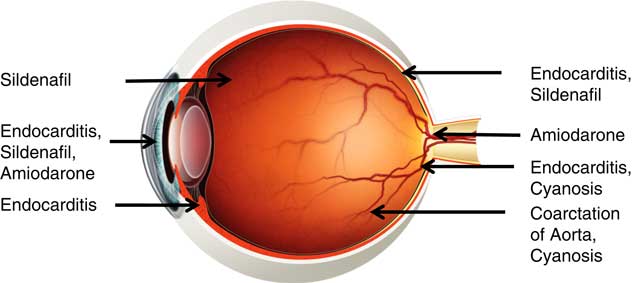
CHD is one of the most common birth defects, affecting ~1% of live births.Reference van Konings, Slager and Witsenburg 1 As a result of improved surgical techniques and progress in modern treatments, over 80% of CHD children now survive to adulthood. As a consequence, physicians now must become familiar with potential non-cardiac complications in this cohort. In a recent meta-analysis, Vilela et alReference Vilela, Sbruzzi and Pellanda 2 studied the prevalence of ocular pathologies in young CHD patients, reporting that 32.5% of patients with non-syndromic CHD have ocular abnormalities. This review aims to highlight ocular complications that are a frequent occurrence in CHD patients, either as a consequence of their defect or the treatments prescribed to manage it. Although genetic disorders such as Down syndrome, Marfan’s, or Ehler–Danlos syndrome affect both the heart and eyes, the heart is not the principal cause of the ocular complication in these conditions; hence, they are not covered in this review. The following sections explore the most prevalent ocular maladies that we have seen in adults with CHD (Fig 1).
Ocular manifestations of CHDs. Sildenafil: bluish vision, retinal haemorrhage, decreased intraocular pressure, conjunctival injection, and oedema. Amiodarone: keratitis, capsular punctate deposits in conjunctiva, coloured halos in vision, and optic disc swelling. Endocarditis: roth spots, branch, central and ophthalmic artery occlusion, endophthalmitis, and posterior uveitis. Cyanosis: retinal venous dilation, vascular tortuosity, retinal haemorrhages, macular oedema, central vessel occlusion, increased retinal vessel branching, and retinal nerve fibre layer thickness. Coarctation of aorta: retinal vessel tortuosity and narrowing. Image source: Human Anatomy Chart.

Cyanotic CHD
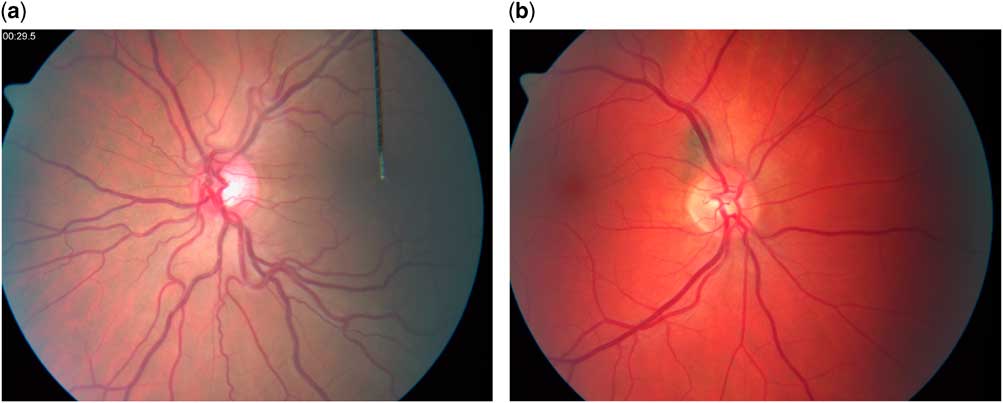
Cyanotic CHD is characterised by cardiac abnormalities with either a right to left shunt or poor pulmonary flow. These lead to oxygen-poor blood being distributed into systematic circulation. The resulting arterial hypoxaemia has adverse effects on the retinal vasculature.Reference Petersen and Rosenthal 3 The most common malformation in cyanotic CHD patients is retinal venous dilation and vasculature tortuosityReference Petersen and Rosenthal 3 , Reference Mansour, Bitar and Traboulsi 4 (Fig 2); less common findings include retinal haemorrhages, macular oedema, central retinal artery, and vein occlusion.Reference Rodriguez and Eliott 5 , Reference Zhao, Wang, Liu and Qian 6 These less common events are more likely to affect visual acuity than vessel tortuosity; hence, the majority of cyanotic patients have normal visual acuity, despite mild changes to the retinal vasculature.Reference Cordina, Leaney, Golzan, Grieve, Celermajer and Graham 7 , Reference Tsui, Shamsa, Perloff, Lee, Wirthlin and Schwartz 8 The abnormal retinal vasculature is probably in response to the chronic hypoxia and erythrocytosis that is prevalent in cyanotic CHD patients.Reference Tsui, Shamsa, Perloff, Lee, Wirthlin and Schwartz 8 Relief of the cyanotic condition after surgical repair almost always results in the retinal vasculature returning to normal.Reference Tsui, Shamsa, Perloff, Lee, Wirthlin and Schwartz 8
Retinal fundus photographs comparing the vessel tortuosity in cyanotic heart disease (a) versus control (b). Arrow highlights the serpiginous nature of the vessels in a cyanotic patient.

The mechanisms involved in remodelling of retinal vessels remain a matter of active investigation. A number of hypotheses have been advanced, including vascular endothelial growth factor-mediated changes in endothelial cell polarity,Reference Hartnett, Martiniuk, Byfield, Geisen, Zeng and Bautch 9 differential activation of endothelial nitric oxide synthetase from increased blood flow,Reference Cheng, van Haperen and de Waard 10 , Reference Li, Wallerath, Forstermann, Li, Wallerath and Forstermann 11 and increased retinal blood flow to arteriovenous shunts.Reference Kushner, Essner, Cohen and Flynn 12 Vascular endothelial growth factor is secreted in response to retinal hypoxia, and is believed to induce changes in the orientation of endothelial cell cleavage planes such that elongation occurs in arterioles, whereas dilation occurs in veins.Reference Hartnett, Martiniuk, Byfield, Geisen, Zeng and Bautch 9 For example, in veins, vascular endothelial growth factor has been found to increase the proportion of endothelial cleavage planes aligned parallel to the vessel long axis, an orientation that favours vessel widening.Reference Hartnett, Martiniuk, Byfield, Geisen, Zeng and Bautch 9 As veins are distensible, widening occurs, whereas in arterioles, which are not distensible, further elongation results in tortuosity.
Increased blood flow occurs in retinal hypoxia, which increases shear stress, along-the-plane frictional force, on endothelial cells within blood vessels.Reference Cheng, van Haperen and de Waard 10 , Reference Li, Wallerath, Forstermann, Li, Wallerath and Forstermann 11 In tortuous vessels, the acutely curved part of the vessel experiences greater shear stress and the opposite side experiences reduced shear stress. Shear stress can activate endothelial nitric oxide synthetase to produce nitric oxide, which affects vascular smooth muscle relaxation and vessel dilatation.Reference Cheng, van Haperen and de Waard 10 , Reference Li, Wallerath, Forstermann, Li, Wallerath and Forstermann 11 Finally, early theories proposed that with increasing hypoxia arteriovenous shunts enlarged, which increased blood flow to venules, increasing tortuosity through a mechanical process, while reducing blood velocity in arterioles, resulting in tortuosity.Reference Kushner, Essner, Cohen and Flynn 12
Furthermore, findings show that cyanotic CHD patients also have increased branching of retinal vessels, leading to an overall complex vasculature bed.Reference Cordina, Leaney, Golzan, Grieve, Celermajer and Graham 7 This has been associated with poor vessel function and blood perfusion, ultimately leading (potentially) to retinal vessel occlusion.Reference Caprara and Grimm 13 Retinal ischaemia secondary to chronic cyanosis may also cause neovascularisation of retinal and iris structures, mainly through upregulation of vascular endothelial growth factor.Reference Penn, Madan, Caldwell, Bartoli, Caldwell and Hartnett 14 Neovascularisation occurs in the context of severe ischaemia, and there has been a case report of iris neovascularisation causing spontaneous hyphaemas in a woman with congenital cyanotic heart disease.Reference Krarup 15 Chronic cyanosis is also associated with vascular dysfunction. Examination of retinal endothelial function in cyanotic CHD shows delayed retinal vascular dilation in response to a flickering light stimulus – a nitric oxide-mediated response – compared with controls.Reference Cordina, Nakhla, O’Meagher, Leaney, Graham and Celermajer 16
Moreover, cyanosis also affects macular and retinal nerve fibre layer thickness. de Aguiar Remigio et alReference de Aguiar Remigio, Brandt, Santos, Arantes and de Aguiar 17 showed a decrease in macular thickness; this is possibly as a result of the low oxygen supply as haemodynamic regulation is essential for retinal function. We have previously found global retinal nerve fibre layer thickness below the normal range in half of our study cohort (6/13); however, owing to a small sample size, these results were not significantly different from controls.Reference Cordina, Leaney, Golzan, Grieve, Celermajer and Graham 7 Retinal nerve fibre layer thickness correlated with cerebral white matter volume, implying potential neuropathological effects of chronic hypoxaemia. In this study, we also reported a high whole-blood viscosity in cyanotic patients, which was negatively correlated with retinal nerve fibre layer thickness, suggesting that viscosity may play a significant role in tissue perfusion and ocular pathogenesis in the cyanotic CHD group.
Coarctation of the aorta
Aortic coarctation is a narrowing of a section of the aorta usually just distal to the left subclavian artery origin. Coarctation of the aorta is a common congenital defect, affecting 5–8% of CHD children. Blood pressure is higher proximal to the coarctation and lower after it; therefore, vessels travelling to the head and arms experience extra pressure that can alter the vasculature. Coarctation patients often have hypertension that persists despite (or recurs late after) surgical intervention.Reference Celermajer and Greaves 18 Untreated coarctation patients and survivors of coarctation repair present retinal changes similar to those observed in patients with arterial hypertension, although visual acuity is not commonly affected.
GranstromReference Granstrom 19 was one of the first to describe the retinal changes in coarctation patients. In 40 patients, he observed varying degrees cork-screw-shaped tortuosity of arteries throughout the retina. A few patients also exhibited narrow arterial vessels; retinal venules appeared to be normal. However, since 1951, retinal venular tortuosity has been recognised as another hallmark of coarctation retinopathy.Reference Gloan, Chakor and Mercier 20 , Reference Shamsa, Perloff, Lee, Wirthlin, Tsui and Schwartz 21 In addition to tortuosity and vascular narrowing, the earlier studiesReference Walker and Stanfield 22 also reported sclerosis and a swinging pulsation of the retinal arteries, which appeared as side-to-side shift of the arterial branches in time to the heartbeat. In contemporary coarctation patients, the incidence of such abnormalities is probably lower, owing to earlier surgical intervention in coarctation patients.
Despite early repair, however, one-third of the patients develop hypertension and, thus, changes in their retinal vasculature. In normotensive repaired coarctation patients, the retinopathy is absent.Reference Potaz, Aleszewicz-Baranowska and Raczyńska 23 Routinely screening the eyes of coarctation could provide prognostic information about vascular health and potential development of late hypertension; this is an area of ongoing research in our centre.
Endocarditis
Individuals with pre-existing defective heart valves are more susceptible to endocarditis than those with structurally normal hearts. Embolic infective material not only can transfer the infection to other parts of the body but can also cause a distal ischaemia or infarction. An examination of the eye is likely one of the quickest and earliest ways of detecting such embolisation, as ocular manifestations appear in almost all infected patients.Reference Wathek and Rannen 24 Many case studies have reported the variety of ocular manifestation of infective endocarditis.Reference Wathek and Rannen 24 – Reference Khawly and Pollock 27 Roth spots, also known as Litten spots, are the most common ocular findings in endocarditis. This is a cluster of superficial retinal haemorrhage with a pale centre; this cluster is made up of red blood cells surrounding inflammatory cells that are present in response to an embolism from vegetations.Reference Wathek and Rannen 24 Roth spots are usually observed near the optic disc.Reference Khawly and Pollock 27
Septic emboli can also lead to retinal arterial occlusions. Central retinal arterial occlusion presents as sudden painless loss of vision in the infected eye, with retinal oedema near the optic disc. On a fundus photograph, this appears as a cherry red spot. If not treated quickly, central retinal arterial occlusion can lead to permanent loss of vision.Reference Schmidt and Zehender 28 Branch retinal arterial occlusion can be asymptomatic or have partial visual loss, appearing as a defect in the visual field, which is dependent on the location of the occlusion. Similar to central retinal arterial occlusion, oedema is observed at the site of the occlusion; perfusion can return to normal once the embolus is broken down. However, the visual field impairment may be permanent, owing to the cell death in the occluded area. The most serious ocular manifestation is the occlusion of the ophthalmic artery. This interrupts blood flow to the retina and the ciliary arteries and it presents as a sudden painful loss of vision, dilated pupils, and weakness or paralysis of extraocular muscles.Reference Wathek and Rannen 24
Endocarditis is also one of the common causes of endophthalmitis. It is a condition where all the intraocular structures of the eye are inflamed by the spread of a pathogen from a distant infection. The most prominently visible symptom is inflammation of the choroid and the retina, known as posterior uveitis. It causes painless blurry vision, floating dark shapes in vision, especially when viewing a bright background, partial visual loss in areas of the visual field, and in some cases it can lead to severe visual loss.Reference Barisani-Asenbauer, Maca, Mejdoubi, Emminger, Machold and Auer 29 It also has a high mortality rate. It can occur bilaterally, as well as unilaterally; unilateral occurrence is more common in the right eye than in the left eye.Reference Sahin 30 Common symptoms include lid swelling, pain, proptosis (anterior bulging of the eye), hypopyon, corneal melting, and decreased visual acuity.Reference Sahin 30
Drugs for CHD patients and the eyes
It is not just the CHDs themselves that can lead to ocular malformations but also certain drug therapies prescribed to manage the CHD.
Sildenafil
One such is drug is sildenafil, commonly known as Viagra and usually a drug therapy for erectile dysfunction. It is a selective inhibitor of phosphodiesterase type 5 and a weak inhibitor of phosphodiesterase type 6, an enzyme involved in the phototransduction process in the retina.Reference Vobig, Klotz, Staak, Bartz-Schmidt, Englemann and Walter 31 The use of sildenafil in treating erectile dysfunction, its effect on phosphodiesterase type 5 in ocular blood vessels, and the blue/green vision tint caused by inhibition of phosphodiesterase type 6 has been well documented.Reference Vobig, Klotz, Staak, Bartz-Schmidt, Englemann and Walter 31 – Reference Fraunfelder 33 Phosphodiesterase type 5 inhibitors are also associated with non-arteritic anterior ischaemic optic neuropathy, for which the incidence increases if patients have existing cardiovascular risk factors.Reference Pomeranz 34 The literature highlights that the adverse visual effects observed in patients using the drugs are acute and dose dependent.
Sildenafil is also used to manage pulmonary hypertension, including in the context of CHD.Reference Michelakis, Tymchak, Lien, Webster, Hashimoto and Archer 35 , Reference Barnett and Machado 36 Sildenafil therapy for pulmonary hypertension is part of a long-term treatment, compared with the common short-term use of Viagra; thus, there is potential for greater impact on the eyes. Wirostko et alReference Wirostko, Tressler, Hwang, Burgess and Laties 37 assessed the ocular safety of chronic sildenafil doses in pulmonary hypertension patients, who were followed up at 24 weeks and 18 months. The study was double masked and included four groups with placebo and 20-, 40-, and 80-mg doses of oral sildenafil, three times a day. Results of the trial highlight that sildenafil doses up to 80 mg are tolerated from an ocular perspective in patients with pulmonary arterial hypertension; no significant detrimental effects on visual function were observed in the duration of the study. However, in the 80-mg group, a quarter of the participants at 12 weeks showed a decrease in intraocular pressure compared with baseline. Furthermore, a subset of patients across all dosage groups showed an increase in conjunctival injection (blood shot eyes), conjunctival oedema, and 11% of patients had an incidence of retinal haemorrhage, which resolved by the patient’s last follow-up. The trial highlighted that although no significant changes to the ocular health occur after long-term sildenafil use in pulmonary arterial hypertension cases, especially in the clinically approved dose of 20 mg three times daily, there are a subset of patients that may be adversely affected and monitoring their dose and time on the treatment is essential for their ocular health. Kumari et alReference Kumari, Kumar, Hazra, Paul and Bandyopadhyay 38 conducted a 6-month trial with 100 pulmonary arterial hypertension patients on doses up to 100 mg daily. During the trial, a minority of patients experienced ocular side effects: conjunctivitis injection (n=7), vitreal detachment (n=3), and increased ocular pressure (n=4). In the group of patients who received doses of 100 mg and above, two individuals experienced the well-documented “bluish” visual flush associated with sildenafil.Reference Yu, Rilk and Sadowski 32 , Reference Fraunfelder 33
The findings further exhibit that while sildenafil is a safe treatment option for pulmonary arterial hypertension, patients should be educated concerning the potential visual adverse effects.
Amiodarone
Amiodarone is a well-known anti-arrhythmic agent used to treat ventricular arrhythmia, as well as atrial flutter and fibrillation. Amiodarone reduces membrane excitability to achieve normal rhythm.Reference Khan 39 However, the effectiveness of the drug is greatly hampered by its toxicity, affecting lungs, thyroid, skin, nervous system, and eyes. Ocular changes associated with amiodarone are time and dose dependent; thus, patients should have routine ophthalmic evaluations. The ocular changes caused by amiodarone include most commonly characteristic vortex-shaped, whorl-like corneal epithelial deposition of amiodarone, which may reduce vision by 1–2 Snellen lines of visual acuity. It is dose dependent and reversible on cessation of amiodarone.Reference Santaella and Fraunfelder 40 , Reference Tuppurainen, Mäntyjärvi and Ikäheimo 41 Far less frequently, coloured halos around eyes, yellow-brown coloured cojunctival deposits, or punctate deposits in the lens capsule may occur.Reference Tuppurainen, Mäntyjärvi and Ikäheimo 41
Amiodarone keratopathy appears to involve hyper-reflective deposits mainly in the subepithelial nerve plexus and epithelium of the cornea, with variable involvement of the basal cell layer of corneal epithelium and stroma.Reference Falke, Büttner and Schittkowski 42 , Reference Wasielica-Poslednik, Pfeiffer, Reinke and Pitz 43 These deposits have been shown to consist of lamellar bodies (4–4.5 nm), crystalloid structures, or a combination of both forms, probably derived from the drug or its metabolites binding to lipids in lysosomes.Reference Hollander and Aldave 44
One of the most severe effects of amiodarone is unilateral and bilateral optic neuropathy, characterised by optic disc swelling leading to visual loss.Reference Passman, Bennett and Purpura 45 Discontinuation of the therapy appears to reduce or stabilise visual function after a few months,Reference Passman, Bennett and Purpura 45 although there are reports of permanent visual loss.Reference Tuppurainen, Mäntyjärvi and Ikäheimo 41 Nonetheless, the issue of causality between amiodarone and optic neuropathy is controversial as patients taking amiodarone often have cardiovascular risk factors and the optic neuropathy may actually be due to hypoperfusion – that is non-arteritic anterior optic neuropathy.Reference Hayreh 46
Acknowledgements
Authors’ contributions: S.N.A. was involved in the research and writing of the manuscript. R.C., G.L., and P.M. performed critical revision of the article. D.C. contributed to concept/design, revision, and approval of the article.
Conclusion
The cardiovascular system is the body’s lifeline, and modern interventional therapies have significantly reduced the mortality in patients with CHD. However, the long-term consequences of improved care in childhood CHD are not yet fully established. It stands to reason that a defect in the heart may over time manifest itself in other organ systems. Hypoxia, as a result of cyanotic heart disease, affects the stability of the retinal vasculature. The circulatory abnormalities associated with aortic coarctation lead to retinal changes, partly related to the development of hypertension. The drugs used in treating some CHD patients have potential ocular side effects, and patients should be educated about such risks. The close association between cardiovascular and ocular pathologies highlights the need of a multidisciplinary approach to achieve optimal management of this population.
Financial Support
This research has received no specific grant from any funding agency or from commercial or not-for-profit sectors.
Conflicts of Interest
None.