Introduction
Salivary gland tumours represent approximately 5–8 per cent of head and neck tumours.Reference Laurie and Licitra1,Reference Guzzo, Locati, Prott, Gatta, McGurk and Licitra2 Salivary gland cancer is also relatively rare, with a worldwide incidence of 0.5–2.0 per 100 000 people.Reference Guzzo, Locati, Prott, Gatta, McGurk and Licitra2 Approximately 80–85 per cent of salivary gland tumours occur in the parotid gland, and patients with these tumours often undergo parotidectomy.Reference Spiro3 Parotidectomy involves careful dissection because of the gland's dense vascularity and close proximity to the facial nerve.Reference Metternich, Sagowski, Wenzel, Jäkel, Leuwer and Koch4 Consequently, intra-operative bleeding can make visualisation more challenging and can contribute to facial nerve injury.Reference Metternich, Sagowski, Wenzel, Jäkel, Leuwer and Koch4,Reference Blankenship, Gourin, Porubsky, Porubsky, Klippert and Whitaker5 Facial nerve injury is a known complication of parotidectomy. Traditionally, this surgery has been performed using a steel scalpel and electrocautery. The Harmonic Scalpel® is a widely used alternative in head and neck surgery, including parotidectomy. In contrast to conventional tools, it operates by performing vessel coagulation and tissue dissection simultaneously. This is achieved by ultrasonic vibrations at a frequency of 55 500 Hz to heat tissues, which allows for protein denaturation at temperatures between 55°C and 100°C. As such, there is less thermal transduction to tissue than with electrocautery.Reference Metternich, Sagowski, Wenzel, Jäkel, Leuwer and Koch4,Reference Muhanna, Peleg, Schwartz, Shaul, Perez and Sichel6,Reference Monfared and Terris7 Similarly, the LigaSure (Covidien®) instrument also reduces energy transfer to tissues compared with traditional methods, but it uses bipolar energy as opposed to ultracision to ligate and dissect simultaneously.Reference Hahn and Sørensen8 Current literature suggests that surgical outcomes between the Harmonic Scalpel and LigaSure instruments are comparable in terms of feasibility, intra-operative variables and post-operative variables.Reference Hammad, Deniwar, Al-Qurayshi, Mohamed, Rizwan and Kandil9–Reference Hwang, Jung, Park and Kim11
The combination of simultaneous dissection and coagulation using these tools has been considered useful in head and neck surgical procedures, including for addressing the intricacies of facial nerve dissection. Yet, some surgeons remain hesitant to use this technology in parotid surgery given the perception that the heat generated could negatively impact facial nerve outcomes.
The use of haemostatic devices has been shown to reduce intra-operative blood loss and to reduce operating time in many head and neck procedures.Reference Blankenship, Gourin, Porubsky, Porubsky, Klippert and Whitaker5,Reference Cordón, Fajardo, Ramírez and Herrera12–Reference Dean, Alamillos, Centella and García–Álvarez15 A 2009 prospective study of 18 patients who underwent glossectomy found that the Harmonic Scalpel reduced operating time by 16 minutes compared with conventional haemostasis.Reference Pons, Gauthier, Clément and Conessa16 There have been mixed results with regard to its use in reducing post-operative pain and intra-operative and post-operative bleeding in tonsillectomy.
A retrospective review of 316 tonsillectomies by Walker and Syed and a non-randomised prospective review of 156 tonsillectomies by Morgenstein et al. both found no advantage of the Harmonic Scalpel compared with the traditional scalpel and cautery in terms of reducing post-operative pain.Reference Walker and Syed17,Reference Morgenstein, Jacobs, Brusca, Consiglio, Donzelli and Jakubiec18 In contrast, a literature review by Wiatrak and Willging found that the Harmonic Scalpel reduced intra-operative blood loss, post-operative blood loss and post-operative pain in tonsillectomy.Reference Wiatrak and Willging14
In thyroid surgery, several studies show the Harmonic Scalpel to be superior to traditional methods in terms of reducing intra-operative blood loss and operating time.Reference Cordón, Fajardo, Ramírez and Herrera12,Reference Shemen13,Reference Ortega, Sala, Flor and Lledo19–Reference Deganello, Meccariello, Busoni, Parrinello, Bertolai and Gallo21 A randomised controlled trial of 60 patients who underwent total thyroidectomy found that the Harmonic Scalpel reduced operating time by 37 minutes compared with conventional haemostasis, the operating cost of the Harmonic Scalpel was 85 dollars less than conventional haemostasis and the Harmonic Scalpel also reduced post-operative pain.Reference Pons, Gauthier, Ukkola-Pons, Clément, Roguet and Poncet22
However, there are few studies that focus specifically on the use of haemostatic devices in parotidectomy. Of these, even fewer have compared the frequency of facial nerve injury during parotidectomy between haemostatic devices and traditional scalpel and cautery. Our objective was to perform a review of the literature and subsequent meta-analysis of studies that have compared these methods in parotidectomy with an emphasis on outcomes of facial nerve injury.
Materials and methods
A systematic review of the literature was performed. Seven studies were identified that compared the use of haemostatic devices with traditional methods in parotidectomy. Six of the selected studies focused on the use of the Harmonic Scalpel, and one study by Hahn and Sørensen compared the LigaSure small jaws (Covidien) instrument to traditional scalpel and cautery.Reference Hahn and Sørensen8 The purpose of including two distinct but similar devices in our study is to increase our sample size as there are a limited number of studies that specifically focus on parotidectomy.
Demographic data and tumour data were collected where available, as were data for the following outcome measures: temporary facial paresis, operating time, intra-operative blood loss, post-operative drain output and length of hospital stay. A subsequent meta-analysis was performed only for data on superficial parotidectomy.
Literature review and study selection
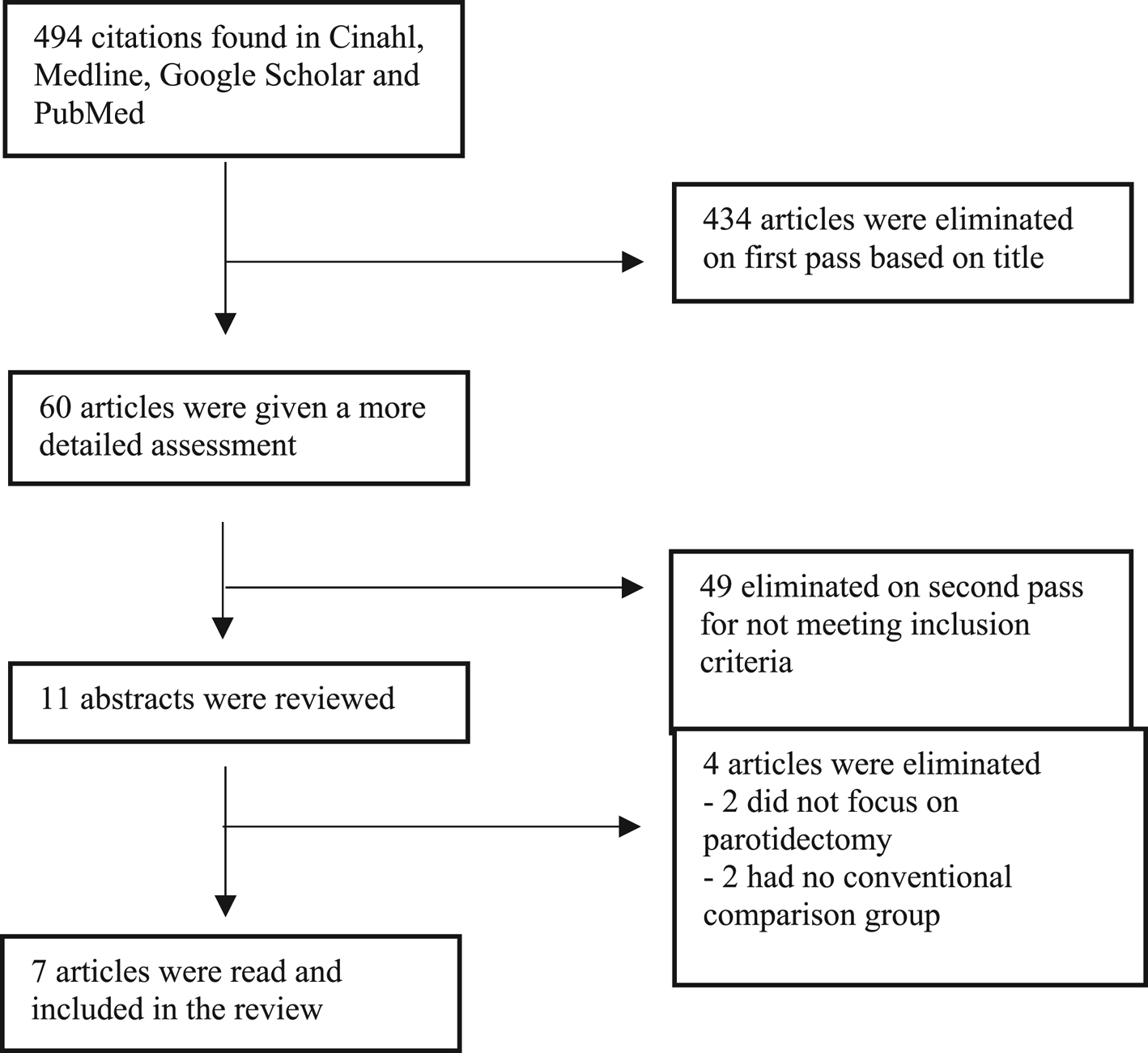
An electronic search of the literature was conducted for citations on the use of haemostatic devices in parotidectomy using the following databases: Google Scholar, PubMed, Cinahl and Medline. Keywords included: parotidectomy, scalpel, facial nerve and injury. Studies reviewed were published no earlier than 2000. This time frame corresponds approximately with the widespread adoption of these devices into surgical practice. Relevant studies were identified and reviewed independently by two reviewers (L Allen and S M Taylor). A total of seven studies were selected for analysis based on the inclusion criteria (Figure 1).
Diagram showing a systematic review of the literature.

Inclusion criteria
Studies that met inclusion criteria measured facial nerve outcomes in parotidectomy for haemostatic devices and traditional scalpel and cautery. Other outcome measures, including operating time, intra-operative blood loss, post-operative drain output and length of hospital stay were favourable but not required. All studies included were published in English between 2000 and 2018. Studies excluded were those that did not evaluate facial nerve outcomes or did not compare the use of haemostatic devices to traditional methods.
No inclusion criteria were defined for the type of study (i.e. retrospective or prospective), type of surgery (i.e. partial or total parotidectomy) or the type of surgical pathology (i.e. benign or malignant), although these data were collected where available. Studies must have been published as full reports: conference abstracts and letters to the editor were not included. Four of the studies were non-randomised retrospective reviews, two were non-randomised prospective reviews and one was a randomised prospective review. Exclusion criteria for participants in all except two studies included: prior parotid surgery, concurrent neck surgery and prior facial nerve weakness. The exceptions are the studies by Salami et al.,Reference Salami, Dellepiane, Bavazzano, Crippa, Mora and Mora23 who did not specify prior facial nerve weakness, and Hahn and Sørensen,Reference Hahn and Sørensen8 who did not specify any of the three criteria but who measured facial nerve function using House–Brackmann grading pre- and post-operatively.
Analysis
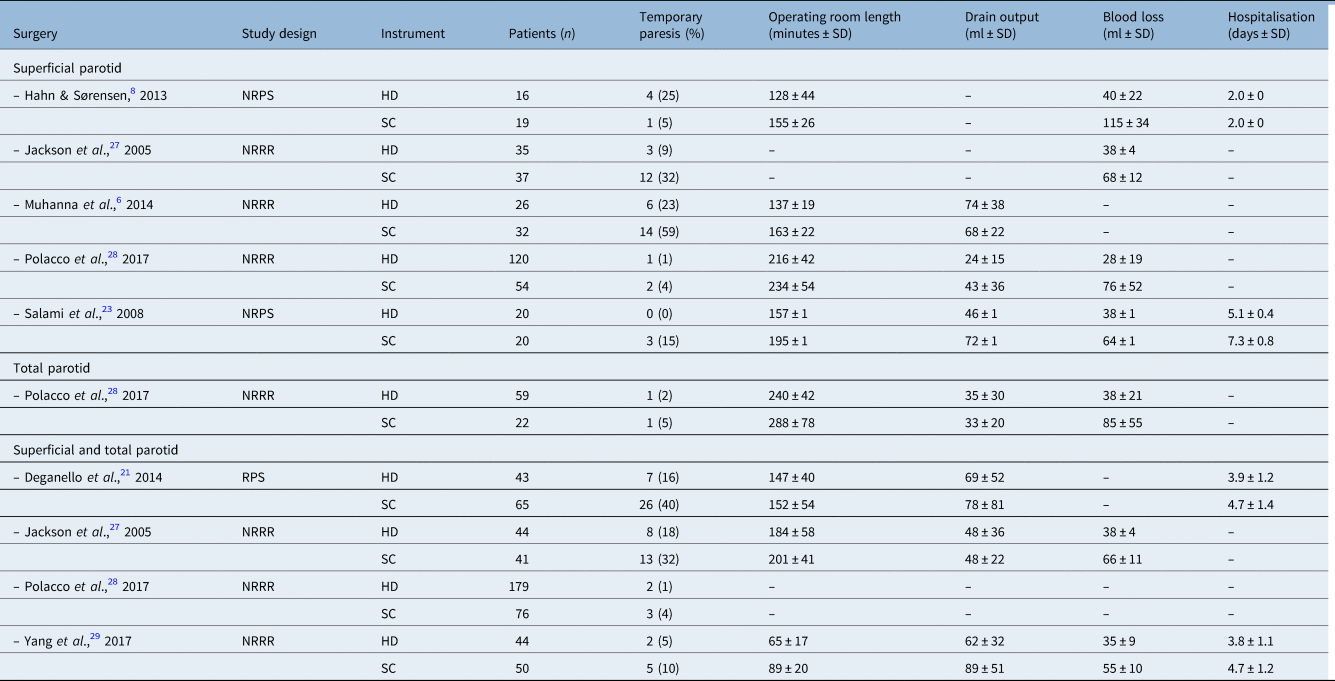
Data for the described outcome measures in total and superficial parotidectomy were compiled using Microsoft Excel® spreadsheet software (version 16.10; Table 1). Analysis was only performed for superficial parotidectomy data. Specifically, a meta-analysis of combinable studies was performed, and heterogeneity was assessed for each outcome. Random effects models, tests of heterogeneity and forest plots were generated.
Literature comparing outcomes in parotidectomy

SD = standard deviation; NRPS = non-randomised prospective review; HD = haemostatic device; SC = scalpel and cautery; NRRR = non-randomised retrospective review; RPS = randomised prospective study
Results
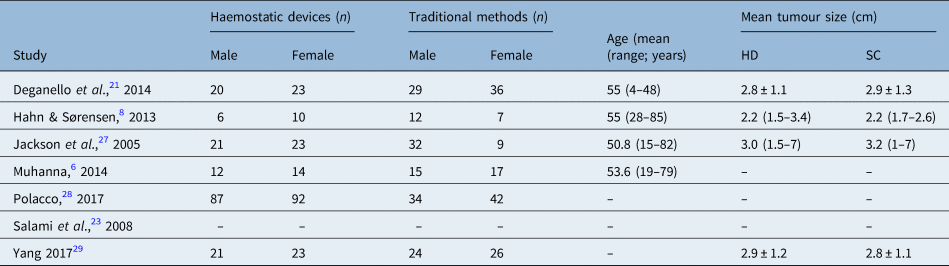
Seven studies were included with a total of 675 patients: 372 patients were treated with haemostatic devices, and 303 patients were treated with traditional scalpel and cautery. Mean age ranged from 50.8 to 55 years in the studies that reported mean age, and mean tumour size ranged from 2.2 to 3.2 cm in reporting studies (Table 2). Outcomes with statistical significance for superficial parotidectomy included operating time, intra-operative blood loss and post-operative drain output (p < 0.01 for all three outcomes). Outcome measures that did not favour either treatment included facial nerve paresis and hospital stay (Figures 2–5).
Patient characteristics

HD = haemostatic device; SC = scalpel and cautery
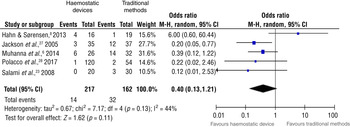
Forest plot of the odds ratio of temporary facial paresis after superficial parotid surgery using haemostatic devices versus traditional methods. Calculated using a random effects model. The size of the square represents the weight of the study with larger squares representing the studies with greater precision. The centre of the diamond represents the estimated effect size and direction of the effect, and the ends of the diamond represent the confidence interval. M-H = Mantel–Haenszel; CI = confidence interval

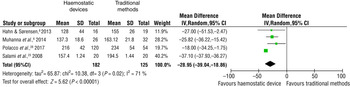
Forest plot of the mean difference of operating time for superficial parotidectomy surgery between haemostatic devices versus traditional methods. Calculated using a random effects model. The size of the square represents the weight of the study with larger squares representing the studies with greater precision. The centre of the diamond represents the estimated effect size and direction of the effect, and the ends of the diamond represent the confidence interval. SD = standard deviation; IV = inverse variance; CI = confidence interval

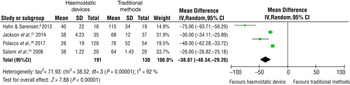
Forest plot of the mean difference of intraoperative blood loss during superficial parotidectomy surgery between haemostatic devices versus traditional methods. Calculated using a random effects model. The size of the square represents the weight of the study with larger squares representing the studies with greater precision. The centre of the diamond represents the estimated effect size and direction of the effect, and the ends of the diamond represent the confidence interval. SD = standard deviation; IV = inverse variance; CI = confidence interval

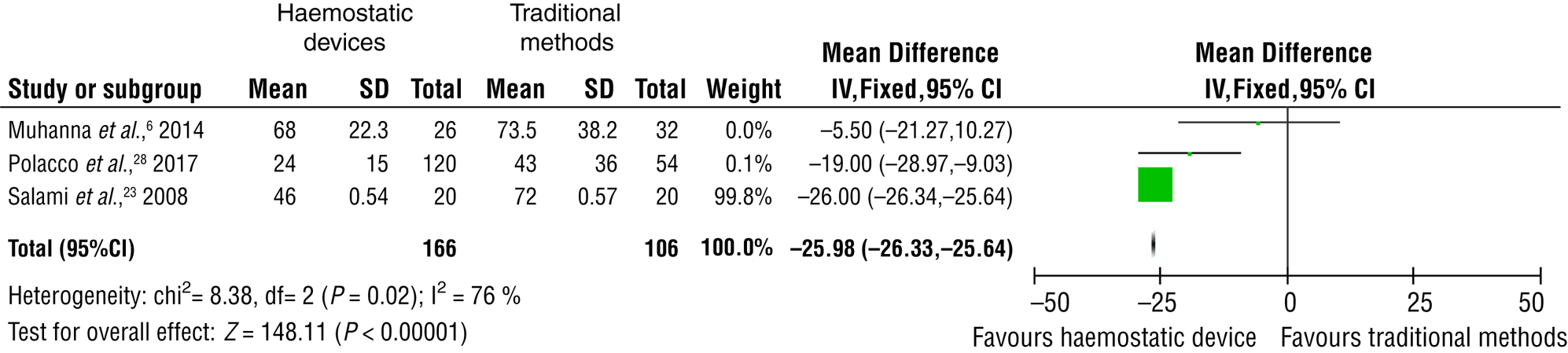
Forest plot of the mean difference of post-operative drain output (millilitres) following superficial parotidectomy surgery between haemostatic devices versus traditional methods. Calculated using a random effects model. The size of the square represents the weight of the study with larger squares representing the studies with greater precision. The centre of the diamond represents the estimated effect size and direction of the effect, and the ends of the diamond represent the confidence interval. SD = standard deviation; IV = inverse variance; CI = confidence interval

Temporary facial paresis
Of the seven studies included in the review, five had separate superficial parotidectomy data for the temporary facial paresis outcome. These studies were combined, and the odds ratio was calculated as the effect size. The heterogeneity was moderate for these data (I2 = 44 per cent); therefore, a random effects model was used. The odds ratio estimate was 0.40 (95 per cent confidence interval (CI), 0.13 to 1.21), which did not significantly favour either treatment (p = 0.11; Figure 2).
Operating time
Of the seven studies included in the review, four had separate superficial parotidectomy data for the operating time outcome. These studies were combined, and the mean difference was calculated as the effect size. The heterogeneity was substantial for these data (I2 = 71 per cent); therefore, a random effects model was used. The mean difference estimate was − 28.95 minutes (95 per cent CI, −39.04 to − 18.86), which significantly favoured treatment using haemostatic devices (p < 0.01; Figure 3).
Intra-operative blood loss
Of the seven studies included in the review, four had separate superficial parotidectomy data for the intra-operative blood loss outcome. These studies were combined, and the mean difference was calculated as the effect size. The heterogeneity was considerable for these data (I2 = 92 per cent); therefore, a random effects model was used. The mean difference estimate was − 38.87 ml (95 per cent CI, −48.54 to − 29.20), which significantly favoured treatment using haemostatic devices (p < 0.01; Figure 4).
Post-operative drain output
Of the seven studies included in the review, three had separate superficial parotidectomy data for the post-operative drain output outcome. These studies were combined, and the mean difference was calculated as the effect size. The heterogeneity was substantial for these data (I2 = 76 per cent); therefore, a random effects model was used. The mean difference estimate was − 25.98 ml (95 per cent CI, −26.33 to − 25.64), which significantly favoured treatment using haemostatic devices (p < 0.01; Figure 5).
Length of hospital stay
Of the seven studies included in the review, two had separate superficial parotidectomy data for the days of hospital stay outcome. These studies were combined, and the mean difference was calculated as the effect size. The heterogeneity was unable to be assessed for this analysis due to all patients in one study having the same length of stay (two days); therefore, a random effects model was used. The mean difference estimate was therefore essentially the mean difference from the Salami et al.Reference Salami, Dellepiane, Bavazzano, Crippa, Mora and Mora23 study which was − 2.20 days (95 per cent CI, −2.59 to − 1.81), which did not significantly favour either treatment (p = 0.32; not shown).
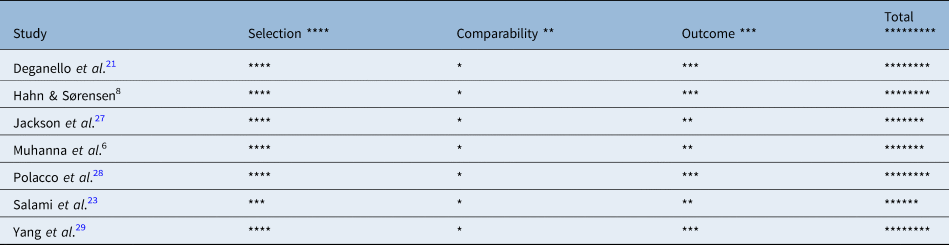
Quality of evidence for included studies was evaluated using the Modified Newcastle-Ottawa Quality Assessment Scale for Cohort Studies (Table 3). All studies were of good quality with three to four of four possible stars in the selection domain and one of two possible stars in the comparability domain and two to three of three possible stars in the outcome domain.
Modified Newcastle-Ottawa quality assessment scale for cohort studies: evaluation of included studies

*Number of points per article in reference to the total points possible per category as indicated in each column title
Discussion
Statistically significant outcomes favouring the use of haemostatic devices over traditional methods were intra-operative blood loss, operating time and post-operative drain output. These findings are consistent with current literature supporting the use of haemostatic devices in head and neck surgery. However, our findings specifically address the advantages of these devices in parotidectomy. Interestingly, our results do not show that they are superior to traditional methods in terms of reducing facial nerve injury, but our results do strengthen existing literature that shows haemostatic devices reduce operating time and intra-operative blood loss. From a clinical standpoint, the importance of limiting blood loss intra-operatively is important with regards to facial nerve dissection. That is, visualisation is key for facial nerve preservation. Limiting intra-operative blood loss and improving surgical field visualisation may contribute to a reduction in operating time: two findings that are consistent in the literature. However, further studies are needed to clarify our findings and this correlation.
It is also important to consider the impact of haemostatic devices on operating costs. For example, the Harmonic Scalpel is relatively expensive because of upfront costs and disposability. However, studies have demonstrated greater or comparable cost-effectiveness between the Harmonic Scalpel and conventional instruments used in head and neck surgery because of the reduction in operating time.Reference Pons, Gauthier, Clément and Conessa16,Reference Sebag, Fortanier, Ippolito, Lagier, Auquier and Henry24–Reference Koutsoumanis, Koutras, Drimousis, Stamou, Theodorou and Katsaragakis26 Similarly, our analysis shows that haemostatic devices reduce operating time, which may justify their cost. However, this was not an outcome measured in this study, and further research is needed to clarify the cost-effectiveness of these devices in head and neck surgery.
The results of this study demonstrate a benefit for the use of haemostatic devices in terms of reducing post-operative drain output but not for reducing length of hospital stay. To our knowledge, this is the largest meta-analysis to date that measures these outcomes in parotidectomy. We plan to add significant data to the literature in the near future as the senior author (S M Taylor) has performed over 50 superficial parotidectomy procedures with the Harmonic Scalpel without the use of a post-operative drain. All patients had combined sternocleidomastoid flaps with pressure dressings, and all patients with one exception were discharged home the day following surgery.
Study limitations
None of the studies used for meta-analysis were randomised controlled trials. Care was taken to ensure comparability of the data being combined. However, given the small number of studies included and the amount of heterogeneity, especially where the I2 value was greater than 60 per cent, these estimates should be interpreted with caution.
Although our results did not clearly lend favour to the use of haemostatic devices for facial nerve preservation, vigilance should be taken when interpreting our results because of bias toward publishing in support of haemostatic devices. This bias may be present in the existing literature and could be due to surgeons’ preference for a particular operative method or device, which may therefore influence this analysis. Our results do highlight the need for further research to more clearly define the role of haemostatic devices in facial nerve preservation.
Conclusion
The use of the Harmonic Scalpel and LigaSure small jaws, when compared with traditional instruments, likely play a role in reducing operating time and intra-operative blood loss in parotidectomy, but they do not appear to impact frequency of facial nerve injury. Another advantage may be reducing post-operative drain output. The impact of these devices on cost effectiveness in parotidectomy remains unclear.
Acknowledgements
L Allen and S M Taylor performed literature reviews. L Allen collected and organised data and prepared the manuscript. C MacKay assisted in data organisation and manuscript preparation, performed the meta-analysis and interpreted results, and provided conceptual direction. S M Taylor was responsible for development of the research question, design of the project and also provided conceptual direction, oversaw manuscript development and assisted in interpretation of results. M H Rigby assisted with data analysis and interpretation of results and provided conceptual direction. J Trites provided conceptual direction. All authors read and approved the final manuscript.
Competing interests
None declared