In our target article we proposed that unconscious influences have been ascribed inflated and erroneous explanatory power in theories of decision making. Many of the commentators agreed with our basic position, noting that more critical treatment of these issues was welcome and a debate overdue (Baumeister, Vohs, & Masicampo [Baumeister et al.]; González-Vallejo, Stewart, Lassiter, & Weindhardt [González-Vallejo et al.]; Huizenga, van Duijvenvoorde, van Ravenzwaaij, Wetzels, & Jansen [Huizenga et al.]; Rakow; Steingroever & Wagenmakers; Waroquier, Abadie, Klein, & Cleeremans [Waroquier et al.]). However, several other commentators strongly disagreed both with our principal claim and with a perceived selective review of the relevant literature (Brooks & Stein; Dijksterhuis, van Knippenberg, Holland, & Veling [Dijksterhuis et al.];Evans; Hassin & Milyavsky; McLaren, Dunn, Lawrence, Milton, Verbruggen, Stevens, McAndrew, & Yeates [McLaren et al.]). This clear divergence of opinion confirms that researchers remain divided on the role of consciousness in decision making and emphasizes the continued need for open discussion. We thank all the commentators, both those generally sympathetic to our analysis and those more critical, for their thoughtful and constructive remarks.
The structure of our reply mirrors that of the target article. First, in light of the critiques challenging our theoretical conceptualizations of consciousness and decision making, in section R1 we clarify what we mean by a “decision” and by an (un)conscious influence, and why we argue for the primacy of conscious rather than unconscious decision making. We then go on to consider commentators' challenges (and/or extensions) to the conclusions we drew in the main topic areas we reviewed. Thus section R2 considers multiple-cue learning; R3, the unconscious thought paradigm; and R4, the Iowa Gambling Task (IGT). Section R5 elaborates on the additional paradigms that we briefly reviewed – subliminal priming, blindsight, and primes-to-behavior. In section R6 we address issues that we did not cover in the original article – in particular the intriguing claim that the context in which decisions occur can exert unconscious influences (e.g., Helzer & Dunning). We conclude in section R7 by suggesting areas in which further study of the potential for unconscious influences on decision making could be particularly informative against the backdrop of current gaps in our knowledge and understanding.
R1. Defining the consciousness of a decision
Dijksterhuis et al., Evans, and Hassin & Milyavsky all question, in various ways, why we presume that in the absence of evidence to the contrary, decision making is a conscious process. These commentators all appear to advocate the opposite position of proposing that all decision making (all of cognition?) is unconscious, and that the onus should be on researchers to provide evidence of conscious influences. We find this line of argument ill-conceived and ill-defined.
Dijksterhuis et al. and Evans both suggest (incorrectly) that our position forces us to endorse a form of Cartesian dualism in which conscious “mind stuff” has powers of causation in the brain. But neither explain how unconscious “mind stuff” – that they argue plays such a central role in cognition – exerts its influence. Simply arguing that all conscious thought must have unconscious precursors begs the question of where these precursors come from.
For the avoidance of doubt, we emphasize that our position does not force us to assume that “consciousness freely hovers in the air” (Dijksterhuis et al.) nor is it remotely correct to state that “it borders in the mystical (or at least Cartesian dualism) to think of consciousness as some kind of ‘mind stuff’ that has powers of causation” (Evans). Claiming that all or most decisions have conscious precursors does not force us to embrace dualism or abandon materialism. We assume that all mental states are brain states. Software states in computers are equivalent to, or realized by, hardware states, yet it is still perfectly meaningful to say that a line of software code caused the printer to start working. Likewise, by any of the usual standards for judging what a cause is, consciously reportable mental processes cause behavior. This is not a dualistic claim – it is perfectly consistent with materialism. To say that report X caused behavior Y means, for example, that Y counterfactually would not have occurred if X had been absent.
A good example is the relationship between conditioning and awareness. In experiments on this topic, independent variables are employed to manipulate awareness levels, with conditioned responding as the dependent variable. Meeting Uhlmann's criterion, numerous studies demonstrate covariation between reportable awareness and conditioning (Lovibond & Shanks Reference Lovibond and Shanks2002), such that in the absence of awareness, conditioned responding is absent. Baumeister et al. make the excellent point that “by the logic of experimental design, such studies prove causation.” No one can seriously doubt that such inferences are valid. Reportable mental states correlate with behavior (my belief that light switches cause lights to come on correlates with my pressing the light switch); behaviors are prevented when the relevant mental state is absent (when I don't believe that pressing the light switch will cause the light to come on – it's been disconnected – I don't press the light switch); and interventions on those states cause or prevent the behavior (you telling me that you've disconnected the light switch will stop me believing that pressing will cause the light to come on and will stop me pressing the light switch). No such commonsense case can be made for unconscious states playing a causal role in behavior. There are no clear-cut and agreed instances in which an unreportable state causes a behavior that would not have occurred in the absence of that state. As the target article argues, it has not even been unequivocally proven that there are any unreportable states that cause behavior. And as Baumeister et al. say, “Does anyone seriously think that a student could pass a college math test without conscious thought?”
Evans argues that we have conflated the System or Type 1 versus System or Type 2 distinction with unconscious versus conscious. We acknowledge that consciousness is but one aspect by which the proposed different modes of thinking can be distinguished, and that for at least some authors it is not the primary one. Nonetheless, the particular instantiation of dual-process theorizing we focused on in the article (Usher et al. Reference Usher, Russo, Weyers, Brauner and Zakay2011) did use awareness of the stages of processing as a key defining feature of the difference between System 1 and System 2 (as illustrated in the quotation we took from that article). Appeals to other defining features, such as involvement of working memory in System 2 but not System 1 (Evans), are also fraught because of the difficulties inherent in interpreting “dissociations” (e.g., Newell & Dunn Reference Newell and Dunn2008), and because there have been repeated demonstrations of the necessity of working memory for tasks that are purportedly under System 1 control (e.g., Lewandowsky et al. Reference Lewandowsky, Yang, Newell and Kalish2012; Newell et al. Reference Newell, Lagnado and Shanks2007a; Reference Newell, Dunn and Kalish2010). In our view discussion about what kinds of processes should and should not be included “in” System 1 and System 2 is exactly the kind of hair-splitting and unproductive debate that appears to handicap the development of dual-process theories. In this regard we agree with Keren and Schul (Reference Keren and Schul2009) that “two-system models currently provide little scientific advance” (p. 533).
Ogilvie & Carruthers contend that even though individuals may be able to give informative reports about their decision processes, this provides no guarantee that these reports accurately reflect knowledge that was both conscious and causal at the time the decision was made. In relation to the IGT, for instance, the accurate ratings given by Maia and McClelland's (Reference Maia and McClelland2004) participants may have been based on their affective reactions to the decks, and not at all causal in regard to deck selection choices. We commented on this possibility in the target article (sect. 4.2) and cited some of the extensive evidence against it in the context of the IGT. But we acknowledge the more general points that (a) many awareness assessments probe post facto knowledge that may have been constructed after the decision itself, and (b) even for knowledge assessed contiguously with a decision, it is a challenge to establish that such knowledge was causal in relation to the decision. One general strategy is to ask whether verbal reports correlate better with choices than do affective reactions or somatic markers; Gutbrod et al.'s (2006) data suggest this is highly likely, though more research is needed on this issue. To that extent, it is plausible to attribute a causal role to conscious knowledge.
Several commentators (Bernacer, Balderas, Martinez-Valbuena, Pastor, & Murillo [Bernacer et al.]; Hogarth; Srinivasan & Mukherjee) raise the issues of attention, automaticity, and habitual behavior. We agree that attention is distinct from awareness and that attention is required for virtually all decisions. Hogarth expresses surprise that we did not explore the topic of automatic processes in more detail. We do not dispute that the acquisition of many physical or perceptual-motor skills involves a period in which people are acutely aware of their movements, and that when such skills are mastered, they are executed with very shallow phenomenological experience. However, just because we allocate very little attention to and engage in minimal monitoring of the mental operations involved in performing perceptual-motor skills, it does not follow that such skills are controlled and executed unconsciously. A relevant example comes from studies of ball catching. Although this ability is often highlighted as a paradigmatic case of a skill outside conscious control, detailed analyses of what people know about the cues they use to decide whether to advance or retreat to intercept and catch a ball reveal surprisingly rich and accurate information (e.g., Reed et al. Reference Reed, McLeod and Dienes2010). Thus while we agree with Hogarth that it can be difficult to prove or disprove the role of unconscious influences in such skills, those studies that have tried to do so provide evidence that falls far short of demonstrating independence from conscious control.
Bernacer et al. suggest that habits are a distinct form of behavior characterized by unconscious triggering alongside conscious monitoring. Thus consciousness can reclaim control of behavior when a difficulty arises. We are not convinced that it is meaningful to say that habits involve any decisions at all. A pianist is not deciding to play each note, and as evidence for this we would point to the fact that true habits run on independently of their consequences: They are “pushed” by the eliciting cues rather than “pulled” toward a goal. Dickinson (Reference Dickinson1985) has shown that habitual responses (such a lever pressing by a hungry rat) continue even if their outcomes (food pellets) have been devalued (e.g., by being paired with poison). A defining characteristic of a decision is that it involves the weighing of different outcomes, which is precisely what is absent in habitual behavior.
In the target article we employed a lens model analysis to explicate the ways in which unconscious influences on behavior might be realized. An elegant redescription of the issue is provided by Sher & Winkielman, who frame it in terms of the relationship between cognition and metacognition. We would certainly not want to take up the challenge they put to us of proposing a cognitive architecture in which cognition and metacognition are inseparable. However, we stress that their cognition/metacognition view does not align with our own conception. We do not believe that a prominent place in the human cognitive architecture needs to be assigned to mental states that may (or may not) become the object of other, metacognitive, states. Instead, we believe that awareness and reportability are intrinsic properties of many mental states. States become reportable not because other states pick them up and move them to the consciousness box, but because reportability is part of (or an affordance of) what they are as states in the first place. How much hinges on this conceptual disagreement we leave for others to judge. Our principal claim is an empirical one, namely, that the coupling between cognition and metacognition, if that is how one wishes to frame it, is far tighter than many have assumed, although we certainly do not deny the theoretical possibility that they can be dissociated. Sher & Winkielman offer the distinction between procedural and declarative knowledge as an empirical example, the former being the “cognitive” part and the latter the “metacognitive” part. We have analyzed this distinction in considerable depth elsewhere (Berry et al. Reference Berry, Shanks, Speekenbrink and Henson2012) and maintain that the evidence does not support the view that people can only “declare” a subset of their procedural knowledge. Last, we agree wholeheartedly with the point Sher & Winkielman make about the incentives in place that might induce researchers to make Type I errors in their observations of the behavior of interest but Type II errors concerning their observations about participants' reports about those behaviors.
Ingram & Prochownik quote from Haidt (Reference Haidt2007) concerning fast and automatic moral intuitions “in which an evaluative feeling of good-bad or like-dislike … appears in consciousness without any awareness of having gone through steps of search, weighing evidence, or inferring a conclusion,” to which we reply, what's the evidence that these intuitive responses went through such steps? Perhaps they were based on one-reason decision making? We also suggest that Ingram & Prochownik are muddled in two further respects. First, we certainly do not (as they imply) confuse awareness of stimuli with awareness of their influence: The lens model framework incorporates this distinction very clearly. Second, they misinterpret the proximal–distal distinction so as to effectively equate a forgotten or neglected distal cue with an unconscious influence. These are quite different things. Our argument is that forgotten distal cues (e.g., Mother always told me that spinach was good for me) are irrelevant to understanding decision making if they causally triggered a chain of events that eventuates in a reportable proximal cue (the current belief that spinach is healthy).
Velmans asks us to consider distinct ways in which a process might be conscious and suggests that adopting a broader perspective leads to the conclusion that evidence for unconscious mental processes is “ubiquitous.” To illustrate his point, Velmans considers the phenomenological experience of reading the sentence: If we don't increase the dustmen's wages, they will refuse to take the refuse. He argues that the syntactic and semantic processing required to assess meaning and assign appropriate stress to “refuse” in the two instances in which it appears must occur outside awareness. This conclusion, however, appears to be at odds with our (and others', based on an informal survey) phenomenological experience: Encountering the second instance of “refuse” provokes hesitation in readers precisely because there is an awareness of the need to correct an initial temptation to pronounce it using the same stress as in the first instance. The correction appears to be a clear instance of “conscious control” over our behavior: An action was initiated (i.e., saying “refuse”), but we “selected” an alternative (i.e., saying “refuse”). Many of us could probably also (correctly) introspect that the inappropriate pronunciation was triggered on the second encounter because we were primed by the initial, alternative pronunciation.
In the target article we made it clear that we do not consider it useful to ask whether, for example, area V5's computation of motion is or is not conscious because we view consciousness as a property of individuals. Thus Velmans's claim that because we are “not conscious of the complex input analyses” involved in reading text on a page, such processes must occur outside conscious control is, we would argue, a category mistake (Ryle Reference Ryle1949). In contrast, it is perfectly reasonable to ask whether an individual is conscious of hesitation in reading sentences containing heteronyms.
R2. Multiple-cue judgment: Challenges and extensions
Rakow and González-Vallejo et al. make the very important point that the validity of self-insight measures is dependent on assumptions about the model underlying judgment. We noted this issue briefly in the target article (sect. 2.4) and agree that judges may often use other models such as similarity to exemplars or sequential heuristics in their judgments. We welcome Rakow's concept of “double-model recovery” and think it could be used very profitably in future research on policy capturing and self-insight. Both commentaries reinforce the point that an inappropriate approach to modeling the judge's implicit policy may lead us incorrectly to misattribute poor self-insight.
R3. Deliberation without attention: Challenges and extensions
We note that of the commentaries which discussed unconscious-thought theory (UTT) and deliberation without attention (DWA), all except one agreed with our general conclusion that such studies fail to provide unequivocal evidence for the involvement of active unconscious processes (González-Vallejo et al.; Huizenga et al.; Srinivasan & Mukherjee; Waroquier et al.). Even those who disagreed with almost everything else in our article agreed that the claims made for the powers of unconscious thought are too strong (Evans).
The exception was Dijksterhuis et al., who criticize us for (among other things) “cherry picking” the studies we reviewed in regard to the DWA effect. Our review was necessarily selective, bearing in mind the burgeoning literature on this topic, and our inclusion criterion was firmly based on discussing the strongest evidence, whether for or against unconscious influences. Dijksterhuis et al. refer to their recent meta-analysis (Strick et al. Reference Strick, Dijksterhuis, Bos, Sjoerdma, van Baaren and Nordgren2011), which they claim now allows the unconscious thought effect to be replicated with greater ease. What happens when all the moderators of the effect that are identified in this meta-analysis are set to the values most conducive to obtaining it? Nieuwenstein and van Rijn (Reference Nieuwenstein and van Rijn2012) provide the answer to this question: It is not obtained. These authors carefully set up a DWA experiment so as to optimize the likelihood of a benefit from unconscious thought, but they had no success whatsoever. For example, they ensured that pictorial information was presented with the choice options together with a relatively short presentation time, factors identified in the meta-analysis as being important moderators. Their results suggest that the Strick et al. (Reference Strick, Dijksterhuis, Bos, Sjoerdma, van Baaren and Nordgren2011) meta-analysis should be treated with considerable caution.
An additional moderator adhered to (in vain) by Nieuwenstein and van Rijn was the use of a moderately difficult distractor task in the unconscious thought condition. Waroquier et al. discuss recent findings suggesting that DWA effects are strongest when “low-effort” distractor tasks are used (Abadie et al. Reference Abadie, Waroquier and Terrier2013; McMahon et al. Reference McMahon, Sparrow, Chatman and Riddle2011). As an initial comment, we note that only the latter study includes an experiment that satisfies our (non-arbitrary) criteria for demonstrating a DWA effect (see target article sect. 3.1), and that experiment (McMahon et al. Reference McMahon, Sparrow, Chatman and Riddle2011, Experiment 1) failed to counterbalance the presentation order of different choice options, leading to the possibility that the DWA advantage was simply a result of a recency bias (cf. Newell et al. Reference Newell, Wong, Cheung and Rakow2009). (We also note that the mode of thought effect in their second experiment – which did not include an immediate thought condition – failed to reach conventional levels of statistical significance.)
The results of the Abadie et al. (Reference Abadie, Waroquier and Terrier2013) study are intriguing, and we welcome further replications using the modified procedure that they adopted in their experiment. However, the more general point made by Waroquier et al. – that “too much attention may sometimes be detrimental” is not at odds with our conclusions. Contrary to Waroquier et al.'s claim, we do not propose a monotonic “more conscious attention=better decision making” view (see sect. 6.2 of the target article). Indeed, one of us (Shanks Reference Shanks2006) was quick to point out that the Dijksterhuis et al. (Reference Dijksterhuis, Bos, Nordgren and van Baaren2006b) result may well have been due to the detrimental effect of inappropriate conscious thinking rather than any advantage of unconscious thinking (cf., Mamede et al. Reference Mamede, Schmidt, Rikers, Custers, Splinter and van Saase2010; Payne et al. Reference Payne, Samper, Bettman and Luce2008). We agree that some of these issues can be clarified by demarcating the differences between attention and awareness (cf. Srinivasan & Mukherjee), but simply suggesting that the term “deliberation without attention” could be replaced with “deliberation without consciousness” (see Strick et al. Reference Strick, Dijksterhuis, Bos, Sjoerdma, van Baaren and Nordgren2011) is not going to help matters. In our view, and it seems that of many commentators, evidence of active processing occurring “outside” conscious awareness in this paradigm is lacking.
In this regard we concur with Huizenga et al., who make the insightful point that the unconscious thought paradigm is ill-suited to test claims about the superiority of different modes of decision making (cf. Srinivasan & Mukherjee; Newell et al. Reference Newell, Wong, Cheung and Rakow2009). The strategy-convergence issue raised by Huizenga et al. is an important one to tackle if we are to obtain clear evidence about the purported abilities of unconscious thought. Progress is already being made in this regard, as noted by Huizenga et al., and to their list we add another recent study by Pachur and Forer (Reference Pachur and Forer2013) that sheds light on the use of different decision strategies (e.g., LEX, WADD, EQW) following different modes of thought. Pachur and Forer find a slight (and statistically nonsignificant) tendency for participants in an unconscious thought condition to use a compensatory equal-weights strategy (EQW) more than those in a conscious thought condition, but find no difference in the use of a weighted-additive strategy (WADD) across conditions. This latter finding is clearly contrary to the weighting principle of UTT (Dijksterhuis & Nordgren Reference Dijksterhuis and Nordgren2006), which states that unconscious thought leads to more efficient and accurate weighting of attribute values. On a related point, we were also somewhat surprised by Dijksterhuis et al.'s statement that “Obviously, participants are capable of generating post hoc weights that justify their previous choice.” While we agree, we thought the key claim was that choices following unconscious thought would be more consistent with these weights than those following conscious and immediate thought (e.g., Dijksterhuis Reference Dijksterhuis2004). In line with the conclusions of González-Vallejo et al., we see little evidence in the literature to support this claim.
In a somewhat related vein, Uhlmann questions our interpretation of research on “reasons analyses,” arguing that such effects are consistent with people lacking conscious introspective access into the “true” bases for their attitudes and subsequent choices (e.g., Wilson & Schooler Reference Wilson and Schooler1991). The key feature of these studies is that participants who are invited to provide reasons to support their choices end up making objectively poorer decisions, and sometimes exhibit greater post-choice regret, than those who make “unexamined” choices. While such studies support the idea that preferences are constructed, labile, and influenced (sometimes detrimentally) by deliberation, we fail to see why they force the conclusion that some influences on choice lie outside awareness. Both sorts of choice – those made intuitively and ones accompanied by an analysis of reasons – are, we contend, accompanied by awareness of the proximal basis for that choice. The fact that this proximal basis might not be the same in the two cases does not imply that the unexamined choice was mediated via an unconscious process.
R4. Iowa Gambling Task: Challenges and extensions
We argued that participants are able to learn to make advantageous choices in the IGT but concurrently acquire considerable levels of awareness and insight into the payoff structure of the decks and of the optimal decision-making strategy. Steingroever & Wagenmakers argue that in one important respect our conclusion is incorrect: Participants do not learn to discriminate the good from the bad decks at all (Huizenga et al. make a similar point). It must be emphasized, however, that although Steingroever & Wagenmakers dispute our analysis, their viewpoint does not challenge our general conclusion about the role of awareness in decision making: If, as they claim, there is minimal discrimination in the IGT, then it also provides no evidence of unconscious influences on decision making.
It is important to note that the conclusions of Steingroever & Wagenmakers may be overly strong, in two respects. First, their statement that there is “a lack of both conscious and unconscious knowledge in this task” is contradicted by their own results, which show that participants learn a great deal about the decks – albeit about their associated loss frequencies rather than long-run payoffs. In principle, this loss-frequency learning could be unconscious.
Second, while we agree with them that participants in the IGT often show a prominent frequency-of-losses effect (a result we ourselves have obtained), this does not mean that they fail to show discrimination between good and bad decks. In our own studies (Konstantinidis & Shanks Reference Konstantinidis and Shanks2013), such discrimination has invariably been statistically significant. We suspect that one or more methodological factors to do with the payoff schedule or the level of performance-related reward or indeed the inclusion of awareness measures may account for this difference, though clearly more work on this issue is called for. But we reiterate that whether or not participants can discriminate good from bad decks in the IGT, Steingroever & Wagenmakers agree with us that the IGT provides minimal evidence for unconscious influences.
In a related comment, McLaren et al. suggest that some studies on the IGT (and variants thereof) that we omitted from our review do show evidence for unconscious influences. However, McLaren et al. themselves note that one of these studies (Guillaume et al. Reference Guillaume, Jollant, Jaussent, Lawrence, Malafosse and Courtet2009) adopted a less than ideal method for indexing awareness. We share this reservation. Guillaume et al. found that explicit knowledge and differential skin conductance response (SCR) magnitude can be uncorrelated. These researchers presented their participants with a standard 100-trial IGT, measuring SCRs concurrently with card selections. Awareness was only assessed at the end of the task, and Guillaume et al. used responses to the awareness questions to classify participants as having no awareness, partial awareness (conscious knowledge of which decks were good or bad), or complete awareness (knowledge of the relative payoffs of the decks). Whereas participants classified as having no awareness performed at chance on the task, higher levels of awareness were associated with increasing proportions of selections from the good decks. Thus awareness correlated with card selections. Likewise, Guillaume et al. found that the extent to which SCRs differed in anticipation of bad versus good deck selections correlated with choice behavior. Yet awareness was not correlated with differential anticipatory SCRs.
While Guillaume et al. (Reference Guillaume, Jollant, Jaussent, Lawrence, Malafosse and Courtet2009) speculated that such a finding is consistent with awareness and somatic markers having independent influences on decision making, they also acknowledged that the nonsignificant correlation (reported as reaching p = 0.1) could simply be the result of low statistical power. We would add to this that their awareness classification was less than ideal as it was presented only once at the end of the task (raising problems of lack of immediacy) and did not include any questions requiring numerical estimates. Instead, the questions required very coarse-grained responses (e.g., “suppose you select 10 new cards from the deck, will you on average win or lose money?”). Since other studies show a gradual development of differential anticipatory SCRs (Gutbrod et al. Reference Gutbrod, Kroužel, Hofer, Müri, Perrig and Ptak2006) and a gradual development of differential awareness (Bowman et al. Reference Bowman, Evans and Turnbull2005; Cella et al. Reference Cella, Dymond, Cooper and Turnbull2007; Evans et al. Reference Evans, Bowman and Turnbull2005), it seems likely that a positive relationship between awareness and SCR differentiation would be observed if the former were measured more sensitively and immediately.
A further study is cited by McLaren et al. as providing evidence for unconscious influences in an IGT-like task. In this study (Dunn et al. Reference Dunn, Galton, Morgan, Evans, Oliver, Meyer, Cusack, Lawrence and Dalgleish2011), participants in one group were probed by the Maia and McClelland (Reference Maia and McClelland2004) awareness questions. For another group, decision making (deck selections) was related to bodily signals (i.e., somatic markers) based on electrodermal responses and heart rate, with the latter two measures being combined into an index of “bodily differentiation,” which assessed for each participant his or her bodily reaction to the good versus the bad decks. Dunn et al. also measured these participants' sensitivity to their own heart rate. The main and highly intriguing finding was that in those individuals who showed high sensitivity to their own heart rate, deck selections were correlated with bodily differentiation, whereas this was not the case for those who showed poor sensitivity. This pattern suggests that bodily signals play an important role in decision making, but only to the extent that they are accurately perceived. Although this is an impressive finding, there are two reasons why it is more consistent with a primary role for conscious processes in decision making than with a causal role for somatic markers. First, sensitivity to heart rate was assessed via a consciously reportable measure, namely, participants' accuracy in reporting the number of beats in a specified time interval. Second, in the group of participants who were administered awareness probes, above-chance levels of awareness entirely in line with those reported by Maia and McClelland (Reference Maia and McClelland2004) were observed. Hence awareness was, at the very least, strongly correlated with the variables assumed to be causally related to deck selections. A promising avenue for future research would be to collect all of the relevant data within a single group of participants to allow analytic techniques such as structural equation modeling to be brought to bear to untangle the causal pathways.
McLaren et al. also refer to research on the relationship between rules and the “peak-shift” effect, which demonstrates striking qualitative differences in patterns of behavior between individuals who can versus those who cannot report a categorization rule. We acknowledge that such effects, although reliant on retrospective reports, provide impressive evidence for unconscious influences. Future studies employing online awareness assessments would be very valuable.
R5. Subliminal priming, primes-to-behavior, and blindsight: Challenges and extensions
In our view, the points of disagreement highlighted by Finkbeiner & Coltheart and Snodgrass, Shevrin, & Abelson (Snodgrass et al.) are vastly overshadowed by the common ground we share with them. These commentators review in detail some of the factors that might lead unwary researchers to draw erroneous conclusions from subliminal priming experiments, such as using inappropriate awareness discriminations (e.g., prime categorization), response biases, task difficulty, and null sensitivity. As Finkbeiner & Coltheart explain, the latter problem alone renders virtually all work conducted within the null hypothesis significance-testing framework uninterpretable. Similarly, on the basis of the doubts they raise over the use of identification and categorization tasks to assess prime awareness, Snodgrass et al. conclude that virtually all recent studies of “subliminal investigations of cognitive control processes … do not conclusively rule out conscious partial identification.”
We thoroughly applaud the careful methods employed in the impressive studies Finkbeiner & Coltheart and Snodgrass et al. describe, which appear convincingly to demonstrate subliminal effects (e.g., Finkbeiner Reference Finkbeiner2011) – and we very much hope that future explorations expand these research programs into more mainstream decision-making tasks – and evaluate priming effects over considerably longer time intervals than a few tens of milliseconds. But the most important point is that almost all decision-making research reported in the past few years using subliminal priming methods has fallen far short of the methodological requirements described by Finkbeiner & Coltheart and Snodgrass et al., and until this is recognized, inferences about unconscious influences must remain in doubt.
We imagine that Finkbeiner & Coltheart and Snodgrass et al. will view Hassin & Milyavsky's and Brooks & Stein's conclusions in much the way that we do, namely, as considerably overestimating the implications of recent research and underestimating the viability of alternative explanations. To give just one example, Hassin & Milyavsky refer to research using continuous flash suppression by Sklar et al. (Reference Sklar, Levy, Goldstein, Mandel, Maril and Hassin2012), which appears to show that reading and doing arithmetic can be achieved unconsciously. Yet by their own awareness tests, and putting aside issues such as task difficulty and null sensitivity in the awareness check, the majority of Sklar et al.'s participants were conscious (i.e., performed above chance in a forced-choice discrimination). Sklar et al. only obtained evidence of unconscious processing by eliminating participants post hoc who performed above chance on the awareness test. As we have argued at length elsewhere (Shanks & Berry Reference Shanks and Berry2012), this introduces a statistical artifact (regression to the mean) that renders the apparent evidence of unconscious processing almost meaningless. At the very least, these experiments need to be done in such a way that each subject is rendered categorically unconscious of the prime, rather than it being left to individual perceptual variability. Brooks & Stein describe subliminal fMRI studies that purportedly demonstrate activation of neural systems involved in emotion and memory such as the amygdala and hippocampus. This is undoubtedly an important research topic, but until due attention is devoted to the methodological issues described by Finkbeiner & Coltheart and Snodgrass et al., interpretation must remain uncertain.
Persaud & McLeod describe data from a binary exclusion task in which participants see a briefly presented letter (“b” or “h”) on each trial and are asked simply to report the letter that was not shown. Their experiments with this task (e.g., Persaud & McLeod Reference Persaud and McLeod2007) reveal that when the stimuli are presented for 15 ms, participants follow the instructions without undue difficulty and tend to respond “h” when “b” is presented and vice versa. However, at shorter presentation durations (5–10 ms) a striking reversal is found, whereby participants tend to report the stimulus that was presented, counter to the instructions. Persaud & McLeod argue that this must be an unconscious influence on responding because if information about the stimulus was consciously represented, participants would follow instructions and respond with the identity of the stimulus not shown.
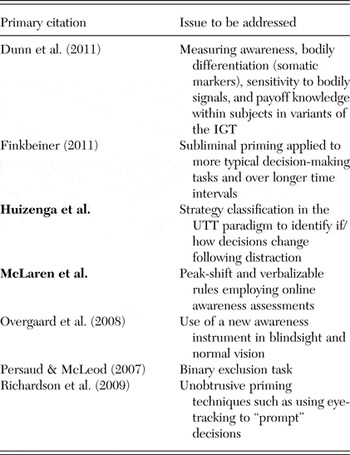
We acknowledge the elegant simplicity of this demonstration and urge researchers to explore it further (see Table R1). Other studies using this basic task have not obtained the same result (Fisk & Haase Reference Fisk and Haase2006; Reference Fisk and Haase2007), so its basis and boundary conditions require further exploration. We also note the peculiarly contradictory position that Persaud & McLeod inevitably find themselves in regarding their definition of unconscious perception. In their studies, they found that at very short presentation durations participants could not make the correct exclusion response, and instead reported the identity of the presented letter. Persaud & McLeod take this to be an unconscious effect. At the same presentation duration, however, participants successfully reported the identity of the presented letter when explicitly instructed to do so (inclusion instructions – i.e., report “b” when “b” is present). The latter would, of course, normally be taken as direct evidence of conscious, not unconscious, processing.
Suggested studies where further research could address major outstanding questions.

Taking a similar line, Uhlmann cites studies in which priming effects from unobtrusive stimuli attenuate or even reverse when participants become aware of the stimulus. But there are many reasons why a change in cognitive state might modulate priming, even for conscious primes (Higham & Vokey Reference Higham and Vokey2000). From the fact that altered levels of awareness (e.g., from weak to strong) may reduce priming effects, it does not follow that priming can occur unconsciously.
The data surrounding blindsight are extensive and complex, but the idea that blindsight is little more than degraded conscious vision has proven extremely difficult to refute. In the target article we reviewed Overgaard's (Reference Overgaard2011) findings that when individuals with blindsight are asked to report whether they have “no experience,” a “brief glimpse,” or an “almost clear experience” of a stimulus, correlations are observed between awareness and discrimination accuracy. Brogaard, Marlow, & Rice (Brogaard et al.) object that such correlations do not prove that the reports are indicative of visual awareness, and could instead reflect “awareness associated with the higher-order predictive act,” that is, awareness of being able to make a judgment. We do not see the force of this objection. Whichever construal is correct, it would remain the case that in the absence of awareness (either visual or judgmental), discrimination would be at chance.
Dijksterhuis et al. found it “mystifying” that we did not discuss a study by Soon et al. (Reference Soon, Brass, Heinze and Haynes2008). In a modern neuroimaging adaptation of the Libet task, Soon et al. presented their participants with a stream of letters (1 every 500 ms) and asked them to make a left or right button-press at a freely chosen time point. Participants then reported the letter that had been on the display at the moment they felt they formed their conscious choice. Using advanced methods for decoding neural activity, Soon et al. found that several seconds before the choice was made, and long before it was conscious, two brain regions (frontopolar and precuneus/posterior cingulate) contained information that predicted that choice.
Soon et al. (Reference Soon, Brass, Heinze and Haynes2008) concluded from these findings that there is a significant contribution of unconscious processes to decision making. But this conclusion rests on adopting the assumption that participants go instantaneously from a state of no bias (i.e., 50:50 right/left) to a state in which they have sufficient bias to commit to a response. It is surely the case that the process of forming a decision takes time. Suppose that a threshold degree of bias or preference (100:0) is required before a participant makes a voluntary movement of the left or right hand. Then the accumulation of bias prior to reaching this threshold could be entirely conscious and neurally measurable for tens or hundreds of milliseconds, even before it compels the button-press. When individuals report the time at which they consciously made their decision, perhaps they (perfectly reasonably) report the point at which their bias reached, say, 70:30, rather than the point it first drifted away from 50:50. The key point is that the threshold for detecting neural activity does not have to be the same as the threshold for reporting a state of awareness.
The notion of information accumulation is more than just a vague possibility. Numerous theories of decision making have developed precise formalizations of the accumulation idea. For example, random walk models conceive of decision making in terms of time-steps during which evidence moves in one direction or another by small amounts. When the total evidence reaches a threshold, a choice is made. Although they have not usually considered whether accumulated information is conscious or unconscious, these models have been very successful in explaining response time distributions and other aspects of choice (e.g., Newell & Lee Reference Newell and Lee2011). Soon et al.'s (2008) findings provide important evidence about the high-level brain structures involved in the development of decisions, but they seem entirely consistent with the idea that consciousness is a necessary component of, and precursor to, our choices.
R6. Additional perspectives: Context, causal fields, and emotions
Hogarth makes the interesting point that mismatches may occur between verbal reports about causal influences and the reality of those influences as a result of experimenters and participants adopting different perspectives on the “causal field.” In Hogarth's example, a couple enjoying a romantic meal in a restaurant might deny that the level of lighting influenced their behavior, whereas an experimenter able to compare behavior between-subjects in conditions of low or high lighting might conclude that lighting level did influence behavior. Such differences in conceptualization of the causal field might lead to erroneous conclusions, as the two people are surely right that (from their perspective) they only experienced one level of lighting and therefore do not have the evidence necessary to assign it a causal role.
A related issue is raised by Hytönen and Helzer & Dunning. It is well-known that formally equivalent decision problems can lead to different decisions depending on the way they are framed. For instance, people may prefer “75% lean” ground beef to “25% fat” beef. Hytönen's view is that such effects result from unconscious emotional signals arising from System 1, which may in some circumstances be suppressed by conscious System 2 control processes. Hytönen describes neuroscientific evidence that she takes to provide support for this two-system view. We, in contrast, find this explanation both unparsimonious and ill-specified. A more plausible explanation is that a typical person does not necessarily believe her interlocutor is saying quite the same thing when he says “75% lean” and “25% fat,” or when he says “the glass is half full” and “the glass is half empty,” and that is why she may behave differently (Sher & McKenzie Reference Sher and McKenzie2006; Reference Sher, McKenzie and Keren2011). Helzer & Dunning, commenting on the same sort of framing effect, suggest that people are likely to have poor insight into the impact of context variables on their decisions. We disagree. “Information leakage” studies (Sher & McKenzie Reference Sher and McKenzie2006; Reference Sher, McKenzie and Keren2011) provide evidence that people are sensitive to the implications of the chosen frame.
Helzer & Dunning describe evidence that, for example, many more people will agree that they would hypothetically dance in front of an audience for a small amount of money than will actually do so when faced with the same choice for real. This seems to suggest a lack of awareness of how a future emotional state (embarrassment) would influence behavior. Similarly, being sated as opposed to hungry decreases the likelihood of choosing a high-calorie food to eat at a future time point, as if people are not always fully aware of how their future bodily states will affect their preferences. These examples of lack of insight are striking, but we do not see that they in any way demonstrate unconscious influences on behavior. Rather, they are consistent with a much simpler explanation, namely, that imagined cues or contexts are often weaker than the real thing. When I contemplate a future time point at which I will have to dance in front of an audience, my imagination fails adequately to represent how embarrassing the situation will be. Both the hypothetical decision and the real one are based on conscious influences and cues. Where they differ is in terms of the cues themselves.
Still on the theme of the contexts in which decisions are made, Antony argues that many influential studies appearing to demonstrate unconscious influences in decision making involve asking participants to introspect in “degraded” conditions in which they have no reasons for their decisions. We fully endorse Antony's point that it is often inappropriate to assume that how we solve problems in normal conditions is similar to how we solve them in degraded conditions. In both cases, a full characterization of the decision process is required before questions can be meaningfully asked about the individual's awareness. We are less convinced that people “confabulate” in degraded conditions. We argued that in Nisbett and Wilson's (Reference Nisbett and Wilson1977) stockings example, participants may have employed a sequential comparison rule such as “if the next one is as good as the previous one, go with the next one.” Antony wonders why participants did not report that they were using this rule. We contend that (a) the “rule” is as much in the environment as in participants' heads, in the sense that the situation offers behavioral affordances including left-to-right choice, and in any case (b) they did report the crucial component of the rule, namely, that it involved a comparison of items in terms of their quality (“…as good as…”).
There is evidence that the relationship between preferences and choices is bidirectional. That is, in addition to preferences influencing the choices one makes, choices seem to retrospectively alter preferences. Coppin reviews evidence on this issue, with a particular focus on whether the latter effect is modulated by awareness. As Coppin notes, a considerable body of evidence suggests that awareness is necessary for choice-induced preference changes. However, she cites recent studies pointing to the opposite conclusion. We find the latter evidence weak. As an example, Sharot et al. (Reference Sharot, Velasquez and Dolan2010) reported evidence for post-decision preference changes but collected no conscious reports from their participants and made no claim that the effects they observed were unconsciously mediated. Coppin et al. (Reference Coppin, Delplanque, Cayeux, Porcherot and Sander2010) reported similar data for choices between pairs of odors, although in this case awareness was assessed via a post-choice explicit recognition test. Their procedure involved initial liking ratings for single odors, and then choices between pairs of odors; and finally the individual odors were re-rated, and participants indicated whether each was new or old. Choice again affected preferences (chosen odors became more liked and rejected ones more disliked) and did so even for odors that were later forgotten. But it is easy to explain such patterns on the basis of a single, conscious, knowledge state, as we have shown in regard to classic dissociations between implicit and explicit memory (see Berry et al. Reference Berry, Shanks, Speekenbrink and Henson2012; Shanks & Berry Reference Shanks and Berry2012). Post hoc selection of forgotten versus remembered items introduces the same statistical artifact that we highlighted in regard to the Sklar et al. (Reference Sklar, Levy, Goldstein, Mandel, Maril and Hassin2012) subliminal priming data. Much more compelling would be a demonstration of a preference change across an entire participant group performing at chance in odor recognition (e.g., as a result of a delayed test).
We thoroughly concur with Uhlmann and Hahn & Gawronski that the role of unconscious processes in tasks like the Implicit Association Test (IAT) has been substantially exaggerated and that when sensitive tests are employed, implicit and explicit attitudes tend to show reliable levels of correlation. For instance, Hahn & Gawronski review evidence showing that asking participants to report their predictions of implicit evaluations (conscious reports) yields stronger correlations with actual implicit evaluations than is observed when standard explicit evaluations are compared to implicit ones. Such a pattern suggests that low implicit–explicit correlations may arise in the IAT and similar tasks because standard explicit evaluations are not fully valid indicators of awareness.
R7. Conclusions
We reiterate our view that the unconscious has been afforded an unwarranted degree of explanatory power in models of cognition. Although it is convenient to think of our main question (are there unconscious influences on decision making?) in binary terms, ultimately this question will inevitably turn out to require a more complex and nuanced answer than a simple yes or no. In all likelihood unconscious influences will be established in certain conditions, although it remains to be seen whether it plays a trivial or a more significant role in these conditions. Our argument, however, is that (a) the evidence available thus far falls significantly short of establishing the importance of such influences, and (b) future research should take careful heed of the methodological issues that have been raised. Awareness can only be evaluated using careful methods. We call for future research to acknowledge the different ways in which consciousness can be involved in decision making (as highlighted in our lens model analysis) and to employ suitable methodology in the measurement of awareness, including awareness assessments that are reliable, relevant, immediate, and sensitive.