Implications
Free-range egg production has been increasing in recent years in a number of countries. However, little is known about ranging behaviour in laying hens. Severe feather-pecking (SFP), which may be associated with reduced range use, poses a significant risk to hen welfare and productivity in non-cage housing systems. This experiment successfully collected data on the range use of individual birds, via radio frequency identification technology, and fearfulness was negatively associated with range use. An improved understanding of range use and other behavioural correlates may allow enhanced management and housing, and enable the eventual control of SFP, a highly deleterious behaviour in the egg industry.
Introduction
Severe feather-pecking (SFP) is a highly prevalent and extremely injurious behaviour in laying hens. It causes serious negative impacts in the egg industry, in terms of both animal welfare and production efficiency. SFP is multifactorial, with contributing factors including environmental, social, genetic, and nutritional (Rodenburg et al., Reference Rodenburg, van Krimpen, de Jong, de Haas, Kops, Riedstra, Nordquist, Wagenaar, Bestman and Nicol2013). In the last half century, there has been increased intensification of animal production, including in egg production systems (Edwards, Reference Edwards2004). Coupled with this increase has been a recent rise in free-range housing systems in countries including Australia (Rault et al., Reference Rault, van de Wouw and Hemsworth2013), and this trend is expected to continue (Richards et al., Reference Richards, Wilkins, Knowles, Booth, Toscano, Nicol and Brown2011). SFP can be a particular problem in systems in which birds are housed in large groups, as often occurs in non-cage housing systems, where the behaviour may spread via social learning (Zeltner et al., Reference Zeltner, Klein and Huber-Eicher2000; Rodenburg et al., Reference Rodenburg, van Krimpen, de Jong, de Haas, Kops, Riedstra, Nordquist, Wagenaar, Bestman and Nicol2013; Bessei and Kjaer, Reference Bessei and Kjaer2015).
Despite a large number of free-range farms, there is a lack of information on range use; what influences range use in individual birds, and also how use of the range may affect variables such as SFP and plumage damage. Range use is thought to be negatively correlated with rates of SFP (Lambton et al., Reference Lambton, Knowles, Yorke and Nicol2010) and plumage damage (Green et al., Reference Green, Lewis, Kimpton and Nicol2000; Nicol et al., Reference Nicol, Potzsch, Lewis and Green2003; Mahboub et al., Reference Mahboub, Muller and von Borell2004). However, there are a number of factors that reportedly affect range use in laying hens, including weather, condition of the range area, pop-hole size (Hegelund et al., Reference Hegelund, Sorensen, Kjaer and Kristensen2005; Gilani et al., Reference Gilani, Knowles and Nicol2014), flock size (Bestman and Wagenaar, Reference Bestman and Wagenaar2003; Gebhardt-Henrich et al., Reference Gebhardt-Henrich, Toscano and Fröhlich2014), and the presence of vertical structures (Rault et al., Reference Rault, van de Wouw and Hemsworth2013), shade structures, and vegetation on the range (Bestman and Wagenaar, Reference Bestman and Wagenaar2003; Zeltner and Hirt, Reference Zeltner and Hirt2003; Nicol et al., Reference Nicol, Potzsch, Lewis and Green2003). In particular, fearfulness may be a mitigating factor in range use, where fearful birds are thought to be less likely to access the outdoor range area (Grigor et al., Reference Grigor, Hughes and Appleby1995). In addition to this, fearfulness is thought to be related to SFP (Rodenburg et al., Reference Rodenburg, van Krimpen, de Jong, de Haas, Kops, Riedstra, Nordquist, Wagenaar, Bestman and Nicol2013). Birds with higher levels of fearfulness are more likely to both perform, as well as receive SFP (Rodenburg et al., Reference Rodenburg, Buitenhuis, Ask, Uitdehaag, Koene, van der Poel, van Arendonk and Bovenhuis2004; Uitdehaag et al., Reference Uitdehaag, Rodenburg, Bolhuis, Decuypere and Komen2009). Fearfulness in chickens is influenced by multiple factors such as previous experience, housing conditions, interaction with humans, and genetic differences (Jones and Faure, Reference Jones and Faure1981; Rodenburg et al., Reference Rodenburg, van Krimpen, de Jong, de Haas, Kops, Riedstra, Nordquist, Wagenaar, Bestman and Nicol2013). Individual variation is an important factor to consider in behavioural studies (Brunberg et al., Reference Brunberg, Jensen, Isaksson and Keeling2011; Rodenburg et al., Reference Rodenburg, van Krimpen, de Jong, de Haas, Kops, Riedstra, Nordquist, Wagenaar, Bestman and Nicol2013; Bessei and Kjaer, Reference Bessei and Kjaer2015), and fearfulness is thought to vary on an individual bird level due to differences in brain morphology and serotonin turnover (Gruss and Braun, Reference Gruss and Braun1997; Rodenburg et al., Reference Rodenburg, van Krimpen, de Jong, de Haas, Kops, Riedstra, Nordquist, Wagenaar, Bestman and Nicol2013). While it is generally believed that there is a negative correlation between range use and fearfulness, very few studies have investigated this association, and the relationship between range use, fearfulness and SFP is relatively unexplored.
Radio frequency identification (RFID) technology has been used extensively in other industries, and in other species (Bonter and Bridge, Reference Bonter and Bridge2011; Ruiz-Garcia and Lunadei, Reference Ruiz-Garcia and Lunadei2011; Morris et al., Reference Morris, Cronin and Bush2012). However, studies using RFID technology in domestic poultry, particularly in relation to range use, are in their infancy (Gebhardt-Henrich et al., Reference Gebhardt-Henrich, Toscano and Fröhlich2014). The use of RFID technology has the ability to provide researchers with considerable volumes of data which were previously unattainable, and to enhance ornithological research and understandings of bird behaviour. The combination of RFID data with additional measurements such as behavioural testing and observations has the potential to increase the scope of data, and contribute to a more holistic understanding of bird behaviour (Bonter and Bridge, Reference Bonter and Bridge2011). The present experiment investigated the association between range use, fearfulness and plumage damage. It was predicted that higher range users would be less fearful, and exhibit less plumage damage.
Material and methods
Housing and husbandry
All experimental procedures were conducted in accordance with the University of Sydney Animal Ethics Committee approved protocol and with the Australian code of practice for the care and use of animals for scientific purposes (National Health and Medical Research Council, 2004). Husbandry procedures were the same as outlined in Hartcher et al. (Reference Hartcher, Tran, Wilkinson, Hemsworth, Thomson and Cronin2015a), but birds were placed in the housing facility at 9 weeks of age, after being housed in the rearing facility. One hundred ISA Brown laying hens were housed in two pens of 50 birds each. Pens measured 1.83×3.25 m, hence birds were kept at an indoor stocking density of ~8.4 birds per m2. Wood shavings were spread over a solid concrete floor, and water and crumbled feed were available ad libitum via a bell-drinker (T-40 Bell Drinker; Tecnica e Innovaciones Ganaderas, S.A., Spain) and metal bell-feeder (25 kg Jumbo Feed Hopper, Protective Fabrications, Werombi, NSW, Australia), respectively. Each pen contained a five-rung timber perch unit from 13 weeks of age, each of the five perches measuring 4×125 cm. A 10-hole nest box unit was provided from 15 weeks of age. Artificial lighting was provided for 15 h per 24 h, with natural light entering the shed through pop-holes and openings at each end of the shed during daylight hours, giving an average light intensity of 52 lux across the shed. The outdoor range areas measured 1.83×10 m per pen, with 2.1 m high wire mesh fences and wire mesh across the top of all pens. The range areas were continuously accessible from 20 weeks of age via one pop-hole per pen, which measured 0.4 m high×0.6 m wide, and allowed unimpeded access to the range area. A small winter garden measuring 2.4 m in length was present in each range area, comprising 1.2 m of metal-roofing and 1.2 m of shade cloth material. The range was covered in grass at 20 weeks of age, and subsequently denuded over the following weeks due to bird usage. No other vegetative or shade structures were present on the range. Daily weather observations were acquired from the Australian Government, Bureau of Meteorology for the suburb (Camden, NSW). Weather observations included the minimum and maximum daily temperatures (°C), average daily rainfall (mm), and average daily wind speed (km/h). Temperature and wind speed were also provided for 0900 and 1500 h daily.
Radio frequency identification technology
At 26 weeks of age, 100 birds were fitted with silicone leg rings, in which RFID transponders were contained (EVERTREND Enterprise Co., LTD Shanghai, China). The system comprised leg rings with transponders, antennas, and high-frequency readers. One antenna was placed on both sides of each pop-hole, one inside and one outside the shed, similar to the setup in Gebhardt-Henrich et al. (Reference Gebhardt-Henrich, Toscano and Fröhlich2014). Birds were required to move over both antennas in one direction, in order for the movement to be recorded by the system, thereby eliminating false movements where birds may cross one antenna but not enter or exit the shed. Antennas were wider than the pop-hole openings, to ensure that all birds were monitored upon exiting and entering the shed. The antennas enabled multiple birds to be simultaneously recorded. Antennas were dull grey in colour, 74 cm long ×33.5 cm wide ×3.5 cm high, with black cables which connected them to the readers which were situated outside the pens. Data on the number of visits to the range and the duration spent outside were then collected over 13 days. Leg rings were removed after 42 days. Data included a timestamp for each entry to, and exit from the shed, tag identification number, antenna number, chicken position (inside or outside), chicken action (inward or outward, determined by the sequence of antennas), outside duration, and a count of whether the bird moved from inside to outside or vice versa (0 or 1). Of the 100 birds fitted with transponders, two distinct subpopulations were created for study. These were the top 15 and bottom 15 (n=30) range users, based on the total duration spent outside over the 13 days of data collection. Since the RFID technology measured when birds entered and exited the shed, rather than the extent to which they utilised the range area, this paper largely refers to range ‘access’ instead of range ‘use’, as the latter may imply how extensively birds utilise the range area. However, the two subpopulations of birds were labelled high and low range ‘users’ for convenience and readability.
Hens were not given time to habituate to the leg rings before data collection. This was because all birds were fitted with leg rings, rather than a proportion of a larger flock which was done in some other studies (Richards et al., Reference Richards, Wilkins, Knowles, Booth, Toscano, Nicol and Brown2011; Gebhardt-Henrich et al., Reference Gebhardt-Henrich, Toscano and Fröhlich2014). Bird behaviour did not appear to be affected by the leg rings that were fitted in the present experiment. The leg rings were brown in colour, did not stand out visually to experimenters, and were constructed of a soft silicone material which was fitted against the leg of each bird. Video cameras were installed outside the shed, above each pop-hole. To assess whether the RFID equipment interfered with hen behaviour and affected range use, data were collected on the number of birds entering the shed before, and following installation of the RFID system. Video footage was observed for four 30 min periods prior to the RFID system being installed, by counting the number of hens entering the shed. The same observations were then conducted at the same time of day, on the second and third days after the system was installed. In order to assess whether bird behaviour was affected on the day the RFID equipment was installed, and whether birds habituated to the RFID equipment, data on range use were also collected for two 30 min periods immediately after the equipment was installed, and at the same time of day on the second and third days after the system was installed.
Tonic immobility testing
The top 15 and bottom 15 (n=30) range users were subjected to a tonic immobility (TI) test at 29 weeks of age, after the conclusion of the trial. Bird RFID identification numbers were randomised, to allow the random selection of birds for the order of testing. The TI test was performed to estimate fearfulness in the selected birds, using the same method as described in Hartcher et al. (Reference Hartcher, Tran, Wilkinson, Hemsworth, Thomson and Cronin2015b). Birds were individually removed from the home pens, and placed on their backs with one experimenter restraining them in this position for a period of 10 s by placing one hand on the sternum and one hand over the head and eyes. Following removal of the experimenter’s hands, duration until self-righting was recorded. If the TI reaction did not persist for a minimum of 14 s, the induction procedure was repeated. The maximum number of inductions was five. The same two experimenters conducted all TI testing.
Feather-scoring
After TI testing, each bird was individually weighed and feather-scored, based on the feather-scoring procedure described in Tauson et al. (Reference Tauson, Kjaer, Maria, Cepero and Holm2005). Each bird was assigned an ordinal score of zero to three for each body area, indicating the extent of feather damage due to SFP. A score of zero denoted undamaged integument, whereas a score of three indicated extensive denuding across a body area. Body areas scored were the neck, back, sides, belly, vent, tail and rump, but the only areas with plumage damage were the rump, back, neck and tail. Following feather-scoring, the birds were marked with coloured, non-toxic paint on their backs to prevent re-testing or re-catching, and returned to their home pens.
Statistical analyses
Range use (high or low) was analysed as a factor in the fixed effect model. TI durations were not censored. Hence TI durations and BWs were analysed using a one-way ANOVA. Feather-scores were analysed by ordinal regression, using the worst score per bird, out of all body areas scored. To analyse the association between continuous data sets, both the fixed effect (range use) and outcome variables (duration of TI and BWs) were treated as variates, and analysed using the linear mixed models procedure. The effect of weather variables on range use were analysed using ANOVA, with date in the random model. In all models, the random effect was the pen. Data were checked for normality before analyses with ANOVA and linear mixed models, and transformed if required. GenStat (15th edition, VSN International, Hemel Hempstead, UK) was used for all analyses except ordinal regression, which was performed using the ordinal library in R version 3.0.1 (R Core Team, 2015). To assess whether the RFID equipment affected range use, ANOVA was used with the number of birds entering the shed as the outcome variable, the time of day as a random effect, and the day as the fixed effect, relative to when the system was installed.
Results
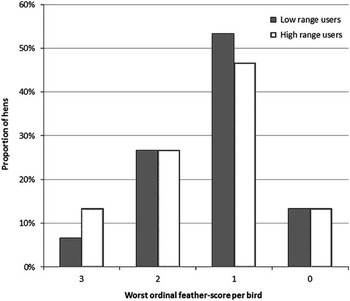
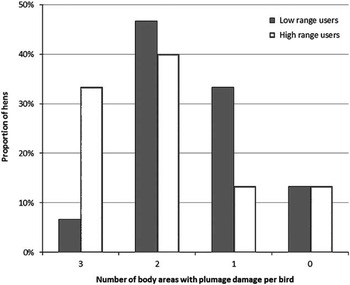
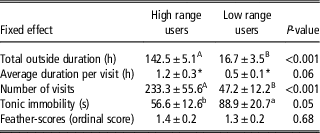
In all, 95% of birds (n=100) accessed the outdoor range more than once per day, with birds accessing the range on all days that data were collected. On average, each bird spent a total of 79.6 h outside (range 0 to 179.8 h), over 140 visits (range 0 to 780 times), for 51.5 min per visit (range 7.6 min to 3.7 h), and 6.1 h per day (range 0 to 13.8 h). When analysed as continuous variates (for n=100 birds), there was a positive association between the total time spent outside and the average duration of visits (P=0.02), and also between total duration outside and the number of visits (P<0.001). Variables measured for the top and bottom range users (n=30) are summarised in Table 1. Low range users had longer TI durations than high range users (Table 1). There was also a negative association between TI duration and total duration outside when analysed as continuous data (P=0.01). Birds exhibited plumage damage, as illustrated in Figures 1 and 2. However, there were no associations between plumage condition and range use measurements (all P>0.1), and no effect of whether birds were high or low range users on BW (P=0.54). There was an effect of wind on the duration of time spent outside per day, where birds spent a longer total duration on the range when some wind was present, compared to calm days (5.55 v. 6.15 h per bird per day, P=0.05). There were no effects of temperature or wind speed on any of the range use variables including the number of visits and the duration outside (P>0.1). The RFID equipment did not appear to interfere with range use. There was no effect of day on the number of birds entering the shed before the system being installed and the 2 days following installation, (P=0.57) or after the system was installed and the subsequent 2 days (P=0.76).
Proportion of hens in the high and low range use subpopulations (n=30 hens) with each ordinal feather-score, as the worst feather-score out of all body areas per bird. A score of 3 denotes the poorest plumage condition, and a score of 0 denotes no plumage damage.

Proportion of hens per subpopulation (high and low range users) with each number of damaged body areas.

Means and standard errors of the means for the range use, tonic immobility duration and plumage damage of free-range laying hens, categorised by their total time spent outside over 13 days

*Values within a row tend to differ at P<0.1.
a,bValues within a row with different superscripts differ significantly at P<0.05.
A,BValues within a row with different superscripts differ significantly at P<0.001.
Discussion
Range use and fearfulness
There were no differences in the numbers of birds entering the shed before the system was installed, or afterwards. Range use therefore did not appear to be affected by the placement of the antennas and the fitting of the leg rings with the RFID transponders. Birds spent more time outside on windy days, although there was no effect of wind speed. Windy days may therefore have been coupled with more cloud cover. Weather information did not include whether the day was sunny or overcast, although windy days were also on average 1°C warmer than calm days, indicating that this may have been the case. Wind may be accompanied by a higher ‘wind chill factor’ which may encourage range use. In total, 95% of birds accessed the range area at least once per day during the 13 days of data collection. The majority of studies in this area report much lower range use. Hegelund et al. (Reference Hegelund, Sorensen, Kjaer and Kristensen2005) studied flocks ranging from 513 to 6000 hens, and found that an average of 9% of hens used the range area, with large variations within and between flocks. Hegelund et al. (Reference Hegelund, Sorensen and Hermansen2006) reported that an average of 18% of hens used the outdoor range area in flocks of 1200 to 5000 hens, and Dawkins et al. (Reference Dawkins, Cook, Whittingham, Mansell and Harper2003) found a maximum of <15% of the total flock accessing the range area during the day, using in situ behaviour observations of broiler chickens on commercial farms. Bubier and Bradshaw (Reference Bubier and Bradshaw1998) found that three larger flocks (1500 to 2500 hens) had an average of 12% of hens outside during the course of the day, and the fourth flock, which comprised 490 hens, had an average of 42% hens using the outdoor range over the course of the day. The present findings support suggestions that flock size is negatively correlated with the proportion of hens that access the range (Bubier and Bradshaw, Reference Bubier and Bradshaw1998; Bestman and Wagenaar, Reference Bestman and Wagenaar2003; Gilani et al., Reference Gilani, Knowles and Nicol2014). Richards et al. (Reference Richards, Wilkins, Knowles, Booth, Toscano, Nicol and Brown2011) also used RFID technology to characterise subpopulations of hens based on range use. Approximately 80% of tagged hens used the pop-holes frequently, where 10% of four flocks of 1500 hens had been tagged with transponders. There were some birds that did not appear to venture on to the range area at all, in concurrence with the data from the present study.
Longer TI durations are thought to indicate higher levels of fearfulness (Gallup, Reference Gallup1979; Campo et al., Reference Campo, Gil, Davila and Munoz2006). Birds with longer TI durations in the present experiment spent less time outside. This finding implies a negative association between range use and fearfulness. Mahboub et al. (Reference Mahboub, Muller and von Borell2004) also found a negative correlation between time spent outside and TI duration. While it is generally assumed that birds with lower levels of fearfulness are more likely to venture outside, this causal relationship has yet to be confirmed. Range use may also act to decrease fearfulness. Generally, fearfulness declines with increased familiarity with the environment, and with age (Hocking et al., Reference Hocking, Channing, Waddington and Jones2001). Studies have also found lower levels of fearfulness in birds housed in smaller groups (Bestman and Wagenaar, Reference Bestman and Wagenaar2003; Rodenburg and Koene, Reference Rodenburg and Koene2007), and early, regular handling is thought to reduce fearfulness later in life (Jones and Faure, Reference Jones and Faure1981). The birds in the present experiment were handled at least every 4 to 6 weeks throughout their lives, and people entered the pens on a daily basis to conduct husbandry procedures. The small group sizes (relative to group sizes in commercial settings), older age, and regular handling that the birds experienced may have contributed to relatively low levels of fear on a group level. This may have been a reason for the large proportion of birds which accessed the range, compared with other studies. In addition to fearfulness, range use seems to be dependent on a number of other variables. These may include birds’ previous experience with the environment and the outdoor range (Grigor et al., Reference Grigor, Hughes and Appleby1995; Janczak and Riber, Reference Janczak and Riber2015), pop-hole size, accessibility to the range (Gilani et al., Reference Gilani, Knowles and Nicol2014), and structures on the range (Hegelund et al., Reference Hegelund, Sorensen, Kjaer and Kristensen2005; Rault et al., Reference Rault, van de Wouw and Hemsworth2013). In the present experiment, the range areas were fenced off and had wire mesh across the top; hence the birds were protected from predators. The pop-hole in each pen was of an adequate width to allow birds to see into the range area and allow easy access to the outdoors. In addition, the small, narrow, 10 m long range areas which were protected from predators may have been conducive to high range use. All of these factors may have contributed to the high proportion of birds which utilised the range area.
Feather-scores
Birds with lower levels of fear, as assessed by TI durations, spent longer outside on the range area. However, range use was not associated with plumage damage. An association between range use and plumage damage may have been precluded in this experiment due to the very high rates of range use in the test population. The sample size was relatively small, and the study was conducted at a research facility. Results are therefore indicative of individual bird behaviour and behaviour of hens in small groups. Extrapolations to bird behaviour in commercial settings should be made with consideration of the different environmental circumstances. However, some other studies also did not find associations between plumage damage and range use. Hegelund et al. (Reference Hegelund, Sorensen and Hermansen2006) found no association between range use and feather-scores when researchers visited 18 organic farms periodically. Similarly, Leenstra et al. (Reference Leenstra, Maurer, Bestman, van Sambeek, Zeltner, Reuvekamp, Galea and van Niekerk2012) interviewed 257 farmers with free-range flocks, and found no relationships between feather condition and range usage. These findings suggest there may be other, sometimes overriding factors that influence range use and feather-pecking. The majority of studies, however, report an inverse association between range use and plumage damage (Bestman and Wagenaar, Reference Bestman and Wagenaar2003). Mahboub et al. (Reference Mahboub, Muller and von Borell2004) noted a negative correlation between feather damage and time spent on a grassland area outside, and Nicol et al. (Reference Nicol, Potzsch, Lewis and Green2003) found that in a multivariate model based on farmers’ reports, feather-pecking occurred at higher levels when fewer birds used the outdoor range. Green et al. (Reference Green, Lewis, Kimpton and Nicol2000) conducted a cross-sectional survey of farmers and found similar results, where there was an association between lower range usage and feather-pecking. Lambton et al. (Reference Lambton, Knowles, Yorke and Nicol2010) visited farms to estimate range use by counting birds visible on the range at the time of the visit, and reported that increased range use may reduce SFP. Higher range use may contribute to lower plumage damage due to the higher foraging opportunities when birds access the range and the reduced stocking densities when birds are distributed across the inside and outside of the shed area.
The data from studies collected via surveys and estimations by producers yield important information relating to range use and associated factors, but should be extrapolated with care. Data collected via observations of birds accessing the range may not be able to differentiate between individual birds. Hence information has been limited in this respect, and it has not been clear whether it is the same birds that consistently access the outdoor range area or different birds on different days (Gebhardt-Henrich et al., Reference Gebhardt-Henrich, Toscano and Fröhlich2014). The relationships between range use, fearfulness and SFP warrant further research.
Use of the radio frequency identification system
No leg rings were lost during the trial, although some numbers on the leg rings were difficult to read at the conclusion of the trial due to the build-up of manure or dirt on the leg rings obscuring the number. This is an improvement from what has been reported previously, where Freire et al. (Reference Freire, Wilkins, Short and Nicol2003) lost 48% of transponders which were encased in leg bands by the end of the study. Mahboub et al. (Reference Mahboub, Muller and von Borell2004) were successful in retaining all of the transponders during their experiment, which were fixed to the wing webs rather than contained within leg bands. Thurner and Wendl (Reference Thurner and Wendl2005) also successfully used RFID technology, where transponders correctly identified 97% of laying hens. However, in the present experiment, there were a number of technological difficulties with the RFID system. These included technical problems with the functionality of the software, which limited data collection to 13 days rather than the intended 42 days. The necessitation of cables to relay information from antennas to the computer was another limitation, as only pop-holes within a close proximity (within 3 m) to a power source and computer were able to be fitted with antennas. A greater distance from the computer and longer cables could result in a loss of data. Despite technical difficulties, RFID technology proved an effective method by which to collect large amounts of data on individual birds. This was also found by Durali et al. (Reference Durali, Groves, Cowieson and Singh2014), who used the same RFID system, but on broiler chickens in a commercial setting.
Technologies which allow the collection and collation of large amounts of data on individual birds have the potential to play a particularly important role in future research. They may provide further substantiation for studies which have previously relied on surveys and questionnaires to estimate bird behaviour. RFID data could also be used to complement studies which utilise in situ observations for data collection. The use of numbered leg rings in this study allowed the measurement of a number of variables which were compiled for individual birds, including plumage damage, fearfulness and BW. Additional variables which could be recorded include in situ behaviour observations, which could be made by marking individual birds and recording behaviour in the home pen. This would provide information on how range use relates to behaviours such as SFP, foraging, and social interactions. Further, information from RFID systems may be compiled with various measurements of biological functioning on an individual bird basis, including physiological, nutritional, as well as behavioural. In this way, future studies may provide a more holistic understanding of the behaviour, welfare, and productivity of birds housed in free-range production systems.
Conclusions
The main finding from the present experiment was that low range users had longer TI durations. This result suggests that there is a negative association between fearfulness and range use. Very few experiments have investigated this association. The RFID technology was effective in collecting large amounts of information on access to the outdoor range on an individual bird basis. Data obtained from automatic tracking systems should be combined with other measurements including physiological, nutritional, and behavioural. In this way, automatic tracking systems may be used to their full potential, and a more holistic understanding of bird behaviour, welfare and productivity may be attained.
Acknowledgements
The authors gratefully acknowledge Mr Tugrul Durali (University of Sydney), who originally acquired the RFID technology for his own PhD trials, for his generous help and advice and without whom this study would not have been possible. The authors also thank Associate Professor Peter Thomson (University of Sydney) for his invaluable assistance with data consolidation methods, Dr Evelyn Hall (University of Sydney) for her advice and reassurance on methods of data analyses, and Ms Mary Tran and Mr Dean Powell for their generous assistance with practical work. This research was conducted within the Poultry CRC, established and supported under the Australian Government’s Cooperative Research Centres Program, with research funding provided by the Australian Egg Corporation Limited.