Over the first year of life, monolingual infants move from a broad ability to discriminate sounds that indicate meaning differences (i.e., phonemes) in both native and non-native languages to a more refined ability to detect differences between sounds that distinguish words in their native language (e.g., Werker & Tees, Reference Werker and Tees1984). Previous research on this perceptual narrowing of phonological categories in bilingual infants indicates that, independently of differences in developmental trajectories, they also have tuned to the basic sound categories of their native languages by 12 months of age (for a review, see Byers-Heinlein & Fennell, Reference Byers-Heinlein and Fennell2014). This perceptual tuning to native sound categories should facilitate the encoding of contrastive sounds in the early lexicon, which begins developing in earnest in the second year in both monolinguals (e.g., Fenson, Dale, Reznick, Bates, Thal & Pethick, Reference Fenson, Dale, Reznick, Bates, Thal and Pethick1994) and bilinguals (e.g., Core, Hoff, Rumiche & Señor, Reference Core, Hoff, Rumiche and Señor2013). Yet, research with bilingual toddlers and adults indicates that, despite their early success in phoneme discrimination tasks, bilinguals possess impoverished representations of some phonological contrasts.
In word recognition tasks, Catalan–Spanish 18- to 24-month-old bilinguals, as well as 3-year-old Spanish-dominant bilinguals, have difficulties in detecting mispronunciations of familiar words involving the Catalan mid-front /e/-/ɛ/ contrast (Ramon-Casas, Swingley, Sebastián-Gallés & Bosch, Reference Ramon-Casas, Swingley, Sebastián-Gallés and Bosch2009). Similar difficulties are seen in adult bilinguals. Predominant exposure to Spanish seems to hinder the ability to eventually encode this Catalan contrast in perception (Sebastián-Gallés, Echevarría & Bosch, Reference Sebastián-Gallés, Echeverría and Bosch2005; Mora & Nadeu, Reference Mora and Nadeu2012) and production (Bosch & Ramon-Casas, Reference Bosch and Ramon-Casas2011; Cortés, Lleó & Benet, Reference Cortés, Lleó, Benet, Braunmuller and House2009; Mora & Nadeu, Reference Mora and Nadeu2012). Properties of the two languages may explain the above difficulties. Spanish, a language with a five-vowel system, has a single mid-front /e/ category, while Catalan, with a system of seven vowels, has two contrastive categories in the mid-front area of the vowel space. Yet, the disconnect between bilingual infants’ success in distinguishing this contrast in pure discrimination tasks (Bosch & Sebastián-Gallés, Reference Bosch and Sebastián-Gallés2003) and subsequent failure in word recognition tasks needs to be addressed.
One key factor that may contribute to the underspecified encoding of this Catalan /e/-/ɛ/ contrast in words is the presence of cognates in bilinguals’ early lexicons. Cognates are words that have similar acoustic forms and meanings across the bilingual's two languages (e.g., [gə’lɛtə], the Catalan word for “cookie”, whose translation equivalent in Spanish is [ga'λeta]). Approximately 65–70% of words in Catalan and Spanish lexicons are cognates (Green, Reference Green, Harris and Vincent1988) and cognates constitute the majority of words in early expressive vocabularies (Bosch & Ramon-Casas, Reference Bosch and Ramon-Casas2014). Thus, vocabulary building in Catalan–Spanish bilinguals necessitates the learning of similar-sounding cognates both early and often, including many differing by a single vowel (e.g., “train”: [trɛn] in Catalan and [tren] in Spanish). The close link between cognates and their cross-language activation may affect the precision of native phonological representations, leading to underspecification of the contrast – a simplified representation missing some phonetic detail. However, it is unclear as to whether this underspecification is restricted to those variable lexical items (i.e., cognates), or generalizes to all lexical items.
Indeed, the original study demonstrating bilingual toddlers’ difficulty with the /e/-/ɛ/ contrast in word recognition (Ramon-Casas et al., Reference Ramon-Casas, Swingley, Sebastián-Gallés and Bosch2009) involved cognate words. Subsequent research revealed that when the words used in a word recognition task were not cognates (e.g., [gə’λɛδə] (bucket) in Catalan translates to [kuβo] in Spanish), bilingual toddlers succeeded at detecting the vowel mispronunciations (Ramon-Casas & Bosch, Reference Ramon-Casas and Bosch2010). Similarly, bilingual adults were better at producing Catalan–Specific vowel contrasts in non-cognate than in cognate words (Mora & Nadeu, Reference Mora and Nadeu2012). Thus, the presence of cognate words can negatively affect the phonological representation of close vowel contrasts, but the effect may be specific to such words.
Yet, a second factor may contribute to a generalized indistinct encoding of the target contrast used in past work: input variability. Spanish–Catalan parents who have Spanish as their L1 inconsistently produce this Catalan vowel contrast, even though they acquired Catalan early and use it regularly at home (Bosch & Ramon-Casas, Reference Bosch and Ramon-Casas2011). These inconsistencies (i.e., higher variability and inaccurate production of Catalan contrasts typically found in Spanish-accented Catalan) present in input to the child, especially in cognate words (Mora & Nadeu, Reference Mora and Nadeu2012), may negatively affect the representation of the /e/-/ɛ/ contrast in a more general manner. Even in monolingual groups the effect of input variability (i.e., dialectal variation) on phonological representations has been attested (see Durrant, Delle Luche, Cattani & Floccia, Reference Durrant, Delle Luche, Cattani and Floccia2014). In this context, the aim of the present research is to explore bilinguals’ ability to learn and successfully encode the contrastive /e/-/ɛ/ Catalan vowels in novel words forming a minimal pair. By doing this we can answer the question of whether or not these phonetic categories, which can be discriminated by the end of the first year of life (Bosch & Sebastián-Gallés, Reference Bosch and Sebastián-Gallés2003), are still available for word learning after accumulated natural experience with word forms, including variable forms. We consider two possible outcomes: if bilinguals are unable to disambiguate novel minimal-pair words involving the /e/-/ɛ/ contrast, this would suggest that the representation of this contrast has already been “blurred” via exposure to inconsistencies in the input. However, if toddlers can successfully encode the target contrast in novel words, this result would reveal that the contrast has not been “blurred”, but is rather available for lexical acquisition. From this perspective, the insensitivities to vowel mispronunciations in familiar, cognate words previously found in the literature (Ramon-Casas et al., Reference Ramon-Casas, Swingley, Sebastián-Gallés and Bosch2009) would be the result of experiential factors (e.g., inconsistent input) that especially affect some frequent cognate words, and said insensitivities would therefore not implicate overall impoverished phonological representations. Rather, a more flexible use of phonological representations in bilinguals would be suggested: relaxed representations in more variable words and more exact representations for words with low variability. Critically, the choice of a minimal-pair word learning task in this study is a strong test for this hypothesis as it allows for the control of experiential factors such as exposure to phonological variability. New words (with which participants have no previous experience) will be presented, with the vowels across the word token types showing a consistent between-category difference. However, there will be enough within-category variability to adequately address phonological encoding of the target contrast, as phonemic categories necessarily entail allophonic variation. This is also a cognitively demanding task: if bilinguals demonstrate the availability of the target contrast in this minimal-pair word learning situation, it should also be available for phonological encoding of novel words in real-world situations.
Relevantly, the results of the current study can inform the only major theory of early, simultaneous bilingual phonological development: the bilingual PRIMIR model (Processing Rich Information from Multidimensional Interactive Representations; Curtin, Byers-Heinlein & Werker, Reference Curtin, Byers-Heinlein and Werker2011). While other theories primarily address phonetic refinement (e.g., the Perceptual Assimilation Model, or PAM, of Best, Reference Best, Goodman and Nusbaum1994; the Linguistic Perception, or LP, model of Escudero & Boersma, Reference Escudero and Boersma2004) and others focus on word recognition (e.g., Word Recognition and Phonetic Structure Acquisition, or WRAPSA, model of Jusczyk, Reference Jusczyk1997), PRIMIR focuses on both the development of the phonetic categories refined in infancy and the application of said categories to early word learning. PRIMIR argues that phonemes are built from the perceptual representations of native phonetic information refined by 12 months and that bilinguals can differentiate clusters of phonetic information across their two languages (e.g., /e/-/ɛ/ in Catalan, but /e/ in Spanish). These representations are initially incorporated into acoustic word form representations. As infants gain experience linking word form exemplars with meaning (i.e., referential words), phonemic information common across these exemplars begins to emerge as generalized, abstract representations that direct infants to criterial information when learning new words. Importantly, the formation of phonological categories is input-driven at all stages and all levels of representation continually interact. The model predicts that infants will have indistinct or incomplete phonological representations if they have more variable input or less exposure to word forms containing the target phonemes – two factors that are part of the bilingual experience reviewed above. Indeed, Curtin et al. argued that bilinguals should perform worse than monolinguals in such minimal pair tasks when the above conditions are met, using Catalan–Spanish bilingual toddlers’ difficulty with the /e/-/ɛ/ contrast in familiar words (Ramon-Casas et al., Reference Ramon-Casas, Swingley, Sebastián-Gallés and Bosch2009) as evidence for this position. However, if bilingual infants in the current study successfully use the contrast in a novel minimal pair, this would set a more complex and less straightforward scenario from the PRIMIR perspective, possibly requiring a more nuanced consideration of the interplay between input factors and word/phoneme representations as it would indicate that infants’ phonological representations are looser for certain lexical items (i.e., cognates).
Method
Participants
Forty healthy full-term toddlers completed the experiment. They were divided into two equal groups according to their linguistic environment as assessed by the language exposure questionnaire (Bosch & Sebastián-Gallés, Reference Bosch, Sebastián-Gallés, Cenoz and Genesee2001): Catalan monolinguals (mean Catalan exposure = 93%; SD = 5.6; range = 80%-99%; 13 males) and Catalan–Spanish bilinguals (mean Catalan exposure 64%; SD = 5.9; range = 55%–75%; 12 males). Monolinguals’ mean age was 22 months (range: 21 months 15 days – 22 months 18 days) and bilinguals’ was 22 months (range: 21 months 17 days – 22 months 28 days). No significant age differences were found [t (38) = −1.14; p = .26]. We selected this age for two reasons: 1) bilinguals can generally succeed in a minimal-pair word learning task by 20 months (Fennell, Byers-Heinlein & Werker, Reference Fennell, Byers-Heinlein and Werker2007); and 2) results could be directly compared to those previously obtained in a word recognition task at this age (Ramon-Casas et al., Reference Ramon-Casas, Swingley, Sebastián-Gallés and Bosch2009). Twelve additional children were tested but not included in the final sample due to fussiness (n = 11; 6 bilinguals) and experimental error (n = 1 bilingual).
Materials
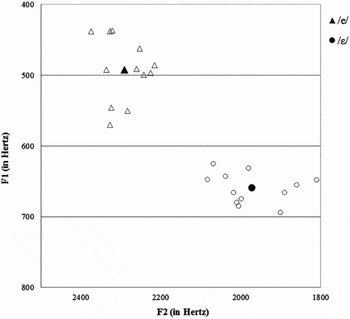
Several tokens of the non-words /bepi/ and /bɛpi/ produced by a female Catalan native speaker were recorded in infant-directed speech. Acoustical measures confirmed that the /e/ - /ɛ/ vowels were contrastive (see Figure 1). Seven tokens of each word were used during habituation trials and five tokens, different from those used in the habituation phase, were presented at test. The non-sense word /tiku/ was recorded for the pre-test trial. Four familiar cognate words from Catalan were selected as fillers: [ə’βio] (airplane), [kot∫ə] (car), [gat] (cat), and [bakə] (cow). Filler words did not contain any of the two target vowels. Unlike target words, which were always presented in isolation, fillers were presented once in isolation and then in a carrier sentence (e.g., Gat! Mira el gat! -Cat! Look at the cat!-), following the procedure implemented in Yoshida, Fennell, Swingley & Werker (Reference Yoshida, Fennell, Swingley and Werker2009). Visual stimuli were colorful pictures presented in motion on a black background. The unfamiliar objects were similar to those in previous word-learning studies (e.g., Werker, Fennell, Corcoran & Stager, Reference Werker, Fennell, Corcoran and Stager2002).
Formant frequency values (in Hertz) for each of the target vowels from the different tokens of the novel words used in the experiment (open symbols). Filled symbols represent mean F1 and F2 values for the /e/ and /ɛ/ vowel categories.

Procedure
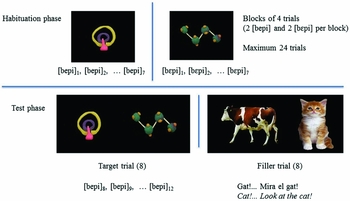
The experimental procedure followed Yoshida et al. (Reference Yoshida, Fennell, Swingley and Werker2009), involving a habituation phase immediately followed by a test phase (see Figure 2). The habituation phase was as in Werker et al. (1998). It consisted of a series of trials, each presenting one of the two target word-object pairs. Test trials following habituation showed the two objects from habituation side-by-side or two fillers side-by-side (no target-filler combinations), similar to the Intermodal Preferential Looking task (Fernald, Pinto, Swingley, Weinberg & McRoberts, Reference Fernald, Pinto, Swingley, Weinberg and McRoberts1998). This paradigm has shown better performance for minimal pair word learning in 14-month-olds (Yoshida et al., Reference Yoshida, Fennell, Swingley and Werker2009). Testing took place in a sound proof room. Infants were seated on parents’ laps, in front of a 50″ television monitor, at a distance of 130 cm. After the pre-test trial (which served as a warm-up trial), children were exposed to blocks of 4 habituation trials until they reached the habituation criterion: either a decrease of 65% of that of the longest previous block, or after 24 trials. Each block of 4 trials contained two trials of each target word–object pairing presented in a random order (e.g., ABAB, ABBA, etc., with the A pairing being the /bepi/ - molecule combination, and B pairing being the /bɛpi/ -crown combination). Each habituation trial lasted approximately 20 seconds and it contained 7 different tokens of one of the target words, each produced in a different intonation. In the habituation phase, objects moved slowly on the screen, from side to side, while the labels played. The test phase comprised 16 trials, each presenting pairs of objects, this time moving slowly up and down the screen in synchrony. There were 8 target trials – 4 labeling “bepi” and 4 labeling “bɛpi” – and 8 filler trials presented as follows: two filler trials went first, followed by two target trials, with the remaining trials being randomly ordered. Side of presentation for the first filler and target trials was counterbalanced (see Yoshida et al., Reference Yoshida, Fennell, Swingley and Werker2009).
Outline of the experimental procedure, following Yoshida et al. (Reference Yoshida, Fennell, Swingley and Werker2009).

The experimenter controlled the experiment from an adjacent room, using Habit 1.0 software (Cohen, Atkinson & Chaput, Reference Cohen, Atkinson and Chaput2004). The entire session was video recorded and infant looking to objects was analyzed off-line frame by frame, which established fixation time to the named (target) and unnamed object (distractor) in each trial. High inter-coder agreement was demonstrated (r = .99; p < .0001) by comparing measures on frame by frame fixation times to those obtained from a second independent coder on randomly selected trials (two per child).
Results
Normal distribution of the dependent variable in this study was confirmed using the Kolmogorov–Smirnov test. Both groups reached the habituation criterion in the equivalent number of trials (t (38) = .17; p = .8; monolinguals = 13 trials, SD 2.5, range 8–20; bilinguals = 12.8 trials, SD 4.4, range: 8–24). For the 16 trials of the test phase, the key dependent variable was mean proportion of looking to target (PLT): Looking to Target Object ÷ (Looking to Target Object + Looking to Distractor Object). PLT was measured within a time standard window beginning 360 to 2000 ms after onset of the target word (Swingley & Aslin, Reference Swingley and Aslin2000, Reference Swingley and Aslin2002). The average PLTs across conditions within this window of analysis were statistically compared to chance level (50%) in target and filler trials.
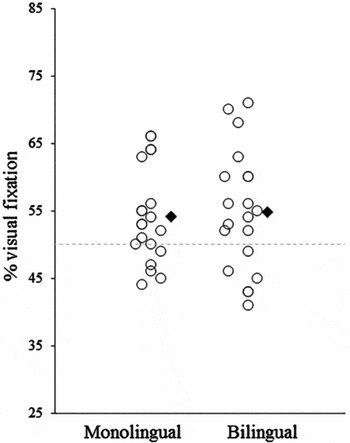
The PLTs to targets (/bepi/ or /bɛpi/) and fillers were above chance in both groups. The PLT for target trials (/bepi/ or /bɛpi/) in the Catalan-monolingual group was significantly above chance [(M = 54.2%; SD 7; range 44 - 66.3, t (19) = 2.6; p = .016; Cohen's d = .8] with 14 of 20 subjects looking more than 50% to the correct object (see Figure 3).
Individual data (open circles) and mean group visual fixation percentages to target words (in black) for Catalan monolingual and Catalan–Spanish bilingual groups. Dashed line represents chance level (50%).

For filler trials, the PLT in the monolingual group was significantly different from chance level [60.6%; SD 8; range 45.2–72.5; t (19) = 5.8; p = .0001; Cohen's d = 1.87], with 18 of 20 subjects exceeding 50%.
For Catalan–Spanish bilinguals, the PLT for target words was significantly different from chance [55%; SD = 8; range: 41.4–71.1; t (19) = 2.4; p = .023; Cohen's d = .88], with 14 of 20 subjects exceeding 50%. In filler trials, bilingual's PLT was 56.05% (SD = 6.4; range: 47.5 - 69.8). Again, this was significantly different from chance levels [t (19) = 4.1; p =.001; Cohen's d = 1.4], with 15 of 20 subjects exceeding 50%. There were no correlations between PLT and age, gender or number of habituation trials in both groups.
A mixed ANOVA with language group (monolingual, bilingual) and condition (targets, fillers) as factors, showed a main effect of condition [F (1,38) = 4.6; p = .037; η2 = .11], no group differences [F (1,38) = 1.4; p = 0.24; η2 = .036], and no interaction [F (1,38) = 2.2; p = .14; η2 = .05].
Overall, the behavior of both groups was similar across conditions. Both groups had higher PLTs in filler trials (familiar words) than target trials, which was unsurprising since the former were previously known words. Both groups were able to successfully learn the target pairings, as indicated by their greater than chance looking to the correct object during these trials. Thus, both monolinguals and bilinguals were able to distinguish the two similar sounding novel words.
Discussion
The present study suggests that both Catalan–Spanish bilingual and Catalan monolingual toddlers can use their [e]-[ɛ] phonetic categories to phonologically encode novel words at 22 months. Bilingual infants’ success in our task suggests that the contrastive [e]-[ɛ] phonetic categories present at 12 months (Bosch & Sebastián-Gallés, Reference Bosch and Sebastián-Gallés2003) are still functional at 22 months, ready to be used in novel word encoding at a time when bilinguals are actively building their dual receptive lexicon.
Against this interpretation, one could argue that our participants' successful word learning might have simply been the result of acoustic memory processes, independently of their pre-lexical phonetic categories. Indeed, a recent finding with younger infants suggested that 15-month-olds detect changes in minimal pairs based on the acoustic magnitude differences in the target contrasts more so than phonological distance (Escudero, Best, Kitamura & Mulak, Reference Escudero, Best, Kitamura and Mulak2014). However, the age of the infants in our study and the specific nature of the procedure implemented in this experiment both disfavor an acoustic memory interpretation of the results.
Escudero et al. (Reference Escudero, Best, Kitamura and Mulak2014) posited that older infants and toddlers (past 19 months) would shift from a greater reliance on acoustic salience to greater dependence on abstract phonological contrasts when processing lexical items (see also Best, Tyler, Gooding, Orlando & Quann, Reference Best, Tyler, Gooding, Orlando and Quann2009). Our participants are past this age and should therefore be processing our stimuli at a phonological level. Importantly, our task also should lead infants use phonological representations, rather than acoustic memory. First, multiple tokens of each word were presented in habituation, showing non-trivial within-category differences in F1 and F2 values. Further, five novel exemplars were presented at test, always preceded by two filler trials involving familiar words. Thus, the implemented procedure precludes an immediate comparison between the habituation and test tokens in terms of their highly specific acoustic properties. Rather, it forces participants to rely on more abstract properties, beyond the individual acoustical features of the tokens in the task. Second, previous research has demonstrated that monolingual 18-month-olds learn minimal pairs that differ by a salient and perceptible acoustic difference (i.e., vowel duration difference) only when it is phonemic in their language: Dutch-learning infants succeed with this native contrast, but English-learning infants fail (Dietrich, Swingley & Werker, Reference Dietrich, Swingley and Werker2007). Importantly, bilingual infants of 22 months also fail to learn a minimal pair differentiated by an acoustically salient, non-native contrast (Graf Estes & Hay, Reference Graf Estes and Hay2015). These results further indicate that neither the bilingual nor monolingual infants in our study were relying on acoustic-memory processes to succeed. Their successful categorization seems to be possible because [e] and [ɛ] phonetic categories have already been built from continued exposure to Catalan since birth and are available to be used in word learning. Further research, with participants having different levels of Catalan exposure and/or previously failing to discriminate the target phonetic categories, could shed more light on the mechanism behind successful minimal pair word learning found in the present study.
As discussed in the introduction, we considered the minimal pair word learning task to be a strong test of bilinguals' capacity to convert their [e] and [ɛ] phonetic categories to a phonological contrast used to differentiate a pair of similar sounding words. Recall here that this task involves relatively high computational demands (see Werker & Curtin, Reference Werker and Curtin2005): participants listen to two similar sounding novel words, see two novel objects, and must establish the link between the two, with no other support from syntactic cues (sentences) or social cues (e.g., no pointing or eye gaze). Successful minimal-pair learning in this cognitively demanding context could thus be taken as an indication that, in more naturalistic settings, the target contrast is also likely to be encoded in the phonological representation of newly acquired words.
What of the interpretation of the present results from the PRIMIR model? The present finding seems to run counter to its predictions that bilinguals should perform worse than monolinguals on difficult (i.e., variable) contrasts in a minimal pair task. Additionally, successful learning of novel words in our task was found at the same age when bilingual toddlers were unable to detect mispronunciations in familiar words involving the same target contrast (Ramon-Casas et al., Reference Ramon-Casas, Swingley, Sebastián-Gallés and Bosch2009). On the surface, this again appears to run counter to a key tenet of PRIMIR: phoneme representations built from experience with familiar words should direct infants’ attention to critical detail in novel words. This accuracy “inversion” appears to require the addition of new factors/variables to PRIMIR to account for directed attention to phonological details in new words that are not present in established lexical items. We propose that PRIMIR's dual focus on input and interactions between word and phoneme representations can explain our finding regarding bilingual participants. Insensitivities to vowel mispronunciations in known words are a result of input factors, especially those specific to cognates or similar-sounding words (phonological neighbors).
Based on past and current evidence, we propose this developmental sequence of bilinguals’ refinement and use of this phonological representation. By 12 months, Catalan–Spanish bilinguals can categorize and discriminate these vowels (Bosch & Sebastián-Gallés, Reference Bosch and Sebastián-Gallés2003). Then, in the second year of life, as the present results suggest, toddlers are able to encode and use this contrast in early word learning. However, over time input factors affect this early encoding. Increased experience with accented input that renders words involving this challenging contrast less specified (i.e., L2 Catalan speakers producing mispronunciations and inconsistencies), as well as increasing experience with cross-language cognates, can “blur” or reshape the phonological representation of these vowels in known words. Data from Catalan–Spanish bilingual adults (Sebastián-Gallés et al., Reference Sebastián-Gallés, Echeverría and Bosch2005) and toddlers (Ramon-Casas et al., Reference Ramon-Casas, Swingley, Sebastián-Gallés and Bosch2009) support this perspective. Bilingual toddlers find this target Catalan contrast to be particularly difficult, making discrimination, categorization and word recognition tasks more challenging compared to similar tasks when other vowel contrasts are involved (i.e., vowels belonging to the bilinguals' two languages).
An interesting possibility raised by current and past results is that bilingual children are using differing phonological representations across cognate (and similar-sounding words) and non-cognate words. Our novel minimal pair words were not cognates, but phonological neighbors (as they referred to different objects), and bilingual infants had no difficulties with the contrast. Yet, toddlers specifically have difficulty with the target contrast in cognates (Ramon-Casas & Bosch, Reference Ramon-Casas and Bosch2010). Perhaps words that have more variable productions (i.e., cognates; as demonstrated by Mora & Nadeu, Reference Mora and Nadeu2012) allow for more flexible representation of the target vowels, or even a loss of its contrastive value. PRIMIR bases phoneme representations on lexically rooted exemplars, and allows for differential phonological information based on phoneme position within the word. It is thus possible that bilingual toddlers create two representations of the critical contrast based on two classes of exemplars: a default clear representation and more flexible representation for words determined to be cognates from the input. Future studies could include measures of bilinguals' vocabulary size and, more specifically, of the number of cognate words in their early vocabularies (often involving vowel differences between Catalan and Spanish words), to better explore the link between these vocabulary properties and the presence of more flexible representation of vowel contrasts.
An additional factor that could affect the encoding of these Catalan vowels is language dominance. Bilinguals tested in the present study were balanced or slightly Catalan-dominant. While similar groups failed to detect the [e]-[ε] mispronunciation in familiar words in Ramon-Casas et al. (Reference Ramon-Casas, Swingley, Sebastián-Gallés and Bosch2009), it has been shown that predominant exposure to Spanish can have a negative impact on the encoding of Catalan–Specific contrasts (Sebastián-Gallés et al., Reference Sebastián-Gallés, Echeverría and Bosch2005). Thus, it is possible that Spanish-dominant bilingual toddlers, who have more exposure to Spanish and are likely to be exposed to Spanish-accented Catalan more often, would not succeed in our task (as predicted by PRIMIR). Further research is needed to clarify the role played by language dominance on the encoding and later consolidation of contrasts belonging to the less-dominant language. Similar to exposure levels and language mixing affecting infants’ vocabulary development (Byers-Heinlein, Reference Byers-Heinlein2013; Hoff, Core, Place, Rumiche, Señor & Parra, Reference Hoff, Core, Place, Rumiche, Señor and Parra2012; Place & Hoff, Reference Place and Hoff2011), these same variables might interfere with the building of robust phonological representations of contrastive vowels.
Here, successful encoding has been obtained for a challenging contrast that belongs to just one of the bilingual's two languages. This is not an infrequent situation, as vowel systems greatly differ between languages and we predict similar results for similar bilingual situations. Further, for language pairs with fewer cognates, vowel encoding may not pose special problems. However, the present study also suggests that even for bilinguals exposed to such languages, this initially accurate encoding can morph over time as the child gets more evidence of a less rigid contrast due to continued or frequent exposure to different accents or phonological variability. Further bilingual cross-linguistic research will help to confirm this hypothesis.