The duo Wham! – George Michael and Andrew Ridgeley – were one of the most successful UK pop acts of the 1980s. With their unfashionable celebration of post-Civil Rights soul and mainstream Saturday night disco, and wryly camp version of high street style, they have perhaps not surprisingly been neglected in the study of culture and popular music. Less understandable is the lack of attention paid to George Michael, whose solo career was always an agreed consequence of the success of Wham! and one reason why he is named in the title of this paper. Michael – alone and with Ridgeley – composed songs that have already become enduring pop standards, such as ‘Wake Me Up Before You Go-Go’, ‘Last Christmas’, and ‘Careless Whisper’. He was acclaimed for his songwriting, arranging and production skills, and for the way he could blend intense emotional expression with hedonistic sensuality and camp ironic wit. His second album, Listen Without Prejudice Vol 1 (1990), challenged the limits of pop conventions at the time, and with Older (1996) he achieved critical acclaim and commercial success.
While numerous rock musicians publicly proclaimed radical left beliefs during this period, George Michael quietly supported many political, community, and charity causes, discreetly and out of the public eye. He had been a member of the Young Communist League, and donated to the fund for striking miners. Wham! performed at a miners’ benefit concert at the Albert Hall in September 1984, yet ‘were roundly booed by certain sections of the audience, who seemed to resent their presence at such a serious and worthy event’ (Smith Reference Smith2017, p. 129). This suggests audience members unable to see beyond stereotypes of how politics and protest are articulated in musical style, lyrics and imagery. George Michael was to many critics what Robert Christgau dismissed as a ‘replaceable teenybop idol’ (Reference Christgau1990) and Wham! nothing more than ‘a heart-throb boy band’ (Ridgeley Reference Ridgeley2019, p. 201). While many rock musicians in this period publicly bemoaned record labels while pocketing the cash from contracts, George Michael went to court with Sony in the name of artistic expression and the limits of contractual obligations. Before his death at the age of 53 he had confronted and dealt with the many artistic and personal dilemmas that come with commercial success, and invasive media scrutiny.
Throughout this time, Andrew Ridgeley was routinely portrayed as an apparent mediocrity who would have been nothing without George Michael. Yet at the end of Wham!'s final performance Ridgeley recalled: ‘George smiled and embraced me, resting his head upon my shoulder one last time before we took our final bows. “I couldn't have done this without you, Andy,” he said’ (Ridgeley Reference Ridgeley2019, p. 19). The marginalisation of Andrew Ridgeley's contribution to Wham! assumes, unrealistically, that talent emerges in self-evident and unmediated ways, and fails to acknowledge his songwriting contribution. Ridgeley was key in forming the band and in the instantiation of the George Michael pop persona. In this article we argue that a focus on the backgrounds and circumstances of their early lives shows how Wham! laid the foundations of Michael's solo career, and how the initial environments and experiences of both its founders were integral to this success.
Behind the pop stardom of Andrew Ridgeley and George Michael, and their neglect as musicians, is not only scholarly snobbery and critical disdain, but unrecognised geographical and social marginalities. In exploring this, we draw on Rupa Huq's studies of the diversity of outer London to challenge uncritically accepted orthodoxies about the homogeneity of suburbs. We illustrate how a focus on Wham! contributes to debates about the postcolonial journeys that have shaped suburban UK popular music sensibilities since the end of World War II. We also extend aspects of the evocative ethnomusicological geography of Sara Cohen, suggesting how the practice of psychogeography can enliven the study of popular music, contributing insights into the physical, emotional, and creative routes taken by musicians. Our narrative is located across and within the sprawl, suburbs, and dormitories of northwest London and Hertfordshire. It is one small part of a much longer narrative. To frame and provide background to the theoretical issues alluded to above, and as context for our more detailed psychogeography of the formation of Wham!, we begin with parental postcolonial journeys to the UK.
The metropolitan margins and the moral mobilities of suburbia
The future members of Wham! met at the age of 12 in 1975 when Andrew was allocated to help new boy Georgios settle into school life (Michael and Parsons Reference Michael and Parsons1991; Jovanovic Reference Jovanovic2007; Ridgeley Reference Ridgeley2019; Smith Reference Smith2017). To contextualise this ordinary event, that would later be accorded much importance, we must discuss the equally prosaic yet profound postcolonial family journeys that carried the boys through the outer London suburbs and to Bushey in Hertfordshire, a few miles northwest of the capital.
Michael was born in 1963 in a rented small three-bedroom 1930s terraced house at Church Lane, East Finchley. His father, Kyriacos Panayiotou, had arrived from Cyprus by boat in 1953 and entered the restaurant trade, a common choice for Cypriots (Panayi Reference Panayi1999). By 1968 he had saved enough money to buy the Angus Pride restaurant in Station Road, Edgware. George's mother, née Lesley Harrison, was a Londoner whose maternal grandmother, Daisy, was half Jewish (Smith Reference Smith2017, p. 7). Georgios was born into an area where many Greek Cypriots had established a thriving community across north and northwest London (Georgiou Reference Georgiou2001). In 1968 the Panayiotous lived above a launderette on Burnt Oak Broadway before purchasing their first house on nearby Redhill Avenue (Smith Reference Smith2017, p. 317). A further move to a larger property in Radlett, Hertfordshire came later in 1974.
The geographical chronology of places inhabited by the Panayiotou family suggest a gradual northwesterly passage out of London, following the ancient Watling Street, from Finchley and through the suburbs, a journey across a ‘socially ranked geographical space’ (Bourdieu Reference Bourdieu1986, p. 124), with broader postcolonial significance. Michael, in his biography, co-authored with Tony Parsons, notes of 1950s Cypriot immigration: ‘It was cheap labour for Britain, finally emerging from the austerity of the post-war years and desperate to fill its menial jobs with Jamaicans and Cypriots’ (Michael and Parsons Reference Michael and Parsons1991, p. 10). In a related account of such migrations, Panikos Panayi (Reference Panayi2008) refers to a Cypriot ‘propensity for risk-taking’ (p. 157) and a ‘strongly developed ideology of property possession as both a right and a goal’ (p. 167). In her account of suburban ‘Asian London’, Huq (Reference Huq2012) recounts a similar movement made by her parents in the 1960s, from pre-independence Bangladesh to lodgings in West Kensington and then to Ealing, following the Piccadilly underground northwestward out of central London.
Kyriacos Panayiotou's journey to and within England forms part of a wider postcolonial narrative of movements, and the cultural and economic histories that underpin them. It can partly be illuminated through Edward Said's ‘contrapuntal’ interpretation of English fiction (such as Jane Austen's Mansfield Park), in which he highlights how British colonialism created a narrative of wealth and development that presaged and predated the Empire by sanctioning a particular ‘spatial moral order’ (Said Reference Said1994, p. 94). This helped foster aspiration towards the culture, institutions and mores of the colonising nation. In a similar way, writing of the French colonies of the Caribbean, Franz Fanon (Reference Fanon1986) argued that proximity to the metropolitan centre was valued across the postcolonial landscape: for the Martiniquian, the centripetal pull of Fort-de-France existed alongside and as part of the magnetic force of France itself. Similarly, the journeys charted by Greek Cypriots both to Britain, and then across London, formed part of the same broader postcolonial moral spatial order, even though their inclusion in this narrative is not always as foregrounded as experiences of people from the Caribbean and Indian subcontinent.
In the context of post-Second World War migrations to Britain, initially encouraged by the UK Government and then resisted as the migratory consequences of decolonisation became apparent, we can locate Kyriacos Panayiotou's movements within such a postcolonial spatial moral order. First, there is the journey to Britain and then the gradual move northwestwards towards the more affluent Radlett. Aspiration in this context, following Said and Fanon, is characterised by the willingness to make the postcolonial journey to Britain, and then to continue that symbolic journey outwards from the capital. Such journeys were accompanied by individual strategies that facilitated integration. Like many immigrants, George Michael's father changed his name to a more manageable ‘Panos’. Andrew Ridgeley revealed that he was unable to pronounce his friend's name as it sounded to him like ‘yoghurt’ and Michael became ‘Yog’ to close friends. Ridgeley's own father was born in Alexandria from an Italian mother and a Jewish Egyptian father, and came to Britain by boat from Egypt in 1956 (Michael and Parsons Reference Michael and Parsons1991, p. 31). He too married an English woman, Jennifer Dunlop, who would become a teacher at Bushey Heath Primary School (Ridgeley Reference Ridgeley2019, p. 43). Ridgeley's father similarly changed his surname, from Zacharia, having seen the ‘English sounding’ Ridgeley Gardens from a bus (Ridgeley Reference Ridgeley2019, p. 43).
Yet, there were more than social mobilities entailed in these movements. There was a very real sense of enforced exile and escape. Panayiotou senior's departure from Cyprus coincided with growing opposition to British colonial rule. It anticipated the unrest that escalated in 1955 as the Greek Cypriot paramilitary organisation EOKA began armed struggle against the British, in turn provoking Turkish Cypriot revolutionary organisation TMT to fight for an ethnic-nationalist agenda that sought partition of the island (Hitchens Reference Hitchens1989). Indeed, the village that Panayiotou left no longer exists, abandoned after the Turkish invasion of 1974 and the displacement of some 200,000 Greek Cypriots who fled to the other side of the island (Michael and Parsons Reference Michael and Parsons1991, p. 8). Kyriacos's departure from Cyprus, with his cousin (Dimitrios ‘Jimmy’ Georgiou), was both an aspirational move within the context of the postcolonial journeys mentioned above and an escape from these looming conflicts.
Ridgeley's father was expelled during the wave of Egyptian nationalism and nationalist-ethnic persecutions that ensued after the invasion of Egypt by Israel, France, and the UK resulted in the ‘Suez Crisis’. The situation in Egypt was paralleled in other countries where the ‘replacement of colonial rule by indigenous elites’ (Talbot Reference Talbot, Panayi and Virdee2011, p. 43) resulted in the displacement of subjects whose identities did not fit the exclusivist ideologies of newly independent nations. The experiences of growing up under colonisation created a complicated sense of identity. In his memoirs of exile, Said recalled that in Cairo his schoolfriends were ‘half-English and half-cosmopolitan Cairenes – Greeks, Jews, Armenians, Syrians, and a sprinkling of native Muslims and Copts’ (Said Reference Said2000, p. 271). With French teachers ‘always a mixture of Greek, Italian, or Armenian’, the ‘contempt of one colonial power for the other’ was tangible. He remembered that by the age of 13 ‘I was hopelessly paradoxical to myself’ (Said Reference Said2000, p. 272). The anxieties of this period in Egyptian history would also have informed the life of Alberto Zacharia. Although of mixed Italian–Egyptian background, an obvious destination for Ridgeley senior was the colonial country that many Egyptians had come to identify with, Britain.
These postcolonial migrations and mobilities of the 1950s created affiliations that filtered through to the next generation. Paul Gilroy (Reference Gilroy1993), drawing on W.E.B. Du Bois and writing of identity across the black Atlantic, developed the notion of ‘double consciousness’ – a sensibility of ‘in-betweenness’ that Myria Georgiou (Reference Georgiou2001, p. 45) argues can also be experienced by Cypriot, Jewish, Italian, and Maltese immigrants, although often casually designated as white. Such identities do not neatly fit crude colour-coded categories, and are experienced and negotiated with other attributes, like Europeanness, exceeding the semiotic associations of white skin (Georgiou Reference Georgiou2001). George Michael recalled that his mother faced prejudice from her own father for marrying Kyriacos ‘because he was Greek, in those times he saw it as absolutely the same thing as marrying someone of a completely different colour’ (cited in Jovanovic Reference Jovanovic2007, p. 13). The experience of difference also figures in Andrew Ridgeley's biographical account of Wham!. He draws attention to his father's facility with languages and work as an interpreter as part of a considered strategy of integration. Conversely, Ridgeley recalled that George's family ‘seemed more attached to their Cypriot history. Unlike my dad, who sounded thoroughly English, Jack's accent was still very strong’ (Ridgeley Reference Ridgeley2019, p. 43).
Both Ridgeley and Michael possessed physical attributes that generated a self-conscious sense of otherness. Ridgeley makes various references to Michael's ‘wiry frizz’ hair (Ridgeley Reference Ridgeley2019, p. 60) and notes that ‘while I was growing up, it was obvious to me that I was a little darker-skinned than most of my friends’ (Ridgeley Reference Ridgeley2019, p. 43). George adopted the surname Michael, from the Christian name of collaborator David Mortimer's father and a primary school friend (Smith Reference Smith2017, p. 84). There is nothing extraordinary about a musician adopting a ‘stage name’. Yet Michael combines the adoption of a more easily marketable moniker with a means of ‘de-othering’, in a similar way to how Farrokh Bulsara reimaged himself as Freddie Mercury. The singer with Queen was another post-colonial child of this period whose Parsi-Indian parents also fled to the suburbs of West London to escape the conflicts, expulsions and revolutionary struggles after Zanzibar gained independence from Britain and became part of The Republic of Tanzania in 1964 (Jones Reference Jones1997). Publicist Tony Brainsby, who worked with Queen, recalled that Mercury did not use his birth name ‘because he thought it might make him look a bit too Asian. It wasn't meant in a prejudicial way. He just didn't think it fitted the image. He desperately didn't want to be thought of, or seen as, an unlikely rock star’ (cited in Jackson Reference Jackson2011, p. 90).
Michael and Ridgeley met in Bushey, Hertfordshire, just southeast of Watford. Located some 13–14 miles northwest of central London, Watford became a ‘countrified’ suburb from the late nineteenth century and then a ‘small city embedded in the big city’ (Nairn Reference Nairn2014, p. 222). Nikolaus Pevsner, describing Bushey in 1953, observed that ‘there is the nucleus of the village still by the church; the rest is hard to define: outer London suburban, Watford suburban and in addition several large schools in their grounds’ (Pevsner Reference Pevsner2002, p. 119). The Ridgeley family had moved eastwards, from a council estate in the ‘commuter belt’ dormitory town of Egham, to 40 Ashfield Avenue, a 1930s semi-detached house halfway up the hill as it climbs towards Bushey Heath. From the front doorstep, the view looks down towards the Three Rivers valley where often-misty Watford sprawls. As we stand here, many years later, staring into the foggy distance, we catch a sense of just how far Ridgeley senior would have felt from Egypt. Equally, we can imagine how Ridgeley junior glimpsed the possibility of another life for himself unconstrained by the opaque suburban horizon. Biographical material suggests that the postcolonial trajectories of Wham!'s parents provided a vision of possibility and aspiration that too informed the outlook of their children. For George Michael, the nature of his father's life journey was intimately tied up with the material improvement of his family's life and translated into a pronounced and hereditary work ethic: ‘he gave his son the gift of determination’ (Smith Reference Smith2017, p. 13).
The Panayiotou family home was now at 2 Oakridge Avenue, a resident-maintained (hence ‘private’) road on the northern periphery of Radlett, a tranquil commuter dormitory town on the edge of the outer suburbs. A detached house at the end of a lane, abutting fields where footpaths lead across country, the discreetly individual character of the houses in the neighbourhood suggest polite respectability. The addition of Doric columns to a more modest English period design is consistent with similar modifications made to suburban houses during that period, often by immigrant owners but equally by minor celebrities and footballers. Radlett figures further up the scale of respectability than Bushey. Ridgeley remembers, ‘I also sensed that Georgios's family might be quite wealthy; Radlett was considered to be very well heeled’ (2019, p. 32).
In the study of popular music, the suburbs and dormitories tend to be neglected in favour of the scenes, subcultures and imageries of metropolitan centres. Although sometimes mentioned in passing, the few sources that focus on the suburbs tend to take musicians’ statements about blandness and boredom at face value, interpreting lyrical imagery from songs as if a straightforward representation of place and articulation of experience (Frith Reference Frith and Silverstone1997; Huq Reference Huq2013). As Huq also notes, there is a tendency to reinforce received ideas that trace back to the 1930s, particularly in accounts of London. Musicians are viewed as creatively responding to the assumed homogeneity of suburbia, with the artfully contrived lyrics of such artists as David Bowie, the Cure or Suede cited as evidence of suburban angst, alienation, and a desire for symbolic escape (Bracewell Reference Bracewell1998; Frith Reference Frith and Silverstone1997; Huq Reference Huq2012).
London's suburbs, let alone suburbia in general, are far from homogenous, and experienced in multiple ways. Peter Ackroyd (Reference Ackroyd2001) distinguished distinct types according to social class and geographical location, while Jonathan Meades argued: ‘Suburbs are so disparate, so various, that to speak of “the suburb” as though of a monolith, is both futile and lazy’ (Meades Reference Meades2021, p. 894). Meades, in keeping with Ackroyd, qualified this emphasis on details with a more general argument that suburbs share a ‘centrifugal bias’. Cities push outwards and ‘suburb breeds suburb breeds suburb’ while ‘edgeland sites’ become ‘dormitories of dormitories of dormitories’ (Meades Reference Meades2021, p. 670). It is indeed in the suburbs of suburbs and dormitories of dormitories where we find Wham! being formed. And it is the possibilities and paradoxes of suburban existence that facilitate their formation.
These challenges to reductive descriptions of London suburbia are echoed in Rupa Huq's studies of how suburbs rearticulate the shifting ethnic identities of the city. Huq is astutely attuned to British Asian ‘suburban drift’ (2013, p. 36) where making music is defined by flows, diasporas and ‘ethnicised soundscapes’ rather than national or city boundaries (Huq Reference Huq2006, p. 84). Drawing on Hanif Kureishi's Buddha of Suburbia (Reference Kureishi1991), a novel set in South London that charts the story of a youth with an Indian father and English mother, Huq also notes that ‘fictitious representations of Asian London have moved on from old postcolonial narratives of arrival and initial settlement … to the stories of everyday second-generation life in the metropolis and its suburbs’ (2013, p. 187). In our account of the formation of Wham!, we illustrate the shift from parental postcolonial movements to second-generational experiences in suburban Bushey.
Michael and Ridgeley could not plausibly be viewed as part of a distinct diaspora, and the continent that has most powerfully shaped their music is the USA, refracted through artists like Elton John and Queen. Yet, here again, there are resonances with how the writer and filmmaker Sarfraz Manzoor (Reference Manzoor2007) moved from Pakistan to Luton when he was two and, feeling neither British nor Pakistani, acquired aspects of his teenage sense of self after Sikh friend Amolak introduced him to the records of Bruce Springsteen. All the writings we have cited, and many that we have no space to include, allow us to locate Michael and Ridgeley within the growing diversity of these outlying London areas, and the ambitions and ambivalence of inhabitants whose imaginations are informed by these contradictory postcolonial moral and material journeys.
Taking psychogeography to the music of the suburbs
In developing this article, and when referring to the location of family homes, we have adopted an approach derived from the sometimes loosely defined practice of psychogeography. This involved mapping and walking locations that feature in the early history of Wham!. When we embarked on this project, we aimed to complete walks that would take in the entire pop career of George Michael. However, as the amount of information and issues began to accumulate, we decided to restrict ourselves to the formation of the duo and their early lives in Bushey and its environs.
Psychogeography affords ways to explore movements through and between places, and to consider how this affects people's perceptions, values, sensibilities, actions, and practices. It was initially associated with Guy Debord's interest in how the environment can shape individuals and the situationist imperative to disrupt the status quo imposed by modern capitalism (Debord Reference Debord and McNabb2006; Coverley Reference Coverley2010). More than anyone in the UK psychogeography has become associated with the walks of Iain Sinclair (Reference Sinclair2003, Reference Sinclair2018), as these are interposed by references to literary figures such as William Blake, Edgar Allen Poe, Thomas De Quincey, and J.G. Ballard, along with allusions to neo-modernist poetry and avant-garde film. His writing conspicuously ignores music and musicians. Sinclair's walks around East London, the M25 motorway, and other routes across the city are dramatised by allusion to the gothic and ‘dark imaginings’ (Coverley Reference Coverley2010, p. 14) that foreground the uncanny potential of places. Although Sinclair distanced himself from the term psychogeography (see Sledmere Reference Sledmere and Flynn2021), his writing has been hugely influential.
Later psychogeographical writing inspired by Sinclair emphasises immersion in surroundings to tease out these more poetic and less rational ways of relating to places (Papadimitriou Reference Papadimitriou2012; Sledmere Reference Sledmere and Flynn2021). Psychogeography also affords people the opportunity to reclaim physical surroundings as a tactic for overcoming inequalities. Walking has been used to assert the right to roam, to contest notions of trespass and to challenge locations deemed inappropriate to identities ascribed by class, race, ethnicity, gender or sexuality (Elkin Reference Elkin2016; Sandhu Reference Sandhu2003; Solnit Reference Solnit2001). Psychogeography is heir to a longer practice of walking as an aid to personal and social understanding and critical reflection, and as a source of creative inspiration more generally (Nicholson Reference Nicholson2011; Solnit Reference Solnit2001). Despite the term, what has emerged under the rubric of psychogeography largely departs from the disciplines of psychology, psychiatry and psychotherapy. The ‘psycho’ is something of a misnomer.
Whilst walking is integral to psychogeography, it is less prescriptive and open to those elements of creativity and imagination that are tempered by more positivistic methodologies and theoretical models. Psychogeography facilitates types of localised meditation not possible when adopting more formal and sedentary methods. Hence, our approach deliberately factors in the experience of walking, talking about and reflecting on specific locations, and allowing a form of immersion in the space of the subjects we are researching.
The reflexive psychogeography we advocate here connects with yet moves outside the way cultural geographers have linked landscapes and buildings to popular songs, as in a study of pastoral nostalgia evoked in the Beatles’ ‘Strawberry Fields Forever’ and ‘Penny Lane’ (Daniels Reference Daniels2006), or the sonic and visual signifiers in Frank Sinatra's 1950s travel songs (Milburn Reference Milburn2019). Our psychogeographical approach resonates with studies of pilgrimages and shrines, such as accounts of the memorial assembled outside George Michael's Highgate home after the singer's death (Orange and Graves-Brown Reference Orange, Graves-Brown, Maloney and Schofield2021), or the way Abbey Road Studios, The Dakota Apartment Block, and numerous other urban landmarks have been adorned by fans marking the locations inhabited by musicians (Orange and Graves-Brown Reference Orange, Graves-Brown, De Nardi, Orange, High and Koskinen-Koivisto2020). Here, a pilgrimage by vehicle and on foot carves out a path and the improvised bricolage of shrines constructs an architecture, proclaiming the fusion of physical environment, music, and artist's biography.
The pilgrimages of fans and their geographical rituals of mourning are certainly appealing. Yet psychogeography is more than pilgrimage and less than the cultural geographer's quest to establish a direct link between a place, the person, and their music. It accepts that there are connections between art and places but is open to the tangential and imponderable, without embracing a mystical metaphysics. In keeping with its situationist roots, psychogeography can also facilitate a critical interrogation of connections between lived environments and the external and global forces that shape them, although in this brief contribution we can only hint at the wider geopolitical currents that have influenced the changing complexion of the suburbs and their inhabitants.
The term psychogeography has been used, often quite casually, in only a few articles on popular music: Tony Mitchell (Reference Mitchell2009, Reference Mitchell2013) draws ideas loosely from psychography to ‘read’ the ‘spirit’ and ‘topography’ of places by interpreting recordings and visual representations of artists from Iceland and New Zealand. Lindsey Eckenroth (Reference Eckenroth2014) alludes to Debord and psychogeography when interpreting representations of Manchester and its environs in postpunk rockumentaries featuring Joy Division. Rebecca Johinke (Reference Johinke2018) draws on psychogeography to explore how popular music is represented as urban heritage during punk rock walking tours in New York City. Philip Long (Reference Long2014) investigates popular music tourism in Sheffield by interviewing participants, recording observations at venues and interpreting visual imagery, while Alex Lawrey (Reference Lawrey, Cohen, Knifton, Leonard and Roberts2015) excavates the psychogeographical routes implicit in a 1980s fanzine that was based in the London neighbourhood of Notting Hill. All these studies are concerned with sonic and visual representation. Whilst Johinke, Long, and Lawrey refer in passing to walking the city, the activity itself is not central to their research.
Although not using the term, Sara Cohen's research on Liverpool connects with many themes in our study of Wham!'s suburban origins. Cohen has carried out extensive studies of Liverpool, mapping the city through a combination of ethnography and interviews with musicians. She explores how the city can be mapped in memories and narratives, and from archives detailing the characteristics of buildings and urban change. Cohen's studies provide details of the rich density of popular music landscapes across Liverpool, taking in clubs, venues, rehearsal rooms, record shops, small labels and community centres, exploring how this has changed over time, and varied according to genre. Psychogeographic themes feature in her studies of unknown bands, famous musicians packaged as heritage, the impact of urban policy, and the cognitive maps of musicians that are recounted in oral histories and geographical memories (see Cohen, Reference Cohen1991, Reference Cohen1995, Reference Cohen2012; Lashua et al., Reference Lashua, Cohen and Schofield2010). Her remarks on fieldwork and Liverpool are pertinent:
As we traced the musical routes of those who participated in our study of music and kinship, and learned about their family histories, consulting related sources of information, I began to perceive the city and its various places and spaces in new and different ways. Familiar streets and landmarks took on a new resonance. Increasingly I came to recognize within the present traces of the musical past and related patterns of internal migration and local settlement. I realized, for example, that my university office was located in an area that had once been a focal point for the city's population of East European Jews. All of a sudden my daily route to work incorporated the site of a 1930s taxi crash that had resulted in the deaths of members of a local Jewish dance band; and I began to notice Hebrew inscriptions on a couple of buildings. Buildings surrounding my office also gained new significance as former synagogues and residences of local Jewish families, and the dance halls that so many Jewish people had frequented. (Cohen Reference Cohen2007, p. 23)
Cohen's reflections allude to the potential of exploring locales at ground level and allowing these to spontaneously generate ideas, connections and narratives. This is the stuff of psychogeography. These informal reflections are instructive and insightful, supporting the case for a more open approach to place and popular music that is less constrained by existing disciplines and their protocols. Our study seeks to build on these insights, often implicit and latent in Cohen's work, and to develop an open and non-prescriptive psychogeography of popular music.
Walking with Wham!: schools, homes, church halls, a pub and a scout hut
The starting point for this research was a shared enthusiasm for walking and exploring, and our animated discussions about the literature that falls within the general category of psychogeography. The idea to focus on George Michael was inspired by walks through areas associated with the singer's life, and the resulting realisation that he was conspicuously neglected in the study of popular music. For us as authors, the songs of Wham! and George Michael evoke memories of our social and musical lives within and across the same and adjoining suburbs, edgelands, and dormitories where greater London blends into Hertfordshire and Buckinghamshire. Whilst neither of us had any connection with Wham!, this is a part of the world where we too rehearsed in living rooms and halls, and were picked up from gigs by friends or parents. We have emerged, in different ways, from the same topographies. Our perspective is undoubtedly more than academic, and incorporates reflections and dialogues conditioned by our own early musical experiences.
Our background research led us to focus on Bushey as the formative location of Wham!. In keeping with psychogeography, we did not plan fixed routes in advance, and explored items of local history not directly connected to Wham!, wandering into parks, buildings, and streets out of curiosity. Our main concern was to combine a visit to specific sites with a sense of place, distance, and the generative potential of these locations.
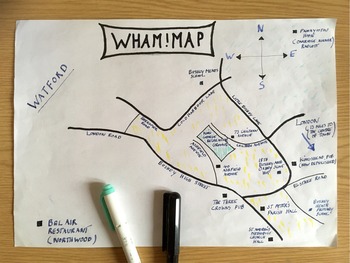
Biographical material (published books, fan-created websites, the archive of the Watford Observer) gave us spatial coordinates to the story and established a chronology. On our first walk we visited places we identified as key narrative elements: Bushey Meads School, family homes, the Three Crowns pub, and then the sites of rehearsals and gigs (the locations are marked on the sketch map in Figure 1). As we traversed this suburban landscape, so questions and ideas would form as a response to the topography and surroundings, leading to further research and reflections. After our first walk, we contacted people associated with specific locations by posting an open request online, explaining what we were doing, and asking for any recollections and memories on the Bushey Memories & History Facebook Group. Following the responses, we arranged interviews with individuals, either via telephone or written text (in email or messenger), obtaining their consent to use the quotes that appear in this article. We did a second walk a few weeks later after further research and conversations alerted us to the inaccurate identification of one site in some biographical and fan sources, while revealing an additional location that we needed to visit. We also wanted to immerse ourselves further in the streets trodden by band members walking between locations.
Wham! Map: main locations.

Bushey Meads School is an important location in the Wham! story. It was here in September 1975 that the new boy who would become George Michael first encountered Andrew Ridgeley. This was also the school that brought together the teenage aspiring musicians that made up The Executive, a six-piece band from which Ridgeley and Michael emerged as Wham!. In June 2021 we met outside the School on a drizzly, overcast morning. Keith Negus had deliberately driven from outside George Michael's old family home, taking the most logical route that would make up the ‘school run’. It took just over 10 minutes along narrow roads passing the orderly fields, schools and small industrial units between Radlett and Bushey. Our assumption was later confirmed when we read that George's mother had indeed driven him to school before he began catching the bus (Smith Reference Smith2017, p. 58). Having parked, Adrian Sledmere followed Andrew Ridgeley's likely walk downhill to school through roads lined with semi-detached 1920s and 1930s houses, many embellished with neo-Tudor or arts and crafts motifs, taking equally about 10 minutes on foot.
Outside the school we witnessed a typically suburban scenario of scholarly comings and goings, the suspicious gaze of the caretaker, the noisy orderly chaos of boisterous children entering and later leaving the school entrance, all punctuated by dutiful parents and carers congesting the area at the beginning and end of the school day. An obvious issue struck us both as we stood outside the gates reflecting upon the day so far: it was and is a school. We began a discussion about the neglect of schools in the study of musician's lives, and the way schools are treated largely as a site of music education. We spontaneously threw out half-remembered anecdotes: Bob Dylan performing at a high school, U2 forming at Mount Temple Comprehensive School in Dublin, and Radiohead meeting at the private and more elite Abingdon School, Oxfordshire.
In 1975 Bushey Meads was a non-selective, inclusive state comprehensive school, and we pondered the contribution that the site might have made to the musical aptitudes of Wham!. We learned that in 1975 George Michael was bought a drum kit by his parents, was deemed good enough to audition for local bands (Smith Reference Smith2017, p. 31) and performed a drum solo at a school Christmas concert (Bywaters Reference Bywaters2021). One teacher said that he played lead violin in the school orchestra and ‘was very good’ (Smith Reference Smith2017, p. 41). Such skills would become increasingly relevant in his solo career when he wanted to establish his credentials as a serious writer/artist/producer and not be defined by his role in Wham! (Smith Reference Smith2017, p. 136). Ridgeley remembers both himself and Michael being largely self-taught and playing by ‘instinct’. This suggests, perhaps, that teachers at the school were elevating Michael's formal musical skills, particularly when being interviewed for biographies produced immediately after the singer's death.
Ridgeley's musical attributes are certainly less easily identified in formal terms, because – like so many rock and pop musicians – he was largely self-taught. His father was known locally for his clarinet playing, heard regularly in the street (Bywaters Reference Bywaters2021) and suggesting a degree of musicality within the family. We know that Ridgeley possessed the sensibility to scope out the chord pattern of ‘Careless Whisper’, also co-writing ‘Wham Rap! (Enjoy What You Do)’ and ‘Club Tropicana’.
Marc Fernandes (Reference Fernandes2021), an ex-pupil and contemporary friend of Ridgeley and Michael, and incidentally (bearing in mind the broader postcolonial context) of a mixed Indian and French Flemish background, told us that although the school did not boast a track record of producing great A Level results or channelling students into Britain's top universities, it afforded considerable latitude for exploring different avenues of creative expression. Ex-pupil and friend, Andy Summers (Reference Summers2021), commented that the two would often take over the new music block (1974–1976) to rehearse and play, leaving others to use more makeshift rooms. Another old friend and ex-pupil, Mike Collins (Reference Collins2021), remembered: ‘The school didn't foster creativity. The AREA did. We all lived within a short proximity of each other and that fostered (at times) almost a friendly rivalry between bands or musicians’. Collins remembers Michael and Ridgeley as members of a ‘transient bunch’ with the membership of a specific group varying according to whoever's home was hosting the practice.
Bushey Meads School was important as a nexus of sociability and friendship, and Wham! was the contingent evolution of friendship between two suburban schoolfriends: visiting each other's houses, meeting parents, hanging out and making music, etc. Even though George Michael lived in Radlett, the two friends spent a considerable amount of time in each other's homes.
Shared adolescent musical preferences can be critical to ‘the formation and stability’ of friendships (Selfhout et al. Reference Selfhout, Branje, Ter Bogt, Meeus and W.H.J.2009, p. 96). For Michael and Ridgeley music was foundational to their relationship with a strong emphasis upon shared taste (Elton John, Queen, Roxy Music) establishing a ‘common ground’ on the first day they met (Ridgeley Reference Ridgeley2019, p. 33). They soon discovered that they owned many of the same LPs and began to attend gigs together, and their shared eclectic tastes were important in the formation of their friendship. Mary Clawson has noted how many ‘bands derive their personnel from peer groups, emanating from friendship groups in which socialising and music-making are closely linked’ (Reference Clawson1999, p. 104).
The first group that Ridgeley and Michael formed in 1979 was a ska band called The Executive. The band's repertoire consisted of a mixture of original tunes and covers, all performed within a ska idiom. Alongside tunes penned by Michael and Ridgeley, like ‘Rude Boy’ and the eponymous ‘The Executive’, they also included Beethoven's ‘Für Elise’ and Andy Williams's rendition of ‘I Can't Get Used To Losing You’. Four of the six members gradually quit, leaving the pair to form Wham! in 1981 based upon the dynamics, shared musical preferences and peculiarity of their friendship.
The Ridgeley/Michael bond was crucial in effecting the transition from Georgios Panayiotou to George Michael. In his memoirs of his time managing Wham!, Simon Napier-Bell engaged in some pertinent music business pop psychology: ‘Wham!'s self-made image of happy-go-lucky, good-looking best friends was the simple truth, but it soon became clear that in George's case the image hid a complex character full of angst and self-doubt’ (2005, p. 12). Napier-Bell recalls an observation made by music publisher Dick Leahy: ‘It wasn't really George and Andrew; it was Andrew (the real person), and Andrew (the copycat version played by George). “Wham! is George writing for Andrew and a friend!” Dick explained to me. “George just happens to be the friend”’ (2005, p. 32). This analysis was supported by Michael himself: ‘As a boy, my biggest fear was that my huge ambitions would stay just out of reach of the child I saw in the mirror. So I created a man (in the image of a great friend), that the world could love if they chose to, someone who could realize my dreams, and make me a star. I called him George Michael’ (Michael and Parsons Reference Michael and Parsons1991, Preface, np). Ridgeley's friendship, his more confident sense of identity and his social–psychological support and belief allowed George to begin developing this performing persona. Ridgeley's contribution to Wham! may look small when judged from simple musical criteria, but when viewed from the perspective of the enigmatic dynamic that goes by the name of friendship, it was crucial.
These bonds were embedded in the specific suburban scenery where the creative narrative of Wham! unfolded, frequently in a curiously informal and happenstance way. For example, Ridgeley notes in his biography that he had once pinned a note to the family fridge asking his mother to ‘Please wake me up up before you go go’ (Ridgeley Reference Ridgeley2019, p. 225). George spotted it on a routine visit to the Ridgeley household and then crafted the phrase into a hit single. This was an instance of the found or ordinary phrase incorporated into a hook for a song. The 1950s lyrical references in the track (such as the jitterbug) allude to the way Michael's parents had been accomplished rock ’n’ roll dancers when younger, an aspect of their past they (initially) concealed from their children (Michael and Parsons Reference Michael and Parsons1991, p. 11). Although not exclusively suburban, the crafting of a song from a fridge note evokes the quotidian comings and goings of a family home, and is emblematic of how the Michael/Ridgeley friendship was central to Wham!.
Hanging out in each other's homes was fundamental in Bushey, as there was little or nothing in terms of night life, making its pubs and the cinema in nearby Watford necessary points of connection with the metropolis and the world beyond it. Ridgeley mentions attempts to sneak in, underage, to see films like Saturday Night Fever and trips into London to visit Soho and go clubbing. He also suggests that their social circle were also pub goers before their eighteenth birthdays (Ridgeley Reference Ridgeley2019, pp. 64, 81), common during the 1970s when there was more tolerance about underage drinking and when the school leaving age in the UK was 16. These examples provide an inevitable sense of the constraints of suburbia, but equally an insight into its possibilities, and the relative ease of venturing into the metropolis and further afield. For teenagers not able to yet drive, the train and bus become a necessary means of travel, whether they are in the suburbs, country or the centre of cities.
Like many passengers, for George Michael the journey on public transport provided a liminal space to daydream and follow the mind's stream of ideas. After leaving school, he managed to secure a gig through family connections as a DJ at a Greek restaurant, the Bel Air in Northwood. There he played recordings for a type of disco ‘dine and dance’ that became popular throughout the suburbs during the 1970s. The time on the bus was an opportunity to compose music, and Michael pinpointed the precise moment he conceived the tune ‘Careless Whisper’. We quote this in full for how it locates the inspiration for an acclaimed popular song in the routine habitus of the suburbs:
I was on my way to DJ at the Bel Air when I wrote ‘Careless Whisper’. I have always written on buses, trains and in cars. These days it's planes – but for me writing has always been about boredom and movement. It always happens on journeys. With ‘Careless Whisper’ I remember exactly where it first came to me, where I came up with the sax line. I can remember very vaguely where I was when I wrote things after Wham! got off the ground – but with ‘Careless Whisper’ I remember exactly the time and place. I know it sounds really weird and a kind of romantic thing to say – but I remember exactly where it happened, where I was sitting on the bus, how I continued and everything. I remember I was handing the money over to the guy on the bus and I got this line, the sax line: der – der – der – der, der – der – der – der. Then he moved away and I continued writing it in my head. I wrote it totally in my head. I worked on it for about three months in my head. Andrew helped me in the finishing of it when we actually put it down on tape. I went to Andrew one day and said – I have this great melodic line but I don't know if it should be a sax or a vocal line. So he said – sing it to me. And he said – that really sounds like it goes with these chords I've got. And he had these four chords, the guitar lines. (Michael and Parsons, Reference Michael and Parsons1991, p. 56)
That George was DJing for diners at a Greek restaurant, rather than a recognisable ‘club’ was not unusual. Ridgeley remembered this as a ‘pretty soul-sapping experience’ for his friend. Having been fired from this gig for not following the musical guidance of his boss, Michael found himself DJing at a squash club. It was here that he played their demo for ‘Careless Whisper’ at the end of one evening to find that it filled the dance floor (Michael and Parsons Reference Michael and Parsons1991, pp. 56–7).
‘Careless Whisper’, later released by Wham!, provides a contrast with their upbeat songs. Its genesis foreshadows the versality of Michael and the concern with production that would become defining for him as a solo artist. The initial demo was recorded by Michael and Ridgeley on an early TASCAM 4 track Portastudio that they hired and used in Ridgeley's parents’ house, by then at 73 Chiltern Avenue. This became the template for a slick but soulless version produced by Jerry Wexler at the acclaimed Muscle Shoals Studios in Alabama, using top sax players from Los Angeles and New York City (Napier-Bell Reference Napier-Bell2005). Disappointed with the Wexler version, Michael went into Sarm West studios in West London to re-record the song and this became the version released in 1984.
The song is in the key of D minor, and both chorus and verse move through a similar tonic (Dm7), fourth (Gm7), sixth (Bbmaj7), fifth (Am7) progression. The opening and different sections are connected by a solo played by Steve Gregory on tenor saxophone, with the track slowed down during recording so that he could hit the highest note. When the tape was played back at normal speed the solo sounded as though it had been played on alto sax. Gregory was the eleventh sax player to have attempted the solo (Forshaw Reference Forshaw2021), including the top session musicians whose performance in Muscle Shoals had disappointed Michael (Napier-Bell Reference Napier-Bell2005). The recurring defining saxophone solo is a bold opening statement, and the song's arrangement skilfully injects rising dynamics as the choruses are sung in a higher register, a more strained delivery contrasting with the whispered, confiding breathiness of the verses.
The gentle grooving ‘in the pocket’ electric guitar strumming of Hugh Burns (whose guitar playing also sat alongside Raphael Ravenscroft's sax solo on Gerry Rafferty's ‘Baker Street’) is embellished by melodic phrases on nylon guitar in the second verse (also Hugh Burns) offering a counterpoint to Michael's vocal. The track progresses by building variation and rhythmic interest, most notably in the bassline of Deon Estus. The final sections follow a similar harmonic progression but with vocal improvisations generated over chorus motifs that don't feature earlier in the song. Recorded direct without any programming, and with overdubs added later, the nuanced liveness of these details is crafted to support and foreground the vocal performance. It is a stark contrast to the Wexler production, and the track highlighted the production skills of Michael, and his ability to fashion a recording according to how he heard it in his mind, after the initial moment of inspiration on the bus journey.
The origins of ‘Careless Whisper’ and reflections on Michael's DJing alert us to an aspect of Bushey that impressed us forcefully on our walks: facilities to support any type of music ‘scene’ would have been limited (recording and rehearsal studios, record stores, venues, etc). Indeed, aside from The Executive, the only other band mentioned in biographical accounts of Wham! are an outfit called The Quiffs, an act not mentioned by any of our respondents. The study of popular music has featured considerable research demonstrating how formal networks and infrastructures of recording, rehearsal, retail, media, clubs and music venues can facilitate the emergence of distinct music scenes (see Bennett and Peterson Reference Bennett and Peterson2004; Curtis and Rose Reference Curtis and Rose1983; Webb Reference Webb2007). Yet there was no Bushey ‘scene’ to speak of and Wham!'s trajectory was contingent upon prosaic venues that served multiple functions for different groups of people in the neighbourhood.
Although young people in cities may also have limited access to live venues, rehearsal rooms, labels, and retail outlets – particularly as these have declined owing to gentrification and online communication – the existing literature cited so far tends to imply a rich vibrant musical life to the landscape of urban centres, such as London or Liverpool, and the limited opportunities provided by dull, bland, sprawling suburbs. Such a dichotomy is also signalled and continually reproduced in the aspirational tales of the musicians from small towns, dormitories, and suburbs that move to ‘make it in the big city’ (see Negus Reference Negus and Hawkins2017).
An everyday venue that served multiple functions and that is important to the formation of Wham! is the church hall. In research on live music (Webster et al. Reference Webster, Brennan, Behr and Cloonan2018), churches are often mentioned but usually as venues for the performance of sacred and classical music, or occasionally Christian gospel. An exception to this neglect can be found in Ruth Finnegan's (1989) ethnography of music making in the English new town of Milton Keynes. Here, she alludes to the ‘active pathways trod by practising musicians in a local setting’ (Finnegan Reference Finnegan1989, p. xiv); how informal spaces, like church halls and scout huts, are directly connected to music making in schools and homes. She does this alongside a broader metaphorical use of the term ‘pathways’ to situate place within the creative and symbolic movements of musicians. In our research we too consider the grounded pathways trodden by the musicians as they walked from home to rehearsal, and from gig to socialising in pubs as an integral part of a wider narrative.
Prior to visiting the Three Crowns pub, we had not been aware that it was opposite a church hall where George and Andrew had rehearsed (a typed note in the pub alerted us to this). St Peter's Parish Hall, a few yards east along the main road from the Victorian gothic revival church with its flamboyant tower, is one of many locally listed buildings that imbue Bushey with layers of pre-suburban history. An important community asset built in 1910 and funded by public subscription, it is a blend of Edwardian gothic with neo-Tudor frontage and an internal hall capped by a semi-circular vaulted roof, an architectural mixture as artfully contrived as the songs of the duo that would soon become so familiar to fans of Wham!.
Again, we were struck by an obvious thought, yet it was one raised by walking up to such places. That is the importance of the vicar, priest, caretaker, and churchwarden. We made a note of contact details that were displayed on noticeboards and other signage with a view to gleaning stories and other insights. We received a response to our enquiries from Father Andrew Burton at St Peter's, who was aware that The Executive had rehearsed in their church hall, but ‘those involved in the management of the hall in the 1980s have been dead for years and no records were kept of hirers’ (Burton Reference Burton2021).
John Wood, Property Committee Chair, St Andrew's Methodist Church, a few hundred yards from St Peter's along the main road in Bushey Heath, told us that The Executive were eventually banned from practising at their church hall as they were too loud, often rehearsed with the windows open, and provoked complaints from neighbours (Wood Reference Wood2021). A modest modernist gable-fronted church, completed in 1968, and on a busy main road, St Andrew's rear hall backs on to the secluded houses in California Lane. Standing in the peaceful, well-appointed, narrow residential road, we could hear how the sound of a pop band rehearsing might not have been welcome in such an area.
Apart from their sacred purposes, churches fulfil several secular functions in suburban locales, encompassing activities for all age ranges including playgroups, fitness and exercise clubs, various community organisations, amateur theatrical societies, and support groups for older people. They have also provided an important space where local bands can perform and rehearse. From our exchanges with contemporaries of Ridgeley and Michael at Bushey Meads School, it was clear that there was competition for such rehearsal spaces. Memories included an account of the band rehearsing in the back garden of a house, and rehearsals in someone's garage.
Tony Bywaters (Reference Bywaters2021), an occasional member of The Executive and four years older than George and Andrew, recalled that many musicians would jam and practise on instruments in the King George Recreation Ground, centrally located between the main locations in this story (see Figure 1), a communal green space with surviving traces of a medieval system of ridge and furrow farming. He recounted pushing a wheelbarrow, loaded with amps and guitars, through the park to band practices, and recalled rehearsals of The Executive ‘as always good fun’. As commonplace as it may sound, the old friends and band members we interviewed for this research readily and spontaneously remembered the ‘fun’. We are reminded of the way Simon Frith invoked ‘the struggle for fun’ in the final words of Sound Effects (Reference Frith1983, p. 272), and of the critical and political dismissal of Wham! for their apparent frivolity and lack of seriousness.
In many ways, Wham!'s music was a playful extension and expression of the lives of the friends who created it. This can be heard most strongly in the first song that Michael and Ridgeley wrote together after the break-up of The Executive, ‘Wham Rap! (Enjoy What You Do)’. Ridgeley (Reference Ridgeley2019) describes the genesis of the song as an informal chant (‘Wham! Bam! I am the man!’) he would boastfully perform when out clubbing with Michael and Shirlie Holliman. Whilst the song was strongly influenced by US rap, its creation caught a very particular carefree moment – post A-Level, ‘signing on’ (claiming unemployment benefit), clubbing, and hanging out at Watford swimming baths where musical collaborator David Mortimer was working as a lifeguard. Ridgeley recalled: ‘“Wham! Bam! I am a man!” captured the very spirit of our young band: good times, dancing with friends to great music, with a little attitude thrown in. It was a compelling mix and one that would set us apart and define us’ (Ridgeley Reference Ridgeley2019, p. 122).
The rehearsals with the windows open at St Andrew's Church Hall were part of the environment where fun was integral to the musical creativity and identity of the duo. From St Andrew's it is a few minutes’ stroll along another narrow street, The Rutts, passing Bushey Heath Primary School (where Andrew Ridgeley's mother taught), and across Elstree Lane towards the scout hut in Little Bushey Lane that Ridgeley (and other sources) identifies as the site of the first gig for The Executive. Here we initially encountered confusion. Some sources refer to a Methodist church hall (Jovanovic Reference Jovanovic2007; Michael and Parsons Reference Michael and Parsons1991; Smith Reference Smith2017), and one fan site misidentifies a more distant Methodist church on the border between Bushey and Oxhey. Smith (Reference Smith2017) also suggested that the scout hut was affiliated with St Andrew's Methodist Church. However, after speaking with contemporaries of the band, a representative of the Church, and consulting various websites of churches, along with the George Michael Appreciation Society of Bushey, it became clear that the hut had no church connection, although various religious denominations used the building (in the late 1960s it was briefly used for Yom Kippur services while the Synagogue was being established).
The scout hut is a modest wooden affair, built in the 1950s, and characteristic of similar hamlets of recreational buildings that populate the margins of the suburbs and form part of its communal life. Looking a little tired, it was renovated in 2012 with support from local organisations and Wham! fans. Older photographs suggest that this would once have been located within a wider expanse of land. However, its semi-rural anonymity on the edge of Bushey has been compromised by housing developments as surrounding land has been sold off for small houses and apartment buildings, along with the demolition of the Kings Head pub (replaced with a small accommodation block) that was opposite the hut until 2007 – one of the seven Bushey pubs that have gone since 1979. Ridgeley notes that at the time of their first gig ‘green paint flaked from the walls and a musty, damp odour clung to the furniture and curtains but to us it felt like Wembley’ (Ridgeley Reference Ridgeley2019, p. 100). His memoirs convey the excitement of the gig and the sensation, after playing encores, that ‘The Executive were on the verge of conquering the world’ (Ridgeley Reference Ridgeley2019, p. 101).
We sought any possible memories of this gig by including reference to it in our posting on the Bushey Memories & History Facebook Group. Perhaps inevitably recollections ranged from those who thought The Executive were amazing to those who thought they were awful (familiar to anyone who has attended local popular music gigs). One of the most interesting memories came from Marc Fernandes, a venture scout and fellow pupil of Ridgeley and Michael, quoted earlier. He explained how The Executive came to play at the Scout Hut:
Scout discos – attendance was initially poor: about 15 people. Then David Izzard traced over an Abba album of two people snogging; we put that round the school, on the noticeboards. When we did that we had about two hundred people who wanted to come to our scout hut disco. The scout hut was only insured for 80 people – we packed everyone in and it was a bit like the underground in the rush hour. We couldn't sell beer or alcohol, but I used to brew beer and sell it as shandy so we wouldn't be competing with the pub across the road. We ran the disco three or four times and this seemed to work. We used to sit together at school: I did French with Yoghurt [GM], and German with Andrew Ridgeley. They were interested in our discos because of the numbers we were getting and asked if they could come along and play. I said ‘sure’. I didn't even see the gig as I was on the door. It was a really good atmosphere though, and there was this guy called Matthew Malone hanging from the rafters, swinging and causing the whole hut to shake. (Fernandes Reference Fernandes2021)
This quote gives a sense of the significance of such an event and its place at the intersection of school friendship groups, illustrating the importance of suburban sites to inchoate bands. A similar point was mentioned by Dave Laing (Reference Laing2010) when describing how youth clubs, church halls, and community centres across outer lying parts of Manchester were integral to the city's scenes of beat groups and folk music during the 1960s. When asking around among musicians we found many possibly apocryphal anecdotes of famous bands that had initially played or rehearsed in scout huts and church halls, tales then repeated and persisting in local folklore. Acts mentioned included Cream, The Stranglers, Humble Pie, and the Undertones, and are consistent with similar mythologised and sometimes misremembered accounts of where the Beatles played and rehearsed that have appeared in biographies (Cohen Reference Cohen2007).
Recollections of The Executive's first public performance allowed additional insights into how the Ridgeley/Michael friendship was located within an environment where the Three Crowns pub was a ‘the focus of social life’ (Ridgeley Reference Ridgeley2019, p. 81). Another school friend from this period, Judith Chaffer (Reference Chaffer2021), remembered the pub as ‘a real hot bed of musicians’ from the local area. Located a few metres from the highest point in the old county of Middlesex, and opposite St Peter's Church, The Three Crowns traces its history back to the late eighteenth century. It is a short 10-minute walk up the hill from Andrew's erstwhile home in Ashfield Avenue, and a similar walking distance from the scout hut. It has, perhaps inevitably, became a site of pilgrimage for fans of the band, and contains a small modest display in the snug bar, where the young men used to sit and socialise: a signed portrait of George, a framed photo of Andrew with bar staff, a signed copy of Andrew's book, a few other music biographies and a typed note about the history of the pub and its significance to the development of Wham!. It was here in 1981 that Andrew flirted with the aforementioned Shirlie Holliman, a contemporary from Bushey Meads, who became his girlfriend and then backing vocalist for Wham!, and went on to achieve success with Helen DeMacque as the duo Pepsi and Shirlie.
The Three Crowns was where Ridgeley and Michael approached Mark Dean, who had set up a small record label called Innervision, jointly with Shamsi Ahmed, founded with modest financial backing and distribution from CBS. Dean had been responsible for licensing the rights to a sampler album of acts signed to the Some Bizzare Label while he was working in the Phonogram Artist and Repertoire Department (Michael and Parsons Reference Michael and Parsons1991) and was friendly with members of various bands. A local resident, he was often in the Three Crowns and approachable by young musicians seeking access to the music business. Ridgeley recalls that he had first met Dean when taking a demo tape of The Executive around various record companies. Although unconvinced by The Executive, Dean was impressed with a later Wham! demo that included ‘Careless Whisper’, and they signed their first and very poor recording deal with him in March 1982. Innervision was a low-budget affair and after some initial success, both Ridgeley and Michael found themselves with little financial return and still living at home with their parents. Like many acts that sign deals naively, they had to be extricated from their legal obligations with the assistance of the management duo of Jazz Summers and Simon Napier-Bell (Napier-Bell Reference Napier-Bell2005).
That the deal with Innervision was secured based on a demo tape handed to Dean in the pub alerts us to the informal dealing that characterised an era when the recording industry was less conditioned by the rigours of corporate culture (Negus Reference Negus1992). Whilst the urban pub has been celebrated in profiles of pub rock, and pubs referred to in a few studies of ‘scenes’ (see Bennett Reference Bennett1997), little acknowledgement has been made of those areas away from the centre where the suburban pub offers something less well defined and bounded yet is vital in the social life of an area. The suburban hostelry, often incorporated from what were once villages or built as the suburbs expanded during the housing boom of the 1930s, is a site of meeting, friendship, romance, family celebrations, and chance encounters. What strikes us here, sitting in the pub, having walked the route from the school via Andrew Ridgeley's house, the churches, and the scout hut, is its role as a suburban hub: a place that was pivotal for the friendship, sociality, fun and community that was distilled into the identity, performance, and the sound of Wham!. After the first gig, and after contract discussions with Dean, it would have been a short walk back to Andrew's house … and, for us, it is a short walk, back down the hill towards the school where we started.
Straight outta Bushey: concluding contingencies …
Our exploration of Wham! has taken place in the suburbs and dormitories of London, specifically focused on Bushey. Yet it began with journeys from Egypt and Cyprus, locating Wham! in postcolonial terms within the context of the backgrounds, exile, and aspirations of their parents, and a ‘spatial moral order’ (Said Reference Said1994, p. 94) that shaped the sensibilities of second-generation immigrants. At the same time, we have located the band's beginnings within a pre-existing set of centrifugal/centripetal dynamics that continue to define the aspirational yet ambivalent qualities of the suburbs. Here, our discussion drew on Huq in challenging orthodox dismissals of the popular culture of the London suburbs and by considering the backgrounds, dynamic activities, and varied experiences of those who move within and across them.
Our research was initially conceived to explore the possibilities afforded by psychogeography, adopting this as a means of extending approaches to popular music and place, drawing inspiration from the work of Cohen. Psychogeography has enabled us to understand types of local mediation and interaction that might not emerge from more sedentary methods, allowing us to explore the consequences of movements through and between places and how this shapes values, sensibilities, actions, and creative practices. Unlike psychogeographic precursors with their intimations of gothic and darker undercurrents, our paths through the lighter tones of suburbia have helped us develop a more grounded enquiry: a psychogeography antithetical to the shadowy and rooted in the ordinary routines of the school day and local pub.
This has meant not only visits to and walks around the Bushey area, but a broader immersion in and exploration of this specific social and cultural geography. This first-hand experience of walking through Bushey has provoked questions and themes which could not have emerged in any other way. We have been struck by how friendships and sociality materialised in this relaxed suburban environment, and how these in turn can be crucial in forming the specific characteristics of creativity. The key locations in this story – the schools, the homes of school friends, the pub, the church halls, the scout hut – are about 10 minutes’ walk from each other, along residential streets and across a recreation ground. A noticeable contrast is the house where George Michael lived in Radlett. Walking past this dwelling and into the fields beyond that lead across the Hertfordshire countryside, we look back at the house as it peeks out from the edge of a small dormitory town and speculate on the contingencies of these historical geographies. What would have happened if Georgios Panayiotou had attended a different school, perhaps a more exclusive institution, and not arrived at Bushey Meads? Yet the contingencies could begin with the conflicts in Cyprus and in Egypt during the 1950s.
What has emerged from our walks, and the research and exchanges that they have inspired, is an informal and loose pattern of very specific suburban affiliations connecting a school, homes, a pub, church halls, and a scout hut. These are physical buildings and places that can be located on a map; spatially close and linked by the historically contingent character of friendships, shared musical preferences, sociability, and chance encounter – very specific moments joined in time and space. It might or might not resonate with other suburban histories. It certainly challenges the orthodox portrayal of the suburbs, in the studies of popular culture, as restrictive, dull, lifeless, alienating places that need to be escaped for the urban centre.
Wham! did not emerge from any distinct subculture, scene or network, but from the prosaic paradoxes and possibilities of a suburb on the margins of metropolitan London. It was a band created by the sons of immigrants who had, in their own ways, made it from the margins of the imperial metropolis.