Introduction
Sugarcane is an important crop in Florida, cultivated on approximately 166,000 ha (USDA-NASS 2018). The crop is primarily cultivated in the Everglades Agricultural Area (EAA) on the southern edge of Lake Okeechobee in south Florida on organic or muck soils (Histosols), representing 74% of the hectarage, and the remaining 26% is on mineral or sand soils adjacent to the EAA (VanWeelden et al. Reference VanWeelden, Swanson, Davidson and Rice2017). A single planting of sugarcane in Florida is harvested three to five times, with the first year’s crop (plant cane) accounting for 32% and ratoon crops (subsequent regrowth crops) accounting for 68% of the hectarage (VanWeelden et al. Reference VanWeelden, Swanson, Davidson and Rice2017). When sugarcane production declines to unacceptable levels, the ratoon crop is terminated, and fields are immediately replanted with sugarcane (referred to as successive planting), planted with a rotational crop, or fallowed for a period before replanting. Crops commonly grown in rotation with sugarcane in Florida include rice (Oryza sativa L.), St Augustinegrass [Stenotaphrum secundatum (Walter) Kuntze], sweet corn (Zea mays L. var. saccharata), radish (Raphanus sativus L.), green bean (Phaseolus vulgaris L.), and leafy green vegetables. A crop rotation of sugarcane with other monocot crops can often lead to an increase of annual and perennial grasses due to limited control options.
Fall panicum, a member of the Poaceae family, native to eastern United States and West Indies (Bryson and DeFelice Reference Bryson and DeFelice2009), is the most prevalent and difficult to control annual grass weed in Florida sugarcane (Odero et al. Reference Odero, Sellers, Baucum and Curtis2014). It is a prolific seed producer, and a single plant can produce 10,000 to more than 100,000 seeds depending on plant size (Fausey and Renner Reference Fausey and Renner1997; Govinthasamy and Cavers Reference Govinthasamy and Cavers1995). The variation in fall panicum seed quantity is attributed to seed shattering soon after ripening, which makes estimation of seed number difficult (Govinthasamy and Cavers Reference Govinthasamy and Cavers1995). Optimal fall panicum germination in the field occurs at depths of 1.0 to 2.5 cm, although some emergence from as deep as 7.5 cm can occur (Brecke and Duke Reference Brecke and Duke1980; Fausey and Renner Reference Fausey and Renner1997). In south Florida, fall panicum germination can occur year-round because of the subtropical climate; however, the highest emergence is usually observed between September and May, which coincides with planting, harvesting, and early-season development of sugarcane (DCO, personal observation). The critical timing of fall panicum removal in sugarcane ranges from 6 to 8 wk after emergence, indicating vulnerability of sugarcane to early-season competition, while season-long interference can result in up to 60% reduction in sucrose yield (Odero et al. Reference Odero, Duchrow and Havranek2016).
Management programs for fall panicum in Florida sugarcane, regardless of the soil type, generally consist of multiple herbicide applications in combination with mechanical cultivation to provide season-long control. Pendimethalin applied PRE in combination with atrazine or metribuzin is used for early-season fall panicum control. However, reduced activity from pendimethalin occurs when applied under dry conditions, particularly with no mechanical incorporation (Odero and Shaner Reference Odero and Shaner2014). Consequently, early POST application of atrazine or metribuzin in combination with ametryn is used for control of fall panicum <4 cm in height. Because of the small window of control provided by the triazine herbicides, asulam applied alone or in combination with trifloxysulfuron is used to control fall panicum that escapes PRE and early POST herbicide applications (Odero and Dusky Reference Odero and Dusky2014; Odero et al. Reference Odero, Sellers, Baucum and Curtis2014). Asulam is labeled for grass control in sugarcane at 2,800 to 3,700 g ha−1 depending on grass size and can be applied on grasses up to 46 cm in height (Anonymous 2018b), while trifloxysulfuron is labeled at 16 g ha−1 (Anonymous 2018c). In Florida, the maximum rate of asulam is used on fall panicum >30 cm in height. The asulam and trifloxysulfuron tank mix has been shown to enhance the efficacy of asulam on johnsongrass [Sorghum halepense (L.) Pers.] control in sugarcane (Dalley and Richard Reference Dalley and Richard2008) and small flowered alexandergrass [Urochloa subquadripara (Trin.) R. D. Webster] control in St Augustinegrass for sod production (Teuton et al. Reference Teuton, Unruh, Brecke, MacDonald, Miller and Ducar2004), although trifloxysulfuron by itself does not result in acceptable fall panicum control. In recent years, Florida sugarcane growers have been reporting reduced control of fall panicum with asulam. Reduced control maybe be attributed to evolution of herbicide resistance, which has not been reported in Florida sugarcane (Heap Reference Heap2018). In addition, the efficacy of asulam can be adversely affected by poor management practices related to application timing and carrier volume (Hossain et al. Reference Hossain, Kuramochi, Ishimine and Akamine2001; Richard Reference Richard1991). Therefore, it is important to determine whether fall panicum in Florida sugarcane is evolving resistance to asulam. The objective of this study was to determine the response of fall panicum populations from Florida to asulam applied alone using a dose–response bioassay and to evaluate whether tank-mix combination with trifloxysulfuron enhances control of difficult to control populations.
Material and Methods
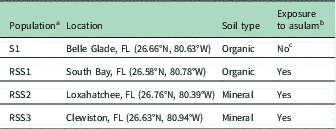
An outside container experiment was conducted at the University of Florida Everglades Research and Education Center in Belle Glade, FL, in 2016 to 2017 to determine the response of fall panicum to asulam, and whether trifloxysulfuron enhances asulam efficacy on fall panicum control for four populations originating from Florida sugarcane fields. Seeds were collected at maturity from multiple plants within the same field from two organic soil locations and two mineral soil locations in 2015 (Table 1). Three populations for which reduced susceptibility was reported (South Bay or RSS1, Loxahatchee or RSS2, and Clewiston or RSS3) were collected in 2015 from fields in which reduced control had been reported, while the Belle Glade population (susceptible or S1) was from a field that has not been planted to sugarcane for >20 yr but adjacent to a sugarcane field (23 m apart). The RSS1, RSS2, and RSS3 populations were from fields treated with at least one application of asulam per season during the sugarcane cropping cycle. Collected seeds from each population were stored in the dark at 2 C before use.
Fall panicum populations, collection locations, and history of exposure to asulam.

a Abbreviations: S1, susceptible 1; RSS1, reduced susceptibility site 1; RSS2, reduced susceptibility site 2; RSS3, reduced susceptibility site 3.
b Population exposed to application of asulam (3,700 g ha−1) every season for the last 10 years and reported as having reduced susceptibility to asulam.
c The Belle Glade population was collected from a field that is not used for sugarcane production (>20 yr but 23 m away from a sugarcane field).
Four to five seeds from each population were planted directly into Cone-tainers™ (Stuewe and Sons, Tangent, OR) containing a commercial potting medium (Sun Gro® Professional Growing Mix, Sun Gro Horticulture, Agawam, MA) and placed outdoors on benches for the entire duration of the study to expose the plants to field environmental conditions. At 21 d after emergence, fall panicum was thinned to one plant per Cone-tainer™ with uniform size across all plants. Plants were subirrigated as needed and fertilized with 14-14-14 slow-release fertilizer to ensure that moisture and nutrients were not limiting factors. The first experimental run was planted on July 26, 2016, and plants averaged 25 cm in height at 56 d after planting; a second experimental run was planted on October 1, 2016, and plant size averaged 25 cm at 52 d after planting. Herbicide treatments were applied immediately after plant height was recorded.
The experiment was a completely randomized design with a factorial arrangement and four replications of each treatment. The factors were asulam (Asulox®, United Phosphorus, King of Prussia, PA) with seven rates (0, 230, 470, 940, 1,880, 3,700, and 7,400 g ai ha−1), trifloxysulfuron with two rates (0, 16 g ai ha−1) (Envoke®, Syngenta Crop Protection, Greensboro, NC), and fall panicum population (S1, RSS1, RSS2, RSS3). The asulam rates correspond to 1/16 to 2X the recommended maximum single-application use rate of 3,700 g ha−1 on sugarcane. A nonionic surfactant at 0.25%v/v (Induce®, Helena Chemical, Collierville, TN) was included for all herbicide treatments. A nontreated control for each population was included for comparison. Herbicide treatments were applied on September 20, 2016, for the first experimental run and November 22, 2016, for second run. Herbicide treatments were applied using a moving-nozzle spray chamber (Generation II Spray Booth, Devries Manufacturing, Hollandale, MN) equipped with a TeeJet® 8002E nozzle tip (Spraying Systems, Wheaton, IL) calibrated to deliver 187 L ha−1 at 172 kPa. Plants were returned outdoors immediately following herbicide treatment and maintained as previously described. To avoid cutting the growing points, biomass was harvested 2.5 cm aboveground at 28 d after treatment (DAT). The harvested biomass was then oven-dried at 60 C for 72 h to obtain dry weight. After harvest, the plants were kept outdoors and allowed to regrow. Regrowth (presence of new green tissue) was only observed for up to 7 d after harvesting, and no new growth occurred thereafter. The binomial response of presence or absence of fall panicum regrowth was recorded as 1 or 0, respectively, from each pot. Dry weight was expressed as a percentage of the nontreated control for analysis.
Statistical analysis
Dry weight data were subjected to ANOVA to determine whether the effect of asulam treatments with or without trifloxysulfuron, fall panicum population, experimental run, and their interactions were significant using R (R v. 3.4.1; R Core Team 2017). Nonlinear regression analysis was then performed on dry weight data using the ‘drc’ package (Ritz and Streibig Reference Ritz and Streibig2005) of R. Data were analyzed using a four-parameter log-logistic model similar to that described by Seefeldt et al. (Reference Seefeldt, Jensen and Fuerst1995), but with the lower limit fixed at 0 so that the equation takes the form:
 $$Y{\equals}d\,/\,(1{\plus}{\rm exp}\left\{ {b\left[ {{\rm log}\left( x \right){\minus}{\rm log}\left( {{\rm ED}_{{50}} } \right)} \right]} \right\}$$
where Y is dry weight expressed as a percentage of the nontreated control, x is the asulam rate (g ha−1), b is the relative slope at the inflection point, d is the upper limit or asymptote, and ED50 is the asulam rate required to cause 50% dry weight reduction. Fixing the lower limit at the priori chosen value is biologically relevant, because dry weight of <0% of the nontreated control cannot be obtained, that is, biomass cannot be negative, even at very high POST herbicide rates. When the main effects (asulam, trifloxysulfuron, and population) were significant, the ED50 values of the S1 population and RSS populations were compared using likelihood ratio tests to determine whether these populations were more or less susceptible to asulam with or without trifloxysulfuron.
A generalized linear model was used to conduct analysis of deviance on fall panicum regrowth data using the glm function in R for each population to determine the effect of asulam rate with or without trifloxysulfuron, experimental run, and their interactions on the probability of fall panicum survival or regrowth following herbicide treatment. Analysis of deviance, analogous to ANOVA, is appropriate for binomial data (Venables and Ripley Reference Venables and Ripley2002). A two-parameter log-logistic model was used to analyze regrowth data to determine the probability of fall panicum survival. The two-parameter log-logistic model is similar to the four-parameter log-logistic model described by Seefeldt et al. (Reference Seefeldt, Jensen and Fuerst1995), but with the upper and lower limits fixed at 1 and 0, respectively, because of the binomial response:
 $$Y{\equals}1\,/\,\left( {1{\plus}{\rm exp}\left\{ {b\left[ {{\rm log}\left( x \right){\minus}{\rm log}\left( {{\rm ED}_{{50}} } \right)} \right]} \right\}} \right)$$
where Y is regrowth (probability of fall panicum surviving asulam treatment with or without trifloxysulfuron tank mix), x and b are the same as in Equation (1), and ED50 is the rate required to result in 50% probability of survival or regrowth. A lack-of-fit test at the 95% level comparing the regression models (Equations 1 and 2) to ANOVA was conducted to determine whether the models appropriately fit the data (Ritz and Streibig Reference Ritz and Streibig2005).
Results and Discussion
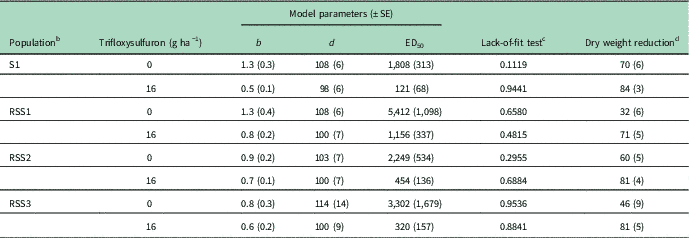
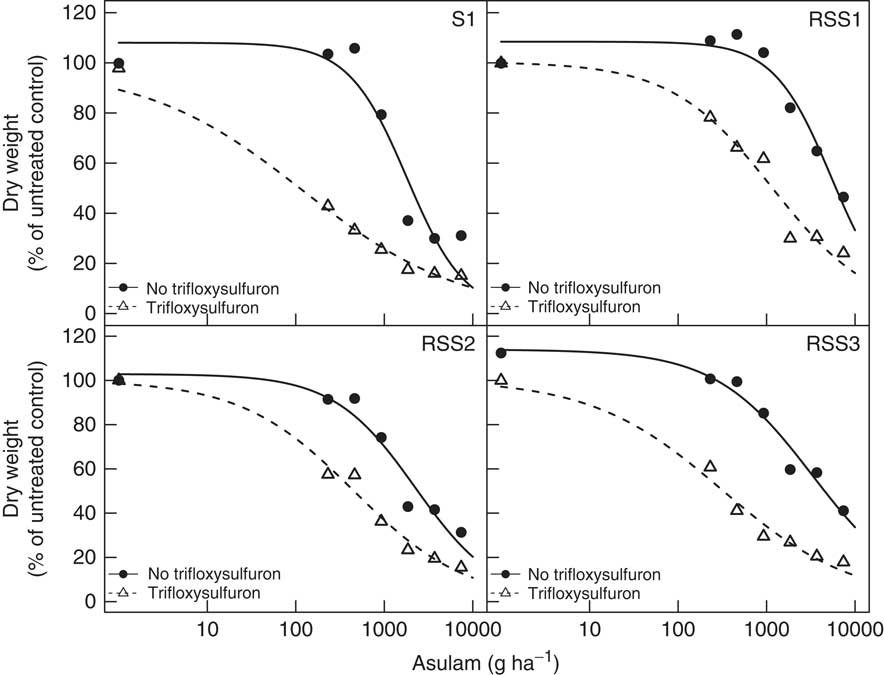
The average daily maximum and minimum temperatures after herbicide treatment for the entire duration of experiments were 20.5 and 29.9 C for the first experimental run and 15.5 and 26.3 C for the second experimental run, respectively (Anonymous 2018a). The interaction of asulam, trifloxysulfuron, fall panicum population, and experimental run was not significant (P > 0.05) for fall panicum dry weight. However, the main effects of asulam, trifloxysulfuron, and fall panicum population were significant (P<0.05); therefore, only the main effects are discussed. Fall panicum dry weight was modeled as a function of asulam applied alone or in combination with trifloxysulfuron using a log-logistic model (Equation 1). A test for lack of fit at the 95% level was not significant (P > 0.05) (Table 2), indicating that the regression model was appropriate for all fitted curves (Ritz and Streibig Reference Ritz and Streibig2005). Fall panicum dry weight decreased as asulam rate increased when applied alone or in combination with trifloxysulfuron for all populations at 28 DAT (Figure 1). Dry weight reduction was greater when asulam was applied in combination with trifloxysulfuron for all the populations. The ED50 values for asulam applied alone or in combination with trifloxysulfuron were 1,808 and 121 g ha−1 for S1, 5,412 and 1,156 g ha−1 for RSS1, 2,249 and 454 g ha−1 for RSS2, and 3,302 and 320 g ha−1 for RSS3 populations, respectively. When compared with the S1 population, the three RSS populations exhibited less sensitivity to asulam because of their significantly higher ED50 values (P < 0.05). The effectiveness of herbicides is typically based on the ED50 parameter (Ritz et al. Reference Ritz, Kniss and Streibig2015); therefore, our results show that the Belle Glade population was most sensitive to asulam, while the South Bay population was the least sensitive based on significantly different (P < 0.001) lowest and highest ED50 values, respectively. The ratios of the ED50 values for asulam applied alone compared with combinations with trifloxysulfuron were significantly different from 1 (P < 0.05) for all populations, indicating that addition of trifloxysulfuron enhanced dry weight reduction. Addition of trifloxysulfuron to asulam increased effectiveness by 15-, 5-, 5-, and 10-fold for the Belle Glade, South Bay, Loxahatchee, and Clewiston populations, respectively. Enhanced efficacy of asulam with the trifloxysulfuron tank mixture has previously been reported on johnsongrass and small flowered alexandergrass control (Dalley and Richard Reference Dalley and Richard2008; Teuton et al. Reference Teuton, Unruh, Brecke, MacDonald, Miller and Ducar2004). The predicted dry weight reduction for asulam at 3,700 g ha−1 (i.e. maximum labeled rate for a single application in sugarcane) based on the log-logistic model (Equation 1) was 70% and 84%, 32% and 71%, 60% and 80%, and 46% and 82% for asulam applied alone or in combination with trifloxysulfuron for the S1, RSS1, RSS2, and RSS3 populations, respectively. This shows that asulam would provide 32% to 60% fall panicum growth reduction for populations for which reduced control has been reported, indicating a differential response to asulam. Furthermore, the ED50 value for the RSS1 population for asulam applied alone exceeded the maximum labeled sugarcane rate by 1.5-fold for a single application.
Log-logistic model parameters and SEs in parentheses for fall panicum dry weight in response to asulam applied alone or in combination with trifloxysulfuron in outside container experiments combined over two experimental runs.Footnote a

a Equation 1: Y = d/(1+exp{b[log(x) − log(ED50)]}). Y is dry weight expressed as a percentage of the nontreated control, x is the asulam rate (g ha−1), b is the relative slope at the inflection point, d is the upper limit or asymptote, and ED50 is the asulam rate required to cause 50% dry weight reduction.
b S1 is the Belle Glade population, while RSS1, RSS2, and RSS3 are the South Bay, Loxahatchee, and Clewiston populations, respectively.
c A lack-of-fit test at the 95% level comparing the regression models (Equation 1) to ANOVA was conducted to determine whether the model was an appropriate fit for the data.
d Predicted fall panicum percentage dry weight reduction and SEs in parentheses following treatment with asulam at the labeled maximum rate of 3,700 g ha−1 for a single application in sugarcane alone or in combination with trifloxysulfuron.
Dry weight of fall panicum populations (expressed as a percentage of nontreated control) in response to asulam applied alone or tank mixed with trifloxysulfuron (16 g ha−1) at 28 d after treatment in outside container experiments combined over two experimental runs. The Belle Glade, South Bay, Loxahatchee, and Clewiston populations are the S1, RSS1, RSS2, and RSS3 populations, respectively.

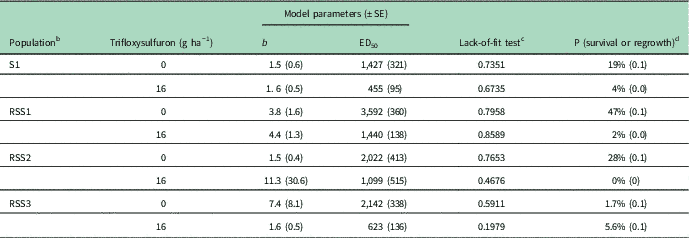
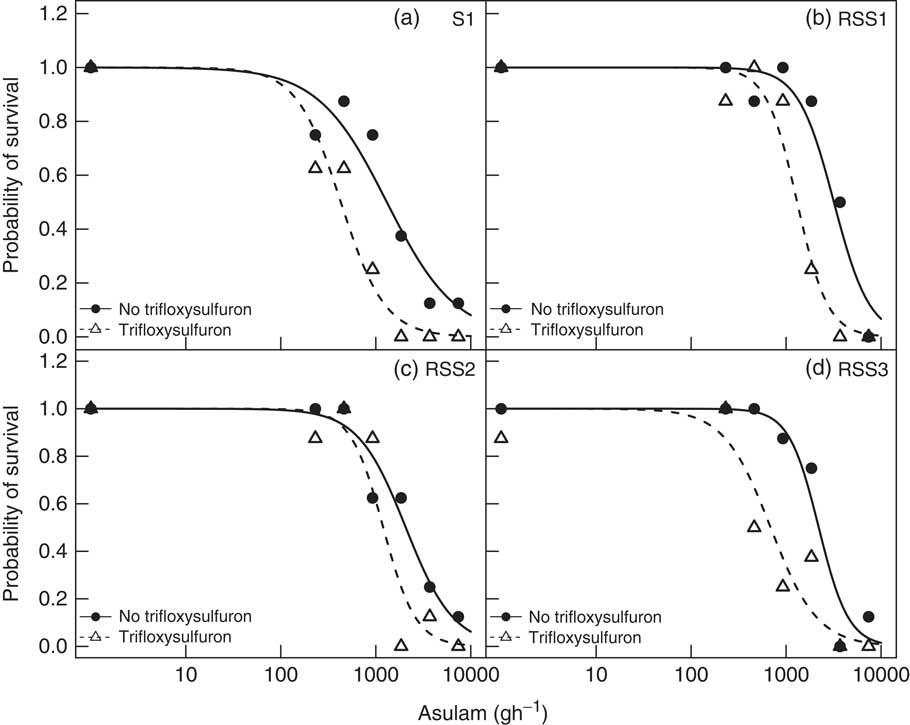
Although dry weight data were used for determining the specified rates of asulam needed for fall panicum growth reduction, either alone or in combination with trifloxysulfuron, this information does not show whether these rates would ultimately result in plant mortality. Consequently, a binary response of fall panicum mortality after aboveground biomass harvesting was calculated to determine probability of survival following exposure to asulam and whether the combination with trifloxysulfuron enhanced mortality. Effects of asulam, trifloxysulfuron, and fall panicum population with respect to fall panicum probability of survival or regrowth were significant (P < 0.05), but four-way interactions with experimental run were not significant. Therefore, only the main effects are discussed. The log-logistic model (Equation 2) provided the best fit to estimate the probability of fall panicum survival following treatment with asulam alone or in combination with trifloxysulfuron. A test of lack of fit at the 95% level was not significant (P > 0.05) (Table 3), indicating that the regression model was appropriate for the fitted curves (Ritz and Streibig Reference Ritz and Streibig2005). The probability of fall panicum survival decreased as asulam rate increased when applied alone or in combination with trifloxysulfuron for all populations 7 d after biomass harvesting (equivalent to 35 DAT) (Figure 2). However, the probability of survival was greater when asulam was applied alone compared with the combination with trifloxysulfuron for all the populations. Similar to dry weight, the ratios of the ED50 values for asulam applied alone compared with tank mixes with trifloxysulfuron were significantly different from 1 (P < 0.05) for all populations, indicating that combination of trifloxysulfuron with asulam enhanced fall panicum mortality. In the presence of trifloxysulfuron, fall panicum survival decreased 3-, 2-, 2-, and 3-fold for the S1, RSS1, RSS2, and RSS3 populations, respectively, based on ED50 values. The probability of fall panicum survival at the labeled maximum rate of asulam for a single application in sugarcane decreased from 19%, 47%, and 28% to 4%, 2%, and 0% for the S1, RSS1, and RSS2 populations, respectively, when trifloxysulfuron was added to the tank mix. In contrast, the probability of survival of the RSS3 population was 2% with asulam alone and 6% with the combination with trifloxysulfuron.
Log-logistic model parameters and SEs in parentheses for fall panicum regrowth (probability of survival) in response to asulam applied alone or in combination with trifloxysulfuron in outside container experiments combined over two experimental runs.Footnote a

a Equation 2: Y = 1/(1+exp{b[log(x) − log(ED50)]}). Y is regrowth (probability of fall panicum surviving asulam treatment with or without trifloxysulfuron tank mix), x is the asulam rate (g ha−1), b is the relative slope at the inflection point, and ED50 is the rate required to result in 50% probability of survival or regrowth.
b S1 is the Belle Glade population, while RSS1, RSS2, and RSS3 are the South Bay, Loxahatchee, and Clewiston populations, respectively.
c A lack-of-fit test at the 95% level comparing the regression models (Equation 1) to ANOVA was conducted to determine whether the model was an appropriate fit for the data.
d Probability of fall panicum survival or regrowth with standard errors in parentheses following exposure to asulam at the labeled rate for sugarcane of 3700 g ha−1.
Probability of survival of fall panicum treated with asulam alone or tank mixed with trifloxysulfuron (16 g ha−1) at 7 d after aboveground biomass harvesting (equivalent to 35 d after treatment) in outsider container experiments combined over two experimental runs. The Belle Glade, South Bay, Loxahatchee, and Clewiston populations are the S1, RSS1, RSS2, and RSS3 populations, respectively.

The probability of fall panicum survival ranged from 2% to 47% when plants were treated with the maximum labeled rate of asulam for a single application in sugarcane. These results confirm observations of reduced fall panicum control by asulam reported by Florida sugarcane growers. Differential sensitivity of fall panicum populations to asulam was observed, suggesting that fall panicum control will probably vary in the sugarcane production area of south Florida depending on the population. These data confirm no evolution of asulam resistance in fall panicum populations in Florida sugarcane; however, some populations exhibited reduced susceptibility. The results showed that reduced control could be overcome by tank mixing asulam with trifloxysulfuron, even for populations that are difficult to control with asulam alone. Additional research is needed to determine the effects of fall panicum growth stage and application practices, such as carrier volume, on the efficacy of asulam. Because of the potential for recurrent selection with lower rates of asulam and repeated use that can select for herbicide resistance (Busi et al. Reference Busi, Gaines, Walsh and Powles2011; Neve and Powles Reference Neve and Powles2005), it is important to educate growers on making more informed management decisions to reduce potential development of fall panicum resistance to asulam in Florida sugarcane. Fall panicum management strategies must include use of PRE pendimethalin when incorporation by rainfall is likely and early POST triazines (atrazine or metribuzin in combination with ametryn) in combination with cultivation to mitigate the risk of asulam resistance.
Acknowledgments
The authors which to thank Nikol Havranek and Raphael Negrisoli (University of Florida–Everglades Research and Education Center) for their help with the project. We acknowledge the Florida Sugarcane League, Inc., for partially funding the project. No conflicts of interest have been declared.