Implications
The present study reports new data on the effect of supplementing diets based on natural grassland hay with extruded linseeds alone or in combination with fish oil on the intake and production of Alpine goats and associated changes in milk fatty acid composition and milk fat secretion, with specific emphasis on trans-18:1, conjugated and non-conjugated 18:2 isomers. The data generated provide further evidence of differential responses to lipid supplements in goats compared with cows and sheep.
Introduction
Nutrition is the major environmental factor regulating milk fat synthesis and fatty acid (FA) composition in ruminants, which is an important determinant of the nutritional quality of milk for human consumers. Specific FA including medium-chain saturated fatty acid (SFA) and certain trans-FA are thought to elicit negative effects when consumed in excess, whereas others (anteiso-15:0, cis-9 18:1, trans-11 18:1, cis-9,trans-11 CLA and 18:3n-3) may have potentially beneficial effects on human health (Shingfield et al., Reference Shingfield, Chilliard, Toivonen, Kairenius and Givens2008; Jacome-Sosa et al., Reference Jacome-Sosa, Jing, Ye, Ruth, Wright, Reaney, Jianheng, Field, Vine and Proctor2010; Pintus et al., Reference Pintus, Murru, Carta, Cordeddu, Batetta, Accossu, Pistis, Uda, Ghiani, Mele, Secchiari, Almerighi, Pintus and Banni2013). For these reasons, the opportunities to enhance the concentration of bioactive FA through dietary supplementation with plant oils or seeds particularly rich in n-3 PUFA (polyunsaturated fatty acids) have been explored. Studies in goats (Nudda et al., Reference Nudda, Battacone, Usai, Fancellu and Pulina2006; Chilliard et al., Reference Chilliard, Glasser, Ferlay, Bernard, Rouel and Doreau2007; Mele et al., Reference Mele, Buccioni, Serra, Antongiovanni and Secchiari2008; Martínez Marín et al., Reference Martínez Marín, Gómez-Cortés, Gómez Castro, Juárez, Pérez Alba, Pérez Hernández and de la Fuente2011) and cows (Chilliard et al., Reference Chilliard, Glasser, Ferlay, Bernard, Rouel and Doreau2007) have demonstrated that plant lipid supplements enriched in 18:3n-3 increase milk 18:3n-3 and cis-9,trans-11 CLA concentrations, with responses being higher in goats than in cows (Chilliard and Ferlay, Reference Chilliard and Ferlay2004).
It has been suggested that including lipids in the diet as an oilseed rather than oil would limit the extent of ruminal biohydrogenation of PUFA because of seed hulls restricting the access of bacterial lipases to storage triacylglycerol. However, changes in milk 18:3n-3 concentrations to linseed oil or linseed supplements in goats and cows suggest that 18:3n-3 in whole unprocessed linseeds is more extensively hydrogenated to 18:0 in the rumen compared with 18:3n-3 in free oils (Chilliard et al., Reference Chilliard, Ferlay, Rouel and Lamberet2003 and Reference Chilliard, Glasser, Ferlay, Bernard, Rouel and Doreau2007). However, a detailed assessment of dietary supplements of extruded linseeds (EL) on milk FA composition has not been documented for dairy goats.
The potential to increase the concentration of 20:5n-3 and 22:6n-3 in milk by including fish oil (FO) to the diet has been examined in cows (Loor et al., Reference Loor, Doreau, Chardigny, Ollier, Sebedio and Chilliard2005; Shingfield et al., Reference Shingfield, Reynolds, Hervás, Griinari, Grandison and Beever2006), ewes (Toral et al., Reference Toral, Frutos, Hervás, Gómez-Cortés, Juárez and de la Fuente2010) and goats (Kitessa et al., Reference Kitessa, Gulati, Ashes, Fleck, Scott and Nichols2001; Gagliostro et al., Reference Gagliostro, Rodríguez, Pellegrini, Gatti, Muset, Castañeda, Colombo and Chilliard2006; Toral et al., Reference Toral, Rouel, Bernard and Chilliard2014). Dietary FO supplements modify rumen biohydrogenation, leading to several-fold enrichment of milk cis-9,trans-11 CLA and trans-11 18:1 concentrations in goats, cows and sheep, with further increases being reported when diets contain plant oils (Gagliostro et al., Reference Gagliostro, Rodríguez, Pellegrini, Gatti, Muset, Castañeda, Colombo and Chilliard2006; Shingfield et al., Reference Shingfield, Reynolds, Hervás, Griinari, Grandison and Beever2006; Toral et al., Reference Toral, Frutos, Hervás, Gómez-Cortés, Juárez and de la Fuente2010). However, the effect of combining FO and 18:3-rich oilseeds such as linseeds on milk production and milk FA composition is not known in goats.
The influence of dietary FO supplements on milk production varies between ruminant species. In cows and ewes, FO typically decreases milk fat content and yield (Chilliard et al., Reference Chilliard, Ferlay and Doreau2001; Loor et al., Reference Loor, Doreau, Chardigny, Ollier, Sebedio and Chilliard2005; Shingfield et al., Reference Shingfield, Reynolds, Hervás, Griinari, Grandison and Beever2006; Toral et al., Reference Toral, Frutos, Hervás, Gómez-Cortés, Juárez and de la Fuente2010), but reports in goats are limited (Toral et al., Reference Toral, Rouel, Bernard and Chilliard2014). The present study was conducted to provide a comprehensive evaluation of the effects of dietary supplements of EL alone or in combination with FO on the performance and milk FA composition in goats, with specific emphasis on trans-FA.
Material and methods
Animals, management and experimental design
All experimental procedures were approved by the Animal Care Committee of INRA in accordance with the Use of Vertebrates for Scientific Purposes Act 1985. Animals were recruited to experiments and allocated to treatment groups according to milk yield, milk fat and protein content, parity, stage of lactation and genotype score at the αS1 casein locus. Goats with medium αS1 casein content were used, as this polymorphism is associated with effects on milk traits and FA composition (Chilliard et al., Reference Chilliard, Rouel and Guillouet2013). A total of 14 multiparous (3.6±0.63) Alpine goats in mid-lactation (85±3.3 days in lactation) were offered three experimental diets according to a replicated 3×3 Latin square design with 28-days experimental periods with four or five animals per group. Initially, 15 goats were recruited to the experiment; however, due to a high milk somatic cell count associated with sharp decrease in milk production at the beginning of the experiment, one animal was withdrawn from the experiment. Each experimental period comprised of 21 days adaptation and 7 days interval for sampling and measurements. Goats were housed in a metabolism unit in individual stalls with continuous access to water and milked at 0800 and 1600 h. Diets were formulated to cover 115% of the metabolizable energy requirements for maintenance and milk yield (INRA, 1989).
Experimental diets
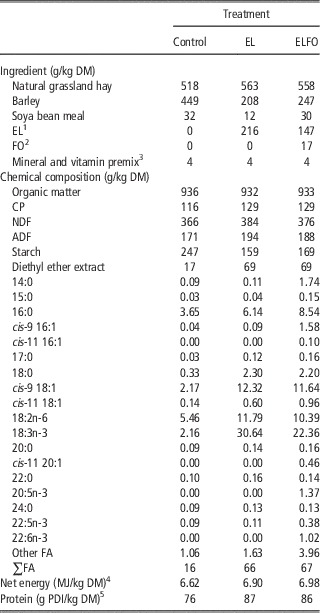
Diets were offered ad libitum and based on hay prepared from regrowths of natural grassland pasture and a concentrate mixture containing barley and soya bean meal (Table 1). Hay and concentrate refusals were weighed daily and used to adjust the amounts of feed offered the following day to maintain the desired dietary forage-to-concentrate ratio. Treatments comprised the basal diet containing no additional lipid (Control), 530 g/day of EL (extruded mixture of linseed : wheat, 70 : 30 wt/wt; Union Invivo, Ets Inzo, Chateau-Thierry, France) or 340 g/day of EL and 39 g/day of anchovy FO (ELFO) (SA Daudruy Van Cauwenberghe and Fils, Dunkerque, France). EL and ELFO diets were formulated to provide the same amount of FA (Table 1). Concentrates were fed according to milk yield at the start of experiment in order to represent 50% to 55% of the dry matter intake (DMI). Supplements of EL and FO were mixed with concentrate ingredients before feeding. Concentrates were offered as two equal meals at 0830 and 1630 h.
Formulation and chemical composition of ingested experimental diets

EL=extruded linseeds; DM=dry matter; FO=fish oil; FA=fatty acids; PDI=digestible protein at the intestine.
1 EL contained (g/kg dry matter (DM)) 16:0 (16.9), 18:0 (9.6), cis-9 18:1 (50.5), 18:2n-6 (40.2), 18:3n-3 (131.8) and total FA (256).
2 FO contained (g/kg FA) 14:0 (98.9), 16:0 (195.8), cis-9 16:1 (90.8), cis-11 16:1 (2.4), 18:0 (29.9), cis-9 18:1 (145.8), cis-11 18:1 (30.0), 18:2n-6 (38.2), 18:3n-3 (16.6), cis-11 20:1 (27.6), 20:5n-3 (82.7), 22:5n-3 (16.6), 22:6n-3 (61.8) and total FA (992).
3 Mineral-vitamin premix declared as containing (g/kg) Ca (240), P (60), Mg (50), Na (15), Zn (7), Mn (6), α-dl-tocopherol (0.3), retinol (0.2) and cholecalciferol (0.002) (Usine d’Ussel, Murat, France).
4 Net energy for lactation calculated according to INRA (1989).
5 PDI calculated according to INRA (1989).
Measurements and sampling
Individual intakes were recorded daily; however, only measurements collected during the last week of each experimental period were used for statistical analysis. During each experimental period, representative samples of hay, ingredients of concentrates (barley and soya bean meal) and EL were collected weekly, composited and used to determine the dry matter (DM) content after 48 h at 103°C. Additional subsamples were stored at −20°C for chemical composition and FA analyses. A representative sample of FO was collected weekly, composited and stored at −20°C. Chemical composition of feed ingredients was determined using standard procedures (Association of Official Analytical Chemists, 1997). Milk yields of individual goats were recorded three times weekly, whereas only measurements collected during the last week of each experimental period were analysed statistically. Samples of milk for the measurement of fat, true protein and lactose were collected from each goat over four consecutive milkings starting at 0800 h on day 21 of each experimental period and treated with a preservative (potassium bichromate; Merck, Fontenay-Sous-Bois, France). Milk fat, protein and lactose contents were determined by mid-IR spectroscopy (AOAC, 1997), calibrated using samples of goat milk for which reference measurements had been made. Unpreserved samples of milk were collected over two consecutive milkings starting at 0800 h on day 22 of each experimental period, stored at −20°C, composited according to yield and submitted for FA analysis. A subsample of unpreserved milk was submitted for the determination of free FA concentrations measured after storage at 4°C for 34 h using the copper soaps method of Koops and Klomp (Reference Koops and Klomp1977). For the assay of lipoprotein lipase (LPL) activity, additional samples of unpreserved milk were collected and stored at −20°C until analysis (Bernard et al., Reference Bernard, Rouel, Leroux, Ferlay, Faulconnier, Legrand and Chilliard2005). Blood samples from the jugular vein were collected on day 20 of each experimental period at 0730 h for the determination of plasma insulin and glucose, non-esterified fatty acids (NEFA), acetate and 3-hydroxybutyrate concentrations as previously described (Bernard et al., Reference Bernard, Rouel, Leroux, Ferlay, Faulconnier, Legrand and Chilliard2005).
Lipid analysis
Fatty acid methyl esters (FAME) of lipid in feed and milk samples were prepared as previously described (Chilliard et al., Reference Chilliard, Rouel and Guillouet2013). Methyl esters were separated and quantified by GLC using a gas chromatograph (GC) Trace-GC 2000, equipped with a flame-ionization detector (Thermo Finnigan, Les Ullis, France) and 100 m fused silica capillary column (CP-SIL 88; Chrompack 7489, Middelburg, The Netherlands) using hydrogen as the carrier and fuel gas (Chilliard et al., Reference Chilliard, Rouel and Guillouet2013), and isomers of 18:1 were further resolved in a separate analysis under isothermal conditions (Shingfield et al., Reference Shingfield, Ahvenjärvi, Toivonen, Äröla, Nurmela, Huhtanen and Griinari2003). Peaks were routinely identified using authentic FAME standards (GLC≠463; Nu-Check Prep Inc., Elysian, MN, USA; iso and anteiso 13:0, 14:0, 15:0, 16:0, 17:0 and 18:0; Sigma-Aldrich, Saint-Quentin Fallavier, France). Reference butter oil (CRM 164; Commission of the European Communities, Community Bureau of Reference, Brussels, Belgium) was used to estimate correction factors to account for the carbon deficiency in the flame-ionization detector response for FAME containing 4 to 10 carbon atoms. Methyl esters not available as commercial standards were identified based on retention time comparisons with milk fat samples for which peaks were identified based on GC–MS analysis of FAME and 4,4-dimethyloxazoline FA derivatives (Shingfield et al., Reference Shingfield, Reynolds, Hervás, Griinari, Grandison and Beever2006).
The distribution of CLA isomers in milk fat FAME was determined by HPLC as previously described (Shingfield et al., Reference Shingfield, Ahvenjärvi, Toivonen, Äröla, Nurmela, Huhtanen and Griinari2003).
Calculations and statistical analysis
Apparent transfer of 20:5n-3, 22:5n-3 and 22:6n-3 from FO into milk was calculated as follows: [g milk FA yield×(g FA/100 g milk fat−g FA/100 g in control milk fat)/(DMI×g FA intake)]×100. Experimental data were subjected to ANOVA using the GLM procedure of Statistical Analysis Systems software package version 8.2 (SAS; SAS Institute, Cary, NC, USA), with a model that included the fixed effects of period and treatment and random effects of goat. Means were compared using the least square means procedure (SAS Institute, 2000), and the level of significance was declared at P<0.05 and considered a trend towards significance at P<0.10. Pearson correlation coefficients (r) were generated for the association between individual FA in milk fat and between the abundance of specific milk FA with milk fat content using the CORR procedure of SAS.
Results
Diet composition
Natural grassland hay was of high quality in terms of nutritional value and had the following composition (g/kg DM, unless otherwise stated): DM (g/kg fresh weight), 855; organic matter, 907; CP, 98; ADF, 281; NDF, 524; and FA content, 17. Concentrations of organic matter and starch were higher for the control compared with EL and ELFO, while ADF, NDF, CP, diethyl ether extract and total FA content were lower (Table 1). The contents of organic matter, NDF, CP, starch, diethyl ether extract and total FA were similar for EL and ELFO. By design, the EL and ELFO increased the concentrations of specific FA in the diet (Table 1).
Dietary forage : concentrate ratio of the diet (on a DM basis) averaged 52 : 48, 56 : 44 and 55 : 45 for the control, EL and ELFO, respectively.
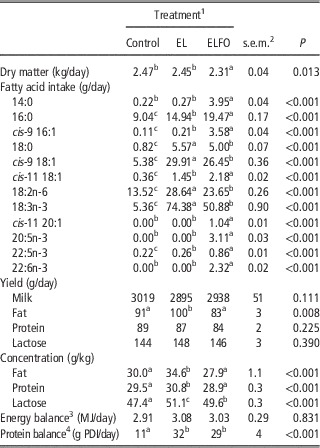
The EL diet supplied the highest amounts of 18:0, cis-9 18:1, 18:2n-6 and 18:3n-3, whereas the ELFO treatment was a source of 20:5n-3 and 22:6n-3 (Table 2). In ELFO and EL diets, cis-9 18:1, 18:2n-6 and 18:3n-3 were the major FA provided by the diets. 18:2n-6 was the major FA provided by the control diet, 18:3n-3 was the major FA provided by the two lipid-supplemented diets and was 31% lower in the ELFO diet compared with the EL diet (Table 2).
Effect of dietary supplements of extruded linseeds (EL) alone or in combination with fish oil on dry matter intake, fatty acid intake, milk yield and milk composition in lactating goats

PDI=digestible protein at the intestine.
a,b,cMean values for each treatment within a row not sharing a common superscript differ (P<0.05).
1 Diets based on grass hay supplemented with no additional oil (control), 530 or 340 g/day of EL and 39 g/day of fish oil (ELFO).
2 s.e.m. for n=14.
3 Net energy for lactation, balance calculated according to INRA (1989).
4 Balance calculated according to INRA (1989).
Animal performance
Compared with the control and EL, ELFO lowered (P=0.02) DMI (Table 2). Treatments had no effect (P>0.05) on the yields of milk, milk protein or lactose. However, compared with the control and ELFO, EL diet increased (P<0.01) milk fat yield and milk fat and protein contents, whereas these parameters did not differ (P>0.05) between the control and ELFO (Table 2). Both EL and ELFO diets enhanced (P<0.001) lactose concentration relative to the control (Table 2), with the increase being greater for the EL than for the ELFO treatment. Energy and protein balances (INRA, 1989) were positive for all the dietary treatments. Energy balance was similar among dietary treatments, whereas protein balance was slightly lower for the control compared with the EL and ELFO treatments (Table 2).
Plasma metabolite concentrations and milk lipolytic activity
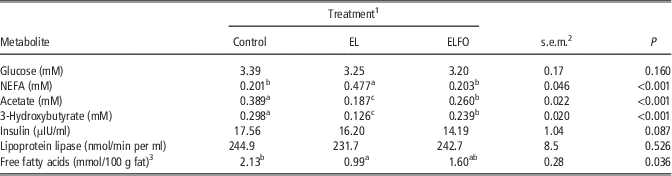
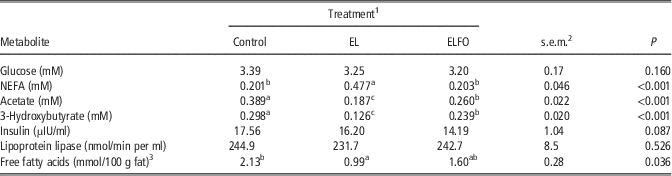
Dietary treatments had no effect (P>0.05) on glucose and insulin concentrations (Table 3). Relative to the control, the EL and ELFO treatments lowered (P<0.001) plasma acetate and 3-hydroxybutyrate concentrations, with greater decreases (P<0.05) observed for the EL compared with ELFO. Compared with the control and ELFO, EL increased (P<0.001) plasma NEFA concentrations. Although lipid supplements had no effect (P>0.05) on milk LPL activity, EL diet decreased (P<0.05) free FA concentration after storage of milk for 34 h at 4°C (Table 3).
Effect of dietary supplements of extruded linseeds (EL) alone or in combination with fish oil on plasma insulin and metabolite concentrations, milk lipoprotein lipase activity and free fatty acid concentrations in lactating goats
NEFA=non-esterified fatty acids.
a,b,cMean values for each treatment within a row not sharing a common superscript differ (P<0.05).
1 Diets based on grass hay supplemented with no additional oil (control), 530 or 340 g/day of EL and 39 g/day of fish oil (ELFO).
2 s.e.m. for n=14.
3 Measured after storage at 4°C for 34 h post-milking.
Milk FA composition
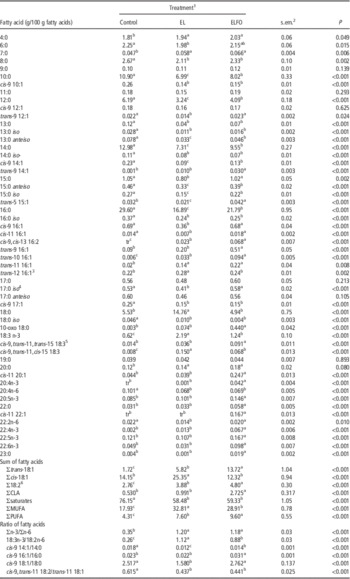
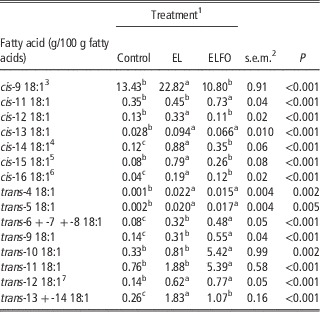
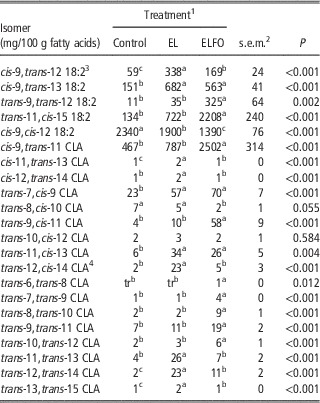
Both EL and ELFO diets altered milk FA composition compared with the control, changes characterized by decreases (P<0.05) in 8:0 to 16:0, cis-9 10:1, cis-9 14:1 and cis-9 17:1, branched-chain FA and an increase in total 18-carbon FA concentration (Table 4). Relative to the control, only EL increased (P<0.05) milk concentrations of 18:0, cis-15 18:1 and 18:2n-6. Both EL and ELFO treatments enhanced (P<0.05) milk 18:3n-3 concentration, with the response being higher (P<0.05) for EL. Compared with the control and EL, the ELFO diet enriched (P<0.05) milk cis-11 20:1, 20:4n-3, 20:5n-3, 22:4n-3, 22:5n-3 and 22:6n-3 concentrations (Table 4). Dietary supplements of EL alone or in combination with FO elevated (P<0.001) milk trans-18:1 concentration (Table 3), with the increases compared with the control being higher for ELFO (+698%) than for the EL treatment (+238%). Both EL and ELFO diets enhanced (P<0.05) milk trans-4 to 9 and 13+14 18:1 concentrations, whereas increases (P<0.01) in trans-10 18:1 and trans-11 18:1 were confined to the ELFO diet, resulting in concentrations 16- and 7-fold higher than the control diet, respectively (Table 5). Overall, trans-10 and trans-11 accounted for 39.5% and 39.3%, respectively, of total milk trans-18:1 content on the ELFO treatment. Concentrations of total cis-18:1 increased (P<0.001) in response to EL (+79%), with enrichment of cis-9 18:1 accounting for 90% of the total increase in cis-18:1. Both EL and ELFO diets enhanced cis-13 18:1 and cis-14 18:1 content, while ELFO treatment resulted in cis-11 18:1 enrichment (Table 5). Compared with the control, EL and ELFO diets increased (P<0.001) milk fat cis-9,trans-12 18:2 and cis-9,trans-13 18:2 concentrations, and ELFO enhanced (P<0.001) the abundance of trans-9,trans-12 18:2 and trans-11,cis-15 18:2 (Table 6). Apparent transfer of 20:5n-3 and 22:6n-3 from the diet into milk for the ELFO treatment were marginal (2.9% and 3.7%, respectively) and much lower than for 22:5n-3 (10.1%; data not presented).
Effect of dietary supplements of extruded linseeds (EL) alone or in combination with fish oil on milk fatty acid composition in lactating goats

MUFA=monounsaturated fatty acids; PUFA=polyunsaturated fatty acids.
tr indicates concentrations below 0.001 g/100 g fatty acids.
a,b,cMean values for each treatment within a row not sharing a common superscript differ (P<0.05).
1 Diets based on grass hay supplemented with no additional oil (control), 530 or 340 g/day of EL and 39 g/day of fish oil (ELFO).
2 s.e.m. for n=14.
3 Contains trans-6,+ -7+-8 16:1 as a minor component.
4 Contains cis-7 16:1 as a minor component.
5 Contains trans-13,cis-17 20:2 as a minor component.
6 Sum of 18:2 fatty acids excluding isomers of CLA.
Effect of dietary supplements of extruded linseeds (EL) alone or in combination with fish oil on milk 18:1 composition in lactating goats

a,b,cMean values for each treatment within a row not sharing a common superscript differ (P<0.05).
1 Diets based on grass hay supplemented with no additional oil (control), 530 or 340 g/day of EL and 39 g/day of fish oil (ELFO).
2 s.e.m. for n=14.
3 Contains cis-10-18:1, and trans-15 18:1 as minor components.
4 Contains trans-16 18:1 as a minor component.
5 Contains trans-17 18:1 as a minor component.
6 Contains cis-9,trans-12 18:2 as a minor component.
7 Contains cis-6 +-7 +-8 18:1 as a minor component.
Effect of dietary supplements of extruded linseeds (EL) alone or in combination with fish oil on milk 18:2 composition (mg/100 g total fatty acids) in lactating goats

tr indicates concentrations below 0.001 g/100 g fatty acids.
a,b,cMean values for each treatment within a row not sharing a common superscript differ (P<0.05).
1 Diets based on grass hay supplemented with no additional oil (control), 530 or 340 g/day of EL and 39 g/day of fish oil (ELFO).
2 s.e.m. for n=14.
3 Contains cis-9,trans-14 18:2 as a minor component.
4 Contains cis-13,trans-15 CLA as a minor component.
Compared with the control and EL, ELFO treatment increased (P<0.001) total CLA concentrations (mean responses+175% and +414%, respectively), with cis-9,trans-11 CLA being the major isomer. Most CLA isomers detected in milk were enhanced (P<0.001) by the ELFO diet, and to a lower extent by the EL. Both the EL and ELFO diets elevated (P<0.001) trans-7,cis-9 CLA, cis-11,trans-13 CLA, trans-11,cis-13 CLA, trans-12,trans-14 CLA and trans-13,trans-15 CLA. Compared with the control, the EL diet resulted in the specific enrichment of (P=0.001), in order of the relative abundance, trans-12,cis-14 CLA, trans-11,trans-13 CLA and cis-12,trans-14 CLA (Table 6). Relative to EL, the ELFO diet increased (P=0.001), in order of relative abundance, cis-9,trans-11 CLA, trans-9,cis-11 CLA, trans-9,trans-11 CLA, trans-8,trans-10 CLA, trans-10,trans-12 CLA, trans-7,trans-9 CLA and trans-6,trans-8 CLA.
Discussion
Several studies have examined the effect of dietary plant lipid supplements on milk production and milk FA composition in the dairy goat (Chilliard et al., Reference Chilliard, Glasser, Ferlay, Bernard, Rouel and Doreau2007; Mele et al., Reference Mele, Buccioni, Serra, Antongiovanni and Secchiari2008; Bernard et al., Reference Bernard, Shingfield, Rouel, Ferlay and Chilliard2009), but few have investigated the interaction of plant oils or oilseeds with FO in this species (Toral et al., Reference Toral, Rouel, Bernard and Chilliard2014). The present study provided a comprehensive assessment of including EL alone or in combination with FO on the performance and milk FA profile of goats fed diets based on grass hay.
Animal performance
Feed consumption was decreased by 6% in goats in response to the ELFO diet, as typically observed in cows with FO addition to the diets (Whitlock et al., Reference Whitlock, Schingoethe, Hippen, Kalscheur, Baer, Ramaswamy and Kasperson2002). Milk production and composition responses to EL were consistent with previous studies (Chilliard and Ferlay, Reference Chilliard and Ferlay2004; Chilliard et al., Reference Chilliard, Glasser, Ferlay, Bernard, Rouel and Doreau2007 and Reference Chilliard, Rouel and Guillouet2013), supporting the view that oilseeds and plant oils typically have no effect on milk yield, increase milk fat concentration and secretion, but have variable effects on milk protein concentration in goats. In contrast, supplements of EL have been shown to lower milk fat content and yield in lactating cows, with the decrease being more pronounced for diets based on maize silage than grass hay (Ferlay et al., Reference Ferlay, Doreau, Martin and Chilliard2013). Inclusion of FO in the diet counteracted the positive effect of EL on milk fat synthesis, highlighting that FO may modify milk fat responses to oilseed supplements in goats. Owing to the lack of data, indirect comparison of responses to EL when FO is included in the diet between ruminant species is not possible.
A recent study reported that supplementing the diet with a 31% : 69% (wt/wt) mixture of FO and linseed oil (5.8 g/kg DM) increased milk fat secretion and content in goats (Toral et al., Reference Toral, Rouel, Bernard and Chilliard2014). The reason for the differences between studies may be because of the form of supplementary lipid used and the basal diet composition, in particular the nature and amount of starch (128 g/kg DM from corn (Toral et al., Reference Toral, Rouel, Bernard and Chilliard2014) v. 169 g/kg DM from barley present study), which is a major determinant of milk fat responses to plant lipids in lactating cows (Shingfield et al., Reference Shingfield, Bernard, Leroux and Chilliard2010). However, differences in dietary starch content have been demonstrated to have no effect on milk fat yield and content responses to FO in goats (Toral et al., Reference Toral, Rouel, Bernard and Chilliard2014) or to a mixture of FO and sunflower-seed oil in cows (Shingfield et al., Reference Shingfield, Reynolds, Lupoli, Toivonen, Yurawecz, Delmonte, Griinari, Grandison and Beever2005).
Milk FA composition
Response to EL
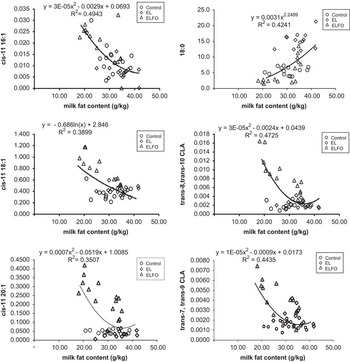
The impact of dietary EL supplementation (equivalent to an additional 52 g oil/kg DM) on the concentrations of the major FA in milk is consistent with earlier studies in lactating goats, ewes and cows (Chilliard et al., Reference Chilliard, Glasser, Ferlay, Bernard, Rouel and Doreau2007 and Reference Chilliard, Rouel and Guillouet2013; Gómez-Cortés et al., Reference Gómez-Cortés, Bach, Luna, Juárez and de la Fuente2009), characterized by decreases in medium-chain SFA and increases in 18:0, cis-9 18:1 and 18:3n-3. The reduction in medium-chain SFA to EL may at least in part be related to lower plasma concentrations of acetate and 3-hydroxybutyrate that are precursors for de novo FA synthesis in the mammary gland. Supplements of EL specifically increased cis-9 18:1, cis-12 18:1, cis-15 18:1 and cis-9,trans-12 CLA. Indirect comparisons of changes in milk fat composition in cows fed similar diets (Lerch et al., Reference Lerch, Shingfield, Ferlay, Vanhatalo and Chilliard2012a and Reference Lerch, Ferlay, Shingfield, Martin, Pomiès and Chilliard2012b; Ferlay et al., Reference Ferlay, Doreau, Martin and Chilliard2013) indicate lower increase in milk cis-9 18:1 and 18:0 contents to EL supplements in cows than that observed in the present and earlier studies in goats (Chilliard et al., Reference Chilliard, Glasser, Ferlay, Bernard, Rouel and Doreau2007 and Reference Chilliard, Rouel and Guillouet2013). Moreover, milk fat content was positively correlated with milk 18:0 concentration (Figure 1 and Table 7; r=0.61), providing additional support to the hypothesis that this substrate is a major factor regulating mammary lipogenesis in goats (Chilliard and Ferlay, Reference Chilliard and Ferlay2004).
Relationships between milk fat content (g/kg) and concentrations of cis-11 16:1, cis-11 18:1, cis-11 20:1, 18:0, trans-8,trans-10 CLA and trans-7,trans-9 CLA in milk (g/100 g of fatty acids) from goats fed grass hay-based diets supplemented with no additional oil (control), 530 g/day of extruded linseeds (EL) or 340 g/day of EL and 39 g/day of fish oil (ELFO). Relationships derived using 42 measurements made for 14 animals.

Pearson correlation coefficients between milk fat content (g/kg) and concentrations of specific fatty acids in milk (g/100 g of fatty acids) in goats fed grass hay-based diets containing no additional lipid, extruded linseeds alone or in combination with fish oil

Relationships derived using 42 measurements made for 14 animalsFootnote 1 .
1 Signs indicate the effect of the variable on the predictor.
*P<0.05, **P<0.01 and ***P<0.001.
The EL treatment (216 g EL/kg DM) increased milk trans-11 18:1 (+147%) and cis-9,trans-11 CLA (+69%) concentrations, in line with other data in goats with EL (Nudda et al., Reference Nudda, Battacone, Usai, Fancellu and Pulina2006; Chilliard et al., Reference Chilliard, Glasser, Ferlay, Bernard, Rouel and Doreau2007), but in lower magnitude than that recently observed in response to 170 g EL/kg DM in goats offered diets containing less starch (and using the same extrusion method to extrude linseeds) (Chilliard et al., Reference Chilliard, Rouel and Guillouet2013), differences that may be associated with the higher starch content of the basal diet in the present study (hay barley-based diet). However, the enrichment of milk trans-11 18:1 and cis-9,trans-11 CLA on the EL treatment was higher than the increases to 50 g EL/kg DM reported for cows fed a similar basal diet (50% hay containing 114 g starch/kg DM; Ferlay et al., Reference Ferlay, Doreau, Martin and Chilliard2013). EL had no influence on milk trans-10 18:1 and trans-10,cis-12 CLA concentrations, as in ewes (Gómez-Cortés et al., Reference Gómez-Cortés, Bach, Luna, Juárez and de la Fuente2009), but contrary to cows where the abundance of these two FA was found to increase (Ferlay et al., Reference Ferlay, Doreau, Martin and Chilliard2013). Differential responses between ruminant species may be associated with a greater stability of the ruminal trans-11 biohydrogenation pathway in the goat and the ewe compared with the cow, in which a shift to the trans-10 pathway is more frequently observed (Shingfield et al., Reference Shingfield, Bernard, Leroux and Chilliard2010).
As expected, milk 18:3n-3 concentration and the ∑n-3/∑n-6 ratio were markedly increased on the EL treatment (Table 4). An enrichment of 18:3n-3 in milk of up to 2.19 g/100 g on a diet supplying 30.6 g 18:3n-3/kg DM is higher than the abundance in milk of 1.53 g/100 g from cows fed a similar diet providing 27.2 g 18:3n-3/kg DM (Ferlay et al., Reference Ferlay, Doreau, Martin and Chilliard2013). This difference was not due to a difference in the apparent transfer efficiency of 18:3n-3 from intake to milk, which was, respectively, 3.0% in goats in the present study and 2.8% in cows in the study by Ferlay et al. (Reference Ferlay, Doreau, Martin and Chilliard2013), but to a lower dilution of absorbed 18:3n-3 because of a lower milk fat yield to DMI ratio in goats v. cows (41 v. 50 g fat/kg DMI, respectively). This observation is in line with previous reports of a greater increase in milk 18:3n-3 concentration to linseed-based supplements in the goat compared with the cow (Chilliard et al., Reference Chilliard, Glasser, Ferlay, Bernard, Rouel and Doreau2007).
Response to EL and FO
The ELFO treatment increased the ∑n-3/∑n-6 ratio in milk due to 18:3n-3 and long-chain n-3 PUFA enrichment (Table 4). The apparent transfer of long-chain n-3 PUFA (20:5n-3, 22:5n-3 and 22:6n-3) was calculated taking into account their secretion on the control. The efficiency of transfer (3.7% to 10.1%) was in the same range reported for goats fed FO alone or as a mixture with plant oils (from 1.4% to 3.4% for 20:5n-3 and 22:6n-3; Toral et al., Reference Toral, Rouel, Bernard and Chilliard2014). Transfer of 22:5n-3 was higher (~10%), as has been reported previously in goats (Toral et al., Reference Toral, Rouel, Bernard and Chilliard2014), cows (Loor et al., Reference Loor, Doreau, Chardigny, Ollier, Sebedio and Chilliard2005) and ewes (Toral et al., Reference Toral, Frutos, Hervás, Gómez-Cortés, Juárez and de la Fuente2010). Part of the higher transfer efficiency may be explained by a lower apparent disappearance of 22:5n-3 in the rumen (Lee et al., Reference Lee, Shingfield, Tweed, Toivonen, Huws and Scollan2008; Shingfield et al., Reference Shingfield, Kairenius, Ärölä, Paillard, Muetzel, Ahvenjärvi, Vanhatalo, Huhtanen, Toivonen, Griinari and Wallace2012) and higher extraction and uptake of 22:5n-3 across the mammary gland (Offer et al., Reference Offer, Marsden, Dixon, Speake and Thacker1999; Loor et al., Reference Loor, Doreau, Chardigny, Ollier, Sebedio and Chilliard2005). Results indicate that supplements of FO and EL are more effective for increasing milk cis-9,trans-11 CLA and trans-11 18:1 concentrations compared with EL alone, which is in agreement with previous observations on the interaction between FO and plant oils in cows and the inhibitory effect of certain FA in FO on the reduction of trans-18:1 isomers to 18:0 in the rumen (Shingfield et al., Reference Shingfield, Reynolds, Hervás, Griinari, Grandison and Beever2006; Chilliard et al., Reference Chilliard, Glasser, Ferlay, Bernard, Rouel and Doreau2007).
The ELFO caused greater increases in milk trans-10 18:1 than EL, resulting in an equal abundance of trans-10 18:1 and trans-11 18:1. A milk trans-10 18:1 concentration of 5.4 g/100 g FA is much higher than 1.04 g/100 g FA in a previous experiment with goats fed FO and linseed oils (Toral et al., Reference Toral, Rouel, Bernard and Chilliard2014). Differences between goat studies may be partly due to differences in the form of linseed lipid and the nature of dietary starch (barley present study v. corn; Toral et al., Reference Toral, Rouel, Bernard and Chilliard2014). Enrichment of trans-10 18:1 on the ELFO treatment is notable, given that the stability of the trans-11 ruminal biohydrogenation pathway is generally greater in the goat than in cows, and concentrations of trans-10 18:1 are typically <3.5 g/100 g FA in milk from goats fed high starch diets supplemented with plant oils (Chilliard et al., Reference Chilliard, Glasser, Ferlay, Bernard, Rouel and Doreau2007; Bernard et al., Reference Bernard, Shingfield, Rouel, Ferlay and Chilliard2009).
Milk trans-10 18:1 concentration (mean 5.4%, s.d. 6.96) varied considerably between individual animals. Enrichment in milk for four goats ranged between 13 and 19 g/100 g FA and was not associated with a decrease in milk fat content. In the goat, increases in milk trans-10 18:1 concentrations are associated with marginal increases in milk fat yield, while the reverse is true in cows (Shingfield et al., Reference Shingfield, Bernard, Leroux and Chilliard2010). Furthermore, the lack of an association between milk trans-10 18:1 concentration and milk fat synthesis in the present study suggests that other biohydrogenation intermediates or other factors may account for the suppression of increases in milk fat yield to EL when FO is included in the diet. Examination of the association between milk fat content and milk FA composition highlighted a negative association with milk cis-11 16:1, cis-11 18:1, cis-11 20:1, trans-8,trans-10 CLA and trans-7,trans-9 CLA concentrations (Figure 1; Table 7), despite the absence of direct evidence on the role of these isomers in the regulation of mammary lipogenesis in ruminants.
Even so, a similar relationship between milk fat and milk cis-11 18:1 concentration has been reported for cows fed supplements of FO and sunflower oil (Shingfield et al., Reference Shingfield, Reynolds, Hervás, Griinari, Grandison and Beever2006). However, the control diet also contained cis-11 18:1, whereas cis-11 16:1 and cis-11 20:1 supplied exclusively on the ELFO treatment originated from FO (Table 4) and their ruminal escape as previously shown (Kairenius et al., Reference Kairenius, Toivonen and Shingfield2011). Studies in bovine adipocytes (Burns et al., Reference Burns, Kadegowda, Duckett, Pratt and Jenkins2012) have demonstrated that cis-11 18:1 can be synthesized endogenously by the elongation of cis-9 16:1. It is, therefore, possible that cis-11 16:1 and cis-11 20:1 may originate from the elongation of cis-9 14:1 and cis-9 18:1, respectively, in the adipose, which during mobilization of body tissue and uptake across the mammary gland could be made available for milk fat synthesis. In vitro, cis-11 18:1 has been shown to lower lipogenesis and FASN gene expression in bovine adipocytes (Burns et al., Reference Burns, Kadegowda, Duckett, Pratt and Jenkins2012), highlighting that this FA may act as an inhibitor of lipogenesis at least in the adipose, and the possibility that it may also inhibits mammary lipogenesis cannot be excluded. However, post-ruminal infusion studies of a mixture of 18:1 (30 g/day) isomers containing 12.5% of cis-11 18:1 were found to have no effect on milk fat synthesis in cows (Shingfield et al., Reference Shingfield, Ahvenjarvi, Toivonen, Vanhatalo and Huhtanen2007), suggesting a neutral effect of this isomer at least in cows. The negative relationship between milk fat content and milk cis-11 16:1 or cis-11 20:1 concentrations may be related to a co-dependence between these parameters rather than a direct effect on lipogenesis.
In cows, relatively few biohydrogenation intermediates are known (trans-10,cis-12 CLA) or putative (trans-9,cis-11 CLA, cis-10,trans-12 CLA) inhibitory effects on mammary lipogenesis (Shingfield et al., Reference Shingfield, Bernard, Leroux and Chilliard2010), and it is possible that others may be active in the goat, including trans-7,trans-9 CLA and trans-8,trans-10 CLA. The ELFO treatment increased trans-9,cis-11 CLA concentrations 14.5-fold (0.058 g/100 g FA). In earlier studies, trans-9,cis-11 CLA was not detected in milk from goats fed hay- or maize silage-based diet supplemented with plant oils, while trans-9,trans-11 CLA was increased (Bernard et al., Reference Bernard, Shingfield, Rouel, Ferlay and Chilliard2009). An increase in milk trans-9,cis-11 CLA content was confined to the same individuals for which concentrations of trans-10 18:1 were elevated, which explains the close association between these FA in milk (Table 7), as previously reported in milk of cows (Shingfield et al., Reference Shingfield, Reynolds, Hervás, Griinari, Grandison and Beever2006) and sheep (Toral et al., Reference Toral, Frutos, Hervás, Gómez-Cortés, Juárez and de la Fuente2010) fed a mixture of sunflower oil and marine oils or from cows fed diets containing oilseeds (Lerch et al., Reference Lerch, Shingfield, Ferlay, Vanhatalo and Chilliard2012a and Reference Lerch, Ferlay, Shingfield, Martin, Pomiès and Chilliard2012b). Collectively, these observations suggest significant variability in the functioning and diversity of the rumen microbiome and adaptations to changes in diet composition between ruminant species that merits further investigation.
Furthermore, milk fat secretion and FA composition responses to the ELFO treatment demonstrated considerable between-animal variation in the synthesis and secretion of trans-9,cis-11 CLA, trans-8,trans-10 CLA and trans-7,trans-9 CLA, with the occurrence of these isomers being accompanied by the prevention of an increase in 18:0 supply, which may have suppressed the increase in milk fat synthesis observed on the EL treatment. Earlier studies have provided evidence to suggest that a shortage of 18:0 for endogenous cis-9 18:1 synthesis may explain or contribute to FO-induced milk fat depression in cows (Loor et al., Reference Loor, Doreau, Chardigny, Ollier, Sebedio and Chilliard2005; Shingfield et al., Reference Shingfield, Reynolds, Hervás, Griinari, Grandison and Beever2006) and ewes (Toral et al., Reference Toral, Frutos, Hervás, Gómez-Cortés, Juárez and de la Fuente2010) due to compromised milk fat fluidity. Overall, a combination of all these alterations may have contributed to FO suppressing the positive effects of EL on milk fat content in goats.
Milk lipolysis
Dietary supplements of EL had an adverse effect on post-milking milk free FA concentrations, consistent with lower levels of spontaneous lipolysis in milk from goats supplemented with 18:3n-3-rich lipids (Chilliard et al., Reference Chilliard, Ferlay, Rouel and Lamberet2003 and Reference Chilliard, Rouel and Guillouet2013; Eknæs et al., Reference Eknæs, Havrevoll, Volden and Hove2009). Such changes may influence the sensory quality of milk by reducing the development of goat flavour (Chilliard et al., Reference Chilliard, Ferlay, Rouel and Lamberet2003). A numerical, but non-significant, difference compared with the control was also detected when FO was fed with EL (Table 3). These observations are in line with previous reports in goats fed a combination of plant oils and FO or FO alone (Toral et al., Reference Toral, Rouel, Bernard and Chilliard2014), which suggest that FO has limited influence or may compensate for the effects of plant lipid supplements on milk fat lipolysis.
Conclusions
Supplementing hay-based diets rich in barley with EL increases milk fat content and yield in goats and alters milk FA composition, characterized by decreases in SFA and increases in 18:0, cis-18:1, trans-18:1, CLA and 18:3n-3. A strong positive relationship between milk fat content and milk 18:0 concentration reinforces the hypothesis that the supply of 18:0 is involved in the regulation of mammary lipid secretion in goats. In contrast to cows, supplements of FO and EL had no influence on milk fat content and yield in goats. However, when compared with supplements of EL alone, FO combined with EL prevented the increase in milk fat synthesis to EL and induced larger increases in trans-18:1 and CLA isomers in milk fat. Data suggest a specific effect of a mixture of FO and EL on ruminal accumulation and secretion of trans-7,trans-9 CLA, trans-8,trans-10 CLA and trans-9,cis-11 CLA in milk, isomers that along with a decrease in 18:0 supply may explain the adverse effects on milk fat synthesis. Direct inter-species comparisons are required to define differential responses to dietary FO supplements and their interaction with plant lipids. A more complete understanding of the diversity and functioning of the rumen microbiome may offer an explanation for species-specific differences in lipid digestion and metabolism and diet-induced changes in milk fat composition.
Acknowledgements
The present study was supported by Apis-Gene and the Agence Nationale de la Recherche (ANR, France; ANR-GANI-014, coordinated by Patrice Martin). Authors gratefully acknowledge the staff of Unité Expérimentale des Ruminants de Theix (INRA, France) for the diligent care of the experimental animals and P. Capitan, E. Tixier, D. Bany and M. Tourret from UMR 1213 Herbivores (INRA, France) for assistance in the management of the animals, sampling and laboratory analysis, and L. Ventto and P. Kairenius (MTT, Finland) for technical support during the analysis of milk FA composition.