Introduction
The visualization and analysis of the occupancy pattern of individuals or groups of organisms in the wild are basic to ecological research (Byers, Reference Byers1992) and provide vital information for interpreting the spatial distribution of populations of organisms (Kuno, Reference Kuno1991). Spatial analysis involves the analysis of data representing geographical features that have a location attribute such as absolute location (co-ordinates) or relative positioning (distance). Some common methods of spatial analysis include description of the occupancy pattern of organisms in a specific area, distribution of organisms across elevation gradients, nearest-neighbour (NN) distance from a reference point to an organism or between conspecific or heterospecific organisms and detection of the degree of clumping in a particular environment (Taylor, Reference Taylor1984; Rossbacher, Reference Rossbacher1986; Byers, Reference Byers1992; Slaa, Reference Slaa2006; Baddeley, 2008). In entomology, occupancy pattern has been studied in natural settings for many arthropod species but similar information for meliponine bees (stingless bees) is scanty. About 800 species of stingless bees have been described worldwide, with over 300 species categorized as eusocial bees (Meyer, 2005). Highly eusocial stingless bees are generally fixed in a location for the entire life of the colony (O'Toole and Raw, Reference O'Toole and Raw1999; Michener, Reference Michener2000). Stingless bee workers from the old colony gradually construct a new nest at a secondary location. Later on, a newly mated queen and many workers join the newly constructed nest (Dollin, 2001). The species richness and dispersion pattern of stingless bee species nests in neotropical habitats has been fairly well documented (Michener, Reference Michener1979; Camargo and Posey, Reference Camargo and Posey1990; Roubik, Reference Roubik1990, Reference Roubik1992). According to MacArthur and MacArthur (Reference MacArthur and MacArthur1961), habitat characteristics are important in regulating species diversity and population sizes as both plants and animals are highly dependent on the quality of their habitats. Furthermore, Jongjitvimol et al. (Reference Jongjitvimol, Boontawon, Wattanachaiyingcharoen and Deowanish2005) reported that stingless bees display species-specific patterns of nest dispersion that may arise from the diversity of their ecosystems, suggesting the existence of certain ecological benefits associated with these nesting patterns. Slaa (Reference Slaa2006) reported that nest dispersion in stingless bees is related to features linked to competition for food or the mechanism of territoriality behaviour. Knowledge on the spatial structure of eusocial stingless bees is vital to the development of rearing and management guidelines for their commercial production and utilization.
On the African continent, there is a paucity of information on the diversity, nesting habits and interactions of stingless bees. A recent study in the Kakamega forest in Kenya has brought to light the existence of various stingless bee species within this forest (Raina et al., Reference Raina, Muli, Nguku, Kioko and Macharia2006). The present study was conducted to establish the species richness, abundance and dispersion pattern of the nests of five stingless bee species in the Kakamega forest.
Materials and methods
Study insect
Five species of meliponine bees hunted for their honey by the Luhya communities living adjacent to the forest were studied. These species were Meliponula bocandei (Spinola), Meliponula ferruginea (reddish brown) (Lepeletier), M. ferruginea (black) (Smith), Hypotrigona gribodoi (Magretti) and Meliponula lendliana (Friese) (all Hymenoptera: Apidae).
Study area
The study was carried out along three successive different habitats (forest, grassland and homesteads) at two different sites namely Isiekuti and Ivihiga in the Kakamega forest in western Kenya. Isiekuti is located in Shavirenga Division, Hamisi District and Ivihiga at Ileho Division, Kakamega East District. The two sites were chosen due to the dissimilarity in habitat types close to the homesteads, and the possession of traditional knowledge on stingless bees by the rural communities dwelling nearby. The Kakamega forest comprises several separate blocks that are not homogeneous (KIFCON, 1994). At Isiekuti, the Kakamega forest neighbouring the homesteads is a mixed indigenous forest; the grassland between the mixed indigenous forest and the homesteads comprises dispersed indigenous tree species. At Ivihiga, the Kakamega forest is an indigenous forest habitat and the grassland between this forest type and the homesteads comprises dispersed Eucalyptus spp. (Myrtaceae).
The Kakamega forest is located about 45 km northwest of Lake Victoria (latitudes 0°10′ and 0°21′ north and longitudes 34°47′ and 34°58′ east) and ranges in altitude between 1500 and 1700 m above sea level (Kokwaro, 1988; von Althof, 2005; Tsingalia and Kassily, Reference Tsingalia and Kassily2009). The forest is the easternmost remnant of the rainforest found in the Democratic Republic of Congo and parts of West Africa (Kokwaro, 1988; Muriuki and Tsingalia, Reference Muriuki and Tsingalia1990).
Sampling method
In each studied habitat (homestead, forest type and grassland), a 30 ha area was surveyed using continuous line transect methods (Krebs, Reference Krebs1999; Jongjitvimol et al., Reference Jongjitvimol, Boontawon, Wattanachaiyingcharoen and Deowanish2005; Otieno et al., Reference Otieno, Le Ru, Ong'amo, Moyal, Dupas, Calatayud and Silvain2008). Thirty line transects, 500 m long and 20 m apart, were followed in each habitat during the search for stingless bee nests. All field surveys were done on sunny days to facilitate the viewing of forager bees flying in and out of their nests. Specific places such as living and dead trees, cavities and holes on the ground, rock crevices, termite or ant nests and house walls were visually inspected along each transect. For living or dead trees higher than 6 m, a pair of binoculars was used to detect the presence of nests (Eltz et al., Reference Eltz, Bruhl, Imiyabir and Linsenmair2003; Mbahin, 2008). When a nest was found, stingless bees flying in and out of it were collected using an entomological net. Samples were stored separately for each colony in 70% alcohol, recorded in a field notebook and later transported to the laboratory for identification. The geographical position (longitude, latitude and altitude) of the nest was recorded using a hand-held global positioning system receiver at the nest entrance. For conspecific and heterospecific nesting in the same location and on the same substrate, the distance between their nest entrances was additionally recorded using either a Vernier caliper or a tape measure. For each line transect surveyed in a habitat, the number of nests and species was recorded. Each nest recorded was given a code for easy recognition in ArcGIS software. All sampling was carried out from June 2009 to February 2010.
Data analysis
Species richness and nest abundance per habitat
Species richness was reported as the number of different stingless bee species in each habitat. Nest abundance was estimated based on (i) total nests discovered for every 30 ha area (Boontop et al., Reference Boontop, Malaipan, Chareansom and Wiwatwittaya2008) and (ii) the mean number of nests discovered per transect (Barbour et al., Reference Barbour, Burk, Pitts, Gilliam and Schwartz1999). A generalized linear model (Poisson's distribution model with logit link) was used to model data on the mean density of nests, and Tukey's test was used to separate the means. The analysis was implemented in R 2.11.1 (R Development Core Team, 2005).
Dispersion patterns
The pattern of nest dispersion in each habitat was described for only those stingless bee species whose nests accounted for at least four nests (Slaa, Reference Slaa2006). The average Nearest Neighbor tool (Spatial statistics) in ArcGIS version 9.3 was used to calculate the NN index (R) and its associated Z score and P value to describe the spatial distribution of species. Nests are randomly distributed when R = 1; R < 1 suggests clustering and R>1 suggests tendency towards dispersion.
Degree of clustering within species nesting in a clumped pattern
The degree of clustering within species nesting in a clumped pattern was compared only for those species that accounted for at least four nests in a specific habitat (Slaa, Reference Slaa2006). The General G tool in ArcGIS version 9.3 was used to calculate the high/low values of the General G index (observed and expected), and its associated Z score and P values for each stingless bee species. A high G value indicates that high numbers of nests of the species are in a clustered pattern and a low G value implies that low numbers of nests of the species are in a clumped pattern. The Z score value is used to determine whether the index value is significant or not.
Average NN distance between nest entrances
Nest spacing between the conspecific and heterospecific stingless bee species was calculated using NN distances according to Slaa (Reference Slaa2006). The NN distance (R o) was assessed for any species recorded in no less than two habitats and that accounted for at least three nests in a specific habitat, as this computation requires a minimum of three points (Hubbell and Johnson, Reference Hubbell and Johnson1977; Slaa, Reference Slaa2006). The average NN distance (R o) between the nests of conspecifics and heterospecifics was calculated using ArcGIS version 9.3. The calculated distances were subjected to analysis of variance (ANOVA) and means were separated using the Welch Turkey test. ANOVA was performed in R 2.11.1 (R Development Core Team, 2005).
Results
Species richness and nest abundance per habitat
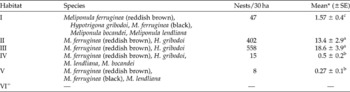
Within the studied habitats at Ivihiga, all five stingless bee species were found nesting in the indigenous forest while only H. gribodoi and M. ferruginea (reddish brown) were discovered nesting in homesteads. No nest of the five studied species was discovered in the grassland with Eucalyptus spp. trees (Table 1). At Isiekuti, M. ferruginea (black) was the only species whose nest was not found in the mixed indigenous forest. The nests of M. ferruginea (black), M. ferruginea (reddish brown) and M. lendliana were discovered in the grassland with indigenous tree species, while the nests of H. gribodoi and M. ferruginea (reddish brown) were abundantly discovered in homestead habitats. The mean number of nests (overall species) recorded per transect within the habitats was highly significantly different (F value = 26.21; df = 5, 174; P < 0.001). The mean number of nests was higher in both homestead habitats but significantly different from the three other habitats. The lowest mean number of nests was recorded in the grassland with dispersed indigenous tree species (0.27 ± 0.1) and mixed indigenous forest (0.5 ± 0.2). No significant difference in the mean number of nests per transect was observed between these two habitats. The mean number of nests recorded in the indigenous forest (1.57 ± 0.4) was significantly different compared with all the other habitats.
Mean (SE) nest abundance (overall stingless bee species) within the six habitats

I, indigenous forest; II, Ivihiga homestead; III, Isiekuti homestead; IV, mixed indigenous forest; V, grassland with indigenous trees; VI, grassland with dispersed Eucalyptus spp.
Mean values within a row followed by the same letters are not significantly different at P < 0.001.
* Significant difference between the habitats at P < 0.001.
+ This habitat was not included in the analysis due to the fact that no nest of the five stingless bee species was recorded in it.
Dispersion pattern
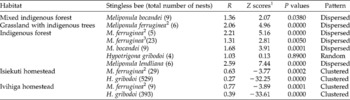
In the indigenous forest and homesteads in both sites, all the reported stingless bee species possessed the minimum number of nests required to determine their dispersion pattern. However, in the mixed indigenous forest and grassland with indigenous tree species, only M. bocandei and M. ferruginea (reddish brown) had sufficient nest numbers to determine their pattern of dispersion. Nesting colonies of M. bocandei in the two types of forest habitat, as well as M. ferruginea (reddish brown) in the indigenous forest and grassland with dispersed indigenous tree species, showed a uniform pattern (Table 2). Other species (M. lendliana and M. ferruginea black) recorded in the indigenous forest nested in a uniform pattern, whereas H. gribodoi nested in a random pattern. However, changes from a uniform and random nesting pattern in the indigenous forest to a clustered nesting pattern in homesteads were observed in M. ferruginea (reddish brown) and H. gribodoi, respectively.
Dispersion pattern of stingless bees nests in the five habitats where nests were recorded

1 Confidence level at 95%.
2 Morpho species reddish brown.
3 Morpho species black.
Degree of clustering within species nesting in a clumped pattern
The two species observed to be nesting in a clumped pattern in homesteads, i.e. M. ferruginea (reddish brown) and H. gribodoi, showed different degrees of clustering which was high in the latter and low in the former (Table 3). This indicates that the nests of H. gribodoi were more aggregated compared with those of M. ferruginea (reddish brown).
Degree of clustering between the clumped nests of Meliponula ferruginea (reddish brown) and Hypotrigona gribodoi in homesteads at both sites

+ Confidence level at 95%.
Average NN distance between nest entrances of conspecific colonies
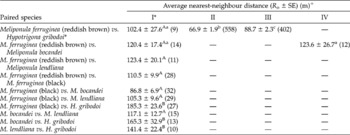
Three species, namely M. bocandei, M. ferruginea (reddish brown) and H. gribodoi, possessed the minimum number of nesting habitats and nests required to determine the average NN distance between nest entrances. The average distance separating the nests of conspecific species differed highly within their nesting habitat (Table 4). The average distance within the M. bocandei nests was significantly different within the indigenous and the mixed indigenous forests (F = 7.63; N = 2; df = 1; P < 0.05). Nesting colonies of M. bocandei, although uniformly dispersed in both forest habitats, were closer to one another in the mixed indigenous forest (58 ± 7.06 m) compared with the indigenous forest (132 ± 25.8 m). This indicates that the nests of M. bocandei were more underdispersed in the indigenous forest compared with the mixed indigenous forest. The average distance of nests within the nesting habitats was also significantly different for M. ferruginea (reddish brown) (F = 4.15; N = 5; df = 4; P < 0.05) and H. gribodoi (F = 5.23; N = 3; df = 2; P < 0.05). The average distance of M. ferruginea (reddish brown) nests was significantly different and lowest in the mixed indigenous forest and homesteads at both sites compared with that of the indigenous forest and grassland with indigenous tree species. The average distance between the H. gribodoi nests was also significantly lower at Isiekuti homesteads where the species nested in a clumped pattern compared with the homesteads at Ivihiga and the indigenous forest. Meliponula ferruginea (reddish brown) and H. gribodoi species nested in a clumped pattern at homesteads in both sites. The average NN distance between the nests of M. ferruginea (reddish brown) was not significantly different within the homesteads in both sites (F = 10.08; N = 2; df = 1; P < 0.05), which implies that homesteads in these sites share a similar degree of low nest clustering. However, the nest spacing of H. gribodoi was significantly different at homesteads of both sites (F = 13.23; N = 2; df = 1; P < 0.05), with colonies at Isiekuti nested closely to each other. This shows that the degree of nest clustering in H. gribodoi in homesteads was higher at Isiekuti, suggesting greater aggregation compared with Ivihiga.
Average nearest-neighbour distance (R o) between the nests of conspecific stingless bee species in their nesting habitats

I, indigenous forest; II, Ivihiga homestead; III, Isiekuti homestead; IV, mixed indigenous forest; V, grassland with indigenous trees.
Values followed by the same lowercase letters within a column are not significantly different.
* Significant difference at P < 0.05 for the same species within its nesting habitats and within species nesting in the same habitat.
1 Values in parentheses indicate the number of all nearest-neighbour nest locations for the species in the particular habitat.
2 Morpho species reddish brown.
3 Morpho species black.
Average NN distance between nest entrances of heterospecific colonies
The average NN distance between the nest entrances of pairs of different species varied significantly in the indigenous forest (F = 2.72; N = 10; df = 9; P < 0.05; Table 5). The nest spacing of all species paired to H. gribodoi was significantly different from the distance between the nests of H. gribodoi versus M. ferruginea (reddish brown). This indicated that colonies of H. gribodoi discovered in the indigenous forest nested farther from a colony of the other three stingless bee species than with a paired colony of M. ferruginea (reddish brown). Within the nesting habitat, the nest spacing of H. gribodoi versus M. ferruginea (reddish brown) was significantly different (F = 26. 31; N = 3; df = 2; P < 0.05) (Table 5). At Isiekuti homesteads, M. ferruginea (reddish brown) and H. gribodoi nested more closely than in the homesteads at Ivihiga and in the indigenous forest. The distance within the nests of M. bocandei versus M. ferruginea (reddish brown) was not significantly different in the mixed indigenous forest compared with the indigenous forest (F = 0.01; N = 2; df = 1; P>0.05) (Table 5). This indicated that the spacing within the M. bocandei and M. ferruginea (reddish brown) nest entrances was similar in both forest habitats.
Average nearest-neighbour distance (R o) between the pairs of stingless bee species nests in the different nesting habitats

I, indigenous forest; II, Isiekuti homestead; III, Ivihiga homestead; IV, mixed indigenous forest; V, grassland with indigenous trees.
Values followed by the same lowercase letters within a column are not significantly different and values followed by the uppercase letters within a row are not significantly different.
* Significant difference at P < 0.05 for the same species within its nesting habitats and within species nesting in the same habitat.
+ Values in parentheses indicate the number of all nearest-neighbour nest locations for the paired species in a particular habitat.
Discussion
This study represents the first documentation of the diversity, nest habitats and pattern of dispersion of stingless bee species present in the Kakamega forest, the only remnant of the Congo basin rainforest in East Africa.
Species richness and nest abundance per habitat
The natural native forest (indigenous forest) habitat had a diverse stingless bee fauna that changed with habitat type, suggesting taxon-specific responses to habitat change. The highest number of five species found in the indigenous forest confirms previous findings by Roubik (Reference Roubik1989) who reported that meliponine bees show a strong association with natural native forest habitats as nesting sites. Most of the meliponine bees nest in tree cavities and therefore rely on tropical forests for nesting habitats (Roubik, Reference Roubik1989). Bommarco et al. (Reference Bommarco, Biesmeijer, Meyer, Potts, Pöyry, Roberts, Steffan-Dewenter and Ockinger2010) also observed that the loss of natural native habitat poses a major threat to biodiversity as it leads to clear shifts in species richness and composition of wild bee communities. In the current study, within the habitats, the mean number of stingless bee species and their nests recorded per 500 m line transect was heterogeneous. Although the highest nest numbers and densities were recorded in homestead habitats, species diversity was lowest compared with the indigenous forest habitat. Brosi et al. (Reference Brosi, Daily and Ehrlich2007) reported that meliponine species might nest in human-dominated habitats close to their natural forest habitats that have experienced high degrees of disturbance. The homestead habitats at both sites offered greater availability of bee nesting sites for M. ferruginea (reddish brown) and H. gribodoi than the other habitats, corroborating previous findings by Winfree et al. (Reference Winfree, Griswold and Kremen2007) who suggested some degree of compatibility between anthropogenic land-use patterns and bee conservation.
Dispersion pattern and degree of clustering within species nesting in a clumped pattern
The dispersion pattern of nests for almost all species nesting in the indigenous forest (with the exception of H. gribodoi), mixed indigenous forest (M. bocandei) and grassland with indigenous trees species (M. ferruginea reddish brown) was underdispersed. Differences in dispersion patterns of stingless bee nests among habitats have been attributed to the diversity of their ecosystems (Jongjitvimol et al., Reference Jongjitvimol, Boontawon, Wattanachaiyingcharoen and Deowanish2005) and competition for food or territoriality behaviour (Slaa, Reference Slaa2006). The observed dispersion pattern in this study may be a result of the above factors plus preference for specific nesting sites by each stingless bee species. Moreover, competition for food or territory (territoriality) probably exists between and within each species, consequently affecting their overall dispersion within the habitats. The change in the nesting pattern observed in M. ferruginea reddish brown and H. gribodoi species suggests that homesteads offer more suitable nesting sites compared with the other habitats. Such competition will be weak or insignificant between closely nesting species such as H. gribodoi and M. ferruginea (reddish brown) and stronger between species that were never found to be nesting close to one another. Also, H. gribodoi and M. ferruginea (reddish brown) showed a greater aggregation of conspecific nests along transects in homesteads, suggestive of minimal within-species competition. Slaa (Reference Slaa2006) reported similar results for three non-territorial and non-aggressive foraging neotropical stingless bee species, Nannotrigona testaceicornis (Lepeletier, 1836), Tetragonisca angustula (Latreille, 1811) and Scaptotrigona pectoralis (Dalla Torre, 1896) (all Hymenoptera: Apidae: Meliponini). Our study revealed that the degree of nest clustering was stronger in H. gribodoi compared with M. ferruginea (reddish brown) as the former had a higher number of nests on the same substrate (wall surface) along surveyed transects in homestead habitats. This clustering behaviour may also have resulted from a close phylogenetic relationship shared by neighbouring colonies as suggested by Roubik (Reference Roubik1989) who noted that the levels of inbreeding tolerated by a bee species might influence the dispersal of daughter colonies from mother colonies.
Average NN distance between nest entrances of conspecific and heterospecific colonies
The average NN distance within conspecific and heterospecific colonies differed highly within and across the habitats. Among homesteads, differences in the average NN distance within and between H. gribodoi and M. ferruginea (reddish brown) may have been influenced by differences in the density of houses and the occurrence of preferable nesting sites on houses at both sites. During our study, the number of houses counted in a transect at Isiekuti was higher compared with Ivihiga. Additionally, the type of wall substrata on houses preferred by H. gribodoi and M. ferruginea (reddish brown) for nesting was more available in homesteads at Isiekuti than at Ivihiga. In the mixed indigenous forest, conspecific colonies of M. bocandei and M. ferruginea (reddish brown) nested closer together compared with the indigenous forest, and this possibly indicates that there is a low level of territoriality among their conspecific colonies. The distance within the nests did not differ for almost all paired species in the indigenous forest and may imply that there was almost no co-operation in nesting within paired species in this habitat type. Kajobe (Reference Kajobe2007) observed a similar scenario for Meliponula species at Bwindi forest in Uganda.
Conclusion
The species richness and spatial distribution of five meliponine bee species in six different habitats in the Kakamega forest was determined from this study. The results reveal that habitat type in the Kakamega forest influences the species richness and nesting pattern of the five stingless bee species, which support food security through pollination services and honey production.
Acknowledgements
The authors acknowledge the International Fund for Agricultural Development and the Global Environment Facility for the financial support received for this research. Our gratitude also goes to the Kenya Forest Service (Kakamega) for granting us full access to the forest and assistance during the fieldwork. We also thank Mr Mark Livaha, leader of the Kakamega stingless bees farmers' group at Ileho Division, Mr Noah Sunguti from Makuchi Plar farmers' youth group and Mr Charles Moshi from Isiekuti organic farming youth group, both in Shavirenga Division, for their participation during the entire process of sampling and data collection.