The hypothalamus–pituitary–adrenal (HPA) axis is one of the main biological systems associated with the human stress response. Dysregulation of this system, such as heightened stress reactivity (Bale, Reference Bale2006) and slowed recovery from stressors (Burke, Davis, Otte, & Mohr, Reference Burke, Davis, Otte and Mohr2005), has repeatedly been linked to depression and may confer risk for depression across generations (Goodman & Gotlib, Reference Goodman and Gotlib1999). Understanding the development of this system may be an integral step in the early identification of vulnerable populations, enabling potential prevention of depression onset in children and adolescents. However, external factors that regulate the development of the HPA axis are still being identified. The primary goal of the present study is to elucidate factors that may influence early development of this system, including positive parenting behaviors and the coregulation of stress responses between individuals (the latter of which is known as attunement).
The quality of caregiving infants receive early in life is closely tied to later stress reactivity across multiple species (Gunnar & Donzella, Reference Gunnar and Donzella2002; Hunter, Minnis, & Wilson, Reference Hunter, Minnis and Wilson2011; Newport, Stowe, & Nemeroff, Reference Newport, Stowe and Nemeroff2002; Sanchez, Reference Sanchez2006; Sanchez et al., Reference Sanchez, McCormack, Grand, Fulks, Graff and Maestripieri2010), yet the mechanism by which caregiving influences infant stress responses is still unclear. A promising area of research that provides new insight into the role of caregiving on the development of stress reactivity places particular emphasis on the attunement of biological systems between caregivers and their infants (Atkinson, Khoury, Ludmer, Jamieson, & Gonzalez, Reference Atkinson, Khoury, Ludmer, Jamieson and Gonzalez2016). Physiological attunement within mother–infant dyads may influence infant stress reactivity in several significant ways. First, changes in maternal physiology may drive changes in infant physiology, suggesting that infants use their mothers as a source of information about how they should respond to various environmental contexts. This type of mirroring could facilitate infant learning about how to respond to and recover from environmental stressors, thus shaping the development of stress regulation.
Second, changes in infant physiology may drive changes in maternal physiology, facilitating or reflecting maternal sensitivity, which itself plays an important role in infant stress regulation (Blair, Granger, Willoughby, & Kivlighan, Reference Blair, Granger, Willoughby and Kivlighan2006; Hane & Fox, Reference Hane and Fox2006). For example, a sensitive mother may be more attentive to microcues that signal her child's distress, which then results in heightening of her own physiological distress response. A few studies have demonstrated that physiological attunement is stronger, or exclusively present, in mother–child dyads in which the mother shows more sensitive caregiving compared to dyads in which the mother shows less sensitive behaviors (Atkinson et al., Reference Atkinson, Gonzalez, Kashy, Basile, Masellis, Pereira and Levitan2013; Sethre-Hofstad, Stansbury, & Rice, Reference Sethre-Hofstad, Stansbury and Rice2002; van Bakel & Riksen-Walraven, Reference van Bakel and Riksen-Walraven2008). Such research provides preliminary support for the notion that attunement may reflect (or facilitate) maternal sensitivity. However, no research has yet utilized time-lagged models to assess the directionality of physiological attunement in mother–infant dyads, so it is unclear whether attunement is a measure of maternal sensitivity and adaptation to her infant's needs or instead reflects the infant's physiological adaptation to maternal cues.
The coregulation of biological stress systems such as the HPA axis is particularly relevant to the development of stress reactivity in early infancy and has been observed in parent–child dyads from 3 months of age (Thompson & Trevathan, Reference Thompson and Trevathan2008) all the way up to adolescence (Papp, Pendry, & Adam, Reference Papp, Pendry and Adam2009). A recent longitudinal study of over 1,000 mother–infant dyads shows that HPA axis attunement between mothers and their infants is stable across infancy and toddlerhood (Hibel, Granger, Blair, & Finegood, Reference Hibel, Granger, Blair and Finegood2015). Attunement may therefore serve an important role in physiological development and/or close interpersonal relationships at multiple developmental stages. Attunement of cortisol fluctuations, a marker of HPA axis functioning, has also been detected in unrelated romantic partners (Brandtstädter, Baltes-Götz, Kirschbaum, & Hellhammer, Reference Brandtstädter, Baltes-Götz, Kirschbaum and Hellhammer1991; Powers, Pietromonaco, Gunlicks, & Sayer, Reference Powers, Pietromonaco, Gunlicks and Sayer2006), suggesting that attunement is not solely a function of shared genetics, but is instead associated with shared environmental context or strong attachment.
Maternal depression may disrupt mother–infant cortisol attunement, but this literature is mixed. At least two studies have failed to find a significant association between history of maternal depression and cortisol attunement between mothers and their adolescent daughters (LeMoult, Chen, Foland-Ross, Burley, & Gotlib, Reference LeMoult, Chen, Foland-Ross, Burley and Gotlib2015) and between mothers and their preschool-age children (Pratt et al., Reference Pratt, Apter-Levi, Vakart, Kanat-Maymon, Zagoory-Sharon and Feldman2017). Yet other evidence links changes in maternal depression to stronger mother–infant cortisol attunement at 18 months postpartum (Laurent, Ablow, & Measelle, Reference Laurent, Ablow and Measelle2011) and heightened maternal depression to stronger attunement when children were 3 to 5 years of age (Merwin, Smith, Kushner, Lemay, & Dougherty, Reference Merwin, Smith, Kushner, Lemay and Dougherty2017). In contrast, maternal depression has been repeatedly linked to decreased sensitivity during mother–child interactions (see Lovejoy, Graczyk, O'Hare, & Neuman, Reference Lovejoy, Graczyk, O'Hare and Neuman2000, for a meta-analysis). Decreased sensitivity in turn predicts weaker mother–infant attunement (Atkinson et al., Reference Atkinson, Gonzalez, Kashy, Basile, Masellis, Pereira and Levitan2013; Hibel et al., Reference Hibel, Granger, Blair and Finegood2015; Sethre-Hofstad et al., Reference Sethre-Hofstad, Stansbury and Rice2002; van Bakel & Riksen-Walraven, Reference van Bakel and Riksen-Walraven2008). Whether, and in what direction, maternal depression may be associated with mother–child cortisol attunement is therefore unclear, but a larger number of independent research groups have replicated associations between maternal depression and decreased sensitivity, and between decreased sensitivity and weakened attunement. Other research has found maternal depression to be associated with weakened behavioral attunement (Field, Healy, Goldstein, & Guthertz, Reference Field, Healy, Goldstein and Guthertz1990) and weakened respiratory sinus arrhythmia attunement (Woody, Feurer, Sosoo, Hastings, & Gibb, Reference Woody, Feurer, Sosoo, Hastings and Gibb2016) between mothers and their children. Much of the extant data therefore suggests that maternal depression may weaken mother–infant cortisol attunement, but more research is required given the dearth of studies in this area. The authors were unable to find any published research that has examined whether maternal depression, and the altered parenting practices that often accompany depression, impact the development of cortisol attunement in mother–infant dyads within the first year of life. Rates of both maternal and paternal depression are particularly high 3 to 6 months after the birth of a child (Paulson & Bazemore, Reference Paulson and Bazemore2010). The first 6 months postpartum is therefore an important time at which to examine the influence of maternal depression on mother–infant attunement.
Mothers with depression show less positive affect overall during mother–infant interactions (Righetti-Veltema, Conne-Perréard, Bousquet, & Manzano, Reference Righetti-Veltema, Conne-Perréard, Bousquet and Manzano2002). It is unknown whether such alterations in positive emotional expression are linked to mother–infant cortisol attunement, but environmental context (Clearfield, Carter-Rodriguez, Merali, & Shober, Reference Clearfield, Carter-Rodriguez, Merali and Shober2014; Ruttle, Serbin, Stack, Schwartzman, & Shirtcliff, Reference Ruttle, Serbin, Stack, Schwartzman and Shirtcliff2011) and maternal sensitivity (Sethre-Hofstad et al., Reference Sethre-Hofstad, Stansbury and Rice2002; van Bakel & Riksen-Walraven, Reference van Bakel and Riksen-Walraven2008) appear to play important roles in attunement. If cortisol attunement occurs following, or in conjunction with, mothers and infants attending to facial and bodily cues that signal distress or relaxation, the extent to which a mother expresses various emotional states may also be an important predictor of attunement. Maternal expression of negative emotion is related to stronger mother–child cortisol attunement (Papp et al., Reference Papp, Pendry and Adam2009; Pratt et al., Reference Pratt, Apter-Levi, Vakart, Kanat-Maymon, Zagoory-Sharon and Feldman2017). However, in infants, both heightened negative emotionality and heightened positive emotionality has been linked to stronger mother–infant cortisol attunement (Merwin et al., Reference Merwin, Smith, Kushner, Lemay and Dougherty2017). Such findings suggest that increases in the expression of both positive and negative emotions may strengthen attunement, at least in infancy. In addition, appropriate maternal gaze toward her infant during interactions may be a necessary prerequisite for the attunement process, particularly if attunement is in part dependent upon the mother's accurate perception and interpretation of her infant's bodily cues. Gaze toward partner predicts stronger behavioral synchrony in mother– and father–child dyads (Feldman, Reference Feldman2003), but it is not yet known whether maternal gaze is similarly related to cortisol attunement.
The vast majority of studies examining cortisol attunement have been conducted in healthy community samples. Given that dysregulated stress reactivity has repeatedly been implicated in the development of depression, attunement of stress systems may be particularly important to study within mother–infant dyads at high risk for depression. The present study aims to fill several key gaps in the literature by examining attunement of a major biological stress system, the HPA axis, in a high-risk sample of psychiatrically ill women and their infants. Severity of maternal depression (measured using both self-report and clinician ratings) will be examined as a predictor of weaker mother–infant cortisol attunement. An additional aim of the present study is to examine whether specific positive parenting behaviors (i.e., positive affect and gaze toward infant) predict stronger mother–infant physiological attunement. Positive parenting behaviors in particular are emerging as important foci in developmental research as they offer protective benefits to children at heightened risk for psychopathology (e.g., Schechter et al., Reference Schechter, Brennan, Smith, Stowe, Newport and Johnson2017). Improving our understanding of the impact of these protective factors may therefore inform future interventions. The final aim of the present study is to explore the directionality of physiological attunement in mother–infant dyads.
Methods
Participants
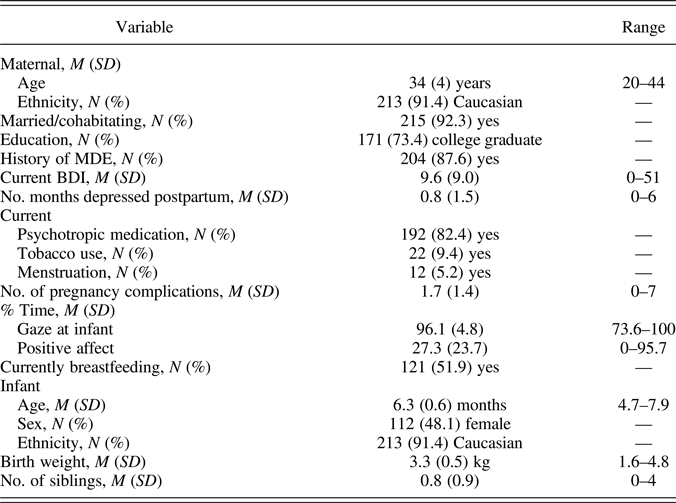
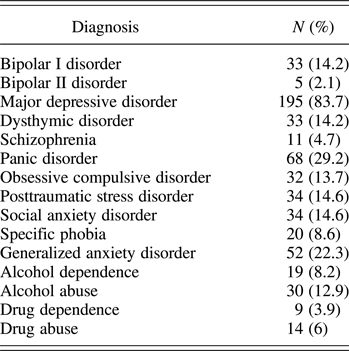
This study utilizes a prospective, longitudinal sample of 233 women and their infants. Mothers’ ages ranged from 20 to 44 years (M = 34.1, SD = 4.2), and 92.3% of mothers were married or cohabitating (see Table 1 for additional demographic information). Mothers were recruited during pregnancy from the Emory Women's Mental Health Program, a tertiary care center for women with psychiatric disorders during the peripartum period. A majority of women experienced at least one psychiatric illness across their lifetime, with the most common diagnosis being major depressive disorder (n = 195, 83.7%). The frequency of DSM-IV diagnoses in the sample are shown in Table 2. In addition, most of the women received psychopharmacologic treatment during pregnancy (n = 204, 87.6%) and were taking psychotropic medication at the time of the study visit (n = 192, 82.4%). Infants with major congenital malformations (e.g., spina bifida) were excluded from the current study. Women were seen during pregnancy and once postpartum as part of a longitudinal study on perinatal mood disorders. The current set of analyses focused on data collected at the 6-month postnatal visit and from birth records.
Sample demographics

Note: The time gaze at infant and time positive affect were coded during the mother–infant interaction. MDE, major depressive episode; BDI, Beck Depression Inventory.
Frequency of lifetime psychiatric diagnoses
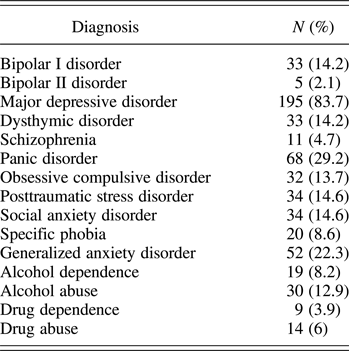
Note: Some women are included in multiple categories because of comorbid illnesses.
Procedure
Women and their infants completed a single 3-hr laboratory visit when infants were 6 months old. All study procedures began between 1:00 p.m. and 1:30 p.m. and were completed by 4:00 p.m. to control for known diurnal variations in cortisol levels (Jessop & Turner-Cobb, Reference Jessop and Turner-Cobb2008; Kirschbaum & Hellhammer, Reference Kirschbaum and Hellhammer1989). Following maternal informed consent, a laboratory stressor paradigm was employed and four salivary cortisol samples were collected as follows.
The first baseline maternal and infant salivary cortisol samples were obtained (T0; baseline) in a quiet room with the mother and infant seated together. The second set of salivary samples (T1; postseparation stressor) were obtained after a 20-min mother–infant separation during which the mother completed questionnaires while her infant was held by a research assistant (RA) across the room. Next, the infant was exposed to two laboratory stressor tasks, including a brief arm restraint and a noise burst, while the mother monitored her infant's behavior on a computer screen. These stressor tasks were followed by a semistructured 3-min videotaped interaction between the mother and infant (details below). The third maternal and infant salivary cortisol samples were obtained immediately following the completion of the mother–infant interaction and approximately 15 to 20 min after the noise burst and arm restraint stressor tasks (T2; postlaboratory stressor I). The fourth saliva samples were collected from the mother and infant an additional 15 to 20 min later (T3; postlaboratory stressor II). Sample collection was timed to capture the full window of cortisol response to the stressors given that cortisol reactivity typically peaks 15 to 25 min after a stressor (Goldberg et al., Reference Goldberg, Levitan, Leung, Masellis, Basile, Nemeroff and Atkinson2003; Lopez-Duran, Mayer, & Abelson, Reference Lopez-Duran, Mayer and Abelson2014; Ramsay & Lewis, Reference Ramsay and Lewis2003), but may peak as late as 40 min poststressor in some infants (Goldberg et al., Reference Goldberg, Levitan, Leung, Masellis, Basile, Nemeroff and Atkinson2003). Including multiple poststressor cortisol samples increases the likelihood of capturing peak cortisol response and may capture cortisol recovery for some infants.
Measures
Maternal psychopathology
Maternal psychiatric illness since delivery was retrospectively evaluated using multiple measures as detailed below.
Structured Clinical Interview for DSM-IV
The Structured Clinical Interview for DSM-IV (First, Spitzer, Gibbon, & Williams, Reference First, Spitzer, Gibbon and Williams2002) is a clinical interview based on DSM-IV diagnostic criteria that was administered by master's-level clinicians at the 6-month visit to assess current and lifetime psychiatric status. Following data collection, a reliability analysis performed by an independent judge on 10% of the sample yielded κs over 0.75 for all mood disorder diagnoses. The number of months since delivery in which mothers met diagnostic criteria for major depressive disorder was used as one measure of maternal depression.
Beck Depression Inventory (BDI)
Mothers completed the BDI (Beck et al., Reference Beck, Ward, Mendelson, Mock, Erbaugh, Comrey and Wittenborn1961). at the 6-month visit as an additional assessment of current depression severity. This measure is a 21-item self-report scale that evaluates depressive symptoms experienced in the last week. The symptoms listed on the measure are consistent with diagnostic criteria for major depressive disorder in the DSM-IV. The BDI has been shown to have good test–retest reliability, high internal consistency, and good construct, concurrent, and discriminative validity in clinical and nonclinical samples (Beck, Steer, & Carbin, Reference Beck, Steer and Carbin1988; Steer, Ball, Raneeri, & Beck, Reference Steer, Ball, Raneeri and Beck1997) and to exhibit stable performance and high predictive validity of major depressive disorder across pregnancy and the postpartum period (Ji et al., Reference Ji, Long, Newport, Na, Knight, Zach and Stowe2011). BDI scores were used in analyses as a measure of current maternal depressive symptomology.
HPA axis functioning
Saliva samples were used to measure cortisol levels of mothers and infants. The mother provided each saliva sample by swabbing a dental cotton roll inside her mouth. Infant saliva samples were collected using a similar methodology, with the RA swabbing the infant's mouth using a dental cotton roll. Saliva was then transferred from the cotton roll to a 15-ml polypropylene tube via syringe. Saliva samples were frozen at –20 °C within 15 min of collection.
Samples were assayed using a commercially available radioimmunoassay kit (DiaSorin GammaCoat, Stillwater, Minnesota) with a cortisol sensitivity of 0.05 μg/dl. Inter- and intraassay coefficients of variation for this kit are 6.0% and 3.5%, respectively. An RA masked to maternal psychiatric status and the time point at which each sample was collected assayed all standards and samples in duplicate.
Maternal affective parenting style
The mother–child interaction occurred after the infant stressors and was videotaped for later scoring. Mothers were instructed to interact with their infants as they typically would at home for 3 min, but asked not to physically touch their infants in order to avoid interference with concurrent collection of infant respiratory sinus arrhythmia. Respiratory sinus arrhythmia data collected from this study have been reported elsewhere (Johnson, Brennan, Stowe, Leibenluft, & Newport, Reference Johnson, Brennan, Stowe, Leibenluft and Newport2014). Maternal affect (positive, negative, and neutral) and time spent looking at infant (i.e., gaze toward infant) was rated by trained coders, and interrater reliability analyses were conducted to ensure adequate reliability (κs > 0.70). The percentage of time mothers exhibited each type of affect was calculated using MANgold INTERACT software. Maternal positive affect was defined as a broad smile with cheeks raised, making funny or positive faces at the infant, half smiling, and when whole eyebrows were raised and eyes were wide open while talking with infant. Maternal negative affect was identified as anger, disgust, contempt, sadness, fear, pain, or a turned down mouth, furrowed brow, raised inner corners of brow, and wincing/scrunched up face with the mouth turned down. Maternal neutral affect was defined as the absence of observable positive or negative affect as defined above. Because maternal negative affect showed little variability in this sample (M = 0.07% of time showing negative affect, SD = 0.35, range = 0.0%–2.7%) compared to maternal positive affect (M = 27.27%, SD = 23.70, range = 0.0%–95.7%) and the focus of the study was on positive parenting behaviors, only positive affect and time spent gazing at infant were used in the following analyses.
Data analysis plan
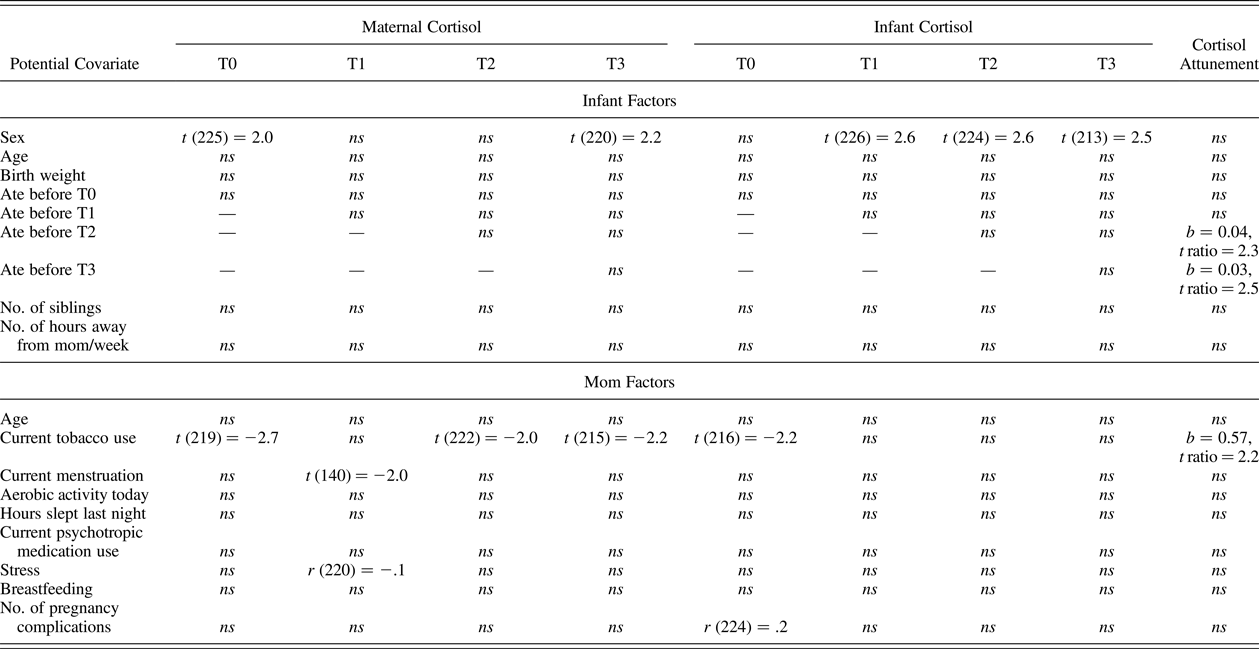
Variables that have been previously associated with cortisol levels (e.g., maternal age, delivery complications, infant food intake, etc.) were examined as potential covariates prior to the primary analyses. Several variables that may be theoretically related to mother–infant attunement (e.g., amount of time infant spends away from mother each week) were examined as potential covariates. See Table 3 for a complete list of variables examined. Variables that were significantly associated with maternal or infant cortisol, or the association between mother–infant cortisol, were included as covariates in the appropriate analyses.
Potential covariates and their relationship to primary outcome measures
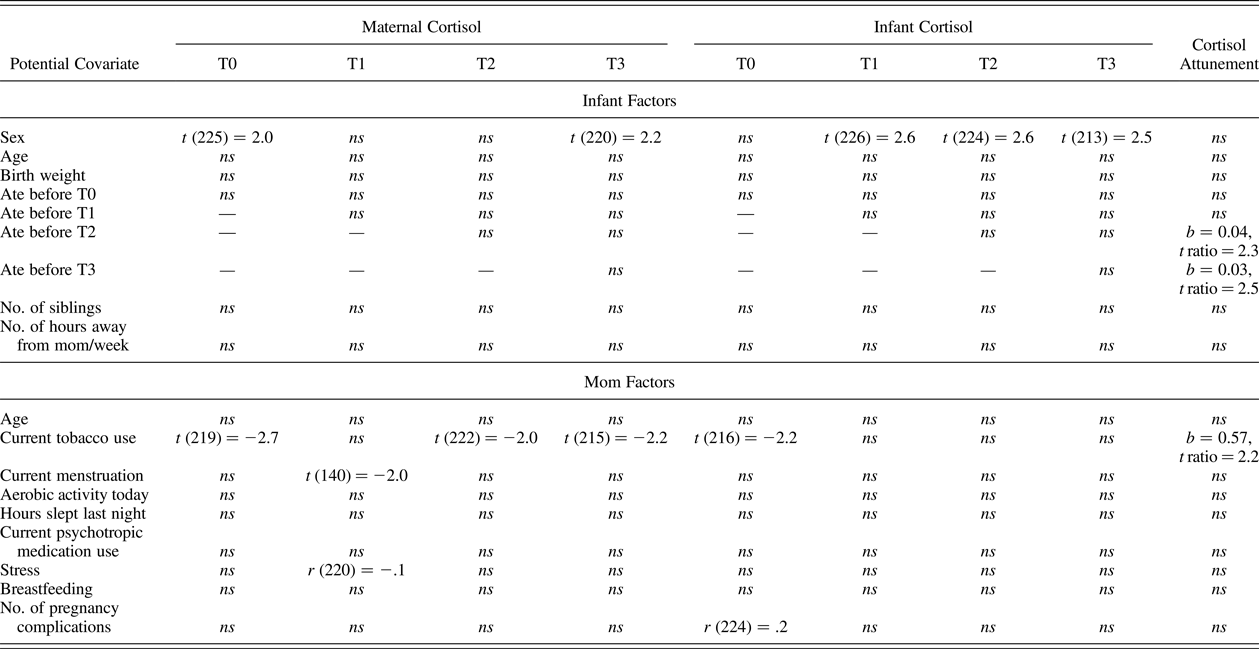
Note: Only associations significant at p < .05 are shown. T0–T3, Times 0–3. ns, nonsignificant associations; —, associations that were not tested. Maternal stress was measured using the Perceived Stress Scale.
Multilevel modeling was conducted using Hierarchical Linear Modeling 7 (HLM-7) software to test the association between maternal and infant cortisol levels across time points as well as to explore predictors of this time-varying association. HLM-7 allows for the use of nested models, which enabled the researchers to examine changes in cortisol within mother–infant dyads across multiple time points rather than collapsing measures of cortisol across all mothers and all infants within a sample, the latter of which may obscure analyses of dyadic attunement.
Results
Since the primary aim of this study was to examine cortisol attunement in a clinically at-risk sample, dyads that were recruited from the community to serve as healthy controls (n = 36) were excluded from the present analyses. Dyads were also excluded if maternal or infant cortisol levels were more than three standard deviations above the mean (n = 7) or if mothers or infants only had one cortisol sample (n = 5). There were four sets of twins in the original sample, so one twin was randomly chosen from each set to be retained for data analysis. The other twin was excluded from analyses to maintain statistical assumptions of independence. The final sample included 233 mother–infant dyads. Of the infants, approximately half were male (n = 121, 51.9%) and all were between 4.7 and 7.9 months old (M = 6.3, SD = 0.6).
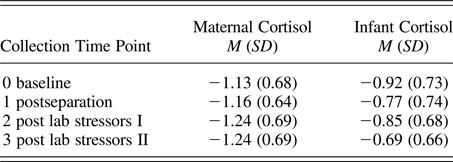
Linear, quadratic, and cubic relationships between time and maternal cortisol, as well as between time and infant cortisol, were examined. Maternal cortisol decreased linearly over the course of the visit, β = –0.07, 95% confidence interval (CI) = [–0.08, –0.003], p = .04, while infant cortisol increased linearly over the visit, β = 0.09, 95% CI = [0.02, 0.10], p = .005. Neither maternal nor infant cortisol showed a quadratic or cubic association with time (see Table 4 for cortisol means and standard deviations).
Cortisol means (standard deviations)

Note: All cortisol values are log transformed.
HLM was used to examine maternal and infant cortisol across all study time points. Infant cortisol (grand mean centered) and collection time point (uncentered) were entered as Level 1 predictors of maternal cortisol in the following model:
 $$\eqalign{{\rm maternal\, cortisol} & = {\rm \beta} _{\rm 0}{\rm \,+\,} {\rm \beta} _{\rm 1}\left( {{\rm infant\, cortisol}} \right) + {\rm \beta} _{\rm 2}\left( {{\rm time\, point}} \right) \cr & \quad + {\rm error}.} $$
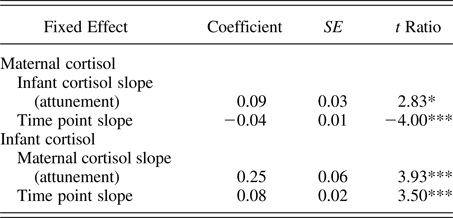
Attunement between mothers and their infants was assessed using significance testing of Level 1 time-varying covariates (see Equation 1). Infant cortisol levels significantly predicted maternal cortisol, beyond any shared association between them due to timing of the sample collection. There was not a significant amount of variance remaining in maternal cortisol after accounting for the impact of infant cortisol and sample timing, σ2 = 0.07, T 2 = 0.03, χ2 (df = 210) = 221.80, p = .28. This lack of variance suggests that infant cortisol levels consistently predicted maternal cortisol levels across dyads, and that no moderators were present for this association.
Next, maternal cortisol (grand mean centered) was examined as a predictor of infant cortisol, over and above saliva collection time point (uncentered), to provide information about effect directionality:
 $$\eqalign{{\rm infant\, cortisol} & = {\rm \beta} _{\rm 0}{\rm \,+\,} {\rm \beta} _{\rm 1}\big( {{\rm maternal\, cortisol}} \big){\rm \,+\,} {\rm \beta} _{\rm 2}\left( {{\rm time\, point}} \right) \cr & \quad + {\rm error}.} $$
Maternal cortisol levels significantly predicted infant cortisol, above any shared association between them due to timing of the sample (see Table 5). Moreover, there was significant variance in infant cortisol remaining after accounting for the influence of maternal cortisol, σ2 = 0.15, T 2 = 0.12, χ2 (df = 210) = 263.04, p = .008, suggesting that moderators of this association could be tested at Level 2.
Hierarchical linear models of physiological attunement

*p < .05. ***p < .001.
Next, current maternal depression, history of maternal depression since birth of infant, maternal gaze toward infant, and maternal positive affect were individually examined as Level 2 predictors of the slope of the relationship between mother and infant cortisol in the following model:
 $${\rm \beta} _{{\rm 10}{j}}\;{\rm =}\; {\rm \gamma} _{{\rm 10}}+ {\rm \gamma} _{{\rm 11}}\left( {{\rm predictors}} \right)\,+\, {\rm error}.$$
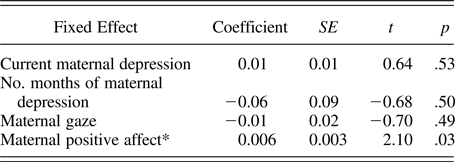
In these predictor models, maternal cortisol was group mean centered, and infant cortisol was the dependent measure at Level 1. Neither maternal depression nor length of time mothers spent gazing at their infants was associated with mother–infant cortisol attunement. Conversely, the percent of time mothers showed positive affect while interacting with their infants predicted infant cortisol attunement to his/her mother (see Table 6).
Maternal characteristics and behaviors as moderators of physiological attunement

Note: Infant cortisol was entered as the dependent variable for the above analyses. Analyses examined each Level 2 factor as a predictor of the slope of mother and infant cortisol.
*p < .05.
Time-lagged model
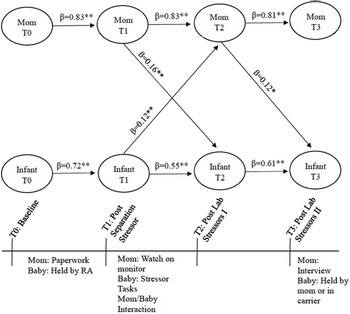
Time-lagged analyses provide additional insight into directionality of attunement. Hierarchical linear regressions were conducted in SPSS to examine whether maternal cortisol from the previous time point predicted infant cortisol at the subsequent time point, above and beyond the infant's own cortisol from the previous time point. These analyses were also conducted with infant cortisol predicting maternal cortisol at subsequent time points. The results from these analyses are graphically depicted in Figure 1. Given the strong correlations between infant and maternal cortisol at all time points, tolerance statistics were examined in these regressions to assess for multicollinearity. All tolerance statistics were above 0.75, suggesting that multicollinearity was not a significant issue in these analyses.
The results from the analyses. The visit timeline is included below the graphical depiction of the results for reference. Only significant associations are shown, but mom T0 predicting infant T1, infant T0 predicting mom T1, and infant T2 predicting mom T3 were also tested. All relationships control for own cortisol at the previous time point. *p < .05, **p < .01.

Mothers and infants showed positive autocorrelations between their own cortisol samples, such that one's prior cortisol level was associated with cortisol sampled at the subsequent time point. Maternal cortisol level at T1 (reflecting response to the initial mother–infant separation) positively predicted infant cortisol level at T2 (reflecting response to the stressor tasks), above and beyond infant cortisol level at T1. Maternal cortisol level after the stressor tasks (T2) also predicted infant cortisol level at the subsequent poststressor time point (T3), above and beyond infants’ own cortisol level after the stressor tasks (T2). In other words, if a mother showed an attenuated cortisol level after a stressor (separation from her infant or the laboratory stressor task), her infant showed a more attenuated cortisol level at the subsequent time point. Infant cortisol level following separation (T1) predicted maternal cortisol level after the laboratory stressor (T2), which in turn predicted infant cortisol level at the next time point. Overall these findings suggest a bidirectional relationship such that infant cortisol levels and maternal cortisol levels influence one another within the context of a stressful event. No other significant time-lagged associations were detected.
Discussion
This is the first study to examine mother–infant cortisol attunement in a clinical sample of women who received psychiatric care during pregnancy. We found a moderate, bidirectional relationship between maternal and infant cortisol across four time points that was not influenced by maternal gaze during a parent–child interaction task or by concurrent maternal depression. Infant cortisol strongly predicted maternal cortisol, over and above any shared variance due to time at which the sample was collected. There was no significant variance in this association, suggesting that the cortisol of mothers in this clinical high-risk sample consistently mirrors that of their infants in the context of an infant stressor paradigm. This is contrary to literature suggesting impaired attachment and decreased sensitivity in mothers with depression, but is consistent with recent research that has failed to find differences in mother–child cortisol attunement between dyads at high and low familial risk for depression (LeMoult et al., Reference LeMoult, Chen, Foland-Ross, Burley and Gotlib2015; Pratt et al., Reference Pratt, Apter-Levi, Vakart, Kanat-Maymon, Zagoory-Sharon and Feldman2017). It is possible that cortisol attunement is a process that, although potentially related to attachment and maternal sensitivity, is distinct from these early caregiving factors and therefore not as clearly dampened by maternal depression. It is also possible that the trajectory of maternal depression may be a stronger predictor of cortisol attunement than current maternal depression (Laurent et al., Reference Laurent, Ablow and Measelle2011). The present study was limited in its ability to assess whether depression trajectories were associated with mother–infant cortisol attunement in this sample, but future research should further examine this possibility. The present results suggest that mothers diagnosed with and at clinical high risk for depression are physiologically linked with their infants in the context of a stressor paradigm, and show sensitivity in that regard.
We also found that maternal cortisol predicted infant cortisol at all time points and that maternal positive affect moderated this association, such that greater maternal positive affect was associated with stronger mother–infant cortisol attunement. This is inconsistent with one study that found high levels of negative affect, but not positive affect, to predict stronger cortisol attunement between mothers and their adolescent children (Papp et al., Reference Papp, Pendry and Adam2009). These differences may reflect a shift in development between infants and adolescents or may be residuals of different study designs. The present study required a mother to interact with her infant following a stressor task. She was therefore most likely to show positive affect during this interaction in an attempt to soothe her infant. There was virtually no negative affect displayed by mothers in our study. Mothers were also asked not to touch their infants during our mother–child interaction. Mothers tend to touch their infants frequently during interactions (Beebe et al., Reference Beebe, Jaffe, Markese, Buck, Chen, Cohen and Feldstein2010) so it is possible that restricting touch during our interaction may have impacted our results in an unexpected manner. In contrast, Papp et al. (Reference Papp, Pendry and Adam2009) measured naturally fluctuating emotion over the course of two typical days. It is possible that maternal positive emotion is important for attunement during the context of stress, but not in day-to-day functioning. An alternative explanation is that any emotional extreme, such as high levels of either positive or negative emotional expression, may heighten cortisol attunement within dyads.
Research on emotional and behavioral contagion, or the spread of emotions and behaviors among social networks, shows that both positive and negative emotions spread across interconnected people (Coviello et al., Reference Coviello, Sohn, Kramer, Marlow, Franceschetti, Christakis and Fowler2014; Fowler & Christakis, Reference Fowler and Christakis2008; Rosenquist, Fowler, & Christakis, Reference Rosenquist, Fowler and Christakis2011). Certain emotional states and health behaviors may even be transmitted between people who are randomly assigned to spend time together, suggesting that being predisposed to spend time with similar people does not fully explain this emotional attunement (Centola, Reference Centola2010; Golberstein, Whitlock, & Downs, Reference Golberstein, Whitlock and Downs2013). The present study extends such research by detecting cortisol attunement among mother–infant dyads and showing that emotional expression is one factor associated with the strength of this attunement. A hopeful avenue for future research may be to examine whether parenting interventions that increase maternal positive affect (e.g., Landry, Smith, Swank, & Guttentag, Reference Landry, Smith, Swank and Guttentag2008) also improve mother–infant physiological attunement.
Maternal cortisol predicted infant cortisol at subsequent time points of measurement, but only when the infant was responding to or recovering from the stressor tasks. These findings suggest that more well-regulated mothers may be better able to regulate their infants’ response to stressful events, and that maternal regulation may be impacted by infant response to separation. Conversely, maternal cortisol dysregulation following stressful events may contribute to a positive feedback cycle in which maternal distress increases infant distress, and infant distress then heightens or maintains maternal distress. Such a cycle could increase the negative emotion expressed within a household, which may have deleterious consequences for preexisting maternal psychopathology, such as increased risk of disease relapse (Butzlaff & Hooley, Reference Butzlaff and Hooley1998). Maternal baseline cortisol did not predict infant's cortisol levels at the subsequent time point, nor did infant baseline cortisol predict maternal cortisol at the subsequent time point. Therefore, the observed time-lagged associations between mother and infant cortisol were specific to the context of the stressor paradigm in this study. This is consistent with research that has found mother–child attunement to be stronger in the context of a challenge (Ruttle et al., Reference Ruttle, Serbin, Stack, Schwartzman and Shirtcliff2011) and suggests that mother–infant cortisol attunement may be activated or heightened by stressful events.
Although still largely unknown, it is interesting to contemplate the factors that contribute to the development of bidirectional mother–infant attunement. Maternal plasma cortisol accounts for up to 39% of the variance in newborn plasma cortisol (Smith et al., Reference Smith, Newport, Ashe, Brennan, Laprairie, Calamaras and Stowe2011), suggesting that a significant portion of cortisol attunement may begin in utero or result from shared genetic predisposition. However, postnatal processes likely contribute to the continued development of bidirectional attunement. Research has identified stronger cortisol attunement when mothers and their infants are physically together compared to when they are apart, suggesting that shared environment may lead to similar HPA axis activity between mothers and infants (Hibel, Trumbell, & Mercado, Reference Hibel, Trumbell and Mercado2014; Thompson & Trevathan, Reference Thompson and Trevathan2008). Maternal parenting behaviors, particularly ones that are inherently associated with increased attention and responsiveness to her infant, such as maternal sensitivity (Sethre-Hofstad et al., Reference Sethre-Hofstad, Stansbury and Rice2002; Thompson & Trevathan, Reference Thompson and Trevathan2008; van Bakel & Riksen-Walraven, Reference van Bakel and Riksen-Walraven2008), also seem to foster the development of transactional attunement between mothers and their infants. It is also possible that certain infant characteristics, such as increased susceptibility to environmental influence (Belsky & Pluess, Reference Belsky and Pluess2009) or lower emotional reactivity (Hibel et al., Reference Hibel, Granger, Blair and Finegood2015), may predispose infants to be more likely to attune to their caregivers, particularly in the context of stress. However, it is important to be cautious when attributing causality to such relationships, especially since it has been suggested that attunement may improve infants’ ability to self-regulate over time (Feldman, Reference Feldman2007). If empirical evidence corroborates that self-regulation is heightened by attunement over time, this may suggest that attunement is, at least in part, an infant-driven learning process. For instance, infants learning to attune to their caregivers’ stress response may be one way they refine their physiological response to stressors over time, much in the same way infants learn to speak by imitating caregiver vocalizations.
Although the present study identifies a bidirectional influence of maternal and infant cortisol on each other, the directionality of this relationship may change with child maturation. One study has found adolescents’ cortisol before, during, and after a family conflict discussion to be predicted by paternal cortisol at the previous time point, above and beyond adolescents’ own cortisol. Adolescent cortisol was not predicted by maternal cortisol at the previous time point, but maternal cortisol at subsequent time points was predicted by adolescent cortisol (Saxbe et al., Reference Saxbe, Margolin, Spies Shapiro, Ramos, Rodriguez and Iturralde2014). This change may occur as children become increasingly independent from their mothers with age. Infancy is a time when offspring are entirely dependent upon their caregivers (the primary of whom is often the mother), which may explain why the present study found infant physiology to be strongly connected with maternal physiology.
It is important to note that our sample consists of highly educated mothers, many of whom received psychiatric treatment at the time of their study visit. Despite the receipt of treatment, mothers in our sample displayed a wide range of BDI scores (see Table 1) with numerous scores (n = 20, 8.5%) above the clinical cutoff (i.e., 21) signifying moderate depression, suggesting that a number of women in our sample continued to experience clinically significant depression in the week leading up to their study visit. Although possible, it seems unlikely that the receipt of treatment interfered with our ability to examine the influence of maternal depression on physiological attunement. However, mother–infant attunement may not occur, or may occur to a lesser extent, in untreated dyads who experience additional stressors, such as those living below the poverty line (Clearfield et al., Reference Clearfield, Carter-Rodriguez, Merali and Shober2014; Laurent et al., Reference Laurent, Ablow and Measelle2011). Future research should therefore examine whether our findings replicate in clinical samples of women who face additional environmental stressors such as poverty. Including a comparison control group of healthy mother–infant dyads may offer additional insight into potential differences in attunement between infants at high and low familial risk for depression (e.g., LeMoult et al., Reference LeMoult, Chen, Foland-Ross, Burley and Gotlib2015), particularly given mixed findings regarding attunement in community samples.
The attunement identified in the present study may not generalize in the same way to all biological markers of stress reactivity. For example, salivary alpha amylase, a marker of sympathetic nervous system activity, and cortisol attunement may occur differentially under different circumstances and at different ages (Davis & Granger, Reference Davis and Granger2009; Laurent, Ablow, & Measelle, Reference Laurent, Ablow and Measelle2012). Future research should examine multiple markers of stress reactivity in the same research study to further identify converging and diverging patterns of within-dyad physiological attunement.
Causal conclusions cannot be drawn from the current study due to its correlational design. To date, there have been no experimental studies on the spread of physiological stress responses within mother–child dyads. Comparison of experimental manipulation of mother and child cortisol using stressors or pharmacological agents and an unmanipulated control group may provide greater insight into causality in this relationship. Moreover, studies have not examined the specificity of cortisol attunement by examining whether it exists between strangers. Determining whether cortisol attunement occurs only within intimate dyads or not would provide information that could drive future research on the mechanisms by which this physiological phenomenon occurs. For instance, if attunement only occurs within intimate dyads, it may be related to shared environment, similar experiences of stress exposure, or secure attachment within that dyad. However, if attunement readily occurs between strangers, then it may reflect general empathy instead of these shared factors that are more unique to intimate relationships. Even when comparing intimately connected dyads, there is great variability in the amount of time spent together and attachment security of the relationship. Additional research is needed to identify which aspects of the dyadic relationship foster or attenuate cortisol attunement across partners and whether these factors are further associated with attunement (or lack thereof) between strangers.
Research and theory are beginning to provide some insight into the adaptive benefit of emotional and physiological attunement. For instance, matching conspecifics who show a fear response may activate biological stress response systems, better preparing an animal for a fight or flight response to a threat. Experiencing an emotion that a conspecific displays may also create a connection that lays the groundwork for empathy (de Waal, Reference De Waal2008), which could further the propagation of a species. In human research, parents whose cortisol changes are driven by changes in their adolescents’ cortisol show lower overall cortisol output during short-term family conflict. This lowered cortisol output may represent better parental physiological regulation in the context of a social stressor. Conversely, adolescents whose cortisol levels change in response to maternal cortisol changes show higher overall cortisol output during family conflict, suggesting this mother–child cortisol linkage may not be similarly helpful for adolescent self-regulation (Saxbe et al., Reference Saxbe, Margolin, Spies Shapiro, Ramos, Rodriguez and Iturralde2014). Future research should examine whether physiological attunement between mothers and their children is associated with future child outcomes, such as child stress reactivity.
The current study has several strengths, including the use of HLM to examine predictors of attunement in a high-risk clinical sample. Mothers who have experienced psychopathology are an especially important group in which to study attunement as their infants are at increased risk of developing mental illness as they age (Goodman et al., Reference Goodman, Rouse, Connell, Broth, Hall and Heyward2011) and are more likely to be exposed to negative or disengaged parenting (Lovejoy et al., Reference Lovejoy, Graczyk, O'Hare and Neuman2000). An additional strength of the study design is the use of multiple cortisol samples and control for variation in diurnal cortisol by only allowing lab visits to occur between 1 p.m. and 4 p.m.
Mother and infant cortisol levels exert a bidirectional influence on one another by 6 months postpartum in a sample of mothers who sought psychiatric treatment during pregnancy. These results suggest that many mothers who experience mental illness maintain a close physiological linkage with their infants, particularly in the context of stressors. The present study extends stress research conducted with healthy mother–child dyads by being the first to identify cortisol attunement in a clinical sample of mothers and their infants in the first year of life. This is an integral step in advancing theory regarding ontogeny of the human stress response and the influence of social factors on HPA axis functioning in children at heightened risk for depressive disorders.