The scientific literature suggests that the practice of teaching can provide positive experiences which are associated with many psychological benefits in teachers (Coladarci, Reference Coladarci1992). However, there are also common negative experiences in educators’ careers that produce psychological disorders such as anxiety, depression, or burnout (Genoud, Brodard, & Reicherts, 2007). Therefore, it is essential to understand how school contextual factors may influence the experiences of teachers, both positively and negatively. In order to increase knowledge and facilitate research in this area, the aim of the current study was to translate the Psychological Need Thwarting Scale (PNTS; Bartholomew, Ntoumanis, Ryan, & Thørgersen-Ntoumani, Reference Bartholomew, Ntoumanis, Ryan and Thøgersen-Ntoumani2011) into Spanish and provide support for its use in an educational setting.
Findings from the Teaching and Learning International Survey (Organization for Economic Co-operation and Development, 2009) suggest that the most important factor in determining the quality of teaching is the teacher themselves. For this reason, the motivation and well/ill-being of schoolteachers has been examined in numerous studies conducted across a number of different countries. Along this line, self-determination theory (SDT; Deci & Ryan, Reference Deci and Ryan1985; Ryan & Deci, Reference Ryan, Deci, Deci and Ryan2002) can be useful in understanding these psychological processes. SDT is an empirically based theory of human motivation, development, and wellness. This theory has been widely used in numerous contexts, such as work, teaching and physical education (Deci & Ryan, Reference Deci and Ryan2008). Research on SDT posits that there are psychological needs that must be satisfied for effective functioning and psychological health. Basic psychological need theory (BPNT; Deci & Ryan, Reference Deci and Ryan2000), a micro theory within SDT, explains that people function and develop most effectively as a consequence of social contextual supports for their competence, autonomy, and relatedness needs. Satisfaction of these needs is vital for individuals to fully develop their capabilities, to grow, and to be preserved from ill health and maladaptive functioning.
The SDT concept of competence concerns the degree to which individuals feel effective in their contacts with the social environment and experience opportunities to demonstrate their mastery (Ryan & Deci, Reference Ryan, Deci, Deci and Ryan2002). The need for autonomy alludes to the level at which individuals feel volitional and responsible for their own actions, and consequently, express an inner approval of their behavior (Ryan, Reference Ryan1995). Finally, the need for relatedness is defined as the degree to which people feel a safe sense of belonging to others in the social context (Ryan, Reference Ryan1995).
BPNT (Deci & Ryan, Reference Deci and Ryan2000) asserts that satisfaction of the needs for competence, autonomy, and relatedness predicts psychological well-being in all cultures (Deci & Ryan, Reference Deci and Ryan2008). Also, numerous studies across different life domains (e.g., education, sport and exercise; for an overview, see Deci & Ryan, Reference Deci and Ryan2008) have confirmed that basic need satisfaction is associated positively with optimal functioning and well-being of people. In the work and organizational setting, the satisfaction of basic needs has been correlated with a number of positive psychological concepts, such as workers’ well-being (Lynch, Plant, & Ryan, Reference Lynch, Plant and Ryan2005).
Research in the educational context, and specifically in the physical education setting, has also demonstrated the usefulness of studying optimal well-being from a need-fulfillment perspective (Pelletier & Sharp, Reference Pelletier and Sharp2009). In the educational context, however, ill-being and teacher burnout are also considered serious problems (van Horn, Schaufeli, Greenglass, & Burke, Reference van Horn, Schaufeli, Greenglass and Burke1997). Teacher burnout can influence job performance by reducing the quality of teaching, which can have a negative effect on children’s’ academic success (Blandford, Reference Blandford2000). Physical education teachers may be particularly vulnerable to experiencing stress and ill-health due to a lack of adequate facilities and the low status frequently afforded to the subject by colleagues and school management (Saenz-Lopez, Almagro, & Ibanez, Reference Saenz-Lopez, Almagro and Ibanez2011). Moreover, Luthans (Reference Luthans2002) asserts that it is important to prevent ill-health, as well as stimulate well-being, in order to improve the engagement and job satisfaction of employees.
Despite a relative lack of empirical research on the topic (Vallerand, Pelletier, & Koestner, Reference Vallerand, Pelletier and Koestner2008), the construct of psychological needs can also play a key role in understanding how some social conditions and interpersonal environments lead to negative outcomes (Bartholomew, Ntoumanis, Ryan, Bosch, & Thogerson-Ntoumani, 2011; Deci & Ryan, Reference Deci and Ryan2000). Specifically, the concept of psychological need thwarting – the negative experiential state which occurs when individuals’ perceive their needs for competence, autonomy, and relatedness to be actively undermined – should provide a useful conceptual framework through which to examine the mechanisms which link negative aspects of the social environment to indices of ill-being (Bartholomew, Ntoumanis, Ryan et al., Reference Bartholomew, Ntoumanis, Ryan and Thøgersen-Ntoumani2011). In line with this reasoning, Bartholomew and colleagues recently developed the Psychological Need Thwarting Scale in order to explore how a more direct assessment of need thwarting could contribute to the prediction of psychological ill-being.
Through a series of studies conducted in the sport domain, Bartholomew, Ntoumanis, Ryan, Bosch et al. (Reference Bartholomew, Ntoumanis, Ryan and Thøgersen-Ntoumani2011); Bartholomew, Ntoumanis, Ryan et al. (Reference Bartholomew, Ntoumanis, Ryan and Thøgersen-Ntoumani2011) demonstrated that experiences of need thwarting entailed more than just the mere absence of need satisfaction. Instead, their findings suggested that need thwarting is characterized by perceptions that the psychological needs are obstructed or actively undermined. Moreover, they affirmed that low scores on measures of need satisfaction cannot be conceptually equated with need thwarting. Thus, in the educational context, a teacher may not feel competent because they do not have the necessary skills to perform well and, therefore, score low on a measure of need satisfaction; however another teacher might feel incompetent because they experience the school environment and/or their colleagues as overly critical or demeaning. According to Bartholomew et al., the first situation is a case of low need satisfaction (or need dissatisfaction) whereas the latter is a case of need thwarting.
Initial research in the domains of sport and exercise (Bartholomew, Ntoumanis, Ryan, Bosch et al., Reference Bartholomew, Ntoumanis, Ryan and Thøgersen-Ntoumani2011; Bartholomew, Ntoumanis, Ryan et al., Reference Bartholomew, Ntoumanis, Ryan and Thøgersen-Ntoumani2011), and the workplace (Gillet, Frouquereau, Forest, Brunault, & Colombat, Reference Gillet, Fouquereau, Forest, Brunault and Colombat2012), has found support for the negative impact of need thwarting. Collectively, these findings indicate that considering the role of psychological need thwarting could further our understanding of the mechanisms contributing to ill-being beyond simply a lack of psychological need satisfaction. This is a particularly important consideration in the educational domain as research suggests that teacher burnout and ill-being is prevalent and can have serious repercussions on teaching quality (Fejgin, Talmor, & Elrich, Reference Fejgin, Talmor and Elrich2005).
However, experiences of need thwarting are yet to be directly examined in this domain and the utility of the original PNTS items for assessing such psychological mechanisms in the educational context remains unclear. Moreover, when instruments have been modified from their original format a rigorous examination of score validity and reliability is needed to ensure that the modifications have not affected the interpretability of item scores. Thus, the principal aim of the study was to adapt and validate a Spanish version of the PNTS (Bartholomew, Ntoumanis, Ryan, Bosch et al., Reference Bartholomew, Ntoumanis, Ryan and Thøgersen-Ntoumani2011) and provide support for the utility of examining experiences of need thwarting among physical education teachers. We hypothesized that the revised version of the PNTS would demonstrate adequate indices of reliability and would retain the proposed three-factor structure of the original scale (i.e., one subscale representing competence, autonomy, and relatedness need thwarting, respectively). It was also hypothesized that the scale would be invariant across gender. Finally, the relationships between psychological need thwarting and burnout were analyzed in order to provide support for the external validity of the revised scale. Specifically, it was hypothesized that the three components of need thwarting would positively predict burnout.
Method
Participants
The sample included 619 PE teachers (386 males and 233 females; M age = 39.31 years; SD = 9.53 years; range = 22–62 years) who taught students between the ages of 12 and 17 and volunteered to participate in this study. The teachers were from several public high schools in Spain and had been teaching for 15.12 years (SD = 9.64 years) on average.
Measures
Psychological Need Thwarting
The Psychological Need Thwarting Scale (Bartholomew, Ntoumanis, Ryan, Bosch et al., Reference Bartholomew, Ntoumanis, Ryan and Thøgersen-Ntoumani2011) was translated into Spanish and adapted for use by physical education teachers (S-PNTS, see Appendix). The original scale was composed with the stem “In my sport…,” which was changed to “In my work environment…,” and is followed by 12 items (four for each subscale). The subscales assess perceptions of autonomy (e.g., “I feel prevented from making choices with regard to the way I train”), competence (e.g., “Situations occur in which I am made to feel incapable”) and relatedness (e.g., “I feel I am rejected by those around me”) need thwarting. The wording of the items was adapted so that they were suitable for completion by teachers. Responses were reported on a 7-point scale starting from 1 (strongly disagree) to 7 (strongly agree). Bartholomew, Ntoumanis, Ryan, Bosch et al. (Reference Bartholomew, Ntoumanis, Ryan and Thøgersen-Ntoumani2011) reported adequate psychometric characteristics for the original version of the scale.
Burnout
A Spanish version of the Maslach Burnout Inventory–General Survey (MBI-GS; Schaufeli, Leiter, Maslach, & Jackson, Reference Schaufeli, Leiter, Maslach, Jackson, Maslach, Jackson and Leiter1996) was used to assess burnout in physical education teachers. The 16-item scale contains three subscales to measure depersonalization (five items, e.g., “I have become more cynical about whether my work contributes anything”); exhaustion (five items, e.g., “I feel burned out from my work”); and reduced accomplishment (six items, e.g., “I feel I am making an effective contribution to what this organization does”). The items of the accomplishment subscale were reverse-scored so that higher scores represented higher levels of burnout. Responses were reported on a 7-point scale ranging from 1 (not at all true) to 7 (very true). In line with previous research (Hakanen, Bakker, & Schaufeli, Reference Hakanen, Bakker and Schaufeli2006), the three subscales were combined to produce one composite burnout score. The validity and reliability of this scale has been supported in previous studies (Gil-Monte, Reference Gil-Monte2002).
Procedure
Following the recommendations of van Widenfelt, Treffers, de Beurs, Siebelink, and Koudijs (Reference van Widenfelt, Treffers, de Beurs, Siebelink and Koudijs2005), the PNTS items were translated into Spanish and adapted for use in the teaching context. All of the items were back-translated (Hambleton, Reference Hambleton and Muñiz1996). First of all the items were translated from English into Spanish. Subsequently, a different transcriber translated the items back into the original language. A high degree of agreement between both versions was observed. Second, three experts in the area (Lynn, Reference Lynn1986) considered the wording of the revised scale items appropriate. The revised scale was then examined by five physical education teachers in order to verify an appropriate understanding of the items. There were no reported problems in relation to their relevance or comprehension. Finally, a sample of 619 Spanish physical education teachers completed the revised scale alongside the burnout measure.
Ethical approval was obtained from a university in Spain and the study was supported by the Spanish professional association of physical education teachers, which facilitated contact with the participants through the Internet. Teachers were contacted and informed that the purpose of the study was to obtain information about their experiences and motivation as physical education teachers. The questionnaires were accessed through a link provided by the researchers and completed online. The participants were informed that completion of the questionnaires was completely voluntary and that all responses would be anonymous.
Data analysis
In order to validate the Spanish version of the PNTS in the educational context, an examination of the psychometric properties of the scale was carried out. Confirmatory factor analyses (CFAs) of S-PNTS were done to confirm the factor structure of the instrument. In line with the recommendations made by Byrne (Reference Byrne2008), the χ2, χ2 /df, Comparative Fit Index (CFI), Tucker Lewis Index (TLI), Incremental Fit Index (IFI), Root Mean Square Error of Approximation (RMSEA), and Standardized Root Mean Square Residual (SRMR) values were used to assess model fit. Although values indicative of acceptable model fit remain controversial (Markland, Reference Markland2007), recognized criteria were used to interpret the results. For the χ2 /df, values less than two show an excellent fit of the model, and values less than five are considered acceptable; for the CFI, the TLI and the IFI, values over 0.90 are considered good; for the SRMR, values less than 0.08 are indicative of an excellent fit (Hu & Bentler, Reference Hu and Bentler1999). Finally, for the RMSEA, values less than 0.08 reveal an acceptable fit (Browne & Cudeck, Reference Browne, Cudeck, Bollen and Long1993).
Also, a statistical analysis of the items, and an analysis of the internal reliability were conducted. Then, in order to find evidence of external validity for the S-PNTS, a stepwise linear regression analysis between the need thwarting subscales (as independent variables) and burnout (as the dependent variable) was performed. Finally, a gender invariance analysis was carried out. The IBM SPSS AMOS 19 package was used for all statistical analyses.
Results
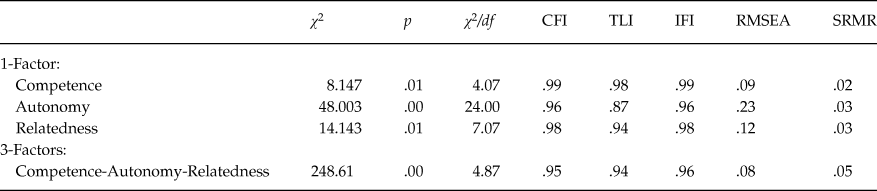
CFAs with one-factor structure (competence, autonomy and relatedness as unique factors) and a CFA with three-factor structure (see Figure 1) was calculated. The indices (Table 1) revealed that the three-factor model demonstrated the best fit to the data. This CFA supported the proposed three-factor structure of the scale (i.e., the factors represented competence, autonomy, and relatedness need thwarting, respectively). Moreover, the four items representing each psychological need loaded strongly onto their respective factors.
Confirmatory Factor Analysis.

Indices of fit of the models of S-PNTS with one and three factors

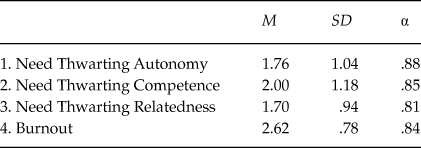
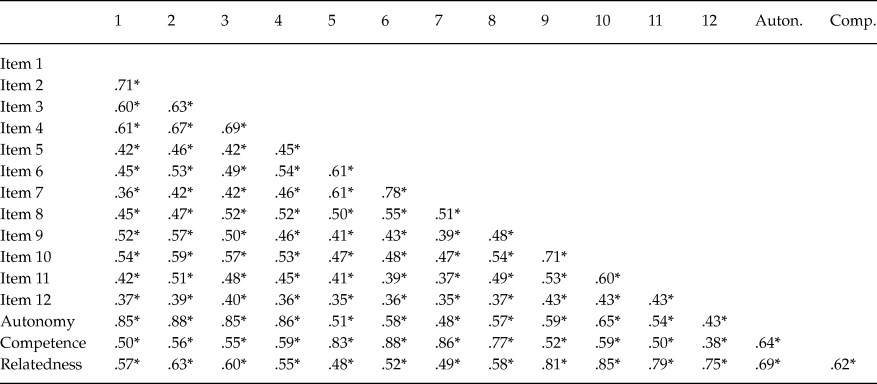
Descriptive statistics and reliability estimates are presented in Table 2. The Cronbach’s alpha for each subscale was also calculated in order to verify its internal reliability. All three subscales demonstrated good reliability with alphas of .81 and above (Kline, Reference Kline1999). Following Nunnally and Bernstein (Reference Nunnally and Bernstein1995), a descriptive analysis of the S-PNTS items was carried out. The coefficient of correlation corrected between the item score and the total score for each subscale were calculated. The values obtained (Table 3) were appropriate (greater than 0.35; Nunnally & Bernstein, Reference Nunnally and Bernstein1995).
Descriptive Statistics and Internal Consistency

Correlation analysis between items and subscales (autonomy, competence and relatedness) of S-PNTS

Note: *p < .05.
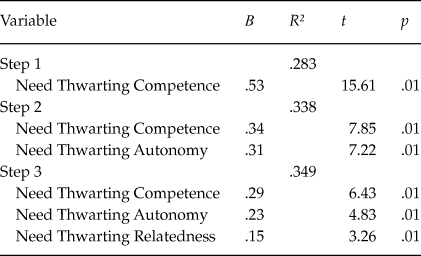
In order to find evidence of external validity for the scale, a stepwise linear regression analysis (Table 4) was carried out using burnout as the dependent variable and the thwarting of the competence, autonomy, and relatedness needs as the independent variables. The result showed that a significant amount of the variance in burnout scores was predicted by psychological need thwarting. Specifically, competence was the strongest predictor of the independent variable, followed by autonomy, and, finally, relatedness.
Regression Analysis. Dependent Variable: Burnout

Finally, a sequential model testing approach was employed via multisample CFA to examine whether the S-PNTS displayed invariance across gender. The relative goodness of fit between increasingly constrained models was analyzed. However, because the χ² statistic is influenced by sample size, the recommendations of Cheung and Rensvold (Reference Cheung and Rensvold2002) were also adopted and a change in CFI of ≤ .01 was considered indicative of model invariance. Thus, as can be seen from Table 5, the invariance of the model was supported across gender.
Gender Invariance Analysis

Note: Model 1 = Without constrained parameters. Model 2 = Item factor loadings constrained. Model 3 = Structural convariances constrained. Model 4 = Measurement errors constrained.
Discussion
Although much discussed within theoretical overviews (e.g., Deci & Ryan, Reference Deci and Ryan2000; Ryan, Deci, Grolnick, & La Guardia, Reference Ryan, Deci, Grolnick, La Guardia, Cicchetti and Cohen2006; Vallerand et al., Reference Vallerand, Pelletier and Koestner2008), psychological need thwarting still remains a relatively understudied component of SDT. Hence, aligned with the call for more empirical work on need thwarting, the aim of the current study was to adapt and validate a Spanish version of the PNTS (Bartholomew, Ntoumanis, Ryan et al., Reference Bartholomew, Ntoumanis, Ryan and Thøgersen-Ntoumani2011) using a sample of physical education teachers. In general terms, the results showed that the Spanish version of PNTS is a valid and reliable instrument for assessing experiences of psychological need thwarting in an educational context. The findings also highlight the importance of assessing need thwarting, an understudied component of the SDT framework with important ramifications for health and ill-being, in this domain.
The results of the factor analysis revealed that the S-PNTS reflected the three-factor model proposed by SDT. The resulting model demonstrated adequate fit indices (Hu & Bentler, Reference Hu and Bentler1999) and the regression weights of the items were all higher than .50. These data are close to the indices of fit of the original scale (Bartholomew, Ntoumanis, Ryan et al., Reference Bartholomew, Ntoumanis, Ryan and Thøgersen-Ntoumani2011). According to Jackson, Gillaspy, and Purc-Stephenson (Reference Jackson, Gillaspy and Purc-Stephenson2009), these results support the construct validity of the instrument. Additional analyses also supported the internal consistency of the competence, autonomy, and relatedness subscales with alphas higher than those previously reported by Bartholomew, Ntoumanis, Ryan et al. (Reference Bartholomew, Ntoumanis, Ryan and Thøgersen-Ntoumani2011), particularly in competence and autonomy. These data indicates a high degree of reliability of the measure of all items of each subscale. Also, in line with Bartholomew, Ntoumanis, Ryan, Bosch, et al. (2011), the results of the regression analysis suggested that the perceived thwarting of each psychological need predicted feelings of burnout, supporting the external validity of the adapted scale. Finally, as in the original instrument (Bartholomew, Ntoumanis, Ryan, et al., Reference Bartholomew, Ntoumanis, Ryan and Thøgersen-Ntoumani2011), the results support the factorial invariance of the S-PNTS by suggesting that the data are equivalent across gender.
The results also exhibit interesting information in relation to how social factors can facilitate or obstruct the satisfaction of basic psychological needs. In this regard, it is essential to stress the low levels of perceived need thwarting were reported among the teacher participants. Autonomy and relatedness were scarcely thwarted by the actions of others, while competence showed slightly higher levels of frustration. These results differ from those reported in previous work by Bartholomew and colleagues (2011) and Gillet et al. (Reference Gillet, Fouquereau, Forest, Brunault and Colombat2012), which found higher levels of perceived need thwarting in young athletes and adult company workers, respectively. In the case of the athletes, these differences may be due to the age of the samples. The participants used by Bartholomew et al. were adolescents and young athletes, while the teachers in the present study were adults, who tend to be more autonomous at work. However these results do suggest that the leadership style of coaches and company heads may be more controlling, whereas the management style of school principals and other administrators in Spain might be based on giving more autonomy to individuals. These assumptions, however, have to be confirmed by future studies.
As in the work of Bartholomew, Ntoumanis, Ryan et al. (Reference Bartholomew, Ntoumanis, Ryan and Thøgersen-Ntoumani2011), significant correlations between the three psychological needs were found. SDT research indicates that associations between the basic needs are common (Deci & Ryan, Reference Deci and Ryan2000). For instance, when the autonomy of an individual is thwarted by the environment (e.g., by the action of the boss), it is likely that this lack of freedom also influences the relationship the employee has with his or her colleagues. For this reason, the need for relatedness may also be frustrated.
The findings of this work also have important theoretical and practical implications. First, besides supporting the external validity of the Spanish version of the scale, the regression analysis reveals that need thwarting made a significant contribution to the prediction of burnout. Specifically, competence was the principal variable for predicting burnout, followed by autonomy and relatedness, respectively. These data indicate that a lack of connecting with colleagues has a limited impact on the teachers’ psychological ill-being. However, if the need for autonomy is thwarted and teachers are not allowed to act in accordance with their own values and beliefs, burnout levels may increase. Finally, feelings of incompetence caused by non-optimal interactions with the social environment appear to have the greatest impact on increasing burnout. In this respect, these results suggest that to prevent burnout in physical education teachers, it may be particularly useful to prioritize support for competence.
Second, according to Bartholomew, Ntoumanis, Ryan et al. (Reference Bartholomew, Ntoumanis, Ryan and Thøgersen-Ntoumani2011), new measures of need thwarting should be developed in different life settings, “given the lack of such measures in the extant SDT literature” (p. 96). In this respect, it is important to note that this is a pioneering study in the evaluation of this construct in teachers. This area offers a unique and relevant setting for the analysis of this construct, because it is a domain in which both need supports (e.g., teaching consultancy) and need thwarts (e.g., external performance assessment) are prevalent. Further research should examine how these two constructs might interact to impact on the health and wellness of teachers in this context. The validated S-PNTS should be very useful in this regard.
Third, the assessment of need thwarting among teachers via this instrument could be particularly useful for the heads of schools and the educational administrators in order to identify individuals at risk of burnout and ill-being. These negative outcomes inevitably lead to a lack of commitment to the profession, a reduction in teachers’ professional performance, and a decrease of the quality of education in class (Burke, Greenglass, & Schwarzer, Reference Burke, Greenglass and Schwarzer1996). According to Deci and Ryan (Reference Deci and Ryan2000), a leader who frustrates the satisfaction of autonomy, competence, and relatedness needs threatens the well-being of their employees. In this respect, high levels of perceived need thwarting among teachers could reveal a disproportionately controlling style of the principal of the school, which can have psychological and physical costs. Instead, a leader who facilitates the fulfillment of psychological needs will help to improve the commitment, effective performance, and well-being of their employees (Gagné & Deci, Reference Gagné and Deci2005). Thus, a greater understanding of psychological need thwarting in the educational context could aid the development of appropriate interventions which aim to reduce the prevalence of teacher ill-being.
Although this study has resulted in an adequate scale to assess psychological need thwarting among Spanish physical education teachers, some limitations need to be mentioned. Regarding reliability, it would be interesting for future research to examine the temporal stability of the S-PNTS. Also, it would be desirable to use the revised scale with a wider sample of teachers from a number of different disciplines, not only to physical education teachers. However it is important to note that the S-PNTS is not specific to physical education teachers or to one educative level; the wording of the items of the S-PNTS was formulated for the context of teaching in general. Further research should also examine the psychometric properties of the PNTS in other contexts, being that the process of scale validation is ongoing and Ryan (Reference Ryan1995) has suggested that it is important for researchers to investigate different domains in order to understand how different influences may be operating and influencing the satisfaction or thwarting on innate psychological needs.
In conclusion, the findings of the current study have provided substantial support the revised version of the PNTS and suggest that it is a valid and reliable instrument for assessing the understudied construct of need thwarting in the Spanish educational context. We hope that the scale will facilitate SDT-based research which has recommended that incorporating direct assessments of need thwarting will lead to a better understanding of how and why negative environmental factors lead to ill-being. Specifically, the concept of need thwarting might be a useful frame of reference through which pressuring educational contexts can be adjusted to reduce perceptions of coercion, incompetence and rejection and, therefore, teacher ill-being.
APPENDIX
Spanish - Psychological Need Thwarting Scale