Since its born, the Hall–Petch equation[Reference Hall1,Reference Petch2] has been always in the focus of the studies on the strengthening of metal alloys. It is well established that the yield stress, σ y, necessary for yielding and plastic deformation of polycrystalline materials depends on the grain size, d by the formula:
 $$\sigma _y = \sigma _0 + A\cdot d^{-1/2}$$
where σ 0 is the friction stress and A is a positive material constant related to the stress required to extend the dislocation activity into adjacent grains. Equation (1) demonstrates that for a given composition, the yield stress and the strength increase with the decreasing grain size. This is the motivation of several efforts to get the finer grain size in conventional materials.[Reference Valiev, Estrin, Horita, Langdon, Zehetbauer and Zhu3–Reference Langdon7] Furthermore, the research of thin Al–Mg is strongly motivated by technological interest. Accordingly, the present study focuses on the relationship between the microstructure and mechanical properties of pure Al and Al–Mg films alloying in the technologically relevant 1–30% Mg composition range. A study of composition-dependent properties of binary films requires usually the preparation and investigation of numerous samples with different compositions. In order to unburden our work, we applied the novel micro-combinatorial technique[Reference Sáfrán8,Reference Sáfrán9] that allows the synthesis of several compositions in one samples with tailored concentration spread and makes it unnecessary to prepare and investigate numerous samples. Concentration spread micro-combinatorial Al–Mg samples are deposited through a slot in a shutter that sweeps over the substrate; meanwhile, the deposition rates of the two DC magnetron sputtering sources, with Al and Mg targets, are regulated in sync. Proper control of the process results in the deposition of a film that exhibits a designed constant concentration gradient along the substrate. The deposition was carried out in a stainless steel UHV vacuum system having 3 × 10⁻⁸ mbar base pressure. The pressure of the Ar-sputtering gas was maintained at 3 × 10⁻³ mbar and the deposition rate of both Al and Mg was varied between 0 and 0.4 nm/s by varying the power of the two DC magnetron sputtering sources. For the present study, two different micro-combinatorial samples were prepared, one for transmission electron microscopic (TEM) and the other for nanoindentation measurements. The sample for TEM was a 40 nm thick film, deposited onto a 3 mm diameter TEM grid, which exhibited a concentration gradient of 0.067 at.%/μm. The sample for hardness measurements consisted of 2 mm wide stripes of distinct compositions that were deposited, side by side, onto a 25 mm long Si slab with a thickness of 1000–1200 nm. The microstructure of the different compositions was investigated by a conventional 100 kV Philips CM20 Transmission Electron Microscope (TEM) attached with an Si drift detector BROOKER EDS and a JEOL 3010 high-resolution TEM working at 300 kV.
Mechanical properties of the samples were studied by indentation using an UMIS (Australia) device with a pyramidal (Vickers) indenter applied at a maximum load of 10 mN. The hardness, H, of the samples was evaluated by using the well-known Oliver–Pharr[Reference Pharr, Oliver and Brotzen10,Reference Oliver and Pharr11] procedures. The yield stress, σ y, is calculated taken as one-third of the hardness value.
Additional atomic force microscopy (AFM) measurements were carried out to examine the surface topographies of the indented sample by using an AFM equipment (SmartSPM-1000) operating in the semi-contact (frequency-modulation) mode with conductive silicon cantilevers having a resonant eigenfrequency of 120–190 kHz.
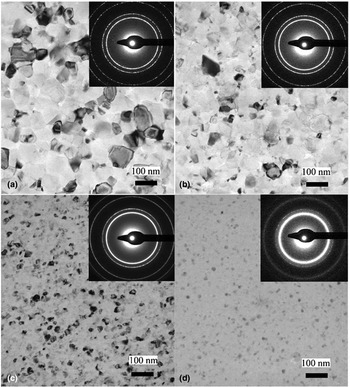
Figure 1 shows the bright-field TEM images with corresponding selected area electron diffractions (SAED) taken on pure Al, Al–1%Mg, and Al–10%Mg samples, which are containing only solid solution fcc phase, and on Al–30%Mg film consisting of mainly amorphous component, with a few 5–10 nm size Al3Mg_2 phase particles. It should be noted that according to the Al–Mg-phase diagram,[Reference Mondolfo12] normally solid solution can be formed only up to 17% Mg and above that various phases and/or eutectic are also present. Results of the analysis of the TEM images revealed that in the case of pure Al film sample, the typical grain size is in the range between 70 and 120 nm, with an average value of 110 nm. The average grain sizes of the Al–1%Mg and Al–10%Mg samples are 70 and 40 nm, respectively. It should be emphasized that these average grain sizes of the deposited pure Al and Al–Mg samples are much lower relatively to that obtained by using well-known grain-refining severe plastic deformation methods such as equal-channel angular pressing (ECAP)[Reference Valiev, Estrin, Horita, Langdon, Zehetbauer and Zhu3–Reference Valiev5] or high-pressure torsion[Reference Valiev5–Reference Langdon7]. The application of ECAP resulted in an average grain size of 1100–1300 nm[Reference Iwahashi, Horita, Nemoto and Langdon13,Reference Hasegawa, Komura, Utsunomiya, Horita, Furukawa, Nemoto and Langdon14] and about 450 nm[Reference Hasegawa, Komura, Utsunomiya, Horita, Furukawa, Nemoto and Langdon14] in pure Al and Al–1%Mg, respectively.
Bright-field TEM images with SAED insets of (a) pure Al, (b) Al–1%Mg, (c) Al–10% Mg, and (d) Al–30% Mg films, showing microstructures having very fine grain sizes decreasing with increasing Mg content. The films exhibit fcc Al(Mg) phase at each composition up to 30% Mg, where amorphous component becomes dominant.

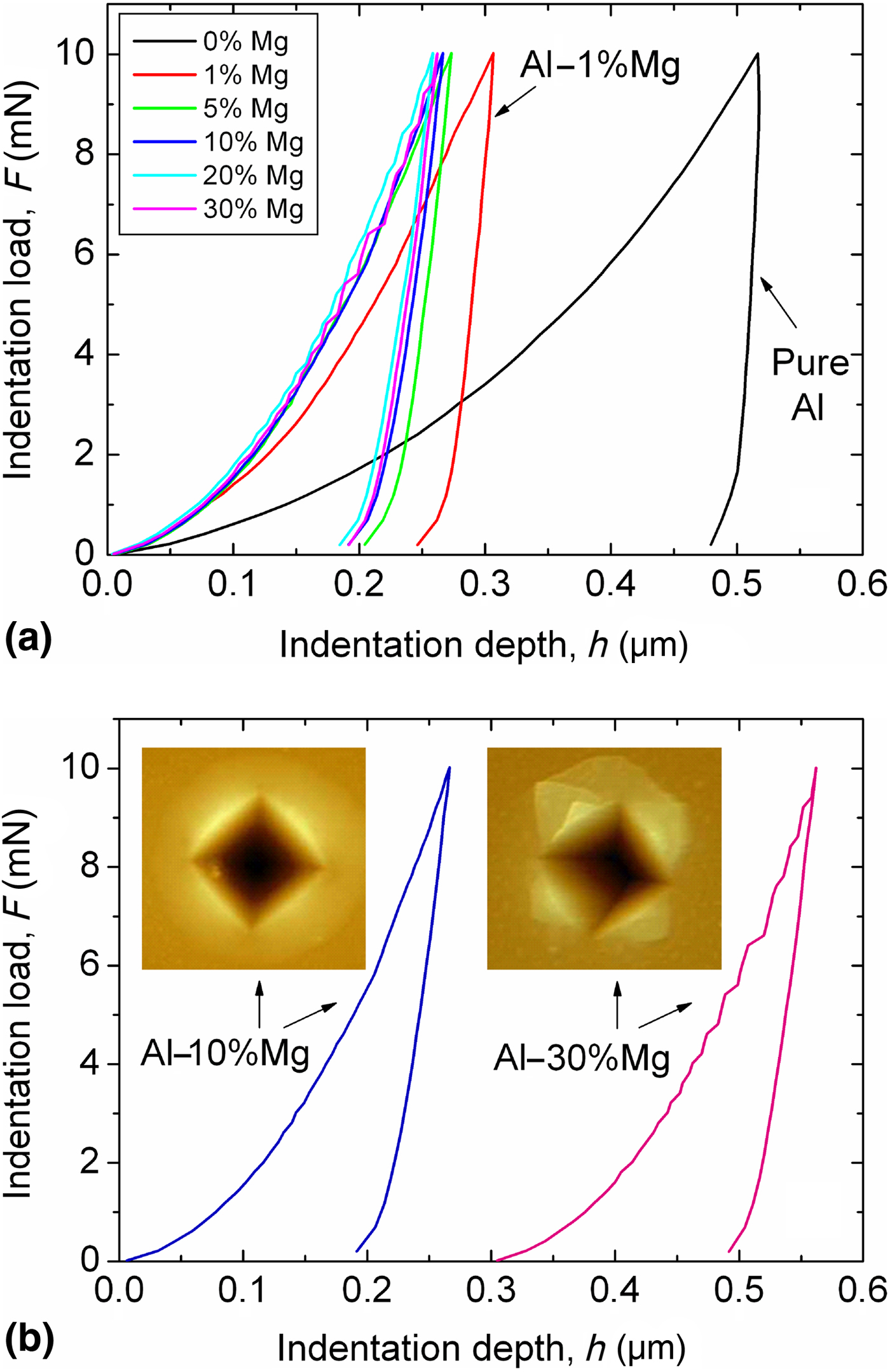
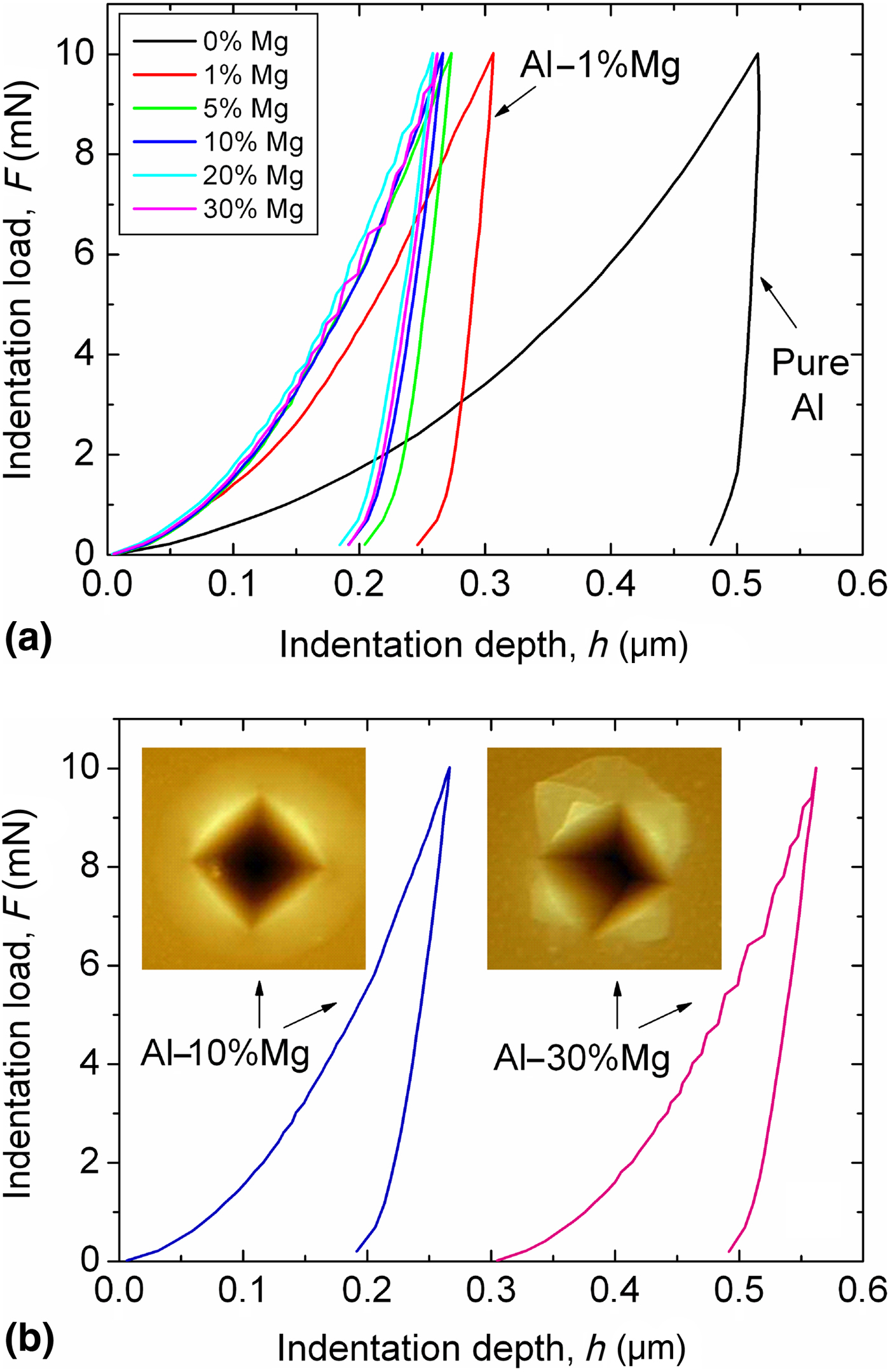
Figure 2(a) shows the indentation depth–load (h–F) curves obtained in 0, 1, 5, 10, 20, and 30 at.% Mg content samples. We remark here that above 15% Mg content, the indentation (h–F) curves are not smooth, showing step-like (pop-in) development, which is characterizing the plastic instabilities occurring during deformation of some metal solid solutions or of amorphous materials.[Reference Chinh, Gubicza, Kovács and Lendvai15,Reference Schuh and Nieh16] Figure 2(b) shows a typical step-like curve obtained on the Al–30Mg film, together with the smooth curve of the Al–10%Mg sample. In order to get some information about the corresponding deformation mechanism, two proper AFM images are also inserted in Fig. 2(b), showing clearly the difference between the indented surface of these two samples. While the surface of the Al–10%Mg sample shows continuously developing pile-up characterizing the indentation in crystalline materials, repeated deformation bands can be observed around the indentation pattern on the Al–30%Mg sample, indicating a typical deformation mechanism of amorphous materials. These observations are certainly confirming the above-mentioned TEM results. A deeper investigation of the film microstructure and the deformation mechanism in the function of Mg content will be discussed in another work.
Indentation depth–load (h–F) curves of (a) the investigated samples and (b) of the Al–10%Mg and Al–30%Mg samples together with the corresponding AFM images about the indented surface (the h–F curve of the sample Al–30%Mg sample is shifted to right by 0.5 µm to be easier visible).
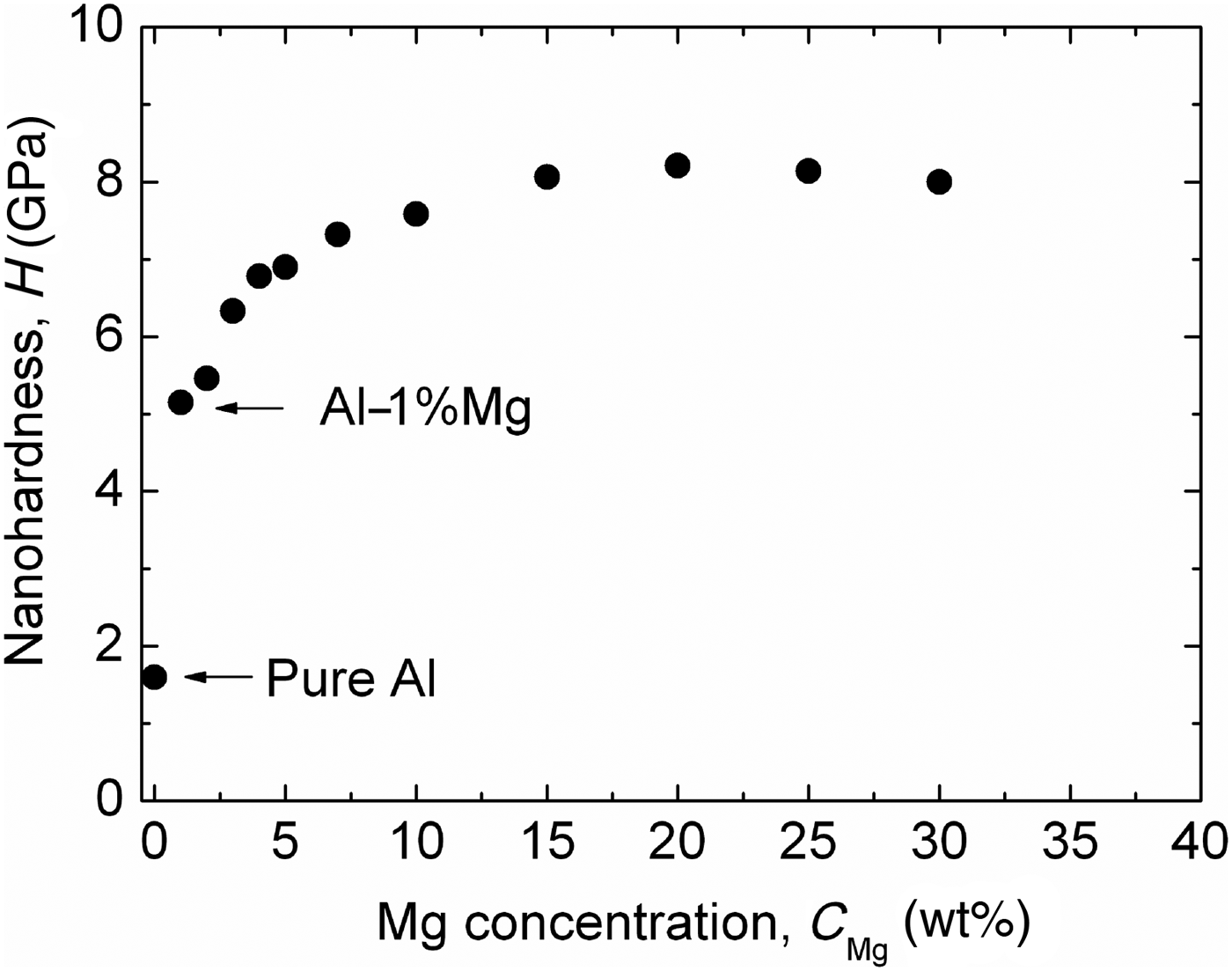
The hardness values of the investigated Al–Mg films are plotted in Fig. 3. It can be seen that the hardness, H, is increasing with the increasing Mg content and saturates at about 15% Mg. Considering the mechanical properties of the solid solution fcc films, it is worth remarking that the addition of 1%Mg resulted in a hardness increase by almost three times in the Al–1%Mg sample relatively to that of pure Al sample (from H of 1.8 to 5.2 GPa). All of the film samples have extremely high hardness compared to the conventional bulk Al–Mg alloys. These results allow us to conclude that thin films of pure Al and Al–Mg alloys would have potential to be acceptably high-strength coatings.
Hardness of the investigated film samples as the function of Mg content.

The yield strength of pure Al and that of solid solutions Al–1%Mg and Al–10%Mg films having average grain size of about 110, 70, and 40 nm can be evaluated to be 600, 1700, and 2600 MPa, respectively. These new results encourage us to examine the validity of the modified Hall–Petch relationship[Reference Chinh, Gubicza and Langdon17] proposed for the uniform description of the effect of the grain size on the strength of the ultrafine-grained face-centered cubic (fcc) metals and solid solutions, which have almost the same Poisson number (ν ≈ 1/3). In the suggested model,[Reference Chinh, Gubicza and Langdon17] it was considered that dislocations are generated by Frank–Read sources and then arrested at the grain boundaries of grains having a size of d. Considering the effect of pile-ups, the yield stress normalized by corresponding shear modulus, μ(σ y/μ), can be given as a function of the grain size, d normalized by the magnitude, b of corresponding Burgers vector (d/b) by the following formula:
 $$\displaystyle{{\sigma _y} \over \mu} = \displaystyle{{\sigma _0} \over \mu} + A^{^\ast}\left( {\displaystyle{d \over b}} \right)^\lambda $$
where A* is a constant. In the case of large grains, d >1000 nm, the value of λ is −0.5, giving back the conventional Hall–Petch relationship given in Eq. (1). For very fine grains,  $d\approx 10 \div 100\;{\rm nm}$, the value of λ can be expected to be −1. Theoretically, these two conditions can be characterized by the activation of totally multi-slip and only single slip, respectively, inside the individual grains.
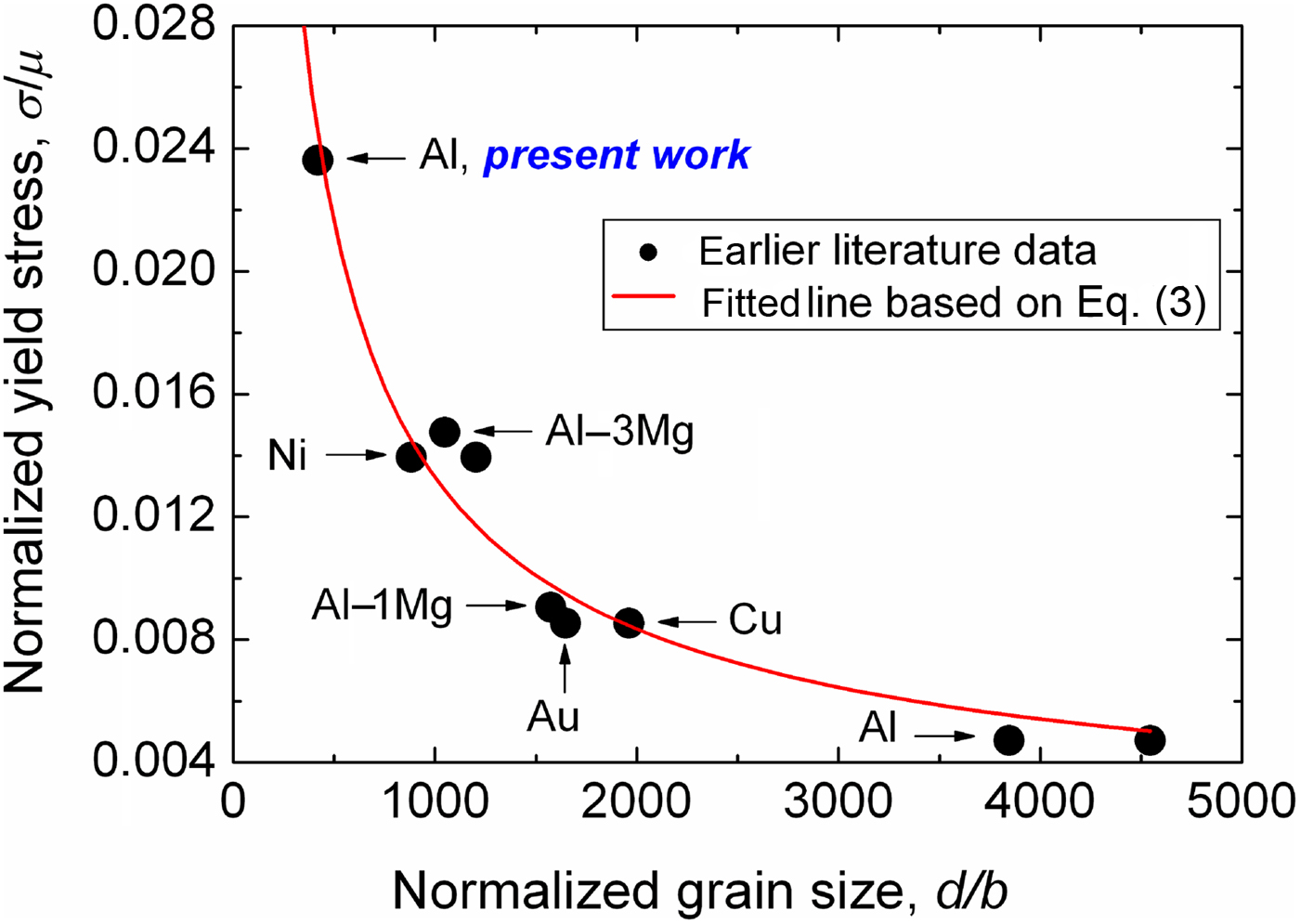
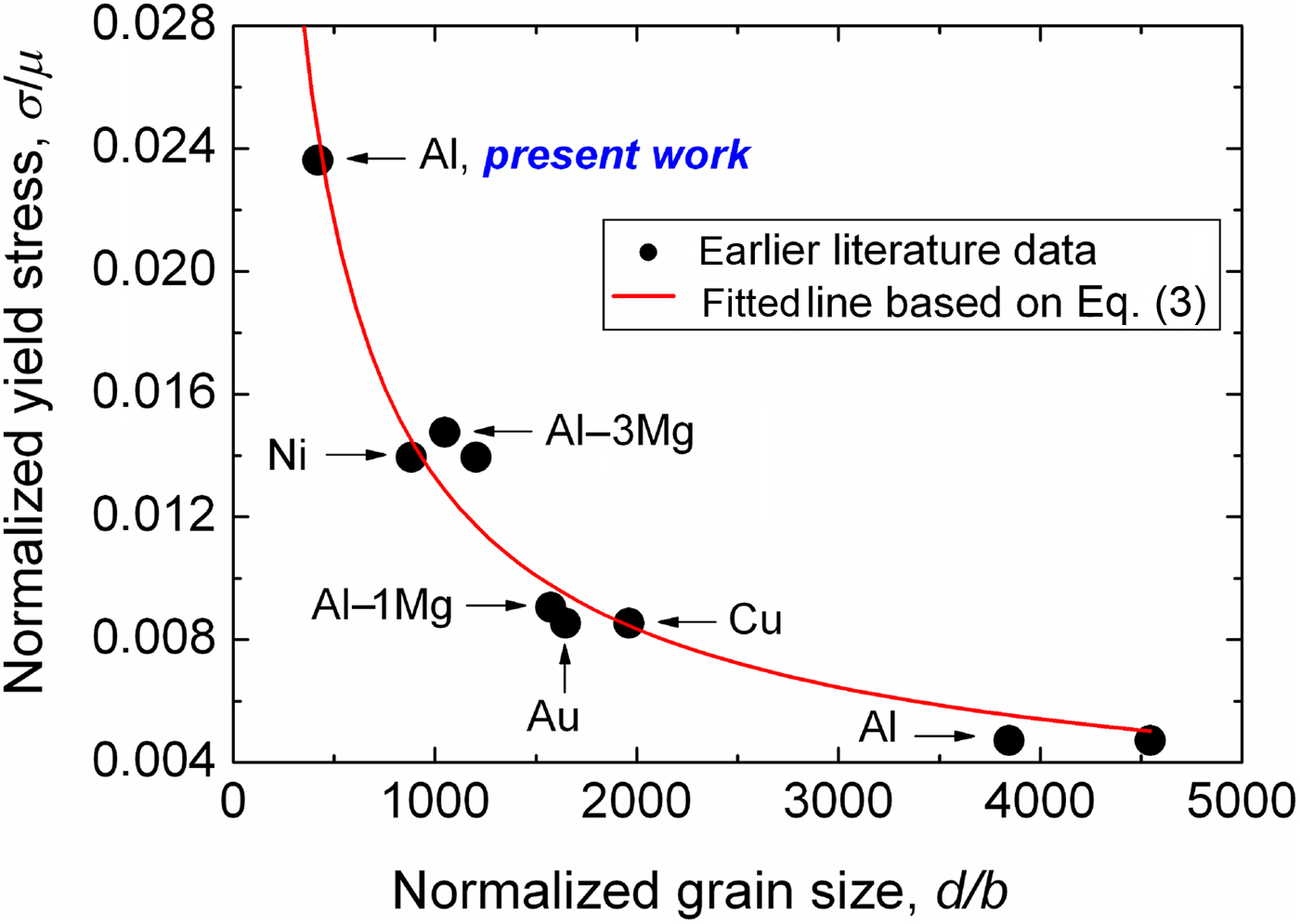
In the case of ultrafine grains,  $d\approx 100 \div 1000\;{\rm nm}$, the value of λ is predicted to be between −1 and −0.5. Taking into account the experimental results obtained on several ultrafine-grained fcc metals, such as bulk Al,[Reference Iwahashi, Horita, Nemoto and Langdon13,Reference Hasegawa, Komura, Utsunomiya, Horita, Furukawa, Nemoto and Langdon14] Au,[Reference Gubicza, Chinh, Szommer, Vinogradov and Langdon18] Cu,[Reference Vinogradov, Suyuki, Hashimoto, Kitagawa, Kuynetsov and Dobatkin19,Reference Hadzima, Janecek, Hellmig, Kutnyakova and Estrin20] Ni[Reference Zhilyaev, Gubicza, Nurislamova, Révész, Surinnach, Baró and Ungár21,Reference Neishi, Horita and Langdon22] and bulk solid solutions Al–1%Mg, Al–3%Mg,[Reference Iwahashi, Horita, Nemoto and Langdon13] as well as the mentioned strength of the Al film, the normalized yield stress and grain size data are replotted in Fig. 4. The analysis of the data confirms the value of − 0.77 ± 0.03 for parameter λ in Eq. (2). The present result obtained on Al film unambiguously supports the modified Hall–Petch relationship:
 $$\displaystyle{{\sigma _y} \over \mu} = \displaystyle{{\sigma _0} \over \mu} + A^{^\ast}\left( {\displaystyle{d \over b}} \right)^{-0.77}$$
for fcc metals and solid solutions having ultrafine-grain sizes. It should be noted that the data obtained on solid solution Al–1%Mg and Al–10%Mg films cannot be described together with other data shown in Fig. 4 by using Eq. (3). The strength of these two films is too high to match to the fitted line. These two films may be considered to be in the group of materials having very fine grain size, under 100 nm.
The modified Hall–Petch relationship for ultrafine-grained fcc metals and alloys.
In summary, Al and Al–Mg films in the 0–30%Mg concentration range were fabricated by a novel micro-combinatorial technique. Thanks to their ultrafine-grained structure, these films have extremely high strength compared to the conventional bulk materials, suggesting a potential application of these films as protecting layers (coatings) against mechanical wear. Furthermore, besides the possible practical applications, the results obtained on films also confirm the validity of the modified Hall–Petch relationship for a uniform description of the strength of fcc metals and solid solution having grain size, d, in the range between about 100 and 1000 nm.
Acknowledgments
The support of the Hungarian Development and Innovation Operative Program GINOP-2.1.7-15-2016-02073 and the National Development Agency grants of OTKA K115852 and K129009 are highly acknowledged. The research of N.Q.C. was supported by the Hungarian-Russian Bilateral Research Program (TÉT) No. 2017-2.3.4-TÉT-RU-2017-00005. This work was financed partly by the Ministry of Human Capacities of Hungary within the ELTE University Excellence Program (1783-3/2018/FEKUTSRAT).