A “Musée de la danse/Dancing museum,” announced by Boris Charmatz in 2009 as the new identity of the Rennes National Choreography Center he was about to direct, sent a signal both to the institutional world and to dance culture. A museum by artists: this is how one might sum up this movement in favor of a program of artistic transmission that also calls itself a conceptual project, that is able to understand dance within “a historical space.” What the choreographer expresses is a desire for an end to cultural compartmentalization as regards both practice and references, a spirit of experimentation, and a fierce resistance to frameworks of preconceived institutional ideas. The vigorous statements of Charmatz's “Manifesto for a Dancing Museum,” which are often quoted, evoke various commonplaces so as to demolish them. “We are at a time in history where a museum in no way excludes precarious movements, nor nomadic, ephemeral, instantaneous ones. We are at a time in history where a museum can modify BOTH preconceived ideas about museums AND one's ideas about dance” (Charmatz Reference Charmatz2009, 3). Indeed, to suggest that dance in the present day should erupt into a silent, static museum would be mere rhetoric. If galleries of modern and contemporary art have for the last decade done much for the inclusion of dance in major exhibitions and are even starting to think of it in terms of collection, this opening up, above all, brings about a different paradigm of movement. With the notions of “time-based media” and “time-based arts,” in recent years there has been an appreciable overhauling of museum culture. The increasing space given in the last two decades to film, video, and sound, whether as works or as documents, has brought with it an unprecedented modification of the temporal experience in museum space. In this regard, the historian Giuliana Bruno (Reference Bruno2007) has maintained that the spread of screens in museum spaces shows the relationship this has had from the very beginning with the temporal organization of film narrative: a sequence which, whether fluid or uneven in nature, shapes perceptual duration by the particular mental and physical use of the space that the spectator passes through. As was recently demonstrated to the extreme by the artist Philippe Parreno, who fine-tuned the authority of the time taken to project a film over the time spent by the visitor to the exhibition,Footnote 1 the fixed lengths of time introduced by “time-based” media actually bring about a real redefinition of modes of attention.
It is significant that the majority of historical exhibitions that have attempted to achieve an organic relation to dance have adopted configurations that were completely open, uncompartmentalized, and conspicuously contrary to the notion of the linear route which a viewer slips along, following a narrative from room to room. Among such exhibitions one can mention in particular Move! Choreographing You (London and Vienna, 2010–2011), curated by Stephanie Rosenthal; Moments: A History of Performance in Ten Acts (Karlsruhe, 2012), curated by Boris Charmatz, Sigrid Gareis, and Georg Schöllhammer; “Rétrospective” by Xavier Le Roy (created in Madrid in Reference Charmatz, Gareis and Schöllhammer2012 and now on tour), a project designed by Xavier Le Roy. However, there is also a piece whose format escapes the traditional material criteria of an exhibition: 20 Dancers for the XXth Century (Reference Le Roy2012), staged by Boris Charmatz in autumn 2013 at New York's Museum of Modern Art.
To invite into a museum “precarious movements,” those that are “nomadic,” “ephemeral,” and “instantaneous,” would seem to suggest a dual challenge addressed to museums. On the one hand it means exploring how and to what extent the performing character of dance is capable of upsetting, on various levels, the processes of conservation by which museums create the history of art. On the other hand, what may perhaps be brought into question by dance is the predominance of a particular formatting of the spectator's temporal experience, which is dictated by his or her journey through the museum. If we return to the words of Boris Charmatz, the kinds of “movements” brought by dance may introduce a shift to the models of temporality that operate in the museum. In this sense, dance can challenge the spectacularization of museums: it endeavors to affect the forms of that very historical narrative that shape the institution and the visitor's experience.
The Heritage Is Us! Non-Material Museums
Whatever its institutional perimeter may be, the “Dancing Museum” of Boris Charmatz, the only choreographer of his generation to embark on such a project, is to be seen as an artist's workshop. “We must first of all forget the image of a traditional museum, because our space is firstly a mental one. The strength of a museum of dance consists to a large extent in the fact that it does not yet exist” (Charmatz Reference Charmatz2009, 3). This latent, liminal space is the basis of a conceptual position in which can be preserved the free vigor of conjecture: “The dancing museum has been invented to avoid having to wonder how to respond to the invitation extended by museums to living art” (Charmatz Reference Charmatz2013b, 9). “The dancing museum asks how one can invent a museum: the heritage is us! The museum is less a body concerned with collection and validation, and more a place to work and think” (Charmatz Reference Charmatz2013b, 9). The reference to Joseph Beuys—La Rivoluzione Siamo noi [The Revolution Is Us] (1972)—implies taking (back) from the institution an inappropriate and engaged writing of history, and putting (back) into the artists' domain the work of producing a conception of heritage that has a militant edge. This was the approach taken by Boris Charmatz in response to invitations given by two institutions with very different collections, spaces, and planning policies: the Zentrum für Kunst und Medientechnologie (ZKM) in 2012 and the New York Museum of Modern Art in 2013.
The kind of interest in dance now being taken by galleries of modern and contemporary art has thrown up three obvious problems. The first relates to the desire to conserve a medium that appears in an ephemeral form—a form whose steps and notation authors have seldom considered or paid attention to, unlike the field of artist performance where this preoccupation has been a major part of artistic endeavor since the 1960s. The second difficulty has to do with what, at the beginning of the 2000s, was flagged up by the works of Tino Sehgal, a true forerunner of the fact-based infatuation with performance that has taken hold of galleries: the unbridgeable dichotomy between the two systems of spectatorship governing theater on one hand and galleries on the other. The third difficulty concerns “the history” of dance itself: this history, which is unwritten, in the sense that scholarly interest in dance—very recent in terms of the history of art—is a more recent development than belief in the single historical narrative that has shaped museum culture, and that MoMA still offers as the established model for twentieth-century art.
The idea of a museum of dance was in fact formulated very early on in terms of a reverse model of a classical museum. Rolf de Maré, when founding the International Archive of Dance in Paris in 1931, had in mind a museum of dance of which many aspects can be seen as progressive in regard to institutional policy: a dismantling of cultural hierarchy that would make it possible to build bridges between modern dance, ballet, non-European dance, folk dance, and even “animal dance”; a journal actively committed to the spread of knowledge, to debate, and to criticism; rooms for exhibitions, lectures, and film showings; “a sociological and ethnographic department”; a library of documents, archives, and films (“Les Archives Internationales de la Dance” circa 1932, 2). This heritage was to the fullest extent “to be open to all without distinction,” so that “not only would it be possible for artists, professionals and specialists to engage in any study or research that might be of use to them, but also everyone who was in any way whatever interested in dance, would have free access” (“Les Archives Internationales de la Dance” circa 1932, 2). The openness regarding geography, chronology, culture, and discipline, and the principle of a platform that would bring together research, reflection, and collection, could immediately be seen as part and parcel of the nature of the endeavor: “In the field of dance nothing is finished, nothing is perfect. Everything has to be done again” (de Maré Reference de Maré1933, 2). Rolf de Maré does not mince his words in a fierce indictment of the mediocre corpus of literary prose, the hagiographies of dancers, and the labyrinth of notational systems. The aim of the project is to “fill the gaps,” and the magazine is presented as a “first effort to get back to the real history of dance, beyond the countless errors that this art has all too grievously been the victim of” (de Maré Reference de Maré1933, 2). He is here voicing a nostalgia for positivist historicism, otherwise known as “history,” of a kind that could no longer be written in 1930s Europe without getting involved in very reactionary deviations. His project, taking a wide-ranging, comprehensive idea of museums, their collections, and their activities, nonetheless reflects an attempt to make dance a paradigm of a new organization of knowledge on the model of “the most living of encyclopedias” (“Les Archives Internationales de la Dance” circa 1932, 1).
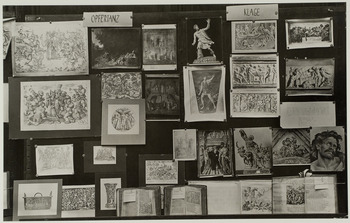
Rolf de Maré's museum of dance is in this sense a failed attempt to continue at an institutional level the reciprocal influence dance and the visual arts previously had on each other, which broadened practice and cultures in the first decades of the twentieth century. It also echoes the attempt to bring together dance and history of art that was instigated by the experimental research of Aby Warburg at the beginning of the twentieth century. The anachronistic montages on the boards of Mnemosyne,Footnote 2 Aby Warburg's uncaptioned atlas of art history, which brought together images originating from any and every source, invented with photographic reproduction the idea of a non-material museum, a conceptual museum able to open up the field of art, and to bring about new confrontations (see Photo 1). The magazine Der Querschnitt went so far as to develop an iconography in which shots of modern dance dialogue visually with photos of architecture and painting of the time. In this same magazine, Jean Borlin (Reference Borlin1922), the choreographer of the Ballets Suédois, published the following statement:
Every image that has made an impression on me is transformed involuntarily into dance. For that reason I owe a great deal to the old masters, as well as to modern artists; they have been an enormous help to me. It wasn't that I was trying to copy them in tableaux vivants. But they inspired me with thoughts, new ideas and new dances. I envy painters. Their works are immortal. They have their own lives within themselves, independent of their creator. The life of a dance is so short. As short as that of a dancer. (1922, 32)
While lamenting the fragility of dance compared with museum works of art, Borlin (Reference Borlin1922) nonetheless defines the particular status of the relation between the dancer and history: a special mode of bodily reading, of memorization, and of the survival of images.
Aby Warburg. Panel titled “Opfertanz, Klage” [Sacrificial Dance, Lamentation] of Aby Warburg's so-called Ovid-Exhibition, 1926. ©The Warburg Institute.

The question of the “body as archive,” as posed by André Lepecki (Reference Lepecki2010a), casts light on the motivation underlying artistic approaches in which the body is defined simultaneously as the (re)inventor and the repository of a work previously produced by another artist. To this can be added another iteration, which arose as a notion in choreographic modernity—that of the body as an active site for a non-material museum: that is to say, not so much the registering and programmatic reactivation of the archive in a form displaying the compossibilities and incompossibilities of the initial work,Footnote 3 but the bodily articulation of fragments of history, absorbed and metabolized through various moments of consciousness and temporality. Georges Didi-Huberman (Reference Didi-Huberman2000) has shown how “non-material museums,” which appeared in texts such as magazines, atlases, and albums in the first decades of the twentieth century, drew on the conceptual and speculative potential of photographic reproduction to claim critical space. His ideas inspired by the legacy of a certain modernity—which brought about the deterritorialization of the history of art itself—are useful when considering ideas around dance from the perspective of wider thinking. In regard to the work of the historian, Didi-Huberman (Reference Didi-Huberman2000) calls for “anachronistic montages” and “cross-rhythm”: “One must not say that there are historical objects belonging to such or such a time: it must be understood that in each historical object all ages meet, collide, melt into each other in their forms, branch out, or overlap one another” (43, emphasis in original).
In 20 Dancers for the XXth Century, Boris Charmatz proclaims a “living archive”:
Twenty performers from different generations perform, recall, appropriate, and transmit solo works of the last century that were originally conceived or performed by some of the most significant modernist and postmodernist dancers, choreographers, and performance artists. Each performer presents his or her own museum, where the body is the ultimate space for the dance museum. (MoMA Reference Charmatz2013)
In the show organized for the MoMA in October 2013, the works of Jérôme Bel, Trisha Brown, Merce Cunningham, Tim Etchells, William Forsythe, Simone Forti, Martha Graham, Benjamin Millepied, Vaslav Nijinski, Yvonne Rainer, and Ted Shawn were presented, among others. … An important point is that the performances had no set time and happened simultaneously, without any program being announced, without a “stage” or any fixed area, in whatever room or corridor was chosen by the performers. From outside they brought a discontinuous temporality into the museum space, escaping the convention of the event announced for a fixed time:
This project is a wild approach to history, where dancers are essentially executing tasks in whatever way they choose—drawing from their memories, their knowledge of historical solo dances, their own habits of movement, their moods, etc. It is less about presenting pristine, unchanged solo dances from the XXth century, and more about providing a window through which to see dancers at work reacting to various circumstances—not least being the context of a museum. It is really about investigating a different kind of museological approach. Entering into a close, but possibly oblique, dialogue with the power of MoMA's display and collection. (Charmatz Reference Charmatz2013)
20 Dancers for the XXth Century is in fact part of an exhibition belonging to a triptych entitled Musée de la danse: Three Collective Gestures. The other panels are two works created in 2010, which evolve according to the context in which they are presented: Flip Book (2010–2013) and Levée des conflits extended (2010–2013). In an interesting approach to possible “dancing museums,” the first explores the illustrated monograph as material for a temporal sequence: the choreography is formed from photographic reproductions in David Vaughan's reference work, Merce Cunningham: Fifty Years (Reference Vaughan2005). It explores memory as a montage of images that can be laid out equally well in the condensed reading of a flip book as in the variations of scale in a pop-up book, since the photographs are performed, following the page order, by dancers in the three-dimensional space of the stage. Levée des conflits extended sets out to approach the open, continuous museum space and fills it with mounting cross-rhythm. The material of the piece consists of eighteen movements. Repeated in canon by seventeen dancers, they unfold time that is splintered and incomplete, without unison, like the collective breathing of separate organisms. By mentioning the “power of MoMA's display and collection,” Boris Charmatz (Reference Charmatz2013) confronts not only the sacred status of institutions that is constantly excoriated in his statements, but also the slanted, monolithic, linear image of the history of art, as it is designed, and thereby suspended, in museum display time.
With Moments: A History of Performance in Ten Acts, created with Sigrid Gareis and Georg Schöllhammer a year earlier, Boris Charmatz was entering a very different world in the Kalsruhe Zentrum für Kunst und Medientechnologie—a place of experimental collections and exhibitions that was open and comprehensive, and promulgated no heroic narrative of the art of the twentieth century. The choreographer decided to question the authority of performance archives by challenging their status in the possible evocation of “moments.” Through this watchword that gives its name to the exhibition, the artist problematizes the supposedly nonreproducible “moments” of performance time, together with historic “moments,” in other words, landmarks in an approved morphology of history, and finally the “moments” of the exhibition itself, which divide into four phases: “Act,” “Re-act,” “Post-Production,” and “Remembering the Act.” Three critical perspectives are present in this exhibition process. The choice of ten female artists, “pioneers” of performance from the 1960s to the 1980s (Marina Abramović, Graciela Carnevale, Simone Forti, Anna Halprin, Lynn Hershman Leeson, Reinhild Hoffmann, Channa Horowitz, Sanja Iveković, Adrian Piper, and Yvonne Rainer), represented first of all a reversal of the normal phallocentrism of art history. The decision to bring together personalities from dance and from artistic performance had the further effect not only of reconsidering the academic boundaries present in the view taken of these practices by historians, but also of opening up a diverse landscape of notations, writings, images, and other forms of record whose status and economic and institutional value vary. Finally, the decision to unite these artists of “the ‘heroic’ generation of performance” (Charmatz, Gareis, and Schöllhammer Reference Charmatz, Gareis and Schöllhammer2012),Footnote 4 who were invited to put their archives on display, with two other generations of artists, set up an inter-play of subjectivities and multiple perspectives on the material that was presented: an arts lab around Boris Charmatz, a group of students of various artistic disciplines, who were invited to enter into the situation as “witnesses,” and lastly a video artist, Ruti Sela, who was invited to make a film from all the processes she observed.
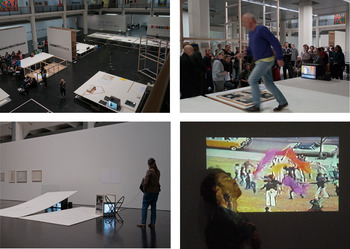
The scenography, composed by Johannes Porsch, consisted of sections of square walls that configured the exhibition in a discontinuous, precarious manner. Those modular elements, set up vertically or laid flat, with supports, so that they became tables, in the large atrium space of the ZKM, allowed shifting views from above and crosswise (see Photo 2). The scenography, a moveable object and work surface, was altered by the artists throughout the exhibition and partly destroyed. The archives were displaced, and the display massively changed, by things being concealed, by inscriptions being left, and by performative experimentation with the historical materials. To these various actions was added the production of a new thread, Ruti Sela's video shooting, which followed all the “moments.” In the short, highly compressed, and elliptical visual essay resulting from it, The Witness (2012), Boris Charmatz's voiceover predominates, obsessively repeating, “Get out of my head, get out of this room.” This is a reference to another historic landmark of performance art, Bruce Nauman's Get Out of My Mind, Get Out of This Room (1968), a sound installation consisting of an empty room where the spectator hears this phrase as repeated by the artist, broadcast by invisible speakers. Boris Charmatz's stress-inducing litany is the expression of a deep tension in the execution of the Karlsruhe project, which was later described as “problematic” by the artist (Charmatz Reference Charmatz2013b). The complex speculative project of the exhibition admits in the final analysis the possibility of avoidanceFootnote 5 or even repellence of the archive, whether that of the past, the present, or the future.
Views of the exhibition Moments: A History of Performance in Ten Acts, Karlsruhe, ZKM, 2012. (a) General view of the scenography and display. Photo by ZKM. (b) Jan Ritsema performing as part of the Artists' Lab on the table displaying Adrian Piper's archival materials. Photo by ZKM. (c) A visitor watching the partly covered Reinhild Hoffmann's archival materials. Photo by ZKM. (d) Boris Charmatz performing as part of the Artists' Lab in the projection of a film of Anna Halprin's City Dance. Photo by Marcella Lista.

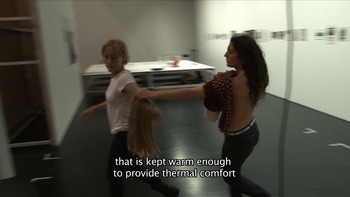
In its turn, Ruti Sela's film notably captures one “moment” of this experience, this confrontation, and this statement (Photo 3). While some of the artists from the Lab, Christine de Smedt, Meg Stuart, Boris Charmatz, and Lenio Kaklea, improvise a circular race, they circle the film maker, leading her to spin to shoot the race from the middle of the round. Caught up, together, in this movement, the performers gradually undress, and take turns putting on what are among the most iconic items in the archive on show: the dress and blonde wig made by Lynn Hershman Leeson for Roberta Breitmore, the fictitious character she created and gave life to in her work (1973–1978). Profanation of the archive, in this case the plundering of the original performance made by the artist into a collection piece, the wearing of the garment belonging to Lynn Hershman Leeson/Roberta is itself an object of avoidance: once they have put it on, the performers take it off again, and pass it on like a baton in their race, as if the circle had a centrifugal power to expel the archive. The circle of performers from Boris Charmatz's artists' Lab inevitably evokes the circles in Anna Halprin's City Dance, which emerged from the squares of San Francisco in the 1970s, the film of which can be seen a few yards further in the show. It seems to assert its right to a utopian innocence of movement, with the body free of any archive. This improvised ritual shows itself as a process that is at once a defense and a metabolization in the face of history's fixation on the archival object.
Ruti Sela. The Witness, 2012. Single-channel video (color, sound). Duration: 10 minutes. Meg Stuart and Lenio Kaklea using Robart Breitmore/Lynn Hershman Leeson's dress and wig as part of the Artists' Lab in the exhibition Moments: A History of Performance in Ten Acts, Karlsruhe, ZKM, 2012. © Ruti Sela.

In a form that is profoundly experimental and critical, and which does not ignore the issues of modernity, Boris Charmatz pushes to the limit the idea of a non-material museum of dance operating in both mental and bodily space. Whether it is portable or moveable, he sets against the materiality of the archive a dynamic of eradication and destabilization aimed at freeing it, if only temporarily, from its strictly regulated institutional sedimentation. Against the representation of history created on museum walls, he sets a bodily topography of memory, in which periods open onto each other, cross one another, collide, or freely avoid each other.
Play Dead: Pivots
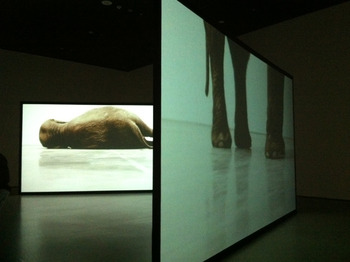
Among the most remarkable experiences produced by 20 Dancers for the XXth Century at the MoMA, the performance of Richard Move addressing the legacy of Martha Graham brings this discussion to an interesting pivot point. The artist, who since the middle of the 1990s has been performing an afterlife personification of Martha Graham—even in the revival of the repertoire by the company (Lepecki Reference Lepecki2010a)—chose as the place for one of his interventions a room in which Douglas Gordon's video installation, Play Dead; Real Time (2013), was being shown (Photo 4). This work by the British artist is based on a film, shot in slow motion, of an elephant trained to collapse onto the ground and fall over on its side, as if pretending to be dead, before getting up again. There is an immediate sense in Douglas Gordon's installation of an explicit form of deterritorialization, since the shots were taken in the white cube of the Gagosian Gallery in New York. Several versions of the animal's performance are edited and shown simultaneously on two big screens positioned more or less at an angle to each other (one with front projection, the other rear projection) and on a monitor, each of them lasting a different length of time, with the group therefore being subject to random synchronization. These three supports for images stand freely on the floor in the middle of the space, echoing the bodies of the spectators who are invited to walk about between them. This is where Richard Move/Martha Graham make their entrance. In place of dance, he switches on music from Appalachian Spring, well known as the piece that Aaron Copland composed in 1943 for Martha Graham's choreography of the same name. Then he introduces himself—as Richard Move—lights an electronic cigarette, drinks from a flask of whisky—taking frequent sips as he speaks, (later he points out “this is not alcohol”)—before starting an informal conversation with the audience. The conversation is about the copyright of the music being played. Richard Move explains that the idea of adapting the song “The Gift to Be Simple,” known as the Quaker hymn, came to Martha Graham, in connection with the subject of her choreography, and in that way led to a specific commission for Aaron Copland. Richard Move then talks about the obstacles the Aaron Copland estate put in the way of any use of the music in performances, either whole or partial, of Martha Graham's Appalachian Spring. These were obstacles that he considers all the more unreasonable and unacceptable, given that the melody was not composed by Copland.
Douglas Gordon. Play Dead; Real Time. 2003. Three-channel video (color, silent), two projectors, two screens, monitor. Duration: 19:11 minutes, 14:44 minutes (on large screens), 21:58 minutes (on monitor). Minimum room size: 24.8 m × 13.07 m. Acquired through the generosity of Richard J. Massey. The Museum of Modern Art, New York. Photo by Marcella Lista.
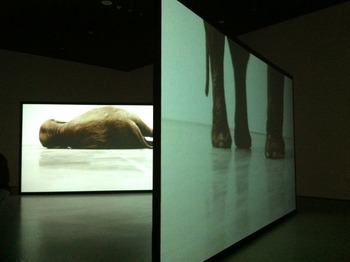
Richard Move's response to the invitation from Boris Chamartz and the MoMA includes an act of institutional criticism in the broad sense, for which the museum becomes the platform. The artist denounces the absolute power of copyright on the grounds that it gets in the way of the circulation of works from one generation to another, which is necessary for there to be a living history of dance. The dialogue that is set up between his criticism of the legal/economic confinement of the heritage, and the amazing beauty of the Douglas Gordon video, adds complexity to each of the works. On one hand the slow-motion movements of the elephant, the organic and absolute fluidity in the simple and abrupt change from the standing position to the collapse of the whole mass onto the ground, can be looked at as a dance, or even thought of as dance itself. Douglas Gordon's title Play Dead suggests a self-reflective meditation on the medium of video and its ability to conserve and transmit any part of reality otherwise than in the form of fiction, pretense, or deadening fixity. Play Dead: Real Time reflects the paradox that the only thing in real time in the work is the functioning of the equipment showing the three-channel video, by means of three techniques, and on three different platforms. Adding to this complex temporal meditation, the contemporaneous reference to the work of Martha Graham by Richard Move serves to enrich this tension. In widening the gap between the filmed performance of the animal, and the one in real time of the performer, it also marks a second gap: that between the authority of a signed work conserved in the collection of the MoMA and the precariousness of creative practice based on an artistic dialogue—his own, in the first place, with the work of Martha Graham—which conflicts with and blurs the modern definition of the creator that the contemporary institution fosters, thus isolating him or her in the untouchable historical past. Richard Move responds to the work of Douglas Gordon on various levels, one of them being the provisional reuse of this “found” title for the space–time of his performance.
In a way, “playing dead” is inevitable for all artists when their work enters the museum during their lifetime. Still, by denouncing the increasing weight of copyright issues, Richard Move seeks to avert the burial of any work that cannot access a shared cultural space, where its potential performative reinvestments can occur. The idea of Nachleben (survival) in the context of the history of art conceived by Aby Warburg is here a pertinent way of viewing the question of “appropriation” as formulated by the art and criticism of the twentieth century on the basis of the values of the authorial status of the modern artist.Footnote 6 Indeed, for Warburg, the survival of past works is not to be understood in terms of revival, influence, or line of descent—a problematic biological metaphor in the view of the German historian of art at a time when the historical sciences were heavily imbued by Darwinism. Instead, as suggested by Georges Didi-Huberman (Reference Didi-Huberman2003), the idea of Nachleben can be understood as an activation or “setting into motion” of history itself by conscious or unconscious circulation of forms, from their representation to their living performance. In this sense it offers—retroactively—a counter-model to the principle of “appropriation” seen as of value for itself, and as setting the works in the frozen time of an unequivocal point of view.
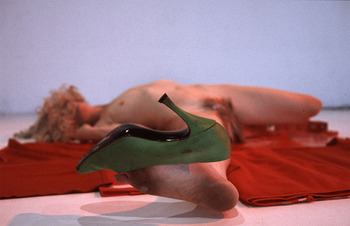
“Playing dead” does not bring this circulation of history to an end, nor does it condemn the movements it involves. On the contrary, it carries a form of potential critical climax. Richard Move's engagement in the subjective creation of a “body archive” of Martha Graham of course involves, in the absence of direct transmission, a constructed conversation with history and with the “dead thing.” From a wider point of view, however, it is difficult to ignore the recurrence of this motif—playing dead—in what goes on conceptually in contemporary dance. This idea, in a variety of guises, often appears as “tableaux” in choreographic pieces from the last fifteen years or so. Like the works themselves, devoid of any narrative or symbolic thread, these “tableaux” produce a particularly acute self-reflective state. One well known example is La Ribot's Pieza Distinguida No. 27, Another Bloody Mary (2000) (Photo 5). In this dance piece, composed for loft-type spaces such as the art gallery, the dancer-choreographer constructs literally under the eyes of the spectators a tableau vivant of a dead body: after setting out a patchwork of red objects on the floor, she slowly sinks onto it, her body more and more torn apart, and then lies motionless on the ground, a blonde wig covering her head, and another, miniature one covering her genitals. By her feet, bright green slippers, which came off in her fall, underline the pictorial quality of the scene. In a museum-type space, by means of an intense visual ambiguity—openly using grotesque and Grand GuignolFootnote 7 theatricality—the artist plays the living game of death, achieving a powerful reversal of perspective through the intermingling of the codes relating to the exhibition of a visual arts installation, and to a theatrical performance. In Panoramix, staged at Tate Modern in London in 2003, where all her thirty-four pieces Piezas Distinguidas were presented, this construction of the performed inertness of the exposed body is even more present. The complete series, in fact, reveals itself subtly framed, with two significant pieces: Muriéndose la sirena (N° 1, 1993), at the start of the performance, and S liquide (N° 33, 2000) at the end of it. In the first, her head covered with a wig, La Ribot lies under a sheet, her immobility only broken at intervals by spasms, like those of a being that has been taken out of its natural element. In the final one, she wraps herself in the sort of thermal survival blanket handed out to homeless people, and has a microphone against her belly to demonstrate the disappearance of the slightest signs of breathing, ending in prolonged absence of breath. Altogether, these three Piezas, appearing at the beginning, middle, and end of Panoramix, offer variations of a complete extinction of movement. While it involves a rich dramaturgy, and statements that include both intimate and sociopolitical levels of enunciation, the choreographic material and the experience of time it provides to the audience also critically set to work the status of an object on display.
La Ribot. Another Bloody Mary (Pieza Distinguida n°27), 2000. Distinguished Proprietor: Franko B. and Lois Keidan, London. Photo: © ZKM Center for Art and Media Karlsruhe. Photo by Franz Wamhof.

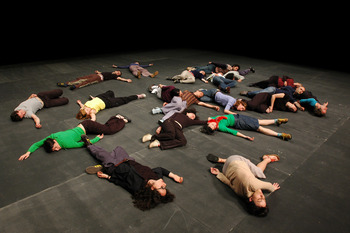
The self-reflective image of the death of the performer is found at the beginning of the 2000s in major stage works as well. Among them is the choreographic interpretation of the song “Killing Me Softly with His Song,”Footnote 8 created by Jérôme Bel in his 2001 piece, The Show Must Go On. This is the penultimate part of a work that is entirely made up of pop songs (played by a visible DJ) whose words are interpreted literally by performers—some nonprofessional—in semi-improvised dances. Throughout the song the performers gently—“softly”—slide to the floor, where they eventually lie motionless, their eyes closed (Photo 6). The words of Roberta Flack's 1973 hit echo like an internal commentary on the whole work: they tell of the “soft death” of a woman hearing an unknown singer singing her own story, or how individual real life dissolves into the common typologies of popular culture. Carried out with the utmost economy of gesture, this ultra anti-dramatic action precedes the tautological climax of the piece: the “resurrection” of the performers on the stage, greeting the audience to the sound of Queen's “The Show Must Go On.” Taking up this motif in various forms in later works, Bel gives it new contexts for consideration. This is particularly the case in Pichet Klunchun and Myself (2005), in which Bel attempts to carry on a discussion with the Thai dancer and choreographer Pichet Klunchun, whom he has invited to explain the traditions of Khon dance on stage. Here the performance of Killing Me Softly, performed by Jérôme Bel, facing Pichet Klunchun more or less in the middle of the piece, creates a pivot in the dramaturgy. Introduced as a quotation from The Show Must Go On, this representation of death is the start of an understanding between the two artists and seems to literally turn around the space of words and movements exchanged on the set, bringing the frontal approach to the questions and answers articulated by the work's formal conceptual structure onto a different level. A second significant reoccurrence is to be found in 3-Abschied, created with Anne Teresa de Keersmaeker in 2011 from Der Abschied (the Farewell), the sixth and last movement of Gustav Mahler's symphony Das Lied von der Erde. Here the pop song disappears, but the audience is invited to experience the “death” of the musicians of the Ictus Ensemble who attempt to perform Gustav Mahler's work on stage in its transcription for chamber orchestra by Arnold Schönberg. Toward the middle of the piece, this moment appears as the artists' “desperate” response to their powerlessness onstage: a climax of self-irony. Anne Teresa de Keersmaeker, Jérôme Bel, and the Ictus musicians confront the monument that is Mahler's symphony and its unattainable expression of the “final question.” In Pichet Klunchun and Myself, as in 3-Abschied, the dramaturgy involves a play of multiple perspectives, direct and indirect, on history and the problematic experience of transmitting it. Generally speaking, in Jérôme Bel's work, the “death” of the performer does not only constitute a halting of movement. It creates a blind spot in the theatrical representation, raising the possibility that it will simply cease. This image, the internal critique of any performance, creates a pivot in the space–time of the stage. In works involving history, it destroys the illusion that there is a continuous space between past and present, opening up other possibilities between distant cultural worlds.
Jérôme Bel. The Show Must Go On, 2001. Photo: © ZKM Center for Art and Media Karlsruhe. Photo by Franz Wamhof.

Transpositions
Raising the question of dance in museums implies more than one shift. Thus the self-reflective commitment to the history of dance that appears in other Jérôme Bel works—in particular his “portraits” of dancers—leads us to reconsider the issues of the museum, transposed in the space of the theater. It explores on stage something that one might liken to a work of dance exhibition.Footnote 9 These shifts create a complex space for critical debate, in which the invention of forms and practices, and the evolution of the institutional culture are going on simultaneously. With this in mind, let us return to the initial question—that of the historic confrontation between various paradigms of “time-based art” in museums: recorded media, video, and sound on the one hand and performance (dance included) on the other. This question is indeed bound up with the necessity for a malleable space. We noted earlier that recent exhibitions that have taken a historical perspective on dance tend to have an open configuration, thus rejecting the spatial materialization of a temporal narrative. At the ZKM, the aim was for the scenography to stay as unobtrusive as possible, so as to leave room for “moments” arising out of and between the works. At MoMA, the route through the permanent collections established by the museum was hampered by unfamiliar presences. Finally the third way in which this openness of configuration can be achieved is by a volume that is wholly modeled by the artist in which the bodies of the performers and the spectators are the only “materials” creating time and space.
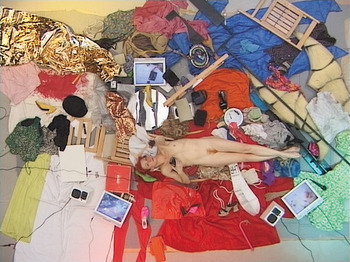
Such is the structural thread of the works of La Ribot, who, from the mid-1990s, took her Piezas Distinguidas (1993–2000) across the thresholds of art galleries. Panoramix, which was created at London's Tate Modern in 2003, completes a retrospective review of her works, showing the whole, perfect corpus of the thirty-four Piezas in a unique volume in which the dancer, the objects figuring in her dance, and the spectators are seamlessly united. In the three hours of the performance, the artist, as Adrian Heathfield points out, keeps in play contradictory formats of the panorama and the mix, that is to say, of an optical field that is open, transparent and continuous, and of “a broken-up jungle of things, or else already a second, a repetition of a previous work, reconstituted or done differently” (2004, 22).Footnote 10 This tension was already at work in another of La Ribot's recapitulations, her video installation Despliegue (2001), whose point of departure is a condensed version of Piezas lasting 45 minutes, which freely experiments with jumbling, blurring, and even hybridization (Photo 7). This interpretation of the Piezas takes place on the ground, on a surface determined by the range of a camera that films the performance from above in a single shot. During her performance, the artist holds in her hands another, pocket, camera, which follows her actions, and more often than not complicates them. In the installation, while the first video is projected onto the ground, reproducing the life-size panoptic viewpoint of the first camera, the second runs on a small monitor that is fixed to one of the walls of the room. Each of the two images is accompanied by its own sound, by means of loudspeakers, one in the wall near the screen and one on the ground at the level of the video being projected. The nature of the mix that predominates in this work thwarts any attempt to focus. The video recording does not here serve to clarify the existence of the absent body. In her experimentation with video, La Ribot makes use of the tension between the two forms of temporality represented on one hand by the recorded duration of the video, and on the other by the organic time of the body. The artist examines the modalities of the recording technology in a challenging conversation with the “real time” of dance, opening up the possibility of a choreography that would organically combine these two modes of spatio-temporal composition. While the video takes are governed by the body's continuous time in two sequence shots, which are taken through these two separate observation points (the view from the body and the view of the body), —the dance seeks in turn to re-produce itself in the form of an accelerated montage—a distanced imitation of the chopped up, fragmented time of the video clip. Through the accumulation of props, the Piezas progressively swamp the field, casting their sediment in the symbolic space of the gallery by means of the compressed “unfolding”—literally: the “Despliegue”—that takes place on the spot.
La Ribot. Despliegue, 2001. Video still. Two-channel video installation (color, sound). Duration: 45 minutes. © La Ribot.

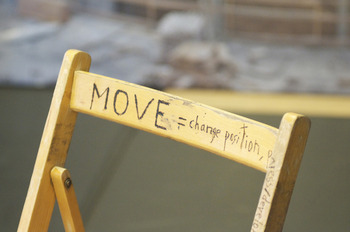
Such reciprocal transpositions, which are involved in the distancing humor of La Ribot's work, are also some of its conceptual mainsprings. In response to an invitation from the Hayward Gallery to take part in the show Move! Choreographing You (2010), the choreographer problematized the leading concept of the curator, Stephanie Rosenthal, which was to bring together for physical use by the spectators objects and installations created in the fields of visual art and dance from the 1960s up to the present day. La Ribot's Walk the Chair brings into the open museum space, subtly designed by Amanda Levete, a group of fifty folding chairs, her signature object, upon which she has pyrographed quotations (Photo 8). These quotations come from dictionaries, artists' writings, designers, writers, and philosophers, and freely evoke movement. The chairs can be spontaneously made use of by visitors to the show, who can look at them as sculptures, read them, manipulate them, move them about, sit on them, rest on them or forget about them in favor of other works, and in the same way the quotations are wandering, floating, and polysemic. Starting from the definition of the word “move,” taken from the McMillan dictionary, they slide toward the subjective and emotional: “It is curious that beautiful things always have something to do with movement” (Pina Bausch); toward a wider view of dance: “The style of a thought is its movement” (Gilles Deleuze); toward a self-referential commentary on the exhibition: “A genre of participatory and socializing art has developed in response to perceived fragmentation of society” (Sally O'Reilly); toward practical exhortations: “Don't look for the meaning, look for the use” (Ludwig Wittgenstein); or contradictory ones: “Chairs are the signs of the absence and the ersatz of the human person. They represent shallowness and the impossibility of communicating. They constitute obstacles to the liberty of movement” (Robert Servos). As is noted by André Lepecki (Reference Lepecki and Rosenthal2010b, 119), “In Walk the Chair (2010) the resonances of the chair in the recent history of dance, and in conceptual and performance art emerge.” The semantic field that is evoked plays in fact with such references and goes beyond them. Walk the Chair suggests, and puts into action for anyone who embarks on it, a crossing of all borders: between the work and the spectator; between subject and object; between acting, reading, and thinking; between historic quotations, immediate experience of the object, and the open future of its use; between all the possible places and positions for looking onto, into, and out of the show. Itself transitive, the object also transposes into the body of the spectator the conceptual, cognitive, and performative positions both of the artist and of the curator of the show.
La Ribot. Walk the Chair, 2010. Detail from the interactive installation created on the occasion of the exhibition Move: Choreographing You, London, Hayward Gallery, 2010. Photo by Gilles Jobin.

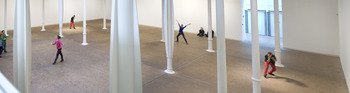
Finally, the experience constructed by Xavier Le Roy, in his Retrospective, which was staged at Barcelona's Fondatió Antoni Tàpies in 2012 (and on tour since), brings about in its apparent slightness a synthesis that is no less complex. In the course of the normal duration of an exhibition (three months), the artist builds his structure from an operation of transposition that sets dance into dialogue with other time-based arts. A tension is created between the performance and the spatio-temporal characteristics of the museum, relaying on a cross-rhythm articulated by the many performers in the “real time” of the show. It is the nature of the museum space, the volume of a great atrium that visitors immediately see from above, once they have passed through the entrance to the building, which has been taken as the initial material for this piece—the artist's self-reflective survey of his corpus of work (Photo 9). As Xavier Le Roy explains in the publication accompanying the show, the operation of time/space conversion is the structural mainspring of his work:
Having a show in a museum makes it possible to show several works at the same time in one space or building, so that visitors can experience them simultaneously or one beside the other—the relations between works also being sources of meaning. … Knowing that I wasn't going to be able to present the pieces in the way they had been created for the theatre, this retrospective was therefore going to force me to find ways of making the changes necessary to go from one set of conventions to another. (2012, 16)Footnote 11
The artist took three types of work normally displayed in galleries, each calling for specific “durations”: pictures, sculpture, or static objects; single-channel video shown on a loop; and installations involving several media, in which duration becomes composite, or conceivably completely random or open. These three categories provide the structure for the actions of three performers in the space, who, in a personal way, following fixed rules, inhabit the œuvre of Xavier Le Roy. One of the performers executes a “freeze frame” inspired by the photographic capturing of a performance, another performs a fragment of dance in a continuous loop, the third addresses the audience more directly, with a miscellaneous recital of concrete examples, which he or she comments on as his or her own retrospective view of Xavier Le Roy amid a stream of autobiography. The actions are changed around each time new visitors come in, in a way similar to the techniques evolved by Tino Sehgal to include the presence of the spectator in the duration of the performance in the gallery space. This redynamization makes it possible to change the roles and positions of the performers according to a circular relay system, which is intuitively transposed into the audience's behavior, offering it a physical experience of the conceptual and performative montage of the temporalities of the work.
Xavier Le Roy. “Retrospective” by Xavier Le Roy, Barcelona, Fondacio Antoni Tàpies, 2012. Montage view of the atrium. Photo by Lluís Bover. © Fondació Antoni Tàpies, 2012.

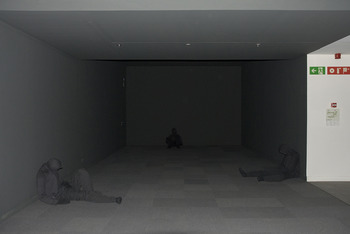
In the totally empty space of the atrium, the bodies of the performers and spectators articulate for themselves alone the experiences and ideas at stake in Xavier Le Roy's piece. Two other spaces add further complexity. One is a reference area where the public can consult the video archives of the entire corpus of works and talk with the performers taking their turn there. In the second, the spectators move about in complete darkness, and gradually discover “sitting” on the floor against the walls black-hooded mannequins that come from Untitled, a piece created in 2005 with no author's name, no stage light and no visible performers (Photo 10). A radical critique of authorship, the staged piece and its transference to the gallery create a challenge to visibility, with the disconcerting strangeness of the deathly effigies reducing dance to its limit. The action of choreographic writing becomes the composition of a space in which the only real movement is produced by the spectator, by virtue of their status as a living body, and the consciousness arising from their presence. Such a deep process of self-awareness recalls something of the experience of the anechoic chamber described by John Cage (Reference Cage1967):
Anybody who knows me knows this story. I am constantly telling it. Anyway in that silent room, I heard two sounds, one high and one low. Afterwards I asked the engineer in charge why, if the room was so silent, I had heard two sounds. He said, “Describe them.” I did. He said, “The high one was your nervous system in operation. The low one was your blood in circulation.” (134)
The course of “Retrospective” by Xavier Le Roy goes through the body of the artist's œuvre, reaching in fine, a problematization of the “museification” of dance. First the show tackles how dance confronts the temporal paradigm of recorded media—those same media that record dance performance. The artist attempts a kind of integration in three types of formats: the photographic arrest, single-channel video in a loop, and video installation combining multiple durations. The show then seems to confront the spectator with an ontological question on two levels: What is dance? What can it be in a gallery? But the encounter with the effigies does not elicit a single response: it places dance neither in the category of the organic life of the spectator nor in that of the inert figures of the mannequins, or the vision of Kleist's dance lesson they may arouse.Footnote 12 It is in the space between the two extremes that the whole point of the encounter is located. In accordance with a governing principle in his work, Xavier Le Roy here puts forward a conceptual extension of dance, calling for an internal movement—both sensory and intellectual—on the part of the spectator, which arises out of his or her own bodily consciousness. As in all the shows that have been discussed here, the conversation between dance and the museum becomes the place where an expansion of dance can be attempted, by means of a series of displacements and changes of perspective. With the reflective coming and going of recorded movement and performed movement, complexity is added to the place of repetition, which is a feature both of performance and of media that have developed from photography. Beyond the superficial competition between the presence of the dancing body and the static matter of archives and simulacra of performance, there is a reinvestment in the museum space as an experiential space.
Xavier Le Roy. “Retrospective” by Xavier Le Roy, Barcelona, Fondacio Antoni Tàpies, 2012. View of the mannequin room. Photo by Lluís Bover. © Fondació Antoni Tàpies, 2012.

The two norms of temporal economy now existing in museums are brought into question there: on the one hand the linear course with its one-way narrative spectacularization; on the other the time of events, designed at set times to involve the audience in something beyond the formats of collection and display. By introducing labyrinths, cross-rhythms, and breaks in time, dance engages in a fertile experimentation with art history through its transformation into a freer museal memory of the established codes of conservation. It also calls upon performers, spectators, and the institutional powers-that-be to open up some new uses of shared time that have not so far been thought of.