Introduction
One of the main aims of aging research, and of our society as a whole, is to promote autonomy and a good quality of life in older adults. Remaining independent demands, among other things, the ability to actualize the so-called everyday functioning, defined as “the ability to adequately perform those cognitively complex tasks considered essential for living on one's own in this society” (Willis, Reference Willis and Marsiske1996, p. 595).
In studies on aging, everyday functioning is usually assessed by means of self-report questionnaires, and refers either to basic activities of daily living or to the more complex instrumental activities of daily living. While the former relate to people's daily self-care activities (feeding, bathing, dressing, toileting, transferring, and continence – the ADL scale; Katz, Reference Katz, Ford, Moskowitz, Jackson and Jaffe1963), the latter entail individuals (or their caregivers) judging their ability to accomplish different activities in seven specific domains (communicating, getting around, shopping, managing medical or financial issues, housekeeping and meal preparation – the IADL scale; Lawton and Brody, Reference Law, Barnett, Yau and Gray1969). These self-report measures cannot fully capture the complexity of the worldly demands of our everyday life in natural settings, or the relative involvement of higher-order intellectual skills required to complete these everyday activities (Marsiske and Margrett, Reference Marsiske and Willis2006).
Performance-based measures, on the other hand, could be considered a suitable way to measure the ability to cope with challenging real-world problems. They entail taking action in response to a real-life situation presented in a standardized format, and solving everyday problems related to the use of instrumental abilities (e.g. comparing and calculating the prices of two products), rather than merely asking individuals (or their carers) about how they cope in certain circumstances (e.g. managing money). Everyday competences are thus considered as superordinate abilities that rely not only on domain-specific knowledge and prior experience (i.e. crystallized intelligence), but also on basic cognitive abilities, such as reasoning, working memory, and processing speed (Marsiske and Margrett, Reference Marsiske and Willis2006; Yam and Marsiske, Reference Yam and Marsiske2013), the role of which depends on the performance-based measures chosen to test them (e.g. Allaire and Marsiske, Reference Allaire and Marsiske1999; Burton et al., Reference Burton, Strauss, Hultscha and Huntera2009; Martyr and Clare, Reference Marsiske, Margrett, Birren and Schaie2012).
Among such performance-based measures, the Everyday Problems Test (EPT; Willis and Marsiske, Reference Wadley, Okonkwo, Crowe and Ross-Meadows1993) is one of those recommended for its psychometrical properties (see Moore et al., Reference Martyr and Clare2007). It is a well-structured test of everyday problem solving, focusing on performance accuracy, and it poses real problems covering all seven IADL domains. Despite its importance, only a few studies have examined the role of age and potential cognitive predictors on performance in the EPT with heterogeneous results. EPT scores were found to be negatively correlated with age (Marsiske and Willis, Reference Lawton and Brody1995), and related to both fluid and crystallized abilities (e.g. Willis and Marsiske, Reference Wadley, Okonkwo, Crowe and Ross-Meadows1993). Similarly, Burton and collaborators (Burton et al., Reference Borella, Ghisletta and de Ribaupierre2006; Reference Burton, Strauss, Hultscha and Huntera2009) found that EPT scores were predicted by verbal performance, processing speed, executive functioning, and episodic memory, even after controlling for age and education. Kimbler (Reference Kelaiditi2013) reported, on the other hand, that EPT scores only correlated positively with inductive reasoning, but not with verbal abilities. These contrasting findings point to the need to better clarify the relative influence of age, basic cognitive abilities, and crystallized components, and this is one of the aims of the present study.
As the relationship identified between everyday functioning performance, age, and cognitive abilities is likely to depend on the measure used (e.g. Allaire and Marsiske, Reference Allaire and Marsiske1999; Burton et al., Reference Burton, Strauss, Hultscha and Huntera2009; Martyr and Clare, Reference Marsiske, Margrett, Birren and Schaie2012), the influence of cognitive abilities on another performance-based measures that focus on execution time was also examined. The Timed Instrumental Activities of Daily Living (TIADL) tasks (Owsley et al., Reference Moore, Palmer, Patterson and Jeste2002) is one of the most used performance-based measures that considers execution time as the critical variable. It involves performing five activities related to everyday life (using a phone book, reading food and medication labels, shopping for groceries, and counting change), and using real objects (i.e. foodstuff and medication packaging, and so on) contained in a small kit. The TIADL tasks has been shown to be related to global cognitive functioning and processing speed, as well as to verbal memory and inductive reasoning (e.g. Owsley et al., Reference Moore, Palmer, Patterson and Jeste2002). After adjusting for demographic and medical variables, however, only processing speed has emerged as an independent predictor of TIADL scores (Owsley et al., Reference Moore, Palmer, Patterson and Jeste2002). The TIADL scores, as the EPT scores (Owsley et al., Reference Moore, Palmer, Patterson and Jeste2002), were found to be related to observational performance measures (such as the observed tasks of daily living – Diehl et al., Reference Diehl, Willis and Schaie1995). Here again, except for two studies, the influence of cognitive abilities on TIADL performance was not thoroughly investigated.
Overall age-related effects on everyday functioning in healthy aging have received little attention. When investigated self-report scales (ADL and IADL) have been used, but they have proved scarcely informative in the case of healthy older adults. As suggested in the few studies conducted on this issue, performance-based measures of everyday functioning might be more sensitive in detecting age-related changes in everyday functioning, due partly to the fact that multiple basic cognitive abilities are involved. There is a growing body of evidence to suggest that performance-based measures could be useful in discriminating between older adults aging healthily and those developing mild cognitive impairments (MCI) or dementia (Law et al., Reference Law, Barnett, Yau and Gray2012). It seems from previous research that, while individuals with MCI may remain able to perform basic activities of daily living, they are likely to have some difficulty in more complex instrumental everyday tasks, when compared with healthy older adults (Winblad et al., Reference Willis and Schaie2004). Their difficulties could be less readily detectable with the traditional self-report scales for two main reasons: self-reported ADL and IADL scores assess daily life skills that are subordinate (and therefore less complex) than performance-based measures; and, being self-reported, they are also sensitive to rater misjudgments, which could induce individuals to over- or underestimate their abilities.
The present study thus pursued two main related aims, which are as follows:
-
1. To examine age-related effects on everyday functional competence using two performance-based measures (the EPT and the TIADL) from an adult lifespan perspective (in adults ranging from 40 to 89 years old), something never done before. Age-related changes (measured cross-sectionally here) in performance-based measures of cognitive functioning have not been clearly identified, despite agreement that the salience of different abilities in performing cognitive tasks in daily life may vary with age (Willis and Marsiske, Reference Willis1991). We thus expected an age-related decline in the two performance-based measures administered. Given the more accelerated decline in processing speed in late adulthood (Salthouse, Reference Saczynski, Beiser, Seshadri, Auerbach, Wolf and Au1996) and the central role of speed of execution in the TIADL, we also predicted a steeper decline in the TIADL than in the EPT scores.
-
2. To use a structural equation modeling (SEM) approach to investigate whether cognitive abilities (i.e. processing resources (i.e. working memory and processing speed, as processing resources, reasoning abilities, text comprehension and vocabulary, as one of the crystallized abilities) mediate the influence of age in the EPT (Willis and Marsiske, Reference Wadley, Okonkwo, Crowe and Ross-Meadows1993) and in the TIADL (Owsley et al., Reference Moore, Palmer, Patterson and Jeste2002). It is worth adding also that, to the best of our knowledge at least, the influence of text comprehension on EPT scores has never been examined before, although the task involves real-world problems presented on printed matter (see Methods section). As suggested by previous studies, the age-related decline in cognitive abilities (i.e. Borella et al., Reference Borella, Carretti and De Beni2011) can be expected to affect performance in everyday tasks (Allaire and Marsiske, Reference Allaire and Marsiske1999). At the same time, since formal education and gender are also associated with changes in cognition and performance in everyday functioning in normal aging (Marsiske and Willis, Reference Lawton and Brody1995; Owsley et al., Reference Moore, Palmer, Patterson and Jeste2002), we also expected cognitive abilities to mediate the influence of age and education, possibly contributing both directly and indirectly to performance.
The role of cognitive abilities may differ in the EPT and the TIADL, however, because of the different demands of the tasks involved. Multiple abilities, working memory, and reasoning in particular (e.g. Willis et al., Reference Willis, Marsiske, Tupper and Cicerone1992) could explain performance in the EPT, whereas processing speed could mediate the age-related effects on the TIADL (see Allaire and Marsiske, Reference Allaire and Marsiske1999; Owsley et al., Reference Moore, Palmer, Patterson and Jeste2002).
Text comprehension may also have a direct impact on performance, but more so in the EPT, which involves understanding written problems. We also expected to find the same results after controlling for demographic variables in adjusted models.
Methods
Participants
The study involved 276 volunteers, from 40 to 89 years of age, with 30–55 participants for each 10-year age bracket. Participants were all native Italian speakers, recruited from various cities all over Italy. The younger participants were still employed and were mainly recruited by word of mouth; those over 60 years were recruited at community centers, universities of the third age, or by word of mouth. All participants lived independently in the community and reported having no major health issues.
Our inclusion criteria for participants were as follows: at least 40 years of age; a Mini-Mental State Examination score (Folstein et al., Reference Folstein, Folstein and McHugh1975) ≥27, indicating a good cognitive functioning; performance above the cut-off for age and education in a working memory task, the Listening span task (see Italian norms, De Beni et al., Reference Crook, Bartus, Ferris, Whitehouse, Cohen and Gershon2008), and in a vocabulary test (Wechsler Adult Intelligence Scale – Revised, 1981; scores on the IADL scale (Katz, Reference Katz, Ford, Moskowitz, Jackson and Jaffe1963) indicating autonomous functioning in all instrumental activities; and Italian mother tongue. Our exclusion criteria (based on a semi-structured interview) were: a history of psychiatric or neurological diseases, or brain fever such as encephalitis or meningitis; any use of benzodiazepines in the previous three months; symptomatic cardiovascular conditions, breathing problems or diseases capable of causing cognitive impairments; visual, auditory, and/or motor impairments (see Crook et al., Reference Cattell and Cattell1986).
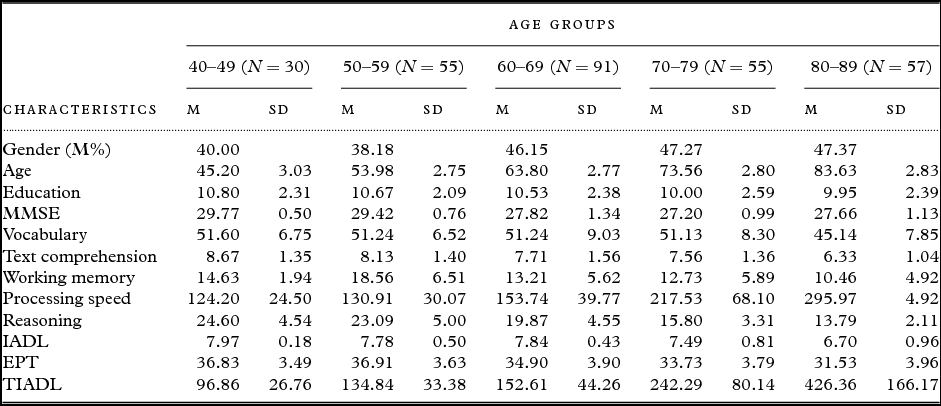
The demographic details of the sample are given in Table 1.
Means (M) and standard deviations (SD) for the variables of interest stratified by age group

Note. MMSE: Mini-Mental State Examination Score; IADL: Instrumental Activity of Daily Living; EPT: Everyday Problems Test; TIADL: Timed Instrumental Activities of Daily Living tasks.
This study was conducted with the approval of the Research Ethics Committee of the School of Psychology. All participants were provided with information about the study and gave their written informed consent in accordance with the Declaration of Helsinki (Sixth Revision, 2008).
Materials
Performance-based measures
Everyday problems test (EPT; Borella et al., Reference Arbuckle2017, adapted from Willis and Marsiske, Reference Wadley, Okonkwo, Crowe and Ross-Meadows1993)
The present Italian version of the EPT was adapted from the 42-item version developed by Willis and Marsiske (Reference Wadley, Okonkwo, Crowe and Ross-Meadows1993) to reflect the Italian culture. Participants were shown material prepared using ecologically valid materials, such as phone bills, medicine bottle labels, and kitchen recipes. These stimuli cover the seven IADL domains: household management, transportation, meal preparation and nutrition, financial management, health, shopping, and telephone skills. For each stimulus, participants were asked two questions, with no time constraints.
The stimuli were based on materials presented in three different formats: charts, directions, and forms. Original items (26) that were not adaptable to the Italian culture (e.g. the “Medicare Benefits Payment Schedule”) were replaced with other stimuli (16) referring to the same IADL domain. An example preceded each item. The final score was the sum of the correct answers (maximum score 42), which was considered as the dependent variable.
Timed instrumental activities of daily living tasks (TIADL – adapted from Owsley et al., Reference Moore, Palmer, Patterson and Jeste2002)
The TIADL assesses both speed and accuracy of task completion for the following five domains of everyday functioning: telephone use, nutrition, financial abilities, shopping, and medication management. Participants were asked by the experimenter to simulate actions for each domain, using real everyday objects and other materials contained in a “kit” (consisting of a small shelf where bottles, cans, a telephone directory, coins, and so on were located). There was a time constraint of 2–3 minutes, depending on the item.
The examiner recorded the time to completion (in sec) of each item and any errors, using three types of error code: “1” if participants completed the task correctly; “2” if they made minor mistakes; and “3” if they made serious mistakes or failed to complete the task within the time limits, in which case testing on the domain concerned was terminated. The time of completion and error codes were then combined into a single composite measure according to the original instructions (see Owsley et al., Reference Moore, Palmer, Patterson and Jeste2002), and constituted the dependent variable.
Cognitive measures
Working memory: listening span test (LST; de Beni et al., Reference Borella, Cantarella, Carbone, Zavagning and De Beni2008)
This task consists of simple sentences with an increasing cognitive load (2–6 sequences): 20 sentences are presented, separated by an interval of 1.5 sec. Participants were asked to listen to each sentence, say whether it was true or false, and retain the last word in the sentence. At the end, participants were asked to recall all the last words in their order of presentation. Two training trials preceded the task. The total number of last words correctly recalled was the dependent variable.
Processing speed: pattern comparison task (pattern comparison; adapted from Salthouse and Babcock, Reference Salthouse1991)
This task consisted of two pages, each containing 30 items in the form of arrangements of lines and segments, placed on either side of the same page. Participants had to decide as quickly as possible whether the stimuli presented were identical or not. Three practice trials were run before the task began. The experimenter recorded the time to completion, which was the dependent variable.
Reasoning: culture Fair test, scale 3 (cattell test; Cattell and Cattell, Reference Burton, Strauss, Bunce, Hunter and Hultsch1963)
Scale 3 of the Cattell test consists of two parallel forms (A and B). Each form comprises four subtests that take between 2.5 and 4 minutes to complete. In each subtest, participants were asked to: (1) complete an incomplete series of figures, choosing which of 6 options best completed the series; (2) identify figures or shapes that differ from the others; (3) choose items that correctly complete matrices of abstract figures and shapes; (4) assess the relationship linking a series of items. The dependent variable was the number of correct answers across the four subsets (maximum score 50).
Text comprehension: “Japan: leaders in the cartoon world” (De Beni et al., Reference Crook, Bartus, Ferris, Whitehouse, Cohen and Gershon2008)
Participants were asked to silently read a passage in this expository text and then answer some questions. There was no time limit. Ten inferential multiple-choice questions followed the text, each with four choices, only one of which was correct. The sum of the correct answers was the dependent variable (maximum score 10).
Procedure
All participants attended two individual sessions, lasting about an hour and a half. The order of presentation of the tests was: Mini Mental State Examination, IADL, Vocabulary Test, EPT and listening span test (LST) for the first session; and Pattern comparison, TIADL, Cattell Test, and text comprehension for the second. Informed consent was obtained from all participants at the beginning of the first session.
Preliminary analyses showed that the Italian version of the 42-item EPT had an acceptable level of reliability (Cronbach α = 0.75), and the TIADL tasks a good reliability (Cronbach α =0.85).
Statistical analyses
First, age-related effects on the EPT and TIADL scores, and on cognitive abilities (working memory, processing speed, text comprehension and vocabulary) were examined using separate multiple linear regressions. Then SEM was used to disentangle the respective contribution of age, education, and cognitive abilities on the EPT and TIADL scores. Given the strong focus of this study on age-gradient effects, all analyses were conducted on the sample as a whole. Participants were not split into separate age groups. Linear and quadratic effects of age were entered as predictors in the multiple linear regression models instead.
A natural logarithmic function was applied to the TIADL scores for response times (RTs) to correct the skewness of their distribution. All analyses reported in this paper were consequently computed using the logarithmic transformation of the TIADL RTs.
Results
Descriptive statistics for the variables of interest by age range are given in Table 1.
Separate multiple regression analyses were conducted to ascertain the age gradient of the performance-based (EPT and TIADL) measures, with linear and quadratic age as predictors. The results of the regression revealed a significant negative linear age gradient for the EPT (ß = −0.45, p < 0.001, R 2 = 20%), and a positive linear (ß = 0.81, p < 0.001) and quadratic (ß = 0.18, p < 0.001) age effect for the TIADL (R 2 = 65%).
Cognitive abilities were prone to the effects of age. Working memory showed a negative linear age gradient and a marginally significant quadratic effect (ß = −0.37, p < 0.001 and ß = −0.10, p = 0.06, R 2 = 0.14). Processing speed was associated with a negative linear and quadratic age effect (ß = −0.72, p < 0.001 and ß = −0.29i, p < 0.001, R 2 = 0.59). Reasoning also had a negative linear gradient with age (ß = −0.68, p < 0.001, R 2 = 0.46), and so did text comprehension (ß = −0.43, p < 0.001, R 2 = 0.18). Vocabulary was associated with both a linear and a quadratic effect of age (ß = −0.22, p < 0.001, and ß = −0.12, p = 0.04, R 2 = 0.05).
We then applied SEM to the EPT and TIADL, in two separate models, to see whether cognitive abilities mediated age-related effects on each of these tasks, respectively. We used the IBM SPSS AMOS version 22 (Arbuckle, Reference Winblad2011). The models tested the direct linear and quadratic effects of age on the outcome measure, and its indirect effects, mediated by the cognitive variables. The direct and indirect effects (mediated by the cognitive variables) of gender and education were controlled for on the outcomes measures. The direct and indirect effects of age were tested for significance by estimating bootstrap confidence intervals (Arbuckle, Reference Winblad2011). Because gender was not predictive in either model, it was removed from the final analysis.
Since previous regression analyses revealed no quadratic effects of age on either reasoning or text comprehension, we excluded these effects from the models.
The models for predicting both EPT (χ2 = 0.62, df = 3, p = 0.89, χ2 /df = 0.21, CFI = 1.00, RMSEA < 0.001, SRMR = 0.0077) and TIADL (χ2 = 0.62, df = 3, p = 0.89, χ2 /df = 0.21, CFI = 1.00, RMSEA < 0.001, SRMR = 0.0076) presented an excellent fit.
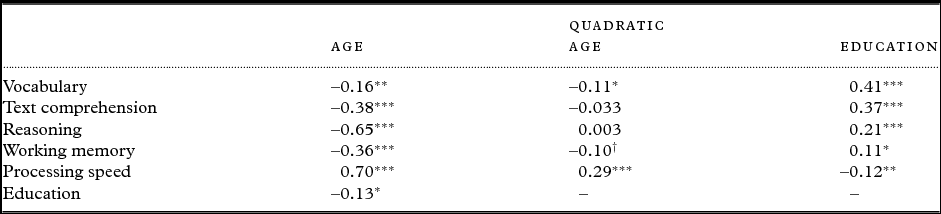
The relations between linear age, quadratic age, education, and cognitive abilities were identical in both models. Older age was significantly associated with a linear decrease in all cognitive variables considered in the model, as well as with an accelerated decline in vocabulary, processing speed and, to a lesser extent, working memory. On the other hand, a higher education had a significant positive effect on all cognitive variables (see Table 2 for the effects of age and education on the cognitive variables).
Standardized estimates of the effects of linear age, quadratic age, and education on cognitive variables and education

Note. *** p < 0.001, ** p < 0.01, * p < 0.05, † p < 0.10.
Pattern comparison task RTs; a positive estimate thus indicates a decrease in processing speed.
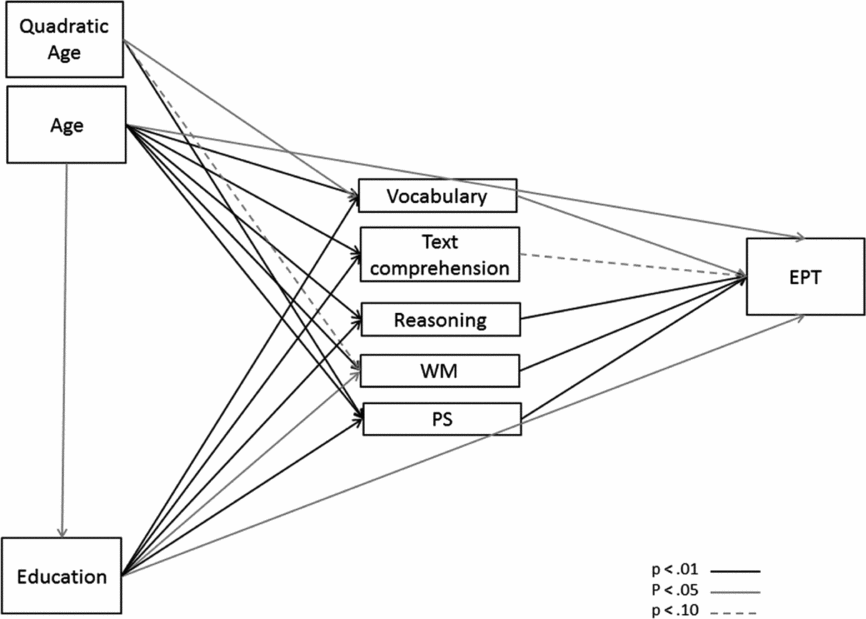
In the first model, the demographic and cognitive variables explained 46.4% of the variance in the EPT score (on the correct answers). The results indicated that linear age and education both had a direct and an indirect effect (mediated by the cognitive variables) on performance in the EPT (see Figure 1 for the significant paths, and Table 3 rows 2–3, for the estimates of the direct and indirect effects), which identified a partial mediation. Performance in the EPT was predicted mainly by working memory and reasoning, but also by vocabulary, processing speed and, to a lesser extent, text comprehension. Finally, there were no direct or indirect effects of quadratic age on the EPT scores.
Partial mediating effect of age and education on everyday problems test scores by cognitive variable. Paths that are not significant are omitted. Note. WM: Working Memory; PS: Processing Speed; EPT: Everyday Problems Test.

Direct and indirect standardized bootstrapped effects of linear age, quadratic age, education, and cognitive variables on Everyday Problems test scores (rows 1 and 2) and on timed instrumental activities of daily living response times (rows 3 and 4)

Note. *** p < 0.001, ** p < 0.01, * p < 0.05, † p < 0.07.
EPT: Everyday Problems Test; TIADL: Timed Instrumental Activities of Daily Living tasks.
aHigher scores indicate a lower processing speed.
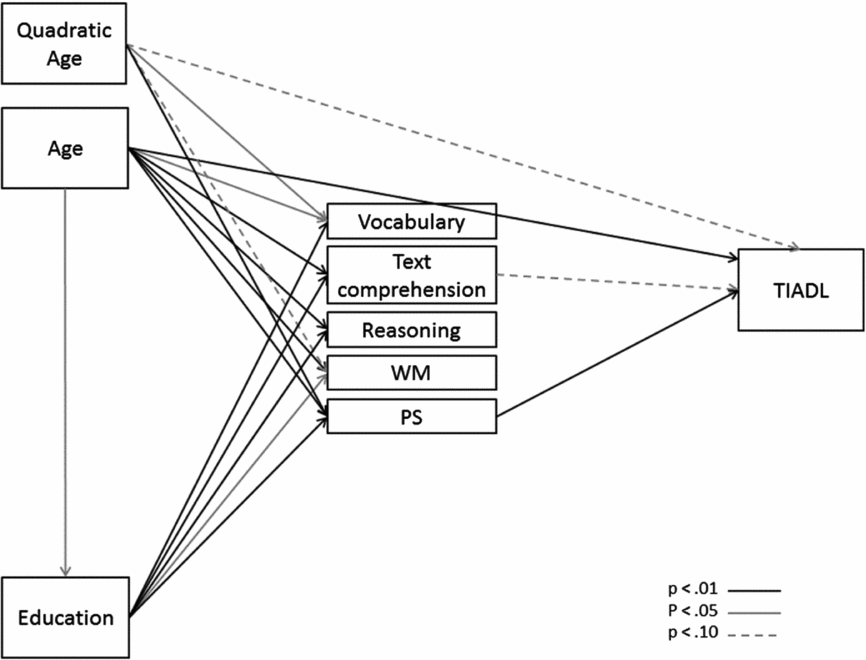
In the second model, the demographic and cognitive variables explained 77.8% of the variance in the TIADL score (the composite measure of the time taken to complete the tasks and the errors made in doing so). Performance in the TIADL was predicted by processing speed and, marginally, by text comprehension (see Table 3, rows 4–5). Our results also identified a partial mediation of linear age and a total mediation of quadratic age and education on the effects on the TIADL score. Linear age had both a direct and an indirect effect (mediated by processing speed and text comprehension) on the TIADL scores (see Figure 2 for significant paths and Table 3 for estimated direct and indirect effects), increasing age being associated with longer RTs in the TIADL. Quadratic age and education exerted only an indirect effect on TIADL, meaning that, although quadratic age did not predict TIADL directly, the accelerated decline in processing speed with aging was associated with longer RTs in the TIADL task. Education had indirect compensatory effects on TIADL.
Partial mediating effect of age and education on timed instrumental activities of daily living scores by cognitive variable. Paths that are not significant are omitted. Note. WM: Working Memory; PS: Processing Speed; TIADL: Timed Instrumental Activities of Daily Living tasks.

Discussion
The novel main goals of the present study were to examine: (i) the effects of age on everyday functioning from a life-span perspective in individuals from 40 to 89 years old, considering two performance-based measures, the EPT and the TIADL; (ii) the contribution of cognitive abilities (i.e. processing resources, in terms of working memory and processing speed, reasoning abilities, text comprehension, and vocabulary), and also of education, in explaining age-related differences and changes in EPT and TIADL performance. A text comprehension task was included among the cognitive measures, because it is a higher-order ability needed in everyday living.
First, our results show that performance in both the EPT and the TIADL tends to deteriorate steadily with age, with an accelerated decline in TIADL scores in the oldest age brackets. It is worth mentioning that the EPT and TIADL revealed only small interrelations, suggesting that they tap different aspects of everyday cognition (e.g. Owsley et al., Reference Moore, Palmer, Patterson and Jeste2002). In line with Marsiske and Willis (Reference Lawton and Brody1995), this result confirms the multidimensionality of the everyday functioning construct: the EPT and the TIADL represent different facets of everyday functioning, the EPT focusing on problem-solving accuracy, and the TIADL on speed of execution. Further, correlations between the two performance-based measures and the IADL scale (used as a screening measure) were also run, and revealed a quite weak association between the two performance-based measures and the self-report measure. In line with other studies (e.g. Willis and Marsiske, Reference Wadley, Okonkwo, Crowe and Ross-Meadows1993), this result suggests that – while the EPT and the TIADL measures seem to adequately capture age-related effects across the adult lifespan and in aging – the IADL scale is less sensitive to the “normal” changes in people's functional autonomy with advancing age (Kimbler, Reference Kelaiditi2013). This pattern of findings can thus have practical implications, highlighting the need to use more descriptive measures to assess everyday functioning accurately and objectively, especially for the purpose of detecting prodromal signs of incipient deterioration.
As for the relationship between cognitive abilities, age, and education, our results differed, depending on the everyday functioning measure considered. Age, on the other hand, showed a linear trend for both the performance measures used here with the impact of age that was both direct and indirect. It was only for the TIADL, however, that there was, in line with other studies (Owsley et al., Reference Moore, Palmer, Patterson and Jeste2002), a large effect of age compared to the EPT, with also an acceleration in the gradual increase in execution times in the older age groups, as shown by the quadratic effect of age. This is hardly surprising, given the centrality of speed of execution in the TIADL tasks, and the fact that the decline in processing speed tends to accelerate in older age (e.g. Salthouse, Reference Saczynski, Beiser, Seshadri, Auerbach, Wolf and Au1996).
The direct influence of age on the cognitive measures (working memory, processing speed, reasoning, and reading comprehension) considered was expected and consistent with the literature on aging (see Borella et al., Reference Borella, Carretti and De Beni2011).
Results also showed both direct and indirect effects of education, but only for the EPT: a higher level of educational attainment was associated with higher EPT scores. This effect may be due to the EPT format, with the problems presented in written form. This result nonetheless suggests that education, as a factor protecting against declining performance – in some settings, at least – should always be taken into account and makes it necessary to use alternative versions of the EPT for individuals with little formal education (e.g. Willis, Reference Willis1993).
As for the role of cognitive abilities on competence in everyday functioning, all the variables considered here strongly mediated the effect of age in the EPT. Since the EPT has been seen as superordinate, composed of a set of underlying basic abilities, it seems reasonable, and consistent with the literature (Burton et al., Reference Borella, Ghisletta and de Ribaupierre2006), that working memory and reasoning abilities had a considerable impact on this measure. As a matter of fact, the EPT demands sophisticated analytical and reasoning skills, and respondents have to retain information actively in their memory in order to identify and mentally manipulate data extracted from everyday stimuli. In contrast, processing speed and vocabulary exerted only a modest effect and text comprehension a marginal one. It may be that this paper-and-pencil measure, which assesses ability in activities of daily living without imposing any time constraints, has some peculiarities that account for the limited role of these other abilities. It is worth noting that the present results concerning the role of the vocabulary test (a measure of crystallized intelligence) are consistent with those of other studies (Willis and Schaie, Reference Willis, Jay, Diehl and Marsiske1986). On the other hand, the results concerning text comprehension were unexpected because understanding the EPT stimuli also demands text comprehension. It may be that the expository text used was unable to capture the nature of the EPT (e.g. De Beni et al., Reference Crook, Bartus, Ferris, Whitehouse, Cohen and Gershon2008), in which different stimuli are presented to test the respondent's ability to draw information from an illustrated text form. Future studies could try to clarify this issue.
As for the TIADL, it was only processing speed (other than age and education) that had direct effects on performance, a finding confirming that this performance-testing measure focuses on speed of execution, while other processes (verbal knowledge, reasoning and WM) are less important to success (Owsley et al., Reference Moore, Palmer, Patterson and Jeste2002). The protocol for administering the TIADL also minimizes reliance on memory and reasoning: although these cognitive skills are important in everyday functioning (finding phone numbers, reading medicine labels, and so on), they seem not to be significant predictors of the efficiency in performing these everyday tasks.
The different influence of the cognitive abilities examined here on performance in these two performance-based measures (which make use of stimuli that individuals encounter in everyday life) also supports the above-mentioned conviction that the EPT and the TIADL assess different aspects of everyday functioning in the healthy general population. It is their content that appears to restrict the definition of functioning to the domains being assessed, while the method participants must use to respond certainly affects their performance. The TIADL reflects activities of daily living are performed because participants actually engage in a series of tasks that they have to complete, while the EPT primarily taps into everyday problem-solving abilities.
The different role of the cognitive mechanisms considered in the EPT and the TIADL can also help clinicians to choose the most appropriate everyday performance-based measures for assessing an individual's cognitive functioning, depending on their personal profile as well as on the purpose of the assessment.
Alongside the above interesting findings, some limitations of this study have to be acknowledged. First, the sample consisted of healthy, active adults, and this limits the generalizability of our results to other adults, such as those with mental health problems (e.g. depression) or cognitive difficulties. It is worth mentioning that clinical and subclinical factors (such as depression symptoms, particularly anhedonia and negative affect), seen in some adults (including older adults), may have an impact on cognition and consequently on everyday functioning (e.g. Saczynski et al., Reference Panza2010). Another weakness lies in that we did not investigate the role of other variables, such as participants’ social networks, their social and emotional skills or perceived self-efficacy, which can influence performance in real life. The models we obtained also need to be confirmed in future studies, including other performance-based and observational measures of everyday functioning, other cognitive measures, and a larger sample. Finally, the results presented here are cross-sectional, while age-related changes in everyday functioning have yet to be examined longitudinally. Since the identification of individuals at risk of dementia or in the prodromal stages of the syndrome is a priority nowadays (driven by the need to take preemptive action wherever possible), shedding light on the patterns and rates of change in healthy individuals’ competence in everyday functioning might have a dramatic clinical impact.
We demonstrated that cognitive abilities do influence everyday functioning and mediate age-related effects. There may be subtle cognitive changes that would go unnoticed using more global measures, but could nonetheless accelerate the normally-expected age-related decline in everyday functioning, revealing prodromal changes in cognition (e.g. Wadley et al., Reference Salthouse and Babcock2008). In this sense, and consistently with the current conceptualization of cognitive frailty (i.e. Kelaiditi et al., Reference De Beni, Borella, Carretti, Marigo and Nava2013; Panza et al., Reference Owsley, Sloane, McGwin and Ball2015 for a review), both the EPT and the TIADL may be useful tools, along with other indicators (e.g. biomarkers, clinical markers, imaging techniques, physical parameters), for prevention purposes. As the transition from pre-frail to frail or robust states appears to be influenced by cognitive impairment, there is a strong need to distinguish between different risk profiles, in terms of future health-related events (e.g. Panza et al., Reference Owsley, Sloane, McGwin and Ball2015), with appropriate measures that reflect everyday functioning. Because of the different cognitive dimensions they involve, the TIADL and EPT measures could serve this purpose both in healthy older adults, and in those who are frail and have potentially reversible cognitive impairments caused by non-neurodegenerative conditions. Indeed, the results of the present study suggest that performance in the EPT and TIADL represents the outcome of a particular combination of abilities that are sensitive to both normal and pathological aging. They could therefore also be regarded as multidimensional aggregate information within a deficit accumulation model of frailty. They might also be extremely useful for disentangling the multiple pathophysiological mechanisms shared by frailty conditions and neurodegenerative disorders. Future studies should make the effort to further investigate this issue, also to enable the development of specific personalized intervention programs (e.g. Kelaidity et al., Reference De Beni, Borella, Carretti, Marigo and Nava2013).
In conclusion, everyday competences show clear age-related changes across the adult lifespan, and the cognitive mechanisms (which also change with age) behind such changes may differ, depending on the performance-based measure used to identify them. This means that clarifying which particular cognitive skills influence everyday functioning may not only improve our understanding of what each measure of functional status is capturing, but also help us to design strategies for coping with a potential decline in the ability to remain autonomous in later life.
Conflict of interest
None.
Description of authors’ role
Erika Borella designed the study, supervised the data collection, and wrote the paper. Alessandra Cantarella designed the study, supervised the data collection, and wrote the paper. Emilie Joly carried out the statistical analysis and assisted with writing the paper. Paolo Ghisletta was responsible for the statistical design of the study and for carrying out the statistical analysis. Elena Carbone assisted with writing the paper. Deborah Coraluppi collected the data and assisted with writing the paper. Federica Piras assisted with writing the paper. Rossana De Beni supervised the formulation of the experimental design and assisted with writing the paper.